





What are LVL scaffold boards made from?
LVL scaffold boards are bonded-veneer working-platform planks pressed on HCPLY’s commercial and packing line. Choosing the wrong plank can mean a rejected load, replacement freight and lost site days. Scaffold boards also come in graded sawn timber and other fabricated forms; our construction line presses anti-slip plywood deck panels.
LVL consists of bonded wood veneers arranged to carry load along the plank. Sawn timber is a solid wood section, while a fabricated platform can incorporate plywood decking and a supporting frame. These are different structural products even when buyers use the same phrase, scaffold board. We do not sell sawn-timber scaffold boards. The selection starts with the intended scaffold system, bearing span, loading arrangement and the engineer’s acceptance criteria.
For the wider family of industrial plywood applications, deck panels and walking planks must be specified separately. A surface that feels firm underfoot is not evidence of the bending capacity needed between scaffold supports.
What sizes and widths do scaffold boards come in?
The required plank width and length come from the scaffold bay layout and support spacing. Market listings commonly show approximately 225 mm-wide planks and thicknesses around 38–42 mm; these are market examples, not an HCPLY stock-size declaration. The producing factory quotes the requested LVL section against the agreed test and manufacturing drawing.
A buyer’s drawing should show finished width, thickness, overall length, end overhang, bearing contact and whether the ends require protection. Specify dimensions in millimetres and identify which measurements are nominal and which are acceptance dimensions. Do not substitute a nominal market label for the measured section.
Deck plywood follows a different dimensional schedule. Our construction line offers 1220×2440 mm and 1250×2500 mm panels, among other listed formats, with custom cutting available. The panel range is 3–40 mm thick, including common 18, 21 and 25 mm choices; thickness alone does not establish a safe scaffold span. For plywood, length and width tolerance is ±2 mm and film-faced thickness tolerance is ±0.5 mm.
A scaffold design must also address the assembled platform width. The 2025 US Code of Federal Regulations, 29 CFR 1926.451(b)(2), specifies at least 18 inches (46 cm) for most scaffold platforms and walkways, with defined exceptions. That is a platform requirement, not a prescribed width for each individual plank. See the official 2025 regulation.
Are LVL scaffold boards an alternative to sawn timber boards?
LVL can replace sawn timber in a scaffold scheme when the particular plank passes the required design and load assessment. The engineered veneer build offers a route to controlled geometry, but the word LVL alone is not a strength rating. The purchaser must compare the tested member, span and support arrangement with the approved scaffold design.
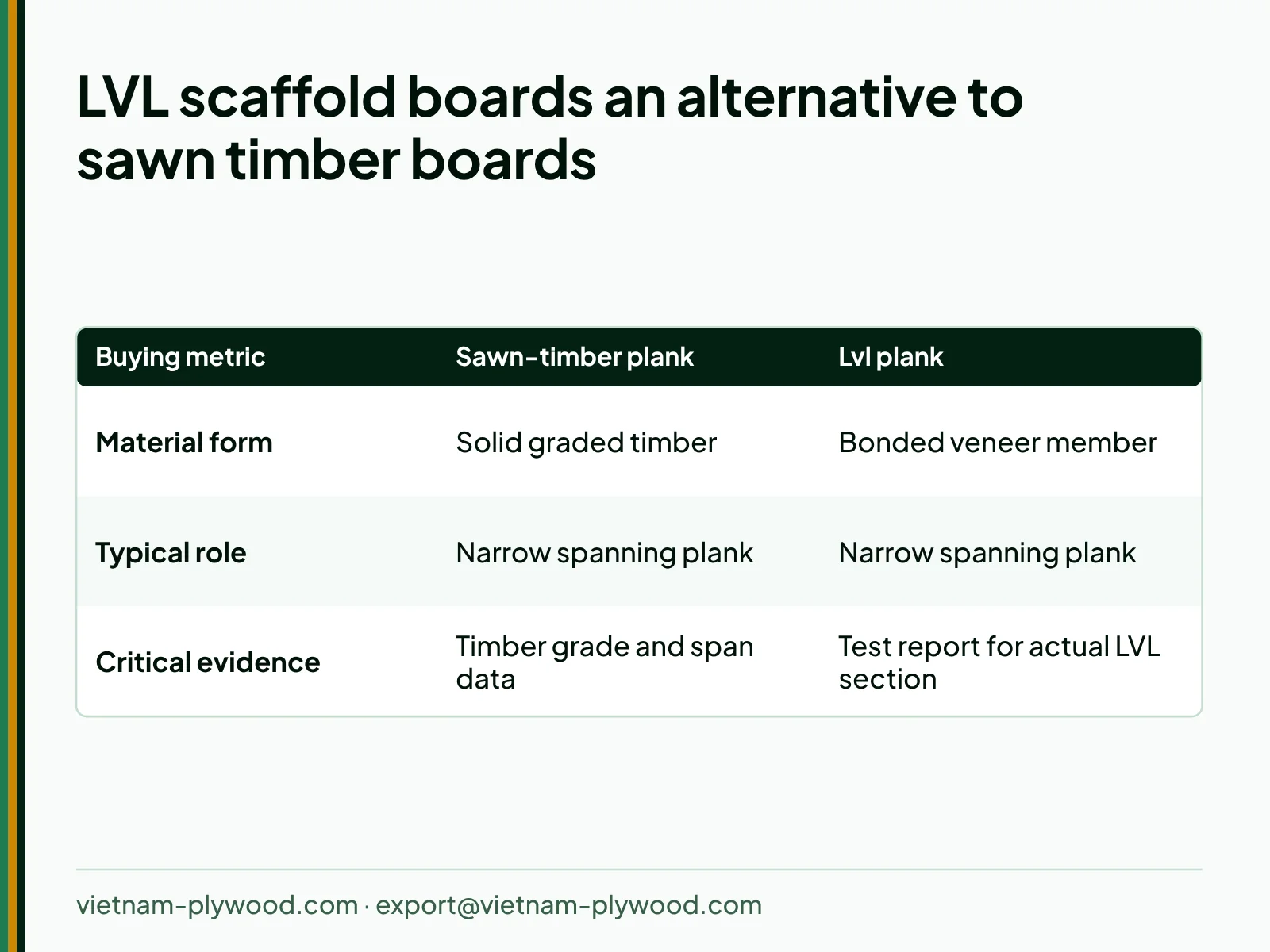
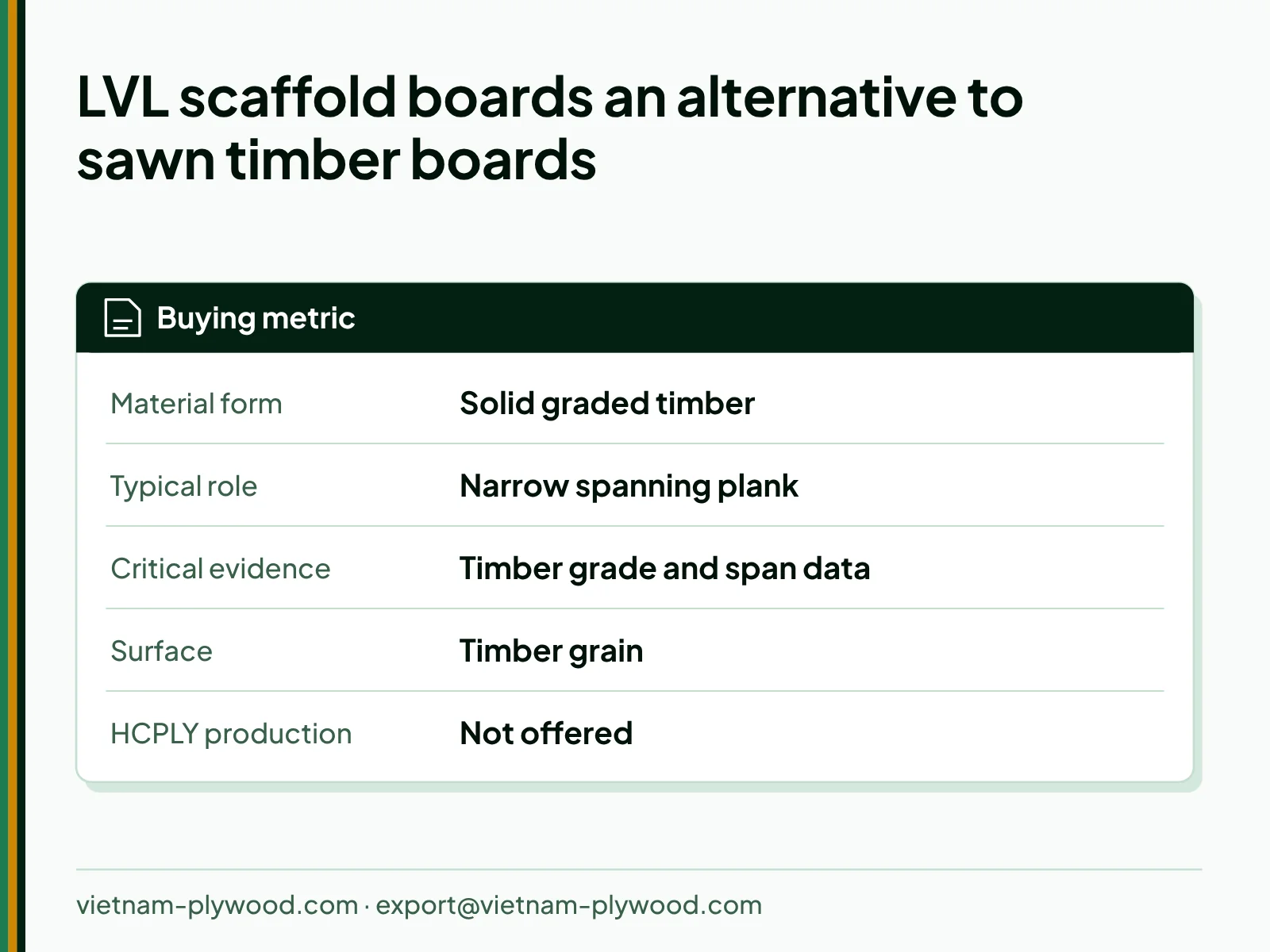
| Buying metric | Sawn-timber plank | LVL plank | Anti-slip plywood deck | Verdict by use |
|---|---|---|---|---|
| Material form | Solid graded timber | Bonded veneer member | Film-faced plywood sheet | Match the scaffold assembly |
| Typical role | Narrow spanning plank | Narrow spanning plank | Wider deck surface on designed supports | LVL for plank bays; plywood for deck assemblies |
| Critical evidence | Timber grade and span data | Test report for actual LVL section | Panel-and-support load assessment | No material label replaces testing |
| Surface | Timber grain | LVL surface treatment per drawing | Textured anti-slip film | Deck face helps footing, not capacity |
| HCPLY production | Not offered | Commercial and packing line | Construction line | Quote the two engineered builds |
The sawn-timber comparison is useful for procurement but cannot establish equivalence by visual inspection. A narrower LVL member may behave differently from a wider sheet on closely spaced framing. Ask the scheme designer to specify bending, deflection, shear, bearing and wet-service requirements for the proposed use.
Our furniture line makes full-stitched, sanded panels with styrax or eucalyptus cores for furniture applications; it is not the plank production route. The construction-project supply overview explains how material selection fits a larger project order.
When is an anti-slip plywood deck used instead of scaffold planks?
An anti-slip plywood deck is considered where the scaffold or temporary platform design calls for a broad sheet supported by a suitable frame. It is not a direct plank substitution across an unsupported bay. Our construction line presses anti-slip film over acacia or eucalyptus plywood cores for deck-panel specifications.
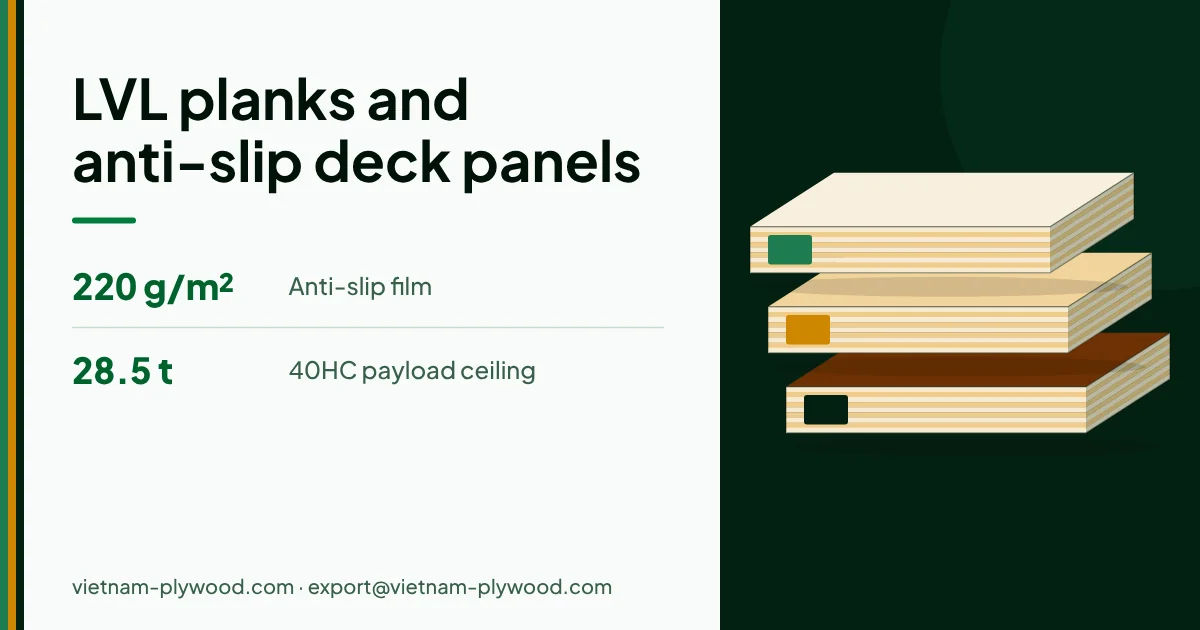
The anti-slip face is 220 g/m² film. Our standard film-faced construction panels use 120 g/m² film, while premium film-faced panels use 135 g/m². These face weights identify the film build; none is a slip-resistance test result. The buyer should request the applicable surface test and acceptance method for the intended site.
Cut edges require attention in exposed handling because water entry can damage a layered panel. The design should state edge sealing, support spacing, fixing method, replacement criteria and how the panel sits within the scaffold frame. For the dedicated product discussion, see scaffold deck plywood. Related surface choices are described under plastic-coated plywood options and stage platform plywood.
For a walking surface over a separate frame, the frame and panel must be assessed together. The panel is only one component of the working platform; fastening, gaps, bearing and support continuity matter as much as the visible tread.
What load test does an LVL scaffold plank need before it is ordered?
The LVL plank needs a load-test report accepted by the buyer’s scaffold designer for the actual section, support span and loading pattern. For US-regulated work, 2025 federal rule 29 CFR 1926.451(a)(1) requires each scaffold component to support its own weight and at least four times its maximum intended load, with specified exceptions. Section 1926.451(f)(16) limits platform deflection under load to 1/60 of the span.
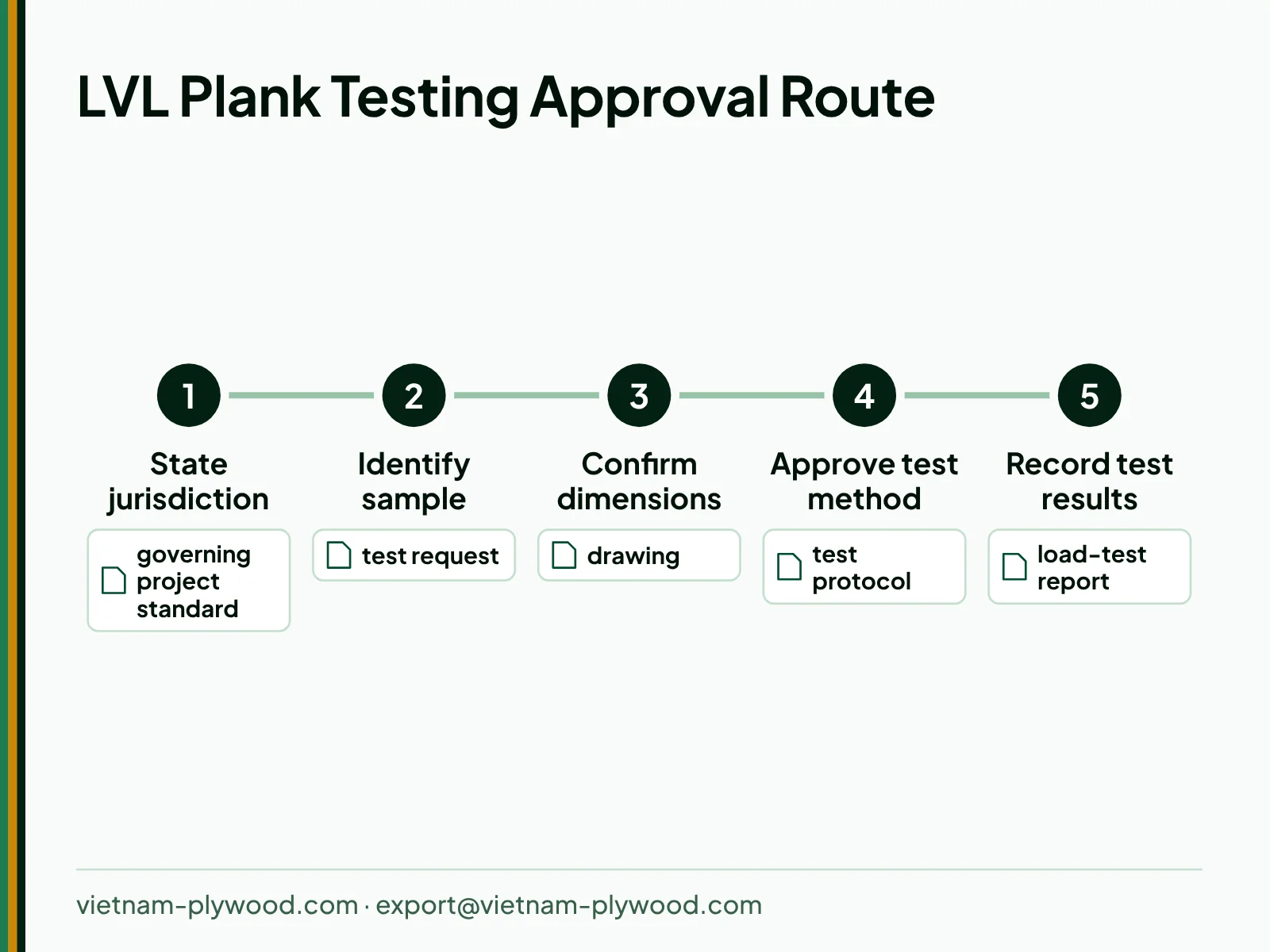
These rules describe design and performance requirements; they are not an automatic product approval or a mark printed on an HCPLY plank. The buyer’s project may apply a different national scheme. State the jurisdiction and the governing project standard before sampling. A report on a different thickness, veneer layup or support arrangement does not answer the same question.
A practical test request identifies the sample’s finished dimensions, veneer direction, conditioning, bearing configuration, load position, test rate, measured deflection, failure mode and acceptance threshold. Ask the testing body to connect each result to a clearly identified sample and report date. A drawing and test protocol should be approved before the order is priced.
The 2025 regulation also requires scaffold design by a qualified person under 29 CFR 1926.451(a)(6). A separate competent-person inspection before each work shift is specified in 1926.451(f)(3). Those site duties remain with the project, even after material acceptance.
What can the inspector witness at the producing factory?
An inspector can witness dimensions, veneer layup identification, bonding-process records and sample selection for the agreed LVL build. The producing factory should segregate the accepted sample lot and match its marks to the test request. HCPLY coordinates the on-site QC record and export preparation from the same production location.
For an anti-slip panel lot, the witness can inspect film identity, surface continuity, cut-edge condition and finished thickness. A physical check can reject obvious damage, but it cannot replace a laboratory capacity or slip test. Agree on the inspection sampling plan, measurement locations and defect definitions before production.
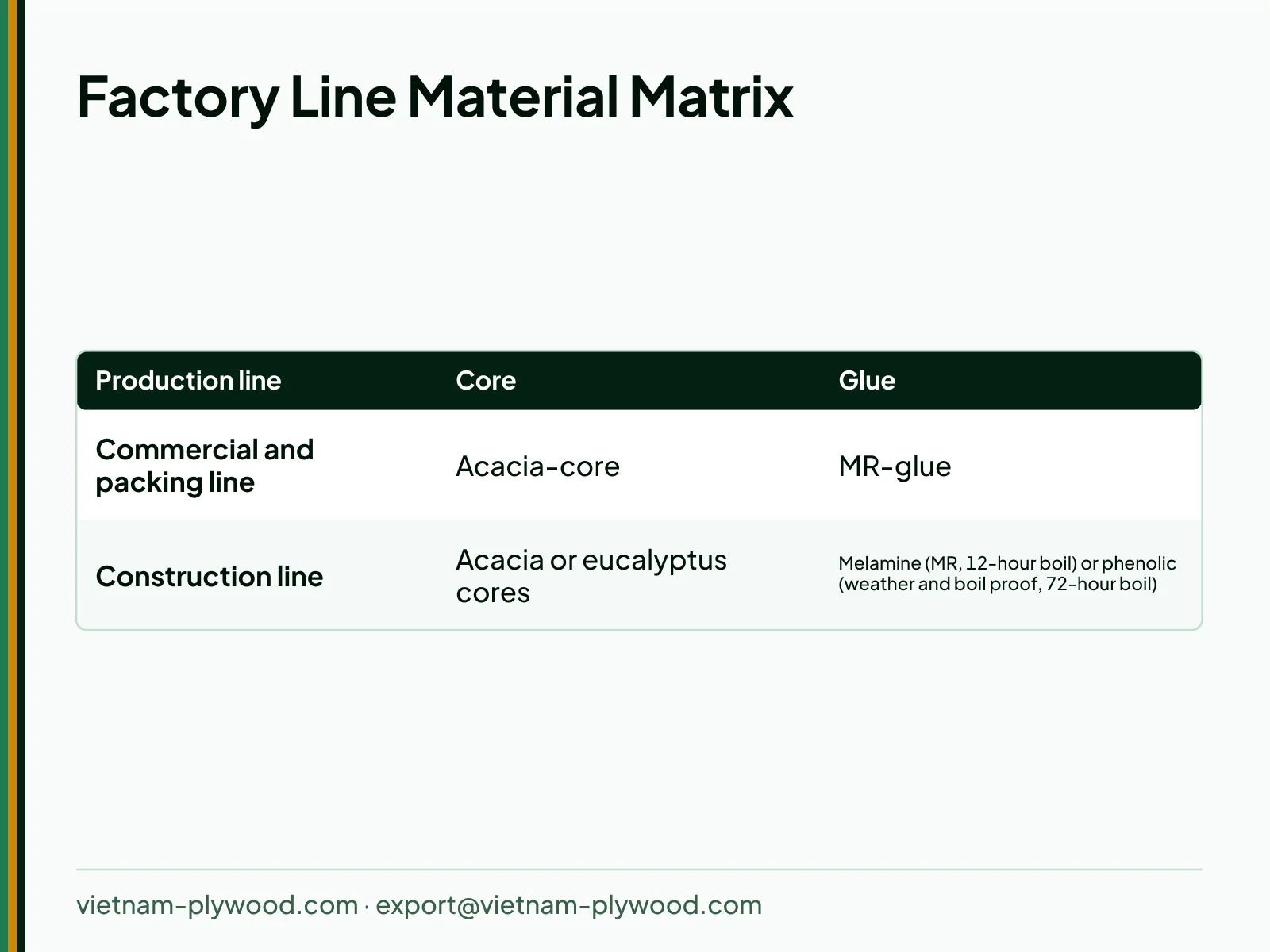
Our commercial and packing line normally works with acacia-core, MR-glue, unsanded or light-sanded plywood; the LVL plank specification must identify its own veneer assembly and test criteria. Our construction line handles film-faced panels with acacia or eucalyptus cores. The construction-panel adhesive can be melamine (MR, 12-hour boil) or phenolic (weather and boil proof, 72-hour boil), as specified. Glue performance and formaldehyde emission are separate fields.
Buyers can visit the factory office and inspect goods at the producing factory. Certificates held by member factories, including FSC, CARB P2, ISO 9001 and CE, are shown with factory details masked, on request. A certificate is considered only where its scope matches the agreed product.
Can LVL planks and anti-slip deck panels ship together?
Yes. LVL planks and anti-slip deck panels can share a 40HC container when the two packing plans fit and the combined payload stays within 28.5 t. The minimum order is one 40HC, and specifications can be mixed within that payload limit. Each item needs its own count, dimensions, packaging weight and loading position.
For a transparent panel reference, 18 mm acacia-core plywood at 1220×2440 mm weighs 31.08 kg per sheet before film weight. A full acacia-only 40HC lookup is 880 sheets, 47.15 m³ and 27.35 t, excluding film weight. That full-load figure is a comparison point, not a mixed-load instruction. The remaining payload for LVL is calculated only after subtracting actual anti-slip panel mass, film, pallets and other packaging.
For example, the planning equation is LVL allowance (kg) = 28,500 − actual deck cargo (kg) − all remaining packing and securing mass (kg). The LVL weight per plank must come from the accepted production specification; do not borrow the plywood sheet weight for a plank. Loading also requires a stowage drawing that checks package lengths, floor loading, restraint and access for unloading.
The container loads reference covers full-sheet loading arithmetic. The one-supplier, several plywood types page describes mixed product planning across factory lines.
How do you write a specification that can be tested?
Write a separate specification for the plank and for the deck panel, with a shared loading schedule. This keeps the structural question attached to the correct product rather than treating all scaffold timber as interchangeable.
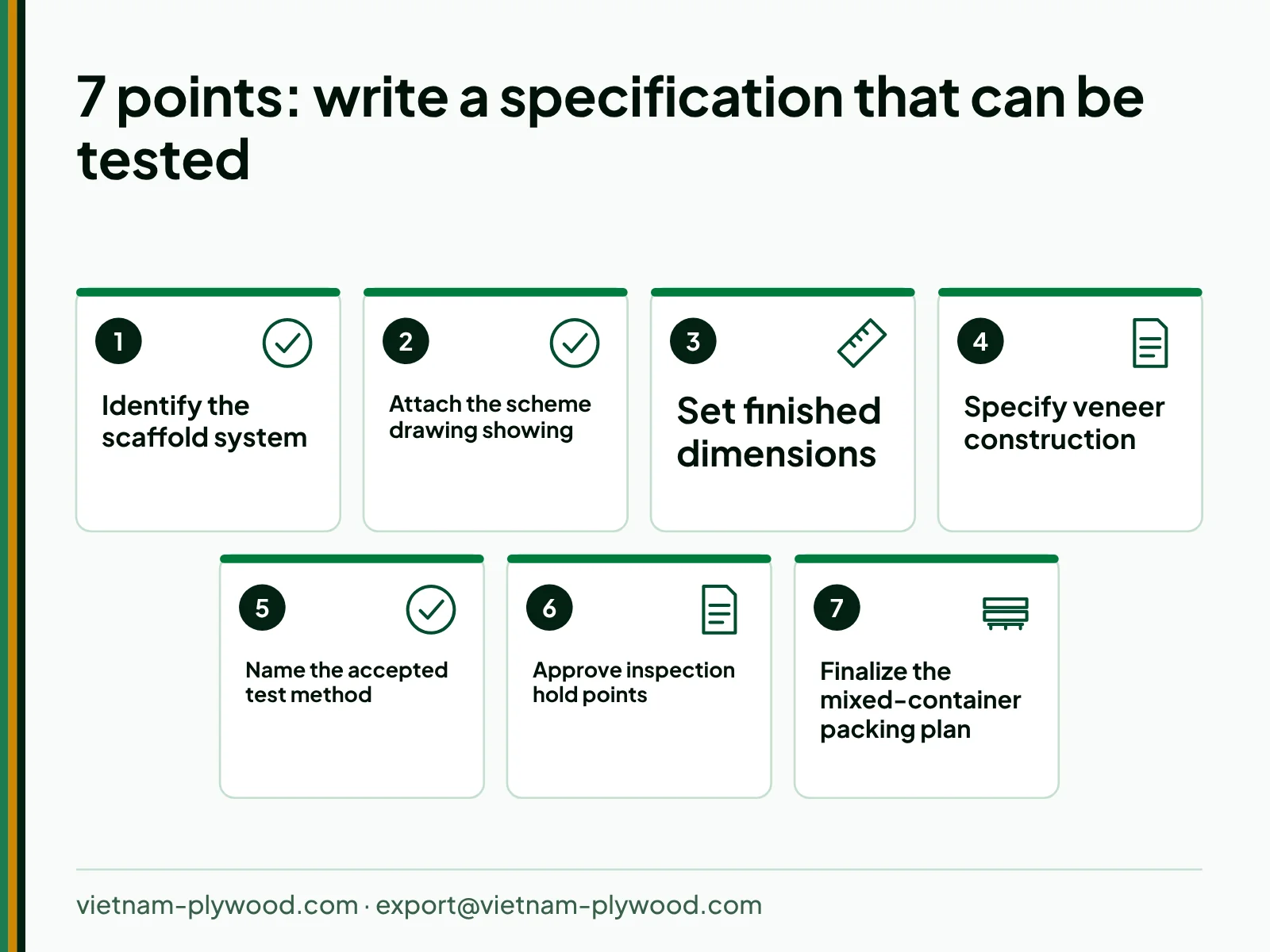
- Identify the scaffold system, country of use and intended service exposure.
- Attach the scheme drawing showing span, support width, fixing and maximum intended load.
- Set finished dimensions, permitted tolerances and packaging orientation for each product.
- Specify veneer construction, adhesive system, emission class where applicable, and surface treatment.
- Name the accepted test method, sample conditioning, test laboratory and pass criteria.
- Approve inspection hold points and traceability from sample to production lot.
- Finalize the mixed-container packing plan using measured package masses.
For deck panels, our core density references are acacia 580 kg/m³ and eucalyptus 650 kg/m³; density follows the core rather than the film face. The furniture-line styrax core is 500 kg/m³, but it is not the specified deck core. The exterior plywood supplier page addresses exposure-related panel selection outside the plank load question.
Where the project also needs printed identifiers or other fabricated panels, keep them as separate order lines. Sign-board plywood and container-floor plywood have different performance questions from scaffold access.
What affects the quotation and shipment documents?
The quotation is driven first by the tested LVL section and veneer assembly, then by adhesive and exposure specification, finished length, machining, surface treatment and inspection requirements. A more demanding tested build and longer handling lengths can cost more than a simpler plank with the same nominal width. Anti-slip film and edge preparation add processing compared with a plain panel face. Request a written quotation for each agreed build; there is no fixed LVL or anti-slip deck price here.
HCPLY exports FOB Hai Phong, CFR (CNF) or CIF. Factory lead time runs 15–45 days from receipt of the 30% deposit; the exact figure depends on order size, line loading and what the contract fixes. The remaining 70% is paid on the scan of the bill of lading, by T/T, or by irrevocable sight L/C. Each order is produced at the factory matched to its specification and shipped directly from it.
The shipment file includes the commercial invoice, packing list, bill of lading, certificate of origin, phytosanitary and fumigation papers, plus agreed certificate and test documents. Insurance is included under CIF, and EU lots include EUR.1 and the EUTR/EUDR file set. After loading, the draft shipping documents come to you for approval. The packing list is where separate LVL and deck-panel quantities and package masses must be identifiable.
For a specification review, contact Lucy at export@vietnam-plywood.com or use the contact page. Samples cost nothing: a first-time buyer pays the courier, and that charge comes off the first confirmed order.
What should the first enquiry contain?
The first enquiry should give the scaffold design basis and the two proposed product schedules, so the factory can identify the test and production route. Send drawings and the project acceptance standard with the dimensions below. If only a deck is required, remove the LVL line; if only planks are required, remove the deck line.
Application: scaffold working platform; design jurisdiction and support span: [insert]
Line or core: LVL — commercial and packing line; deck — construction line, acacia/eucalyptus
Glue: [specified LVL bond]; deck melamine MR or phenolic WBP
Emission: [project class, if required]
Face and grade: LVL finish [insert]; deck 220 g/m² anti-slip film, face acceptance [insert]
Thickness and tolerance: LVL [drawing]; deck [mm] ±0.5 mm
Size: LVL length × width [mm]; deck [listed format or cut size]
Quantity: LVL [pieces]; deck [sheets]; combined package weights [kg]
Destination port: [insert]
Load test: [method, span, load pattern, pass criteria, report acceptance]
Ask Lucy for a sample set tied to the proposed LVL and anti-slip deck specifications.