





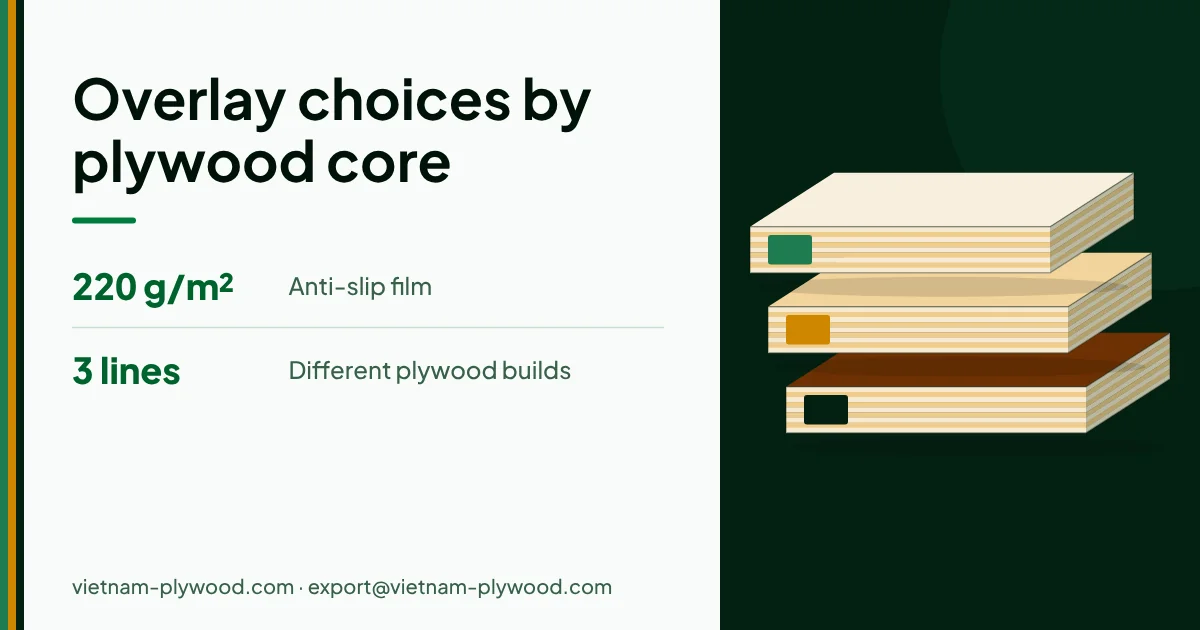
HCPLY separates coated plywood into factory-pressed phenolic or mesh film and specialist-applied plastic, vinyl or FRP over a calibrated substrate. Choosing the wrong combination can mean premature wear, extra repair days or a rejected shipment. Our construction line presses working films; our furniture line prepares sanded cores for a separate coater. The surface and core must be specified together.
What is plywood coated for industrial service?
Plywood coated for industrial service is a veneer-core panel protected by a bonded film, sheet or reinforced skin. The overlay changes surface wear, cleaning and grip; the core carries bending loads and fasteners. “Plastic coated plywood” is therefore a buying description, rather than a single manufacturing specification.
A phenolic film is resin-treated paper consolidated against the plywood face. A mesh-pattern film adds texture for traction. Plastic sheet, vinyl film and fibre-reinforced plastic (FRP) are different surface systems, usually bonded to a prepared plywood substrate by a specialist coater. A metal-faced panel, including plywood with aluminum face, adds another bonding and corrosion interface.
Start with the use: moving freight, washable lining, decorative fit-out or repeatedly handled industrial decking. Then specify the surface, underlying plywood, edge treatment and inspection method. The wider industrial plywood applications page places these uses alongside packing and construction panels.
How do phenolic, vinyl, plastic and FRP overlays compare?
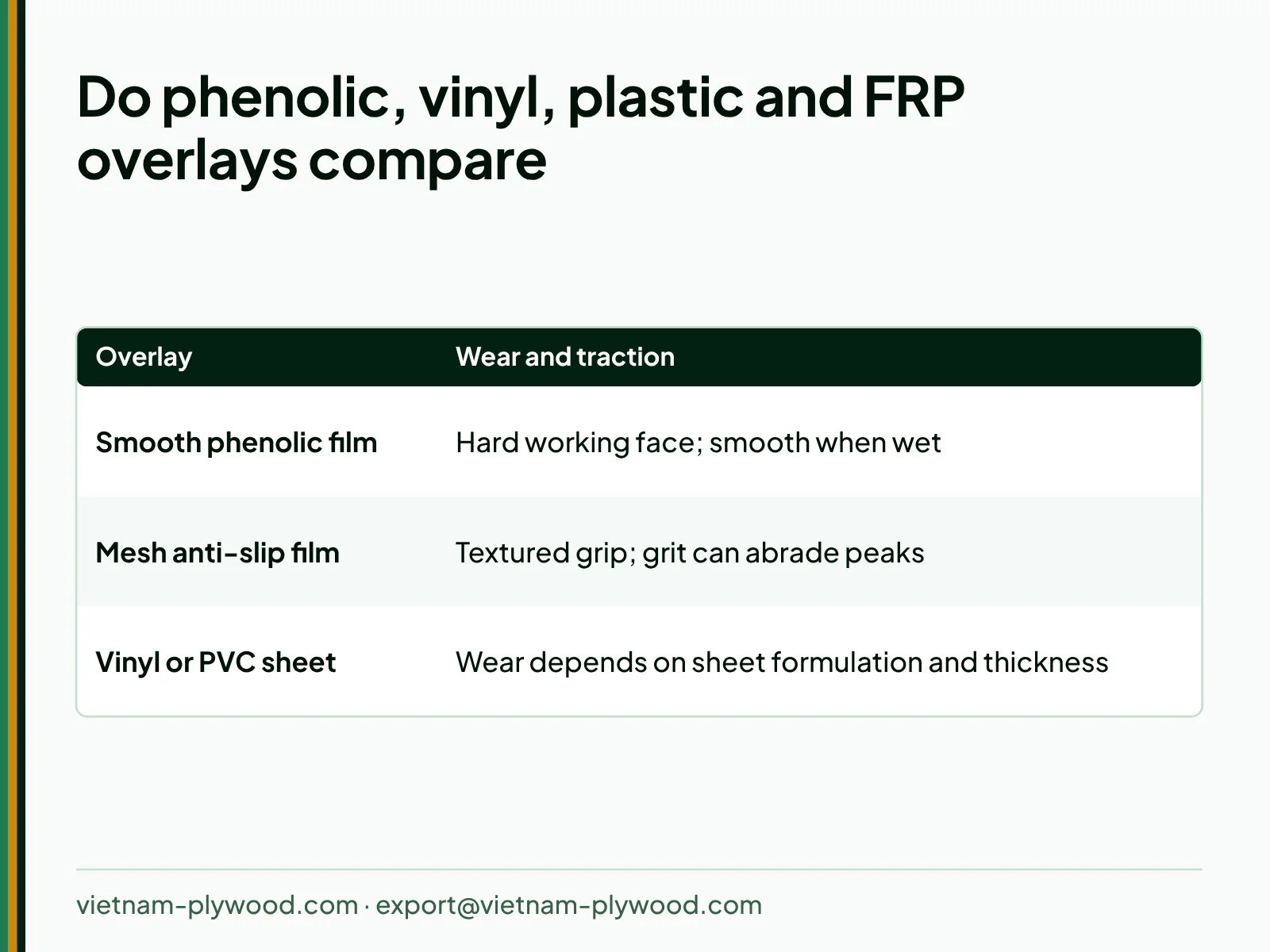
The comparison below concerns construction types, not performance test results for a particular order. Wear resistance depends on overlay thickness, resin, surface texture, adhesion and service conditions. Cleaning depends on chemical exposure and joint detailing; repair depends on whether a damaged skin can be patched or must be replaced.
| Overlay | Wear and traction | Cleaning and moisture interfaces | Repair approach | Verdict by use |
|---|---|---|---|---|
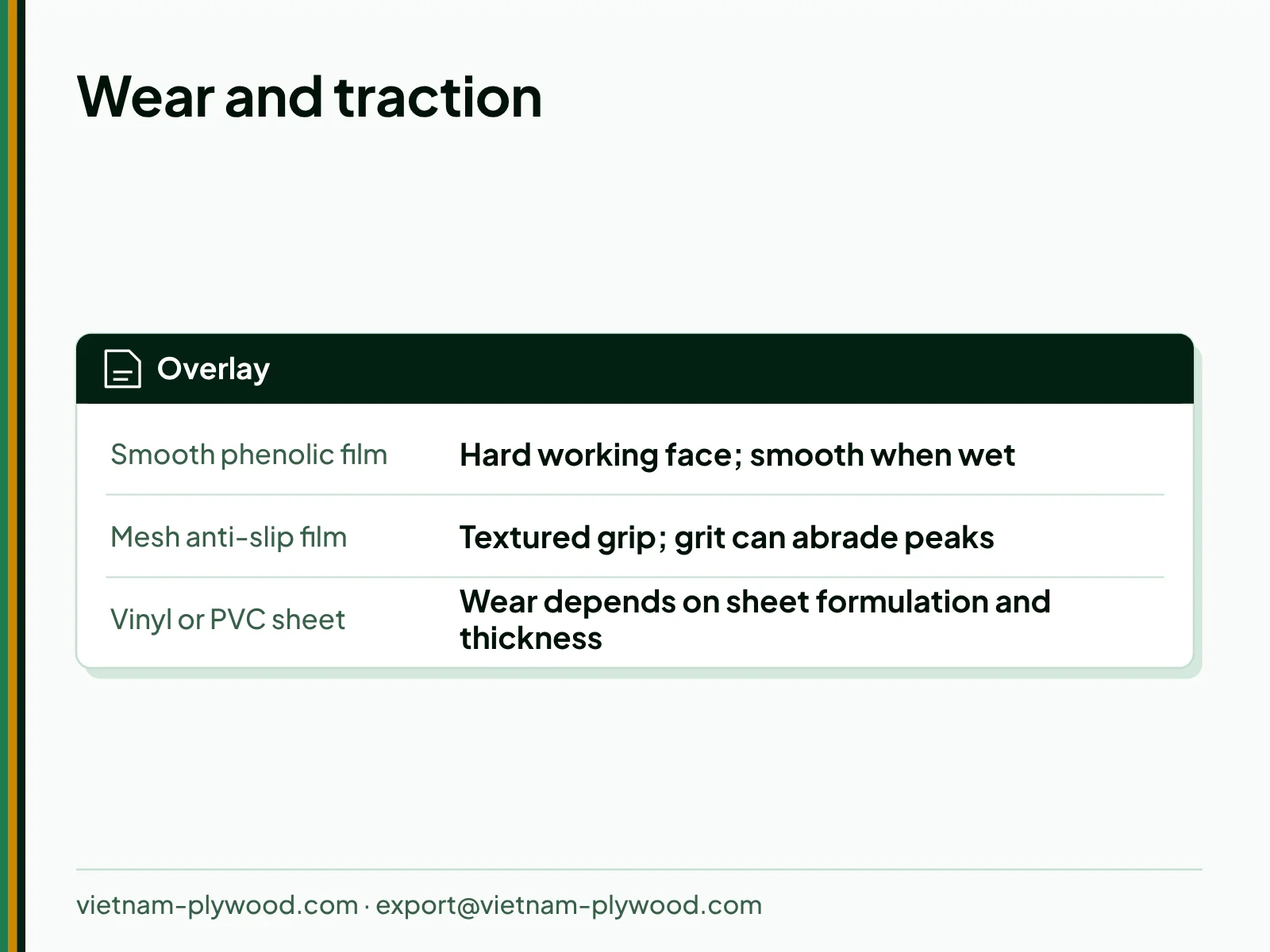
| Smooth phenolic film | Hard working face; smooth when wet | Wipeable face; cut edges need sealing | Seal exposed edges; replace severely worn face | Formwork or protected industrial lining |
| Mesh anti-slip film | Textured grip; grit can abrade peaks | Texture holds dirt; scrub without damaging film | Local edge sealing; replace worn deck areas | Truck and trailer walking or loading surfaces |
| Vinyl or PVC sheet | Wear depends on sheet formulation and thickness | Smooth sheet can clean easily; seams and adhesive matter | Patch or re-laminate where the system permits | Interior vehicle lining and washable fit-out |
| Other plastic sheet | Properties differ by polymer and bonding method | Check cleaners against polymer and adhesive | Follow coater’s repair system | Specialized protective linings |
| FRP laminate | Reinforcement can resist impact and abrasion; finish controls grip | Continuous surface helps washing; joints remain critical | Resin-and-fibre repair by trained fabricator | Wet or impact-prone industrial lining |
| Aluminum sheet | Dents and scratching are possible; surface can be slippery | Metal corrosion and adhesive compatibility matter | Replace or mechanically repair face | Specialized metal-faced fit-out |
Ask vendors for the exact surface construction and a test method relevant to the duty cycle.
Which coated plywood belongs on truck and trailer floors?
Mesh anti-slip film over a suitable structural design is the HCPLY construction-line option for truck and trailer floor discussions. It provides a textured walking and loading face; the vehicle builder must still assess axle loads, support spacing, fasteners, wet traction and applicable vehicle rules. See the dedicated buffalo-board trailer-floor specification for the floor-specific selection.
Our construction line presses 220 g/m² anti-slip film on acacia or eucalyptus core. Standard smooth film is 120 g/m², while the premium smooth option is 135 g/m². Film mass describes the facing material; it is not a measured slip coefficient or a floor load rating.
For a washable wall or ceiling liner, vinyl faced plywood can be a more appropriate assembly when a coater has validated the adhesive and cleaning system. FRP laminated plywood can suit impact-prone or wet-service lining, provided the fabricator defines the laminate, edge closures and repair process. Neither automatically becomes a suitable floor merely by having a protective skin.
Which overlays do our factories press?
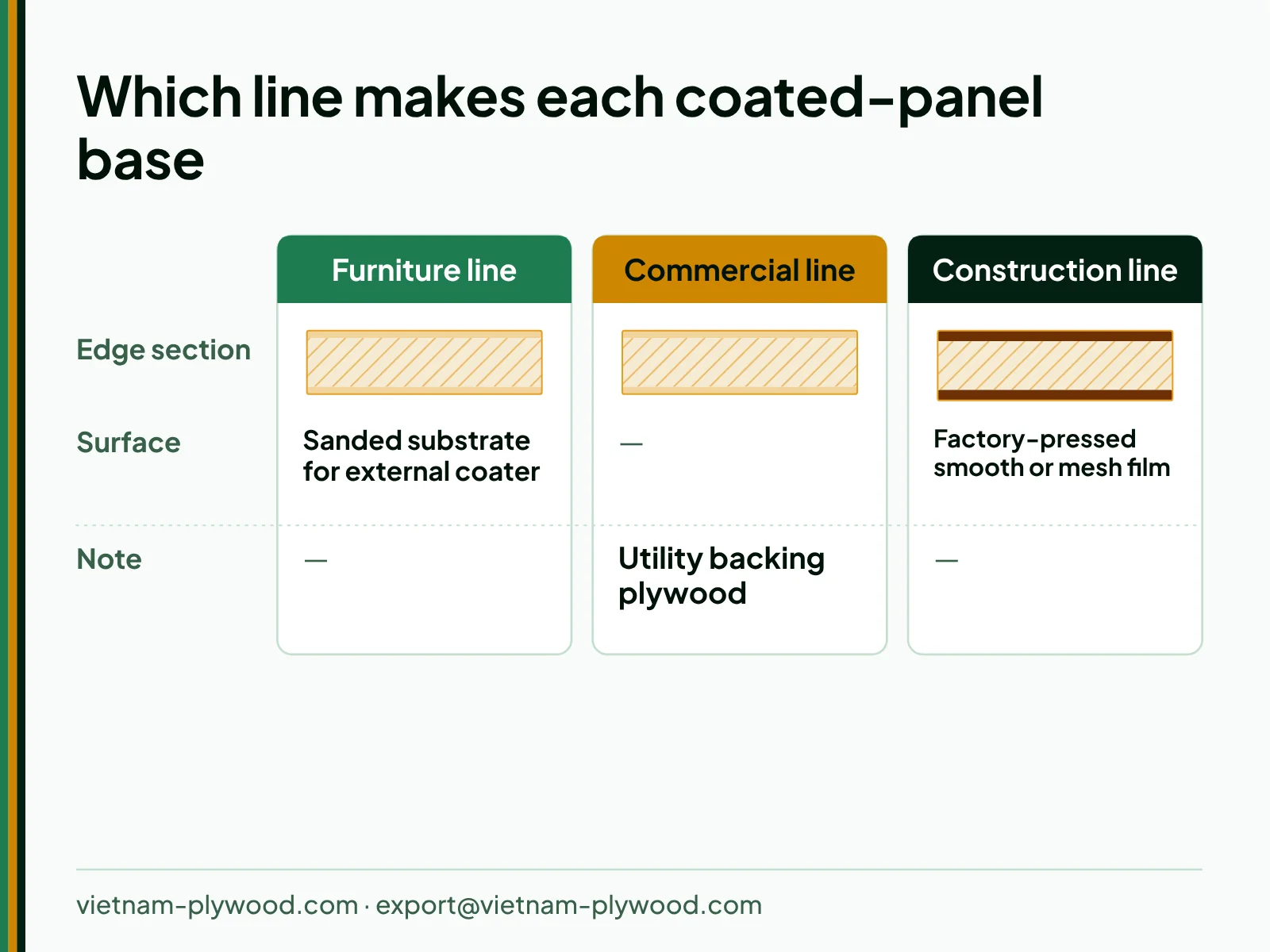
Our construction line presses phenolic or melamine film and mesh anti-slip film onto plywood. Our furniture line makes calibrated, sanded substrate for a separate plastic, vinyl or FRP coater. HCPLY does not operate a PVC, vinyl, FRP, aluminum, melamine decorative-sheet, high-pressure laminate or other plastic-overlay finishing line.
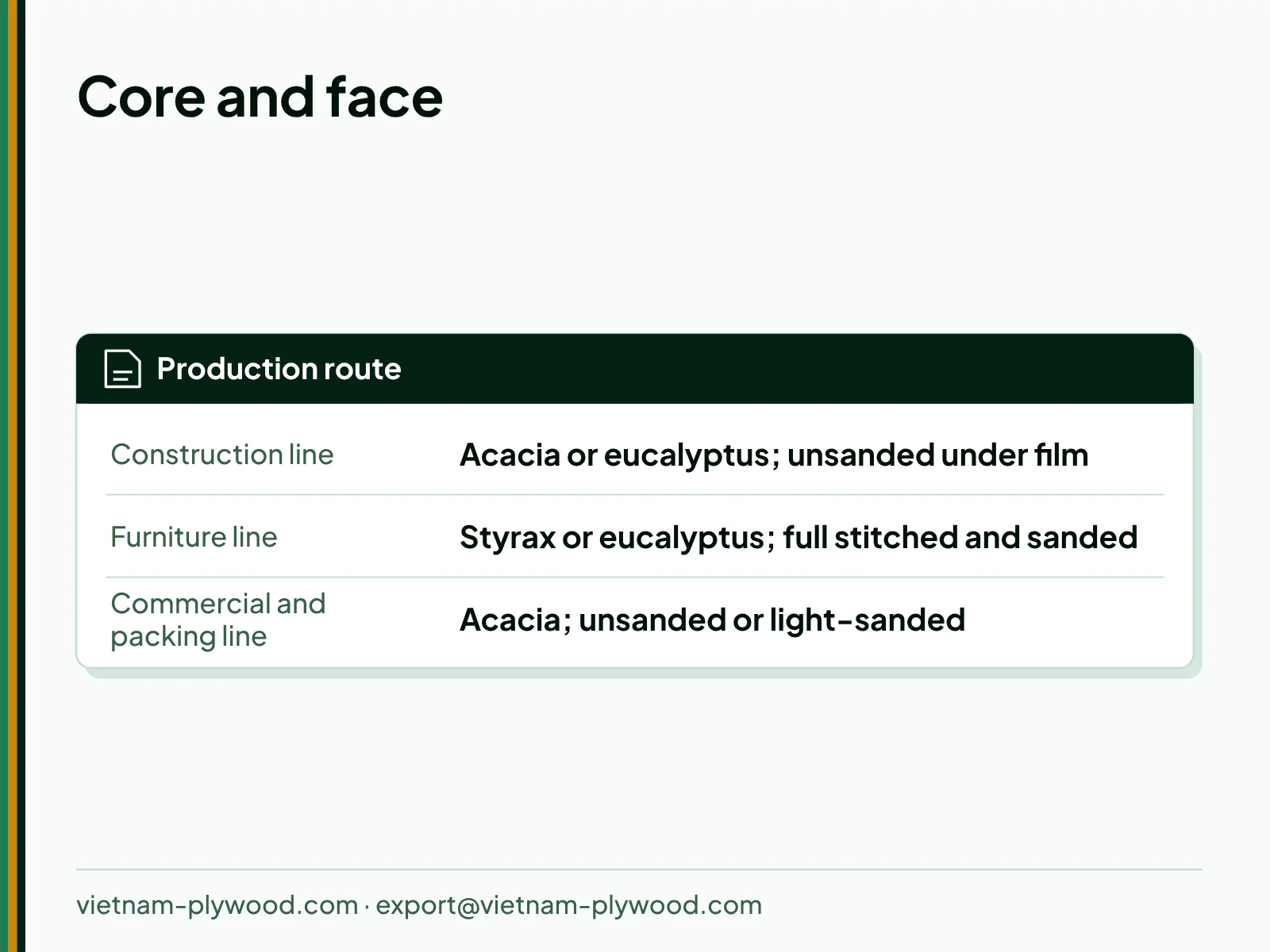
| Production route | Core and face | Surface operation | Practical purchasing outcome |
|---|---|---|---|
| Construction line | Acacia or eucalyptus; unsanded under film | Factory-pressed smooth or mesh film | Order a film-faced panel from us |
| Furniture line | Styrax or eucalyptus; full stitched and sanded | Raw substrate leaves for specialist coating | Specify substrate dimensions and flatness with the coater |
| Commercial and packing line | Acacia; unsanded or light-sanded | MR-bonded utility plywood | Packing or industrial backing, rather than a calibrated decorative overlay base |
These are distinct builds even at the same nominal thickness. A finished plastic coated ply quotation must distinguish the plywood component from the downstream coater’s material, adhesive and conversion work. Our Vietnam plywood manufacturing overview explains the producing-factory arrangement.
What core should sit beneath plastic or vinyl?
A plastic or vinyl overlay needs a flat, stable plywood substrate with a bonding surface compatible with the coater’s adhesive. Our furniture line offers full-stitched, sanded styrax or eucalyptus core, with thickness tolerance ordered at ±0.2 or ±0.3 mm.
Styrax core has a stated density of 500 kg/m³; eucalyptus core is 650 kg/m³. Density follows the core rather than the decorative or protective face. For a rigid skin, surface telegraphing from gaps and joints can become visible after pressing.
A construction-film panel uses unsanded acacia or eucalyptus core with ±0.5 mm thickness tolerance. Commercial plywood uses acacia at 580 kg/m³ and ±0.5 mm; packing tolerance is ±0.5–1.0 mm. The nominal thickness range is 3–40 mm, with common selections including 9, 12, 15, 18 and 21 mm. Available standard formats include 1220×2440 and 1250×2500 mm, plus other listed sizes and custom cutting.
What do glue, emission class and edge sealing change?
Glue governs the plywood bond; emission classification describes a separate requirement. Our MR option uses melamine glue with a 12-hour boil designation; the phenolic weather-and-boil-proof (WBP) option has a 72-hour boil designation. These are stated build descriptions, not a substitute for a buyer-approved test report on a finished coated assembly.
Furniture substrates can be ordered in E0 or E1 emission classes. E0, E1 and E2 are emission classes; CARB Phase 2 and TSCA Title VI concern a US regulatory limit with third-party certification. A coating does not replace the need to specify the underlying panel’s emission documentation where applicable.
Water can enter at drilled holes, joints and cut edges even when the face is water-resistant. Specify sealing of cut edges, fastener penetrations and exposed plywood before wet-service installation.
How should a buyer compare wear, cleaning and repair?
Compare the whole assembly under the intended service conditions, starting with the failure that would stop the equipment. For a trailer, that can be traction loss, surface wear or fastener pull-through. For a washable lining, it can be chemical damage, delamination at seams or water entry at cutouts.
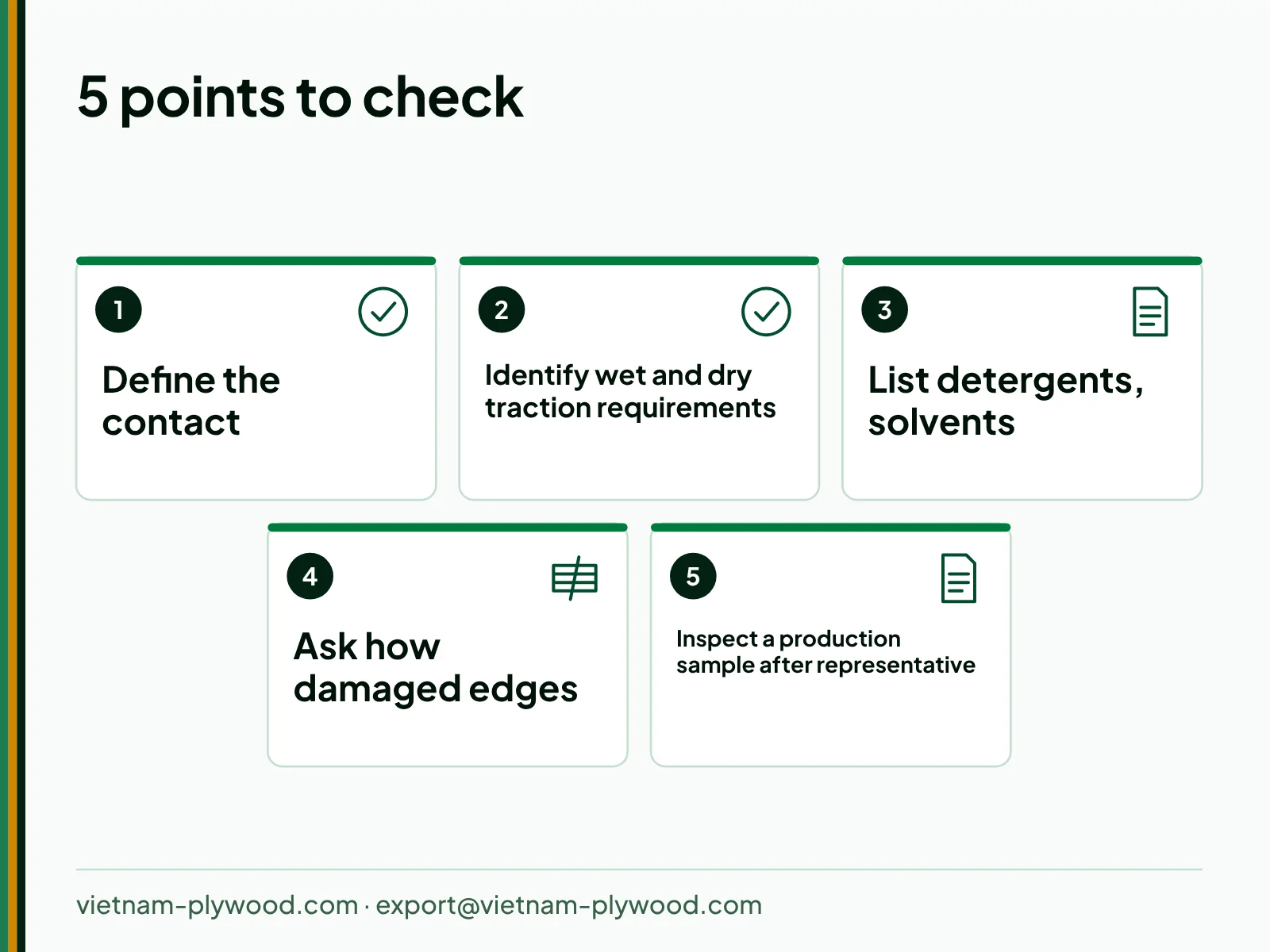
- Define the contact: footwear, pallet feet, wheeled carts, abrasive cargo or cleaning tools.
- Identify wet and dry traction requirements, including any specified test method.
- List detergents, solvents, wash frequency and expected exposure temperature.
- Ask how damaged edges, punctures and worn areas will be repaired in service.
- Inspect a production sample after representative cutting, fastening and cleaning trials.
A hard phenolic face can wear through at repeated contact points; mesh texture offers grip but is harder to wash completely. Vinyl can be easier to wipe yet vulnerable at seams and under incompatible solvents. FRP repair needs matching resin and reinforcement, while a metal sheet needs attention to denting and dissimilar-material interfaces.
What can an inspector witness at the producing factory?
An inspector can check core construction, thickness, face condition, film identity, cut edges and packed quantities at the producing factory. For construction film, request a witness check of the agreed smooth or mesh facing and look for missed areas, blisters and exposed edges. For a furniture substrate destined for vinyl coating, check sanding consistency and visible core defects before dispatch.
Use the written acceptance plan to record sheet measurements at agreed positions. Furniture sanded panels follow the ordered ±0.2 or ±0.3 mm thickness tolerance; commercial and film-faced panels use ±0.5 mm. Length and width tolerance is ±2 mm. Inspection should also compare the agreed surface, packing marks and lot identification with the purchase specification.
A coater’s adhesion, chemical-resistance and finished-surface checks occur after the substrate leaves our factory. HCPLY handles on-site QC, loading and export documentation for its plywood orders.
How can coated-panel substrates share a shipment?
A 40HC shipment has a 28.5 t payload limit, and specifications can be mixed within that limit. For 18 mm, 1220×2440 mm sheets, the full-load lookup is 990 styrax sheets at 26.52 t, 880 acacia sheets at 27.35 t or 795 eucalyptus sheets at 27.69 t. These calculations exclude the additional mass of any film or later-applied coating.
That difference matters when a buyer combines furniture-line coating substrates with construction-film flooring stock. As an illustrative split using the stated sheet weights, 495 styrax sheets at 26.79 kg each weigh 13,261.05 kg, while 440 acacia sheets at 31.08 kg each weigh 13,675.20 kg. Their combined calculated panel mass is 26,936.25 kg before film, pallets and other packing.
The container loading reference covers full-container quantities. A mixed order should identify each build separately on the packing list so the receiving warehouse can distinguish substrate from finished film-faced stock.
Which export papers and EU requirements apply?
The shipment’s commercial invoice and packing list identify the ordered plywood build and quantity. The bill of lading records carriage; the certificate of origin, phytosanitary and fumigation papers, and applicable order-specific certificates support customs and buyer review. EU lots include the EUTR/EUDR file set and EUR.1 where applicable; insurance documents accompany CIF shipments.
The European Commission’s 2026 EU Deforestation Regulation overview states that wood and certain derived products fall within the regulation’s product scope. It also states that covered operators must perform due diligence on relevant products. See the European Commission’s EUDR overview for scope and application dates.
Member-factory certificates covering FSC, CARB P2, ISO 9001 or CE, and related EUDR/EUTR documents, are shown with factory details masked, on request. After loading, the draft shipping documents come to you for approval.
How should a coated plywood quotation be specified?
A quotation needs the plywood construction first, followed by the surface system and who applies it. For factory film, specify smooth or anti-slip film, core, glue, thickness, size and inspection requirements. For vinyl covered plywood or PVC coated plywood, separate our sanded substrate specification from the specialist coater’s sheet and adhesive requirements.
The largest cost differences usually arise from the core construction and substrate calibration, followed by overlay type and conversion steps, then surface testing, edge finishing and packing. A full-stitched sanded furniture substrate costs more to prepare than an unsanded utility core because it requires tighter assembly and finishing. FRP lamination adds reinforcement and resin processing beyond a plain plywood substrate; exact quotations require the complete specification.
The minimum order is one 40HC. Factory lead time runs 15–45 days from receipt of the 30% deposit; the exact figure depends on order size, line loading and what the contract fixes. The remaining 70% is paid on the scan of the bill of lading, by T/T, or by irrevocable sight L/C. We ship FOB Hai Phong, or CFR (CNF) or CIF to your port. Discuss industrial backing through commercial and packing plywood and film applications through construction plywood supply.
What should go into the first sample request?
A sample request should name the actual duty and the party responsible for the overlay. Ask for a construction-film sample when evaluating a pressed mesh or smooth film. Ask for a sanded furniture-line substrate when your selected coater will apply vinyl, plastic or FRP. For applications where impact and moisture meet, include a cut-edge sample so the sealing detail can be evaluated.
HCPLY provides free samples; a first-time buyer pays the courier, and that charge comes off the first confirmed order. Send the written build to Lucy at export@vietnam-plywood.com or through the coated plywood enquiry form.
Application: truck floor / washable lining / industrial fit-out
Line or core: construction film / furniture substrate; acacia / styrax / eucalyptus
Glue: MR melamine / WBP phenolic
Emission: E0 / E1 / agreed requirement
Face and grade: smooth phenolic / mesh anti-slip / sanded substrate; agreed face grade
Thickness and tolerance: ___ mm; ±___ mm
Size: ___ × ___ mm
Quantity: ___ sheets / pallets / 40HC
Destination port: ___
Ask Lucy for a sample set matching the selected build.