





What stage plywood is best for event-hire decks?
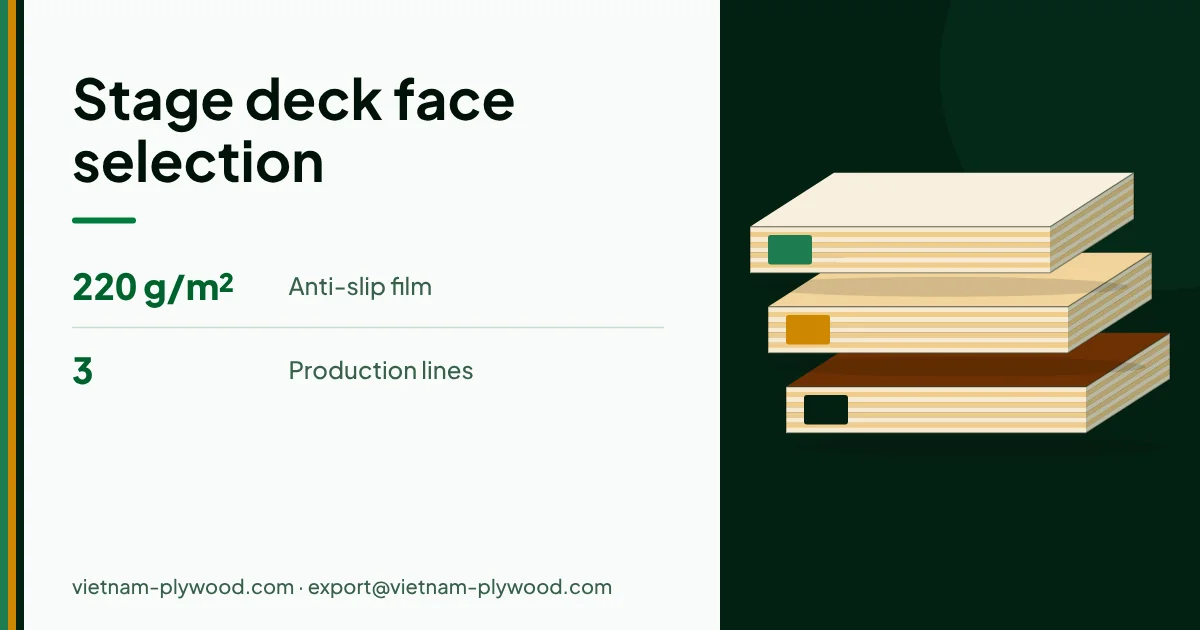
Stage plywood for an event-hire fleet should match the exposed walking surface, support layout and handling cycle. The wrong face can force refinishing, delay a show or leave a shipment unsuitable for the planned deck. HCPLY builds textured anti-slip panels on our construction line and offers sanded plywood through our furniture line for decks receiving a separate finish.
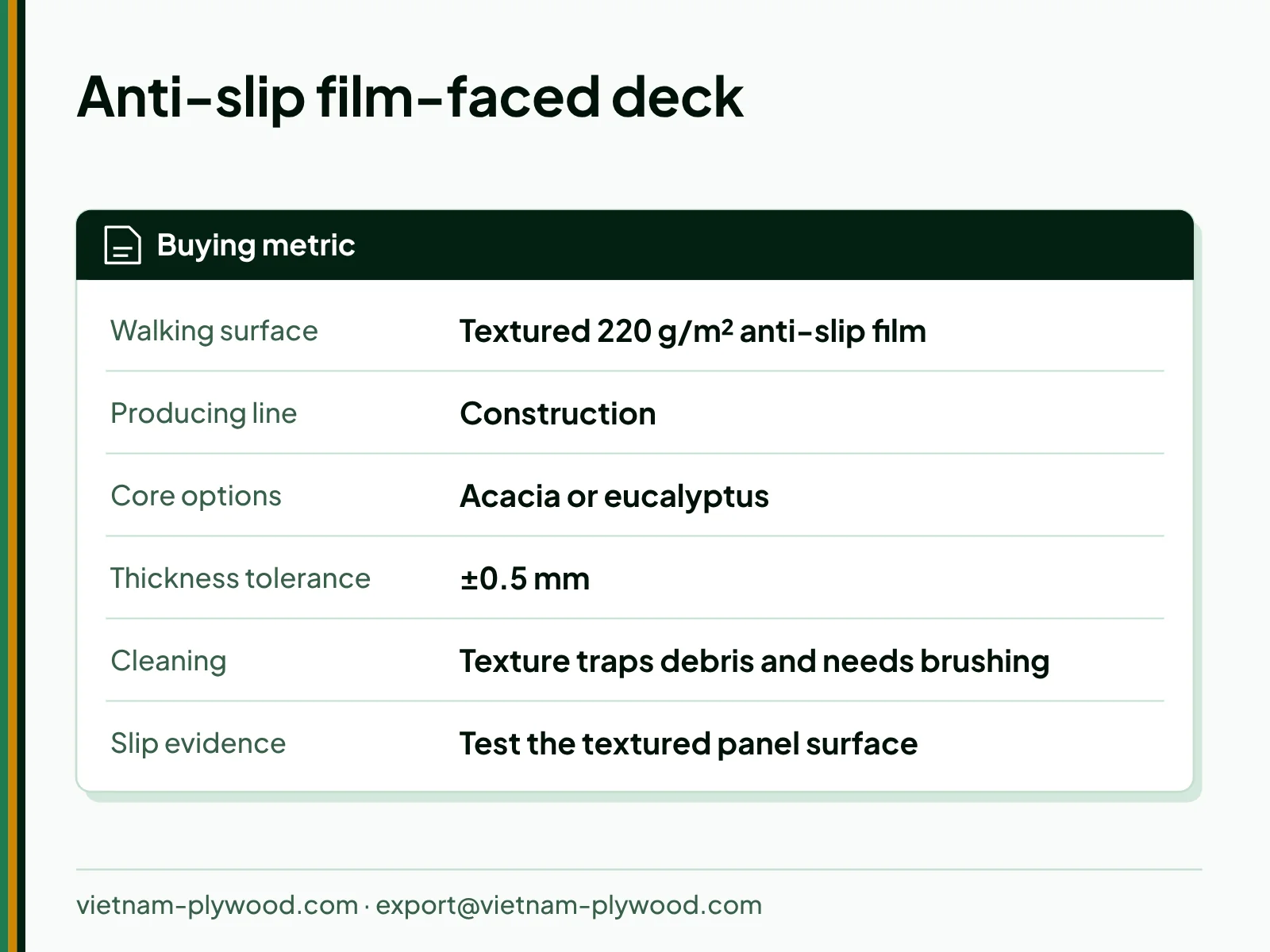
For an exposed, repeatedly assembled walking deck, see industrial plywood applications and start with anti-slip plywood and obtain a slip-test report for the exact proposed face. For painted or carpeted decks, start with the finishing system and select a smooth panel beneath it. Neither choice replaces the deck designer’s load, span, fixing and deflection calculations.
Should stage decks use anti-slip film or a sanded face?
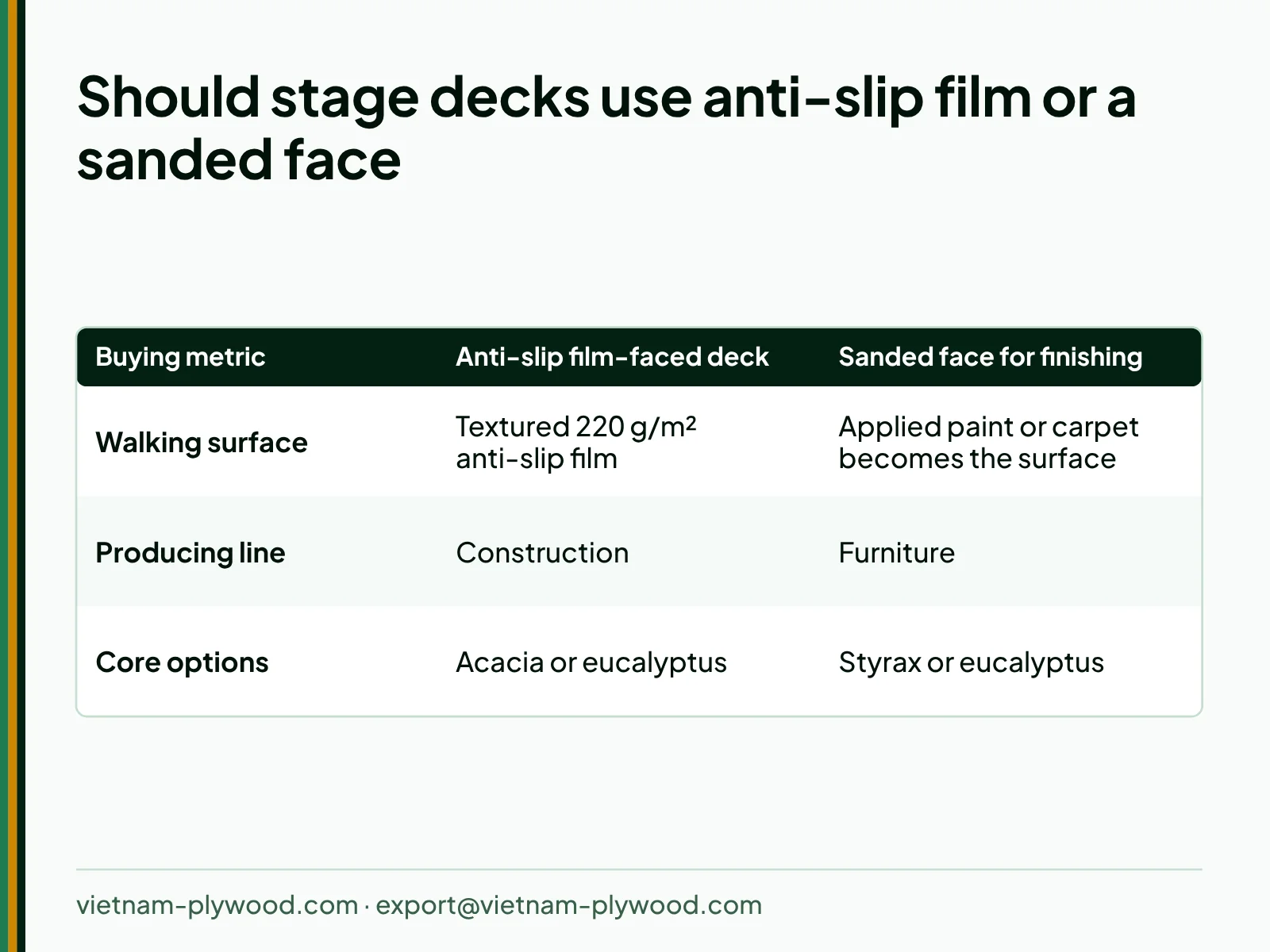
Anti-slip film is the stronger starting choice when the plywood face remains exposed to pedestrian traffic; a sanded face is the practical starting choice beneath a tested paint or carpet finish. The choice changes factory construction and acceptance evidence. See scaffold-board buying for related exposed decks.
| Buying metric | Anti-slip film-faced deck | Sanded face for finishing | Verdict by use |
|---|---|---|---|
| Walking surface | Textured 220 g/m² anti-slip film | Applied paint or carpet becomes the surface | Exposed deck: film; finished deck: sanded |
| Producing line | Construction | Furniture | Specify the actual line |
| Core options | Acacia or eucalyptus | Styrax or eucalyptus | Compare weight and handling |
| Thickness tolerance | ±0.5 mm | ±0.2 or ±0.3 mm as ordered | Close-fitting finished modules: sanded |
| Cleaning | Texture traps debris and needs brushing | Finish dictates cleaning method | Match maintenance procedure |
| Slip evidence | Test the textured panel surface | Test the completed coating or carpet system | Neither inherits the other’s result |
| Repeated transport | Protect film and sealed cut edges | Protect finish and exposed corners | Match handling and repair plan |
Which plywood suits painted or carpeted stage decks?
Sanded plywood suits a painted or carpeted stage when the surface finish, adhesive and fixing method are designed as a complete assembly. Our furniture line makes full-stitched, sanded styrax- or eucalyptus-core panels, with E0 or E1 emission classes. Its ordered thickness tolerance supports repeatable modules and face preparation.
For painted decks, agree on the paint manufacturer’s preparation, primer, coating build and cure process. Test a representative sample for adhesion, abrasion and grip after the actual finish is applied. Paint can fill the texture of a surface, so a slip report for bare plywood cannot establish the painted deck’s performance.
Our commercial and packing line instead makes acacia-core MR-glue plywood, unsanded or light-sanded, for a more basic covered or protected deck substrate. That surface needs additional preparation where a visible paint finish is required. A buyer specifying sign-board plywood for graphics should separately address the walking surface and its wear.
What does an R13 slip rating mean?
R13 is a classification from a shod-foot inclined-ramp test system, commonly presented as R9 through R13. It refers to performance in a defined test arrangement, with specified footwear and contaminant. It is not a universal friction coefficient or a substitute for checking the conditions at a particular event.
Ask which standard and edition the laboratory used, which face was tested, whether the test sample was new or worn, and whether its construction matches the purchase specification. An R13 claim attached to a textured product listing cannot establish an R13 result for another core, film or production build.
The UK Health and Safety Executive’s Slip resistance tests guidance, updated in 2025, explains that ramp tests can produce slip-resistance data but that test contaminants and footwear can limit their suitability for real walking conditions. The same guidance warns against using dry-only sled measurements for wet or contaminated floors. See HSE’s slip resistance tests guidance.
For a stage with outdoor loading, rainwater, spilled drinks or mixed footwear, include those conditions in the acceptance discussion. R13 may be one requested classification, while a separate in-use assessment remains appropriate.
Does the slip rating have to be tested on the panel itself?
A buyer should require slip evidence for the actual ordered walking surface, with a traceable sample description and an accepted test method. The laboratory report should identify the film texture or finished coating, relevant test conditions, test date and specimen identification. A supplier’s photograph of a pattern is not a test report.
Request a sample panel from the intended construction and record the face, film, core and finishing state. Have a competent laboratory assess that surface against the buyer’s specified method. If a carpet or paint layer is added later, assess the completed walking layer instead of transferring a bare-panel result.
The HSE’s undated Slips and Trips—Frequently asked questions says profiled surfaces wear and can lose slip resistance as their peaks round off. It also identifies the pendulum method as a way to assess wet-floor slip resistance. See HSE flooring questions. Build a repeat-inspection threshold into the hire fleet’s maintenance procedure rather than relying on the initial texture indefinitely.
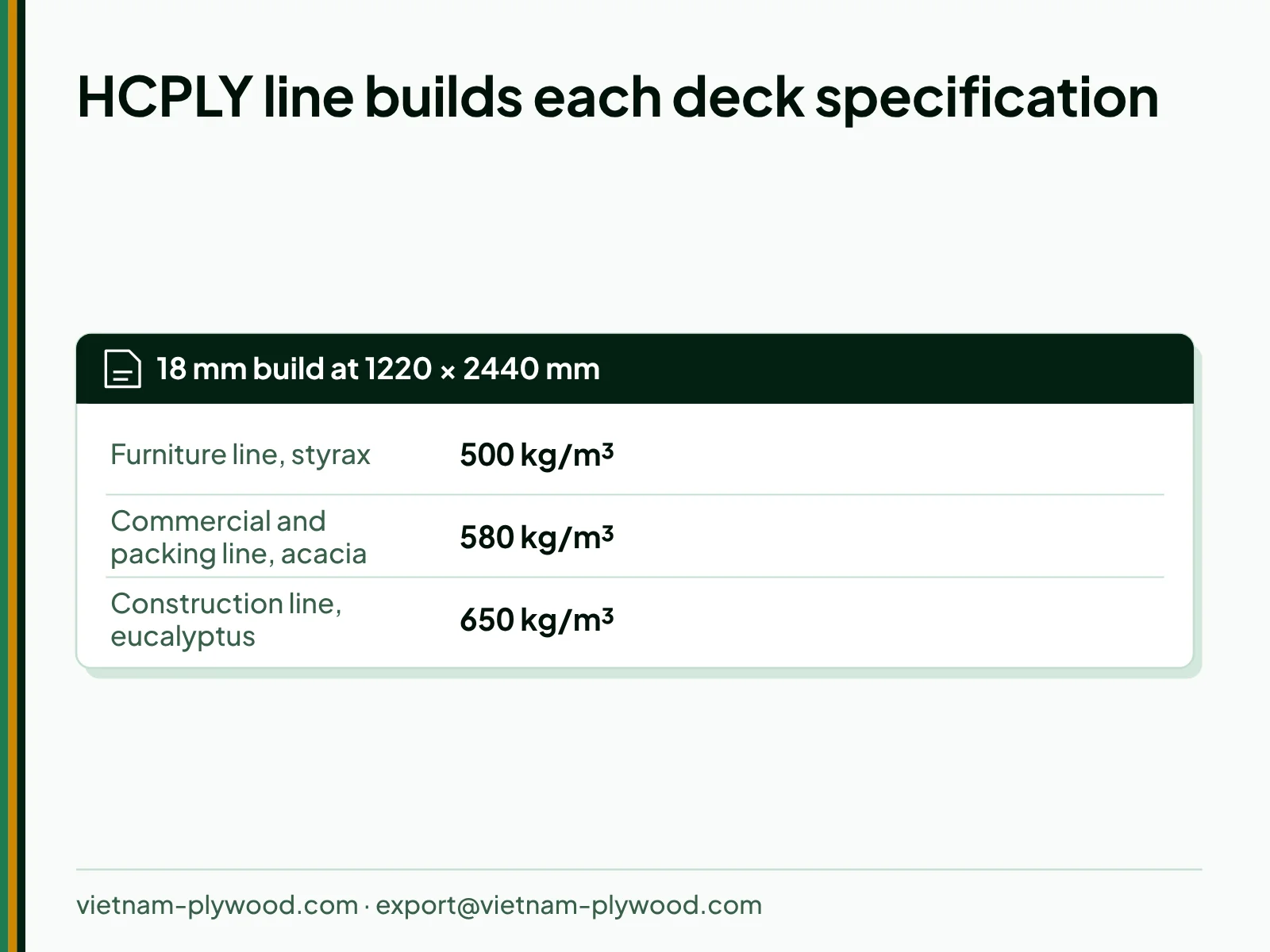
Which HCPLY line builds each deck specification?
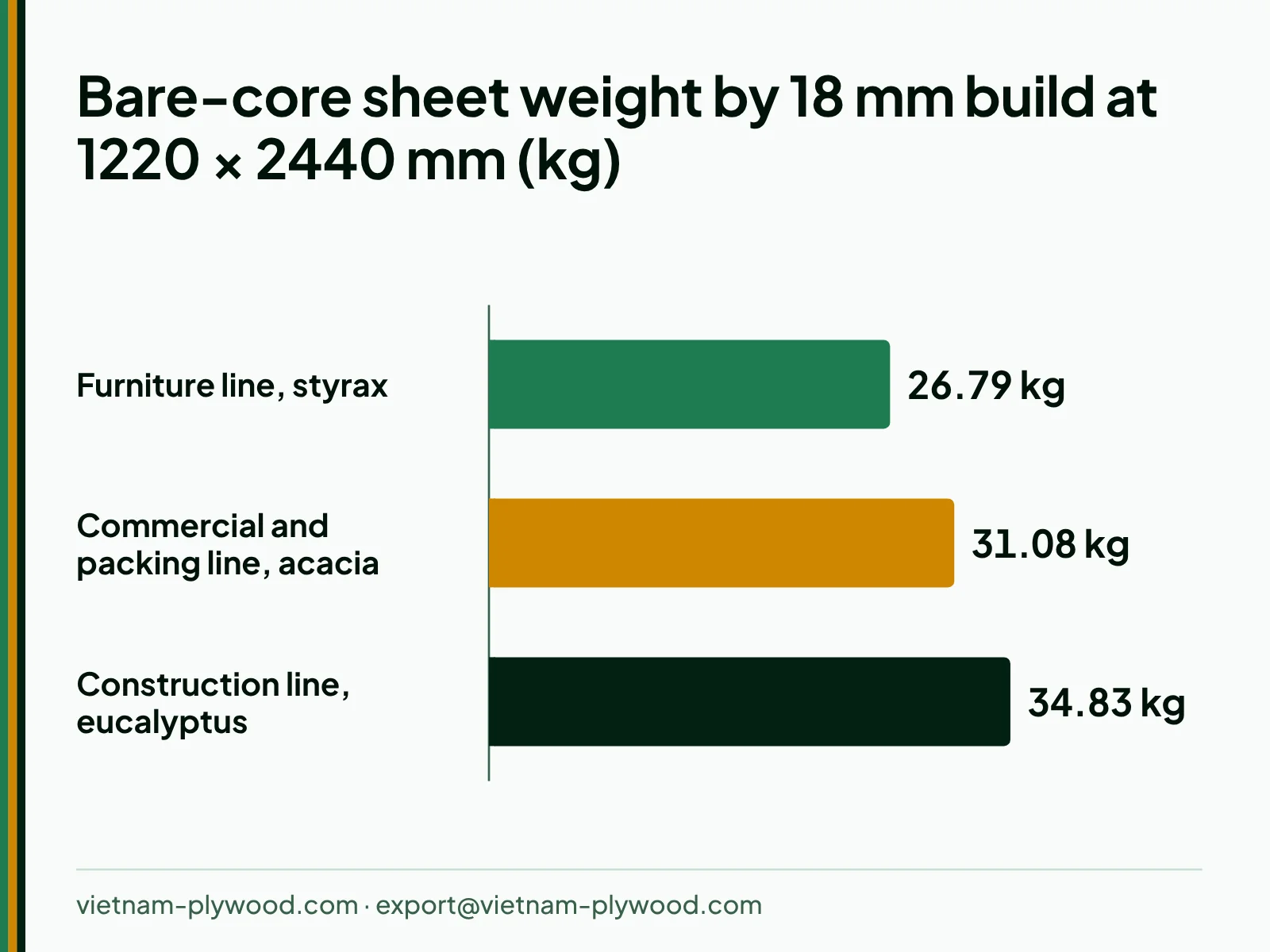
Our construction line presses anti-slip film-faced stage panels with acacia or eucalyptus cores. The furniture line instead makes full-stitched, sanded panels for a separate finish; the commercial and packing line makes acacia-core, light-sanded or unsanded substrates. The same nominal 18 mm thickness therefore represents different faces, tolerances and handling weights.
| 18 mm build at 1220 × 2440 mm | Core density | Bare-core sheet weight | Face and preparation | Suitable stage role |
|---|---|---|---|---|
| Furniture line, styrax | 500 kg/m³ | 26.79 kg | Sanded, full stitched | Painted or carpeted modules |
| Commercial and packing line, acacia | 580 kg/m³ | 31.08 kg | Unsanded or light-sanded | Protected subdeck |
| Construction line, eucalyptus | 650 kg/m³ | 34.83 kg | Anti-slip film | Exposed textured walking deck |
The weights follow core density and exclude film and later finishes. An event fleet should also check whether added surface layers and edge fittings change the final handling weight. We do not press birch-core plywood; a birch-faced panel, where specified, is named for its face rather than its core.
What thickness, size and loading plan fit a hire fleet?
Choose panel thickness from the deck engineer’s support spacing, loading and deflection design, then match the production tolerance to the modular joint detail. HCPLY offers 3–40 mm panels, including common 12, 15, 18, 21 and 25 mm thicknesses. Available formats include 1220 × 2440 mm and 1250 × 2500 mm, with custom cutting available.
For a typical 18 mm, 1220 × 2440 mm planning comparison, the full 40HC figures are 990 styrax sheets at 26.52 t, 880 acacia sheets at 27.35 t, or 795 eucalyptus sheets at 27.69 t. The 28.5 t payload ceiling governs the mixed load. These figures use the core weights; film, packaging and other additions need allowance in the final packing plan.
One 40HC is the minimum order, and specifications can be mixed within its payload limit. A combined order might pair textured entrance decks with sanded interior modules, provided each pallet group remains identifiable. The mixed-container specification process and container loading reference cover shipment planning in more detail.
What glue, face and edge details belong in the order?
The order should state glue type, emission class, face treatment and edge protection as separate fields. Melamine MR glue is associated with a 12-hour boil specification; phenolic weather-and-boil-proof glue, or WBP, with a 72-hour boil specification. These glue descriptions do not replace a slip test or establish a structural rating.
For exposed anti-slip panels, the specified film is 220 g/m². Standard smooth film is 120 g/m², while premium smooth film is 135 g/m²; neither figure describes the anti-slip film. For finished panels, specify the required face grade and any finishing trial before bulk production.
Cut edges deserve a separate line on the purchase order because modular decks are often trimmed for hatches, ramps and cable runs. Require sealing of original and newly cut edges in the deck maintenance procedure. Protect corners during stacking and keep the walking face free from adhesive residue, grit and standing water.
Where the deck is intended to carry significant concentrated loads, the event engineer must assess the full support system. Neither a glue designation nor a thick panel alone establishes allowable span, point-load capacity or a national structural classification.
What plywood works for dance floors and marquee flooring?
A plywood dance floor usually calls for a smooth, finished surface selected for the intended dance style and footwear. Coarse anti-slip texture can interfere with movement and may abrade shoes or costumes. A sanded plywood platform under a separately tested dance finish is a more suitable specification starting point.
A plywood marquee flooring system faces different conditions at entrances and service corridors. Tracked-in rain, food spills, temporary ramps and frequent cleaning favour a surface whose grip is assessed under realistic contamination. Anti-slip film can be considered for exposed entry or service modules, while carpeted guest areas call for a secure carpet finish over a flat substrate.
How can an inspector check panels at the producing factory?
An inspector can witness dimensions, visible construction, face texture, edge condition and packing before shipment. The producing factory should present the agreed specification beside the sample and the packed lot. The buyer may visit the factory office and inspect goods at that location.
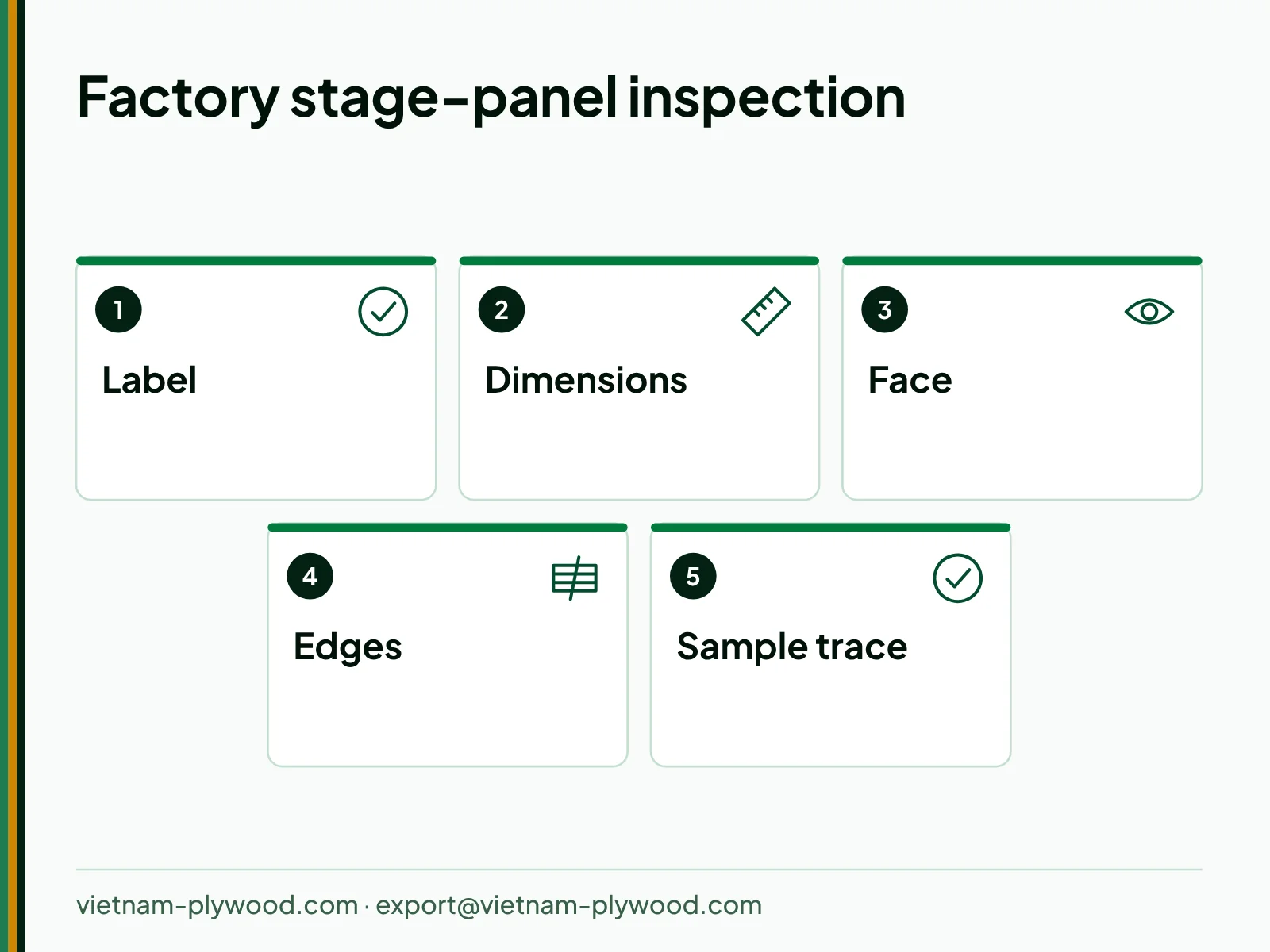
- Match pallet labels and order lines to core, thickness, face and quantity.
- Measure thickness at agreed points and check length and width against the ordered tolerances.
- Examine face pattern continuity, edge sealing, corner damage and visible core gaps.
- Check a sample module’s fit and document any mismatch before loading.
- Record the panel identity used for independent slip testing and keep its report with the order file.
For construction and commercial panels, thickness tolerance is ±0.5 mm; packing grade is ±0.5–1.0 mm. Furniture-line sanded panels use ±0.2 or ±0.3 mm as ordered, and length and width tolerance is ±2 mm. The inspector should apply the tolerance belonging to the purchased line, rather than one generic rule to every pallet.
HCPLY manages on-site quality control, export documentation and loading. Factory-specific certificates such as FSC, CARB P2, ISO 9001 and CE, where relevant to the agreed order, are shown with factory details masked, on request.
How should distributors specify a repeatable deck order?
A repeatable deck order starts with an application drawing, a face decision and an agreed inspection sample. Record the deck’s exposure, finishing process, module size, core, tolerance, fastening layout and slip-test acceptance method. The same description should appear in the purchase order and sample approval.
Our three factories in Phu Tho and Hai Phong make different builds. Each order is produced at the factory matching its specification and shipped directly from it, FOB Hai Phong. HCPLY coordinates specification, production inspection, documents and loading for the export order.
Factory lead time runs 15–45 days from receipt of the 30% deposit; the exact figure depends on order size, line loading and what the contract fixes. The remaining 70% is paid on the scan of the bill of lading, by T/T, or by irrevocable sight L/C. We ship FOB Hai Phong, or CFR (CNF) or CIF to your port. The distributor supply programme helps frame recurring sizes and finishes.
What paperwork and sample request complete the purchase?
The commercial invoice and packing list identify the stage-panel build and quantities in the shipment; the bill of lading records transport. The shipment file also includes a certificate of origin, phytosanitary and fumigation papers, insurance under CIF, and agreed certificate or test documents. EU lots add EUR.1 and the EUTR/EUDR file set. After loading, the draft shipping documents come to you for approval.
Ask for a slip-test report against the actual panel construction if a slip classification forms part of acceptance. Do not substitute an emission document, glue description or generic product leaflet for surface-friction evidence. Keep the approved sample, inspection photos and report identifiers tied to the purchase order.
Send Lucy at export@vietnam-plywood.com the following specification for a stage-deck quotation:
Application: event-hire stage / dance floor / marquee deck; exposure and finish
Line or core: construction acacia/eucalyptus OR furniture styrax/eucalyptus OR commercial acacia
Glue: melamine MR or phenolic WBP, as required
Emission: E0 / E1 / E2 as agreed, separate from glue
Face and grade: 220 g/m² anti-slip film OR specified sanded veneer and grade
Thickness and tolerance: ___ mm; applicable ordered tolerance
Size: ___ × ___ mm; cut-edge treatment and module details
Quantity: ___ sheets / pallets; mixed specifications if required
Destination port: ___; delivery term: FOB Hai Phong / CFR (CNF) / CIF
Slip evidence: agreed test method, actual finished face and acceptance criteria
Request a sample set for the exposed and finished deck options before approving the bulk specification. Samples cost nothing: a first-time buyer pays the courier, and that charge comes off the first confirmed order.