





Industrial plywood from HCPLY can be specified across construction, packing and furniture factory lines, then combined in a mixed container. Choosing the wrong surface or core can cause wasted material, delayed assembly or a rejected load. This buyer guide matches industrial applications to the producing line, shows what inspectors can verify and explains how different builds share a shipment.
What is industrial plywood?
Industrial plywood is a veneer-built panel specified for a working duty: carrying loads, protecting goods, lining transport equipment or forming a durable working surface. It is an application description rather than a single universal grade. At HCPLY, the core, glue, face, thickness and surface treatment are selected against the job and the producing factory’s line.
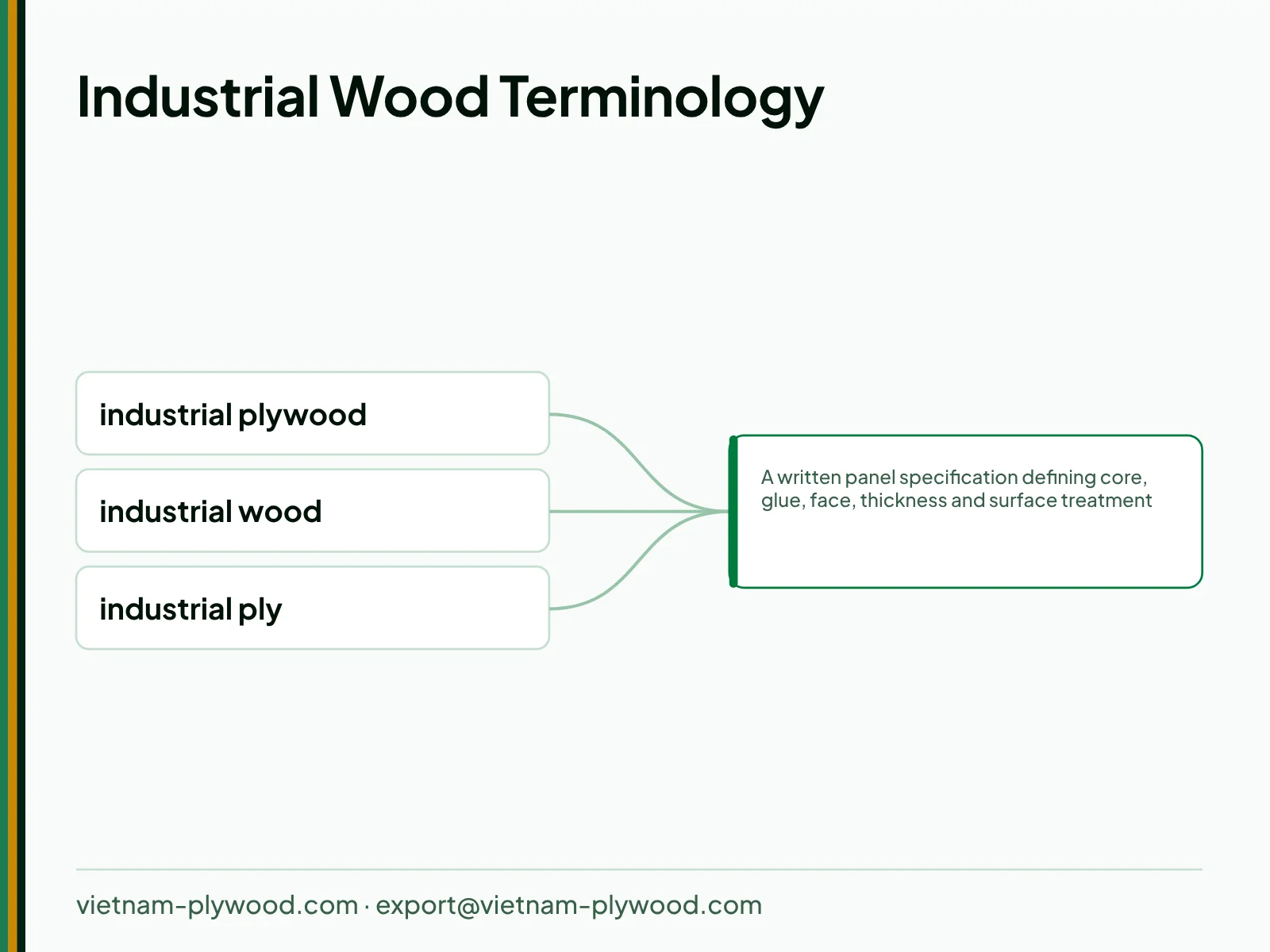
The wider phrase industrial wood includes sawn timber and engineered wood materials. Among industrial wood materials, plywood uses bonded veneer layers; industrial ply is simply a shortened trade description. A buyer should replace either broad label with a written panel specification. The same nominal thickness can represent very different surfaces and core constructions.
For industrial orders, start with contact conditions: abrasion, wet handling, forklift traffic, crate fastening or repeated assembly. Then select a face, core and adhesive. Our Applications articles cover related uses, while this page maps the three available plywood lines to industrial purchasing decisions.
What is industrial plywood used for?
Industrial plywood is used in vehicle and trailer floors, cargo linings, packing crates, drums, cases, work platforms and industrial fixtures. These applications ask different things of the panel. A vehicle floor needs a grip surface and a specified support arrangement; a crate needs workable cutting and fastening characteristics.
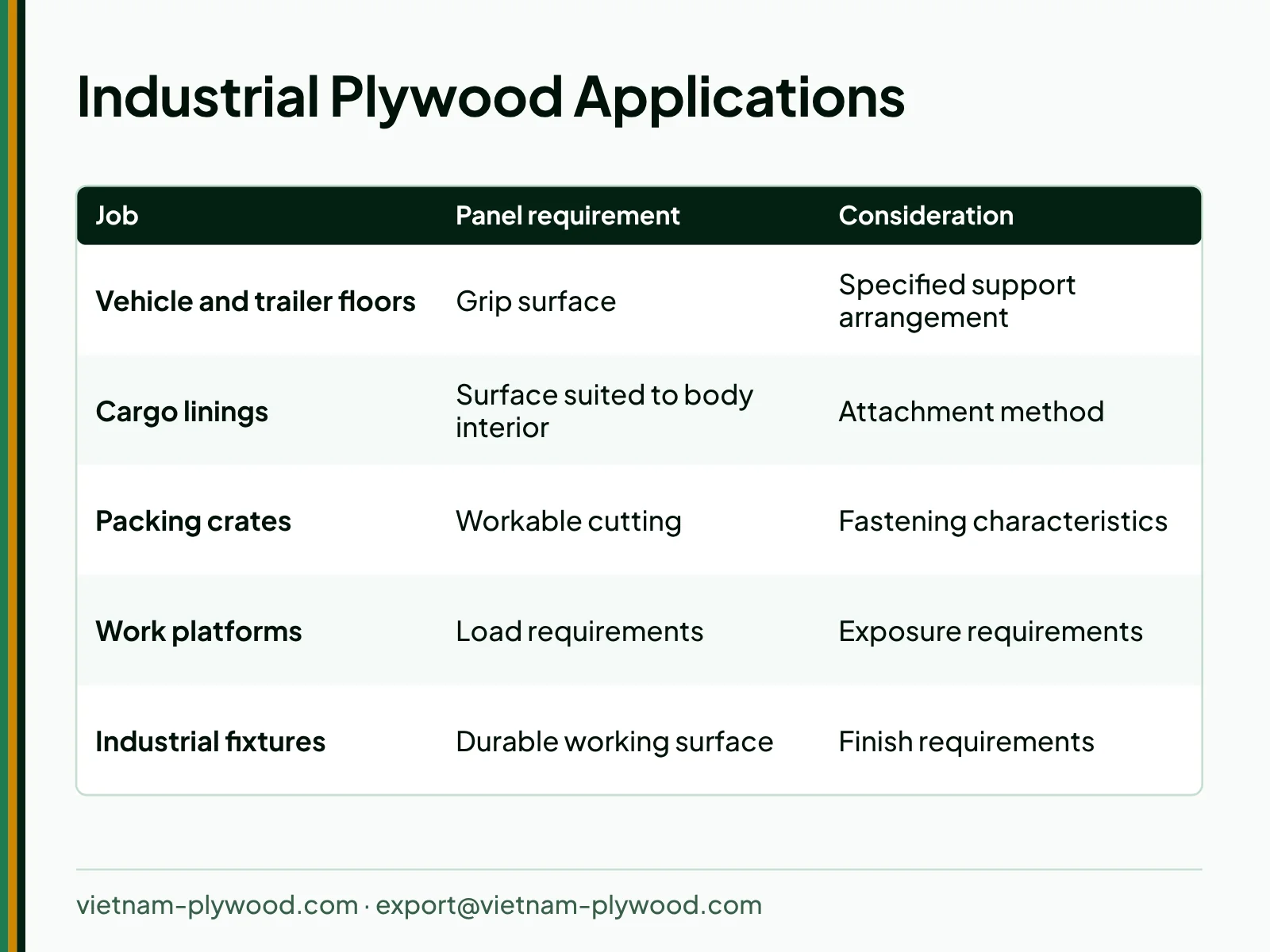
For transport bodies, consider van lining plywood separately from the floor. Linings need a surface that suits the body interior and attachment method. A floor panel instead faces rolling loads, wear and moisture brought in with cargo. For shipping containers, see shipping container flooring; a replacement floor must be evaluated against the container operator’s design and approval requirements.
Other related uses include stage plywood, scaffold boards, coated plywood and outdoor sign plywood. These have distinct load, exposure or finish requirements. Do not transfer a vehicle-floor selection to a scaffold or stage solely because the thickness matches.
Which line builds each industrial panel?
Our construction line presses phenolic or melamine film-faced and anti-slip film panels for vehicle-floor and working-surface applications. Our commercial and packing line builds acacia-core, moisture-resistant (MR) glue panels for crates, cases and drum components. Our furniture line builds sanded, full-stitched styrax- or eucalyptus-core panels where a clean, controlled face matters more than a textured floor surface.
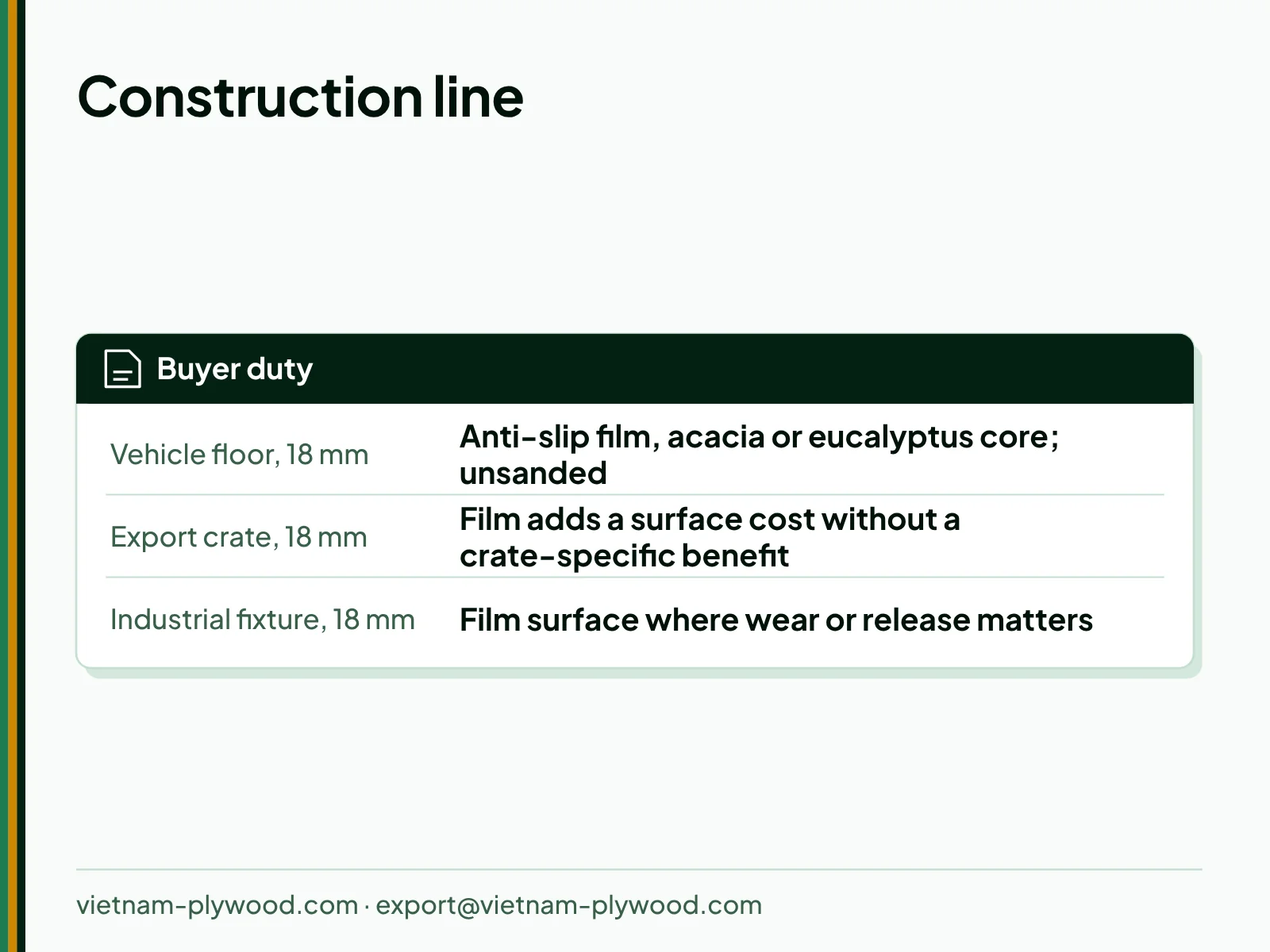
| Buyer duty | Construction line | Commercial and packing line | Furniture line | Selection verdict |
|---|---|---|---|---|
| Vehicle floor, 18 mm | Anti-slip film, acacia or eucalyptus core; unsanded | Raw acacia core, light-sanded or unsanded | Full-stitched, sanded panel | Specify construction anti-slip for grip; engineer the support and load |
| Export crate, 18 mm | Film adds a surface cost without a crate-specific benefit | Acacia core, MR glue, packing tolerance | Sanded face and full-stitched core add finishing cost | Specify commercial and packing for ordinary crate fabrication |
| Industrial fixture, 18 mm | Film surface where wear or release matters | Acacia core for utility fixtures | Full-stitched sanded core for accurately finished fixtures | Choose by surface, fastening and machining needs |
The three lines are not interchangeable grades. In particular, an anti-slip face describes traction texture, not a verified structural rating. For load-bearing fixtures or vehicle floors, the buyer’s engineer must establish spans, fastening and test acceptance criteria. Compare the builds further in plywood grades across factory lines.
Which plywood works for vehicle floors?
For a vehicle floor needing traction, specify anti-slip film-faced plywood from the construction line, with the core and bond selected for the exposure. Film-faced panels use 120 g/m² standard film, 135 g/m² premium film or 220 g/m² anti-slip film. The 220 g/m² figure belongs only to the anti-slip build.
Acacia core has a planning density of 580 kg/m³; eucalyptus core is 650 kg/m³. Higher density changes panel weight and can influence the fastening design, but it does not establish allowable floor loads. Ask for the required face texture, wheel contact conditions, support spacing and acceptance test. An anti-slip panel is not automatically a certified transport floor.
The construction line can use melamine MR glue with a 12-hour boil designation or phenolic weather-and-boil-proof (WBP) glue with a 72-hour boil designation. Those are bond descriptions, not a guarantee of a floor’s service life. Sealing cut edges, protecting joints and designing drainage are separate installation decisions. For a more specific textured-floor selection, see buffalo boards for trailer floors.
Which plywood works for crates, drums and cases?
For crates, drums and cases, start with acacia-core commercial or packing plywood from the commercial and packing line. The line uses MR glue and supplies unsanded or light-sanded surfaces. The relevant checks are cutting yield, fastener positions, core gaps, dimensions and the way the finished package is assembled.
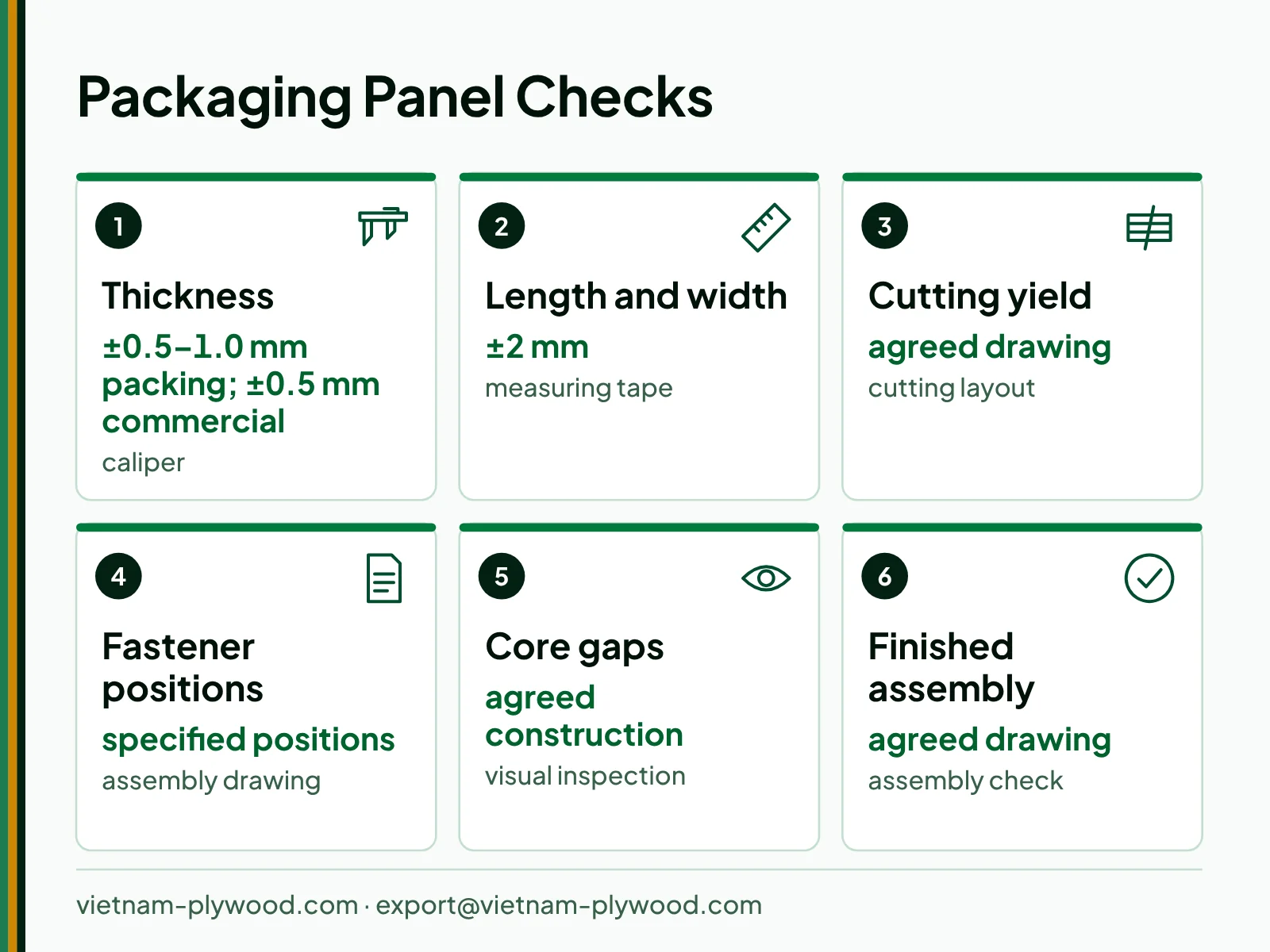
A crate wall that only protects goods does not need the same face as a frequently loaded floor. For drum cheeks and cases, send a drawing with the hole pattern, edge distance, curvature or joint layout. If the assembly carries concentrated loads, the packaging designer must define its strength requirement; a face grade alone does not answer that question.
Packing thickness tolerance is ±0.5–1.0 mm; commercial thickness tolerance is ±0.5 mm. Length and width tolerance is ±2 mm. Those distinctions affect repeatable cut parts and assembled clearances. Available sheet sizes include 1220×2440 and 1250×2500 mm, with custom cutting available.
The International Plant Protection Convention’s ISPM 15 publication (2021) excludes packaging made wholly from processed wood such as plywood. This exemption does not automatically cover an assembled crate with solid-wood blocks or braces. Review the destination’s packaging rules and the solid-wood components separately: Australian government ISPM 15 guidance.
How should core, glue and emission be written?
Write core species, adhesive and emission class as separate fields. Acacia, eucalyptus and styrax cores have planning densities of 580, 650 and 500 kg/m³ respectively. Density follows the core rather than the decorative face name. A bintangor-faced panel can therefore have a different weight from another bintangor-faced build.
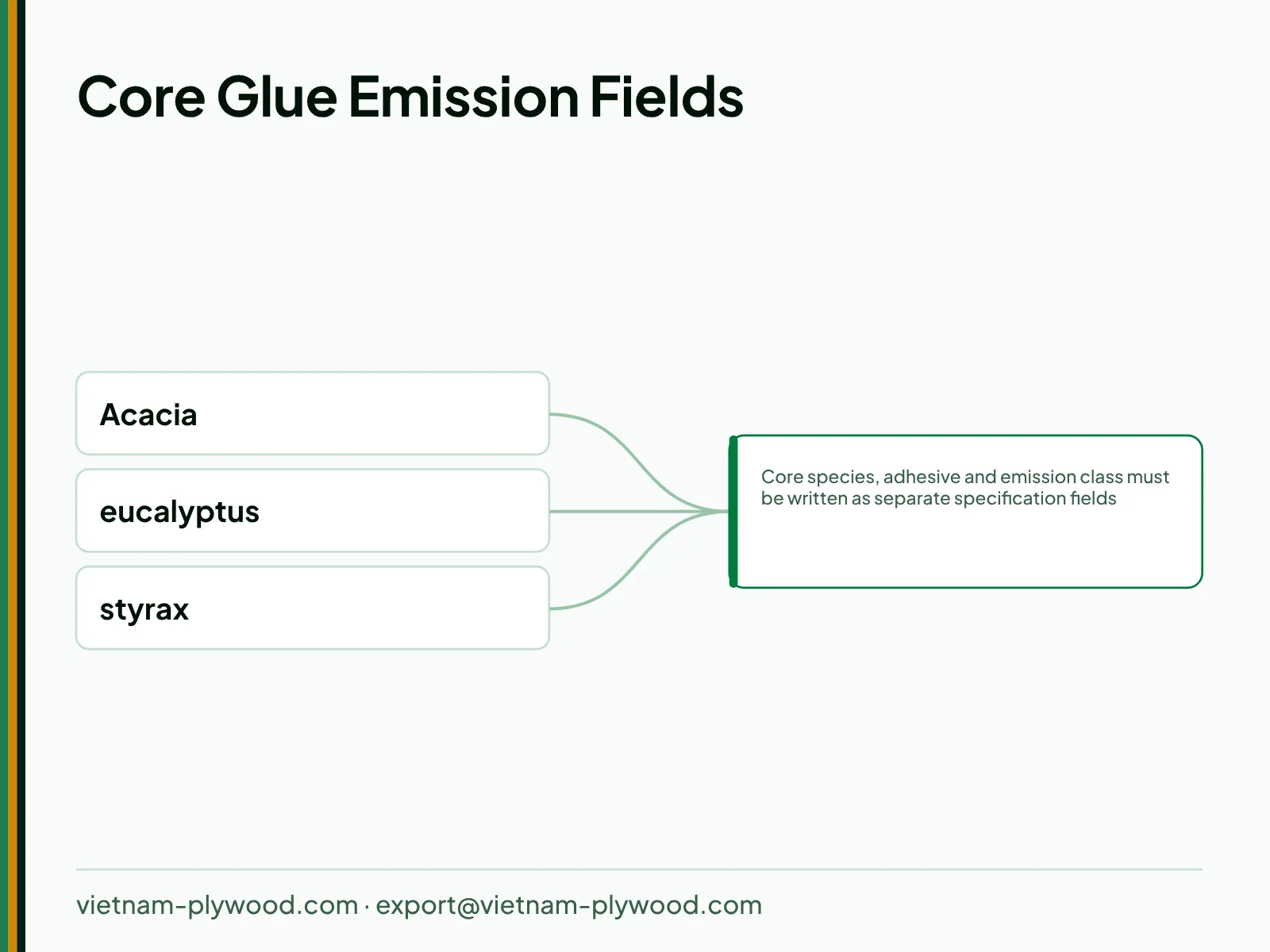
Glue specifies the bond system: melamine MR or phenolic WBP. Emission describes a different attribute, with E0, E1 and E2 as classes. CARB Phase 2 and TSCA Title VI relate to a US emissions limit and third-party certification. Do not write an emission class as though it names an adhesive.
For a commercial crate, MR and the agreed core construction can be written together. For an exposed floor, write the phenolic bond request and the film separately. For a furniture-line fixture, specify full-stitched core, sanded face, E0 or E1 and ordered thickness tolerance of ±0.2 or ±0.3 mm. The right combination follows the intended environment and required evidence.
Can industrial panels from different lines share one container?
Yes. HCPLY accepts a minimum order of one 40HC, with specifications mixed within its 28.5 t payload limit. The mix can include anti-slip flooring panels from the construction line and packing panels from the commercial and packing line. Weight, pallet geometry and the ordered sheet counts control the allocation.
For a concrete reference, 18 mm, 1220×2440 mm acacia panels weigh 31.08 kg per sheet. At 55 sheets per pallet and 16 pallets, the full acacia reference load is 880 sheets, 47.15 m³ and 27.35 t. The same thickness and size in eucalyptus weighs 34.83 kg per sheet; 53 sheets per pallet and 15 pallets make 795 sheets, 42.60 m³ and 27.69 t. Film weight is excluded from these core-based figures.
For a mixed order, list the acacia packing pallets and eucalyptus flooring pallets separately. Send the proposed pallet counts, stack heights and packing tare for a loading check against the 28.5 t payload limit. Film, pallets and packing materials must be included in the final loading plan.
For other thicknesses or mixed cuts, request a pallet-by-pallet loading plan that includes packaging weight. Use the mixed-container order guide for coordination and the container packing reference for complete single-build quantities.
What can an inspector check at the producing factory?
An inspector can compare the written specification with physical panels, labels and loading records at the producing factory. Buyers visit the factory office and inspect goods where the order is made. The most useful inspection is tied to the failure mode of the application.
- Identify the order line and separate the anti-slip floor build from the crate or case build.
- Measure panel thickness and dimensions against the agreed tolerances, sampling across the stack.
- Inspect faces, cut edges, core construction and visible gaps; record which stack each sample represents.
- Check the specified film type and surface texture on floor panels, then inspect edge sealing requirements.
- Compare pallet counts, bundle marks and loading photographs with the packing list before dispatch.
For an industrial fixture, include machining and screw-position checks against the customer’s drawing. For a floor, record the film build and any agreed laboratory evidence. Neither a visual inspection nor a nominal thickness replaces an engineering load assessment. HCPLY manages specification, on-site quality control, documents and loading.
Which export documents cover the mixed order?
The packing list identifies quantities and packages for the different industrial builds. The commercial invoice records the invoiced goods; the bill of lading (B/L) records carriage. A certificate of origin, phytosanitary and fumigation papers, and order-specific test or emission documents are handled with the shipment as applicable.
For European Union lots, the document set includes EUR.1 where applicable and the EUTR/EUDR file set. Under CIF, insurance documents are included. After loading, the draft shipping documents come to you for approval. Certificate documents belong to the member factories and can be shown with factory details masked, on request; the same applies to relevant FSC, CARB P2, ISO 9001 and CE evidence.
The shipment terms are FOB Hai Phong, CFR (CNF) or CIF. Factory lead time runs 15–45 days from receipt of the 30% deposit; the exact figure depends on order size, line loading and what the contract fixes. The remaining 70% is paid on the scan of the bill of lading, by T/T, or by irrevocable sight L/C. Match every required document to the ordered build and destination before approving the specification.
What changes industrial plywood cost?
Core construction, face treatment, adhesive and finishing drive industrial plywood cost. Full-stitched cores require more preparation than stitched outer layers with edge-trimmed inner veneers, followed by finger-jointed and loose-laid constructions. A sanded furniture-line fixture panel therefore has different cost drivers from an unsanded packing panel.
For flooring, anti-slip film adds a distinct surface requirement compared with raw packing plywood. Phenolic bonding and the requested inspection or test evidence can also change the quotation. A larger cut-loss allowance or a tighter tolerance affects the usable yield. Send the same dimensions and quantity when comparing two proposed builds, or the quotations will not describe equivalent goods.
The commercial plywood indicative starting price is from US$250/m³ FOB Hai Phong (October 2026). The furniture plywood indicative starting price is from US$350/m³ FOB Hai Phong (October 2026). No fixed price is given here for anti-slip flooring, film-faced panels or particular crate constructions; request a quotation against the written specification.
What should a buyer settle before ordering?
Settle the duty, the acceptance criteria and the shipment mix before issuing a purchase order. A phrase such as industrial plywood alone cannot identify a workable panel. The application drawing and the producing line should agree with the packing list and the intended use.
For vehicle flooring, record concentrated loads, support geometry, grip requirements, moisture exposure and who approves the design. For crates, record the contents, lifting points, fastener plan and whether any solid-wood components trigger separate packaging rules. For fixtures, record hole patterns, tolerances and the intended surface finish.
Our three factories are in Phu Tho and Hai Phong: a furniture line, a commercial and packing line, and a construction line. Each order is made at the factory suited to its specification and shipped directly from it. Furniture and commercial plywood capacity is up to 100 containers a month; construction plywood capacity is up to 140. For technical follow-up, contact Lucy at export@vietnam-plywood.com.
What specification should you send for a sample set?
Send one written specification for each industrial use and identify which quantities belong together. For a floor, include the texture, support and edge requirements; for packing, attach the cut-part drawing and fastening layout. State the destination port so the shipping papers and packing requirements can be reviewed together.
The example below is a request template rather than an approved performance specification. Replace its placeholders with the values accepted by your engineering or packaging team.
Application: vehicle floor / crate / drum / case / industrial fixture
Line or core: construction anti-slip / commercial acacia / furniture styrax or eucalyptus
Glue: melamine MR / phenolic WBP
Emission: E0 / E1 / E2 / required US evidence
Face and grade: anti-slip film 220 g/m² / raw matt / named veneer and grade
Thickness and tolerance: ___ mm; ___ mm
Size: ___ × ___ mm
Quantity: ___ sheets by build; mixed 40HC allocation
Destination port: ___
Ask Lucy for a sample set at contact before finalizing the industrial build.