






How much can a plywood supplier for construction projects deliver?
HCPLY is a plywood supplier for construction projects with a construction line of up to 140 containers a month. A project can plan successive film-faced plywood shipments against its pour programme, with each lot inspected at the producing factory before loading. Agree the project shipment sequence against its pour programme and written specifications.
Our construction line presses film-faced plywood for concrete shuttering and formwork yards. Contractors, formwork rental companies and importers can order directly from the factory, starting with one 40-foot high-cube (40HC) container. A construction plywood bulk order can combine specifications within the container’s payload limit. For the available film, cores and dimensions, see construction plywood.
Start a supply discussion with the number of pours, planned formwork turnover, destination port and quantity required at each milestone. The production sequence should follow the site schedule, while shipment and transit dates are calculated backward from each required arrival.
HCPLY has three member factories in Phu Tho and Hai Phong. Each order is produced at the factory fitted to its specification, with export work managed from specification through on-site quality control, documents and loading. Buyers can visit the factory office and inspect goods at the producing factory.
How are deliveries phased to the pour programme?
Phased deliveries begin with the site’s required arrival dates, then work backward through ocean transit, loading and production. The buyer supplies a pour sequence and a release schedule showing which panel build is needed at each stage. We translate that into factory production lots and a shipment plan agreed with the buyer.
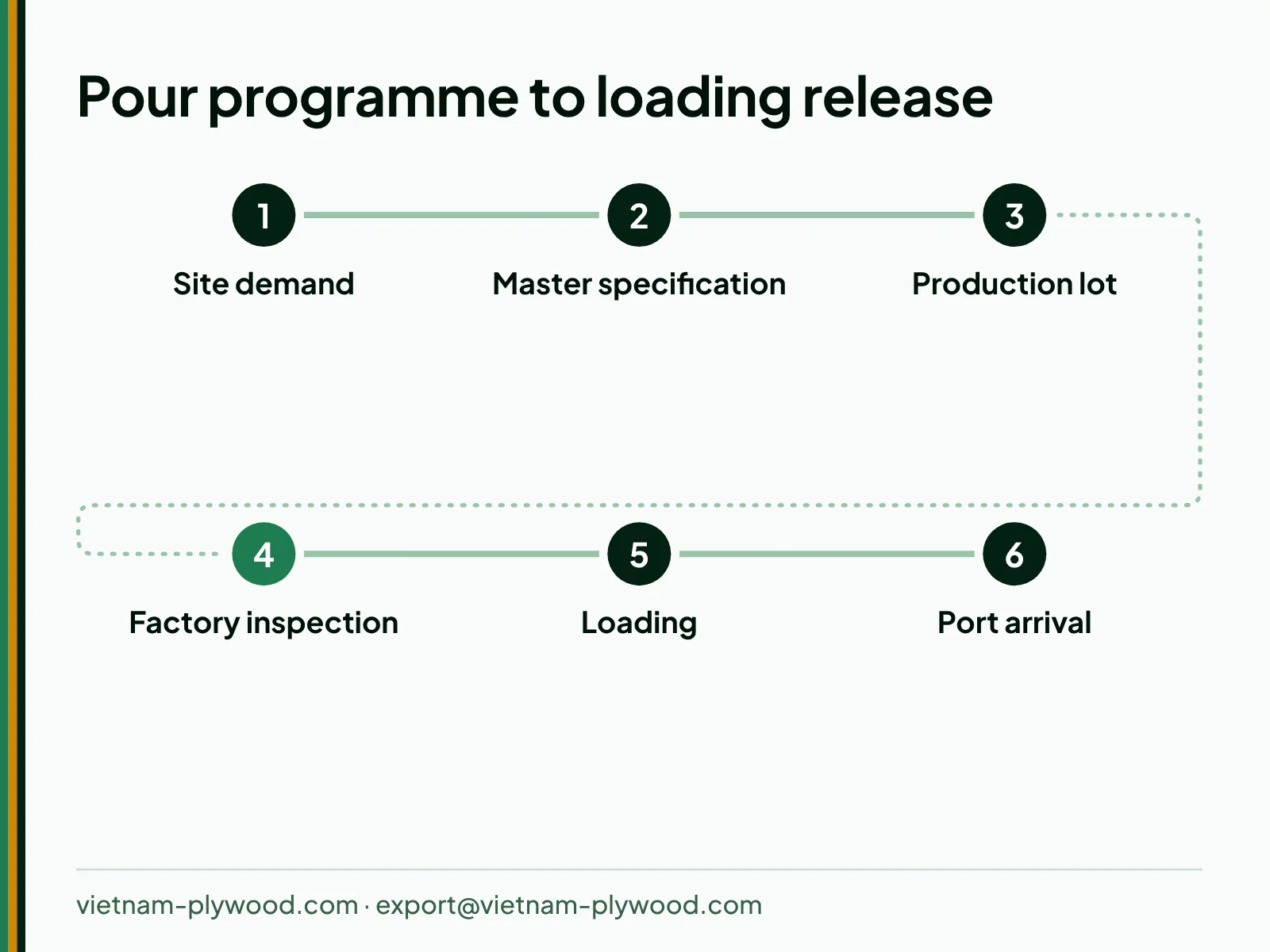
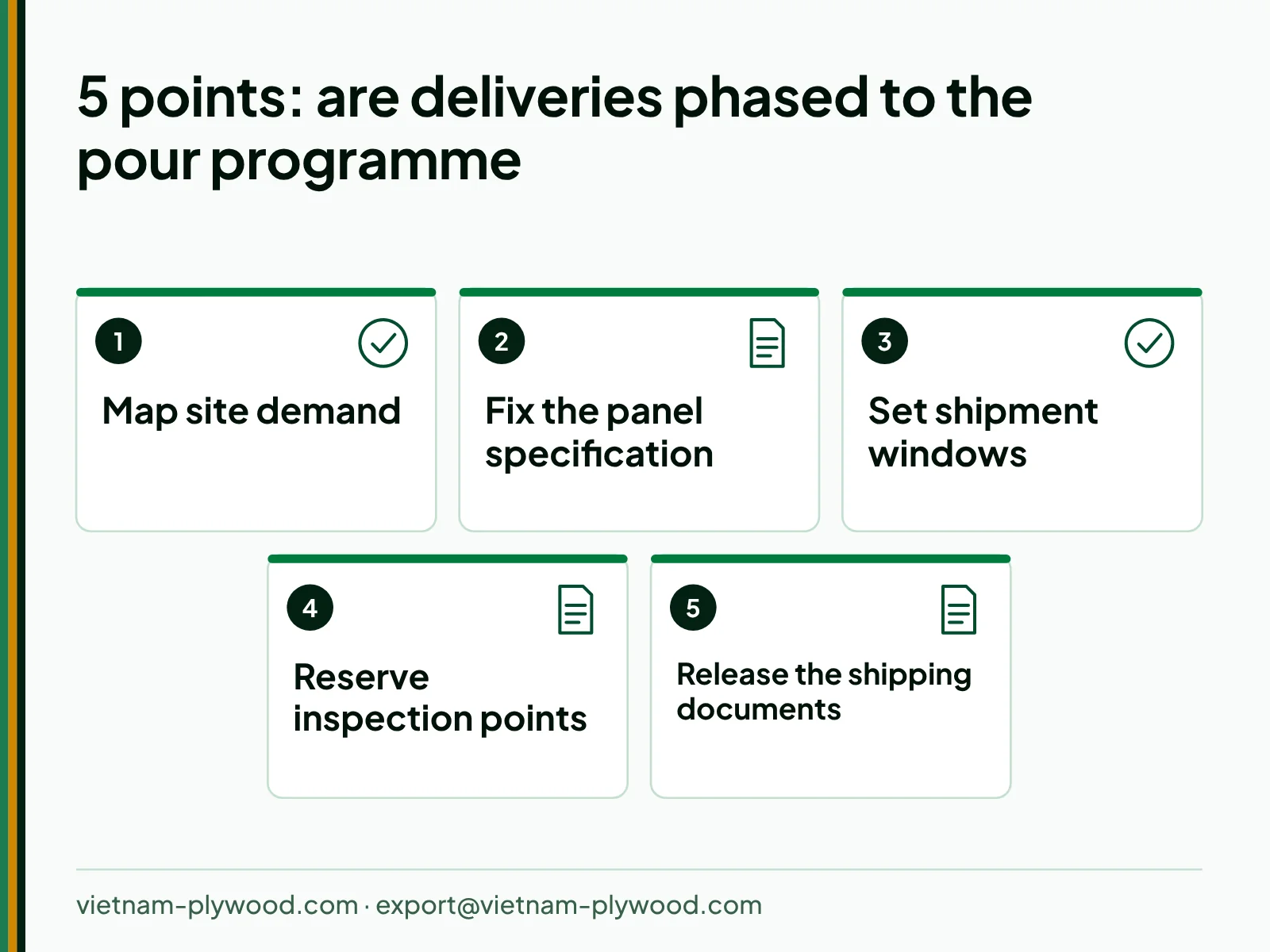
- Map site demand. List each pour zone, planned concrete placement date, panel dimensions and expected formwork turnover. Distinguish replacement sheets from first-installation stock.
- Fix the panel specification. Record core, glue, film, thickness, size and tolerances before scheduling lots. A changed film or glue selection creates a different build.
- Set shipment windows. Work backward from the required port arrival and allow for carrier routing, clearance and inland delivery arranged by the buyer.
- Reserve inspection points. Arrange buyer or third-party inspection at the producing factory before each loading, against the agreed lot specification.
- Release the shipping documents. After loading, draft documents go to the buyer for approval. Match packing-list quantities to the lot release.
Production takes 15–45 days from the 30% deposit, set by order size, line loading and the contract. Sea transit from Hai Phong depends on carrier and route: the Middle East takes 15–25 days, the Mediterranean 25–35 days, and Northern Europe 30–40 days. These are voyage ranges, so a site planner must separately allow for inland transport and clearance.
Do not equate the date of a concrete pour with a vessel departure date. The practical scheduling document is a lot-by-lot matrix: panel specification, required port arrival, quantity, target loading and inspection release. A change to the pour programme should update that matrix before another lot is pressed. For wider recurring purchasing, see plywood supply programmes for distributors.
How is one specification held across phased lots?
One written master specification governs each production lot, and inspection compares the actual panels with that same agreed build. The buyer should approve a reference sample and specify acceptance checks before the first loading. Every later lot is then compared with the agreed core, bonding, film and dimensional requirements.
For a typical film-faced specification, select acacia or eucalyptus core, phenolic or melamine glue, a smooth film or anti-slip surface, and the required dimensions. Our construction line uses unsanded cores beneath the film. Standard film is 120 g/m², premium film is 135 g/m², and anti-slip film is 220 g/m². The film weight belongs in the purchase specification rather than being inferred from its colour.
The common thickness range is 3–40 mm, with 12, 15, 18 and 21 mm among the listed thicknesses. Film-faced thickness tolerance is ±0.5 mm, while length and width tolerance is ±2 mm. Common sheet sizes include 1220 × 2440 mm and 1250 × 2500 mm; custom cutting is available. An 18 mm sheet uses 11–13 plies according to veneer thickness.
Glue and formaldehyde-emission class are separate entries. Melamine glue is MR, with a 12-hour boil designation; phenolic glue is WBP (weather and boil proof), with a 72-hour boil designation. E0, E1 and E2 are emission classes. If an importer requests a specific report or emission certificate, the agreed build and the document must correspond.
Core assembly also belongs in the specification. Full stitched construction sits above stitched outer layers with edge-trimmed inner layers, then finger-jointed, then loose-laid construction in descending order of core assembly quality. A reference photograph of a cut edge and a retained sample help inspectors compare successive lots. The buyer should agree what constitutes an unacceptable veneer gap or film defect using the agreed inspection acceptance criteria.
Where and when is each lot inspected?
Each lot can be inspected at the producing factory before loading, with the buyer or appointed inspector witnessing the agreed checks. The factory office is the visit point; the actual goods inspection takes place where the panels are made. Inspection before stuffing is the useful decision point because any rejected pallet can be separated before export loading.
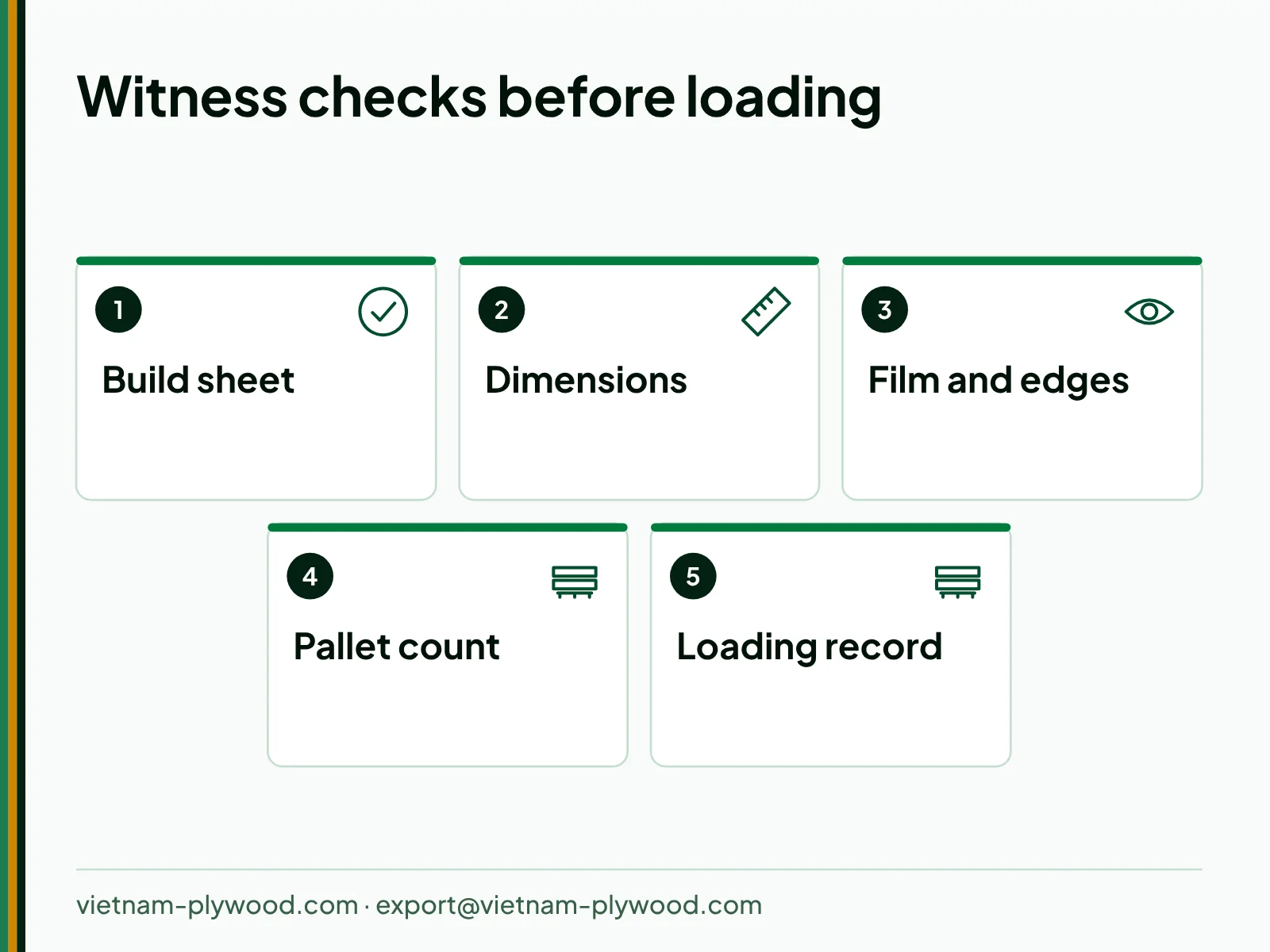
A practical inspection walk begins with the lot identification and the approved build sheet. Inspectors can select sheets from different pallets, measure thickness and length/width, examine film continuity and edges, and compare visible core construction at sample cut edges. They can check pallet counts and shipping marks against the packing plan, then witness loading and record the container identification.
For film-faced plywood project supply, the inspector should record the actual measurement, location on the panel, agreed tolerance and disposition of each nonconformity. A photograph without a measurement cannot settle a thickness dispute. Likewise, a surface photograph cannot establish bonding performance: where a performance requirement is contractual, use the test report for the agreed build.
HCPLY handles on-site QC and export loading. The commercial invoice, packing list and bill of lading (B/L) form the shipment quantity trail. The packing list is the document that connects the inspected pallet quantities with the exported lot; the B/L records carriage after loading. Draft shipping documents are sent for buyer approval after loading.
The United States Occupational Safety and Health Administration (OSHA), under its regulation at 29 CFR 1926.703, requires formwork to support anticipated vertical and lateral loads. Factory panel inspection supports purchasing control; the contractor’s formwork design and site inspection still address the complete installed system. This distinction matters especially when a plywood sheet is used as part of a load-bearing assembly.
Which line makes the required construction panel?
Our construction line presses smooth and anti-slip film-faced panels; the other lines produce different panel builds for other project needs. The same nominal 18 mm thickness does not identify the same product across our three factories. Face, core, adhesive and finish determine the correct producing line.
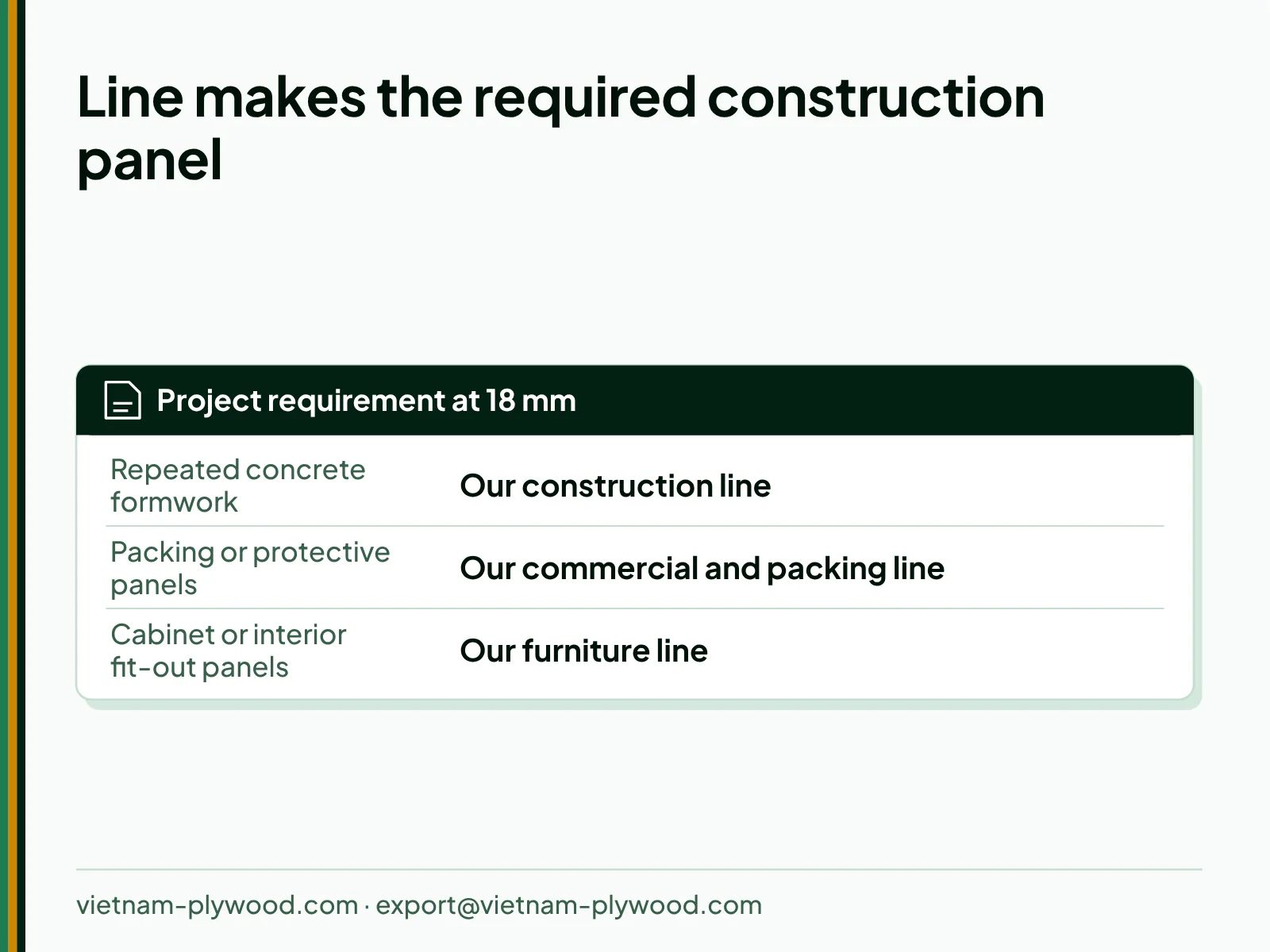
| Project requirement at 18 mm | Producing line | Core and face | Finish and tolerance | Appropriate use |
|---|---|---|---|---|
| Repeated concrete formwork | Our construction line | Acacia or eucalyptus; 120 or 135 g/m² film | Unsanded core; ±0.5 mm | Formwork panels |
| Packing or protective panels | Our commercial and packing line | Acacia; raw matt face | Unsanded or light-sanded; packing ±0.5–1.0 mm | Packaging and temporary protection |
| Cabinet or interior fit-out panels | Our furniture line | Styrax or eucalyptus; selected veneer face | Full stitched, sanded; ±0.2 or ±0.3 mm as ordered | Furniture and cabinetry |
Our furniture line can use bintangor, okoume, engineered veneer and other listed veneer faces according to the order. Our commercial and packing line uses MR glue with acacia core. The construction line offers phenolic or melamine film with acacia or eucalyptus core. For related applications, see plywood in construction uses and one supplier for several plywood types.
A textured anti-slip face is a different application from smooth concrete-contact film. Specify anti-slip for a surface requiring traction and have the project designer assess its intended use. We do not manufacture medium-density fibreboard (MDF), oriented strand board (OSB), chipboard, blockboard, bamboo board, medium-density overlay (MDO), high-density overlay (HDO), three-ply spruce panels or birch-core plywood. If the design calls for a structural grade, request the test report the buyer accepts for the proposed build; do not substitute a product name for evidence.
Can anti-slip, packing and furniture panels share a shipment?
Yes. Film-faced, anti-slip, packing and furniture specifications can be mixed in a 40HC container within its 28.5-tonne payload limit. Different products are produced on their matching lines and the mixed loading plan must account for the weight of each pallet. The quantity on the purchase schedule should therefore be expressed in both sheets and tonnes.
For 18 mm sheets measuring 1220 × 2440 mm, the reference sheet weights are 31.08 kg for acacia, 34.83 kg for eucalyptus and 26.79 kg for styrax. A full single-core reference load is 880 acacia sheets at 27.35 t, 795 eucalyptus sheets at 27.69 t, or 990 styrax sheets at 26.52 t. Film weight is excluded from those reference figures.
For mixed specifications, request a factory loading plan showing each build’s sheet count, pallet count and gross weight. Check film, pallets, packing and stowage against the container payload limit before approving the load.
For precise pallet counts and other thicknesses, use the container loading reference. The purchase order should separate the construction and other line items, with pallet marks that identify which lot is intended for the formwork yard, packing operation or fit-out contractor. Mixing builds is useful only when the receiving team can sort them without confusion.
Which film, glue and core should the formwork yard specify?
Choose the film and bonding system against the planned pour conditions, handling method and reuse target. A 120 g/m² smooth film is the standard option, 135 g/m² is the premium option, and 220 g/m² is the anti-slip surface. The textured panel should be listed separately from the smooth concrete-contact panel.
With proper handling, a release agent on every pour and sealed edges (cut edges included), melamine-glue film-faced plywood yields about 12–15 pours, while phenolic-glue film-faced plywood yields up to about 25 pours. Those conditions belong in the yard’s handling procedure. Edge damage during stripping or cutting changes the service life of a sheet regardless of the film specified.
Acacia core has a reference density of 580 kg/m³; eucalyptus is 650 kg/m³. At the same size and thickness, eucalyptus is heavier. A yard choosing between them should compare the agreed panel construction, handling weight and applicable test report, rather than treating density as a complete structural rating.
For exterior exposure, review exterior plywood selection. For a design that distinguishes structural and non-structural uses, read structural versus non-structural plywood. Film-faced plywood must be selected within the engineer’s formwork system requirements; a face film or WBP glue designation alone does not specify allowable loads.
How should contractors place a factory bulk order?
Contractors and formwork rental companies can place a factory bulk order by sending the complete panel specification and phased quantity schedule. The minimum order is one 40HC, and specifications can be mixed within the payload limit. The producing factory is selected by the product build; export handling remains coordinated through HCPLY.
The order should identify the site programme, the importer of record, destination port and the agreed inspection method. A construction plywood bulk order should also state whether each release needs smooth film, anti-slip film or both. Specify the core and film weight on each line rather than using an informal term such as heavy-duty board.
We ship FOB Hai Phong, or CFR (CNF) or CIF to your port. The remaining 70% is paid on the scan of the bill of lading, by T/T, or by irrevocable sight L/C. Samples cost nothing: a first-time buyer pays the courier, and that charge comes off the first confirmed order. The sample should carry the same build description as the intended shipment.
Buyers can discuss an inspection appointment at the producing factory before the first loading and repeat the agreed procedure for later lots.
What export paperwork follows each lot?
Each shipment carries the commercial invoice, packing list, B/L, certificate of origin and applicable phytosanitary and fumigation papers. Insurance is included under CIF. The order’s agreed certificate documents, emission certificate or test reports accompany the relevant build, with an EUTR/EUDR file set for European Union lots and EUR.1 for EU lots.
Factory certificates such as FSC, CARB P2, ISO 9001 and CE, together with EUDR/EUTR documents, are shown with factory details masked, on request. These documents belong to the member factories. An FSC claim, where agreed, is carried on sales documents. Match each document to the actual producing factory and ordered product rather than attaching unrelated paperwork.
For phased shipments, the packing list should make the lot identity and quantity legible to the importer and receiving yard. Record the film weight, thickness and core on the order specification, then match the pallet markings during inspection. When a lot is split, the buyer should reconcile the loaded quantities with the approved release schedule.
Review draft documents after loading against the approved specification and release schedule.
What determines the quotation for phased supply?
A film-faced quotation is built from the written specification, quantity and delivery arrangement. The largest build choices to compare are core construction, glue system and film selection; size, thickness, custom cutting and mixed-load packing also affect the quotation. Request a film-faced quotation against the selected build and delivery term.
A fuller stitched core costs more than a loose-laid core because of veneer selection and assembly work. A phenolic-glue build costs more than a comparable melamine-glue build because the bonding system differs. Premium film and anti-slip film add face-material requirements beyond the standard smooth film; custom cutting adds handling and yield considerations. Ask for separate quotations when comparing these options so the specification remains visible.
For a phased programme, price comparisons should use the same destination term, lot schedule and inspection scope. Ask the quotation to show the selected build and the shipping term beside each lot, and compare the total planned supply on that basis.
The agreed production window and the buyer’s arrival dates belong in the commercial discussion. An accurate offer needs the port, required quantities and the complete panel build, not simply a requested sheet price.
What should the receiving yard check after delivery?
The receiving yard should compare the pallet marks and quantities with the packing list, then check visible condition before allocating panels to the pour zones. Record transit damage separately from factory specification findings. Keep the agreed reference sample available for comparison when a later shipment arrives.
Inspect film scuffs, edge impacts, moisture exposure and the integrity of the wrapping. Separate any damaged pallet for review before its panels enter the formwork rotation. When cutting sheets on site, seal the new edges and use a release agent on every pour under the stated reuse conditions.
Formwork system safety is a site responsibility. OSHA’s regulation also requires shoring equipment to be inspected before erection and erected shoring to be inspected around concrete placement. That site check is distinct from the factory’s pre-loading panel inspection. The formwork designer determines what evidence and allowable loads the assembly requires.
Use the yard records to revise the next purchase schedule.
What specification should you send for a sample set?
Send one complete build sheet for each required panel type, with the phased quantities and destination port attached. The first sample should represent the film, core, glue and thickness that will be inspected in production. A separate anti-slip or packing sample is useful when those products are part of the same project.
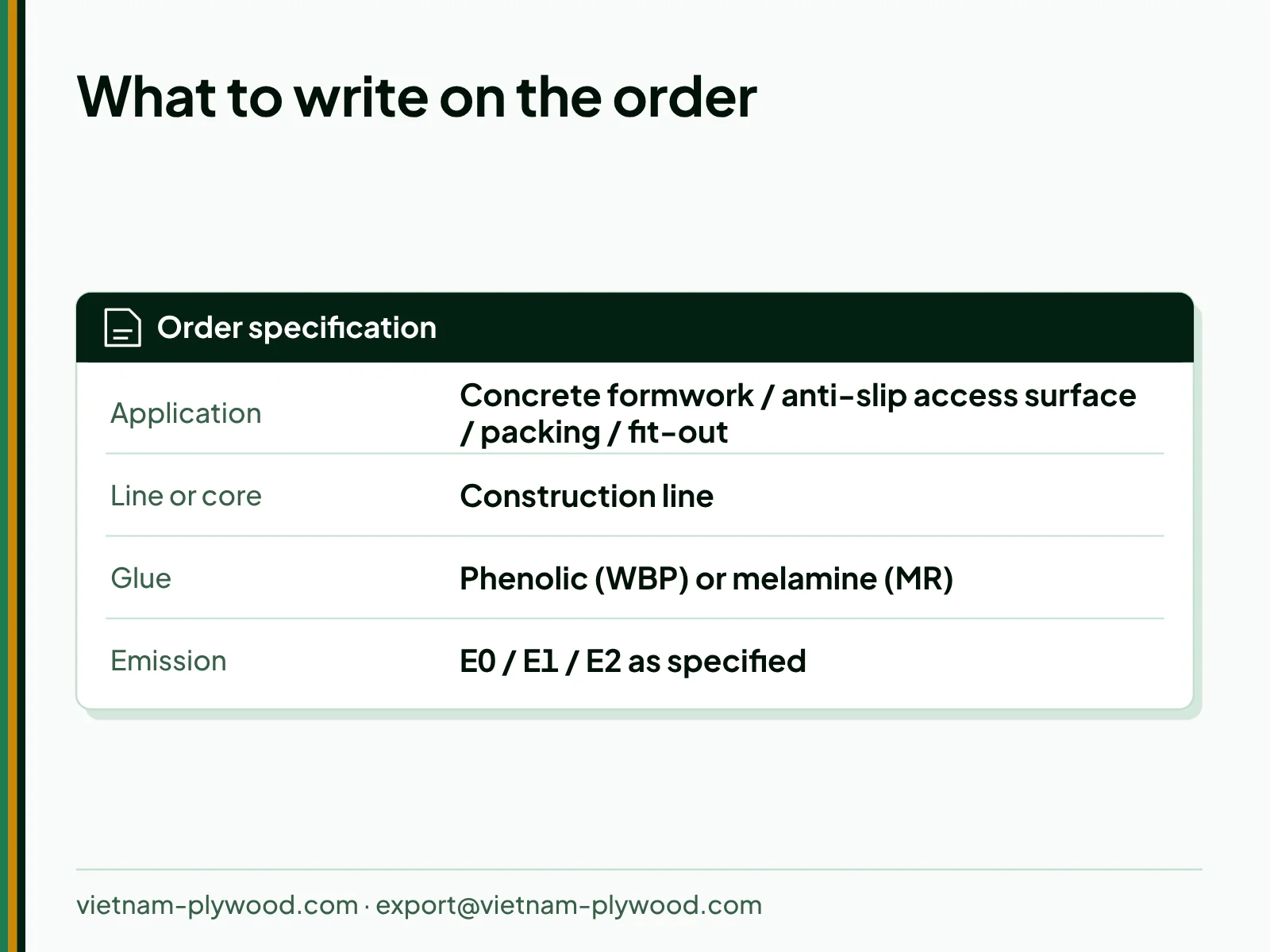
Application: concrete formwork / anti-slip access surface / packing / fit-out
Line or core: construction line; acacia or eucalyptus core
Glue: phenolic (WBP) or melamine (MR)
Emission: E0 / E1 / E2 as specified
Face and grade: smooth film 120 or 135 g/m²; anti-slip film 220 g/m²
Thickness and tolerance: 18 mm; ±0.5 mm for film-faced
Size: 1220 × 2440 mm; length and width ±2 mm
Quantity: sheets per phased release; one 40HC minimum
Destination port: [port and country]
Ask Lucy at export@vietnam-plywood.com for a sample set against this specification, or use the construction project contact form.