





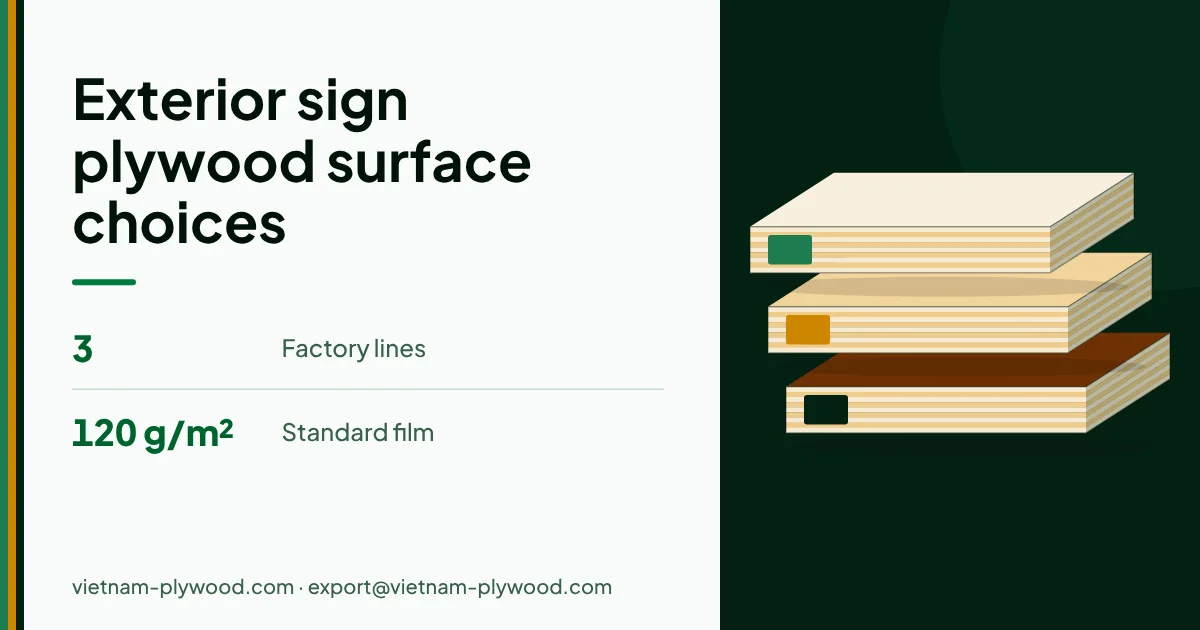
What is the best plywood for outdoor signs?
The best plywood for outdoor signs combines an exterior phenolic glue bond, a face suited to the intended graphics, and a complete edge-sealing and finishing system. For painted lettering, start with sanded poplar or okoume veneer; for selected applied graphics, test a film-faced panel. HCPLY can discuss both builds against a written sign specification.
Choosing the wrong face or glue can mean failed paint adhesion, swollen edges and replacement work after installation. Exterior exposure involves more than a rain-resistant front surface: water reaches fastener holes, cut-outs, back faces and mounting points. A sign maker should specify the complete panel and finish rather than buy on a generic exterior label.
The wider industrial plywood applications range includes different surfaces for different fabrication routes. For a conventional painted sign, a smooth wood face is the practical first sample; for a film-compatible graphic, a construction film surface merits a separate adhesion trial.
Which glue should plywood for exterior signs have?
For prolonged exterior wetting, specify phenolic weather and boil proof (WBP) glue rather than relying on a face coating alone. Our phenolic bond specification uses a 72-hour boil test designation; melamine moisture-resistant (MR) glue is described by a 12-hour boil designation. Those are factory build descriptors, not a forecast of outdoor sign life.
The surface and the bond have different jobs. The face receives the paint or graphic, while the glue holds the veneers together during moisture cycling. Water can still enter exposed wood through edges and penetrations, even when the glue bond resists wetting. A well-bonded panel with poorly protected edges can develop visible damage around its perimeter.
Keep the emission requirement separate from the adhesive selection. E0, E1 and E2 are emission classes; they do not tell a sign maker whether the glue is phenolic or melamine. A buyer specifying both should place them on separate order lines. For the wider product distinction, see exterior plywood supply.
Which plywood faces give a smooth sign surface?
Sanded poplar and okoume veneer faces give sign makers a wood surface to prime and paint after checking face quality. Our furniture line works with sanded, full-stitched styrax or eucalyptus cores and A/B face grades. Common face veneer thickness is 0.2–0.4 mm, so aggressive sanding can cut through the decorative layer.
A/B face grade and sanding tolerance should be agreed alongside the intended finish. For a sign carrying close-spaced lettering, inspect patches, grain movement and visible joints under the actual primer. Prepare sample blanks using the same finishing method planned for production.
Face species does not determine core density. Styrax core is 500 kg/m³ and eucalyptus core is 650 kg/m³ in our planning figures; the face name remains poplar or okoume when those veneers are used. The lighter core can matter for suspended displays, while support design still controls the safe installation. Ask for cut samples so the maker can inspect the internal veneer layup.
How do the three factory builds compare for signs?
The furniture build is the first candidate for painted sign faces; the construction build is a separate option for tested graphic films. Our commercial and packing line serves rougher utility uses and is less suited to fine painted lettering. The comparison below holds the intended sign application constant while changing the factory build.
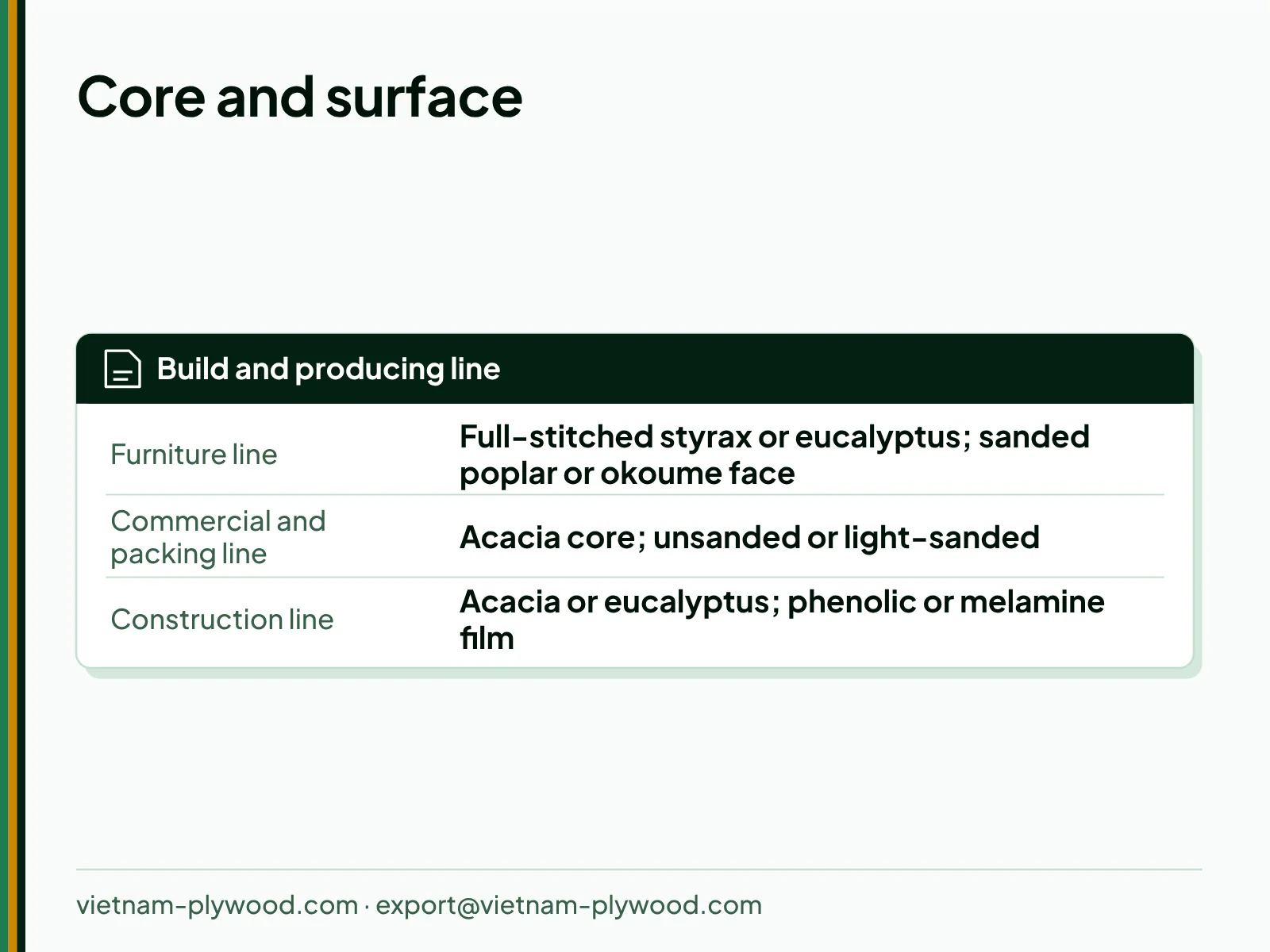
| Build and producing line | Core and surface | Glue and finish starting point | Verdict by sign use |
|---|---|---|---|
| Furniture line | Full-stitched styrax or eucalyptus; sanded poplar or okoume face | Specify phenolic exterior bond for this sign order; primer and paint trial | Preferred sample for painted lettering and fine graphics |
| Commercial and packing line | Acacia core; unsanded or light-sanded | MR glue; additional surface preparation | Better suited to temporary protected utility boards than exposed painted signs |
| Construction line | Acacia or eucalyptus; phenolic or melamine film | Film surface; check graphic adhesion and edge finish | Candidate for applied graphics after a compatibility trial |
The construction line also produces anti-slip film for flooring uses, which is a poor surface choice for small lettering. The plastic-coated plywood options discussion separates film and other surface systems. For signs, specify the exact film and graphic method instead of treating every smooth sheet as interchangeable.
Can film-faced plywood be used for outdoor signs?
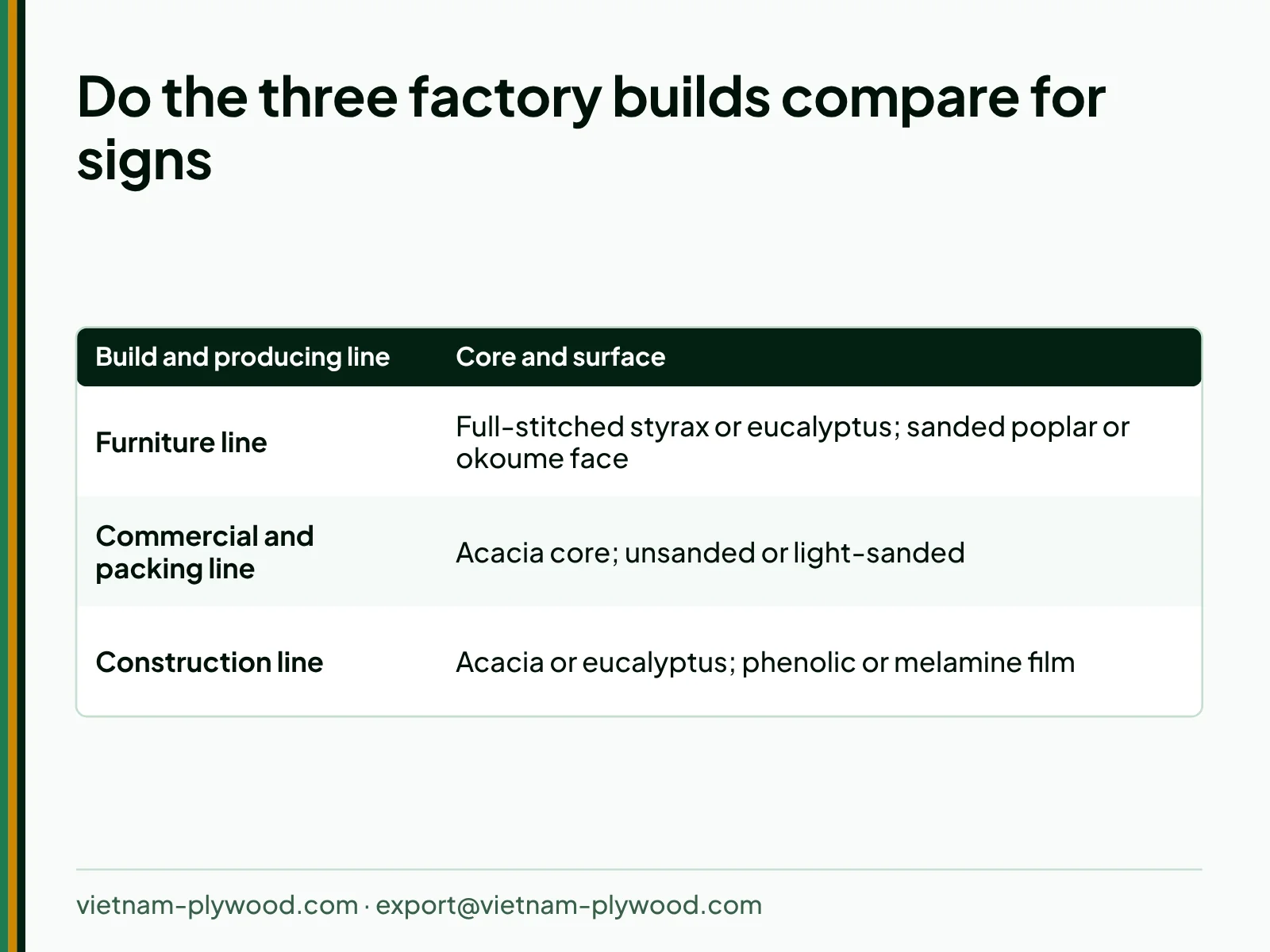
Film-faced plywood can serve as an outdoor sign substrate when the chosen graphic system adheres to its film and all machined edges receive protection. Our construction line presses phenolic or melamine film over acacia or eucalyptus cores. Standard film weight is 120 g/m², premium film is 135 g/m², and 220 g/m² is reserved for anti-slip film.
The film surface was developed for concrete formwork, so paint behavior cannot be inferred from its appearance. A slick face can resist the very primer or adhesive a sign shop intends to use. Run a test using the actual ink, primer, vinyl adhesive or printed graphic, including a weather-exposure evaluation selected by the buyer.
Seal edges after routing and drilling, then inspect them after assembly. A construction panel’s formwork reuse figure is unrelated to how long a sign remains readable outdoors.
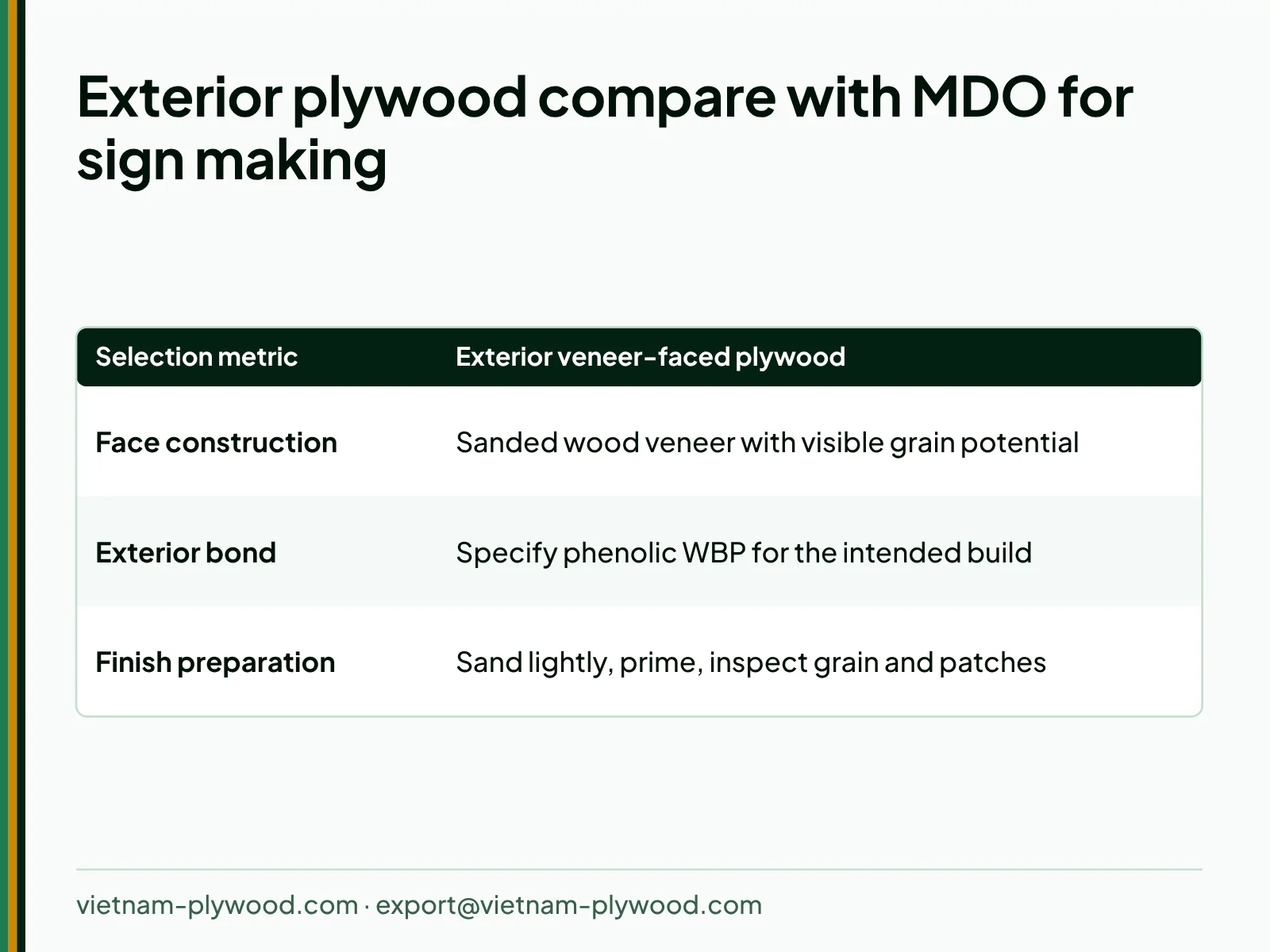
How does exterior plywood compare with MDO for sign making?
Medium-density overlay (MDO) is a purpose-made resin-fiber overlay used for paintable sign surfaces, whereas veneer-faced exterior plywood requires more attention to wood grain. HCPLY does not press MDO or high-density overlay (HDO); the comparison helps buyers decide when a specialized signboard is the better procurement choice.
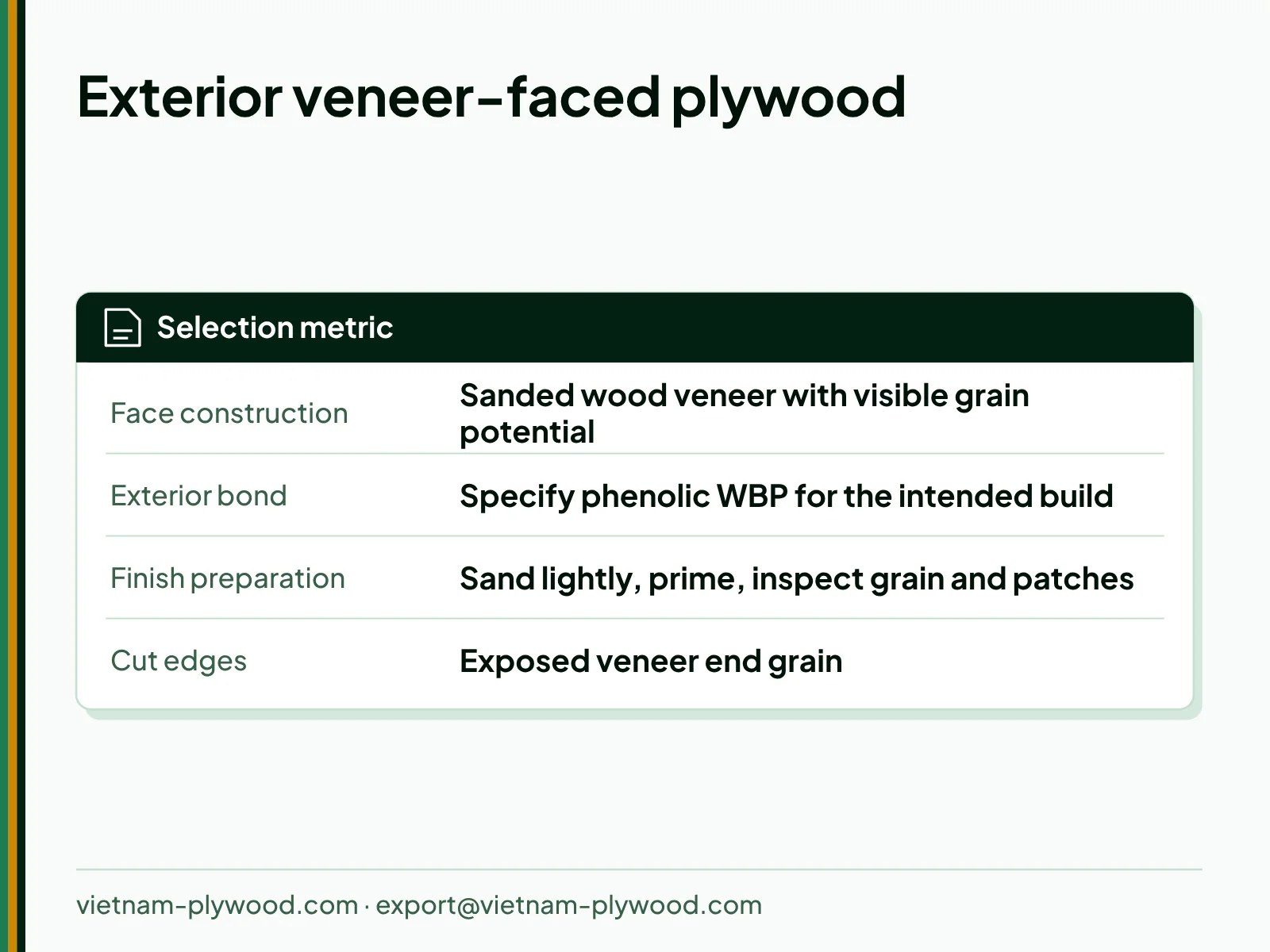
| Selection metric | Exterior veneer-faced plywood | MDO signboard | Verdict by use |
|---|---|---|---|
| Face construction | Sanded wood veneer with visible grain potential | Resin-impregnated fiber overlay | MDO for a low-grain painted finish |
| Exterior bond | Specify phenolic WBP for the intended build | Exterior bond is part of MDO product classification | Both require bond verification against the order |
| Finish preparation | Sand lightly, prime, inspect grain and patches | Follow overlay-specific primer and paint guidance | Test the actual paint system on both |
| Cut edges | Exposed veneer end grain | Exposed plywood core at cuts | Seal all cut edges for either product |
| HCPLY production route | Furniture-line exterior-glue specification | Not manufactured by our lines | Choose veneer-faced plywood when its sample finish passes |
APA – The Engineered Wood Association describes MDO’s resin-impregnated fiber overlay and exterior bond classification in its MDO/HDO technical guidance. APA also identifies MDO General grade as a paint base. These are characteristics of the MDO category, not certifications of our veneer-faced panels. Sign buyers should compare the actual painted sample rather than substitute one product name for another.
Do the edges of sign board plywood need sealing?
Yes: seal every edge, including new saw cuts, routed letters, drilled holes and mounting penetrations. End grain absorbs water faster than a broad finished face, making edge preparation a primary part of an outdoor sign specification. Sealing the original sheet edge alone leaves fresh fabrication cuts exposed.
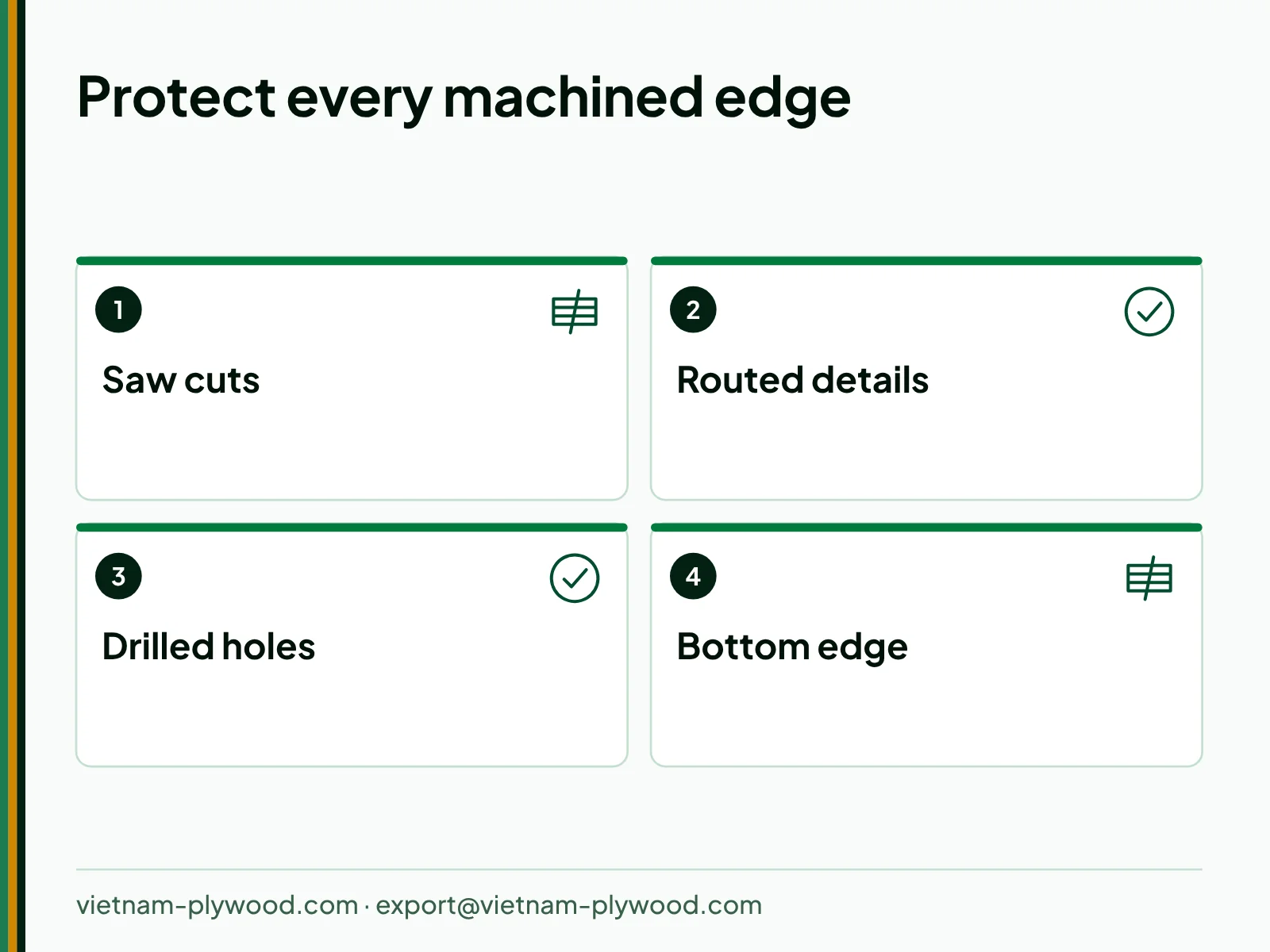
APA’s guidance for exterior plywood siding recommends resealing edges cut during construction. The same moisture-entry mechanism is relevant to sign blanks, although the siding recommendations are not a signboard performance certificate. For the finished sign, follow the coating maker’s instructions for primer compatibility, film preparation and cure.
- Cut and route the sign blank to final dimensions before applying the full finishing system.
- Remove dust, loose fibers and any surface contamination without cutting through a thin veneer.
- Apply a compatible edge sealer or exterior primer to all cut edges and penetrations.
- Prime and finish the front, back and exposed sides to the chosen coating specification.
- Recoat damaged or newly cut areas after mounting work and check lower edges where water collects.
A sealed edge reduces moisture entry but does not replace drainage, suitable supports or periodic finish maintenance.
What thickness and size should a sign maker specify?
Choose thickness from panel span, frame support, fixing method and the project wind-load calculation. HCPLY produces plywood from 3–40 mm, with common thicknesses of 3, 5, 9, 12, 15, 18, 21 and 25 mm. Those manufacturing options are not structural sign-design approvals.
Standard sizes include 1220×2440, 1250×2500, 1220×2135, 1220×1830, 915×2440, 915×2135 and 915×1830 mm; custom cutting is available. Selecting a sheet size that matches router-bed capacity and graphic nesting reduces trimming and joint lines. For long signs, ask the fabricator to show the proposed framing and joint layout before fixing the order quantity.
Our furniture-line sanded thickness tolerance is ±0.2 or ±0.3 mm as ordered. Commercial and film-faced tolerance is ±0.5 mm, while packing panels use ±0.5–1.0 mm. Length and width tolerance is ±2 mm. Record the chosen tolerance in the purchase specification, especially where panels enter a close-fitting frame.
What can the buyer inspect at the producing factory?
The buyer can witness face inspection, dimensional checks and cut-edge examination at the producing factory before loading. HCPLY handles specification, on-site quality control, shipping documents and loading. Buyers visit the factory office and inspect goods where the order is made.
Start with the approved reference sample and written order. Measure thickness at multiple points, check length and width, inspect face repairs under directional light and compare core construction at a clean cut edge. For sanded furniture panels, look for the full-stitched core arrangement and visible gaps; for film-faced panels, check film coverage, edge finish and surface damage.
Ask the inspector to record glue type and emission class separately in the inspection record. Review any agreed test report for the specific build and confirm that the samples represent the ordered face, core and thickness. Certificates held by member factories, including FSC, CARB P2, ISO 9001 and CE, are shown with factory details masked, on request. They should be evaluated against the exact certificate scope and destination requirements.
How do sign panels fit an export order?
A 40HC is the minimum order, and different specifications can share its 28.5 t payload limit. For example, 18 mm, 1220×2440 mm panels have planning weights of 26.79 kg per sheet for styrax core, 31.08 kg for acacia and 34.83 kg for eucalyptus. These core-only figures exclude added film weight.
A full 40HC load of that thickness and size is 990 styrax-core sheets at 26.52 t, 880 acacia-core sheets at 27.35 t, or 795 eucalyptus-core sheets at 27.69 t. A mixed load of 500 styrax-core sheets and 300 acacia-core sheets weighs 22.72 t using the stated sheet weights, before pallets, packing and any facing additions. The final load plan must also fit pallet dimensions and the carrier’s requirements. See container packing calculations and mixed-container ordering for the related logistics questions.
Orders ship from the appropriate factory FOB Hai Phong, with CFR (CNF) and CIF available. Factory lead time runs 15–45 days from receipt of the 30% deposit; the exact figure depends on order size, line loading and what the contract fixes. The remaining 70% is paid on the scan of the bill of lading, by T/T, or by irrevocable sight L/C. Samples cost nothing: a first-time buyer pays the courier, and that charge comes off the first confirmed order.
What documents and cost drivers belong in the order?
The purchase specification should state face, core, glue, emission class, dimensions, finish test and inspection acceptance criteria. The shipment documents include commercial invoice, packing list, bill of lading (B/L), certificate of origin, phytosanitary and fumigation papers, and order-specific certificates or test reports. For EU lots, the file includes EUR.1 and EUTR/EUDR documents; CIF shipments include insurance. After loading, the draft shipping documents come to you for approval.
For a sign-board quotation, a sanded full-stitched exterior-glue furniture build will cost more to make than a rough MR commercial build because of face selection, core preparation, sanding and adhesive specification. Premium film adds a separate facing cost compared with standard film, while custom cuts and tighter tolerances affect conversion work. The chosen sign finish and exposure requirements should decide the build before comparing quotations.
HCPLY’s construction project plywood supply page covers broader procurement coordination. For this application, the practical commercial comparison is the accepted sample, measured tolerances, finishing compatibility and shipment specification together.
What should the sign maker send for sampling?
Send a complete sign blank specification with the intended paint or graphic system, mounting exposure and a sample acceptance test. Keep the final finish approval with the sign maker who will apply the graphics.
Application: Exterior painted sign / applied-graphic sign; exposure and mounting details
Line or core: Furniture line, styrax or eucalyptus / construction line, acacia or eucalyptus
Glue: Phenolic WBP for the exterior build
Emission: E0 or E1 as specified separately
Face and grade: Sanded poplar or okoume A/B / selected construction film
Thickness and tolerance: [mm] and [ordered tolerance]
Size: [length × width in mm]; cutting and hole layout
Quantity: [sheets]; mixed-load breakdown if relevant
Destination port: [port and country]
Ask Lucy at export@vietnam-plywood.com for a sample set to test primer adhesion, graphic appearance and edge sealing before approving production. The contact page is the next step for the written specification.