





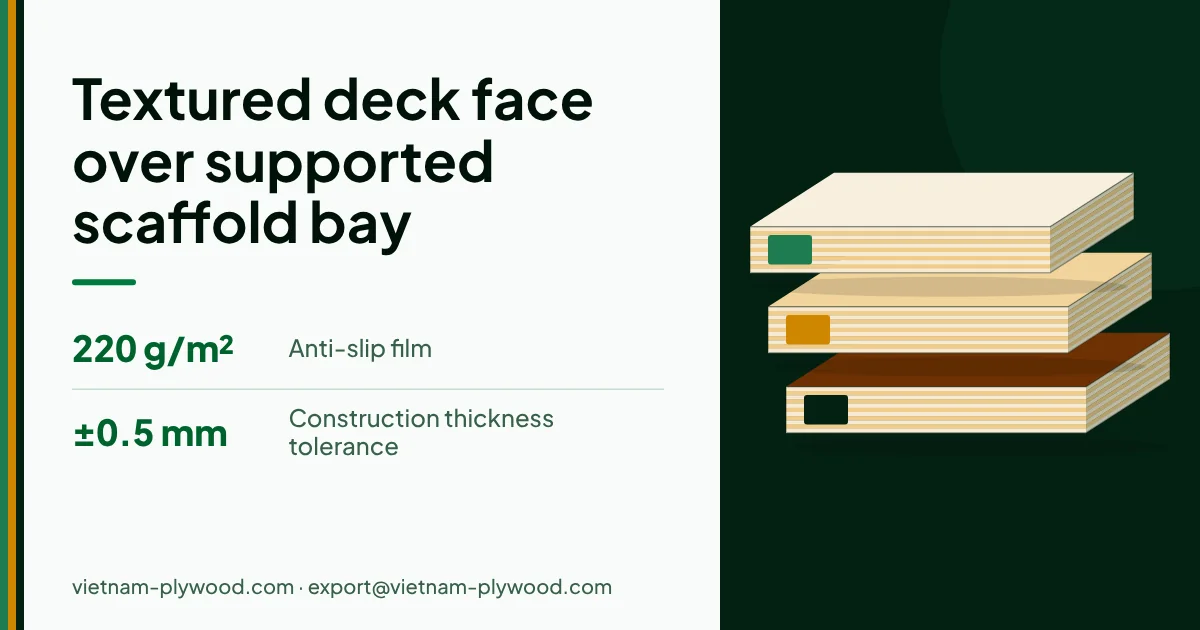
Scaffold deck plywood from HCPLY’s construction line has a textured anti-slip film face, with panel thickness selected against the scaffold designer’s load test. A wrong deck selection can cause a rejected platform, replacement costs and lost site days. Start with the bearer arrangement and required test evidence, then specify the face, core, bond and edge treatment together.
Which plywood is used for scaffold decks?
A scaffold deck can use anti-slip film-faced plywood when its complete platform arrangement has been designed and tested for the intended loading. The textured face addresses footing; the veneers, glue lines, support spacing and connections address load transfer. HCPLY presses these sheets on our construction line with acacia or eucalyptus cores. The scaffold designer must approve the finished deck assembly before use.
Scaffolding plywood is sometimes sold as a generic sheet, while plywood scaffolding planks may refer to narrow cut panels or assembled platform units. Neither label supplies a safe working load. Give the producing factory a drawing showing bearer spacing, end restraint, panel orientation, fasteners and the expected live and concentrated loads.
Our scaffold board buying guide covers the wider platform purchasing decision. For an adjacent material specification, see exterior plywood supply; exterior exposure resistance alone does not qualify a walking deck.
Which anti-slip pattern suits scaffold deck plywood?
The appropriate pattern is the one that passes the buyer’s agreed slip test under representative site conditions. A raised mesh, rice-like or geometric texture can change contact with footwear and the way slurry collects. Pattern names alone do not describe a tested coefficient of friction.
Compare actual production samples with the boots and contaminants expected on site. A coarse relief can offer drainage channels but may retain dried cement; a finer relief can be easier to clean yet behave differently under wet soles. Record the test method, surface condition, direction of travel and acceptance criterion in the purchase specification.
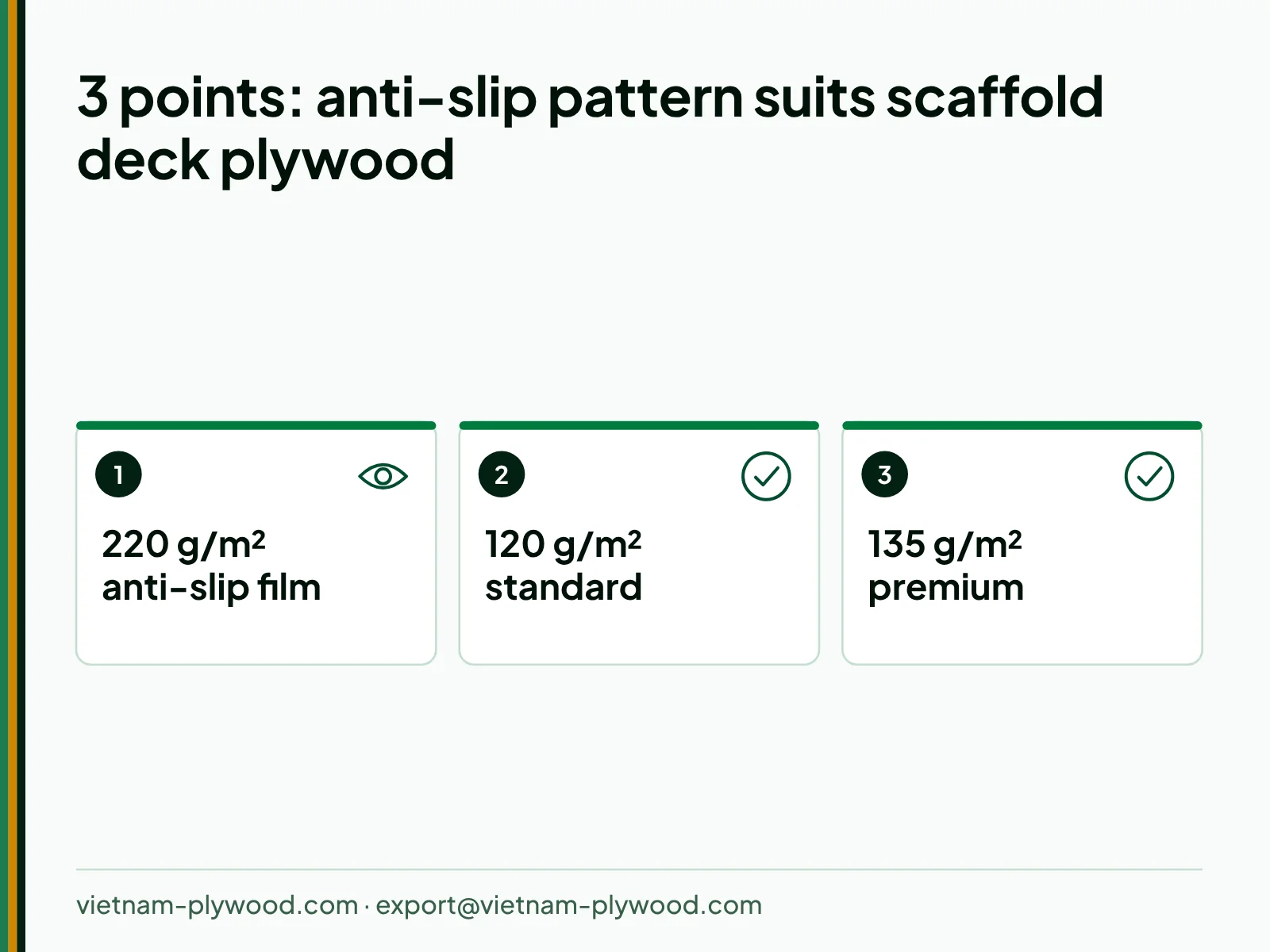
Our construction line uses 220 g/m² anti-slip film for this build. Smooth film-faced panels for concrete contact use 120 g/m² standard or 135 g/m² premium film. Those film weights describe overlays, not structural strength or measured traction. Specify whether the underside is smooth film and which face must remain exposed as the walking surface.
Do not adopt an unverified friction number from a sales comparison. Ask the testing party to identify its footwear or slider, wetting medium and specimen condition. Inspect the relief after cutting and cleaning because a damaged or slurry-filled texture changes the surface the worker encounters.
What thickness suits each bearer span?
Thickness follows the scaffold designer’s load and deflection assessment for the actual bearer span. There is no HCPLY span table that turns a nominal thickness into an approved platform rating. Test the specified panel build and support configuration, including edge supports and local concentrated loads.
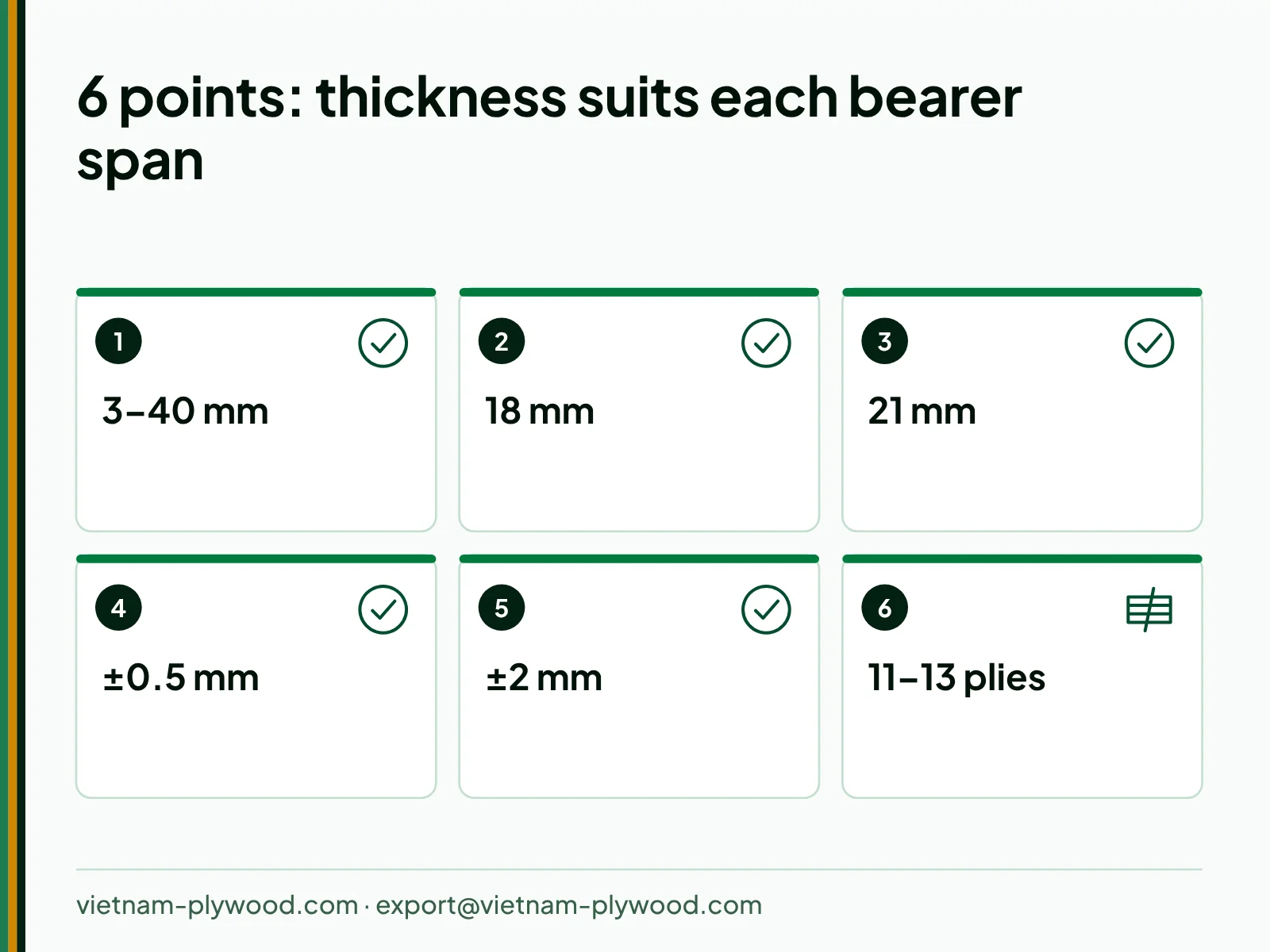
Our production range is 3–40 mm, with 18 mm and 21 mm among the common thicknesses. For construction film-faced sheets, thickness tolerance is ±0.5 mm and length and width tolerance ±2 mm. An 18 mm panel has 11–13 plies, depending on veneer thickness; ply count by itself is not a load rating.
The United States Occupational Safety and Health Administration (OSHA), in 29 CFR 1926.451 (1996, as amended), says scaffolds shall be designed by a qualified person. The same rule sets capacity requirements for scaffolds and their components. This US rule is a useful illustration of the design responsibility, while the project must follow its applicable jurisdiction and scaffold system requirements.
For a test request, record the clear bearer span, orientation of the face grain, support width, restraint method, uniform and point loading, allowable deflection, failure criterion and conditioning. Request results for the actual deck build rather than substituting a timber-plank span chart. A change in core or bond requires a fresh assessment of the evidence.
How do our three lines build the same nominal thickness?
Only our construction line presses anti-slip film-faced scaffold deck sheets. The other lines serve different specifications at the same nominal thickness, so an importer should identify the line as well as the dimension.
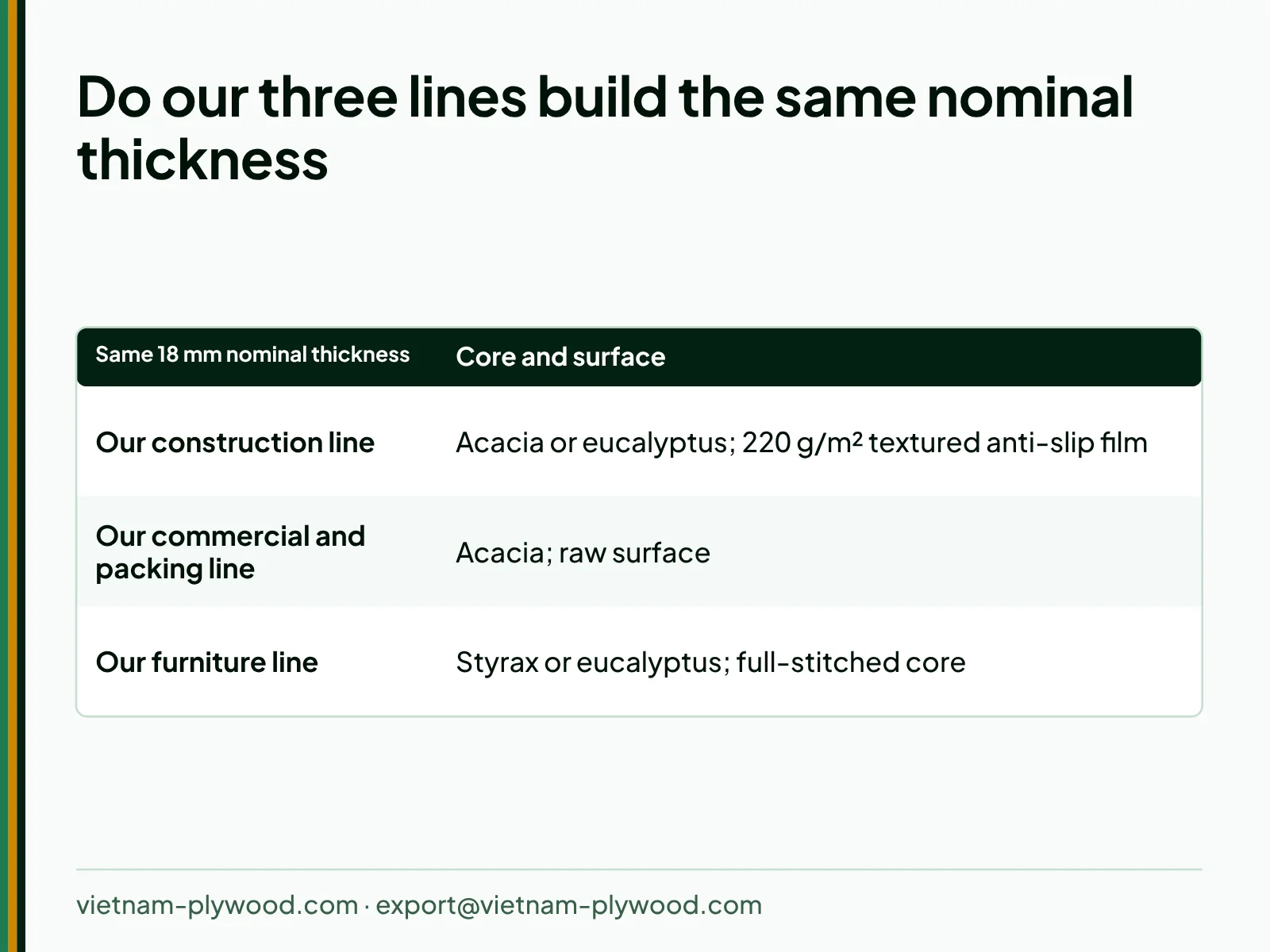
| Same 18 mm nominal thickness | Core and surface | Bond / finish | Appropriate purchasing use |
|---|---|---|---|
| Our construction line | Acacia or eucalyptus; 220 g/m² textured anti-slip film | Phenolic or melamine glue; unsanded core | Candidate deck component for designer-approved testing |
| Our commercial and packing line | Acacia; raw surface | MR glue; unsanded or light-sanded | Packing and commercial panels, not a deck substitution |
| Our furniture line | Styrax or eucalyptus; full-stitched core | Sanded, E0/E1 emission class | Furniture and cabinet components, not a deck substitution |
The distinction also affects inspection. The furniture thickness order can specify ±0.2 mm or ±0.3 mm, while construction sheets use ±0.5 mm. Glue and emission are separate specification fields: a phenolic bond is a bond choice, while E0, E1 and E2 describe emission classes.
Acacia core density is 580 kg/m³, eucalyptus 650 kg/m³, and styrax 500 kg/m³. Density follows the core, not the face. These values support shipping calculations; they cannot replace bending and platform tests.
Should the edges of scaffold deck plywood be sealed?
Yes: seal the factory edges and every newly cut or drilled edge before the panel enters a wet site. Film protects the broad faces, while exposed veneer edges provide a route for moisture. The edge treatment must match the intended handling, cleaning and exposure cycle.
Specify whether the order is delivered as full sheets or cut deck blanks. Custom cutting is available, but the drawing must distinguish factory-finished edges from cuts made by the deck assembler. The inspector should check edge coverage around corners, openings and any hardware recesses.
A practical maintenance sequence is:
- Inspect the walking film for cuts, peeling, polished patches and packed-in concrete residue.
- Clean the relief using a method that does not gouge the film or expose veneer.
- Examine all edges, especially cutouts and drilled points, for coating breaks or swelling.
- Recoat exposed wood and let the sealant cure under the product instructions.
- Remove panels with delamination, damaged support edges or failed deck inspection from service.
Formwork reuse figures should not be treated as scaffold service-life ratings. With proper handling, a release agent on every pour and sealed edges (cut edges included), melamine-glue film-faced reaches about 12–15 pours and phenolic-glue film-faced up to about 25 pours in formwork use. Those figures concern concrete pours, not approved scaffold-deck cycles.
Can anti-slip film-faced plywood be used for scaffolding platforms?
Yes, as a specified component of a scaffold platform that has passed the designer’s assessment and applicable inspection. A textured face does not establish the platform’s strength, connection security, fall protection or allowable loading. Verify the entire assembly rather than the loose sheet alone.
OSHA’s scaffold platform requirements address platform decking, support, loading and surface conditions. Its 29 CFR 1926.451(b)(9) also restricts opaque finishes on wood platforms while allowing certain slip-resistant coatings that do not obscure wood surfaces. Because an overlaid plywood deck is a different construction from visible solid-wood planking, have the project safety professional determine whether the proposed system is acceptable under the governing rule before ordering.
Check that the finished platform has the required width and gap control, supported joints, suitable end restraint and protection at open sides. A walking surface can have good traction and still be unsafe if its edge lifts, the bearer spacing is wrong or the deck slips off its frame.
For vertical concrete work, keep the use distinction clear. Form-facing panels resist concrete pressure in their formwork assembly; deck panels carry workers and materials through their scaffold supports. A texture specification for one does not certify the other.
What can an inspector witness at the producing factory?
An inspector can compare the ordered anti-slip face, dimensions, edge coating and core build against a marked production sample. The buyer visits the factory office and inspects goods at the producing factory, where our on-site QC team follows the order specification.
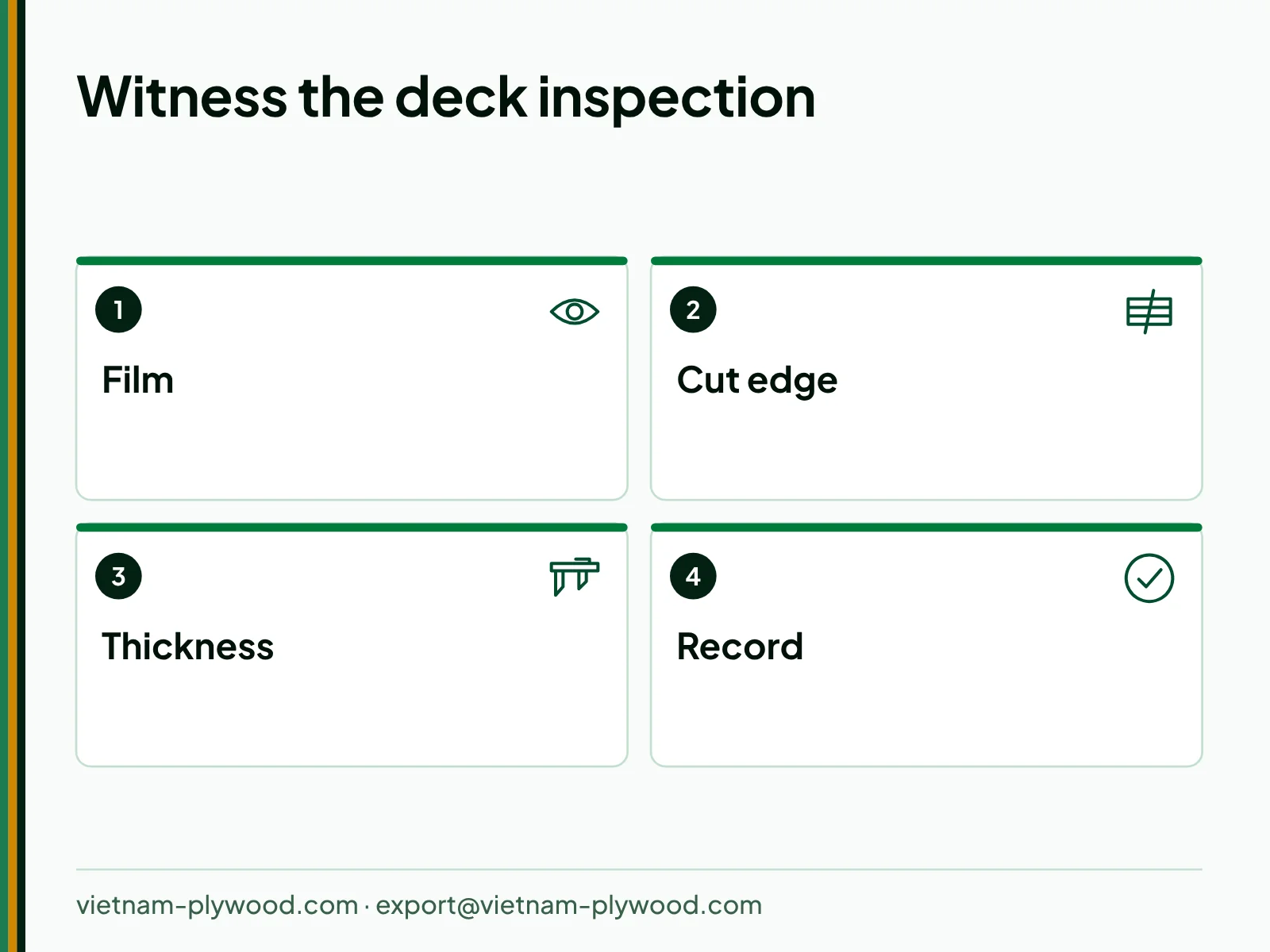
Start with a written check sheet and approved sample. Identify the panel batch, count the sampled plies at a cut edge, measure thickness at agreed locations, examine veneer gaps and look for film lift or bubbles. Check the 220 g/m² anti-slip film designation against the production record; visual appearance alone cannot verify film weight.
For bond specification, our construction line uses melamine MR (12-hour boil) or phenolic WBP (72-hour boil) glue. The stated boil descriptions are glue categories in our specification, not a substitute for the buyer’s accepted test report. Our MR hot press operates at 110–120 °C, and WBP at 130–145 °C; press conditions do not by themselves certify deck performance.
Ask the independent testing body to examine a representative finished deck assembly where structural or slip acceptance is required. The factory inspection confirms what was made and packed; the designer’s evidence confirms what the assembled platform is permitted to carry.
Can scaffold deck sheets share a container with formwork panels?
Yes. Our construction line can load textured deck sheets alongside smooth film-faced formwork panels for the same site, provided the mixed specification stays within the 28.5 t 40HC payload limit. The packing list must separate the two builds by item, size and quantity.
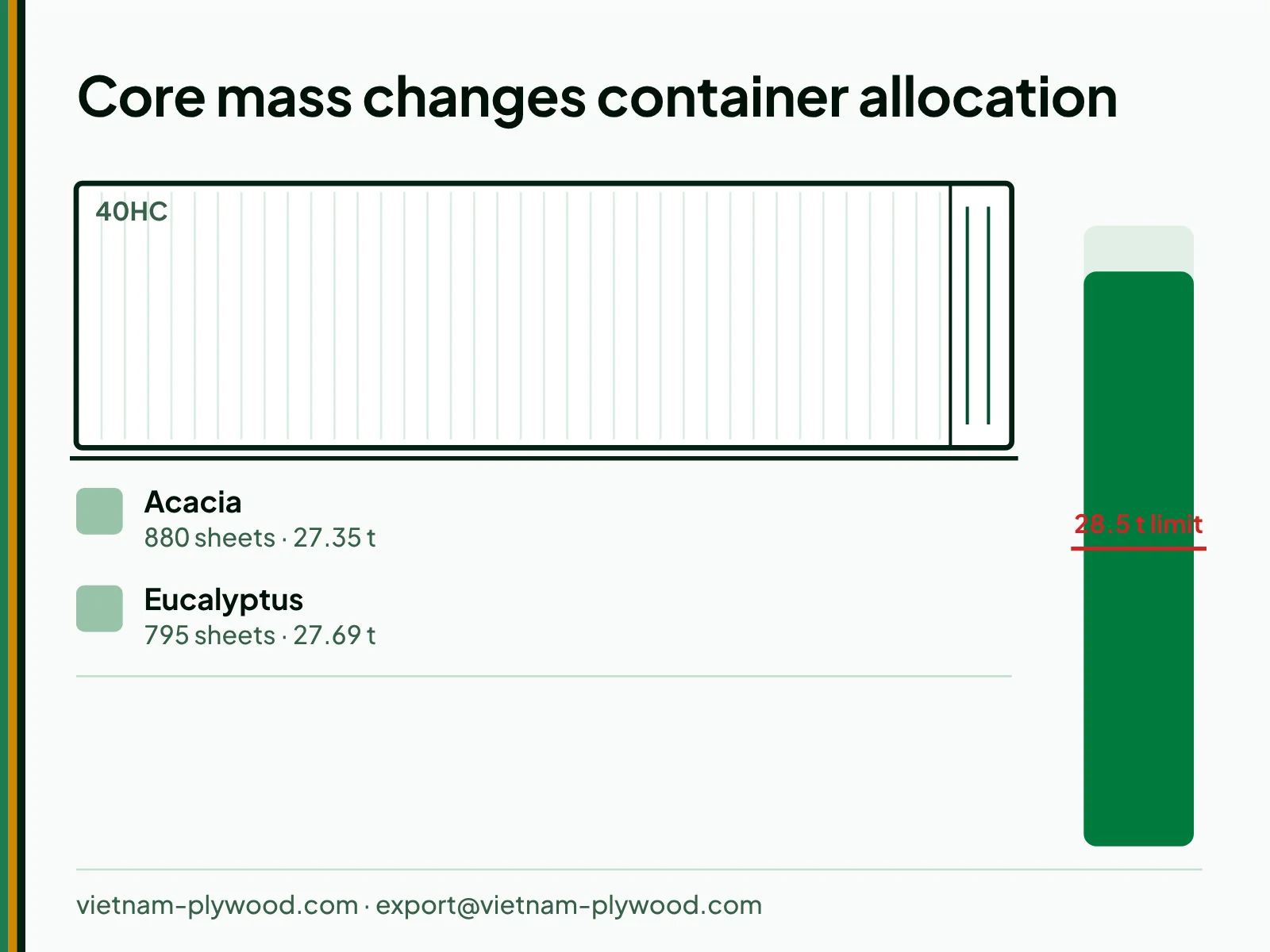
For 18 mm, 1220 × 2440 mm acacia-core sheets, the reference sheet weight is 31.08 kg before film weight. A full acacia reference load is 880 sheets, 47.15 m³ and 27.35 t, with 16 pallets. Actual anti-slip film, pallet mass and the formwork mix must be included in the shipping calculation.
A eucalyptus-core sheet at the same dimensions weighs 34.83 kg before film. Its full reference load is 795 sheets, 42.60 m³ and 27.69 t across 15 pallets. The heavier core changes how much deck and formwork can travel together even when sheet dimensions match.
Use mixed-container planning to set the allocation and container loading calculations for the dedicated load-count topic. Mark each pallet as deck or formwork and keep the anti-slip walking face protected during handling.
What documents and order terms belong in the deck specification?
The packing list identifies the deck and formwork items, while the agreed test reports address the ordered build. Each shipment also carries a commercial invoice, bill of lading (B/L), certificate of origin, phytosanitary and fumigation papers, and relevant certificate documents. For European Union lots, the file includes EUR.1 and the EUTR/EUDR documents; CIF shipments include insurance.
Member-factory FSC, CARB P2, ISO 9001 and CE documents, where relevant to the order, are shown with factory details masked, on request. A certificate’s presence does not supply the scaffold system’s working-load test. After loading, the draft shipping documents come to you for approval.
Minimum order is one 40HC; one container can carry several specifications as long as the payload limit holds. Production is 15–45 days from the 30% deposit, set by order size, line loading and the contract. Balance 70% on the scanned bill of lading, by T/T or irrevocable sight L/C. Delivery terms are FOB Hai Phong, CFR (CNF) or CIF. See production lead time for the scheduling topic.
There is no published deck-sheet price figure here. The largest cost decisions are the tested deck build and core choice, followed by anti-slip overlay, thickness, cutting and edge finishing. The 220 g/m² textured film uses more overlay material than a 120 g/m² smooth standard film; eucalyptus has greater mass per sheet than acacia at equal size. Request a quotation against the written build and accepted testing scope.
What should the buyer put on the purchase order?
Specify the finished deck’s intended platform use and required evidence before selecting a sheet thickness. Keep the drawing revision and approved sample reference attached to the order so the factory and scaffold designer are working from the same configuration.
For a repeatable handover, state the bearer span, deck frame attachment, loading case, slip-test condition and acceptance authority. Include the cleaning method and edge treatment in the same inspection sheet. This makes the incoming-goods check actionable for contractors and formwork yards.
HCPLY handles specification, on-site QC, documents and loading for the order. Lucy at export@vietnam-plywood.com can arrange the producing-factory visit after the deck drawing and proposed test schedule are available.
Application: scaffold deck component; approved bay drawing and test criteria attached
Line or core: construction line; acacia or eucalyptus core
Glue: phenolic WBP or melamine MR (select one)
Emission: state required class separately from glue
Face and grade: 220 g/m² anti-slip film; pattern/sample reference; underside finish
Thickness and tolerance: designer-selected mm; construction tolerance ±0.5 mm
Size: selected standard size or cut drawing; length/width tolerance ±2 mm
Quantity: deck sheets and any smooth formwork sheets, by pallet
Destination port: name port and requested FOB Hai Phong, CFR (CNF) or CIF term
Next step: book a producing-factory visit to witness the sample and inspection plan before release.