





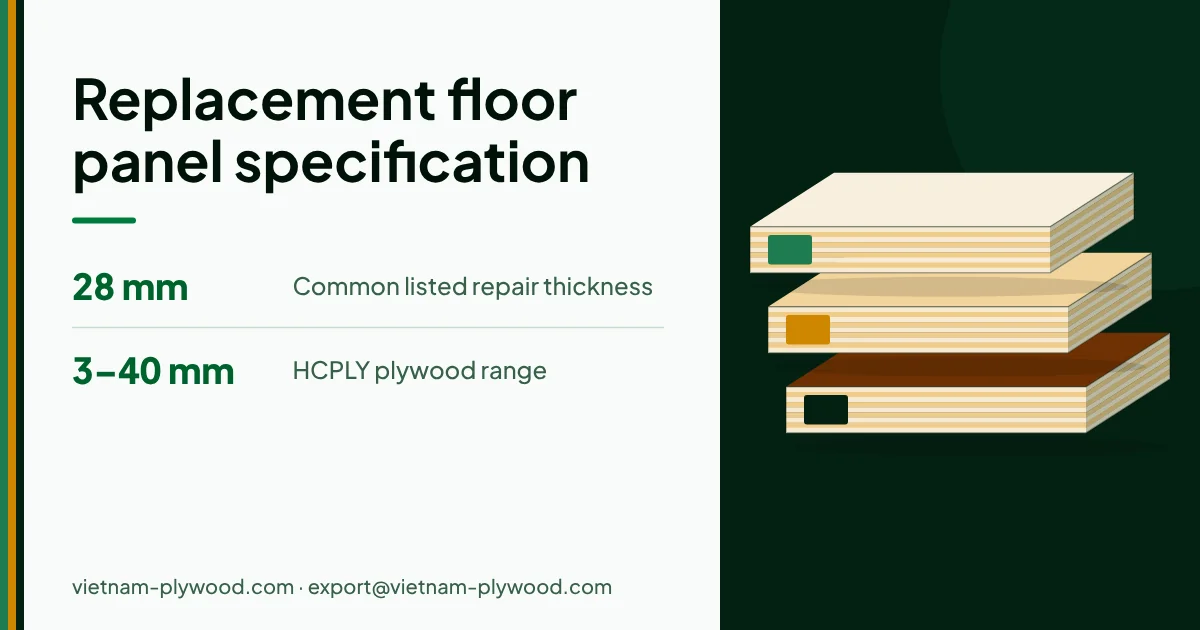
Shipping container flooring replacement must fit the original floor geometry and meet the container owner’s accepted structural requirements. A wrong panel can mean rejected repairs, extra depot days and wasted freight. HCPLY evaluates thick plywood requests against written drawings, core and glue specifications, and a test report the buyer accepts.
What must shipping container flooring match?
Shipping container flooring replacement must match the existing floor’s measured thickness, panel footprint, edge detail, core construction, adhesive specification and accepted performance evidence. A matching nominal thickness alone does not establish a suitable repair. Depot buyers should begin with the container owner’s repair instruction and a sample removed from the floor, then issue a written acceptance schedule.
The first distinction is between a panel that fits the opening and a panel accepted for structural service. Fit is checked at the depot; performance needs evidence tied to the actual construction. For related industrial panel applications, see industrial plywood uses.
What thickness is shipping container flooring?
A 28 mm panel is a common replacement format, but the required shipping container floor thickness comes from the existing unit and its approved repair specification. The replacement must also match the width, length, edge profile, fastening layout and support spacing. A supplier’s advertised 28 mm sheet is therefore a starting reference, not a universal instruction for every container.
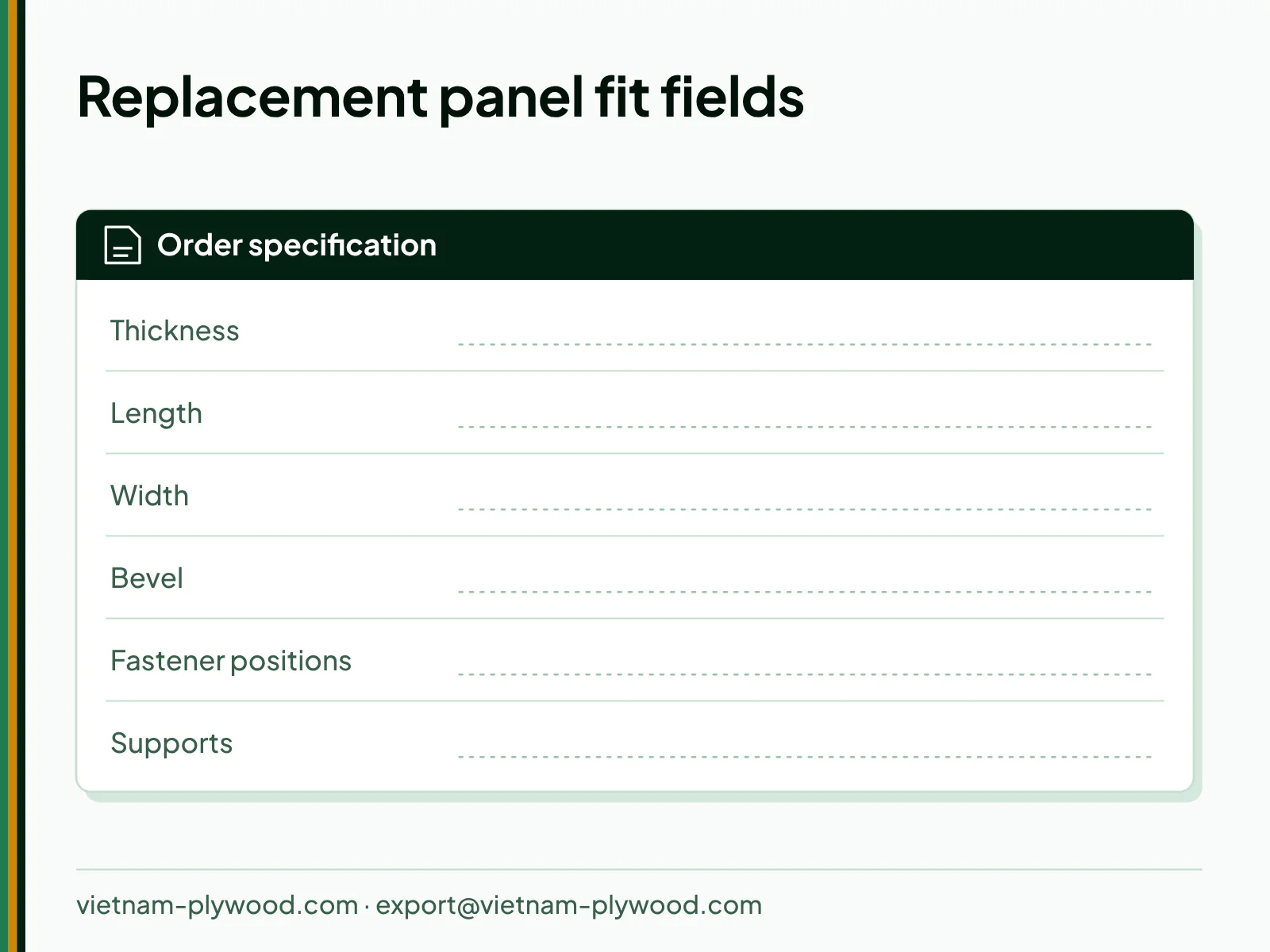
A published container-flooring listing gives 1160 × 2400 × 28 mm panels, illustrating why depot drawings should include all three dimensions and the edge geometry. HCPLY’s general thickness range is 3–40 mm; the standard listed sheet sizes differ from that example replacement footprint. Custom cutting is available, while the final edge profile and machining requirement must be defined in the inquiry.
Ask the depot to measure several locations on an undamaged reference board. Record whether the stated thickness is nominal or a measured acceptance band. Our commercial and film-faced thickness tolerance is ±0.5 mm; packing tolerance is ±0.5–1.0 mm. An unusually tight requirement needs its own written production and inspection decision.
What plywood is used for shipping container floors?
Container flooring plywood is a multi-ply wood panel selected for the container’s structural floor and the loading conditions specified by its owner. Buyers encounter hardwood-core constructions, different face finishes and bonded panels sold for container repair. Those descriptions alone do not identify an approved structural replacement.
A repair specification should identify veneer species, jointing method, grain arrangement, face finish, bond system, moisture conditioning and the applicable performance test. A film face is a surface choice; it does not substitute for core strength or an accepted test. Likewise, a product described as marine requires a test report the buyer accepts.
We work with acacia, eucalyptus and styrax cores. Their reference densities are 580, 650 and 500 kg/m³ respectively, and density follows the core rather than the face. We do not press birch-core plywood. The buyer should specify the required mechanical performance rather than infer it from a species name.
Which glue and core details belong in the repair specification?
For a moisture-exposed replacement, request the required bond classification and the test method before selecting a factory build. Our phenolic weather-and-boil-proof (WBP) glue has a 72-hour boil designation; our melamine moisture-resistant (MR) glue has a 12-hour boil designation. These are glue-system descriptions, not proof of floor-load acceptance.
Core layout is another independent field. Our construction options run from full stitched veneers through stitched outer layers with edge-trimmed inner veneers, finger-jointed veneers and loose-laid veneers. A depot specification should identify which joins are permitted, where voids are unacceptable and how cross-sections will be checked.
Emission classification is separate from adhesive selection. E0, E1 and E2 describe emission classes; they do not mean ‘E0 glue’. If the destination requires an emission document, list the specific accepted standard and certificate with the purchase specification.
Which of our three factories can quote this build?
Our construction line is the relevant starting point for a thick phenolic-bonded film-faced inquiry, using an acacia or eucalyptus core. Its normal finish is unsanded, and the film specification must be written separately. A container-floor replacement request still requires the depot’s drawing and an agreed performance-test route before it can be evaluated as a floor panel.
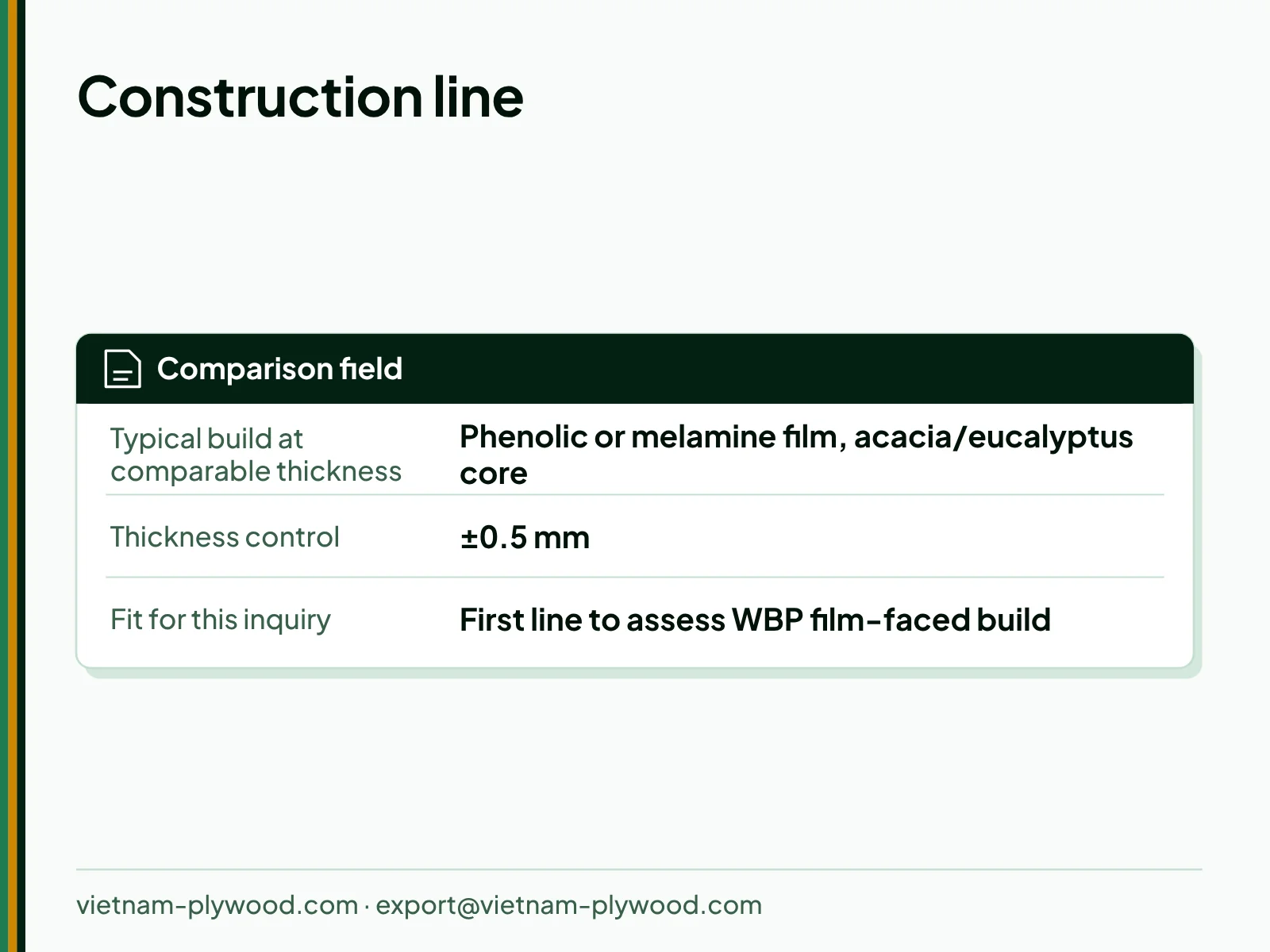
| Comparison field | Construction line | Commercial and packing line | Furniture line |
|---|---|---|---|
| Typical build at comparable thickness | Phenolic or melamine film, acacia/eucalyptus core | Acacia core, MR glue, unsanded or light-sanded | Styrax/eucalyptus core, full stitched, sanded |
| Thickness control | ±0.5 mm | Commercial ±0.5 mm; packing ±0.5–1.0 mm | ±0.2 or ±0.3 mm as ordered |
| Fit for this inquiry | First line to assess WBP film-faced build | Alternative packing panel, not a presumed structural replacement | Interior precision panel, not a presumed structural replacement |
Film weights are 120 g/m² standard, 135 g/m² premium and 220 g/m² for anti-slip film only. A depot may require a different surface or bare-wood traction treatment; state that finish in the request rather than replacing it with a film by default. See anti-slip plywood options and trailer floor panel distinctions for adjacent uses.
What is the IICL container floor test?
The Institute of International Container Lessors (IICL) publishes a performance standard for new, unused structural container floor panels installed in international freight containers. Its official 2026 dry-van technical bulletin index lists TB-001 Revision 4, dated 18 June 2026, under that title. See the IICL dry-van technical bulletins.
The buyer should obtain the applicable full bulletin and identify the test setup, specimen conditioning, load application, failure criteria and reporting format in the contract. A glue boil designation or a supplier’s material data sheet is a different kind of evidence. Do not treat advertised wheel-load figures or claimed service years as transferable results for another factory’s build.
The same official IICL index lists TB-006, a floor quality assurance program audit form, and TB-008 on materials used for repair. Those documents serve different purposes from the structural panel performance standard. Identify the edition used by the lessor, since a depot’s repair authorization and a panel qualification are separate decisions.
Who proves IICL acceptance for a replacement panel?
The buyer or container owner defines the acceptance requirement, and an accepted test report provides the evidence for the specific replacement construction. A factory can supply samples and production records, while the responsible owner, depot or appointed inspector decides whether those records satisfy its repair instruction. A proposed build needs that evidence before IICL acceptance is stated.
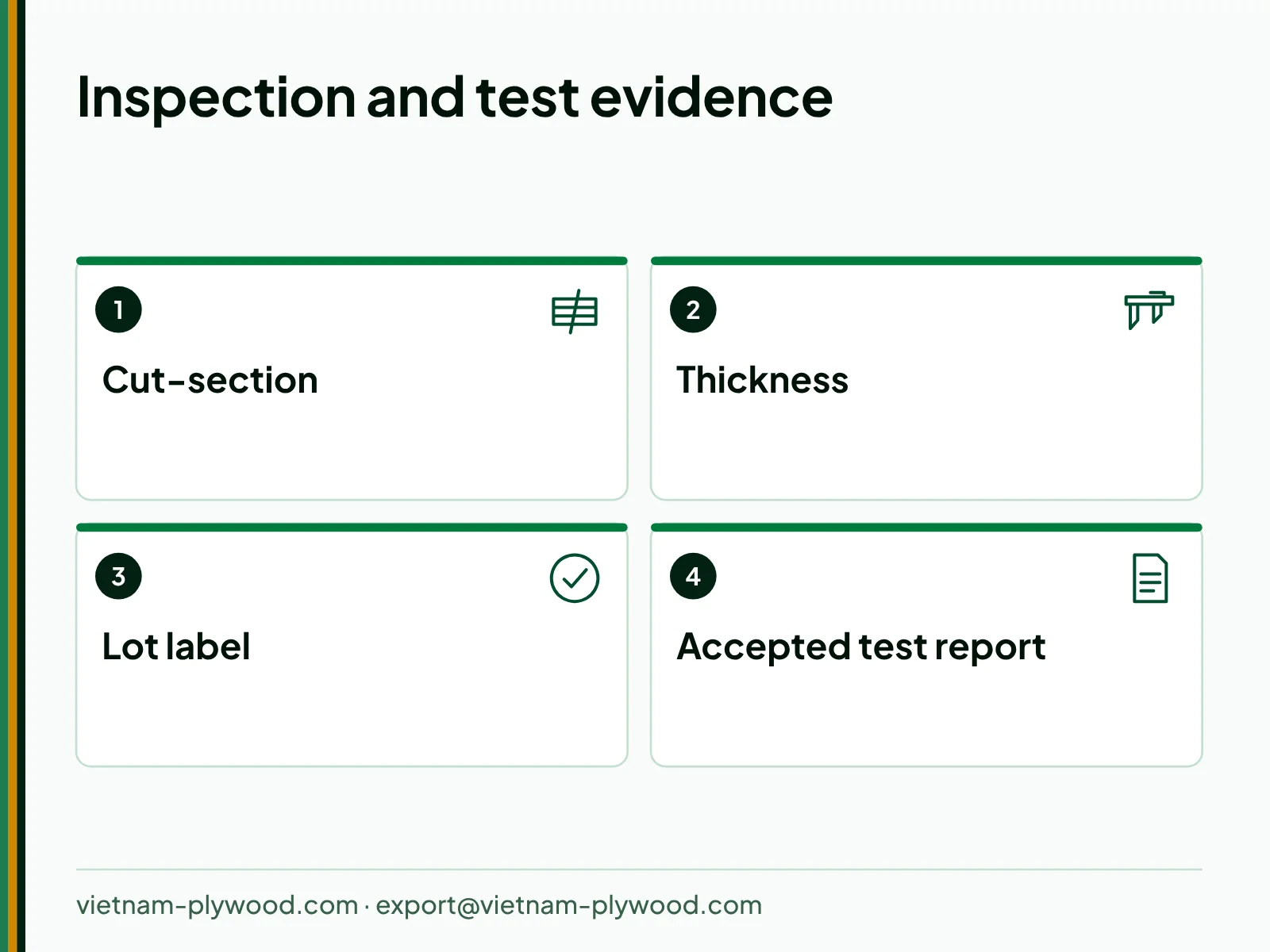
Request that the report identify the panel dimensions, veneer arrangement, core species, adhesive system, face treatment, sampling, test edition and results. Match those identifiers to the production lot and the inspection record. A result for a different core, glue or thickness cannot be silently applied to the offered panel.
For a factory visit, buyers inspect goods at the producing factory. A witness can check thickness across the panel, count and examine plies on a cut section, inspect visible gaps and joints, and compare labels with the approved sample. Those checks support traceability; the accepted performance test addresses structural suitability.
How should a depot prepare a replacement order?
Start with the container owner’s repair instruction and the removed panel, then turn them into measurable purchasing fields. A sketch should show the exact aperture, bevels, screw positions, underside supports and the required surface finish. Include a clear instruction for any treatment or sealing of cut edges.
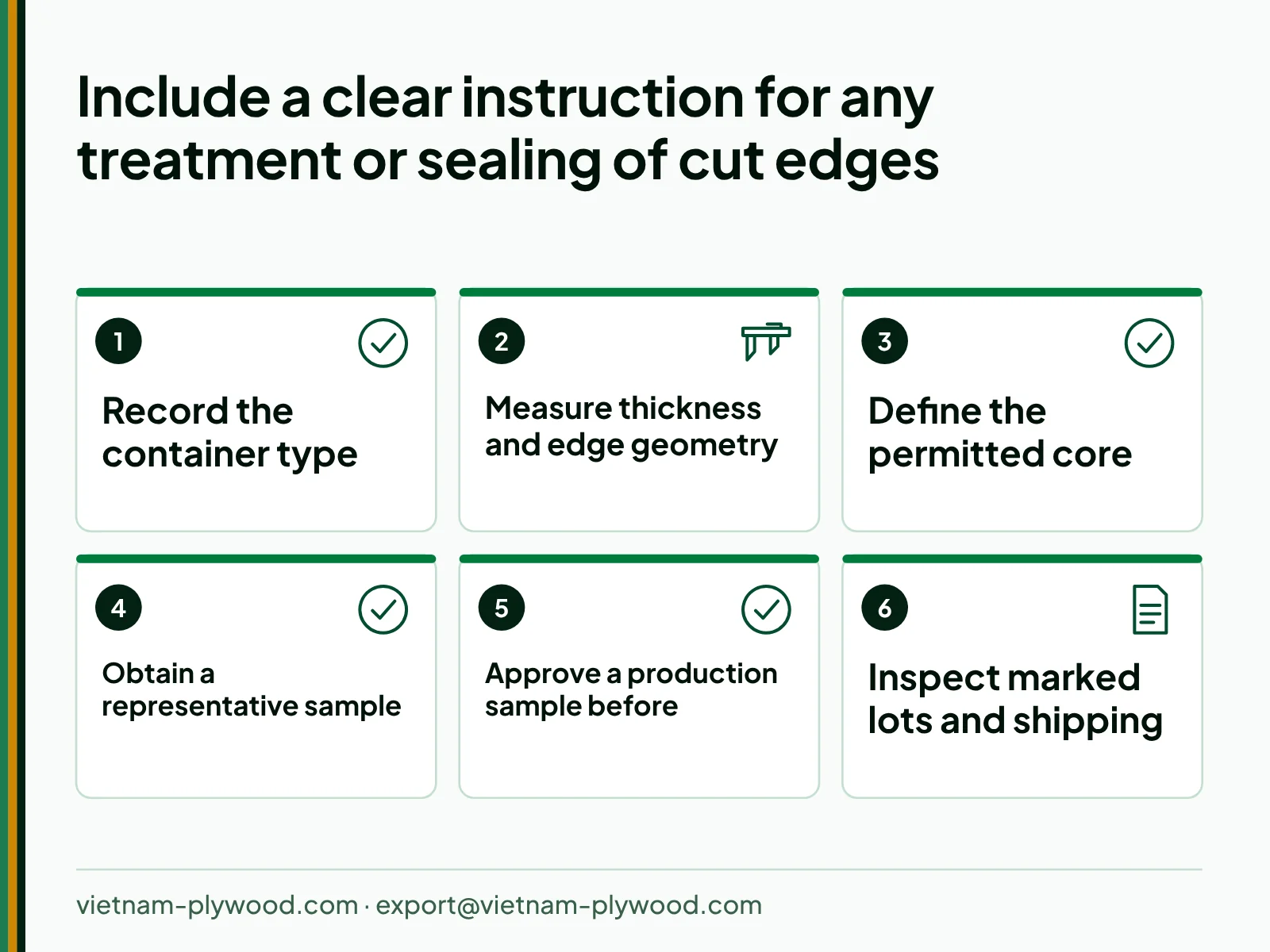
- Record the container type, floor location, original panel dimensions and observed damage.
- Measure thickness and edge geometry against a sound board and note fastening details.
- Define the permitted core, glue, face and veneer construction with a named test edition.
- Obtain a representative sample and agree the report, laboratory and acceptance decision-maker.
- Approve a production sample before releasing the balance of the order.
- Inspect marked lots and shipping documents against the approved specification.
Replacement installation remains a depot operation governed by the owner’s repair procedure. Panel selection cannot resolve damaged crossmembers, incorrect fasteners or unsuitable installation workmanship. For other construction procurement controls, consult plywood supply for construction projects.
What do density and container loading change?
A denser core changes shipment weight even when the face and dimensions look identical. For the reference 18 mm, 1220 × 2440 mm format, acacia weighs 31.08 kg per sheet, while eucalyptus weighs 34.83 kg. The same format has full 40HC lookup totals of 880 acacia sheets at 27.35 t or 795 eucalyptus sheets at 27.69 t.
Those figures describe the reference format and exclude film weight; they are not a 28 mm container-floor loading calculation. The 40HC payload limit is 28.5 t. Mixed specifications can share a container within that limit, with the actual pallet pattern and loading plan agreed for the ordered dimensions.
The difference matters when a depot mixes trial flooring with other industrial sheets. Compare container loading calculations before proposing a mixed load. Shipping volume should follow the approved cut dimensions and actual packaging, rather than a generic sheet-count estimate.
What affects the quotation and production route?
The largest quotation drivers are the required structural qualification and core construction, followed by adhesive system, machining, surface treatment and inspection scope. A full-stitched, tightly controlled WBP build costs more to make than a simpler MR packing build because it requires different veneer preparation and bonding. Special cutting and edge machining add work compared with a standard rectangular panel.
There is no published starting price for this container-floor grade. Request a quotation against the complete drawing, test requirement and shipment plan. The minimum order is one 40HC; one container can carry several specifications as long as the payload limit holds.
Factory lead time runs 15–45 days from receipt of the 30% deposit; the exact figure depends on order size, line loading and what the contract fixes. The remaining 70% is paid on the scan of the bill of lading, by T/T, or by irrevocable sight L/C. We ship FOB Hai Phong, or CFR (CNF) or CIF to your port. See plywood production lead time for planning context.
Which documents travel with the flooring shipment?
The commercial invoice and packing list identify the invoiced build and shipped quantities; the bill of lading (B/L) records the sea shipment. The shipment document package also includes a certificate of origin, phytosanitary and fumigation papers, insurance under CIF and the order’s agreed certificate documents or test reports.
For European Union lots, the origin document is EUR.1 and the EUTR/EUDR file set is included. Member-factory FSC, CARB P2, ISO 9001 or CE documents, where relevant to an agreed order, are shown with factory details masked, on request. Such documents must be matched to the specific producing facility and purchase requirement.
After loading, the draft shipping documents come to you for approval. We manage specification, on-site quality control, export documents and loading through shipment from the producing factory. For repair panels, add the accepted qualification report and lot identifiers to the document checklist before ordering.
Can a Vietnamese factory quote to a depot specification?
Yes. We can evaluate a written request for thick WBP plywood against the depot’s dimensions, construction requirements and accepted testing route. A quote is an offer to build the stated specification; acceptance for container-floor service follows the buyer’s approved report and repair criteria.
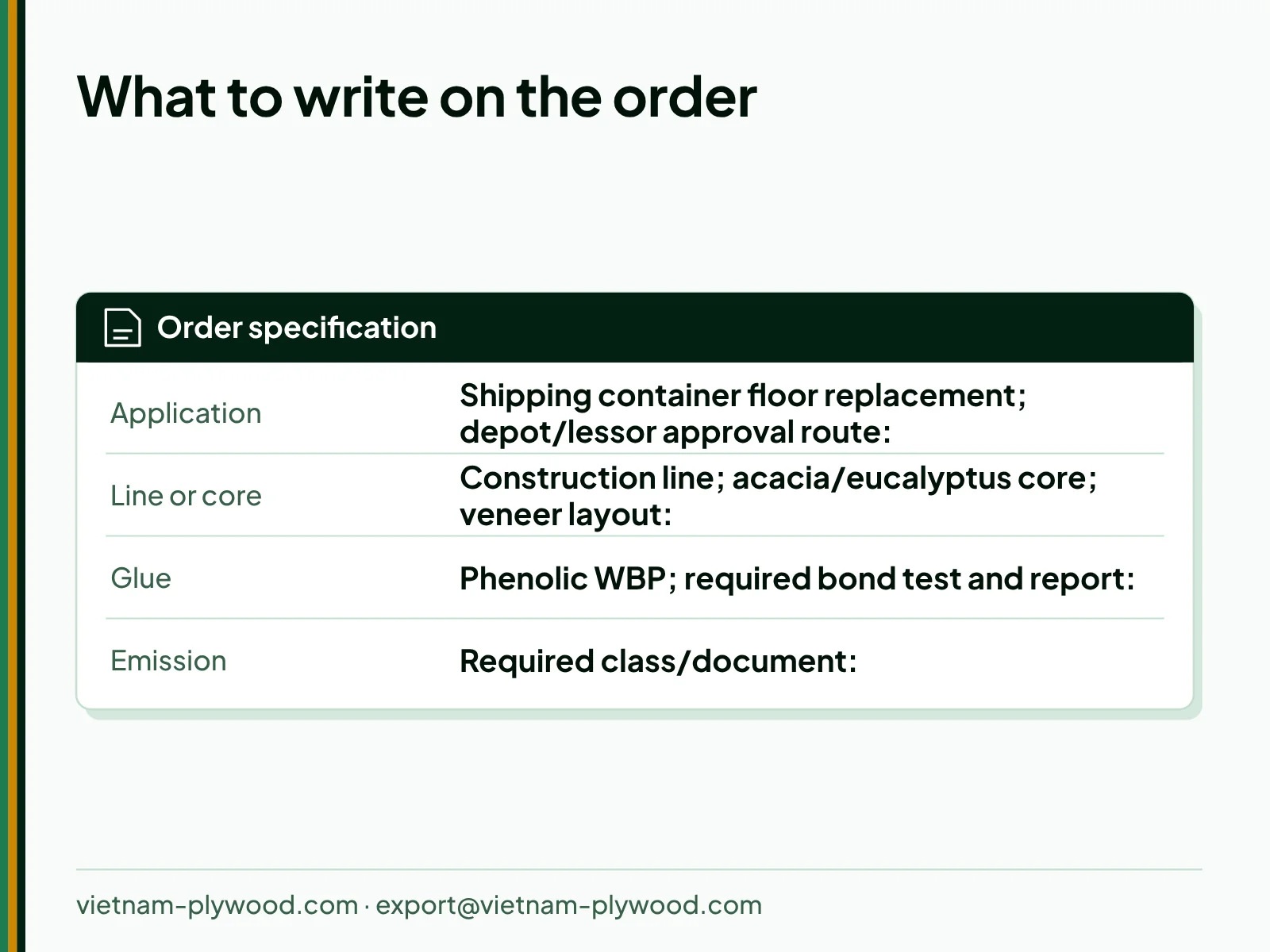
Send the original board drawing, desired finish, sample requirement, applicable IICL edition and the party authorized to sign off the trial. Buyers can visit the factory office and inspect the goods at the producing factory. Free samples are available; a first-time buyer pays the courier, and that charge comes off the first confirmed order.
For a practical first order, plan a trial container and set a hold point for the sample report before authorizing volume production. Use the specification block below when contacting Lucy at export@vietnam-plywood.com or through contact.
Application: Shipping container floor replacement; depot/lessor approval route: ______
Line or core: Construction line; acacia/eucalyptus core; veneer layout: ______
Glue: Phenolic WBP; required bond test and report: ______
Emission: Required class/document: ______
Face and grade: Surface/film or raw face; face grade and edge finish: ______
Thickness and tolerance: Nominal ______ mm; accepted range ______ mm
Size: Length ______ mm × width ______ mm; bevel and fixing drawing: ______
Quantity: ______ sheets / pallets; trial 40HC mix: ______
Destination port: ______; delivery term: ______
Plan a trial container with the approved sample, inspection hold points and acceptance report attached to the order.