





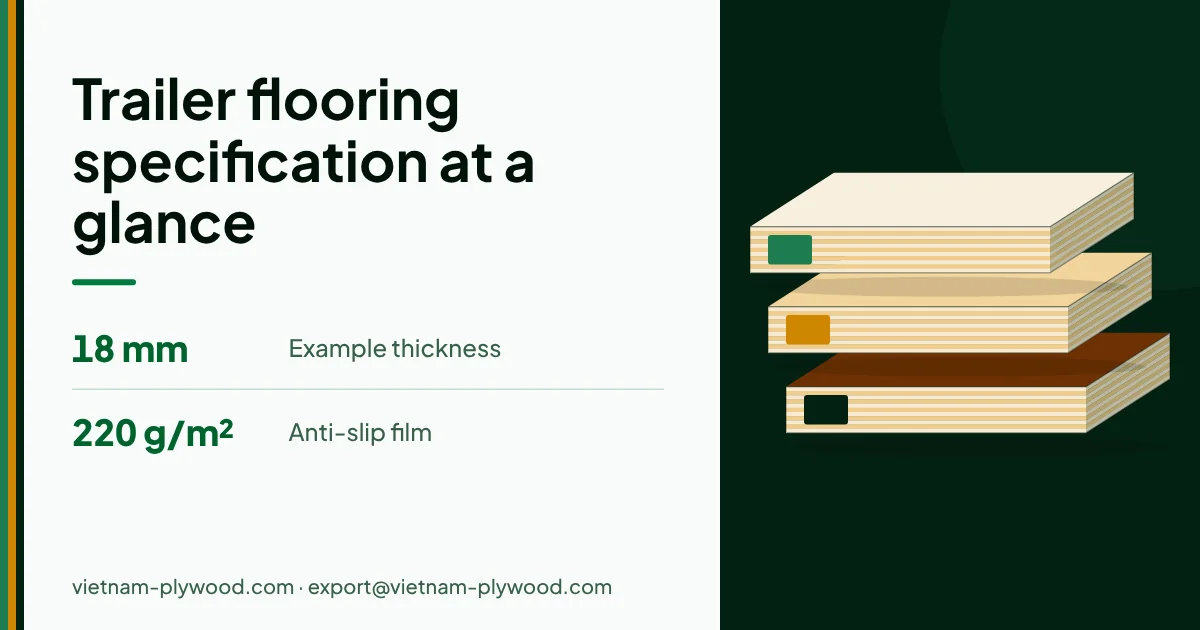
Buffalo boards are textured film-faced plywood sold under a trade name rather than a fixed technical grade. Choosing the wrong face or core can mean a rejected trailer-floor load and costly replacement. HCPLY turns the name into a written build for industrial buyers, including the film, glue, core, dimensions and inspection requirements.
What are buffalo boards?
Buffalo boards are a trade description commonly used for textured, film-faced plywood sold for trailer decks, truck beds and industrial platforms. The name alone specifies neither strength nor surface friction. A purchase order should identify the anti-slip film, adhesive system, core, thickness, dimensions and acceptance checks. HCPLY builds the specified anti-slip panel on our construction line.
A mesh or hexagonal impression helps distinguish the walking or loading face from smooth film-faced plywood. It does not establish a measured slip coefficient, load rating or a particular national standard. Buyers comparing industrial plywood uses should begin with the actual operating surface and the support spacing beneath it.
Is buffalo board a grade or a trade name?
Buffalo board is a trade name, not a defined plywood grade. Two quotations using that label can describe panels with different cores, glue systems, overlays and tolerances. An importer should replace the nickname with measurable purchase-order fields before approving a sample.
Ask the seller to identify which face is textured, whether the reverse is smooth film, and how cut edges will be protected. Record the approved sample’s texture and surface appearance. If the trailer designer requires a structural classification, obtain a test report the buyer accepts for the exact proposed build rather than inferring a grade from the product name.
Other suppliers describe hexagonal grip and specialist transport composites under their own product names. Such descriptions do not make the terms interchangeable. HCPLY does not press birch-core plywood or specialist sound-insulation composite cores.
What is the difference between buffalo board and plywood?
Buffalo board is one marketed form of plywood; plywood describes the layered wood panel beneath the face. The useful comparison is between a textured overlay and an alternative surface for a stated duty.
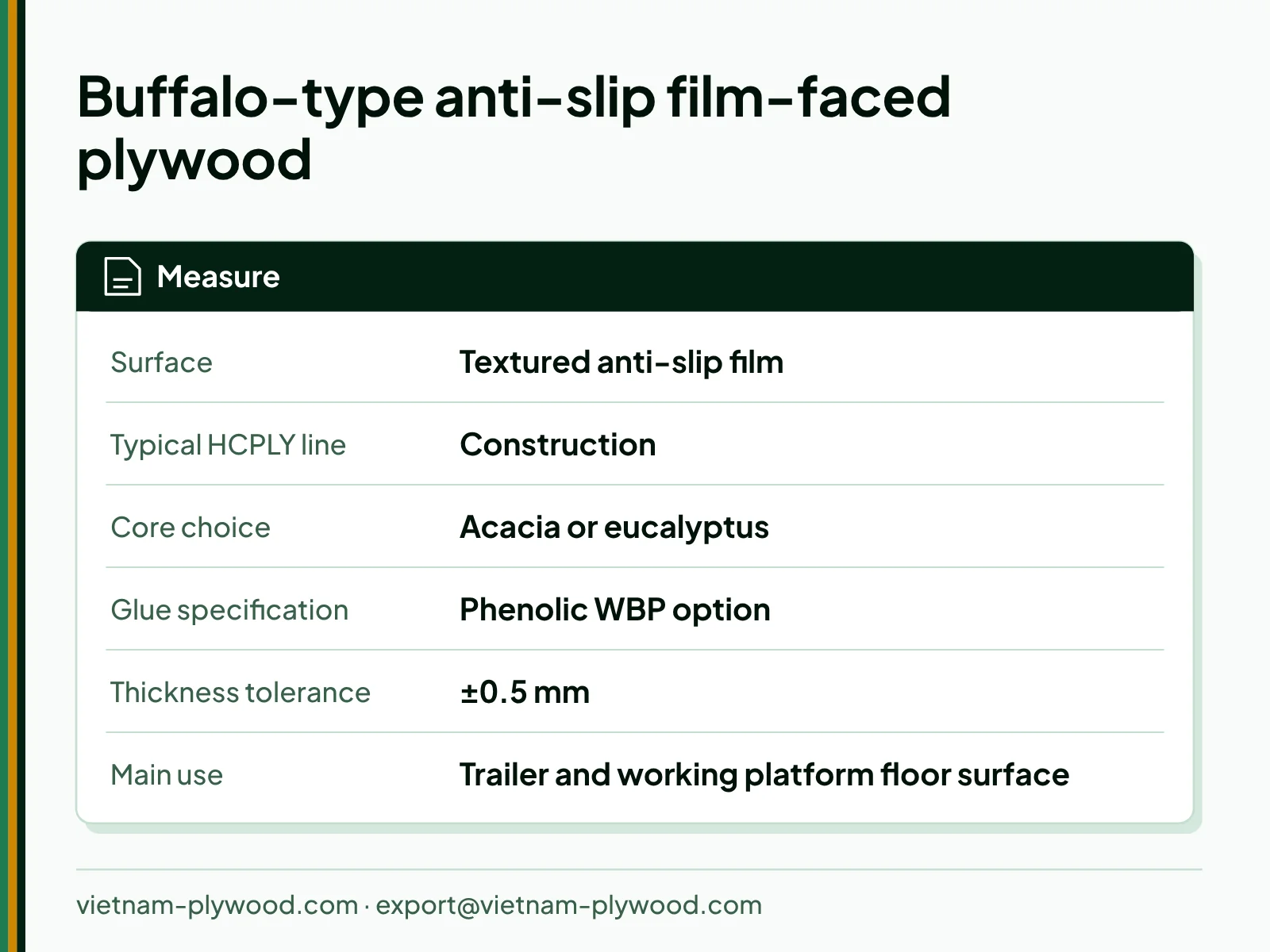
| Measure | Buffalo-type anti-slip film-faced plywood | Smooth film-faced plywood | Raw commercial plywood | Buying verdict |
|---|---|---|---|---|
| Surface | Textured anti-slip film | Smooth film | Unfaced, unsanded or light-sanded | Specify textured film for a trailer deck requiring grip |
| Typical HCPLY line | Construction | Construction | Commercial and packing | Select by application and finish |
| Core choice | Acacia or eucalyptus | Acacia or eucalyptus | Acacia | Record density for handling and payload |
| Glue specification | Phenolic WBP option | Phenolic WBP or melamine MR | Melamine MR | Match moisture exposure and test requirement |
| Thickness tolerance | ±0.5 mm | ±0.5 mm | ±0.5 mm; packing ±0.5–1.0 mm | Put the ordered tolerance on the drawing |
| Main use | Trailer and working platform floor surface | Concrete formwork face | Crates and industrial packing | Do not substitute solely by thickness |
For surface details see anti-slip plywood. For a distinct deck assembly, compare container floor plywood and stage platform plywood.
What specification should I write for trailer flooring?
Write a build specification that identifies the textured face, phenolic glue, core and the deck’s mounting requirements. A usable request gives the producing factory a physical target and gives an inspector objective acceptance points.
- State trailer flooring as the application and identify the expected traffic, contact materials and cleaning conditions.
- Specify anti-slip film on the exposed face, including the approved mesh pattern and 220 g/m² anti-slip film weight. State the reverse-face finish.
- Choose acacia or eucalyptus core and phenolic glue (WBP, 72-hour boil). Record the glue separately from any requested emission class.
- Set nominal thickness, tolerance, sheet size, cutting plan, edge sealing requirement and allowable visible defects.
- Attach the buyer’s load and fastening design, support spacing and any independently accepted test method or report requirement.
- Agree a reference sample and the factory inspection checklist before production.
A textured overlay is one part of deck safety. The UK Driver and Vehicle Standards Agency’s Securing loads on HGVs and goods vehicles guidance, published in 2023 and updated in 2026, states that a high-friction surface must not be used alone to secure a load. See its load-securing guidance. The trailer operator must design the restraints and assess the actual surface-load pairing; a mesh pattern does not supply a tested friction value.
How much does an 18 mm buffalo board weigh?
An 18 mm, 1220 × 2440 mm acacia-core sheet weighs 31.08 kg before film weight; the eucalyptus-core equivalent weighs 34.83 kg before film weight. These are core-based planning weights, not measured finished-sheet masses. The 220 g/m² anti-slip overlay and any other finish are excluded from the core lookup.
For procurement, record the chosen core rather than asking for a single universal buffalo board 18mm weight. Acacia core density is 580 kg/m³; eucalyptus is 650 kg/m³. The sheet dimensions and nominal thickness must remain fixed when comparing figures. An 18 mm core uses 11–13 plies according to veneer thickness.
For 1220 × 2440 mm sheets, the corresponding full 40HC core-only lookup is 880 acacia sheets at 27.35 t or 795 eucalyptus sheets at 27.69 t. The 40HC payload limit is 28.5 t. Those figures are full-container reference cases; a mixed load needs its own pallet and mass schedule.
Which thicknesses and sizes can I order?
HCPLY can specify panels from 3–40 mm, with 9 mm and 18 mm among the common thicknesses. A request for buffalo board 9mm or 9mm buffalo board should still state the deck load, supports and fastening details. Thickness alone cannot establish fitness for a trailer floor.
An 8x4 buffalo board commonly means a nominal 1220 × 2440 mm sheet in this quotation context. Other available sizes include 1250 × 2500, 1220 × 2135, 1220 × 1830, 915 × 2440, 915 × 2135 and 915 × 1830 mm. Custom cutting is available; length and width tolerance is ±2 mm.
For construction-line film-faced products, thickness tolerance is ±0.5 mm. Specify whether the drawing refers to nominal panel thickness before machining or a finished installation clearance. For panels meeting rails, hinges or edge trim, approve the cutting schedule against the actual trailer drawing before mass cutting.
Which factory line presses the floor panel?
Our construction line presses textured film-faced panels with acacia or eucalyptus core. It also makes smooth phenolic or melamine film-faced panels for formwork, allowing related construction specifications to be planned together.
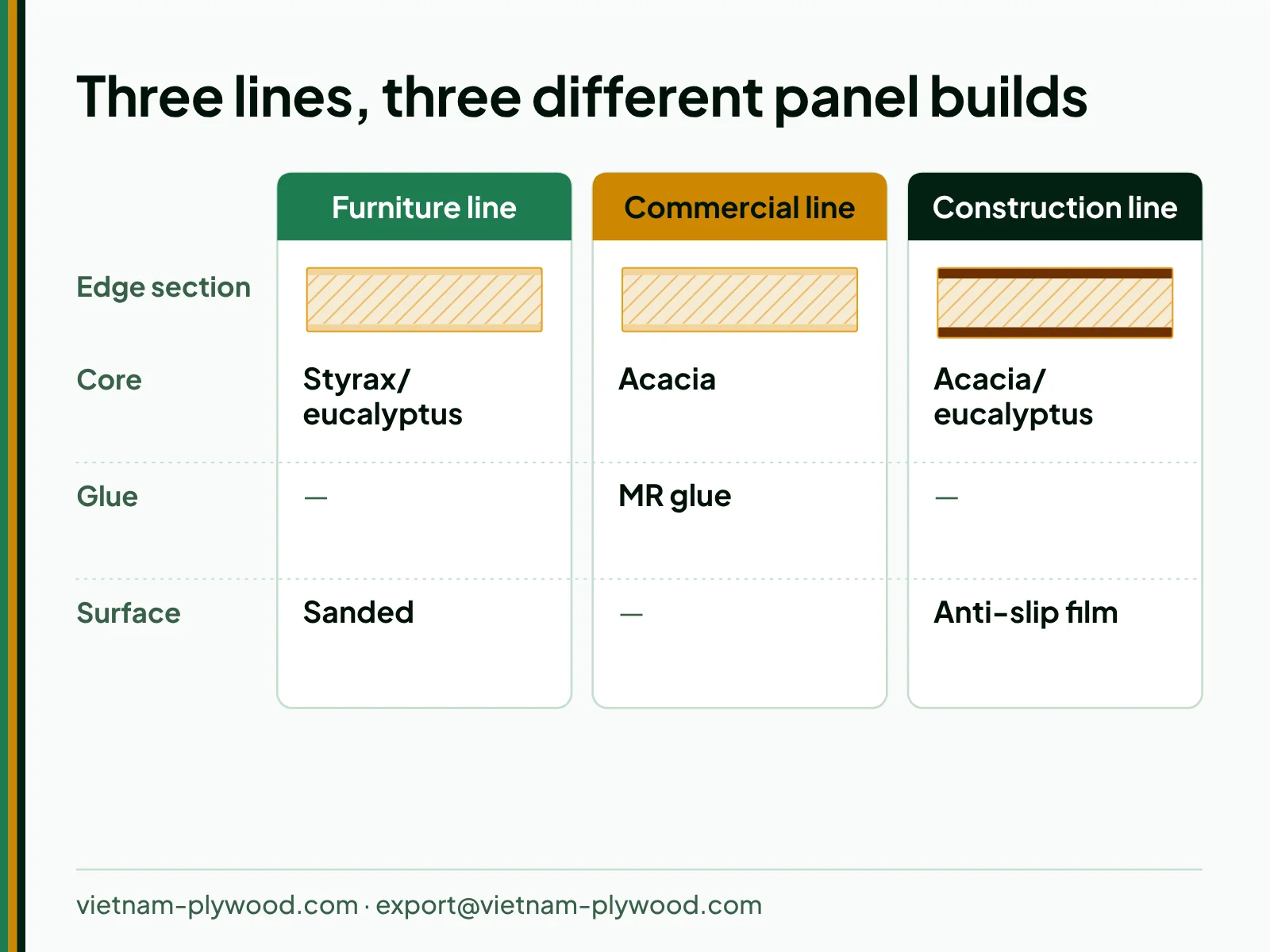
Our commercial and packing line makes acacia-core MR-glue panels with unsanded or light-sanded faces for crates and industrial packing. Our furniture line makes full-stitched, sanded styrax- or eucalyptus-core panels in E0 or E1 classes for furniture and cabinet work. Neither is a substitute for a textured trailer floor merely because the thickness matches.
HCPLY has three member factories in Phu Tho and Hai Phong. Each order is produced at the factory suited to its specification and shipped directly from the producing factory under FOB Hai Phong arrangements. Buyers can visit the factory office and inspect goods where production takes place.
Can buffalo board share a container with formwork or packing plywood?
Buffalo board trailer flooring can share a 40HC with formwork or packing plywood when the combined pallet plan stays within 28.5 t payload. The minimum order is one 40HC, and specifications can be mixed within that limit.
Consider the core-only 18 mm, 1220 × 2440 mm lookup. Acacia-core construction or packing panels weigh 31.08 kg per sheet, while eucalyptus-core construction panels weigh 34.83 kg. A planning example of 400 acacia sheets and 300 eucalyptus sheets gives 12.432 t plus 10.449 t, or 22.881 t before film, pallets and packing materials. That leaves 5.619 t to the payload ceiling before those additional masses; it is not a final loading approval.
For a complete loading plan, allocate pallet positions, calculate the weight of each finish and pallet, and check container floor loading as well as payload. The full reference for container sheet quantities covers single-specification loads. Our mixed-container arrangements explain how separate product specifications are coordinated. See also distributor supply programmes for recurring combinations.
What can the buyer inspect at the producing factory?
An inspector can compare the approved sample with the textured film, panel edges, dimensions and pallet labels at the producing factory. Agree the inspection method and sample selection before the run, especially where a trailer installer needs consistent surface orientation.
Check the mesh face for skips, tears and visibly uneven texture. Measure thickness across agreed points and check the ±0.5 mm construction tolerance; measure length and width against ±2 mm. Inspect edge condition and any specified cut-edge sealing. Verify the recorded core species, glue build and film designation against the production order and the agreed supporting test reports.
For a project demanding a measured slip coefficient, wear result or bending capacity, write the test method and acceptance threshold into the contract and request a test report for the agreed build. A visual mesh check cannot replace those measurements. Factory-member certificates, where applicable, are shown with factory details masked, on request.
What documents accompany the export order?
The shipment’s packing list identifies the shipped panel specifications and quantities; the commercial invoice and bill of lading support the commercial and transport record. A certificate of origin and applicable phytosanitary and fumigation papers accompany the shipment, with insurance under CIF.
For EU lots, the document package includes EUR.1 and the EUTR/EUDR file set. Order-specific certificate documents can include an FSC claim on sales documents, an emission certificate and test reports for the agreed build. After loading, the draft shipping documents come to you for approval.
HCPLY manages specification, on-site quality control, documents and loading. The invoice description should use the agreed technical build alongside any buffalo-board trade wording so that the order, inspection and shipment records identify the same product.
What drives a buffalo-board quotation?
The largest price distinction is usually the selected build and its performance requirements: a textured anti-slip film and phenolic glue require a different specification from raw MR-glue packing plywood. Next come core choice, thickness, cutting yield, surface acceptance requirements and the order’s mix of pallets.
A thicker panel consumes more core material per square metre. Custom cuts can increase waste and handling; tighter acceptance or additional tests add work. Request a quotation against the written specification rather than treating an unrelated commercial-plywood starting price as a buffalo-board price.
Factory lead time runs 15–45 days from receipt of the 30% deposit; the exact figure depends on order size, line loading and what the contract fixes. The remaining 70% is paid on the scan of the bill of lading, by T/T, or by irrevocable sight L/C. We ship FOB Hai Phong, or CFR (CNF) or CIF to your port. Samples cost nothing: a first-time buyer pays the courier, and that charge comes off the first confirmed order.
What should go into the trial-container request?
A trial-container request should contain the floor specification, an approved inspection basis and the exact mix of panel types. This lets the producing factory assess film availability, pallet planning and cutting against a written order.
Include the trailer’s support layout and fastening drawings if the panels will be installed directly into a vehicle. State whether the load also includes smooth formwork panels, packing panels or other agreed grades. Related plastic-coated plywood options and sign-board plywood have different surface duties and should carry separate line items.
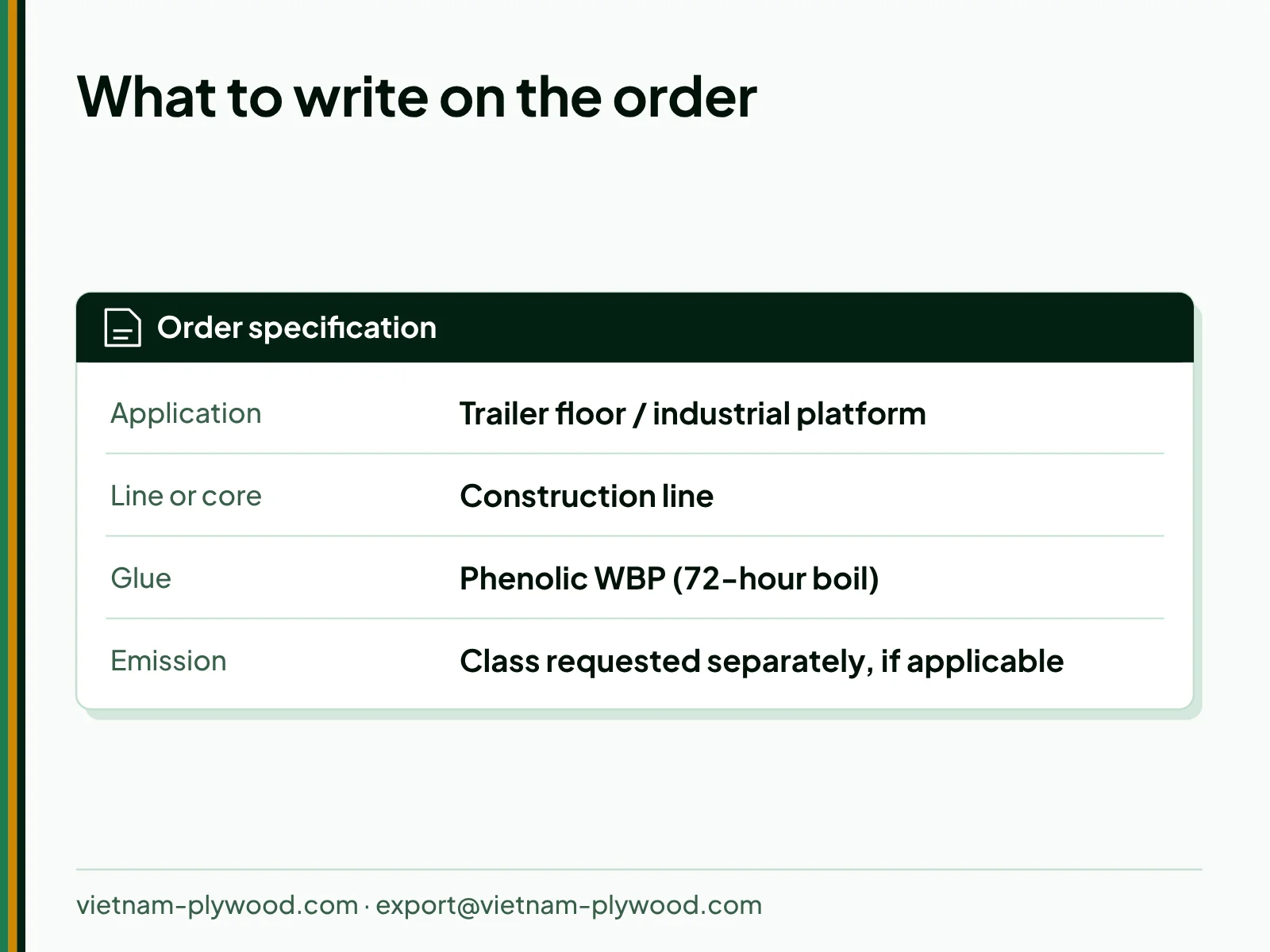
Send the following specification to Lucy at export@vietnam-plywood.com or through contact:
Application: Trailer floor / industrial platform; expected duty and support layout attached
Line or core: Construction line; acacia core (or eucalyptus core)
Glue: Phenolic WBP (72-hour boil)
Emission: Class requested separately, if applicable
Face and grade: 220 g/m² anti-slip mesh film; approved pattern and reverse finish
Thickness and tolerance: 18 mm; ±0.5 mm
Size: 1220 × 2440 mm; length/width ±2 mm; cutting drawing attached
Quantity: One 40HC trial load; itemized mixed-pallet schedule if needed
Destination port: [buyer to enter]
Next step: plan a trial container with the approved floor sample, inspection points and pallet mix.