





At HCPLY, a quote line that reads “18 mm plywood, 1220×2440” becomes a different panel on each line that presses it: sanded and full stitched, unsanded acacia with MR glue, or film-faced. Choose the wrong one and you pay for sanding you will never use, or a load built for another job is rejected at your yard. To compare plywood grades, compare the build fields, not the name.
This page sits with our other plywood buying guides. It answers the questions furniture and cabinet makers, fit-out firms, importers and distributors ask when two quotes carry the same thickness and face name but different prices. All numbers come from our production specification and the 40HC loading formula we use for every order.
How do furniture, commercial and construction grade plywood differ?
They differ in five build fields, not in the face name: core and repair, glue, emission class, sanding and tolerance, and surface. Our furniture line sands a full stitched styrax or eucalyptus core to ±0.2 or ±0.3 mm. Our commercial and packing line presses acacia with MR glue at ±0.5 mm. Our construction line puts film over acacia or eucalyptus.
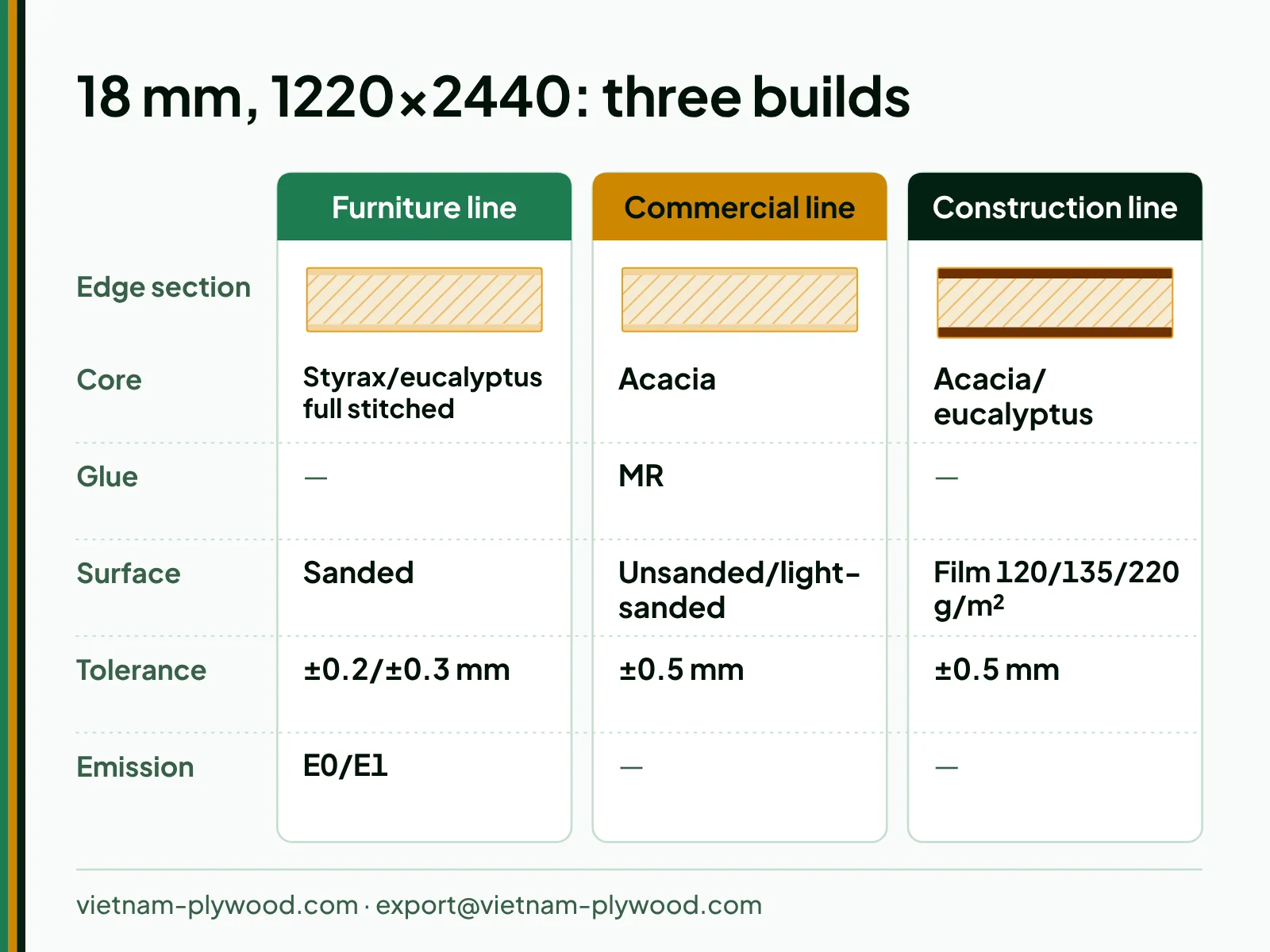
The table holds one size and thickness constant, 18 mm at 1220×2440 mm, and shows what each line builds. Weights and loads follow the core density, because the face adds only 0.2–0.4 mm of veneer per side.
| Metric (18 mm, 1220×2440 mm) | Our furniture line | Our commercial and packing line | Our construction line |
|---|---|---|---|
| Core species and density | Styrax 500 kg/m³ or eucalyptus 650 kg/m³ | Acacia 580 kg/m³ | Acacia 580 kg/m³ or eucalyptus 650 kg/m³ |
| Core construction | Full stitched | Written on the order (one of four steps, see below) | Written on the order |
| Glue and boil test | MR (12-hour boil) or WBP (72-hour boil), as ordered | MR, 12-hour boil | MR or WBP, as ordered; WBP for wet sites |
| Emission class | E0 or E1 | Class written on the order | Class written on the order |
| Surface | Sanded, face grade A or B | Unsanded or light-sanded | Unsanded core under film |
| Face or film | Bintangor, okoume, EV (engineered veneer), sapele, poplar, pine, eucalyptus; birch graded D/E/F | Same face species, or matt (unfaced raw core) | Film 120 g/m² standard, 135 g/m² premium, 220 g/m² anti-slip |
| Thickness tolerance | ±0.2 or ±0.3 mm | ±0.5 mm (packing ±0.5–1.0 mm) | ±0.5 mm |
| Hot-press temperature | 110–120 °C (MR) or 130–145 °C (WBP) | 110–120 °C | 110–120 °C (MR) or 130–145 °C (WBP) |
| Sheet weight | 26.8 kg (styrax) or 34.8 kg (eucalyptus) | 31.1 kg | 31.1 kg (acacia) or 34.8 kg (eucalyptus), before film |
| Full 40HC load | 990 sheets, 53.05 m³, 26.5 t (styrax) | 880 sheets, 47.15 m³, 27.4 t | 880 sheets (acacia) or 795 sheets, 42.60 m³, 27.7 t (eucalyptus) |
| Verdict by use | Visible furniture, cabinet carcasses, laminating substrate | Distributor stock, hidden parts, crates and packing | Concrete formwork, anti-slip floors and walkways |
The furniture and construction lines both list MR or WBP because glue is an order field on those lines. A cabinet maker in a dry interior rarely needs a 72-hour boil. A formwork yard does.
Why does the same thickness and face name differ from one line to another?
The face name describes two veneers of 0.2–0.4 mm each, while the line decides the other 17 mm or so of an 18 mm panel. We name a product by its face, but the density follows the core. An “18 mm okoume” sheet can weigh 26.8 kg on styrax or 34.8 kg on eucalyptus, and both are correctly called okoume.
Ply count follows the core veneer, not the face. Our core veneers run 1.4–2.0 mm, so an 18 mm panel carries 11–13 plies. Two quotes for 18 mm bintangor can differ by two plies and still both be honest.
One request shows how this works. Take “18 mm bintangor, 1220×2440, 2 containers”:
- On our furniture line it becomes a full stitched styrax core, sanded to ±0.2 mm, E1, face grade A. This fits a cabinet maker who edge-bands and sprays.
- On our commercial and packing line it becomes an acacia core with MR glue, light-sanded, ±0.5 mm. This fits a distributor selling general panels by the sheet.
- On our construction line bintangor is not the face at all. The line would quote a 120 g/m² film over acacia or eucalyptus, because a formwork buyer needs film, not veneer.
When a quote says only “bintangor 18 mm”, ask which of these three panels it describes. Our plywood manufacturer in Vietnam page lists what each of our three factories presses.
How does core repair change between plywood grades?
Core repair is the build difference you cannot see on the face. We rank core construction in four steps, best to lowest cost:
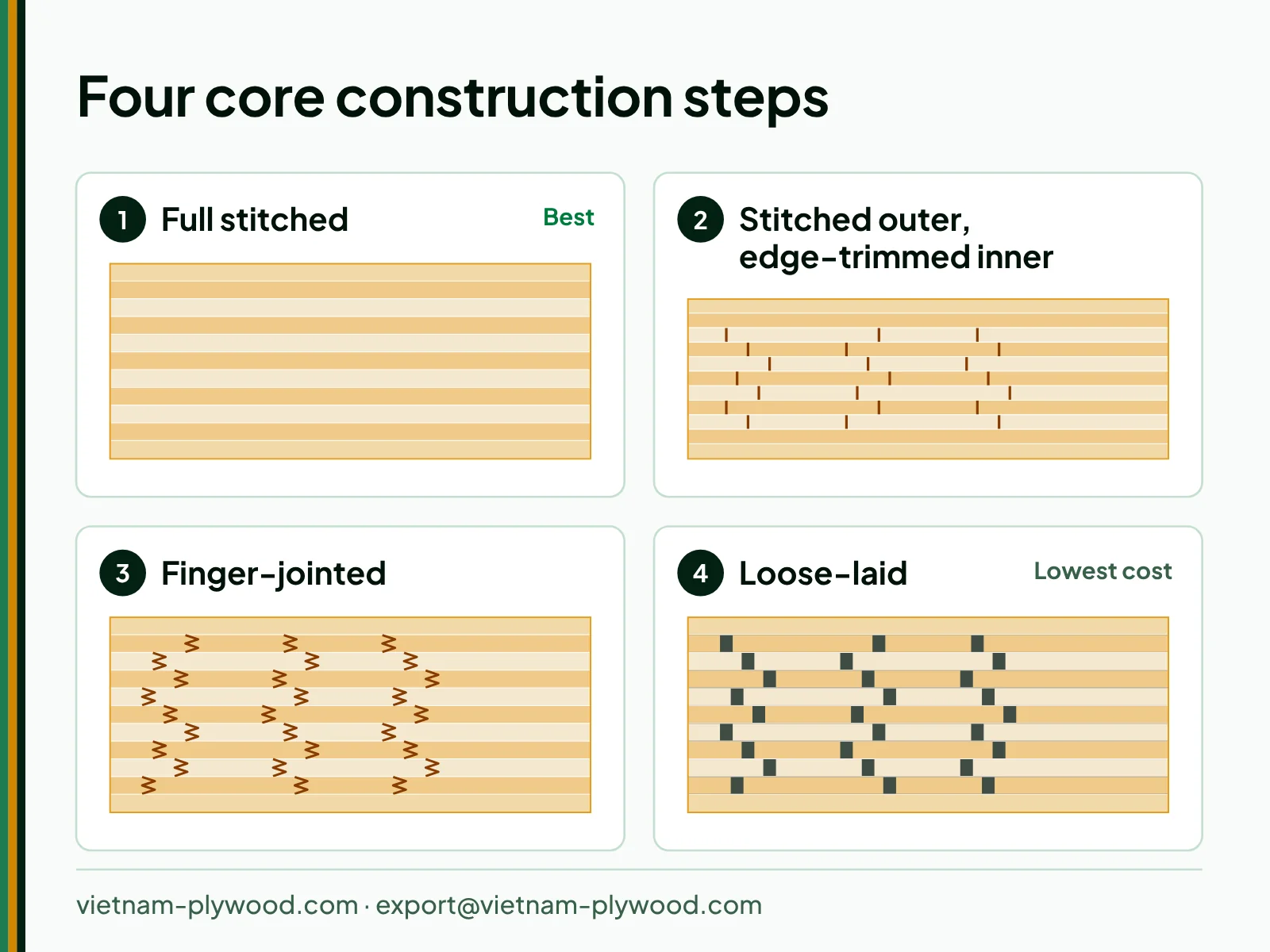
- Full stitched: every core sheet is stitched into one piece before laying.
- Stitched outer layers, edge-trimmed inner: the layers under the faces are stitched; inner layers are trimmed and butted.
- Finger-jointed: core pieces are joined end to end.
- Loose-laid: core pieces are laid side by side without joining.
Our furniture line builds full stitched cores. On the commercial and construction lines, the core construction is a field on the order, and it moves the price. Write the step you want by name.
The step matters most where the face is thin or the edge is exposed. Gaps in a loose-laid core can print through a 0.2 mm face after sanding or spraying. They show as voids when a CNC (computer numerical control) router cuts a part edge. They weaken screw holding near the edge of a cabinet side.
Laminating is a common reason to pay for step 1. Melamine paper and high-pressure laminate (HPL) faces are pressed over a substrate, and the substrate surface decides the finish. We do not offer melamine, HPL or laminate faces as a product line. Laminators buy the sanded, full stitched panel from our furniture line and press their own surface.
For crates and packing, step 3 or 4 is usually the right buy, because the panel is hidden and short-lived. Our packing or commercial plywood comparison covers that choice in detail.
How do glue and emission class differ on a quote?
Glue and emission are two separate fields, and a quote that merges them is incomplete. Glue says how the bond survives water. Emission class says how much formaldehyde the finished panel releases.
Glue. We press two glue systems:
- MR (moisture resistant, melamine glue): passes a 12-hour boil; pressed at 110–120 °C. Our commercial and packing line uses it.
- WBP (weather and boil proof, phenolic glue): passes a 72-hour boil; pressed at 130–145 °C. The higher press temperature and the phenolic resin both add cost.
Emission. E0, E1 and E2 are emission classes. They describe the panel, so a quote line reading “E0 glue” mixes two fields. Our furniture line builds to E0 or E1.
CARB P2 / TSCA Title VI is a US limit, not a class, and it needs third-party certification. Under 40 CFR 770.10, the US EPA rule in force since 1 June 2018, hardwood plywood with a veneer core or composite core is held to 0.05 ppm formaldehyde, tested by ASTM E1333-14. The same 2018 rule defines hardwood plywood as a panel intended for interior use. US cabinet and furniture importers therefore buy against that limit.
FSC, CARB P2, ISO 9001 and CE certificates, and EUDR and EUTR documents, belong to our member factories. They are shown with factory details masked, on request.
What does thickness tolerance change for a cabinet or CNC shop?
Tolerance sets the spread of thickness across a stack, and that spread decides whether grooves, hinges and edge banding fit without rework. At 18 mm, a ±0.2 mm panel runs 17.8–18.2 mm, a spread of 0.4 mm. A ±0.5 mm panel runs 17.5–18.5 mm, a spread of 1.0 mm.
| Line | Tolerance on thickness | 18 mm panel range | Spread | Fits |
|---|---|---|---|---|
| Furniture, sanded | ±0.2 mm | 17.8–18.2 mm | 0.4 mm | Grooved joints, CNC nesting, hinge boring |
| Furniture, sanded | ±0.3 mm | 17.7–18.3 mm | 0.6 mm | Carcasses with screwed joints |
| Commercial | ±0.5 mm | 17.5–18.5 mm | 1.0 mm | Backing, hidden parts, general stock |
| Film-faced | ±0.5 mm | 17.5–18.5 mm | 1.0 mm | Formwork, floors |
| Packing | ±0.5–1.0 mm | 17.0–19.0 mm at ±1.0 | up to 2.0 mm | Crates, pallets |
Length and width hold ±2 mm on every line. Standard sizes are 1220×2440, 1250×2500, 1220×2135, 1220×1830, 915×2440, 915×2135 and 915×1830 mm, and we cut custom sizes.
A cabinet shop cutting 18 mm housings for shelves feels the difference first: at a 1.0 mm spread, some shelves bind and others rattle. If the job needs ±0.2 mm, write ±0.2 mm. A sanded panel ordered at ±0.3 mm is built to ±0.3 mm.
Which plywood grade fits which use?
Match the line to the use first, then set core, glue and face inside that line. The matrix below gives our verdict for the uses our buyers name most often.
| Use | Line | Core | Glue | Surface | Tolerance | Verdict |
|---|---|---|---|---|---|---|
| Visible furniture panels, stained or clear | Furniture | Styrax or eucalyptus, full stitched | MR | Sanded, face A | ±0.2 mm | Furniture line only |
| Cabinet carcasses, painted | Furniture | Styrax (lighter) | MR | Sanded, face B | ±0.3 mm | Furniture line, face B saves cost |
| Laminating substrate | Furniture | Full stitched | MR | Sanded | ±0.2 mm | Furniture line; buyer presses the laminate |
| Distributor stock, general joinery | Commercial | Acacia | MR | Light-sanded | ±0.5 mm | Commercial line |
| Crates, pallets, export packing | Commercial and packing | Acacia | MR | Unsanded, matt | ±0.5–1.0 mm | Packing grade |
| Concrete formwork | Construction | Acacia or eucalyptus | WBP | 120 or 135 g/m² film | ±0.5 mm | Construction line |
| Trailer floors, walkways | Construction | Eucalyptus or acacia | WBP | 220 g/m² anti-slip film | ±0.5 mm | Construction line |
Choose styrax when sheet weight matters to the installer and the container; choose eucalyptus when you want a denser panel. Any structural use, such as a load rating for a floor, is quoted only against a test report the buyer accepts.
Some products sit outside all of our factories. We do not press MDF, OSB, chipboard, blockboard, bamboo, MDO or HDO, 3-ply spruce panels or birch-core plywood. Birch appears on our panels only as a face veneer, graded D, E or F.
How do prices step up from commercial to furniture to construction plywood?
At a given thickness, the commercial line sits at the bottom of the ladder, and each field you add moves the panel up. The furniture line adds a full stitched core, sanding, a tighter tolerance and an E0 or E1 build. The construction line adds film and, for wet sites, phenolic glue pressed at 130–145 °C.
Whether an 18 mm film-faced panel prices above or below an 18 mm furniture panel turns on three fields: the furniture face species and grade, the core species on each, and the film weight (120, 135 or 220 g/m²). HCPLY gives a dated price per m³ free on board (FOB) Hai Phong once those fields are written down. We do not publish a ladder of prices.
The cost drivers, in the order we read them on a quote:
- Line and core construction: full stitched against loose-laid.
- Glue: WBP against MR.
- Face: species and grade A against B; film weight on the construction line.
- Finish and tolerance: sanded to ±0.2 mm against unsanded at ±0.5 mm.
- Emission class: E0 against E1 or E2; CARB P2 / TSCA Title VI where the US market needs it.
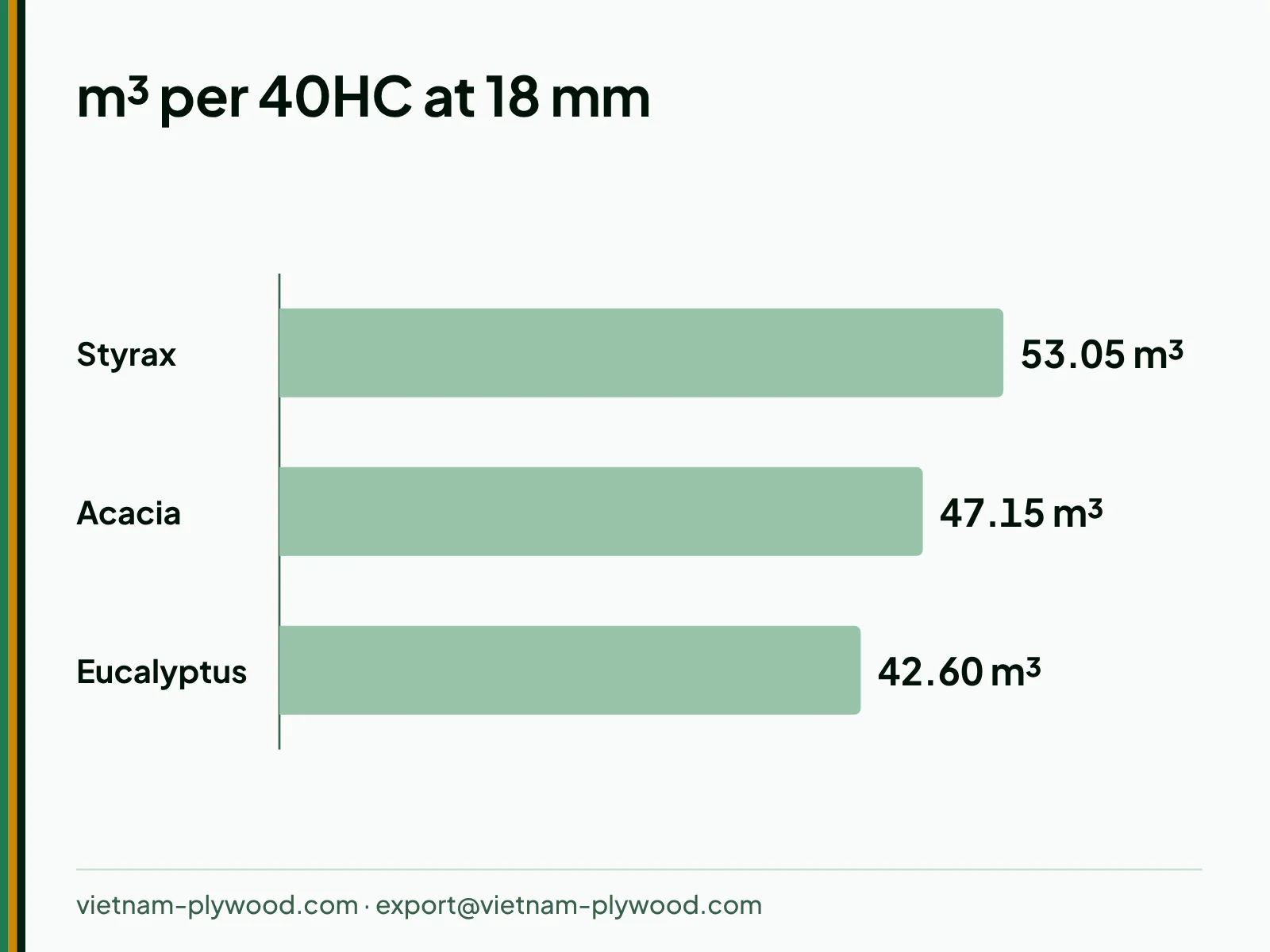
Freight per m³ is the cost buyers forget. A 40HC carries 53.05 m³ of 18 mm styrax panels but only 47.15 m³ on acacia and 42.60 m³ on eucalyptus, because the 28.5 t payload limit binds first on the denser cores. Spread one freight bill over those volumes and the per-m³ freight on acacia is about 12.5% higher than on styrax, and about 24.5% higher on eucalyptus.
What can share one 40HC with a grade comparison order?
All three grades can share one 40HC, as long as the combined weight stays under the 28.5 t payload limit. Our minimum order is one 40HC, and specifications can be mixed in it. A distributor testing grades side by side often loads one block from each line.
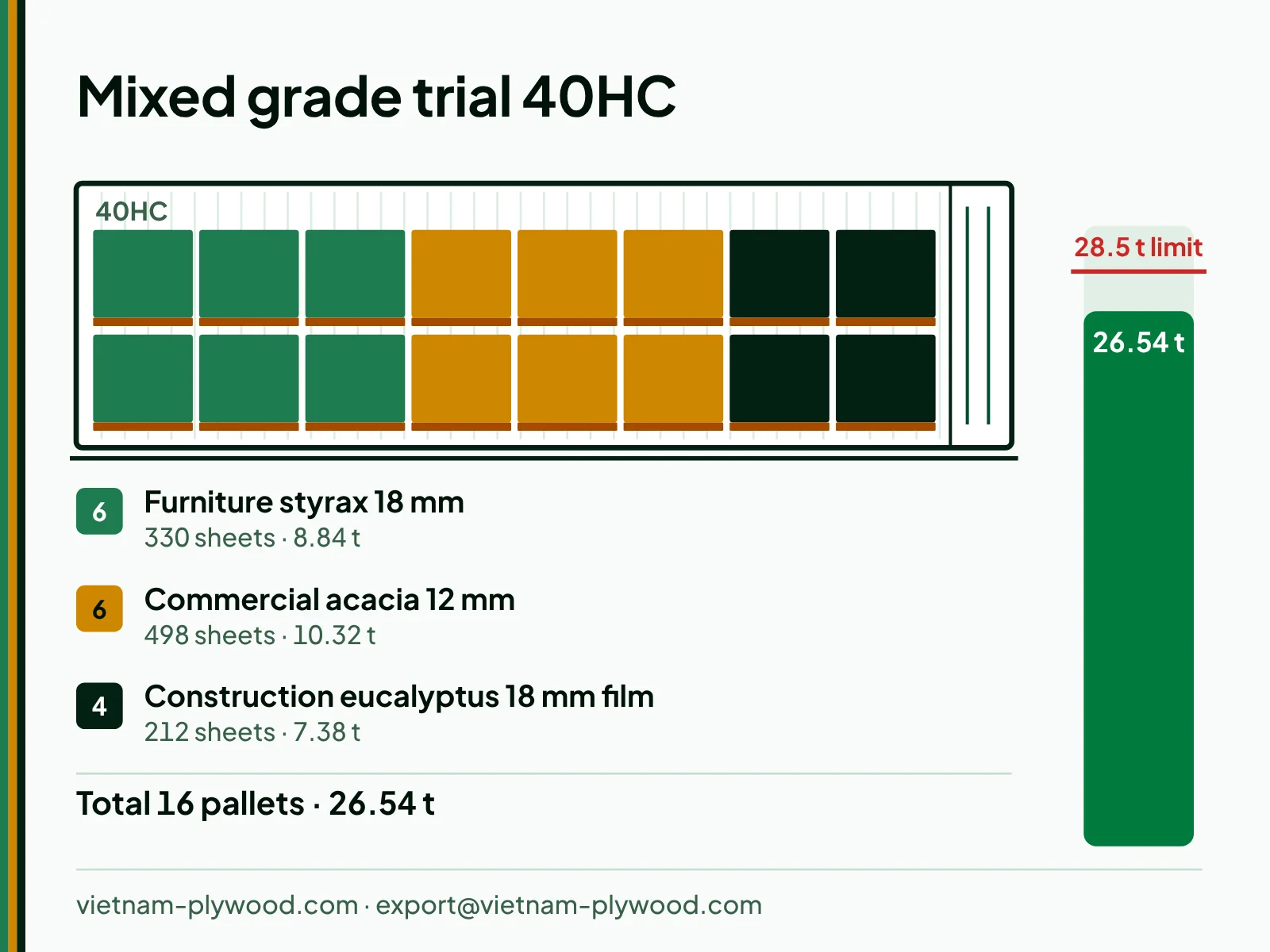
A mixed load we would plan for an importer comparing grades, all 1220×2440 mm:
| Block | Line and core | Thickness | Pallets | Sheets per pallet | Sheets | m³ | Tonnes |
|---|---|---|---|---|---|---|---|
| A | Furniture, styrax | 18 mm | 6 | 55 | 330 | 17.68 | 8.84 |
| B | Commercial, acacia | 12 mm | 6 | 83 | 498 | 17.79 | 10.32 |
| C | Construction, eucalyptus | 18 mm | 4 | 53 | 212 | 11.36 | 7.38 |
| Total | 16 | 1,040 | 46.83 | 26.54 |
The arithmetic follows our loading formula. Sheets per pallet = floor(stack height ÷ thickness): 1000 ÷ 18 = 55 for styrax, 1000 ÷ 12 = 83 for acacia, 970 ÷ 18 = 53 for eucalyptus. Volume = sheets × 1.22 × 2.44 × thickness in metres. Tonnes = m³ × core density ÷ 1000.
The load lands at 26.54 t, 1.96 t under the limit. Our figures use core density only. Film, glue lines and pallet timber add weight we do not count here, so we keep that margin rather than add a seventh pallet of styrax, which would take the load to 28.0 t.
Distributors who want the same mix every month can set it up as a supply programme. Our plywood supply programmes for distributors page explains how. On capacity: furniture and commercial plywood up to 100 containers a month; construction plywood up to 140.
How do you compare plywood grades on a quote?
Compare plywood grades field by field, never by product name or price per sheet. Put two quotes side by side and check that each names the line or core, core construction, glue with its boil test, emission class, face and grade or film weight, thickness tolerance, size and sheets per 40HC. A missing field is where the price gap hides.
Work through the quote in this order:
- Core species. Acacia, eucalyptus or styrax. A density that does not match the stated core (580, 650 or 500 kg/m³) is a warning.
- Core construction. One of the four steps, by name. “Good core” is not a step.
- Glue. MR or WBP, with 12-hour or 72-hour boil written next to it.
- Emission class. E0, E1 or E2, written apart from the glue. If the quote says “E0 glue”, ask for both fields again.
- Face and grade. Species and grade A or B; birch D, E or F; for film-faced, the film weight in g/m².
- Surface and tolerance. Sanded or unsanded, and the tolerance in mm. A furniture panel without a tolerance is not a furniture spec.
- Size. Length × width, with ±2 mm.
- Load. Sheets per pallet, pallets, sheets, m³ and tonnes per 40HC. Check them with the formula above; a load above 28.5 t will not ship.
If two quotes still differ after all eight fields match, compare the supplier, not the panel. Our plywood supplier evaluation checklist covers that step.
How do US letter grades and stamps map to our grades?
US letter grades describe face appearance, while our grades describe the full build, so a direct one-to-one match does not exist. US grading uses A to D faces for softwood and codes such as A-1 for hardwood, where the letter is the face and the number the back. Our order uses face grade A or B, and lists the back separately.
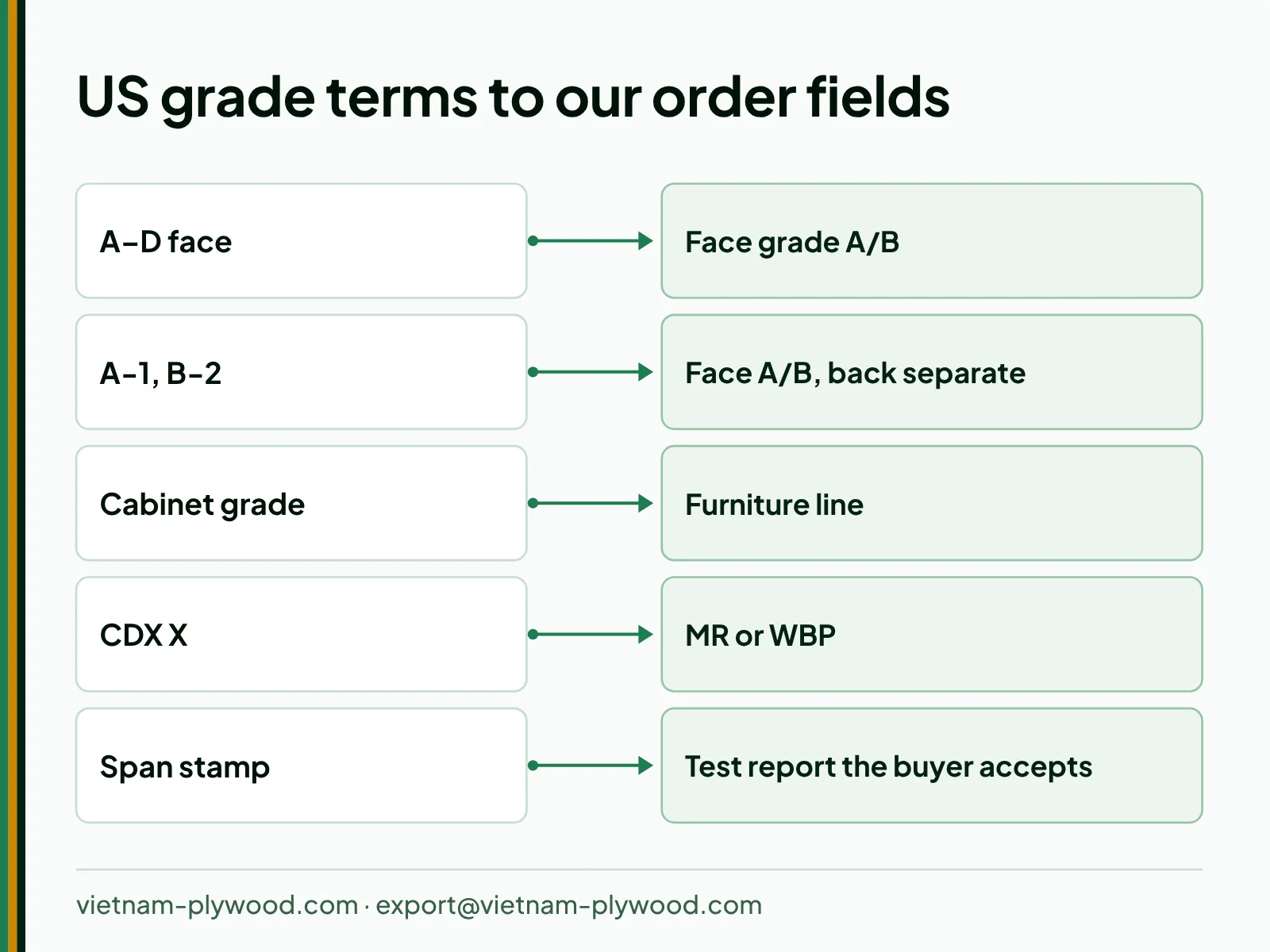
| Term on a US quote | What it describes | Field on our order |
|---|---|---|
| A, B, C, D face | Face appearance | Face grade A or B; birch D, E or F |
| A-1, B-2 (hardwood) | Face letter, back number | Face grade A or B; back written separately |
| ”Cabinet grade” | A buying category | Furniture line, full stitched, sanded, tolerance in mm |
| X in CDX, “exterior” | Bond durability | Glue: MR (12-hour boil) or WBP (72-hour boil) |
| Span rating, structural stamp | Load performance | Not stamped by us; only against a test report the buyer accepts |
| Veneer, MDF or particleboard core | Core type | Veneer core only: acacia, eucalyptus or styrax |
| CARB P2 / TSCA Title VI label | US emission limit | Emission field; certificates masked, on request |
We do not apply APA or PS 1 stamps or HPVA grades to our panels. A US buyer who needs a stamped structural panel should buy it from a producer that stamps it. A buyer who needs a cabinet panel can specify ours field by field.
What can you witness at the producing factory?
A buyer or inspector can witness every build field at the producing factory, before loading. Buyers visit the HCPLY factory office and inspect goods at the factory that pressed them. These are the checks that separate one grade from another:
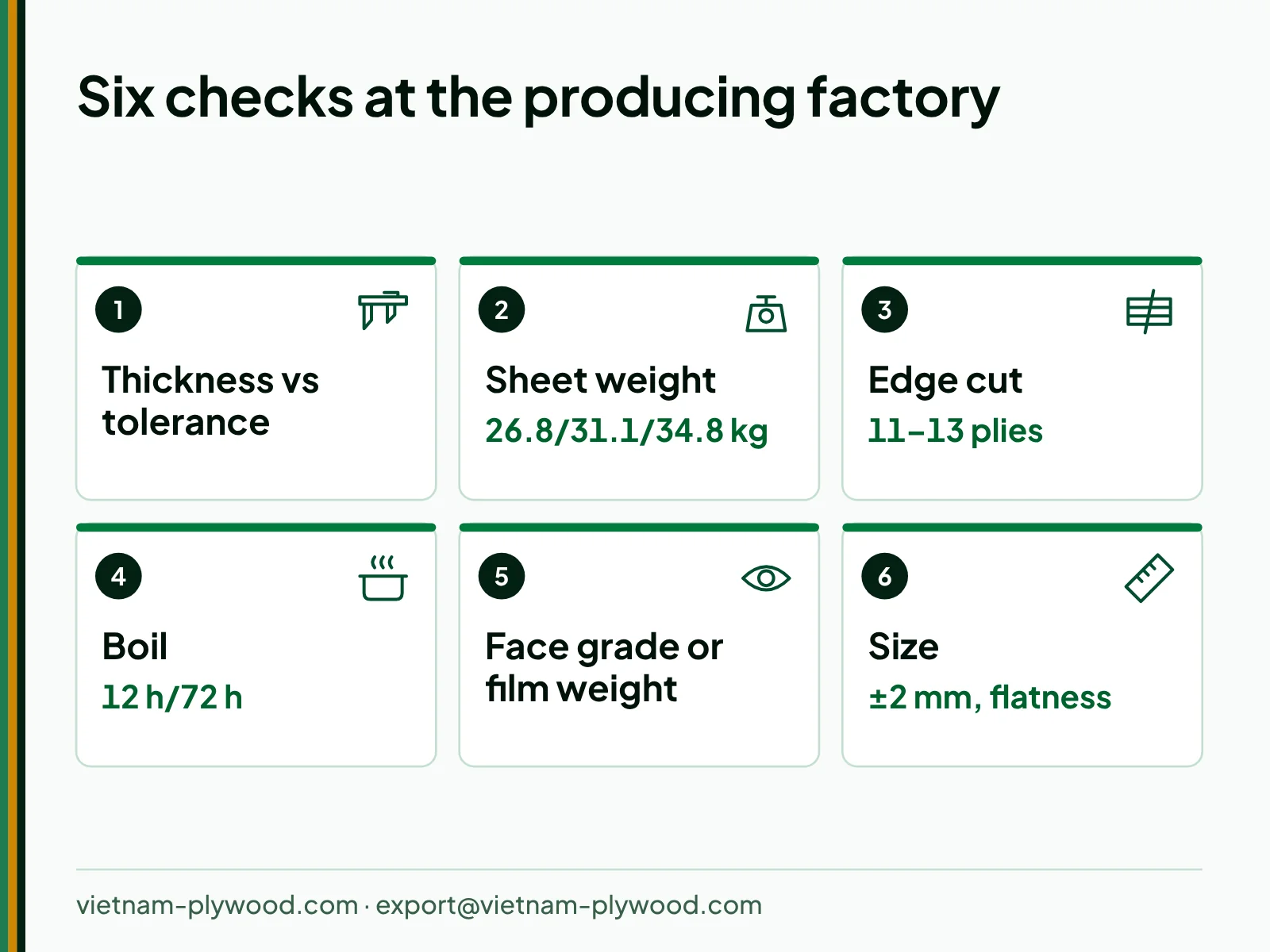
- Thickness. Measure several points per sheet against the ordered tolerance: ±0.2 or ±0.3 mm for furniture, ±0.5 mm for commercial and film-faced.
- Sheet weight. Weigh a sheet and compare it with core density. An 18 mm 1220×2440 sheet should weigh about 26.8 kg on styrax, 31.1 kg on acacia and 34.8 kg on eucalyptus. A styrax order that weighs like eucalyptus has the wrong core.
- Edge cut. Cut a sheet and count plies: 11–13 at 18 mm. Look for core gaps that show which of the four core steps was built.
- Boil test. Boil a bonded sample for 12 hours (MR) or 72 hours (WBP) and check the glue line.
- Face or film. Check face grade A or B on sanded sheets in raking light; on film-faced, check the film weight ordered.
- Size and flatness. Measure length and width against ±2 mm, and sight along the long edge for bow.
Run the same checks on every repeat order, and drift between containers shows up before loading, not at your yard. Our page on consistent plywood quality on repeat orders sets out how we hold a specification over time.
How do you start a grade comparison with us?
Start with free samples from each line you are considering, then plan a trial container that mixes them. Our minimum order is one 40HC, shipped FOB Hai Phong directly from the producing factory. The plywood order calendar shows how to time a first order around your season.
Send the specification in the form below, one block per grade. Lucy handles export enquiries at export@vietnam-plywood.com, or use the contact page.
Application:      cabinet carcasses, painted
Line / core:      furniture line, styrax, full stitched
Glue:             MR (12-hour boil)
Emission:         E1
Face and grade:   okoume, face B, back written separately
Thickness / tol.: 18 mm, ±0.3 mm, sanded
Size:             1220×2440 mm, ±2 mm
Quantity:         6 pallets (330 sheets) in a mixed 40HC
Destination port: [your port], FOB Hai Phong

Application:      concrete formwork
Line / core:      construction line, eucalyptus
Glue:             WBP (72-hour boil)
Emission:         E1
Face and grade:   film 135 g/m², both sides
Thickness / tol.: 18 mm, ±0.5 mm
Size:             1220×2440 mm, ±2 mm
Quantity:         4 pallets (212 sheets) in the same 40HC
Destination port: [your port], FOB Hai Phong
Next step: send these lines to Lucy and plan a trial container that puts each grade you are comparing into one 40HC.