





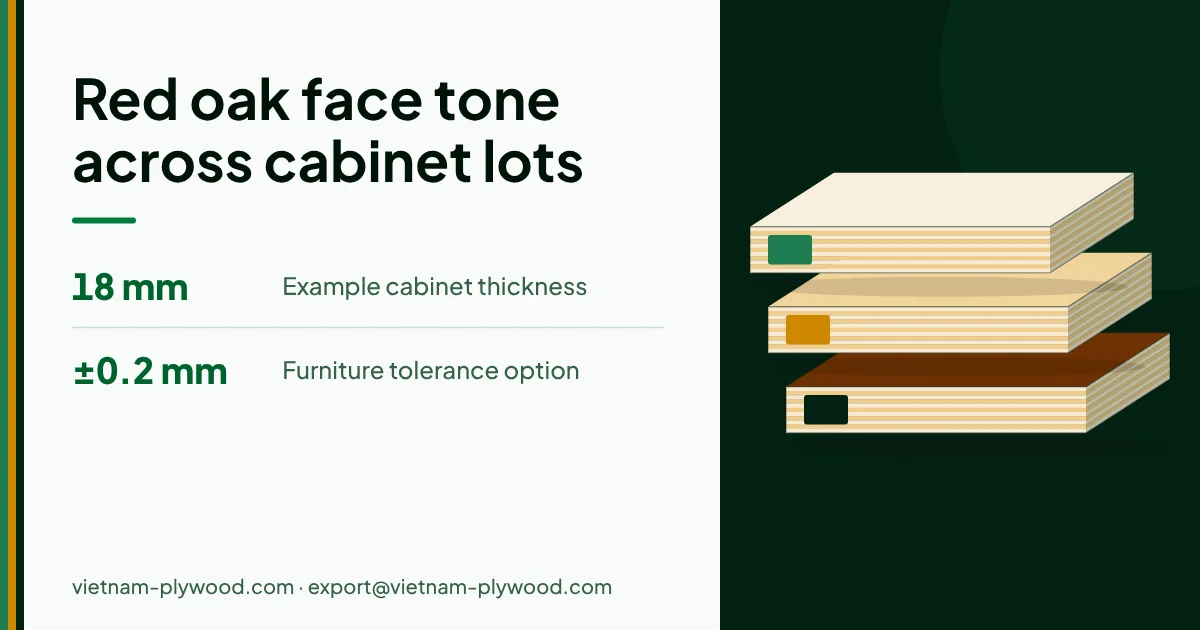
Red oak plywood for US cabinet programs needs a controlled pink-brown face range across production lots. A mismatched replacement lot can cost a cabinet maker rejected doors, re-finishing expense and production days. HCPLY specifies natural or engineered red oak appearances through the furniture line, then checks face samples and packed lots against the buyer’s agreed reference.
What is red oak plywood?
Red oak plywood is a veneer-faced panel specified for the open grain and pink-brown appearance associated with the red oak group. In cabinet work, the visible face controls the look, while the internal core controls much of the sheet weight and machining behavior. HCPLY discusses red oak as a face selection for our furniture line, with natural veneer and an engineered veneer (EV) red oak appearance considered against the buyer’s approved sample.
The USDA Forest Service Wood Handbook chapter (2010) describes commercially important woods and their uses. Natural color and grain differences mean that “red oak” alone cannot establish a repeatable cabinet-door color. Buyers should approve a color range, grain figure and finish sample rather than a species name alone.
For the broader face selection, see oak and hardwood veneer plywood.
Natural red oak face or EV red oak face: which matches the job?
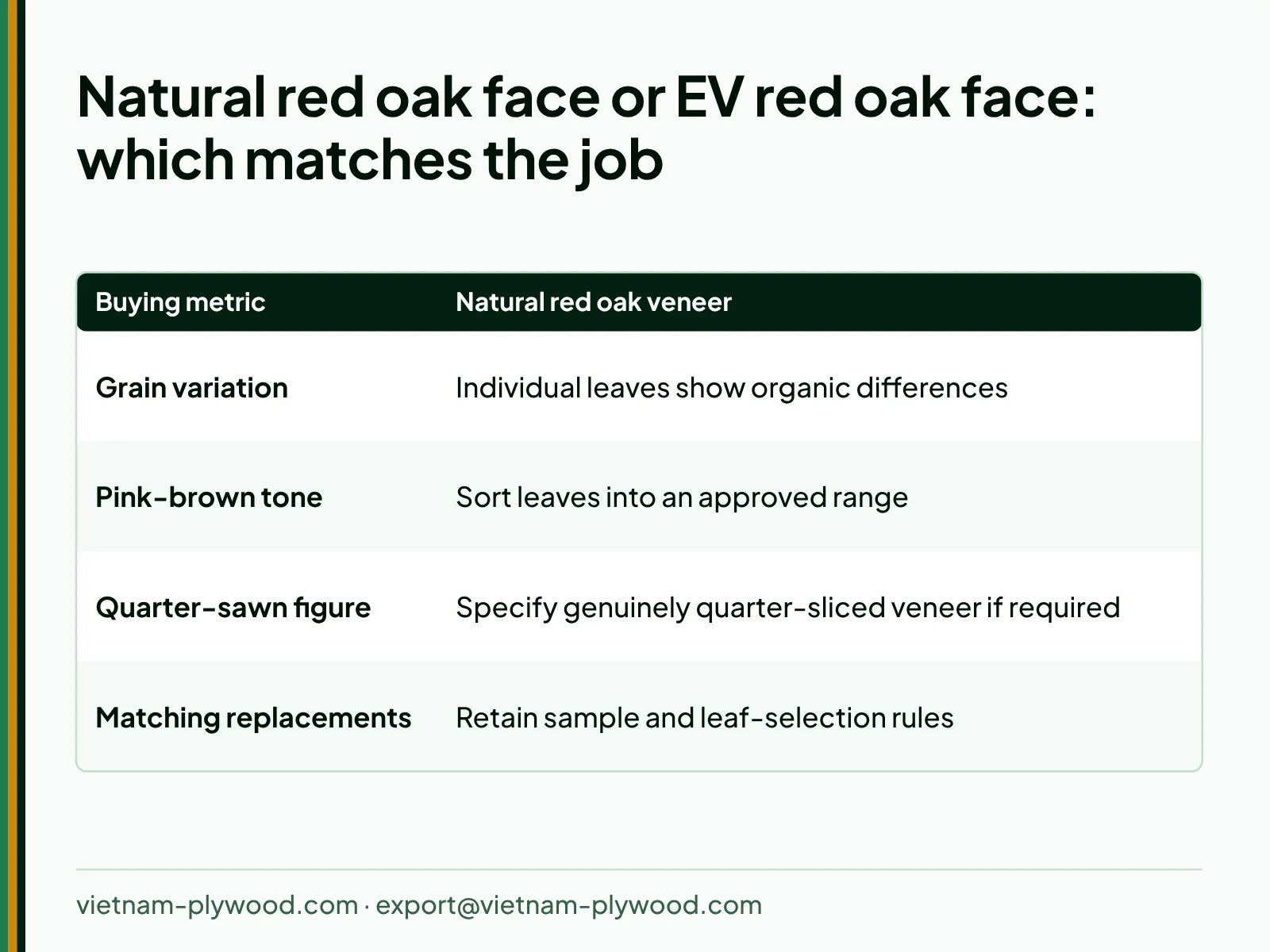
Natural red oak veneer is selected for its real wood grain and variation between leaves. An EV red oak appearance uses engineered veneer to create a more repeatable visual pattern. Both require an agreed reference sample: repeatability of pattern is different from an identical finished color.
| Buying metric | Natural red oak veneer | EV red oak appearance | Verdict by use |
|---|---|---|---|
| Grain variation | Individual leaves show organic differences | Designed grain sequence can repeat | Natural for character; EV for repeated runs |
| Pink-brown tone | Sort leaves into an approved range | Compare engineered face against a controlled reference | EV for tighter visual grouping |
| Quarter-sawn figure | Specify genuinely quarter-sliced veneer if required | Specify a quarter-sawn look in the pattern | Natural for authentic ray figure; EV for a uniform visual brief |
| Matching replacements | Retain sample and leaf-selection rules | Retain approved pattern and color reference | EV for repeated cabinet programs |
| Inspection | Check actual veneer sheets and pressed panels | Check pattern repeat and pressed-panel tone | Both need physical approval |
Approve physical samples under intended lighting and finish. EV is explained further in EV plywood from Vietnam.
How is the pink-brown tone held across production lots?
The working control is an approved range of face samples and a recorded inspection sequence. A single attractive sample cannot represent every permissible face in a shipment. We recommend signing off both a lighter and a darker acceptable boundary, together with a grain example and a rejected example.
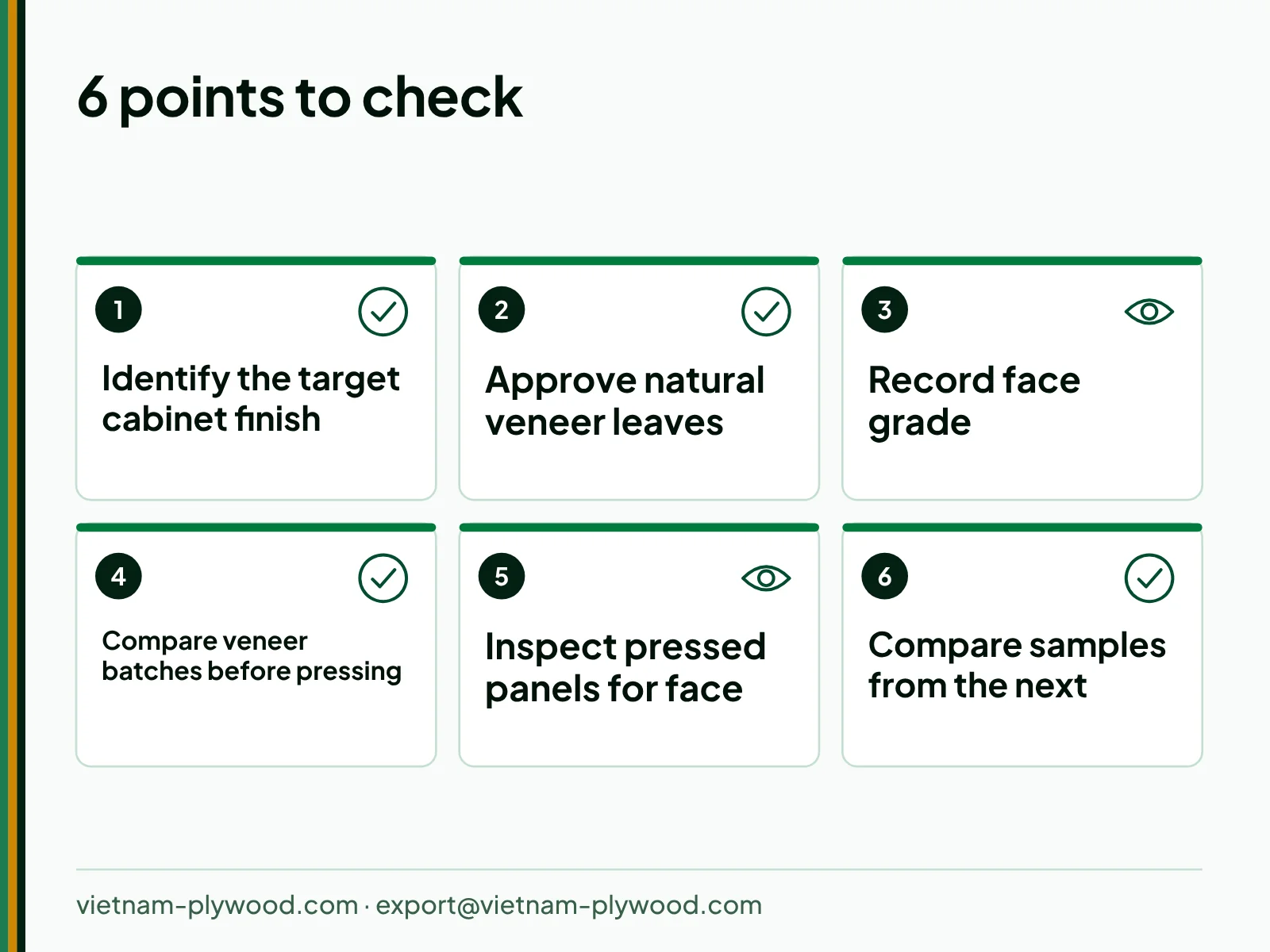
- Identify the target cabinet finish and whether the face will receive a clear coat, stain or opaque coating.
- Approve natural veneer leaves or an EV pattern against the same color reference under agreed lighting.
- Record face grade, grain orientation and allowable sapwood contrast in the written order.
- Compare veneer batches before pressing and retain the approved physical reference at the producing factory.
- Inspect pressed panels for face mismatch, glue marks, sanding marks and veneer defects before packing.
- Compare samples from the next production lot against the original approved range, rather than against a newly chosen sample.
Approve the intended finish on the actual face, including edge treatment. The decorative veneer faces overview helps define the visual vocabulary before an order is released.
Can a quarter-sawn red oak look be ordered on plywood?
A quarter-sawn red oak look can be specified as a visual requirement, with natural quarter-sliced veneer or an engineered pattern proposed against the approved sample. A true quarter-sliced face can show prominent ray fleck; a printed or engineered visual resemblance does not establish the veneer’s cutting method.
For a cabinet program, the purchasing specification should distinguish straight grain, ray-fleck intensity, veneer matching and acceptable panel-to-panel movement. “Quarter sawn red oak plywood” by itself leaves these decisions open.
Ask for a full-sheet face layout, not merely a small square sample. On tall cabinet ends, repeating grain can be more visible than on narrow doors. Where adjacent doors form a continuous bank, agree whether sequence matching is required before veneer selection. This is an appearance specification and should not be confused with a structural grading claim.
Which factory line builds a red oak cabinet panel?
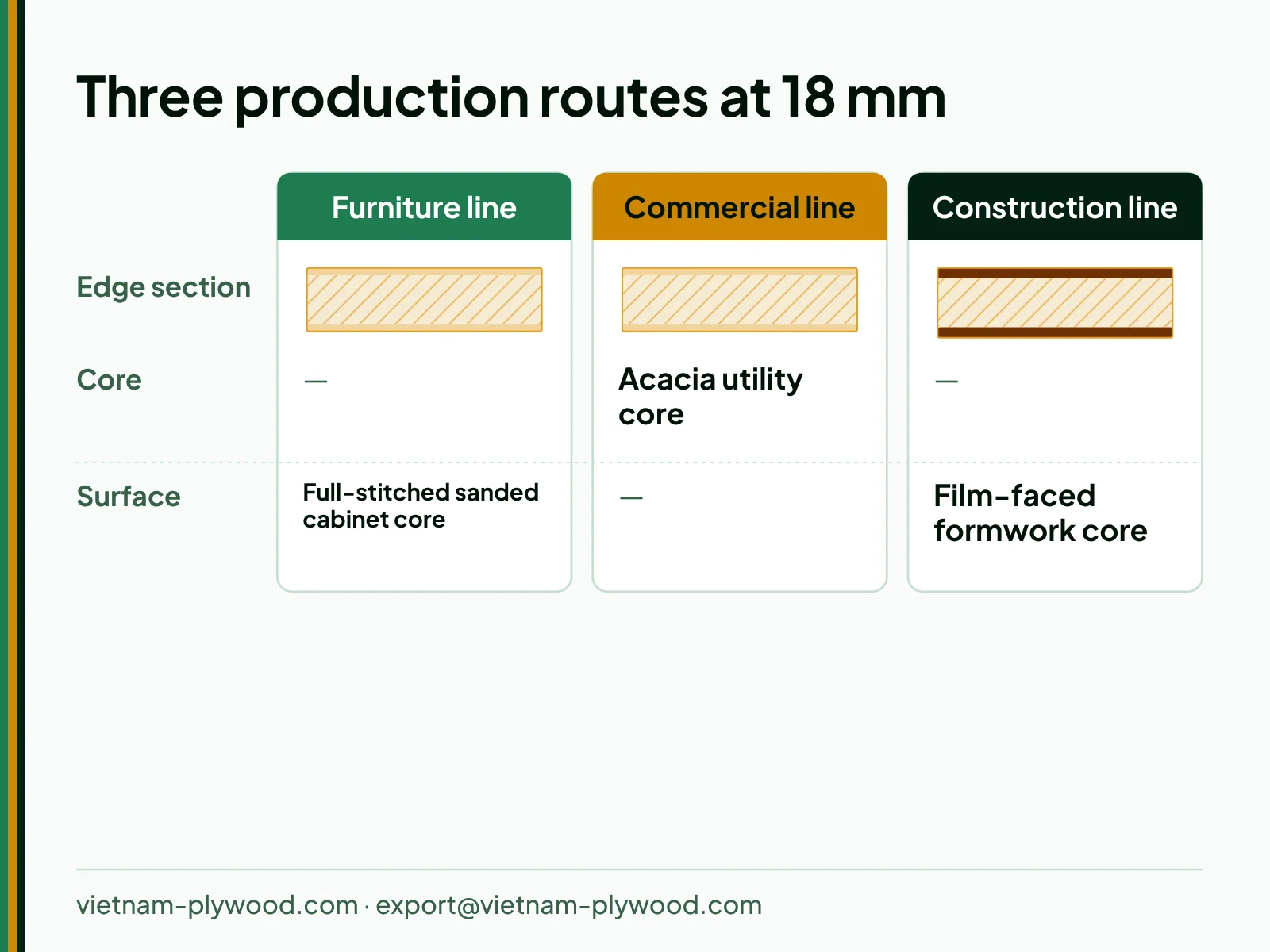
Our furniture line is the appropriate route for a decorative cabinet panel: styrax or eucalyptus core, full-stitched construction, sanding and an E0 or E1 emission class as ordered. The commercial and packing line builds acacia-core MR-glue panels for utility or packing needs; our construction line builds film-faced panels for formwork. The latter two are different products, even when a buyer asks for the same nominal thickness.
| Line | Example 18 mm build | Surface and tolerance | Appropriate purchasing use |
|---|---|---|---|
| Furniture | Styrax or eucalyptus, full stitched | Sanded; ±0.2 or ±0.3 mm as ordered | Visible cabinet parts |
| Commercial and packing | Acacia, MR glue | Unsanded or light-sanded; commercial ±0.5 mm | Concealed utility or packing panels |
| Construction | Acacia or eucalyptus, film face | Unsanded; ±0.5 mm | Concrete formwork |
The face names the decorative product; it does not change the core density. For other line choices see plywood grades across factory lines. HCPLY produces each order at the line suited to the written specification, with on-site quality control and direct dispatch from that factory.
Can red oak ship with white oak or other faces?
Yes. A minimum order is one 40HC container, and different specifications can share it within the 28.5 t payload limit. A furniture order can group red oak appearance panels with white oak veneer plywood or other decorative faces when the approved builds and packing plan are compatible.
For a 1220 × 2440 × 18 mm furniture panel, the core-based lookup gives 26.79 kg per styrax sheet and 34.83 kg per eucalyptus sheet. A full styrax load is 990 sheets, 53.05 m³ and 26.52 t; a full eucalyptus load is 795 sheets, 42.60 m³ and 27.69 t. These figures exclude added face or packaging weight, so the actual mixed loading plan must check the packed gross weight.
A mixed load needs compatible pallet heights, segregation labels and an accurate packing list. Ask for a pallet-by-pallet loading plan that records each face, core and thickness, then check the packed gross weight against the container payload limit. The container loading reference covers full-load calculations.
Which core, glue and emission fields belong on the order?
For cabinet faces, start with the furniture line’s full-stitched styrax or eucalyptus core. Styrax has a core density of 500 kg/m³ and eucalyptus 650 kg/m³. The resulting handling weights differ, even if both panels display the same red oak face. A cut edge sample helps buyers assess voids and veneer alignment.
Glue and formaldehyde emission must be written as separate fields. Melamine MR glue is associated with a 12-hour boil specification, while phenolic weather-and-boil-proof (WBP) glue has a 72-hour boil specification. E0 and E1 are emission classes for the furniture line. For U.S. orders, CARB Phase 2 and TSCA Title VI are regulatory emission requirements involving third-party certification, not names for glue.
Specify the market requirement and request the relevant factory documentation for the actual order. Certificates belonging to member factories, including CARB P2, are shown with factory details masked, on request. Do not infer an emission result from a veneer color or from the glue name.
What sheet size and thickness should cabinet makers specify?
The common cabinet format is 1220 × 2440 mm, with other available formats including 1250 × 2500 and 915 × 2440 mm. Thicknesses run from 3 to 40 mm; common selections include 9, 12, 15, 18 and 25 mm. Custom cutting is available, so the cut list should state the actual dimensions required by the machining program.
For a sanded furniture panel, specify either ±0.2 mm or ±0.3 mm thickness tolerance in the order. Length and width tolerance is ±2 mm. An 18 mm panel has 11–13 plies, reflecting the thickness of the individual core veneers. The visible face veneer is commonly 0.2–0.4 mm, making sanding control particularly relevant.
Confirm which edges will remain visible, which will receive edging and where the panel will be routed or drilled. Inspect cut edges for gaps after machining.
What should the buyer inspect at the producing factory?
The buyer or appointed inspector can witness face selection, core construction, sanding and packed-lot identification at the producing factory. HCPLY arranges visits to the factory office and inspection where the goods are made. The acceptance record should connect the physical sample to the purchase-order specification.
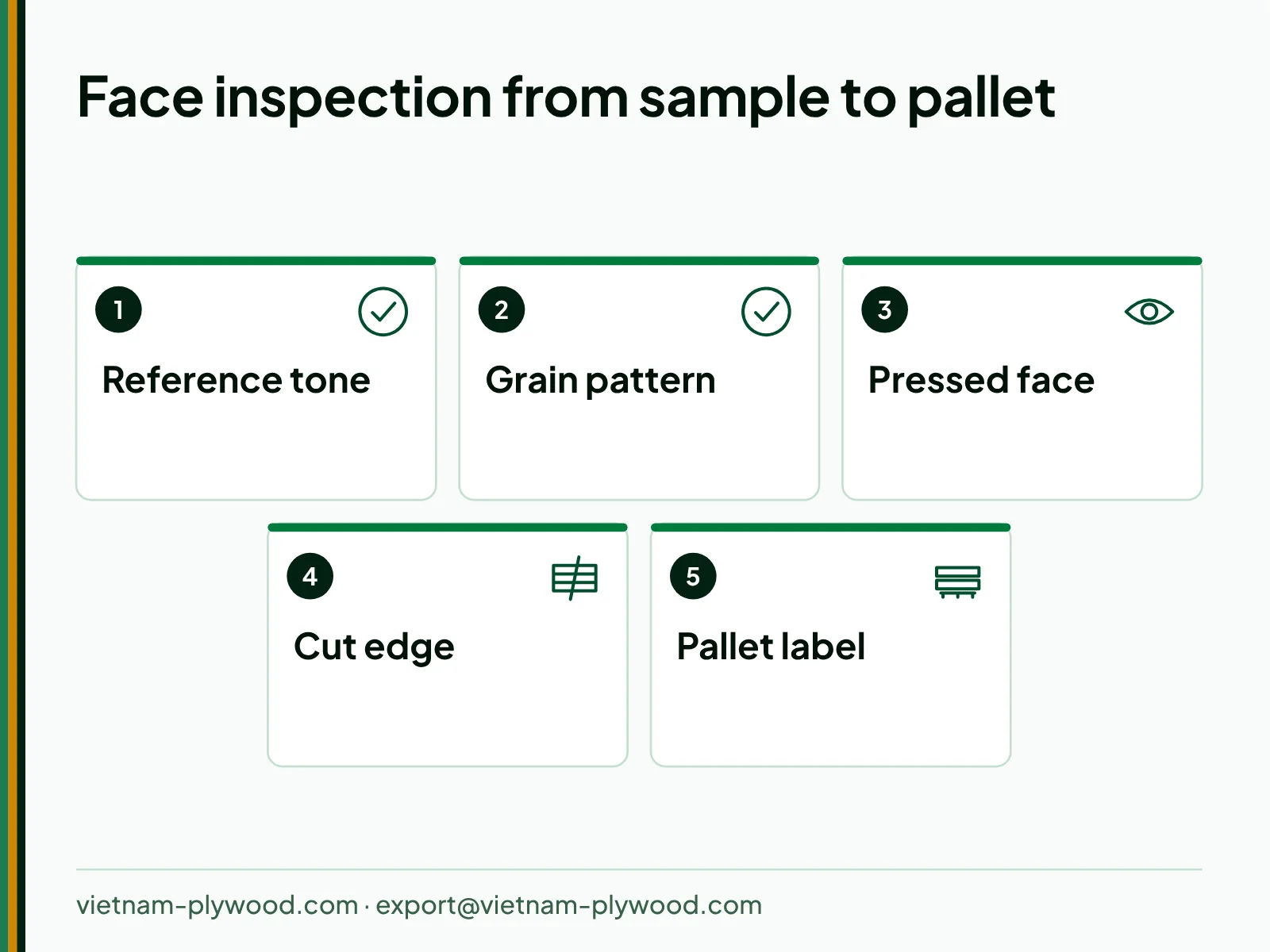
Check a representative full sheet under consistent light, then compare several sheets from different pallet positions. Look for excessive pink-to-brown shifts, unintended sapwood bands, patching, veneer overlaps, scratches and face-to-back confusion. Use a thickness gauge at agreed locations, and check the cut edge for gaps and loose inner veneers.
For an EV pattern, compare grain-repeat placement across adjacent sheets. For natural red oak, inspect whether the approved variation range is respected. Record photographs beside the reference sample and identify the pallet sampled, so the next lot can be compared on the same basis.
How are face grade and finish expectations written?
Write the visible face and reverse face separately. A/B face grades are available in the general decorative range, but the buyer still needs an agreed visual acceptance sample for the red oak appearance. Grade lettering alone does not specify pinkness, ray figure or the permitted number of color transitions.
For a cabinet run, identify whether the face is natural red oak or EV red oak appearance, the requested grain direction, the finish method and the acceptable face-to-back relationship. If the reverse is concealed, describe its appearance requirements rather than assuming it matches the display face. For a door program, distinguish book matching, slip matching and random matching in the drawing if those layouts matter.
The walnut veneer plywood page is a useful separate face reference when a program mixes contrasting cabinet finishes.
What documents and timing support a mixed-face export?
One set of export documents covers the shipment: commercial invoice, packing list, bill of lading, certificate of origin and the applicable phytosanitary and fumigation papers. Insurance is included under CIF. Order-specific emission certificates, test reports or an FSC claim on sales documents are added where agreed. Draft shipping documents are sent to the buyer for approval after loading.
The packing list is the document that should identify the red oak and companion face specifications by package. Each pallet label should agree with that list, so receiving staff can separate cabinet programs without relying on visual guesswork. For EU lots, the applicable EUR.1 and EUTR/EUDR file set also form part of the shipment documentation.
Factory lead time runs 15–45 days from receipt of the 30% deposit; the exact figure depends on order size, line loading and what the contract fixes. The remaining 70% is paid on the scan of the bill of lading, by T/T, or by irrevocable sight L/C. We ship FOB Hai Phong, or CFR (CNF) or CIF to your port. See production lead time for the ordering sequence.
How should a red oak plywood quotation be requested?
The largest pricing distinction is the decorative face specification: natural veneer selection with tight color and grain matching calls for more sorting than a broad visual range. A specified quarter-sliced natural face can require more selective material than a quarter-sawn-look EV pattern. Core choice, face grade, thickness, sanding tolerance and mixed-container packing then affect the quote.
Request a quotation against a written sample and a named destination port. A buyer should state the number of cabinet runs and the acceptable color range, rather than requesting a generic “plywood red oak” price. Samples cost nothing: a first-time buyer pays the courier, and that charge comes off the first confirmed order.
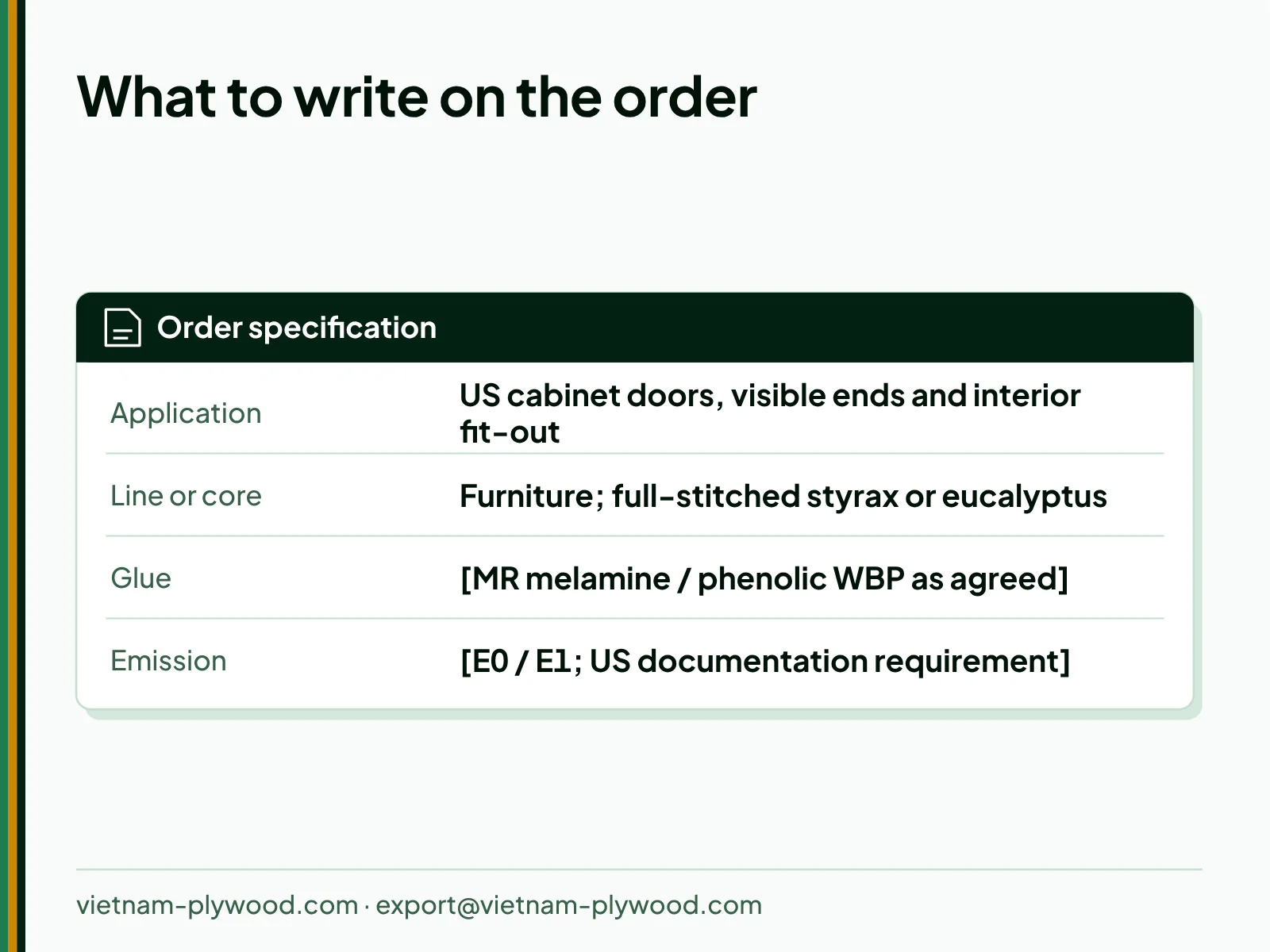
The specification below gives Lucy at export@vietnam-plywood.com the fields needed to discuss a production sample and order. For commercial discussion use the contact page.
Application: US cabinet doors, visible ends and interior fit-out
Line or core: Furniture; full-stitched styrax or eucalyptus
Glue: [MR melamine / phenolic WBP as agreed]
Emission: [E0 / E1; US documentation requirement]
Face and grade: [natural red oak / EV red oak look]; [A/B]; approved tone and grain range
Thickness and tolerance: [18 mm]; [±0.2 mm / ±0.3 mm]
Size: [1220 × 2440 mm]; grain direction [specify]
Quantity: [sheets by face and core]; mixed 40HC plan [if needed]
Destination port: [port and country]
Book a factory visit to review the face reference and inspect the producing factory before shipment.