





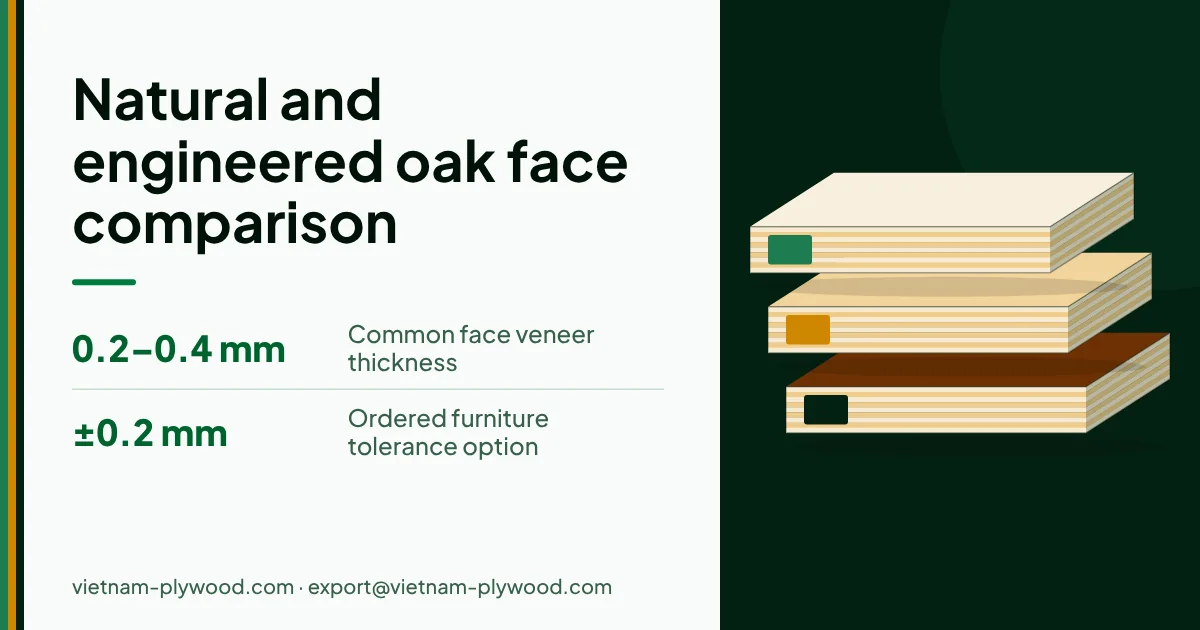
Plywood with hardwood veneer holds oak colour across reorders only when the face reference, cut and grade are fixed before pressing. A wrong face choice can leave cabinet makers sorting doors, losing production days or rejecting a load. HCPLY uses a furniture-line core specification as the constant while buyers approve the visible face separately.
What is plywood with hardwood veneer?
Plywood with hardwood veneer is a layered wood panel whose visible surface carries a decorative wood veneer. For cabinet and furniture orders, the face determines the visible character while the core determines much of the panel weight and construction. We build furniture panels with a stitched, sanded styrax or eucalyptus veneer core and a specified decorative face.
A buyer ordering “oak plywood” without defining the face can receive panels whose colour and grain differ across production lots. That difference can delay cabinet matching, require sorting at assembly or lead to a rejected visible-face shipment. A reference panel and a written acceptance method are more useful than the species name alone.
The terms wood veneer plywood, veneered plywood and veneer plywood sheets describe the same broad construction, but they do not identify a particular oak cut, face grade or core. “Plywood with oak veneer” identifies the desired appearance; the purchase specification must identify the actual supplied face material. See our furniture plywood range for the core and finish context.
The US Environmental Protection Agency’s 2025 codification of 40 CFR 770.3 defines hardwood plywood as an interior hardwood or decorative panel made with veneer layers and an adhesive-bonded core. That regulatory definition is relevant when a US importer checks product scope; it is not a statement that a particular shipment has passed emissions testing. 2025 US regulation.
Natural oak veneer or EV oak: what changes?
Natural oak veneer displays the variation present in individual logs. Engineered veneer (EV) is reconstructed to repeat a designed grain and colour pattern more predictably. The face can change without changing the furniture-line core specification; the buyer should therefore compare the two faces on equivalent core samples.
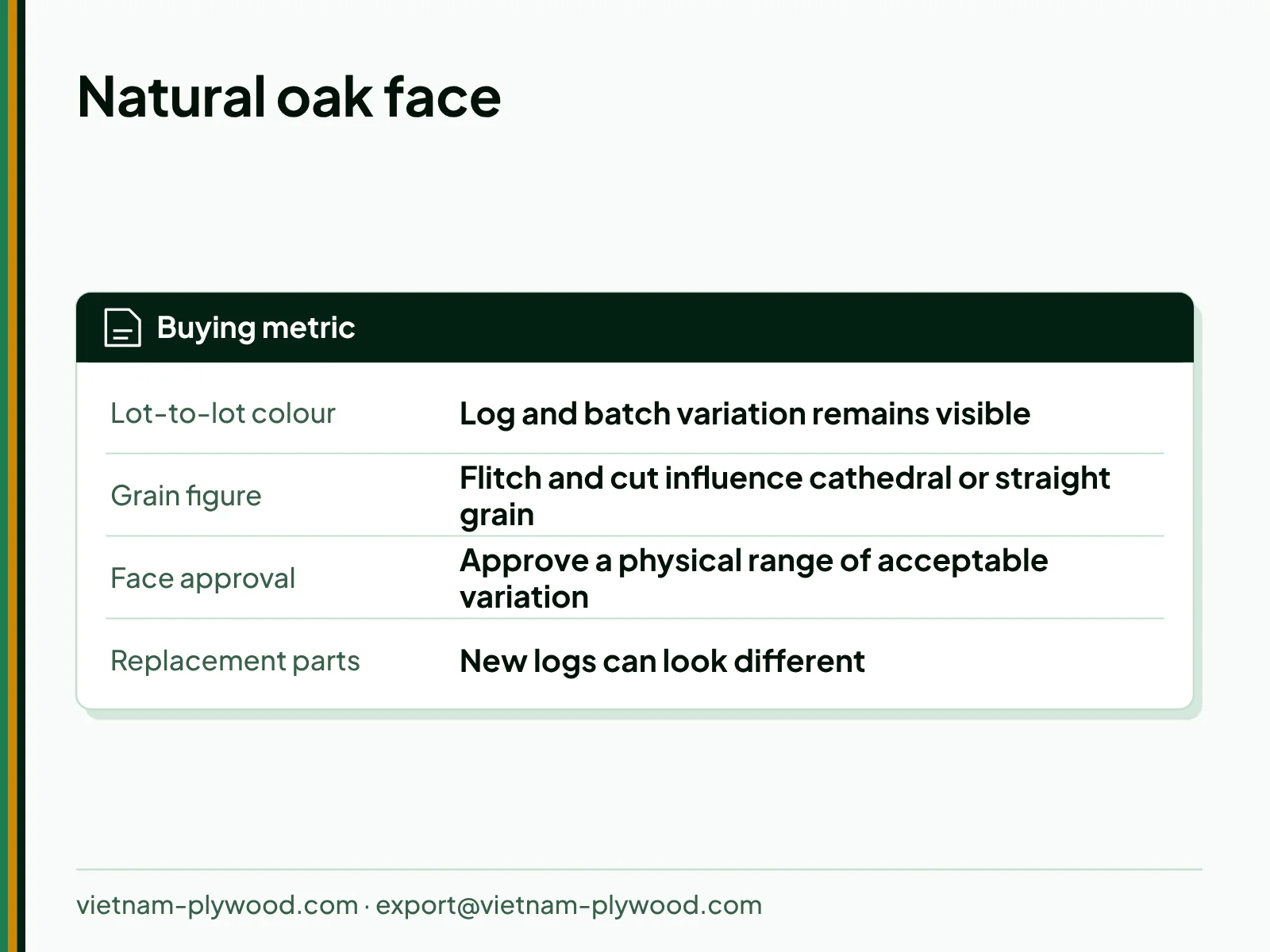
| Buying metric | Natural oak face | EV oak appearance | Verdict by use |
|---|---|---|---|
| Lot-to-lot colour | Log and batch variation remains visible | Designed repeatability offers a narrower visual target | EV for repeated cabinet programmes; natural for character |
| Grain figure | Flitch and cut influence cathedral or straight grain | Pattern follows the engineered veneer design | Natural for expressive feature doors; EV for matched runs |
| Face approval | Approve a physical range of acceptable variation | Approve a master reference and acceptable deviation | Both need signed samples |
| Replacement parts | New logs can look different | Reorder against the same design reference | EV has the practical advantage for replacements |
| Visual authenticity | Natural oak figure and irregularity | Reconstructed oak-look design | Natural where genuine oak figure is specified |
| Cost control | Matching and selection can add sorting | Repeated design can reduce visual sorting | Quote both against the same core and size |
EV is a face description, not an emission class or glue specification. The 2025 US regulation describes engineered veneer as dyed and glued veneer leaves formed into a block, then sliced to create a highly repeatable design. That supports the distinction in pattern repeatability, but does not establish a measured colour tolerance for a particular supplier. Compare our engineered veneer plywood specification separately from natural veneer appearance.
If the purchase order says oak ply wood or plywood oak, ask whether it means genuine natural oak veneer, an engineered oak-look face or another decorative face. HCPLY’s stated face list includes EV but does not establish a stocked natural-oak or EV-oak design. Treat both oak options as specification requests until a face sample and supply route are approved.
Which oak face holds colour better across reorders?
EV oak is the stronger starting choice for repeatable appearance because its pattern is engineered, while natural oak varies by log and veneer cut. Neither choice replaces a physical master sample, a defined light condition and an agreed comparison method. A colour promise without an agreed tolerance is not a usable acceptance criterion.
For a cabinet programme, label the master face sample with its design identifier, production lot, cut or pattern, finish state and viewing orientation. Keep an approved range sample when natural oak variation is part of the intended look. If a buyer uses stained or clear-coated parts, evaluate the veneer after the buyer’s actual finishing process, since raw-panel colour alone is incomplete evidence.
A replacement door made months later must match the assembled kitchen, rather than a photograph of the original shipment. Ask for retained reference pieces from the approved lot and a trial of the new lot beside them. Record which deviations trigger sorting, remaking or approval; the agreed thresholds belong on the order sheet.
Which veneer cut suits each furniture part?
Quarter-cut oak is the usual specification when a straight, controlled grain is needed on tall cabinet doors; crown or plain-sliced oak makes a more expressive feature face. The actual selection should follow the visible area, the desired figure and the acceptable variation between adjacent parts.
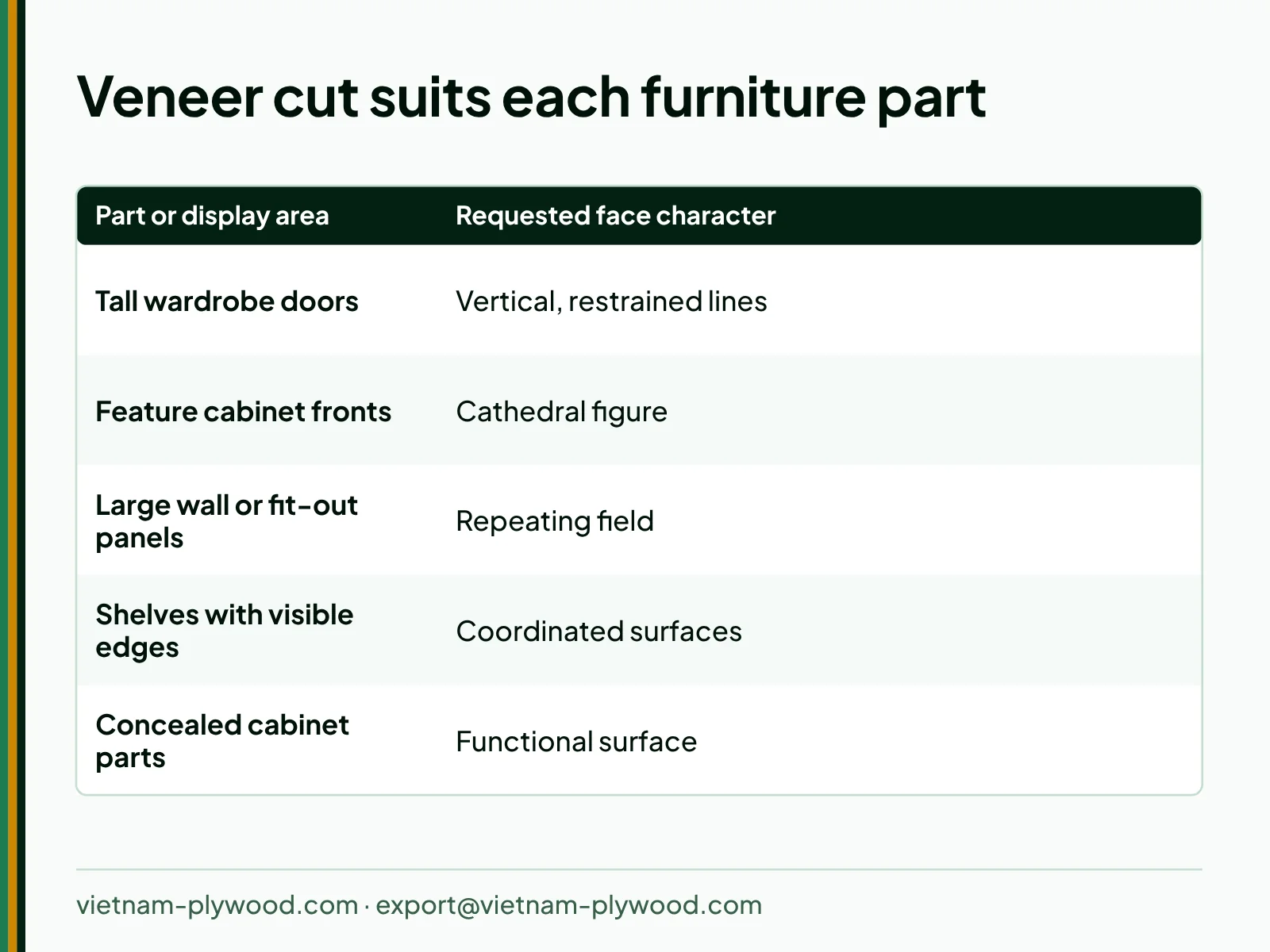
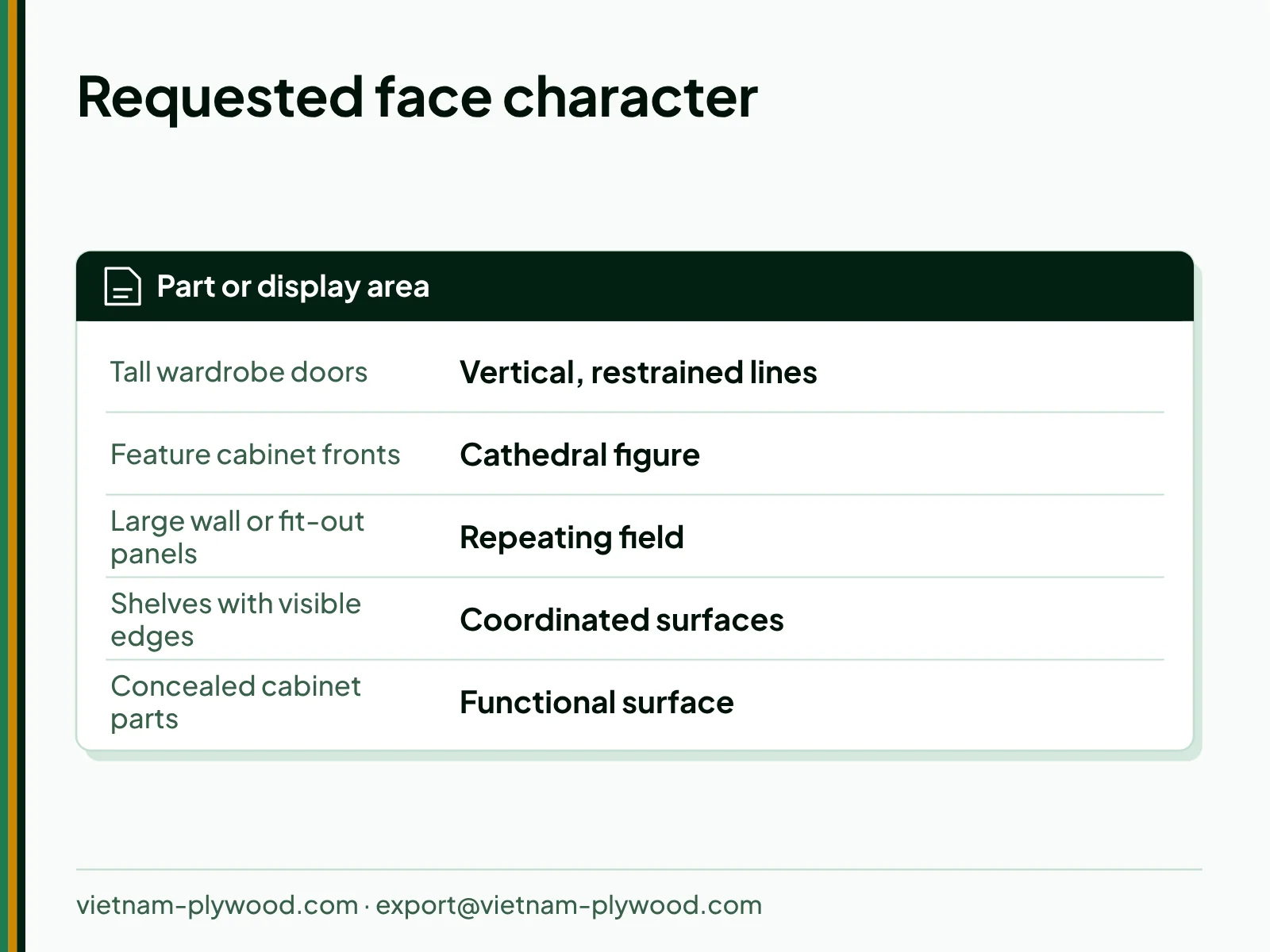
| Part or display area | Requested face character | Suggested cut or layout | Inspection focus |
|---|---|---|---|
| Tall wardrobe doors | Vertical, restrained lines | Quarter-cut or straight-grain matching | Grain direction across door set |
| Feature cabinet fronts | Cathedral figure | Plain-sliced or crown-cut natural oak | Balance across adjacent fronts |
| Large wall or fit-out panels | Repeating field | EV oak pattern with defined orientation | Pattern continuity at joints |
| Shelves with visible edges | Coordinated surfaces | Same face reference on exposed surfaces | Edge treatment and face orientation |
| Concealed cabinet parts | Functional surface | Approved lower-visibility face choice | Core and dimensional specification |
Specify the grain arrow on drawings. For wide fitted panels, also identify the visible side, panel sequence and any doors that must read as a continuous set. The buyer should approve a layout diagram before veneer faces are committed to production.
Our white oak plywood and red oak plywood pages distinguish the intended oak appearance; decorative hardwood plywood covers other face choices. These names do not replace a verified face sample for the actual order.
Which factory line builds a veneered cabinet panel?
Our furniture line is the relevant build for a decorative, sanded interior panel: full-stitched styrax or eucalyptus core with an agreed face and E0 or E1 emission class. The other lines make different products even when the nominal thickness is identical.
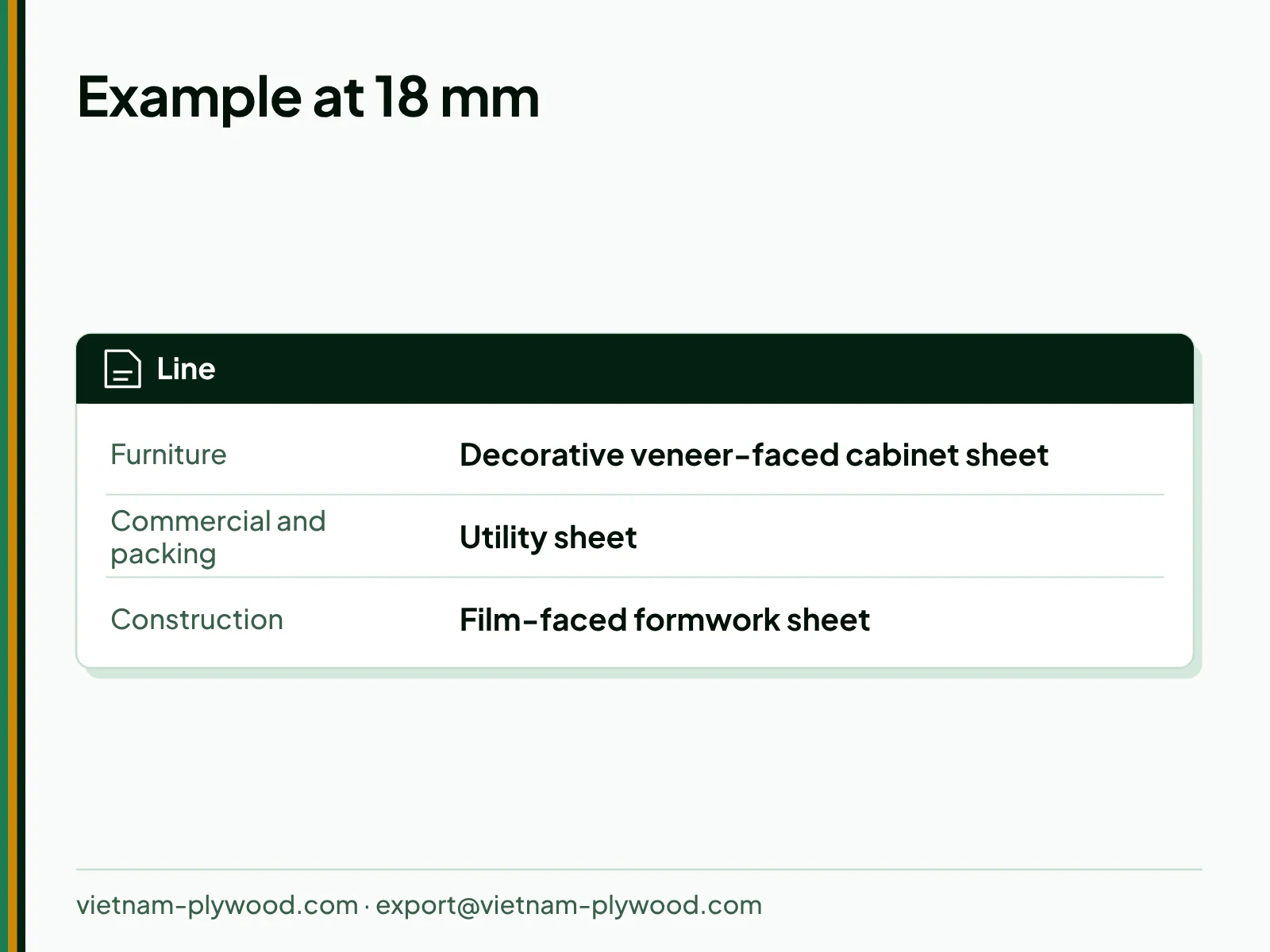
| Line | Example at 18 mm | Core and surface | Tolerance and purpose |
|---|---|---|---|
| Furniture | Decorative veneer-faced cabinet sheet | Full-stitched styrax or eucalyptus, sanded | ±0.2 or ±0.3 mm as ordered; visible joinery |
| Commercial and packing | Utility sheet | Acacia, MR glue, unsanded or light-sanded | Commercial ±0.5 mm; packing ±0.5–1.0 mm |
| Construction | Film-faced formwork sheet | Acacia or eucalyptus, phenolic or melamine film | ±0.5 mm; concrete formwork |
The face does not determine core density. The stated core reference densities are styrax 500 kg/m³, eucalyptus 650 kg/m³ and acacia 580 kg/m³. For a veneer-faced cabinet panel, that difference changes handling and shipment weight even when face appearance is similar.
Our furniture line uses full-stitched core construction and sanding before the agreed face is evaluated. The commercial and packing line targets utility applications; the construction line applies film, including anti-slip where specified. The factory-line grade comparison explains why a shared thickness cannot stand in for a shared grade.
We do not press medium-density fibreboard (MDF), oriented strand board (OSB), chipboard, blockboard, bamboo panels, medium-density overlay (MDO), high-density overlay (HDO), three-ply spruce panels or birch-core plywood. Melamine, high-pressure laminate and laminate faces are distinct surface topics, rather than products offered as our decorative face line.
How do I specify face, cut and grade on one order?
Write the visible-face identity, veneer construction and acceptance sample on the same order sheet as the core, glue, emission class and dimensions. A line reading only “oak plywood furniture, A grade” leaves the cut, colour reference and intended face material unresolved.
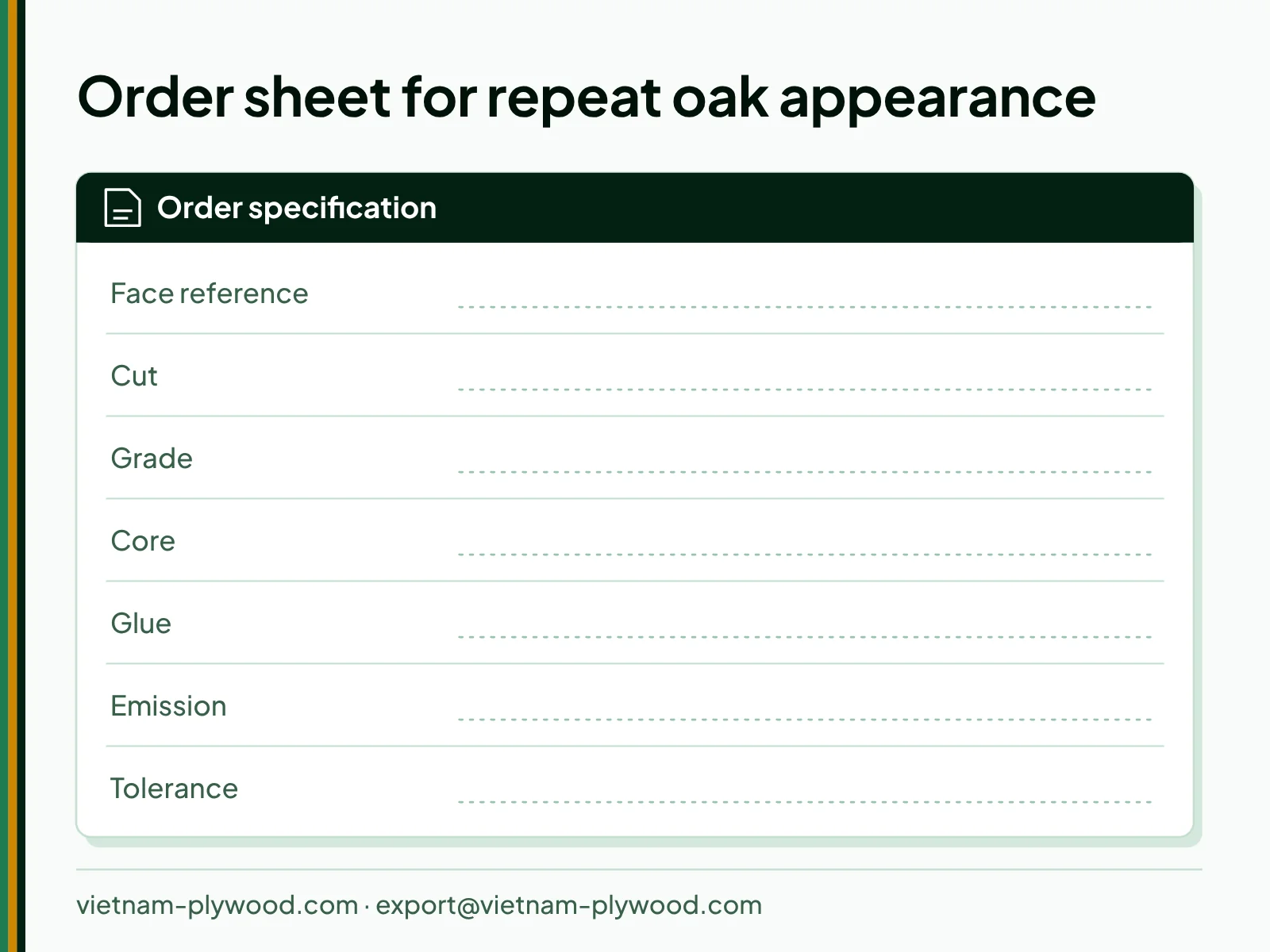
- Identify the application and visible components: doors, cabinet sides, wardrobe fronts or fit-out panels. Mark the face side and grain direction on a drawing.
- State natural oak or EV oak-look as the requested face, then obtain a verified available sample. Name the species or design reference, veneer cut, leaf matching and allowable natural variation.
- Specify face grade A or B and what the grade means in the signed visual sample. List disallowed repairs, open defects, stain marks and mismatched leaves in observable terms.
- Select furniture-line styrax or eucalyptus full-stitched core, plus a glue field and a separate emission field. A glue description cannot serve as proof of emission compliance.
- State thickness, tolerance, size, quantity and the destination port. Add the finish state used for colour acceptance and whether both faces are visible.
- Sign a reference sample, label the order lot and define the factory inspection hold point before pressing. Attach photographs and the agreed comparison conditions to the order record.
Face veneer thickness commonly falls in the 0.2–0.4 mm range for our furniture panels; the chosen thickness belongs on the order sheet. Available panel thickness spans 3–40 mm, with common sizes including 1220 × 2440 and 1250 × 2500 mm. A requested oak face remains conditional on an approved sample and a written build, not on the availability of a generic veneered ply board.
What can an inspector witness before shipment?
An inspector can compare the actual veneer face with the signed reference under agreed lighting, then check dimensions, grain direction and visible repairs at the producing factory. This is the point to catch a face mismatch before the panels enter a container.
Use a practical witness sequence: verify bundle labels against the order, inspect representative top and internal sheets, compare adjacent faces in the intended installation orientation, measure thickness and size, then review any rejected sheets. The sample plan and acceptance thresholds must be agreed by the buyer; set a measurable defect allowance in the purchase specification.
For furniture sanding, the ordered thickness tolerance is ±0.2 or ±0.3 mm; length and width tolerance is ±2 mm. A thickness gauge can test the dimension, but it cannot judge a veneer colour match. Keep dimensional readings and visual findings in separate inspection records.
The buyer may visit the factory office and inspect goods where the panels are produced. We handle on-site quality control and loading records. An approved reference sample, photographed lot labels and a signed inspection report make a later reorder discussion more precise than a colour adjective in an email.
Can oak-look panels share a container with other builds?
A mixed container can carry furniture veneer-faced panels and other approved specifications, provided the combined payload stays within the 28.5 t limit for a 40HC. The allocation must be calculated by core, size and thickness, not by decorative face name.
For 1220 × 2440 × 18 mm styrax-core panels, the reference sheet weight is 26.79 kg. A full 40HC allocation is 990 sheets, 53.05 m³ and 26.52 t of panels, excluding pallet and packing weight. The face choice does not change the stated core-based reference weight.
For equivalent eucalyptus-core panels, the reference sheet weight is 34.83 kg. A full 40HC allocation is 795 sheets, 42.60 m³ and 27.69 t of panels, excluding pallet and packing weight. Mixed orders need a pallet-by-pallet loading plan that accounts for both panel and packing weights.
The minimum order is one 40HC; one container can carry several specifications as long as the payload limit holds. The final packing plan must include pallet and packing weight. For mixed specifications, use the mixed-container loading discussion and the container loads calculation owner rather than applying the single-build examples as a universal capacity promise.
What glue, emissions and documents belong on the order?
Glue chemistry, emission class and export evidence must be recorded as separate fields. The furniture build states E0 or E1 emission class; the order must independently identify the agreed glue system and any required destination-market test evidence.
Melamine glue is MR with a 12-hour boil description; phenolic glue is WBP with a 72-hour boil description. Those are product-process descriptions, not a substitute for an accepted test report or an emission certificate. The furniture-line specification should be agreed against the actual build rather than assuming a glue from the face name.
For US-bound hardwood plywood, the 2025 US Code of Federal Regulations, 40 CFR Part 770, addresses formaldehyde emission standards and third-party certification. A buyer requiring California Air Resources Board Phase 2 (CARB P2) or Toxic Substances Control Act Title VI (TSCA Title VI) evidence should request documents for the producing member factory and the agreed product. Certificates for member factories are shown with factory details masked, on request; do not treat an E0 or E1 label as automatic US regulatory compliance.
The shipment’s commercial invoice and packing list identify the goods and quantities; the bill of lading records carriage. Other shipment papers include the certificate of origin, phytosanitary and fumigation papers, and insurance under CIF. EU lots use EUR.1 where applicable and an EUTR/EUDR file set; order-specific emission certificates, test reports and FSC claims on sales documents follow the agreed build. After loading, the draft shipping documents come to you for approval.
Is oak veneered plywood suitable for cabinets and furniture?
Oak veneered plywood is suitable for interior cabinet doors, furniture panels and fit-out surfaces when the decorative face, core construction and finishing system are specified together. The intended use is non-structural interior joinery; wet exposure and structural loading require a different, independently verified specification.
For cabinet carcasses, choose core density and dimensional tolerance according to machining, hinge fixing and handling requirements. For visible doors, give face colour and grain sequence greater attention. For long wardrobe fronts, control grain direction and panel-to-panel appearance before cutting begins.
A cabinet maker might combine veneer plywood for visible doors with matt plywood for concealed components, provided both builds meet the assembly specification. The wardrobe plywood grade page covers the different visual demands of doors and internal components; sofa-frame plywood addresses another furniture application.
Natural veneer is a wood surface, so coating and service conditions remain part of the furniture maker’s responsibility. Do not treat a raw veneer face as a finished stain sample. Approve the finish system on actual material before releasing a full furniture programme.
What drives the quotation and reorder risk?
The face selection and matching work are the main quotation variables for this specification, followed by core selection, panel dimensions and inspection requirements. A tightly matched natural-oak face can require more selection than an approved repeatable EV design; that does not establish a universal price ranking without supplier quotes.
A/B face grading, cut selection, veneer thickness, back-face treatment and colour sorting each change the work requested. Styrax and eucalyptus cores also differ in density, handling weight and construction planning. The quoted build must identify which choices are included so that later reorders do not silently change the visible result.
For oak veneer, request a face-specific quotation based on the approved sample, cut and grading requirements. Ask for a quotation against the signed specification rather than applying the dated starting price for generic furniture plywood to an oak-look face.
Factory lead time runs 15–45 days from receipt of the 30% deposit; the exact figure depends on order size, line loading and what the contract fixes. The remaining 70% is paid on the scan of the bill of lading, by T/T, or by irrevocable sight L/C. We ship FOB Hai Phong, or CFR (CNF) or CIF to your port. Samples cost nothing: a first-time buyer pays the courier, and that charge comes off the first confirmed order.
What should the buyer send before a trial container?
Send a complete panel specification and an approved face reference before requesting a trial container. The trial should test actual colour matching, machining and finishing performance on the furniture maker’s components.
Application: Interior cabinet doors and visible furniture panels
Line or core: Furniture line; full-stitched styrax core (or specified eucalyptus core)
Glue: State agreed glue system separately from emission class
Emission: E0 or E1; destination-specific evidence requested separately
Face and grade: Requested natural oak or EV oak-look; sample ID; cut/pattern;
  grain direction; matching method; A/B grade; back-face requirement
Thickness and tolerance: 18 mm; ±0.2 mm as ordered
Size: 1220 x 2440 mm
Quantity: One 40HC, with any mixed specifications itemised
Destination port: [buyer to insert port]
Inspection: Signed master sample, lighting, lot identification and hold point
Contact Lucy at export@vietnam-plywood.com through the contact page with the component drawing and sample reference. The next step is to plan a trial container around the agreed face, core and inspection criteria.