





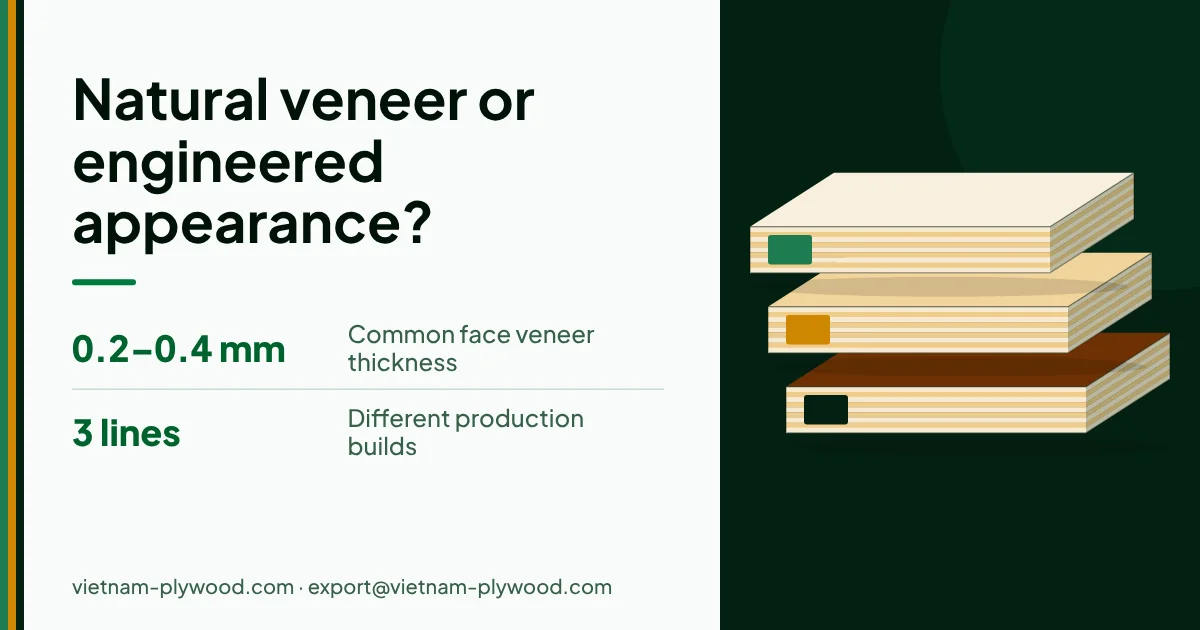
Decorative hardwood plywood uses a selected wood veneer over a plywood core, with the visible face determining its commercial name. Choosing an imitation when a project requires natural maple, teak or cherry can mean rejected panels, replacement costs and lost production days. HCPLY builds decorative-face panels on our furniture line in Vietnam, with face identity written into the order and checked at the producing factory.
What is decorative hardwood plywood?
Decorative hardwood plywood is a layered wood panel whose visible veneer is selected for colour, grain and finishing appearance. Its core supplies most of the thickness and weight; the face supplies the visual identity. Buyers specify both independently, because a maple appearance does not establish a maple species. Cabinet doors, exposed carcasses, shopfitting and wall panels can require different face matching even at the same nominal thickness.
The Canada Border Services Agency, in its 2021 statement on decorative and non-structural plywood, describes face species, face grade, cut pattern, core and dimensions as separate specification fields. Its discussion of decorative panels also identifies plain, quarter, rift and rotary veneer cuts. Those distinctions matter when matching a new shipment to an existing furniture range. See the official CBSA product explanation.
Can maple, teak or cherry faced plywood be ordered from Vietnam?
A Vietnam-made plywood panel can carry an engineered veneer (EV) appearance resembling maple, teak or cherry. A requirement for the actual botanical species instead calls for documented natural veneer of that species. These are different purchasing instructions. HCPLY’s stated regular faces include EV, bintangor, okoume, gurjan, pine, poplar, eucalyptus, birch and sapele; natural maple, teak and cherry are not listed regular faces.
Our furniture line presses the specified decorative face over a full-stitched, sanded styrax or eucalyptus core. For a specialty natural species outside that face list, availability and the identity evidence for the incoming veneer must be established before an order is accepted. An EV maple-look face must be named EV maple-look, never sold or described as natural maple veneer.
See hardwood veneer plywood and EV plywood for related builds.
Which decorative faces can engineered veneer reproduce?
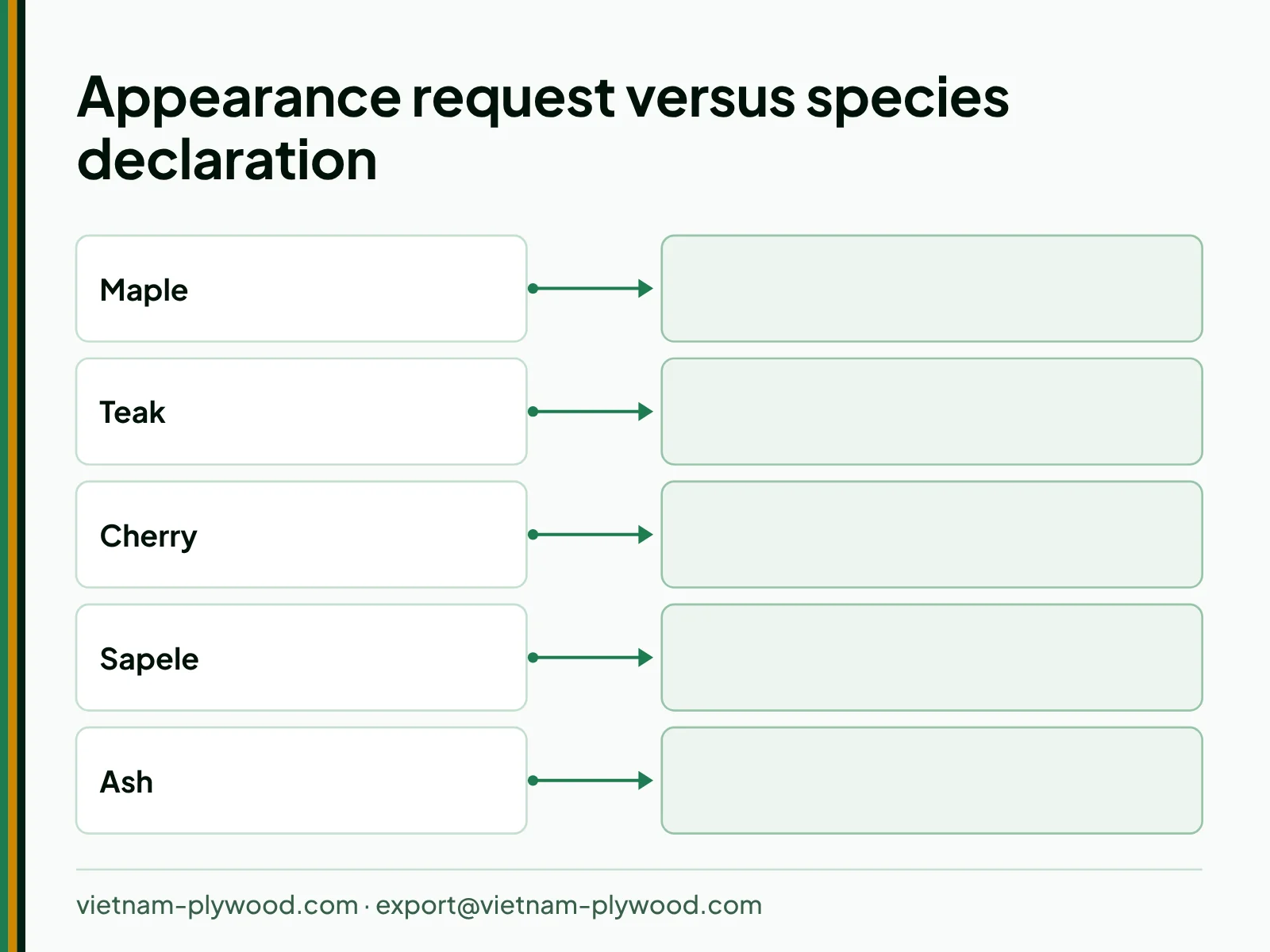
Engineered veneer can reproduce a selected visual pattern associated with maple, teak, cherry, walnut, mahogany, beech, ash or cedar. The result is a design match, rather than evidence that the named species is present. Repeatability of colour and grain must be judged against approved physical samples under the buyer’s actual finish and lighting.
| Requested appearance | EV description to write | Natural veneer alternative | Buying verdict |
|---|---|---|---|
| Maple, pale and even | EV maple-look | Identified natural maple | EV for controlled visual matching; natural for species-led work |
| Teak, warm linear grain | EV teak-look | Identified natural teak | EV for a specified look; natural when teak identity is required |
| Cherry, warm reddish face | EV cherry-look | Identified natural cherry | Sample EV for colour; natural for genuine cherry |
| Mahogany or sapele figure | EV mahogany-look or EV sapele-look | Natural sapele from listed faces; other natural species by separate assessment | Natural sapele for a species requirement |
| Beech, ash or cedar effect | EV beech-look, ash-look or cedar-look | Identified natural species | Choose by appearance requirement versus species requirement |
An EV name is a pattern descriptor, not a timber-origin declaration. Specify whether a plain-sliced, quartered or other visual layout is needed, and use a reference board to resolve the expected figure. For repeat cabinet fronts, record colour, grain and back-face requirements.
Which faces need a natural imported veneer?
Natural maple, teak, cherry, mahogany, beech, ash or cedar must be supplied as identified natural veneer when the contract requires that exact species. A lookalike face cannot satisfy a species-specific bill of materials. For species not on our regular face list, the veneer source and traceability paperwork require a separate assessment; the furniture-line core specification alone cannot establish availability.
Specify species, cut, grade, thickness and face/back coverage. Check batch identity and supplier records; appearance alone cannot prove species.
For sapele, the position is different: sapele is among our listed faces. The buyer can request a natural sapele face specification and a matched physical sample. The word mahogany should not silently replace sapele on invoices or inspection records, even when the appearance is similar.
Is maple plywood good for cabinets?
Maple faced plywood is a suitable cabinet specification when the designer needs a pale, fine-grained visible surface and the required face is clearly defined. Cabinet makers should distinguish natural maple veneer plywood from maple-look EV panels. Neither label by itself states core construction, emission class, sanding tolerance or finish performance.
Our furniture line uses full-stitched styrax or eucalyptus cores and a sanded surface. Common panel thicknesses include 9, 12, 15 and 18 mm, with sanded thickness tolerance ordered as ±0.2 mm or ±0.3 mm. Length and width tolerance is ±2 mm. The face veneer is commonly 0.2–0.4 mm, so sanding and finishing trials should be planned around the actual veneer layer.
Sanded maple plywood veneer characteristics should be checked on a finished sample: grain raising, stain uptake, colour change and visible joins can alter the appearance. A request for UV maple plywood describes a finishing process or prefinished product; it does not establish a separate maple species. HCPLY’s listed production facts do not establish a UV-prefinished product line, so a UV coating requirement needs its own technical review.
Is sapele faced plywood available from Vietnam?
Sapele faced plywood is a listed face option for HCPLY, pressed on our furniture line when ordered as a furniture-grade decorative panel. Sapele ply, plywood sapele and sapele veneer plywood can all describe that visible face, but the written specification should consistently say natural sapele face if that is what the buyer needs.
Specify face and back separately: natural sapele on both sides differs from sapele face with an alternative back. Never substitute EV without written approval.
Which factory line builds the same thickness differently?
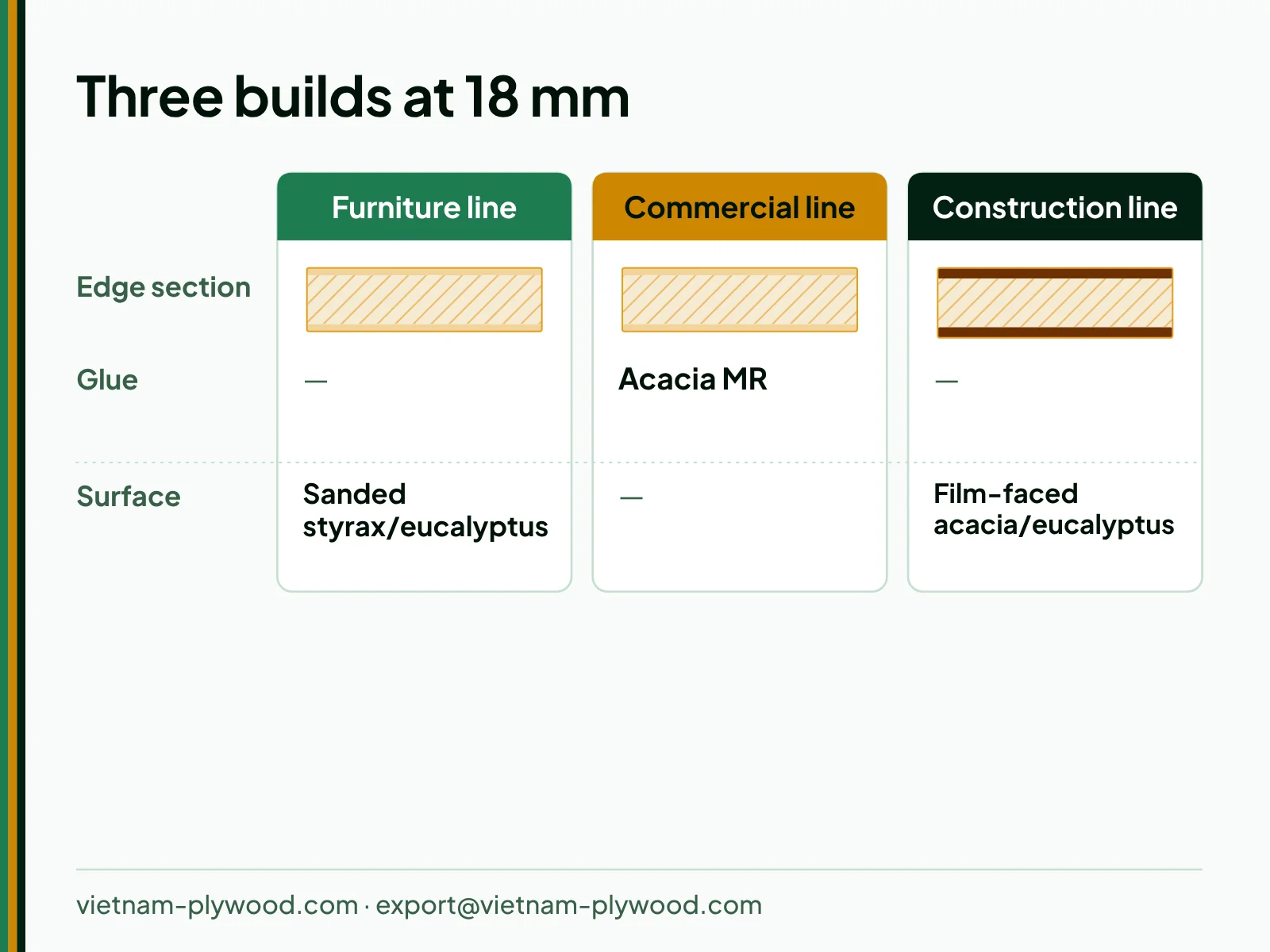
The decorative-face order belongs on our furniture line. The same 18 mm nominal thickness has different construction, finish and inspection priorities on the other lines. A buyer should select the line by end use rather than assume equal-thickness sheets are interchangeable.
| Line | 18 mm build | Core and surface | Tolerance | Suitable order |
|---|---|---|---|---|
| Furniture | Decorative veneer face | Full-stitched styrax or eucalyptus, sanded | ±0.2 or ±0.3 mm as ordered | Visible cabinet and fit-out panels |
| Commercial and packing | Commercial or packing face | Acacia, unsanded or light-sanded, MR glue | ±0.5 mm commercial; ±0.5–1.0 mm packing | Non-visible packing or commercial work |
| Construction | Phenolic or melamine film | Acacia or eucalyptus, unsanded | ±0.5 mm | Formwork surfaces, rather than decorative furniture |
Core density follows the core: styrax 500 kg/m³, eucalyptus 650 kg/m³ and acacia 580 kg/m³. We do not press MDF, OSB, chipboard, blockboard or birch-core plywood. HPL and laminate faces are not our offered product lines.
How is a specialty-face order checked at the factory?
A specialty-face order is checked by matching the written species declaration and approved veneer sample to the incoming veneer batch and finished panels. The buyer or appointed inspector can witness that comparison at the producing factory. The process also checks dimensions and surface appearance before loading.
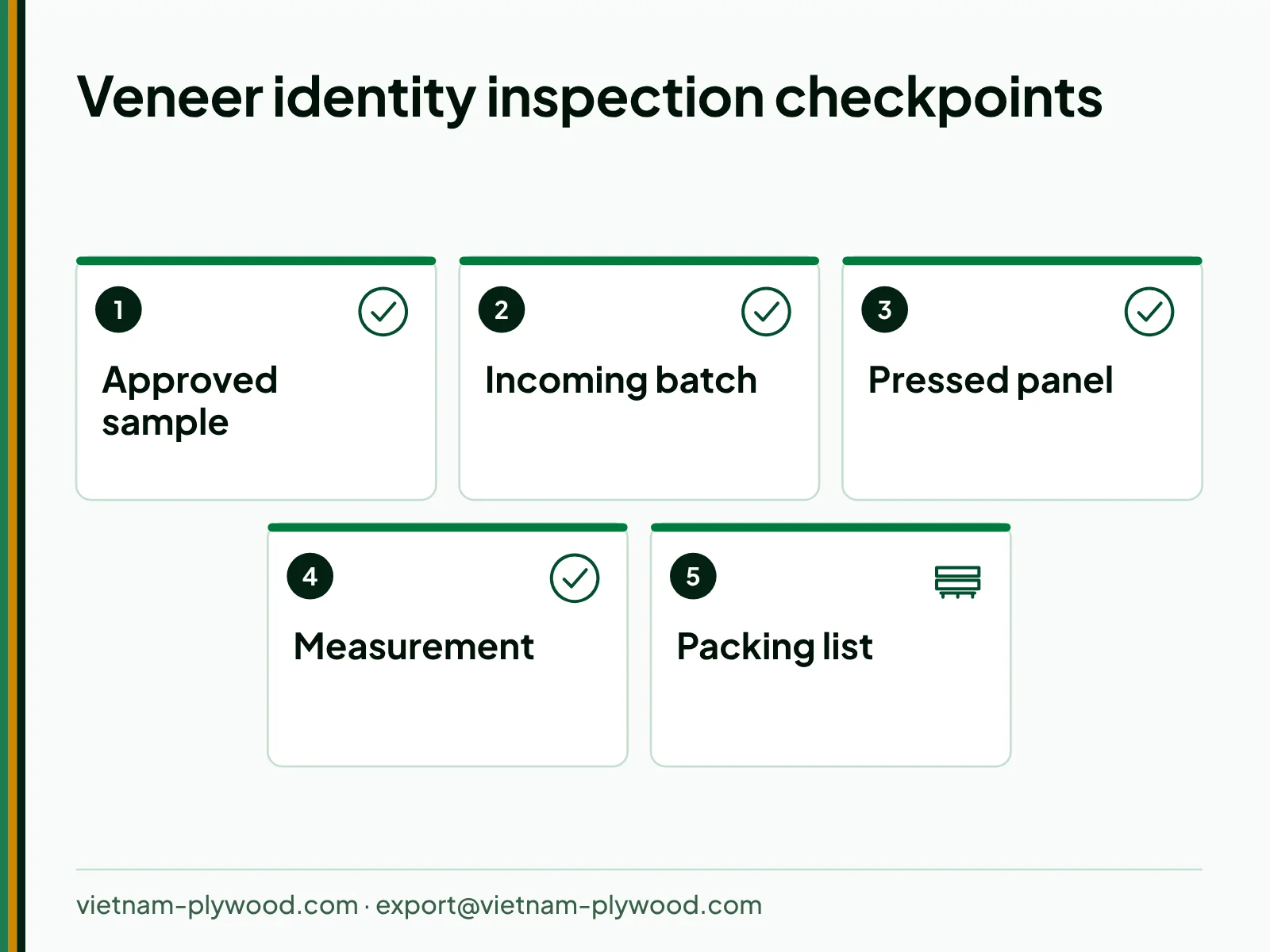
- Approve the face reference. Identify natural species or EV pattern, face/back arrangement, cut direction, colour range and permitted visible defects. Keep a signed reference sample or approved sample photographs linked to the order.
- Record the incoming veneer identity. For natural specialty species, compare the supplier’s batch description and available traceability records with the order. Separate the physical visual check from documentary species verification.
- Inspect the pressed panel. Check face matching, sanding marks, splits, open joints, glue bleed and edge condition against the approved reference. Record the core type and the agreed glue and emission fields separately.
- Measure the lot. Measure thickness at agreed positions and check length and width against the specified tolerances. Keep the inspection result tied to the sampled lot.
- Approve loading documents. Reconcile the face description, quantity and packing marks with the commercial invoice and packing list. After loading, the draft shipping documents come to you for approval.
HCPLY coordinates specification, on-site quality control, documentation and loading. Buyers can inspect goods at the factory that presses their order and visit its factory office. The veneer species should appear consistently in the purchase specification, inspection record and relevant commercial description.
How do glue, emissions and veneer grade affect the order?
Glue performance, formaldehyde emission classification and visible face grade are separate purchasing fields. The furniture line offers E0 or E1 emission classes. Glue options in the stated production range are melamine MR, with a 12-hour boil description, and phenolic WBP, with a 72-hour boil description; neither is an emission class.
For a US-bound cabinet order, a requested CARB Phase 2 or Toxic Substances Control Act Title VI compliance route must be supported by the applicable third-party certification documentation. Member-factory certificates including FSC, CARB P2, ISO 9001 and CE, and EUTR/EUDR documents, are shown with factory details masked, on request. Do not infer a certification from a face name or an emission-class label.
A/B face grades describe our regular face ordering range; birch uses D/E/F grades in the stated range. These grade systems should not be interchanged. Record the actual acceptance sample and agreed surface defects, especially where a finished cabinet set must match an earlier shipment.
Can decorative faces share a container with other specifications?
Different specifications can share one 40HC within the 28.5 t payload limit. The order minimum is one 40HC. A mixed order should be calculated from each core’s density and the packing plan, rather than treating decorative face names as separate weight categories.
For 18 mm sheets at 1220 × 2440 mm, the reference full-container figures are 990 styrax-core sheets at 26.52 t, 880 acacia-core sheets at 27.35 t, or 795 eucalyptus-core sheets at 27.69 t. Individual sheets weigh 26.79 kg, 31.08 kg and 34.83 kg respectively. These values exclude film weight. Mixed quantities require a pallet-by-pallet payload calculation; the full-load counts cannot simply be added together.
For example, 400 styrax-core 18 mm sheets weigh 10,716 kg and 300 eucalyptus-core sheets weigh 10,449 kg using the reference sheet weights. Their combined panel weight is 21,165 kg before pallet and other packing weight. The loading plan must still respect pallet geometry and the payload ceiling. The container packing guide covers full loading arrangements.
What determines the quotation and export paperwork?
The principal price driver is the face specification: a documented natural specialty species and tight visual matching require more selective material than an approved EV appearance. Next come face/back coverage, grade and cut, then core choice, thickness tolerance, finishing requirements and volume. A natural imported specialty face can cost more than an EV lookalike because the specified veneer must be obtained and identified. No fixed specialty-face price is stated; request a quotation against the written build.
Factory lead time runs 15–45 days from receipt of the 30% deposit; the exact figure depends on order size, line loading and what the contract fixes. The balance is 70% against the scanned bill of lading, by telegraphic transfer (T/T) or irrevocable letter of credit (L/C) at sight. We ship FOB Hai Phong, or CFR (CNF) or CIF to your port. Samples cost nothing: a first-time buyer pays the courier, and that charge comes off the first confirmed order.
Each shipment uses a commercial invoice, packing list, bill of lading, certificate of origin, phytosanitary and fumigation papers, plus the order’s agreed certificate and test documents. EU lots add EUR.1 and the EUTR/EUDR file set; CIF adds insurance. The invoice and packing list should carry the agreed face description and lot quantity, while supporting veneer identity evidence remains available for the species-specific inspection.
See production lead time and contact.
What should the buyer send for a specialty-face order?
Send a specification that distinguishes the actual veneer species from an engineered visual pattern and names the inspection reference. A short label such as maple ply or maple faced plywood is insufficient for a species-sensitive cabinet programme. Use the following fields, with a physical reference sample and finish requirements attached where applicable.
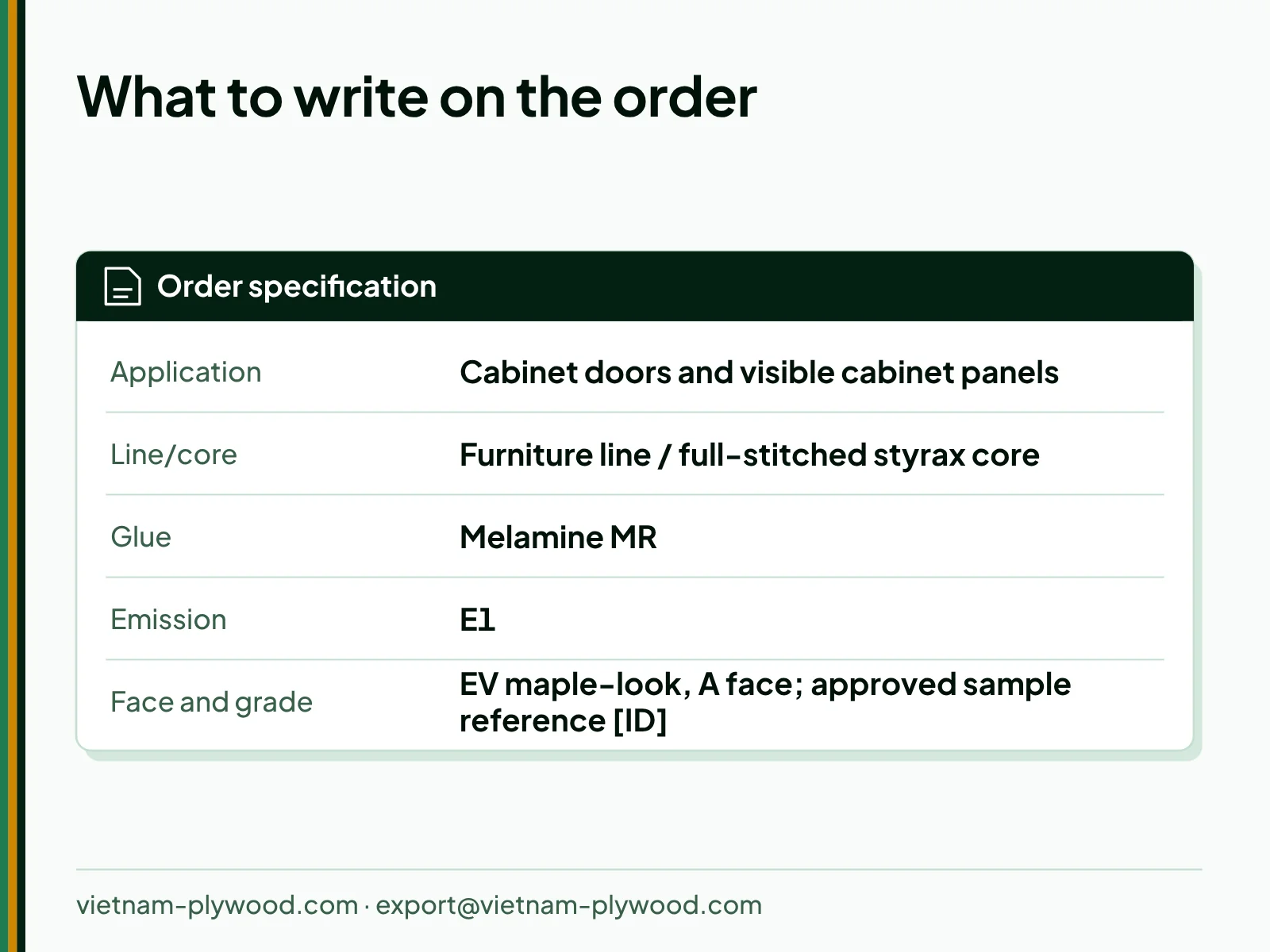
Application: cabinet doors and visible cabinet panels
Line/core: furniture line / full-stitched styrax core
Glue: melamine MR
Emission: E1
Face and grade: EV maple-look, A face; approved sample reference [ID]
Back: approved matching or alternative back [describe]
Thickness and tolerance: 18 mm, ±0.2 mm
Size: 1220 × 2440 mm
Quantity: [sheets and pallets; one 40HC minimum]
Destination port: [port and country]
Species evidence: EV pattern declaration; natural-species documents if applicable
Book a factory visit with Lucy at export@vietnam-plywood.com to inspect the face reference and the producing factory before shipment.