






HCPLY plans plywood production lead time around the producing line, with 15–45 days after the 30% deposit depending on quantity, production conditions and agreement. A mistaken line choice can cost production days, inventory money or a rejected load. The practical target is an agreed inspection and loading sequence for the actual panel specification.
What is the plywood production lead time from Vietnam?
HCPLY’s plywood production lead time is 15–45 days from the 30% deposit, set by order size, line loading and the contract. That period covers production planning through factory readiness; the loading date must also be coordinated with inspection and the shipment booking. Furniture, commercial and construction orders follow different manufacturing routes, so a useful schedule identifies the producing line and the actual loading milestone.
For an importer, a late container can leave a cabinet production slot idle or a distributor without saleable stock. An early vessel booking against unfinished panels can create additional handling and rescheduling work. We therefore discuss the specification and factory sequence before treating a proposed loading date as a planning date.
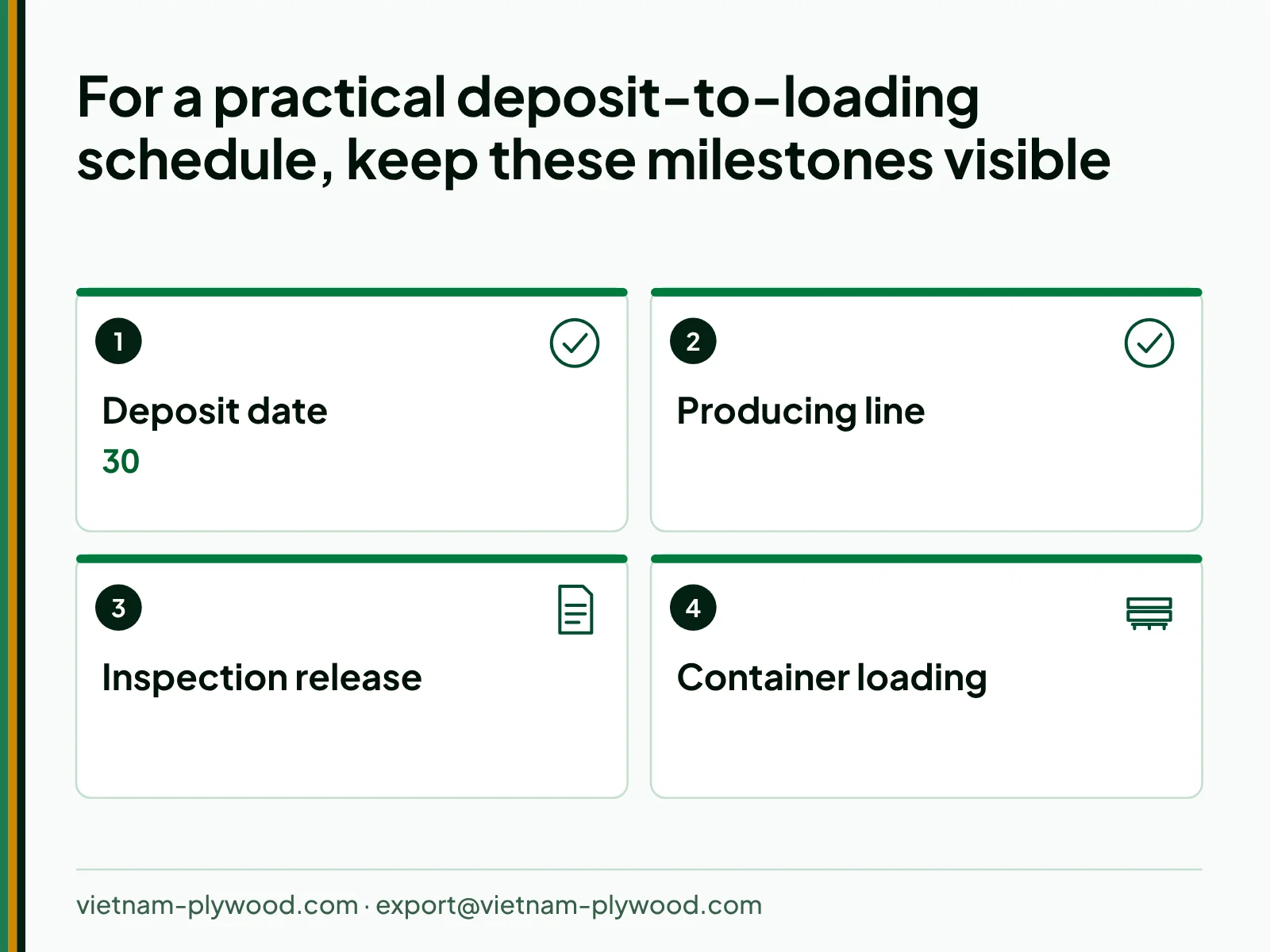
For a practical deposit-to-loading schedule, keep these milestones visible:
- Deposit date. Record when the 30% deposit starts the agreed production window.
- Producing line. Identify the furniture, commercial and packing, or construction route for each ordered specification.
- Inspection release. Set the date for checking finished panels and pallet labels against the approved order.
- Container loading. Record the planned loading slot separately from factory readiness and vessel departure.
The stated production window is the starting point for a purchase schedule, rather than a separate fixed number for every panel. For broader ordering decisions, see the plywood minimum-order and ordering guide. Our Vietnam plywood manufacturing overview explains the product families behind these line choices.
How long does a first 40HC take from deposit to loading?
A first 40-foot high-cube (40HC) order starts with an agreed written specification and a 30% deposit. The production window is 15–45 days after that deposit, depending on quantity, production conditions and agreement. Inspection, packing, loading and the selected sailing must be placed on the same schedule; an exact deposit-to-loading day count is established for the particular order.
- Freeze the build. Record application, core, face, glue, emission class, size, tolerance, quantity and destination port. Resolve whether the order needs samples or a buyer-approved test report.
- Match the factory. Assign the panels to our furniture line, our commercial and packing line or our construction line. Confirm the sequence for the selected face, core and surface.
- Agree the production window. Put the deposit date, planned factory completion, buyer inspection and proposed loading slot on the order schedule.
- Inspect before loading. Check the actual panels and pallet labels at the producing factory against the approved specification.
- Load and review papers. We handle loading and export documents; after loading, the draft shipping documents come to you for approval.
The minimum order is one 40HC. Specifications can be mixed in a container within the payload limit. A buyer placing a first order can use free samples; a first-time buyer pays the courier, and that charge comes off the first confirmed order. Sample travel and approval belong in the pre-deposit planning discussion, rather than being silently counted as factory production days.
The purchase terms are 30% deposit, with the balance 70% against the scanned bill of lading (B/L), by T/T or irrevocable L/C at sight. See the plywood order payment terms for the commercial sequence.
How do furniture, commercial and construction lines differ?
The line determines the build and inspection points, but there is no published line-specific day promise. Production takes 15–45 days from the 30% deposit, set by order size, line loading and the contract, across the factory routes. A buyer should compare the manufacturing work required rather than assume the same thickness takes the same time on every line.
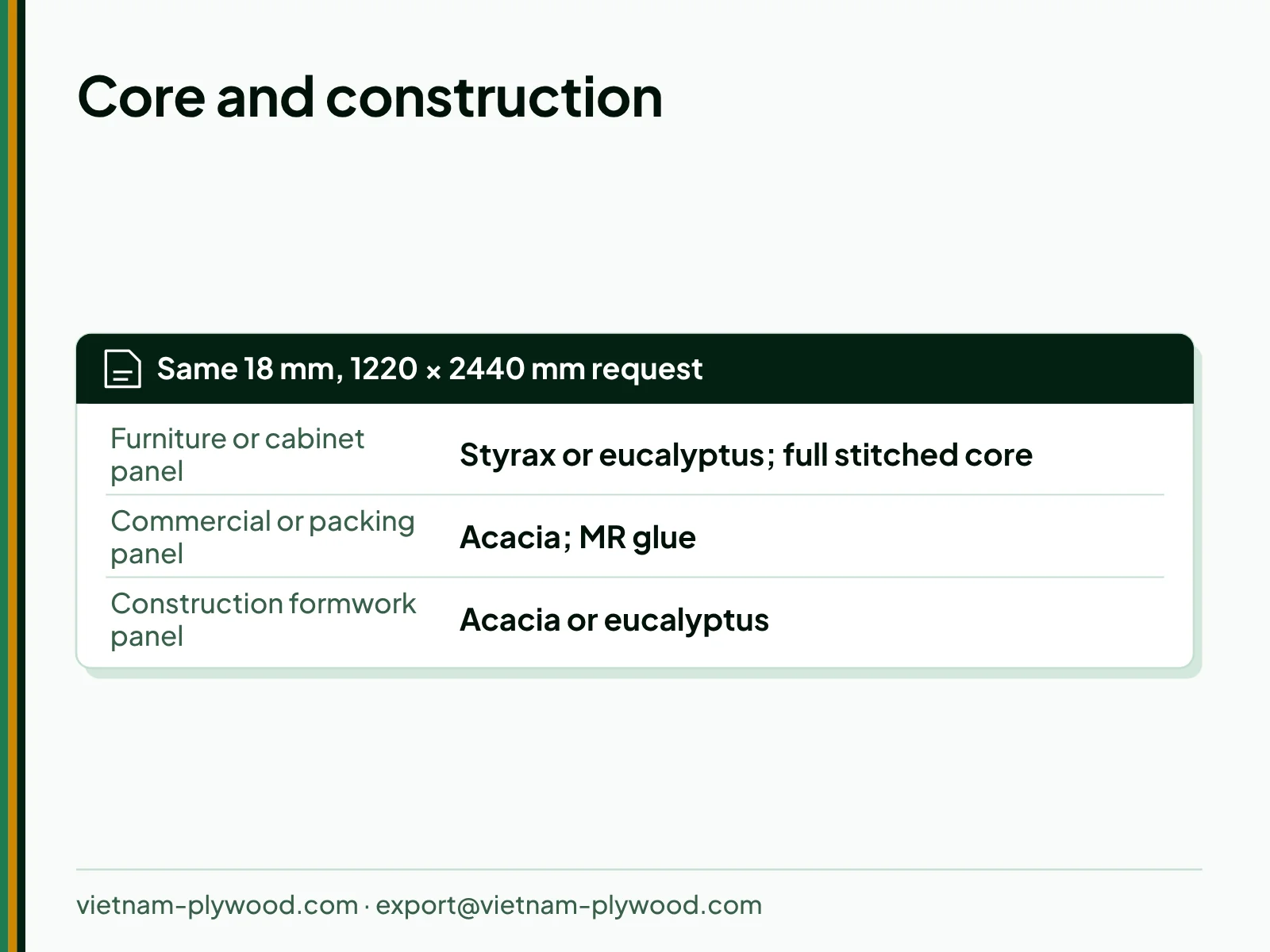
| Same 18 mm, 1220 × 2440 mm request | Core and construction | Surface and process | Tolerance | Schedule item to settle |
|---|---|---|---|---|
| Furniture or cabinet panel | Styrax or eucalyptus; full stitched core | Sanded, face veneer selected by use; E0/E1 | ±0.2 or ±0.3 mm as ordered | Face matching, sanding and thickness inspection |
| Commercial or packing panel | Acacia; MR glue | Unsanded or light-sanded | ±0.5 mm commercial; packing ±0.5–1.0 mm | Core layup, press batch and pallet sorting |
| Construction formwork panel | Acacia or eucalyptus | Phenolic or melamine film, including anti-slip options | ±0.5 mm | Film selection, pressing and edge checks |
The furniture build calls for a stitched, sanded face-ready panel. The commercial build instead prioritizes an acacia-core panel with the agreed surface preparation. Construction panels have a film surface and a different release and edge-inspection concern. These are distinct orders even when the nominal dimensions match.
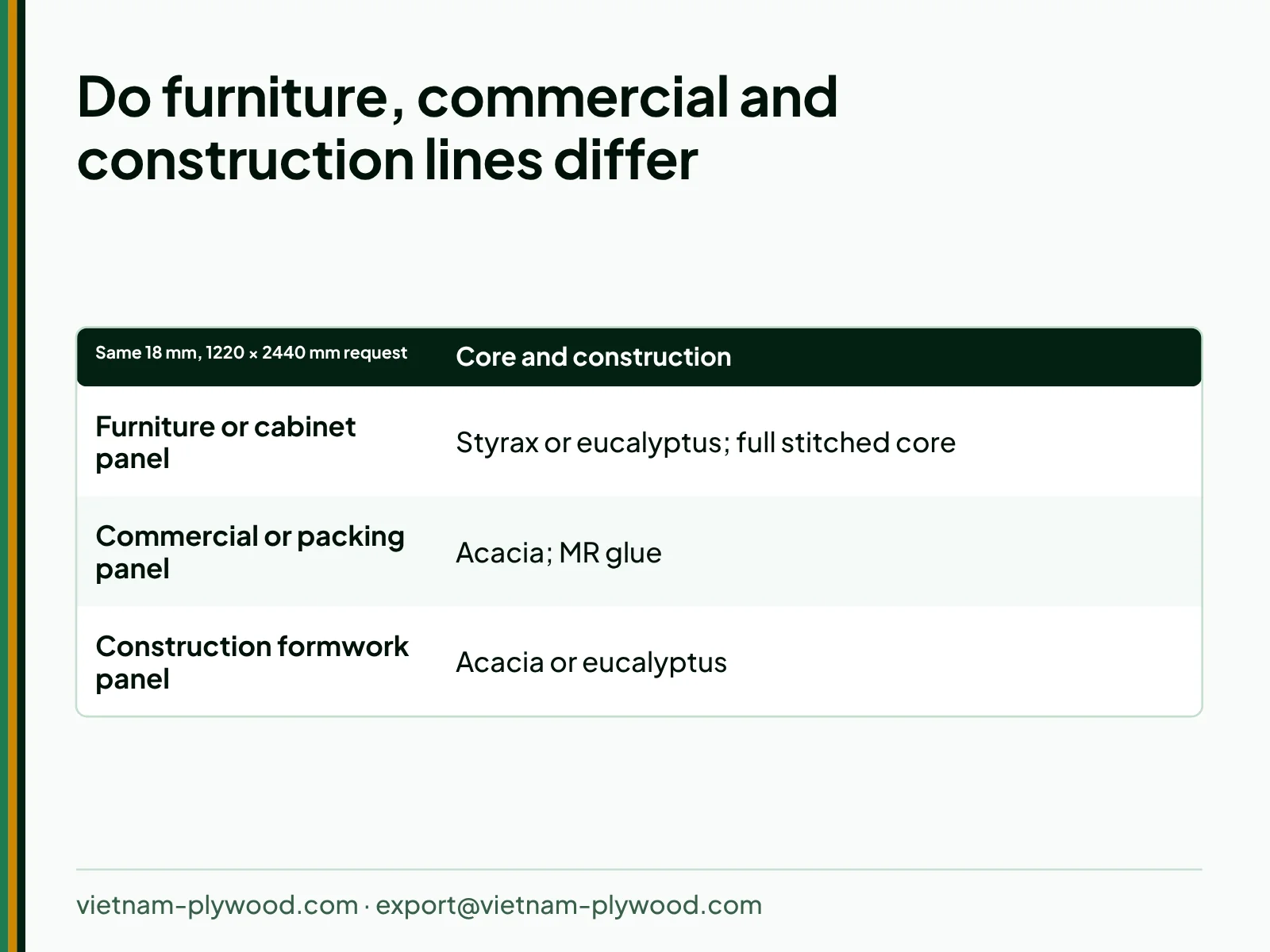
The furniture line uses styrax or eucalyptus cores; the commercial and packing line uses acacia; the construction line uses acacia or eucalyptus. Our factories do not press birch-core plywood. A birch face is a veneer option, with birch face grades D/E/F; it does not turn the core into birch. Compare the grades across factory lines before approving substitutions.
Furniture and commercial plywood capacity is up to 100 containers a month; construction plywood is up to 140. These capacities describe the respective lines and do not replace the production window for a specific specification.
Why can 4 mm plywood take longer to produce?
A 4 mm plywood request needs a separate thin-panel plan because veneer selection, layup, pressing and handling become sensitive to the finished thickness. The specification must state whether 4 mm is a finished sanded dimension and which tolerance applies. We make thicknesses from 3–40 mm, but no verified 4 mm-specific production-day figure is available.
The core veneers used for ply construction are 1.4–2.0 mm thick. That range makes layup design a real decision for thin panels: a mill cannot simply copy the ply count of an 18 mm board. The order also needs a clear face veneer choice; common face veneer thickness is 0.2–0.4 mm. Face grade, core build and sanding allowance need to be considered together before pressing.
For a furniture application, full stitched construction and a sanded surface require checks for finished thickness and face condition. For a packing application, a different core and surface preparation may be appropriate. A thin construction-film request requires its own film and finished-panel assessment; film weights are 120 g/m² standard, 135 g/m² premium and 220 g/m² anti-slip only.
Ask for a production sequence that identifies veneer preparation, press selection, thickness measurement and final packing. Thin sheets also need a loading plan that respects the selected core density and pallet height. The exact reason for extra days, if any, belongs on that production plan, not in a blanket claim that every 4 mm order is slower.
Does a mixed container change the lead time?
A mixed container can change the production sequence when its specifications require different press runs, sanding work or factory lines. Mixing is allowed within the 40HC payload limit of 28.5 tonnes, but the last component ready for inspection can determine the loading slot. Buyers should state every line item before the deposit and agree which items share the shipment.
Consider an 18 mm, 1220 × 2440 mm load. A full styrax-core reference load is 990 sheets, 53.05 m³ and 26.52 tonnes. The corresponding acacia-core reference is 880 sheets, 47.15 m³ and 27.35 tonnes; eucalyptus-core is 795 sheets, 42.60 m³ and 27.69 tonnes. These are separate full-load references, not quantities to add together.
For a mixed load, request a line-item packing plan with pallet counts, actual gross weights and a container payload check before booking. The full reference figures and loading method are on 40HC plywood packing.
Mixing two furniture faces may require different veneer batches while sharing the furniture press route. Mixing furniture and film-faced panels involves different producing lines and a consolidation plan. The mixed-container ordering guide addresses how to write those combinations into the purchase specification.
How does bulk order size change the lead time?
Bulk order size changes the number of production batches, material preparation and inspection lots that must fit the schedule. The published production range remains 15–45 days from the 30% deposit, set by order size, line loading and the contract. More containers do not automatically translate into the same loading date as a first container.
For a repeat furniture specification, the main questions are whether the face veneer, core construction and sanding requirements stay unchanged. For commercial packing panels, acacia veneer supply and the selected MR press sequence matter. For construction panels, film specification and glue selection affect which run can be combined with another order.
The buyer should distinguish an entire order completion date from staggered loading dates. Where multiple containers are discussed, request a per-container readiness sequence and inspection plan. Do not infer a daily output rate from monthly capacity: the stated capacities cover different product families and do not establish how many sheets of a particular build can be pressed each day.
A repeat specification reduces the number of decisions reopened at order entry. It does not remove the need to check the producing factory’s current schedule, accepted quality criteria and the requested destination sailing.
Which production checkpoints belong on the schedule?
A useful production schedule identifies the physical checkpoints a buyer can verify. Our on-site quality control follows the specification at the producing factory, and buyers may visit the factory office and inspect the goods where they are made.
The first checkpoint is the approved core and face construction. Full stitched, stitched outer layers with edge-trimmed inner layers, finger-jointed and loose-laid cores are different builds; a request must name the accepted one. The second is the press specification. MR glue uses a hot-press range of 110–120 °C; WBP uses 130–145 °C. Melamine MR is associated with a 12-hour boil condition and phenolic WBP with a 72-hour boil condition; these are specification categories, not substitute test results for a shipment.
The third checkpoint is finished dimensions and surface. Furniture sanded tolerance is ±0.2 or ±0.3 mm as ordered; commercial and film-faced ±0.5 mm; packing ±0.5–1.0 mm. Length and width tolerance is ±2 mm. An inspector can witness thickness measurement, face review, edge inspection, sheet counting and pallet labeling against the approved order.
Glue and emission are separate specification fields. E0, E1 and E2 describe emission classes; CARB P2 / TSCA Title VI refers to a US limit with third-party certification. Certificates from member factories, including FSC, CARB P2, ISO 9001 and CE, and EUDR/EUTR documents are shown with factory details masked, on request. Where a particular report is required, put the agreed build and report into the inspection plan before loading.
What happens between factory completion and shipment?
Factory completion, container loading and vessel departure are separate milestones. A finished pallet still needs the agreed inspection release, container arrangement and export paperwork before the shipment can move. HCPLY manages specification, on-site checks, documents and loading, with orders shipped directly from the producing factory, FOB Hai Phong.
The shipment documents include commercial invoice, packing list, B/L, certificate of origin (EUR.1 for EU lots), phytosanitary and fumigation papers, insurance under CIF, the order’s agreed certificate documents and the EUTR/EUDR file set for EU lots. The packing list is the practical cross-check for quantity, package description and weights when the buyer reviews the loaded shipment.
The US International Trade Administration’s Common Export Documents guidance (2026 access) describes an export packing list as a record of quantity, package type and weights. This supports reviewing the packing list alongside the commercial invoice rather than treating a factory-ready date as proof of completed export paperwork: official export-document guidance.
Delivery terms offered are FOB Hai Phong, CFR (CNF) or CIF. The International Chamber of Commerce’s Incoterms 2020 text distinguishes FOB delivery on board the vessel from earlier terminal handover. Read the FOB shipment explanation and CIF versus FOB comparison when matching a loading milestone to the contractual delivery point.
How do ocean transit and order timing connect?
Ocean transit starts after the factory production and shipment milestones; it should not be added into the stated 15–45-day production range as though it were factory time. Route and carrier determine the voyage, and the buyer’s warehouse receipt occurs later still.
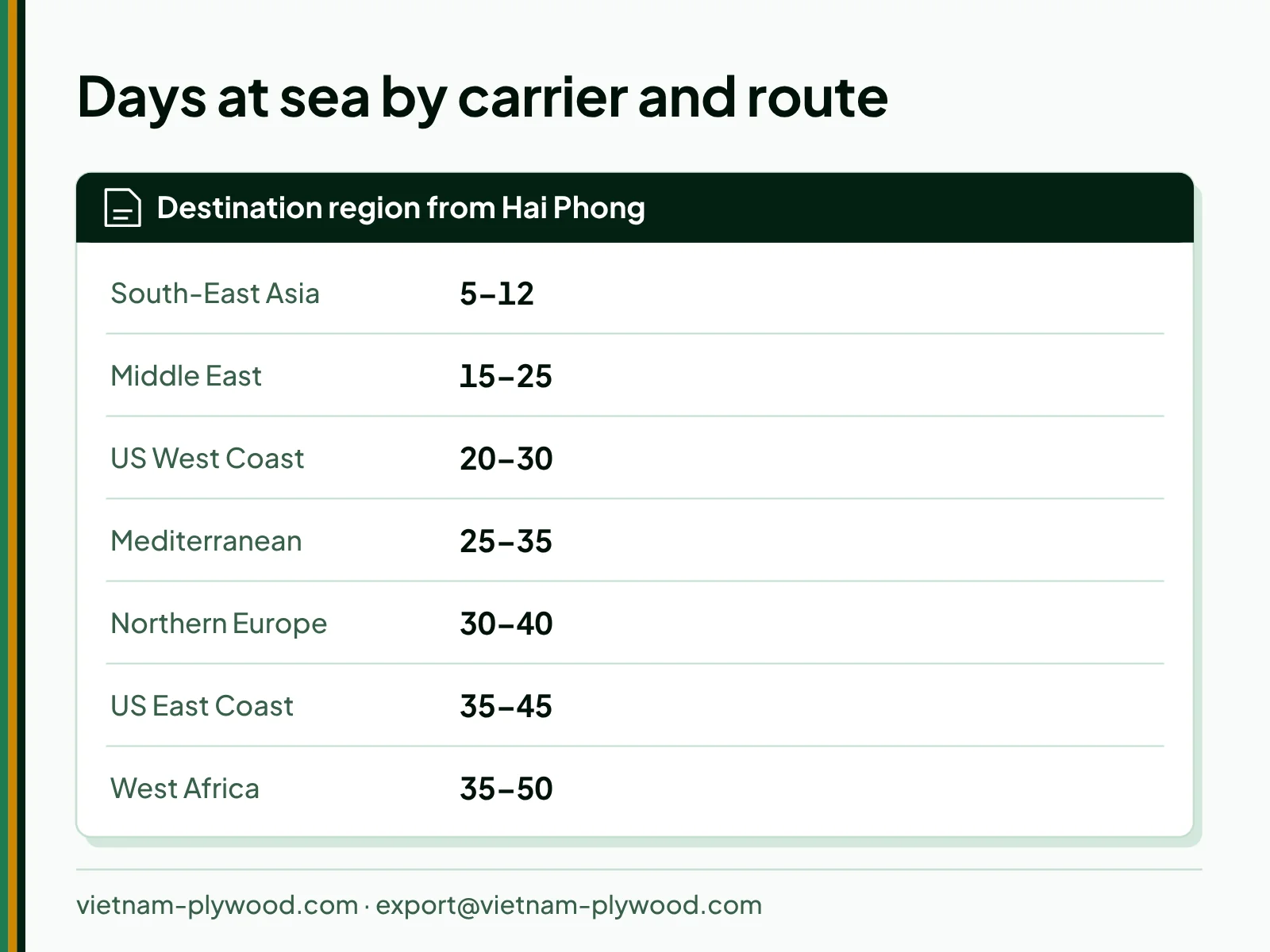
| Destination region from Hai Phong | Days at sea by carrier and route |
|---|---|
| South-East Asia | 5–12 |
| Middle East | 15–25 |
| US West Coast | 20–30 |
| Mediterranean | 25–35 |
| Northern Europe | 30–40 |
| US East Coast | 35–45 |
| West Africa | 35–50 |
A cabinet maker planning an installation date should work backward from the date panels must enter production. Subtract the ocean leg, destination clearance and inland movement, then allow the agreed loading and inspection steps before factory completion. This is a planning sequence; it does not establish customs clearance days or a vessel departure date.
The route should be written alongside the order specification. A switch from FOB to CIF changes the carriage and insurance responsibilities and the documents included, but it does not by itself change the panel’s manufacturing operations.
How can buyers shorten avoidable order delays?
The most useful lead-time improvement is to settle decisions before the production slot is assigned. Specify the product in a form the factory can press and inspect, then keep changes visible on the order schedule. A shorter quoted number without a defined build provides little value to an importer managing inventory.
First, choose the producing line by application. Cabinet components needing a sanded, stitched panel belong in the furniture discussion; transport packing belongs in the commercial and packing discussion; concrete formwork belongs in the construction discussion. See plywood supply for construction projects when the application involves formwork cycles.
Second, resolve the specification details that can reopen production planning: face species and grade, core, glue, emission class, finished thickness, tolerance, sheet size, packaging and quantity. Available sizes include 1220 × 2440, 1250 × 2500, 1220 × 2135, 1220 × 1830, 915 × 2440, 915 × 2135 and 915 × 1830 mm; custom cutting is available. A change from a standard size to custom cutting needs to be visible in the schedule.
Third, arrange inspection criteria before the panels are pressed. Specify the witness checks and any required third-party report, then reserve time for the buyer or inspector to examine the finished goods. Finally, give the intended destination port and shipping term early enough for a loading plan to be built around the finished cargo.
What should the purchase order say about loading?
The purchase order should distinguish the deposit-triggered production window from the agreed factory inspection and container-loading dates. It should also define how a revised specification affects the sequence, which party approves the inspection and when draft documents will be reviewed.
A good schedule names the producing line, the ordered build, the planned factory-ready milestone, inspection access, pallet counts and the intended vessel arrangement. For mixed specifications, record separate line-item readiness checkpoints and the final consolidation date. For a first order, attach sample approval and any accepted test-report requirement to the same record.
For a practical factory discussion, send the following specification to Lucy at export@vietnam-plywood.com. The fields make it possible to quote a product and discuss its production sequence without guessing at thickness, surface or port.
Application: [cabinet / furniture / commercial packing / formwork]
Line or core: [furniture: styrax/eucalyptus | commercial: acacia | construction: acacia/eucalyptus]
Glue: [melamine MR / phenolic WBP, as applicable]
Emission: [E0 / E1 / E2 / required third-party limit]
Face and grade: [species or film weight; grade]
Thickness and tolerance: [mm; finished tolerance]
Size: [length × width, mm]
Quantity: [sheets and 40HC containers; mixed line items if any]
Destination port: [port and country]
Next step: book a factory visit to review the production route and witness the agreed checks at the producing factory.