





What is walnut plywood?
Walnut plywood at HCPLY is a layered wood panel with a walnut-looking decorative face over a bonded veneer core. The visible face defines its commercial name; the inner veneers determine most of its weight and construction. A buyer ordering by the word “walnut” alone risks paying for the wrong appearance, losing production time, or rejecting a mismatched delivery.
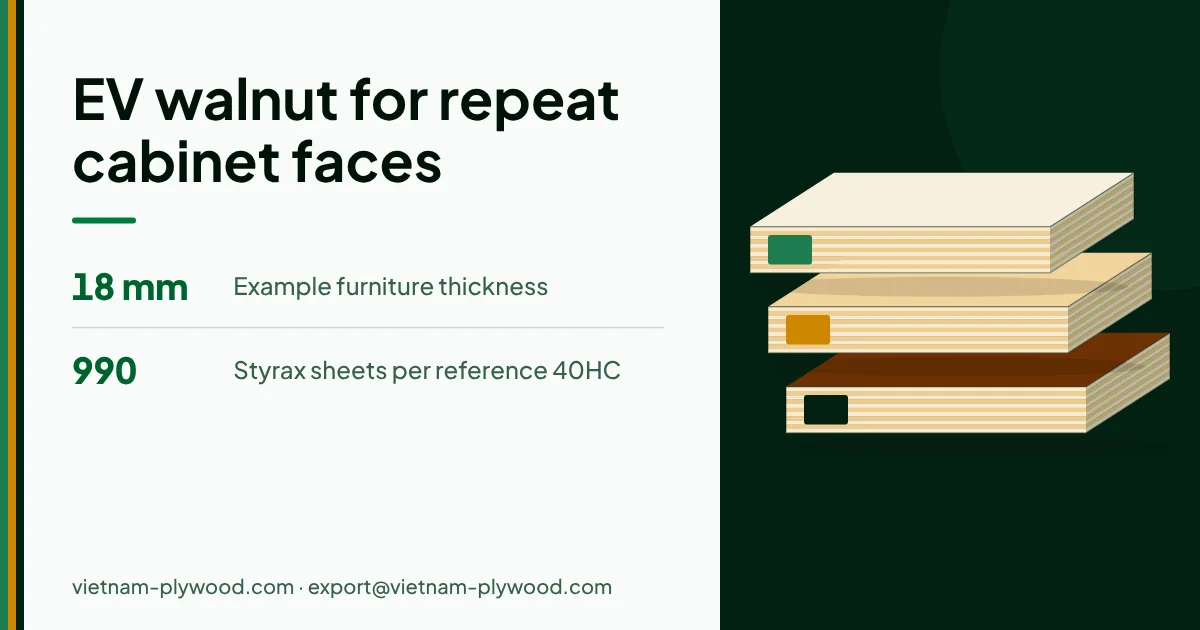
The relevant repeat-order option is engineered veneer (EV) walnut on our furniture line. It gives furniture and cabinet programmes a controlled walnut appearance without requiring each new batch to reproduce the grain of a different natural log. A walnut veneer board can be specified for visible doors, side panels, shelving and interior fit-out elements.
For the broader hardwood-face family, see oak and hardwood veneer plywood.
How does EV walnut compare with natural black walnut veneer?
EV walnut offers a repeatable visual reference across orders, while natural black walnut preserves the individual variation of real walnut logs. The difference matters most when replacement cabinet doors must sit beside doors made months earlier.
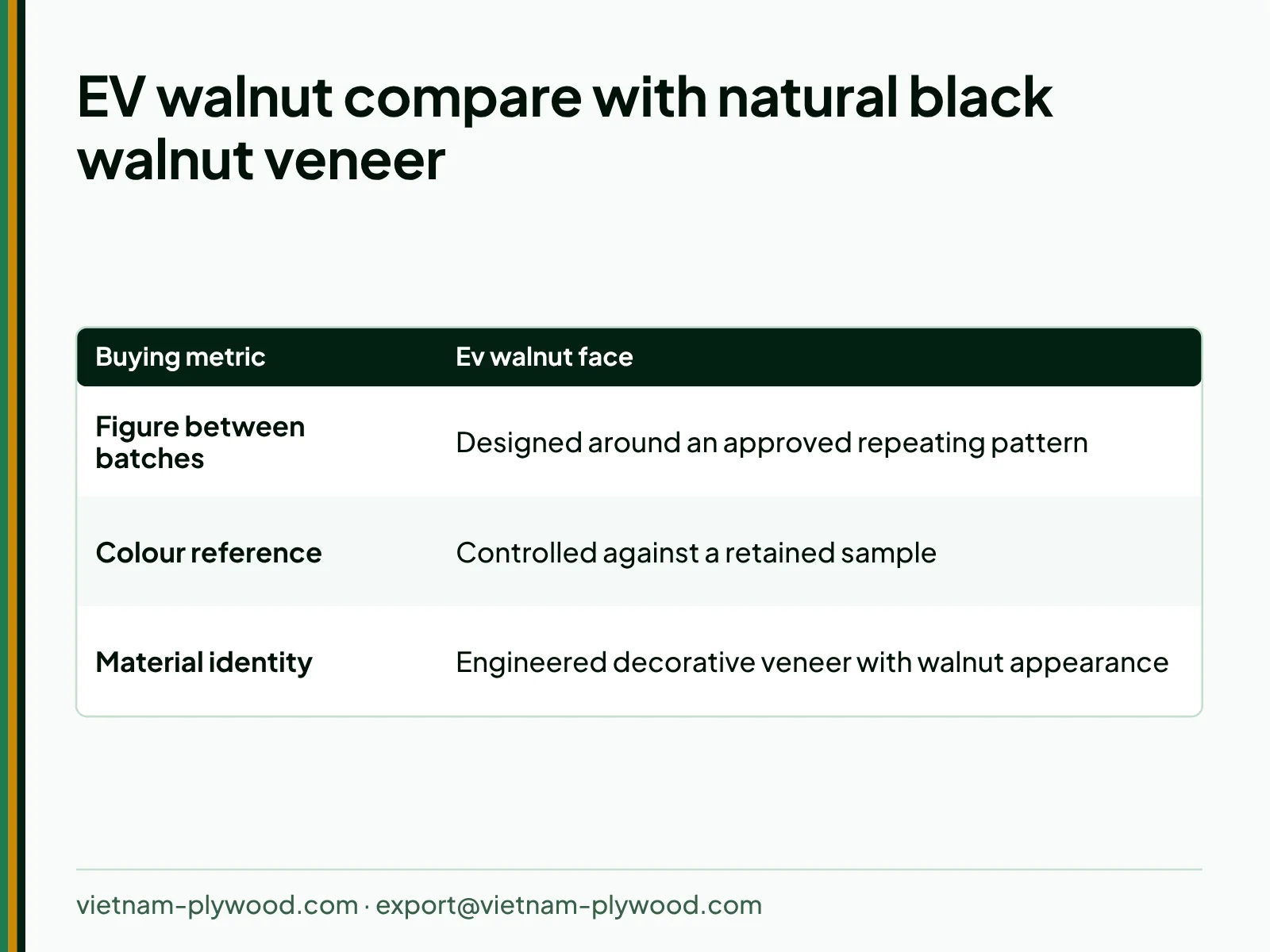
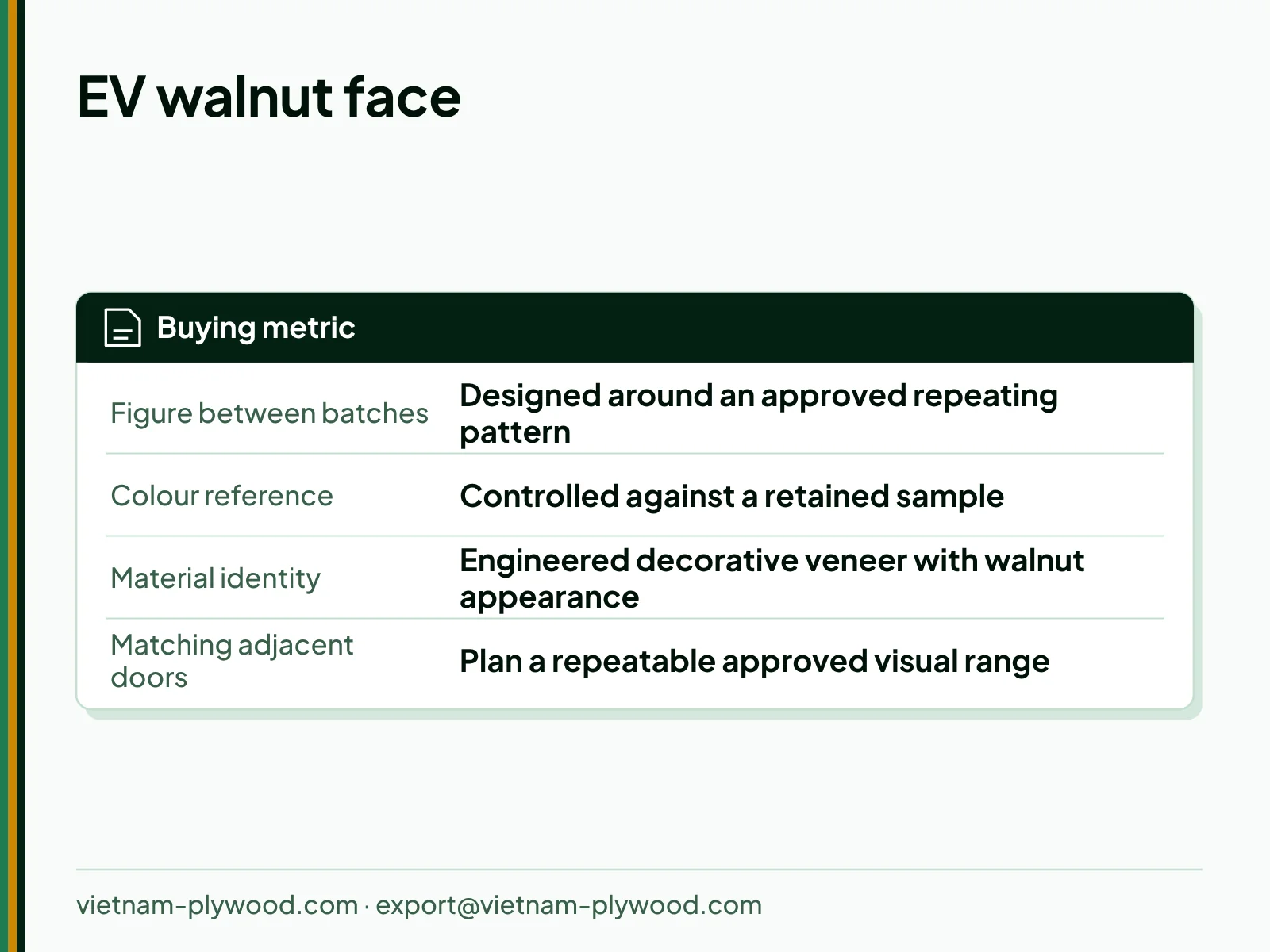
| Buying metric | EV walnut face | Natural black walnut face | Verdict by use |
|---|---|---|---|
| Figure between batches | Designed around an approved repeating pattern | Changes with log and veneer sequence | EV for repeat cabinet programmes |
| Colour reference | Controlled against a retained sample | Heartwood and sapwood vary between logs | EV for coordinated rollouts |
| Material identity | Engineered decorative veneer with walnut appearance | Genuine walnut species veneer | Natural for species-specific design briefs |
| Matching adjacent doors | Plan a repeatable approved visual range | Reserve sequential veneer bundles for close matching | EV for future replacements; natural for matched feature sets |
| Purchase specification | State EV design reference and face grade | State walnut species, cut and matching method | Both require a physical sample |
| Finish approval | Test the actual face under the intended finish | Test the actual face under the intended finish | Neither should be approved from a screen image |
The term black walnut plywood should be reserved for a natural black walnut face when species identity is part of the contract. EV walnut must be identified as engineered veneer. An approved sample is the purchasing reference, including its colour range, grain direction and finish response.
Why does natural walnut veneer vary from lot to lot?
Natural walnut veneer varies because each log grows with its own colour, grain direction and figure. Slicing position, heartwood distribution and the way leaves are matched also change the resulting face. Two panels called walnut can therefore look different while both meet a broad species description.
Plain-sliced veneer often produces cathedral figure, while quartered or rift-oriented cuts can create straighter visual lines. These are veneer-cut descriptions rather than interchangeable grades. A request for straight grain should say so explicitly; the word “premium” does not define a matching pattern.
Finishing can increase the visible difference between logs. Clear coating, stain and lighting alter how contrast appears on the finished panel. For natural walnut, buyers should identify the approved veneer bundle or matching sequence for a particular installation, then decide how future replacements will be handled.
Which walnut face suits a furniture programme that reorders?
EV walnut is the practical choice when a furniture programme requires the same approved face appearance on successive orders. HCPLY can use a retained EV design reference to guide appearance inspection on our furniture line. Buyers should still define acceptable visual variation and review a physical sample from the proposed build.
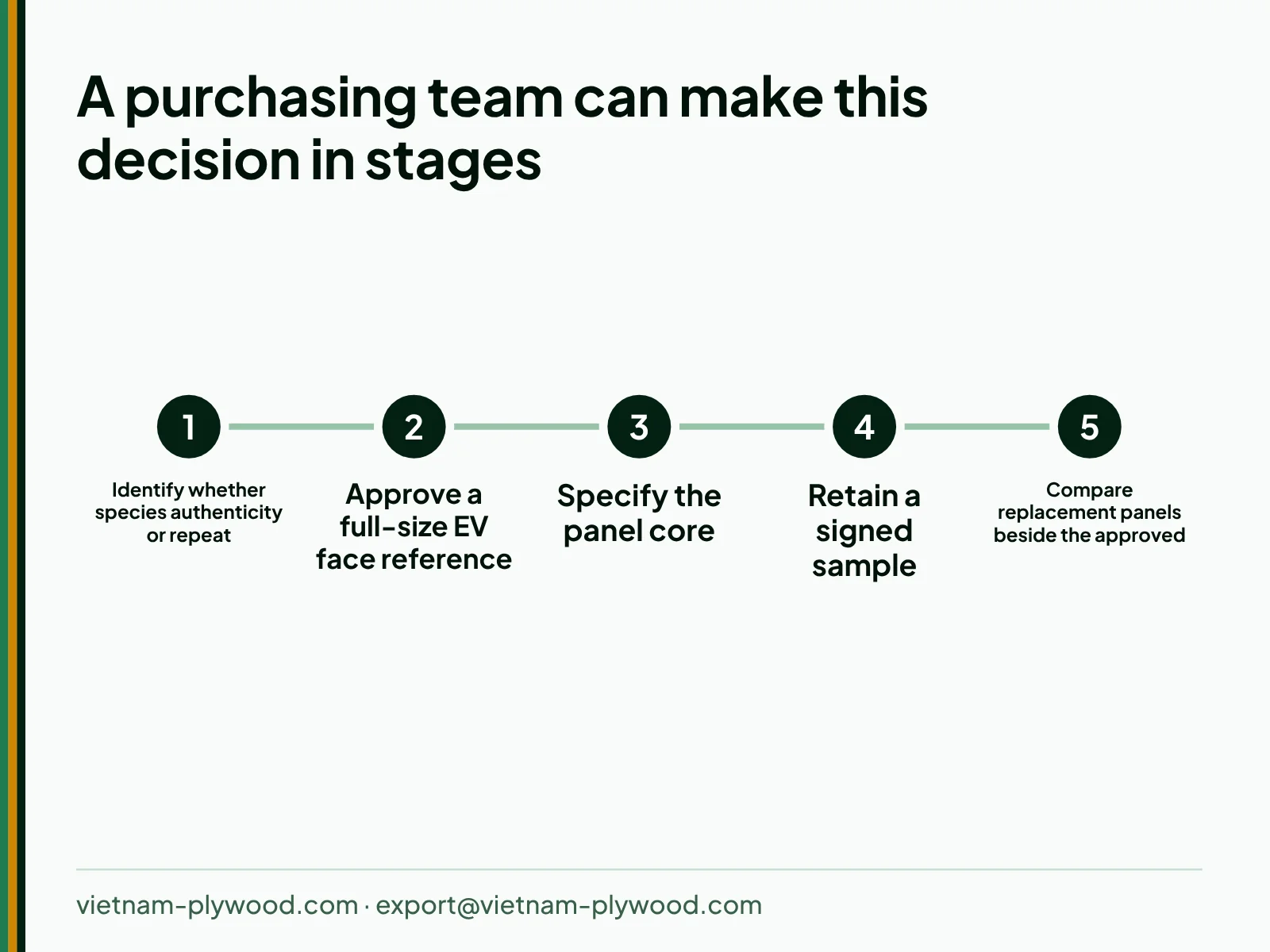
A purchasing team can make this decision in stages:
- Identify whether species authenticity or repeat appearance is the design requirement.
- Approve a full-size EV face reference and record grain direction, colour range and finish.
- Specify the panel core, grade, thickness, glue and emission class independently of the face.
- Retain a signed sample and an agreed inspection method for subsequent batches.
- Compare replacement panels beside the approved reference before dispatch.
Natural black walnut remains appropriate for projects whose drawings call for genuine walnut veneer or a deliberate sequence of natural leaves. For those projects, reserve and document the matching scheme rather than assuming a future log will reproduce the original figure.
Our EV plywood programme addresses the engineered-face route. The decorative veneer face comparison helps teams choose other visible appearances when walnut is one finish within a wider cabinet range.
Which factory line makes a walnut-faced panel?
Our furniture line makes the EV walnut-faced plywood described here, using a full-stitched, sanded styrax or eucalyptus veneer core. The other lines serve different uses and do not turn an EV walnut order into the same product simply by matching its thickness.
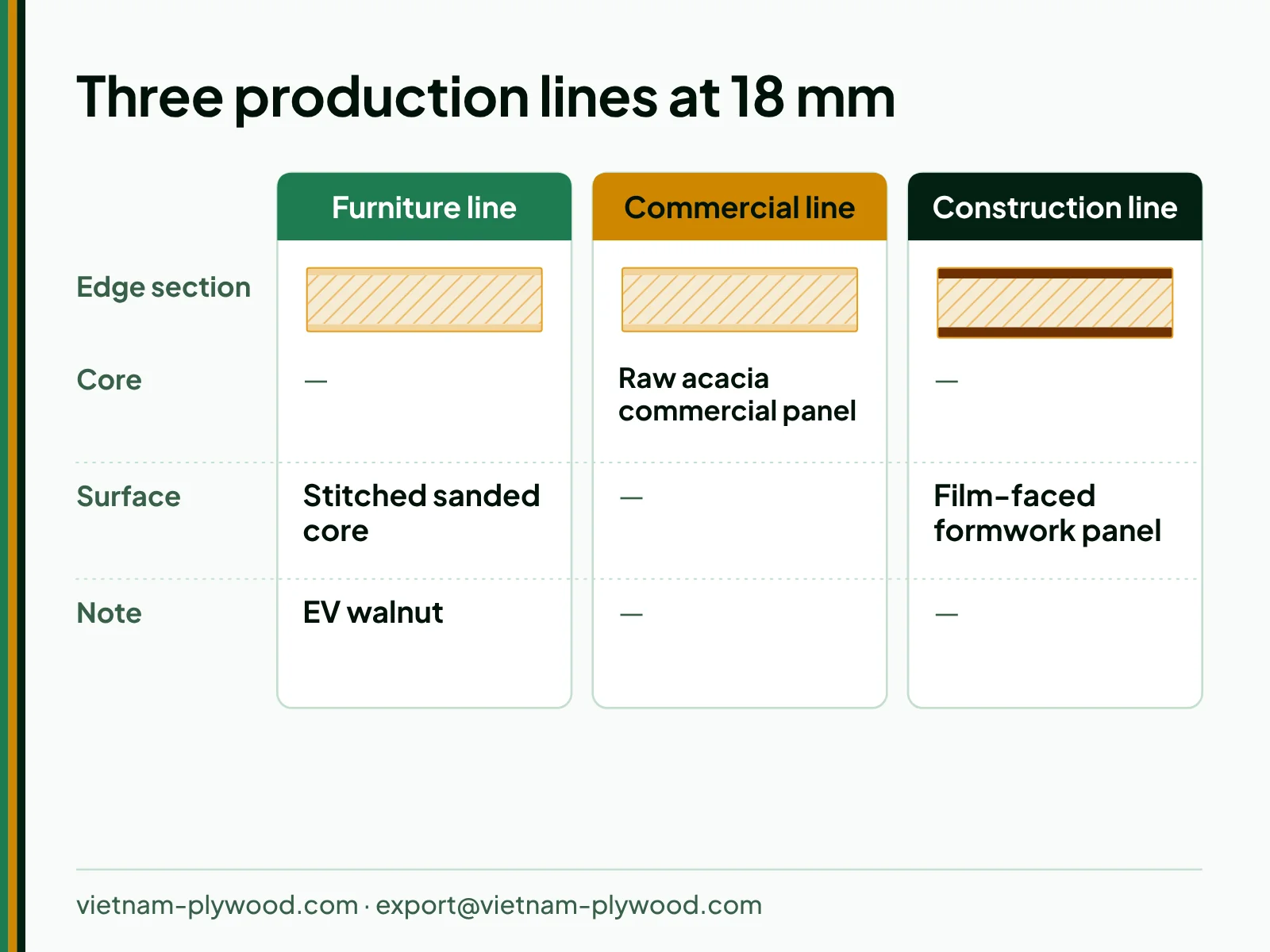
| Line | Example at 18 mm | Core and finish | Intended buyer use |
|---|---|---|---|
| Furniture | EV walnut face | Full-stitched, sanded styrax or eucalyptus | Visible cabinet and furniture parts |
| Commercial and packing | Raw commercial panel | Acacia core, unsanded or light-sanded | Packing and utility components |
| Construction | Film-faced panel | Acacia or eucalyptus core, unsanded | Concrete formwork |
This comparison explains why thickness is only one specification field. A cabinet door needs an approved visible face and controlled sanding. Packing plywood instead prioritises a different surface requirement; construction plywood uses a film surface for formwork rather than decorative veneer.
The three factories operate in Phu Tho and Hai Phong, with each order produced at the factory matching its specification. Buyers can visit the factory office and inspect the goods at the producing factory. The factory-line grade comparison gives a broader view of these build choices.
What specification should a walnut veneer plywood order carry?
A walnut veneer plywood order should name its face design, veneer core, adhesive, emission class, dimensions and inspection reference separately. Face names do not determine panel density, and an emission class is not a glue formulation.
For furniture production, the core choices are styrax at 500 kg/m³ or eucalyptus at 650 kg/m³. Face veneer commonly measures 0.2–0.4 mm. Furniture faces use A/B grading; specify which side remains visible after assembly. A sanded furniture thickness tolerance is ±0.2 or ±0.3 mm as ordered, with length and width tolerance ±2 mm.
Available thicknesses span 3–40 mm, with common choices including 9, 12, 15, 18, 21 and 25 mm. Standard formats include 1220×2440 mm and 1250×2500 mm; additional formats and custom cutting can be discussed against the cutting schedule. At 18 mm, a panel has 11–13 plies according to the thickness of the core veneers.
Adhesive and emissions must occupy separate lines on the purchase order. Melamine adhesive is the MR option with a 12-hour boil description; phenolic is the WBP option with a 72-hour boil description. Emission classifications are E0, E1 and E2. For this furniture line, specify E0 or E1 as required by the order.
The United States Environmental Protection Agency’s 2025 Code of Federal Regulations, 40 CFR § 770.10, sets a 0.05 parts-per-million formaldehyde limit for hardwood plywood made with a veneer or composite core. That US rule also addresses third-party certification; request the applicable factory evidence for a US-bound order. Factory certificates and documents are shown with factory details masked, on request. White oak veneer plywood and red oak veneer plywood are useful adjacent face comparisons.
Can walnut veneer plywood share a container with other furniture faces?
Yes. EV walnut-faced sheets can share a 40-foot high-cube container with other furniture-line faces when the written specifications and loading plan fit the payload limit. The face mix changes the appearance schedule; the core and thickness determine the base loading arithmetic.
For 18 mm, 1220×2440 mm styrax-core furniture sheets, the reference load is 990 sheets, 53.05 m³ and 26.52 tonnes. An equivalent eucalyptus-core reference is 795 sheets, 42.60 m³ and 27.69 tonnes. These are full-container reference loads without film weight, not a claim that different cores can be stacked without recalculating weight.
A mixed-face order can use the 990-sheet styrax reference when all sheets share the same 18 mm thickness, 1220×2440 mm size and styrax core. The reference full load is 26.52 tonnes against the 28.5-tonne payload limit. Allocate the approved faces across pallets in the final loading plan.
For other core mixes and dimensions, calculate loading again using the container loading reference.
What should an inspector check before the walnut panels ship?
An inspector should compare the production lot with the signed face sample and the purchase specification at the producing factory. The strongest repeat-order check places current panels beside a retained approved reference under consistent lighting.
Check the face across several panels, including colour band, grain direction, visible defects and any edge-to-edge figure transitions. Inspect both the full sheet and a cut-piece arrangement that resembles the intended cabinet fronts. Record which face grade applies to each side and which surface will be exposed in the finished product.
Next, measure panel thickness and dimensions at agreed points, inspect edge construction and look for visible core gaps or surface defects. Confirm the specified sanding and review glue and emission records for the ordered build. The inspector can witness the checks, photograph sample comparisons and record findings against the lot identification.
How should buyers compare walnut plywood cost and value?
The strongest price driver is whether the order calls for natural black walnut veneer or a repeatable EV walnut design. Natural species-specific face selection and close veneer matching add material selection and handling work; EV walnut can reduce that matching burden on repeat programmes.
After face type, grade and matching demands influence the quotation. Core choice, thickness, sanding tolerance, sheet dimensions and order mix also affect production cost. A high-visibility A face with tighter appearance matching costs more to prepare than a less selective face requirement, because fewer veneer sheets qualify.
Compare quotes against identical written specifications. A lower quotation for a different core or an unspecified back face is not a like-for-like comparison. For a cabinet programme, calculate the effect of rejected or mismatched replacement fronts alongside the initial panel cost.
Request a quotation for the approved EV design, quantity and destination port. HCPLY quotes the specific build rather than using a generic walnut sheet price list.
What export paperwork follows the walnut-faced order?
The shipment paperwork should identify the agreed walnut-face specification and the actual loaded goods. HCPLY manages specification, on-site quality control, shipping documents and loading through export.
The commercial invoice and packing list describe the sold and packed material, while the bill of lading records the carriage. The shipment also includes a certificate of origin, phytosanitary and fumigation papers, and the agreed certificate documents or test reports. European Union lots include the relevant EUTR/EUDR file set and EUR.1 where applicable; CIF shipments include insurance paperwork.
After loading, the draft shipping documents come to you for approval. FOB Hai Phong, CFR (CNF) and CIF are available delivery terms. The buyer should align the face description, core species and quantity across the purchase specification, invoice and packing list so a receiving warehouse can identify each furniture-face group.
For a mixed-face container, distinguish the walnut design from the other decorative faces on the packing list. That helps the receiving team separate pallets and compare each group against its own approved sample.
How should a buyer approve the first walnut-face sample?
Approve the first EV walnut sample as a production reference for the programme, including its appearance under the intended finish. A small loose swatch helps with initial selection, but a full-size panel shows repetition, colour spread and grain direction more clearly.
Ask for a sample set covering the proposed face and an alternative appearance where the design team is still choosing. Free samples are available; a first-time buyer pays the courier, and that charge comes off the first confirmed order. Keep the approved reference with the drawing revision and the purchase specification.
Factory lead time runs 15–45 days from receipt of the 30% deposit; the exact figure depends on order size, line loading and what the contract fixes. The 70% balance is against the scanned bill of lading, by telegraphic transfer or irrevocable letter of credit at sight. Those terms belong in the commercial order, while appearance acceptance belongs in the signed sample record.
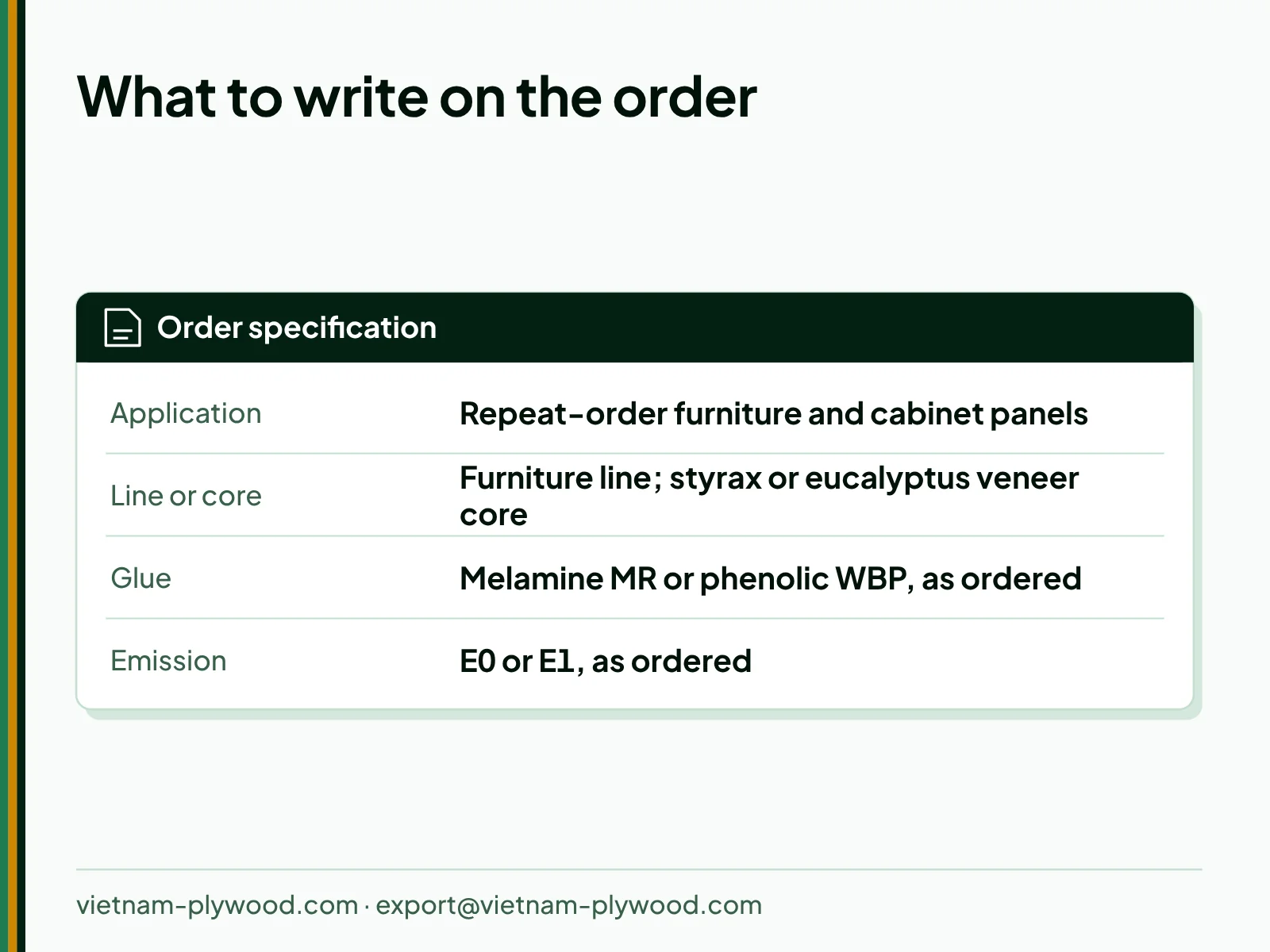
For the next furniture programme, send the specification below to Lucy at export@vietnam-plywood.com. Request a sample set as the next step before fixing the first production lot.
Application: repeat-order furniture and cabinet panels
Line or core: furniture line; styrax or eucalyptus veneer core
Glue: melamine MR or phenolic WBP, as ordered
Emission: E0 or E1, as ordered
Face and grade: EV walnut design reference; A/B; approved sample
Thickness and tolerance: 18 mm; sanded ±0.2 or ±0.3 mm as ordered
Size: 1220 × 2440 mm
Quantity: specify walnut sheets and any other furniture faces; one 40HC minimum
Destination port: specify receiving port