





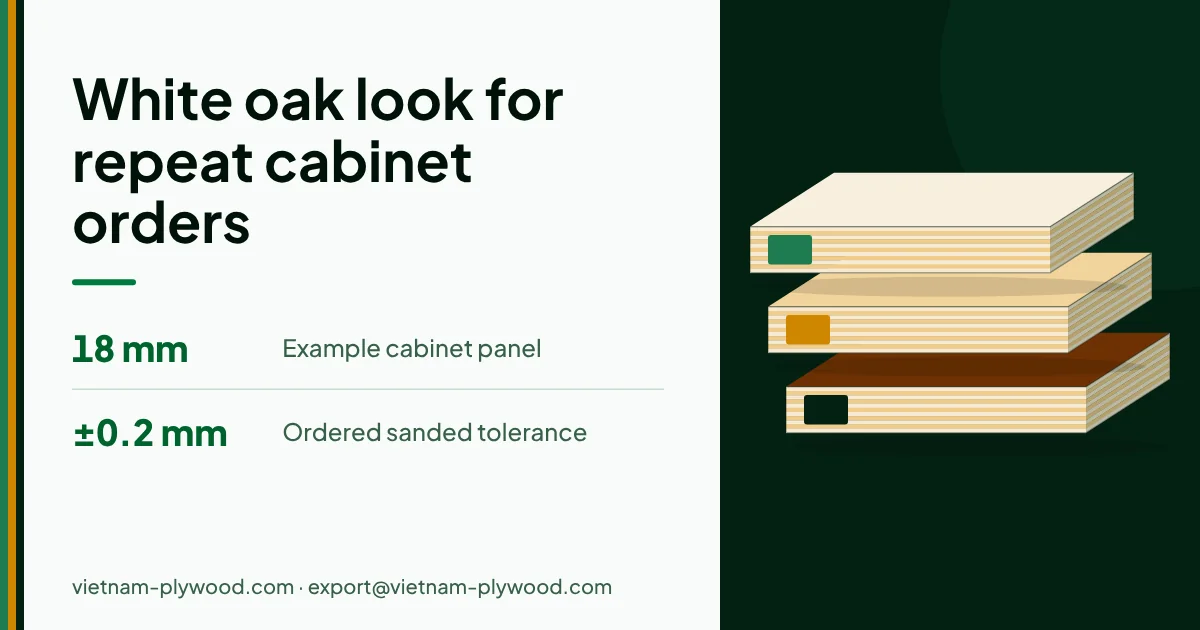
HCPLY builds white oak plywood programmes around a controlled cabinet-face appearance, with EV white-oak-look veneer on our furniture line. A mismatched face or wrong core can cost a cabinet shop days of sorting, rejected doors and replacement material. The order must fix colour reference, grain figure, core and machining dimensions before repeat production.
What is white oak plywood?
White oak plywood is a veneer-faced panel: the visible surface has a white oak appearance while cross-laid wood veneers form its core. For cabinet programmes, buyers specify the face appearance separately from core species, adhesive, emissions and machining tolerances. White oak on the purchase order describes the visible face; it does not establish that every internal ply is oak.
HCPLY develops cabinet-facing specifications through oak and hardwood veneer plywood. The distinction between face and core matters when a cabinet shop compares two visually similar panels with different weights or machining behaviour.
Can HCPLY supply white oak veneer plywood for US cabinet shops?
Our furniture line is the route for a white-oak-look cabinet programme using an engineered veneer (EV) face, a stitched and sanded veneer core, and a written appearance reference. A natural white oak face requires a separate availability and production review before it is entered as an agreed order specification. The standard named face range includes EV, while natural white oak is not a listed standard face.
We produce furniture plywood with styrax or eucalyptus core, full stitched construction, sanding and E0/E1 emission-class options. HCPLY manages specification, on-site quality control, loading and export documents at the producing factory. The export contact is Lucy at export@vietnam-plywood.com.
Natural white oak face or EV white oak face?
Natural veneer shows the wood’s own variation; an EV white-oak-look veneer offers a more repeatable designed grain and tone target. Neither label alone defines a cabinet-ready finish. The approved sample, matching method and grading rules still control what arrives.
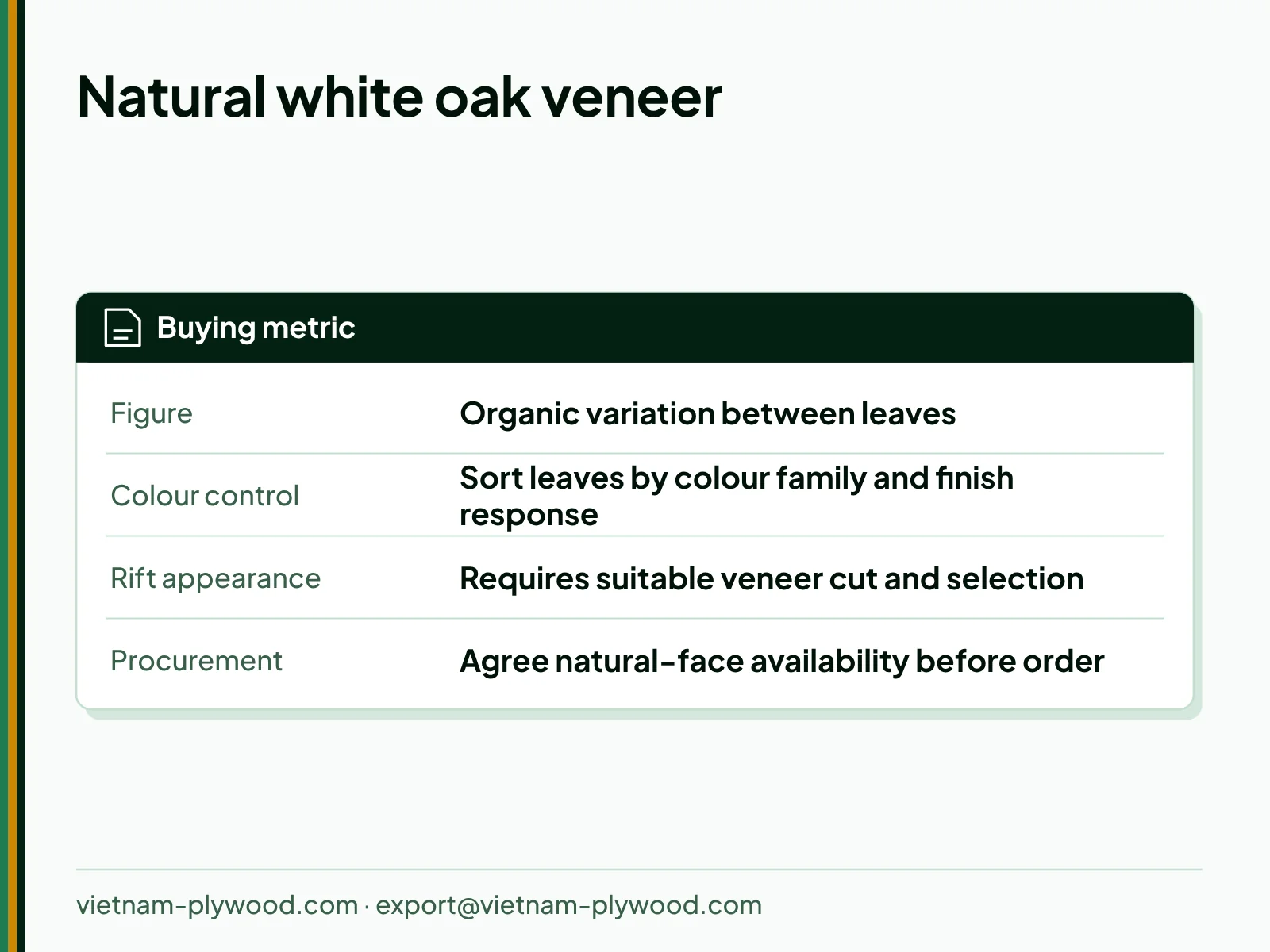
| Buying metric | Natural white oak veneer | EV white-oak-look veneer | Verdict by use |
|---|---|---|---|
| Figure | Organic variation between leaves | Designed, repeatable figure | EV for repeated uniform fronts; natural for varied feature panels |
| Colour control | Sort leaves by colour family and finish response | Match production to approved engineered pattern | EV when multiple cabinet lots must coordinate |
| Rift appearance | Requires suitable veneer cut and selection | Can target a straight-grain visual | Sample both for straight-grain cabinet fronts |
| Procurement | Agree natural-face availability before order | EV is in our named face range | EV for the defined furniture-line programme |
| Acceptance | Approve range of natural variation | Approve pattern, tone and visible repetition | Both require a signed visual reference |
For a broader explanation of engineered faces, see EV plywood from Vietnam. Natural veneers can have attractive variation across adjoining doors; that variation becomes a cost when a later cabinet batch must match an installed kitchen. EV reduces one source of visual drift, but finishing and lighting still affect perceived colour.
How are colour and figure held across repeat cabinet orders?
Colour and figure are held by writing the approved appearance into the order and checking production against it at each repeat lot. A verbal instruction such as “light oak” leaves too much room for different grain direction, tone and face selection.
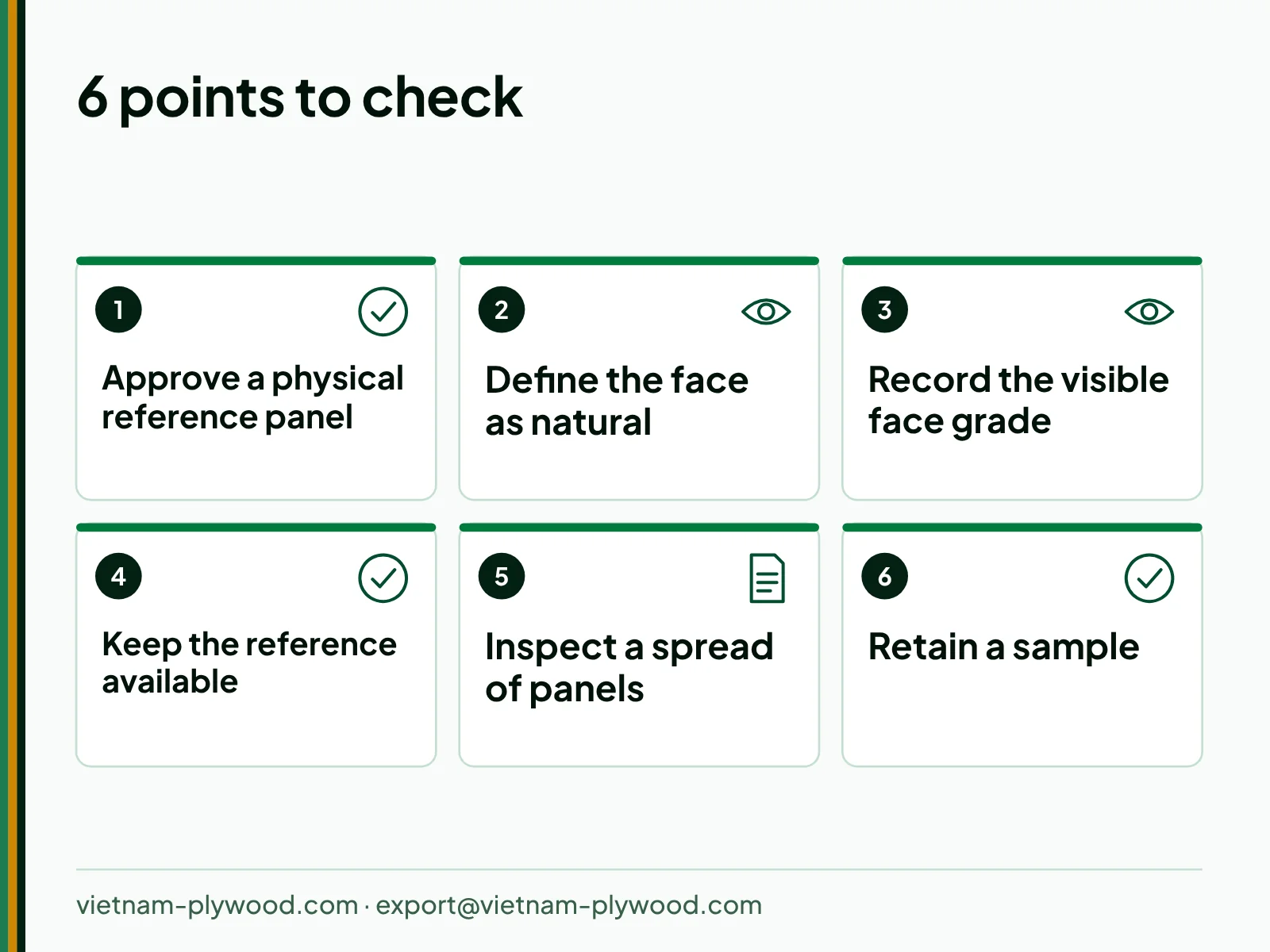
- Approve a physical reference panel under agreed lighting, with the intended clear coat or stain recorded.
- Define the face as natural white oak or EV white-oak-look, and identify the desired straight or varied figure.
- Record the visible face grade, allowable knots or repairs, back-face requirement and matching direction.
- Keep the reference available for lay-up and sorting at the producing factory.
- Inspect a spread of panels from the lot, including panels from different pallets, against that reference.
- Retain a sample from the accepted lot as the comparison point for the next production order.
For cabinet fronts, a visual comparison should include adjacent sheets, rather than isolated attractive examples. Ask the inspector to view panels both side by side and after the proposed finish is applied to sample pieces. This exposes colour breaks that can become conspicuous when doors are installed together.
HCPLY can arrange a buyer inspection at the producing factory. A repeat order should refer to the same approved standard while explicitly recording any intentional change in stain, grain or grade.
What core sits under a white oak face?
The core under an oak-look face on our furniture line is styrax or eucalyptus veneer, selected according to the agreed cabinet build. The face names the appearance; the core drives the panel’s density and much of its transport weight.
Styrax core has a stated density of 500 kg/m³, while eucalyptus core is 650 kg/m³. For a 1220 × 2440 × 18 mm sheet, the corresponding core-based lookup weights are 26.79 kg and 34.83 kg. Those weights exclude any separate face-film calculation; cabinet veneer and finish selection remain specification details.
Full stitched core construction closes internal gaps more consistently than loosely laid veneers. Sanding provides a prepared panel surface, but it does not replace the cabinet maker’s own finishing trial. If exposed edges matter, request a cut-edge inspection and agree the allowable core openings before production.
Our factories do not press birch-core plywood, medium-density fibreboard (MDF), oriented strand board (OSB), chipboard or blockboard. A buyer comparing these constructions should evaluate them as separate material categories rather than assuming they are options under this veneer specification.
How do the three production lines differ for the same 18 mm order?
An 18 mm cabinet-facing panel belongs on our furniture line; the other lines serve packing and formwork requirements. Choosing by thickness alone can put an attractive face on a core or finish unsuitable for visible cabinetry.
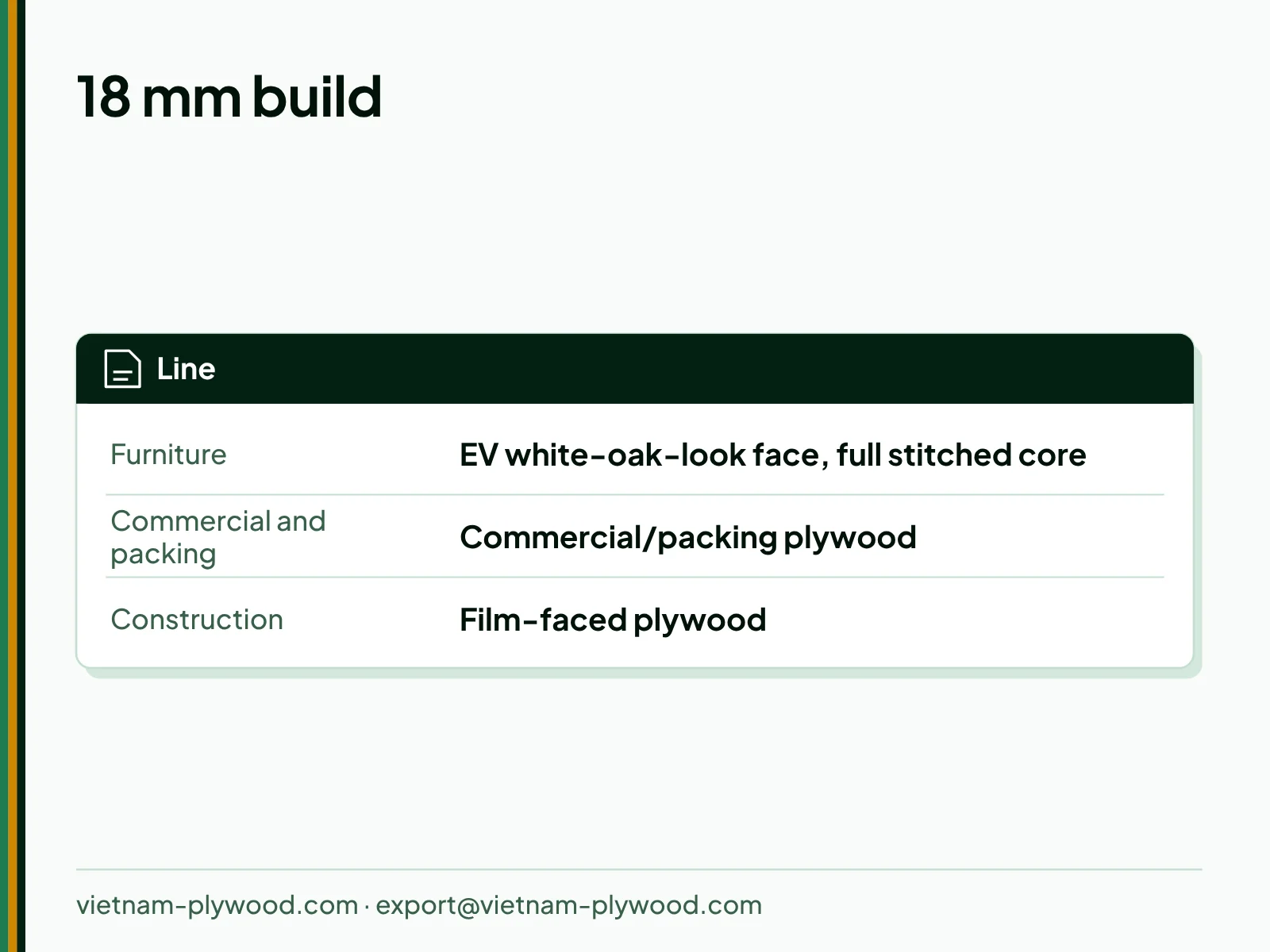
| Line | 18 mm build | Surface and core | Buyer use |
|---|---|---|---|
| Furniture | EV white-oak-look face, full stitched core | Sanded styrax or eucalyptus; E0/E1 | Visible cabinets and fit-out panels |
| Commercial and packing | Commercial/packing plywood | Acacia, MR adhesive, unsanded or light-sanded | Crates, transit protection and concealed industrial uses |
| Construction | Film-faced plywood | Acacia or eucalyptus, unsanded, phenolic or melamine film | Concrete formwork rather than cabinet fronts |
For a broader decision matrix, see plywood grades across factory lines. This separation lets the order specify appearance, machining and application together.
Which face grade, thickness and sheet size should the order fix?
Fix face grade, approved colour range, actual thickness tolerance and cut dimensions before cabinet nesting begins. A face label without those fields leaves the workshop to absorb trimming losses and appearance sorting.
For the named furniture face range, A/B face grades are available as specification categories; an oak-look EV request should identify the chosen appearance standard and grade in writing. Specify the back separately when it will be visible inside open cabinetry. Also record whether face grain runs along the long edge or the short edge, because a reversed orientation changes door matching and nesting yield.
Available thicknesses span 3–40 mm, with common options of 3, 5, 9, 12, 15, 18, 21 and 25 mm. Furniture-line sanded thickness tolerance is ±0.2 or ±0.3 mm as ordered; length and width tolerance is ±2 mm. An 18 mm build has 11–13 plies, reflecting the thickness of the core veneers.
The 1220 × 2440 mm format is the familiar nominal 4 × 8 cabinet-sheet choice. Other stated formats include 1250 × 2500, 1220 × 2135, 1220 × 1830, 915 × 2440, 915 × 2135 and 915 × 1830 mm. Custom cutting is available. The CNC operator should program against the ordered metric dimensions and tolerance, rather than assuming a nominal imperial label is exact.
Can a rift sawn white oak plywood look be supplied?
A straight-grain, rift-sawn white oak look can be specified as an appearance target for an EV face, then evaluated against an approved sample. Natural rift-cut white oak veneer is a distinct material request that needs a production and availability review.
The term “rift sawn” describes a characteristic straight, restrained figure in solid wood or natural veneer cutting. It should not be treated as a guarantee about the cutting method used to make an engineered pattern. In the order, write “straight-grain EV white-oak look” if appearance is the requirement, and attach the approved reference.
Buyers considering warmer or more pronounced grain can compare red oak veneer plywood and decorative veneer faces.
What can an inspector check before the cabinet lot ships?
An inspector can check the face match, sheet dimensions, thickness and cut-edge construction at the producing factory before loading. The checklist should be linked to the approved purchase specification, not a generic description of decorative plywood.
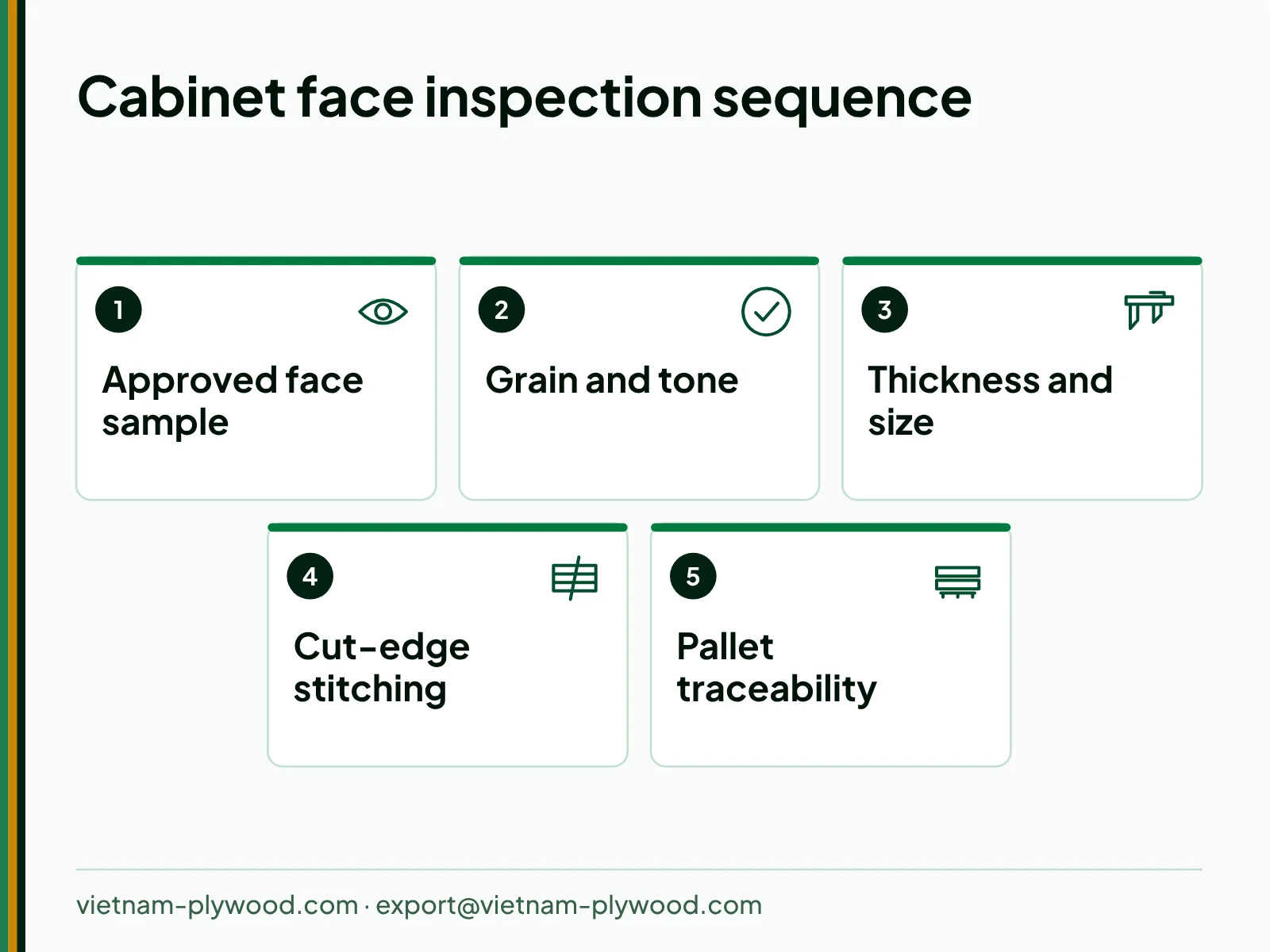
Lay representative sheets flat under consistent light and compare the face against the retained reference. Check tone, grain orientation, surface repairs and any repeating EV pattern that would be visible across adjacent cabinet doors. Inspect the back face where the cabinet design exposes it.
Measure thickness at agreed locations and compare readings with the ordered ±0.2 or ±0.3 mm furniture tolerance. Check length and width against the ±2 mm tolerance. Examine sample cut edges for gaps and stitching, then record pallet identification and photographs against the lot.
What US emissions evidence belongs with the order?
US-bound hardwood plywood orders need a defined emission-compliance route and the relevant factory certificate documents. An E0 or E1 class and an adhesive description are separate specification fields; neither substitutes for US third-party certification.
The 2025 US Code of Federal Regulations, 40 CFR §770.10, sets a formaldehyde emission limit of 0.05 parts per million for regulated hardwood plywood with veneer or composite core. The official 2025 regulation also addresses certification, testing, records and labelling. The US Environmental Protection Agency’s rule summary explains the TSCA Title VI framework for imported products.
For the US purchase order, identify the agreed emission requirement, applicable test report and third-party certificate. Member-factory FSC, CARB P2, ISO 9001 and CE documents are shown with factory details masked, on request. Certificate scope must match the producing factory and ordered build. A US importer should also check the product labelling and recordkeeping requirements applicable to the transaction.
How does core choice affect a mixed container?
Core density changes the sheet count and payload calculation when a cabinet order shares space with other agreed specifications. A 40HC has a payload limit of 28.5 t, so volume alone cannot determine the loading plan.
For 18 mm sheets measuring 1220 × 2440 mm, the lookup gives 990 styrax-core sheets at 26.52 t for a full load, compared with 795 eucalyptus-core sheets at 27.69 t. The respective sheet weights are 26.79 kg and 34.83 kg. These are core-based reference figures, not a promise that an arbitrary mixed order has either full-load count.
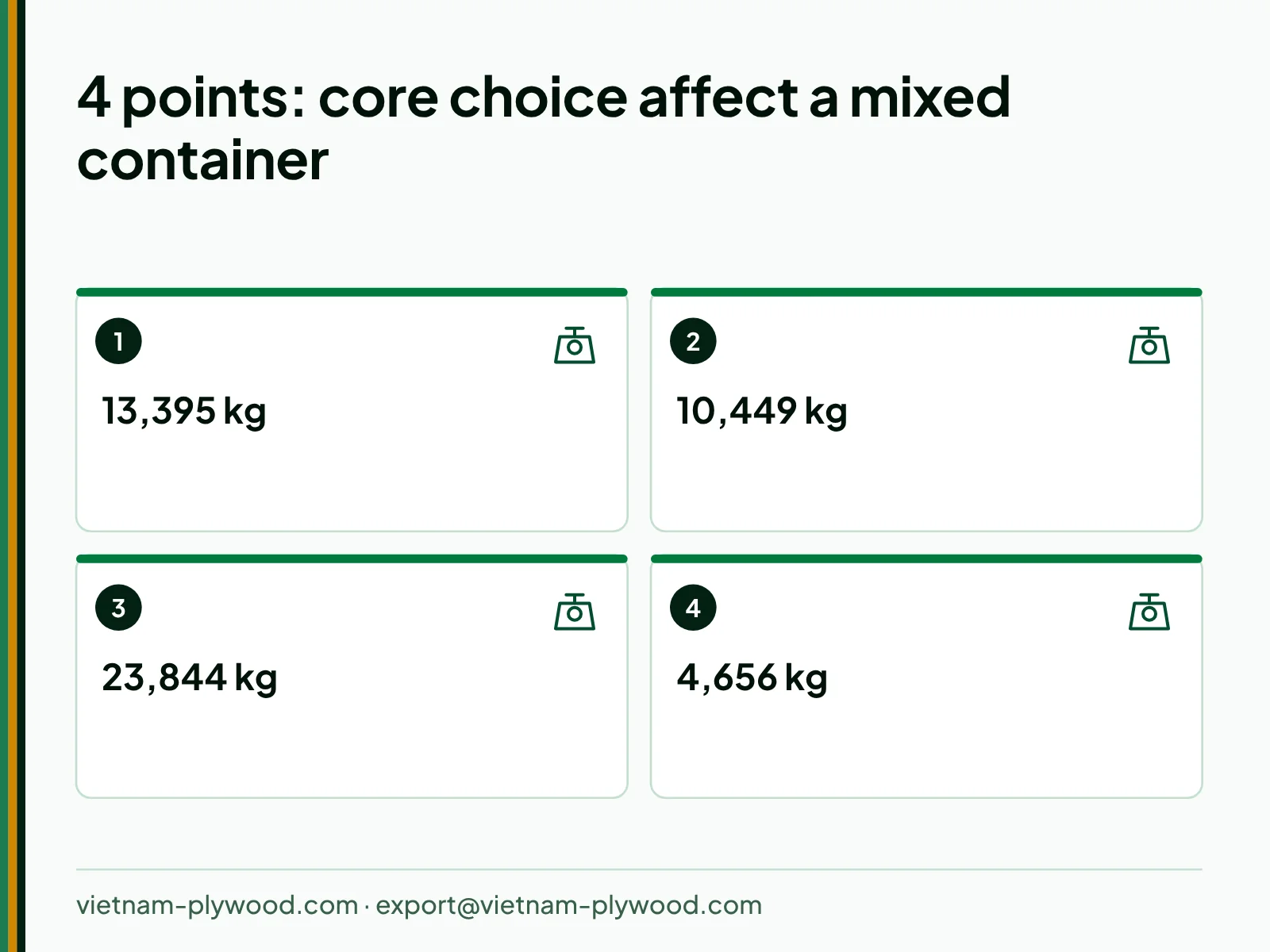
For example, 500 styrax-core sheets at 26.79 kg contribute 13,395 kg, and 300 eucalyptus-core sheets at 34.83 kg contribute 10,449 kg. Together the sheets contribute 23,844 kg, before pallets and any other load items; the remaining payload allowance is 4,656 kg. Loading must also respect pallet layout and dimensions.
The order minimum is one 40HC, and specifications can be mixed. For complete container tables and pallet calculations, use the container loading reference.
How is the cabinet specification carried into shipment?
The approved cabinet specification should follow the goods from factory inspection into the export paperwork. A face-reference identifier, core choice, thickness and size should be traceable to the commercial order and packing identification.
HCPLY ships directly from the factory that produces the order, with FOB Hai Phong, CFR (CNF) or CIF terms available. Factory lead time runs 15–45 days from receipt of the 30% deposit; the exact figure depends on order size, line loading and what the contract fixes; the The remaining 70% is paid on the scan of the bill of lading, by T/T, or by irrevocable sight L/C. Production lead-time planning can help coordinate cabinet release schedules.
The shipment document set includes the commercial invoice, packing list, bill of lading, certificate of origin, phytosanitary and fumigation papers, insurance under CIF, and order-specific certificate documents or agreed test reports. After loading, the draft shipping documents come to you for approval. A packing list identifies shipped packages; the approved specification and inspection records control the visual acceptance of the face.
What should the cabinet buyer send for a quotation?
Send the application, appearance reference, core, dimensions and destination together so the furniture-line build can be assessed as one specification. Natural-face availability, veneer matching requirements and the agreed finish trial can affect material selection and sorting effort.
Ask for a written quotation against the exact cabinet schedule rather than a generic price list.
Application: US cabinet fronts, exposed ends and fit-out panels
Line or core: Furniture line; styrax or eucalyptus veneer core
Glue: Specify MR melamine or WBP phenolic requirement
Emission: E0/E1 class; US TSCA Title VI evidence required
Face and grade: EV white-oak-look; A/B as agreed; approved tone and grain reference
Thickness and tolerance: 18 mm; sanded ±0.2 mm or ±0.3 mm as ordered
Size: 1220 × 2440 mm; length/width ±2 mm; grain direction stated
Quantity: One 40HC minimum; mix schedule attached if needed
Destination port: [US destination port]
Next step: request the white-oak-look cabinet specification sheet from Lucy, export@vietnam-plywood.com.