





What is the 18mm plywood 8x4 price across three lines?
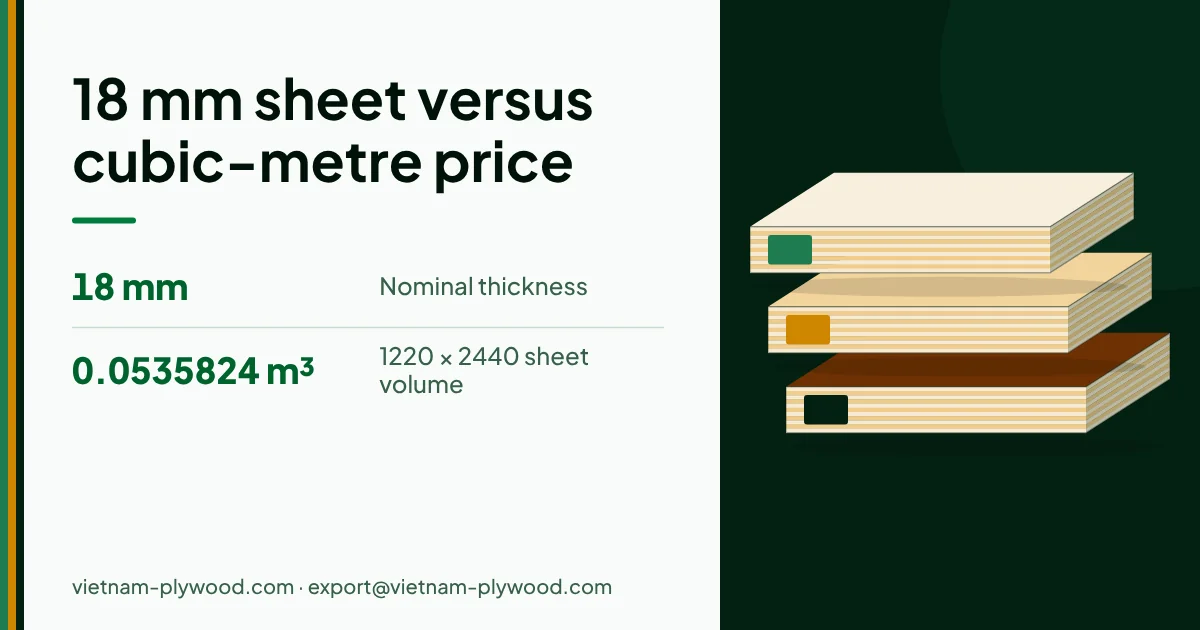
For an 18 mm 8x4 sheet, HCPLY quotes commercial plywood from US$250/m³ FOB Hai Phong (October 2026) and furniture plywood from US$350/m³ FOB Hai Phong (October 2026). These are starting cubic-metre rates, not fixed sheet quotations. Construction-line film-faced panels require a written build specification and individual quotation. At the nominal 1220 × 2440 mm size, one 18 mm sheet occupies 0.0535824 m³.
An incorrect comparison can consume a cabinet maker’s margin or leave an importer with panels unsuitable for the intended service. Compare the same thickness, dimensions, core, adhesive, surface and tolerance before comparing prices. The Vietnam plywood export cost breakdown explains the wider landed-cost components.
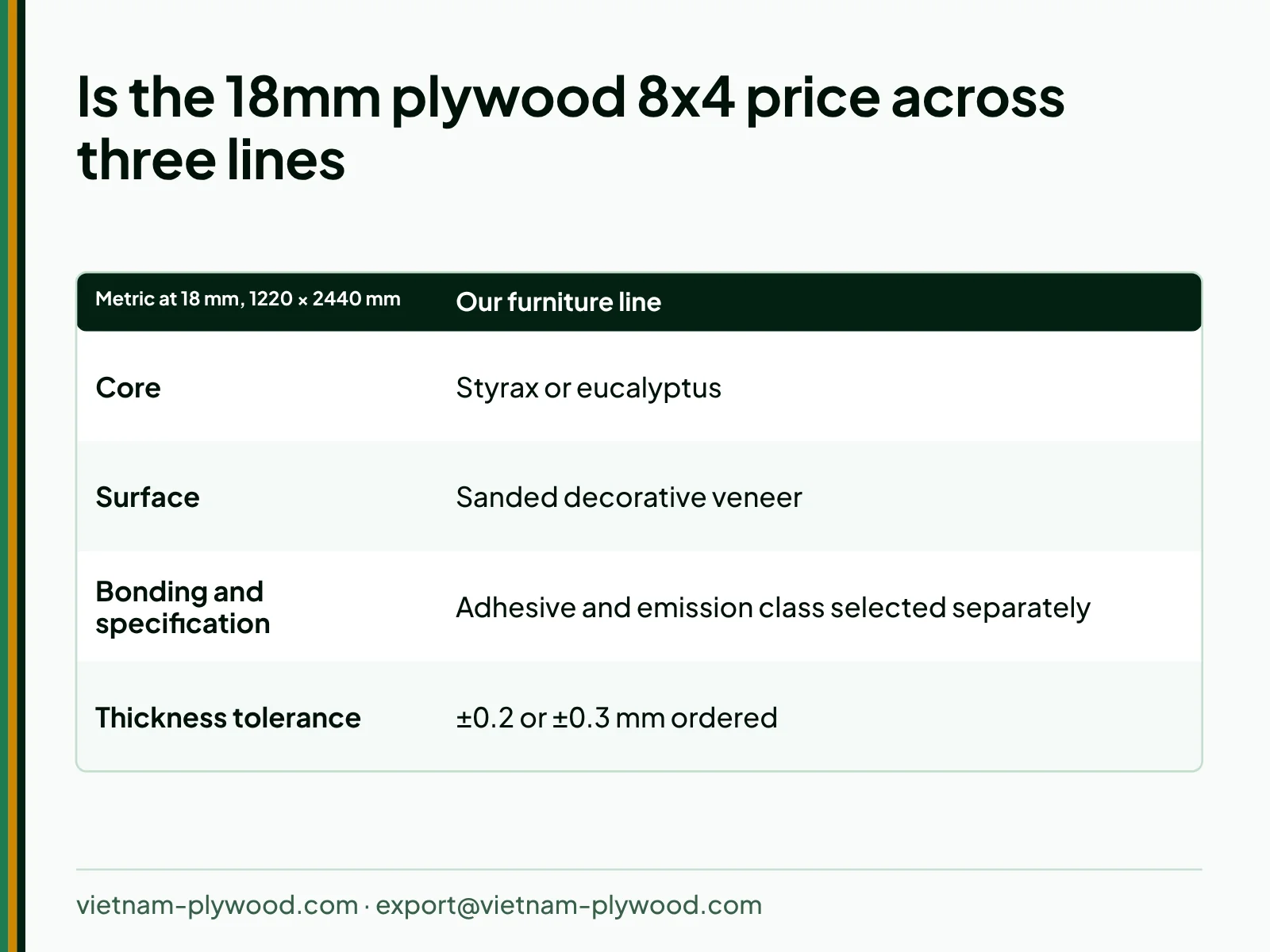
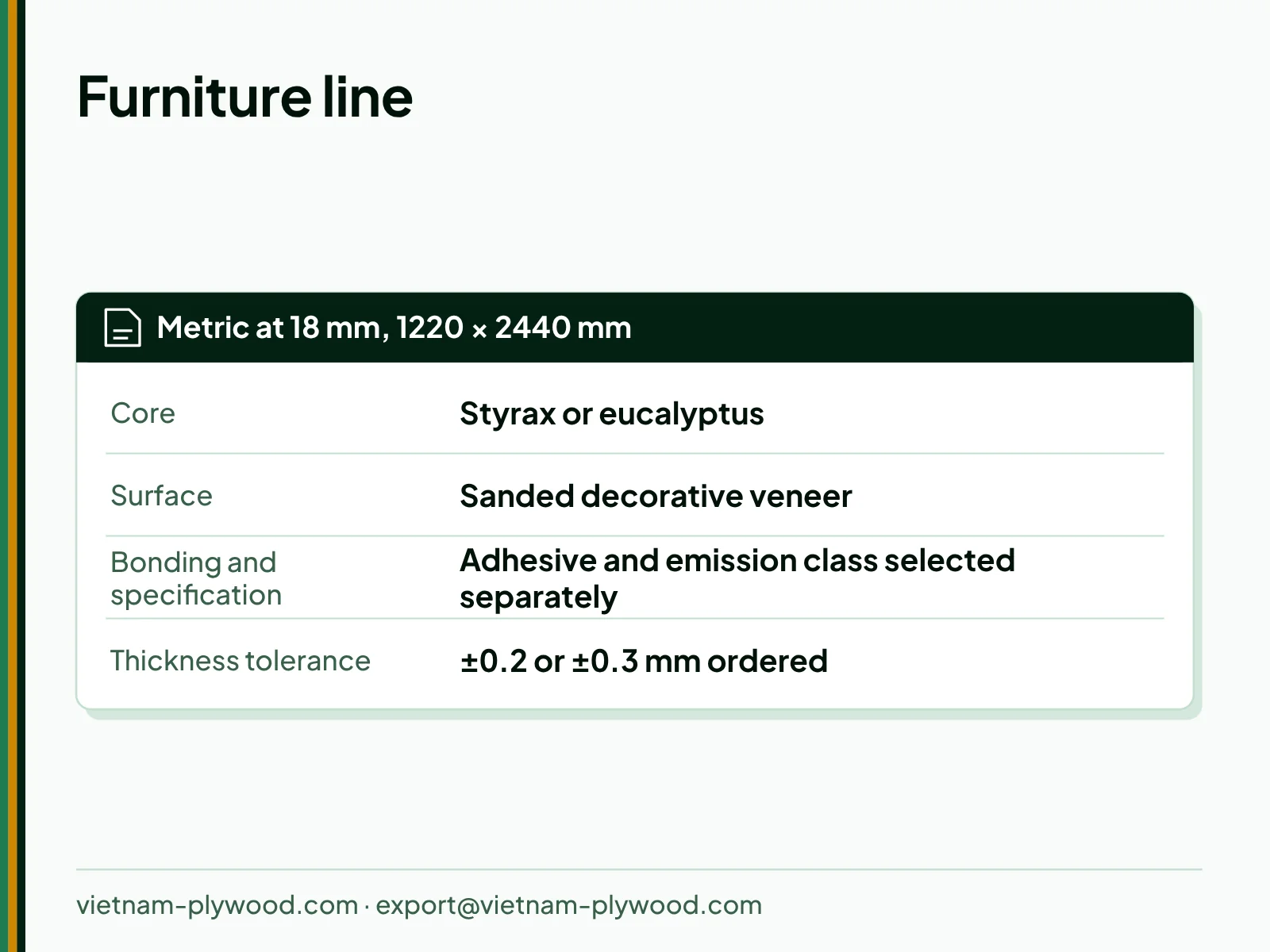
| Metric at 18 mm, 1220 × 2440 mm | Our furniture line | Our commercial and packing line | Our construction line |
|---|---|---|---|
| Core | Styrax or eucalyptus | Acacia | Acacia or eucalyptus |
| Surface | Sanded decorative veneer | Raw, unsanded or light-sanded | Phenolic or melamine film |
| Bonding and specification | Adhesive and emission class selected separately | MR glue | Film and MR or WBP bonding as specified |
| Thickness tolerance | ±0.2 or ±0.3 mm ordered | ±0.5 mm; packing ±0.5–1.0 mm | ±0.5 mm |
| Dated starting price | from US$350/m³ FOB Hai Phong (October 2026) | from US$250/m³ FOB Hai Phong (October 2026) | Quotation by specification |
| Appropriate buying use | Cabinet and furniture components | Commercial panels and packing | Concrete formwork |
The furniture starting rate exceeds the commercial starting rate because these are different build categories: selected faces, stitched construction and sanding add operations. A film-faced build has separate resin, film and service requirements, so its rank against a particular furniture build requires matched quotations. See furniture plywood and commercial and packing plywood for their distinct applications.
How do you convert a per-m³ quote into a sheet price?
Multiply the quoted cubic-metre rate by the sheet’s length, width and thickness in metres. This produces the panel-only FOB equivalent per sheet at the same rate; it does not add freight, duties or local distribution costs.
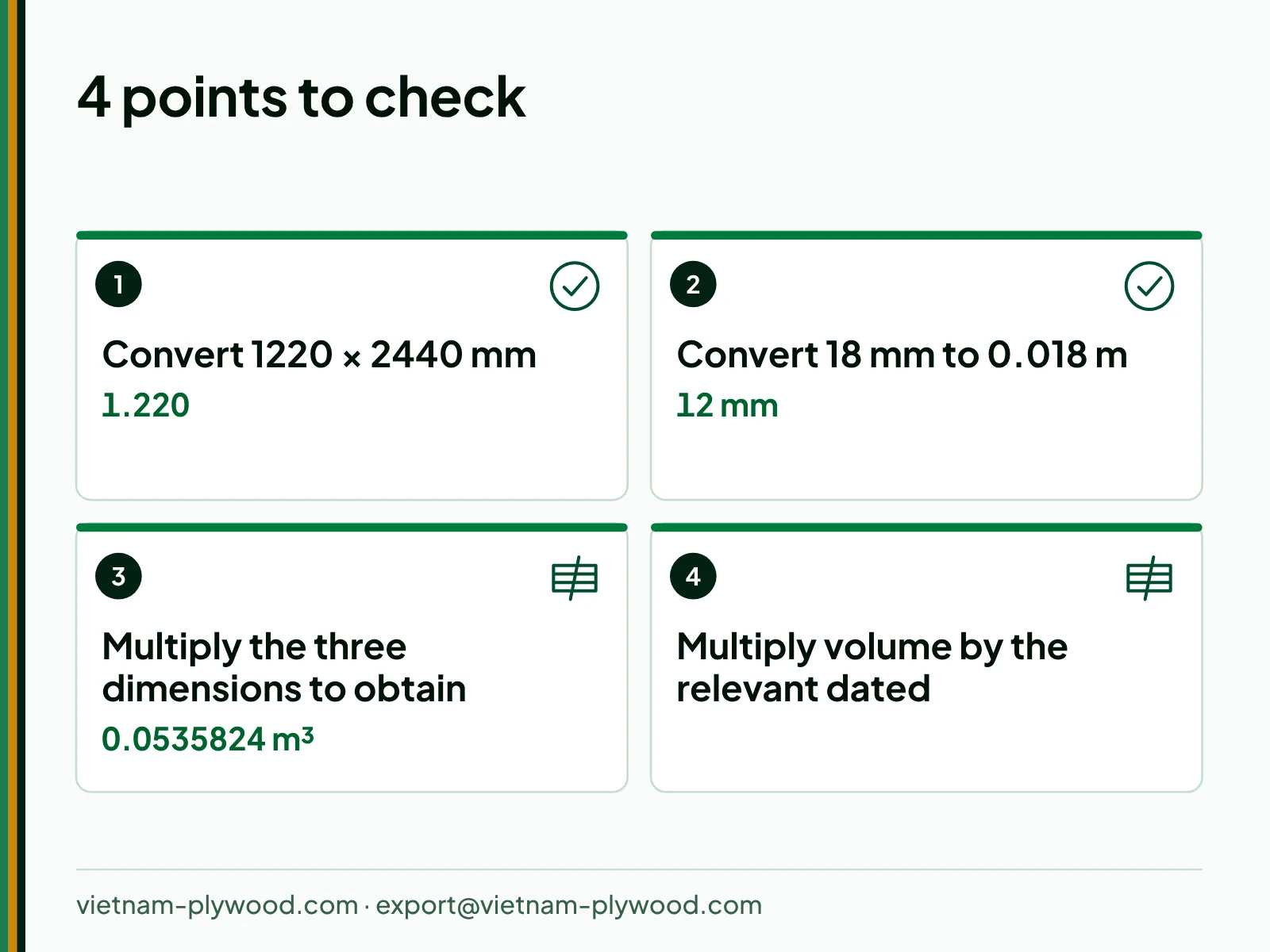
- Convert 1220 × 2440 mm to 1.220 × 2.440 m.
- Convert 18 mm to 0.018 m, or 12 mm to 0.012 m.
- Multiply the three dimensions to obtain 0.0535824 m³ for 18 mm, or 0.0357216 m³ for 12 mm.
- Multiply volume by the relevant dated starting rate, keeping the result labelled as a mathematical illustration rather than an actual sheet offer.
For an 18 mm commercial sheet, 0.0535824 × US$250/m³ = US$13.3956 per sheet as a conversion of the October 2026 starting rate. For furniture, 0.0535824 × US$350/m³ = US$18.75384. At 12 mm the same arithmetic gives US$8.9304 and US$12.50256 respectively. These calculated amounts inherit the starting-rate conditions and cannot price an unspecified grade. For quotations, request a sheet rate and a cubic-metre rate on the same specification.
Why do per-m³ and per-sheet rates differ?
A cubic-metre price measures the volume of wood-based panels, while a sheet price measures one panel of a particular size. At a fixed cubic-metre rate, a thicker sheet costs more because it contains more volume. At a fixed thickness, a larger sheet follows the same rule.
The two price units also respond differently to production economics. A thin sheet needs face handling, pressing and finishing even though its cubic volume is small. A very thick sheet requires more veneer layers, glue application and press capacity. Thus the price per cubic metre can rise at both ends of a thickness range while the sheet price still rises as thickness increases.
A quoted sheet price can conceal size substitutions. An 8×4-foot nominal sheet is often discussed alongside 1220 × 2440 mm export dimensions, but the dimensions are not identical. Specify millimetres on the purchase order rather than assuming a label describes the exact cutting size.
Why can thin and very thick plywood cost more per m³?
Thin panels spread preparation and handling costs across less saleable volume. Very thick panels consume more veneer, adhesive, pressing time and handling capacity per panel. These are cost mechanisms, not a universal percentage surcharge.
For a 3 mm panel, the face veneers and repeated handling represent a larger share of the small panel volume. For a 25 mm panel, veneer selection, lay-up control and press constraints become more demanding. Mid-range thicknesses can spread fixed sheet operations across a more efficient volume. A quotation must still identify the actual core, surface and adhesive because material quality can outweigh the thickness effect.
The veneer sheets used for the core are 1.4–2.0 mm thick, so ply count cannot be derived from finished thickness alone. An 18 mm panel contains 11–13 plies according to its veneer construction. This is one reason two panels labelled 18 mm can differ in build and price.
Which specification drivers change the quoted rate most?
The largest comparison errors come from changing the panel category or adhesive requirement while retaining the same thickness label. The table orders practical quotation checks by their potential to change the build, rather than assigning unsupported percentage premiums.
| Driver to fix first | What changes in the factory | Price-comparison decision |
|---|---|---|
| Intended use and production line | Decorative furniture, commercial packing or film-faced formwork construction | Do not compare unlike categories as equivalents |
| Core construction | Full stitched, stitched outer layers with edge-trimmed inner, finger-jointed or loose-laid | Ask for the exact core construction |
| Adhesive and water exposure | Melamine MR versus phenolic WBP | Match the service requirement and bond system |
| Face and surface | Selected decorative face, raw face or film | Specify face species, grade and finishing |
| Thickness tolerance | Sanded furniture versus commercial or packing allowance | Price the ordered tolerance |
| Sheet dimensions and cutting | Standard or custom cut size | Convert each dimension to volume |
| Order quantity and shipment | Mixed builds within a payload-constrained 40HC | Quote the actual loading mix |
| Testing and destination documentation | Agreed tests, emission records and shipping papers | Identify evidence required before pricing |
The eucalyptus plywood cost and birch-faced plywood cost discussions help distinguish a core choice from a face name. HCPLY names a product by its face, while density follows its core.
How do sizes and thicknesses affect plywood prices?
A sheet’s price at a fixed cubic-metre rate scales with its geometric volume. The standard size 1220 × 2440 mm is 2.9768 m² in area, and thickness converts that area into cubic metres. A custom-cut sheet changes both yield and loading layout.
The available sizes include 1220 × 2440, 1250 × 2500, 1220 × 2135, 1220 × 1830, 915 × 2440, 915 × 2135 and 915 × 1830 mm. Thickness spans 3–40 mm, with 3, 5, 9, 12, 15, 18, 21 and 25 mm common. Length and width tolerance is ±2 mm. A 9mm plywood 8x4 price, a 12 mm rate and an 18 mm rate cannot be compared as if each sheet contains the same volume.
Terms such as plywood price 1/4, plywood price 1/2, plywood price 3/4 and plywood price 3 4 often refer to inch-based nominal thicknesses. Translate the requested label into an agreed metric thickness before ordering. The same applies to plywood price 1 4 and plywood sizes and prices tables: a size heading without actual dimensions is insufficient for a purchase order.
Why does an 18 mm WBP sheet cost more than MR plywood?
Phenolic weather and boil proof (WBP) bonding calls for a different adhesive system and pressing conditions than a moisture-resistant (MR) build. HCPLY’s WBP hot pressing operates at 130–145 °C, compared with 110–120 °C for MR. The defined adhesive tests are a 72-hour boil for phenolic WBP and a 12-hour boil for melamine MR.
Waterproof plywood price 18mm and wbp plywood 18mm price are therefore incomplete requests unless the buyer identifies the test, face, core and service environment. The term waterproof does not establish that every exposed edge, cut or fixing point resists water. For film-faced formwork, sealed edges and a release agent on every pour are part of the handling specification.
An MR commercial sheet should be cheaper than an otherwise comparable WBP build when the stronger adhesive system adds resin and processing cost. A premium face or tighter tolerance can reverse the order across different product categories. Ask for a matched build comparison rather than treating the word waterproof as a grade.
What can an inspector check at the producing factory?
An inspector can compare the written order against the actual panel, its cross-section and its packing marks before loading. HCPLY arranges inspection at the producing factory, where buyers can visit the factory office and inspect the goods.
Measure thickness at agreed points and record the tolerance. Examine a sample edge for core gaps and construction, then check the face grade and sanding or film finish. Compare the adhesive designation and agreed test report with the order; a visual check alone cannot establish boil-test or emissions performance. Verify pallet counts and dimensions against the packing list before loading.
For furniture, the sanded build can be checked against ±0.2 or ±0.3 mm as ordered. Commercial and film-faced panels use ±0.5 mm; packing panels use ±0.5–1.0 mm. These are different acceptance bands and should appear clearly in the purchase specification.
How does core density change container economics?
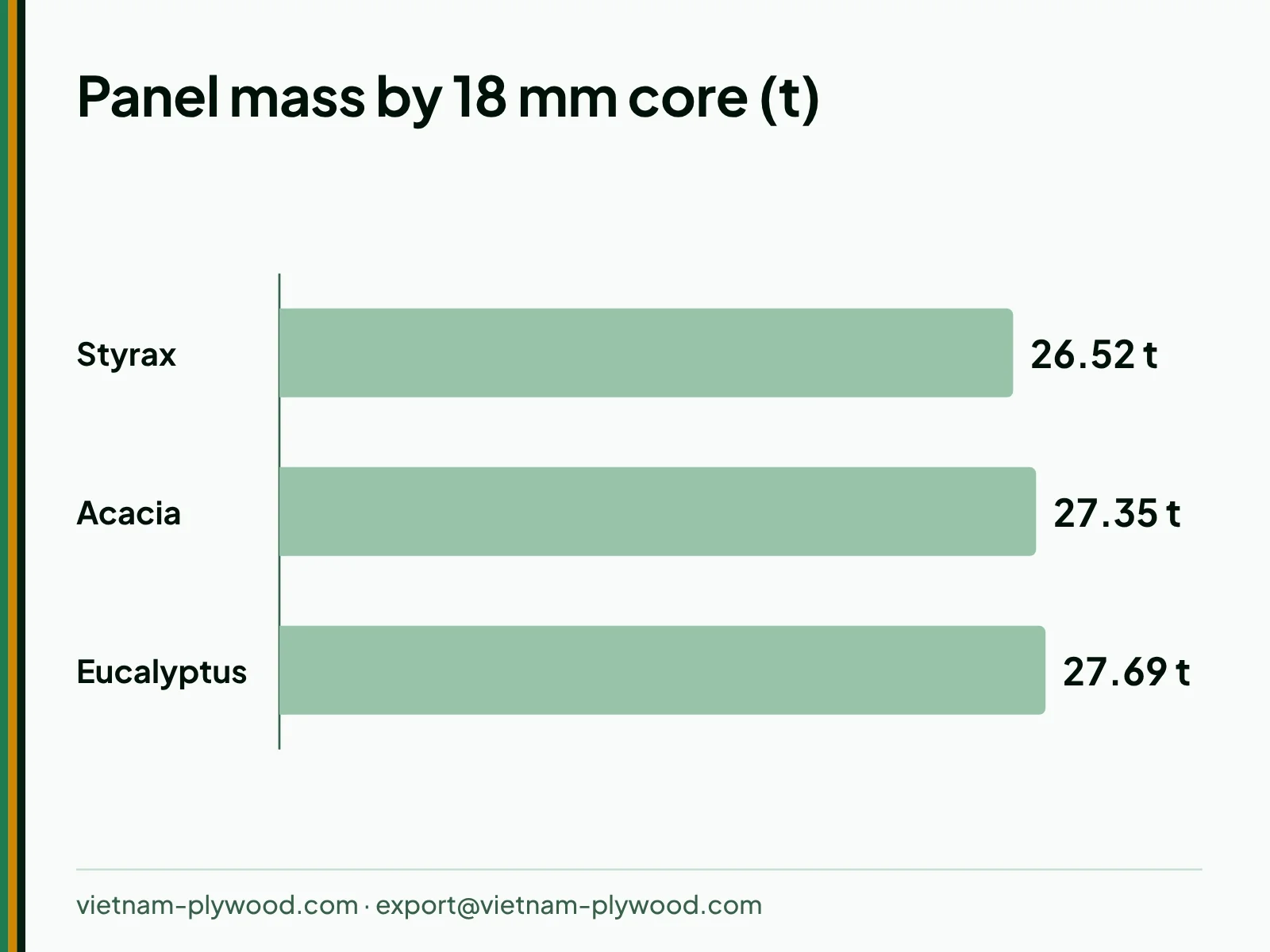
Core density changes shipping weight even when every sheet has the same nominal dimensions and thickness. At 18 mm and 1220 × 2440 mm, styrax weighs 26.79 kg per sheet, acacia 31.08 kg and eucalyptus 34.83 kg, excluding film weight.
| 18 mm core | Sheets in a full 40HC lookup | Panel volume | Panel mass |
|---|---|---|---|
| Styrax | 990 | 53.05 m³ | 26.52 t |
| Acacia | 880 | 47.15 m³ | 27.35 t |
| Eucalyptus | 795 | 42.60 m³ | 27.69 t |
These loading figures use a 28.5 t payload limit and the stated pallet arrangement. For example, an acacia 18 mm load is 880 sheets at 31.08 kg each, approximately 27.35 t using the lookup. Mixed specifications can share a container within the payload limit, but the final pallet plan must account for all selected cores and sizes. The container loading calculator covers full loading scenarios; distributor supply programmes address recurring mixed-spec purchases.
Which documentation belongs with a price quotation?
The quotation should identify which certificates and test reports accompany the agreed construction. The U.S. Environmental Protection Agency’s 2016 formaldehyde rule, as summarized on its updated 2026 official page, requires third-party certification for regulated hardwood plywood under Toxic Substances Control Act (TSCA) Title VI. EPA’s rule summary distinguishes this regulatory evidence from a seller’s adhesive description.
E0, E1 and E2 are emission classes; they are separate from MR or WBP glue. For applicable orders, member-factory FSC, CARB P2, ISO 9001 and CE materials, and EUTR/EUDR documents, are shown with factory details masked, on request. A destination’s required evidence must be written into the order before production.
The shipment document set includes a commercial invoice, packing list, bill of lading, certificate of origin (EUR.1 for EU lots), phytosanitary and fumigation papers, insurance under CIF, and the agreed certificate or test documents. EU lots also carry the EUTR/EUDR file set. After loading, the draft shipping documents come to you for approval. The invoice records the commercial amount while the packing list records quantities and dimensions.
What should an importer request before placing an order?
A comparable quotation needs one written specification, one unit basis and one destination. HCPLY handles specification, on-site quality control, documents and loading from the selected production line, shipping directly FOB Hai Phong.
The minimum order is one 40HC; one container can carry several specifications as long as the payload limit holds. Factory lead time runs 15–45 days from receipt of the 30% deposit; the exact figure depends on order size, line loading and what the contract fixes. The remaining 70% is paid on the scan of the bill of lading, by T/T, or by irrevocable sight L/C. We ship FOB Hai Phong, or CFR (CNF) or CIF to your port.
Samples cost nothing: a first-time buyer pays the courier, and that charge comes off the first confirmed order. For a wider export-cost comparison, separate the FOB panel price from freight and insurance. The Gulf plywood pricing discussion and film-faced plywood price discussion cover different destinations and applications.
What specification should be sent for a trial container?
Send an application-led build request with exact dimensions, core and bond type. The written specification lets our furniture line, our commercial and packing line or our construction line quote the relevant manufacturing work.
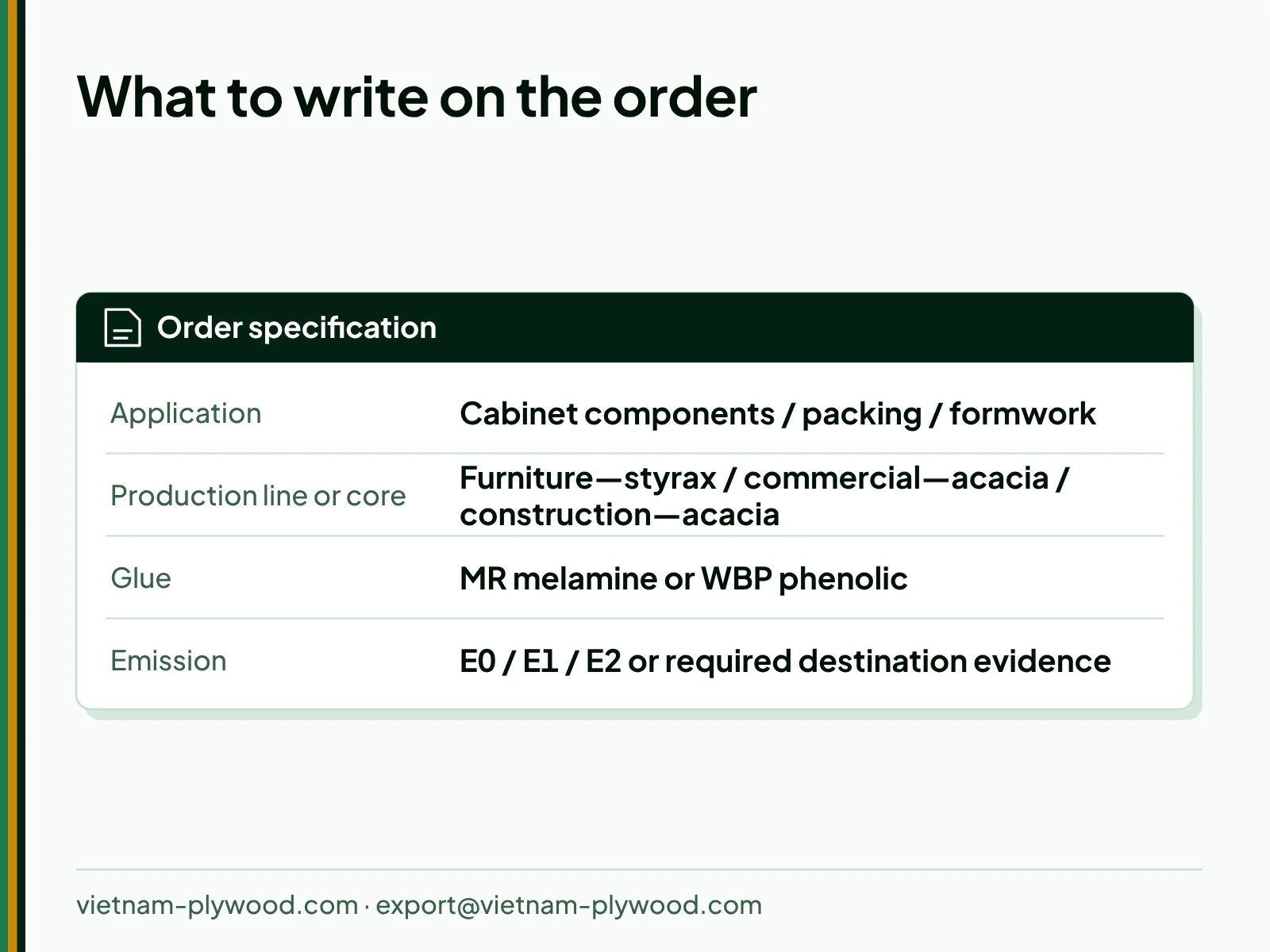
Application: cabinet components / packing / formwork
Production line or core: furniture—styrax / commercial—acacia / construction—acacia
Glue: MR melamine or WBP phenolic; agreed test
Emission: E0 / E1 / E2 or required destination evidence
Face and grade: species, A/B (birch D/E/F), or film type
Thickness and tolerance: 18 mm; ordered tolerance in mm
Size: 1220 × 2440 mm or exact cut size
Quantity: sheets and proposed 40HC mix
Destination port: [port and country]
Plan a trial container with Lucy at export@vietnam-plywood.com or through the contact page.