






How does a plywood supply contract work?
A plywood supply contract sets a repeat-order framework: approved panel specifications, a forecast, a release process, an agreed production window and commercial terms. We can plan distributor orders across our furniture, commercial and packing, and construction lines. Each released container still needs a clear build and shipment instruction; the framework makes those decisions repeatable rather than starting each purchase from scratch.
A wrong allocation can leave a cabinet buyer with unsanded packing panels, or a formwork yard with the wrong bond system. That costs inspection time, replacement freight and missed installation dates.
Start by agreeing the application and a reference sample. Then document the accepted face grade, core construction, glue, emission class, dimensions, tolerances, packing and inspection method. An approved sample is useful only when the written specification identifies what the sample represents. For a structured first-order review, use the plywood supplier evaluation checklist.
A supply agreement should distinguish the overall programme from each purchase release. The programme records product families, forecast cadence, price review method, contacts and dispute procedure. A release records the actual quantity, approved specification revision, requested shipping window, destination and commercial documents. This separation allows a distributor to forecast several product families without treating every forecast line as an immediate purchase.
A trial container gives both parties a practical reference. Inspect face quality, dimensions, packing condition, records and shipment papers, then record deviations before moving to regular plywood supply. The Buying Guides collection covers related purchasing decisions.
Can monthly plywood capacity be reserved for a distributor?
Monthly capacity can be planned against an agreed distributor forecast and identified production line. Furniture and commercial plywood capacity is up to 100 containers a month; construction plywood capacity is up to 140. These are line capacities, not a distributor-specific reservation amount. A proposed allocation must identify product mix, quantity, release dates and the producing factory.
A useful capacity schedule shows each month separately, with a firm release column and a later forecast column. Mark the dates when a forecast becomes a purchase instruction, who accepts a revision and what happens when an order moves between months. The exact reservation volume and any cancellation or rollover rules belong in the negotiated agreement.
Capacity is a press-planning issue as much as a container count. Furniture panels use full stitched, sanded styrax or eucalyptus cores; commercial and packing panels use acacia with a different surface and tolerance expectation. Film-faced construction panels follow their own finishing requirements. A distributor cannot swap those builds without reviewing production routing and the approved sample.
Our three factories are in Phu Tho and Hai Phong. Orders are produced at the factory matched to the specification and shipped directly from that factory, FOB Hai Phong. Buyers can visit the factory office and inspect goods at the producing factory. The manufacturer overview explains the production scope.
Which line should carry each repeat specification?
The producing line follows the end use, surface requirement and bond specification. The same nominal 18 mm thickness does not create interchangeable products. The comparison below is a purchasing map for three distinct uses.
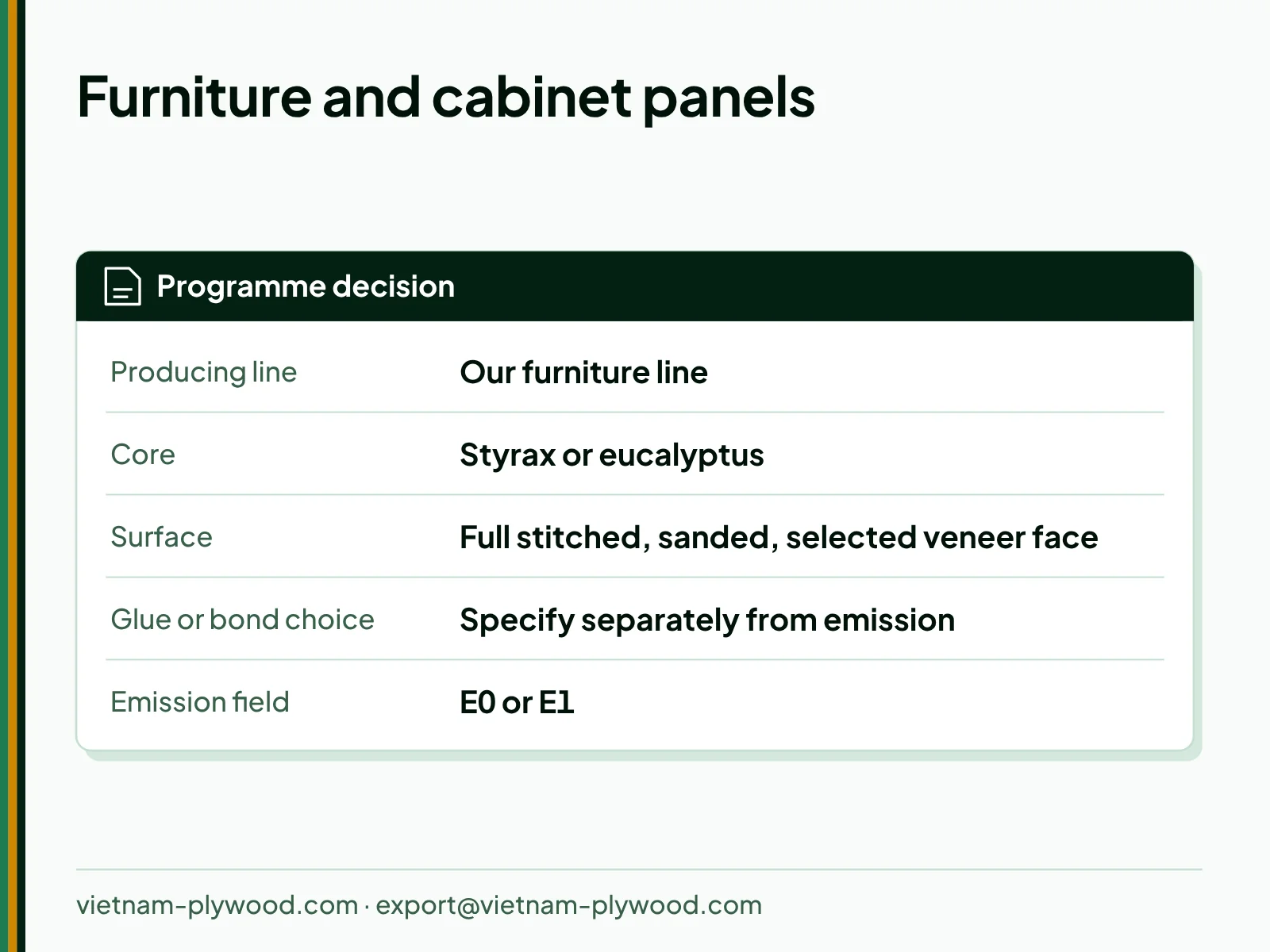
| Programme decision | Furniture and cabinet panels | Commercial and packing panels | Construction formwork panels |
|---|---|---|---|
| Producing line | Our furniture line | Our commercial and packing line | Our construction line |
| Core | Styrax or eucalyptus | Acacia | Acacia or eucalyptus |
| Surface | Full stitched, sanded, selected veneer face | Unsanded or light-sanded, raw or specified face | Phenolic or melamine film, including anti-slip option |
| Glue or bond choice | Specify separately from emission | MR glue | Specify film and agreed bond |
| Emission field | E0 or E1 | State required class separately | State required class separately |
| 18 mm thickness tolerance | ±0.2 or ±0.3 mm as ordered | Commercial ±0.5 mm; packing ±0.5–1.0 mm | ±0.5 mm |
| Verdict by use | Cabinet faces and fitted furniture | Packing and general commercial uses | Concrete formwork and working surfaces |
Face veneer and core density are separate purchasing fields. A bintangor face does not turn an acacia core into a different-density core. Furniture faces can include bintangor, okoume, engineered veneer and other specified veneers; the final face grade must appear on the release.
Film weight is another separate field: 120 g/m² standard, 135 g/m² premium and 220 g/m² for anti-slip film only. For raw or commercial panels, the commercial and packing plywood overview gives the relevant product context. A programme can include more than one family, but each family needs its own approval record.
How do plywood call-off orders work?
A call-off order is a release of a defined quantity from an agreed programme for production and shipment. It should cite the approved specification revision and the target dispatch period. A forecast alone should not be mistaken for an accepted release.
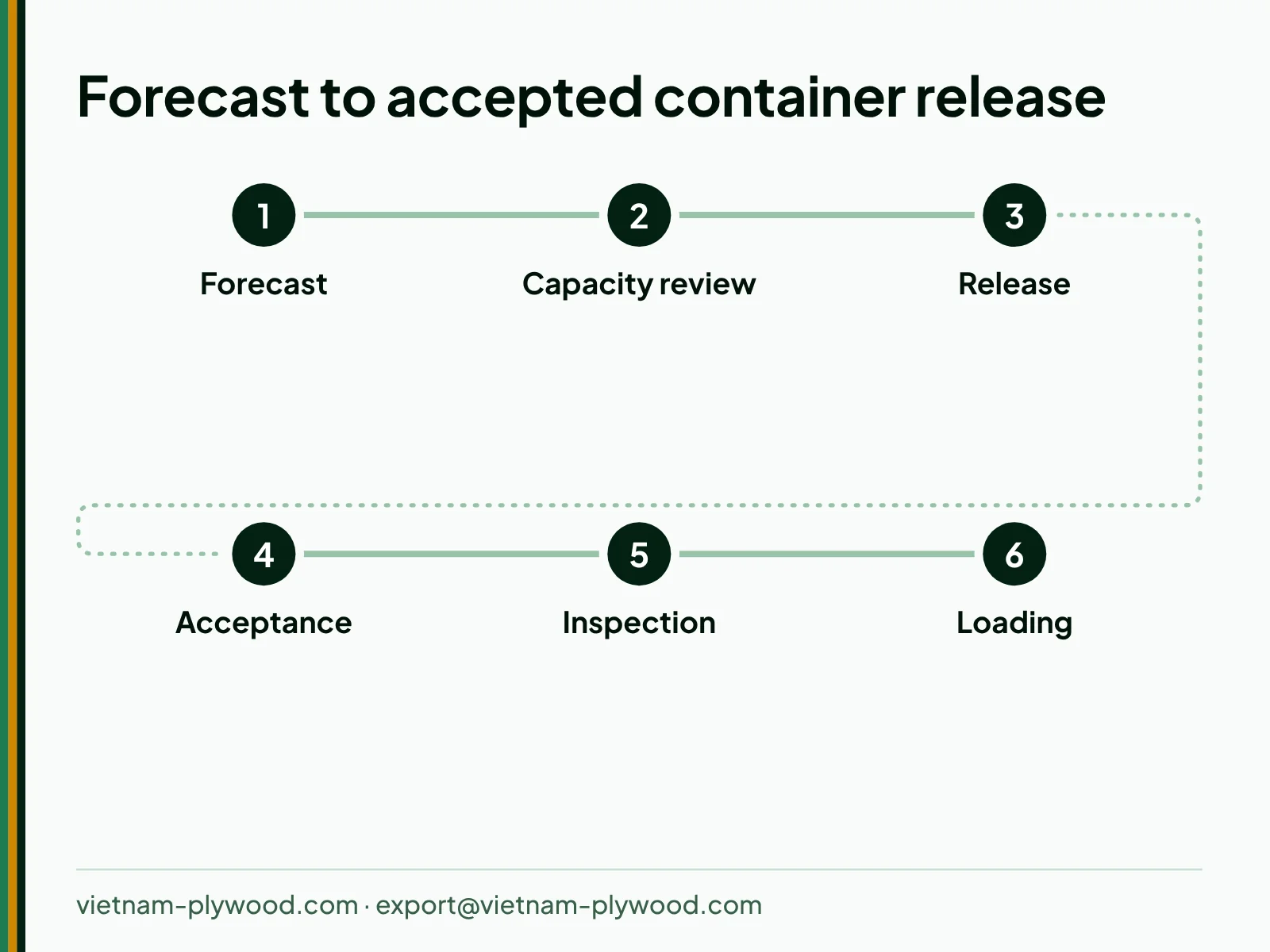
- Forecast: The buyer sends a rolling view by month, panel family and container count, separating likely demand from firm demand.
- Capacity review: We match the proposed releases to the relevant press line and returns the workable production sequence.
- Release: The buyer issues a written container instruction with specification, quantity, destination port and shipment terms.
- Acceptance: Both sides record the accepted release, commercial price basis and any changes to the forecast.
- Production and inspection: The producing factory builds against the approved specification; the buyer or inspector checks the identified lot.
- Loading and documents: The shipment is loaded, draft shipping documents are sent for buyer approval after loading, and the final document package follows the agreed transaction.
This workflow makes repeat plywood orders Vietnam buyers place easier to audit. It also makes late changes visible. A new face grade, tolerance or glue selection is a specification change, even when the thickness and container quantity stay unchanged.
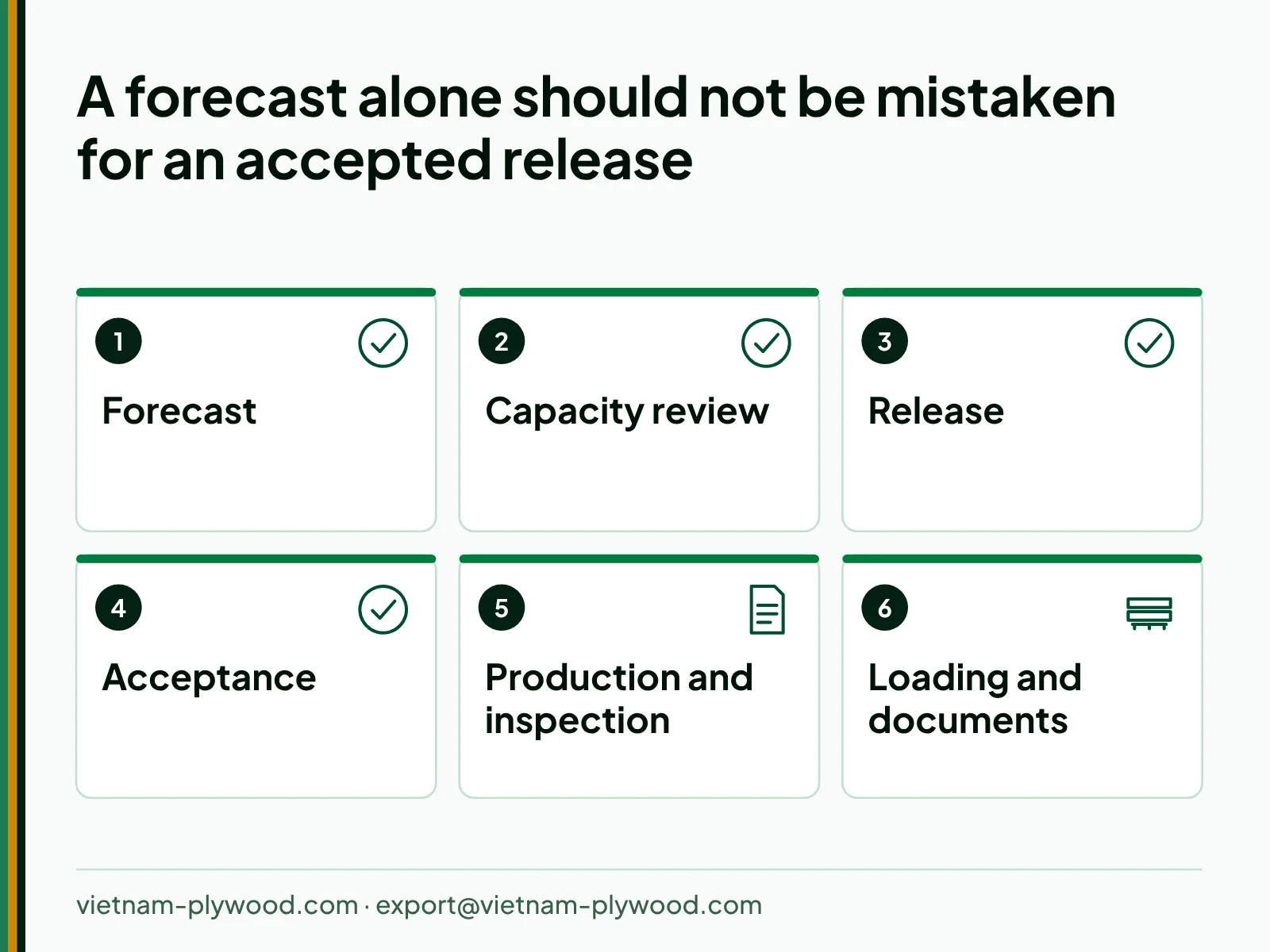
Use a release register with a unique reference, revision date and approval contact. Keep the latest accepted specification beside the sample and inspection record. If the buyer requests a split shipment, treat each resulting container as a separately identified release rather than relying on an informal email thread.
What can share a container under the programme?
Specifications can be mixed in a 40HC container within the 28.5 t payload limit. The packed cargo weight is the controlling check before a mixed-container release is accepted. Thickness, core density and pallet configuration affect how many sheets fit.
For 18 mm sheets measuring 1220×2440 mm, the reference full-container figures are 990 styrax sheets at 26.52 t, 880 acacia sheets at 27.35 t, and 795 eucalyptus sheets at 27.69 t. These are separate full-load examples, not quantities to add together. Film weight is excluded from the figures.
For a mixed release, list each core, thickness and pallet count separately. Request a packed-weight loading plan that includes pallet and packaging weight, then check the combined gross cargo weight against the 28.5 t payload limit. Use the approved plan for the packing list and the factory loading check.
The remaining allowance must accommodate pallets, packaging and other loaded items. The load plan also needs stack height, restraint and compatible packing. The mixed-container guidance explains how to specify the mix; container packing reference owns the full loading tables.
A distributor should send the proposed mix before the release is accepted. The producing factory can then prepare pallet counts and the packing list against that exact combination. Do not substitute the sheet count from one core for another merely because dimensions match.
How often are plywood prices reviewed?
A quarterly price review is a practical clause to propose for a plywood supply agreement, with the review dates and change procedure written down. It is a negotiation structure, not an existing fixed HCPLY tariff. Each accepted call-off needs an identifiable price and currency basis.
For furniture plywood, the indicative starting point is from US$350/m³ FOB Hai Phong (October 2026). For commercial plywood, it is from US$250/m³ FOB Hai Phong (October 2026). These starting points do not establish a standing quarterly price or a quote for every grade.
The main price drivers should be reviewed in this order for a repeat specification: core construction and veneer quality; face selection and grading; glue and finishing requirements; thickness and tolerance; then packing, mix and delivery term. Full stitched furniture cores require more controlled assembly than loose-laid construction. Sanded face preparation adds processing compared with an unsanded packing build. A premium film build costs more to prepare than a standard film build because the surface specification changes.
The agreement can say whether a revised quotation affects only future releases or also a release awaiting acceptance. It should identify the effective date, who signs off the revision and how disputed items are handled. For freight and delivery-term comparisons, see export cost breakdown.
What does the buyer commit to?
The buyer commits to a usable forecast, approved product specifications and clear release decisions. A long term plywood supply agreement works when the factory can distinguish a planning signal from a purchase obligation. The parties should write the minimum firm volume, if any, into their own agreement rather than infer it from published capacity.
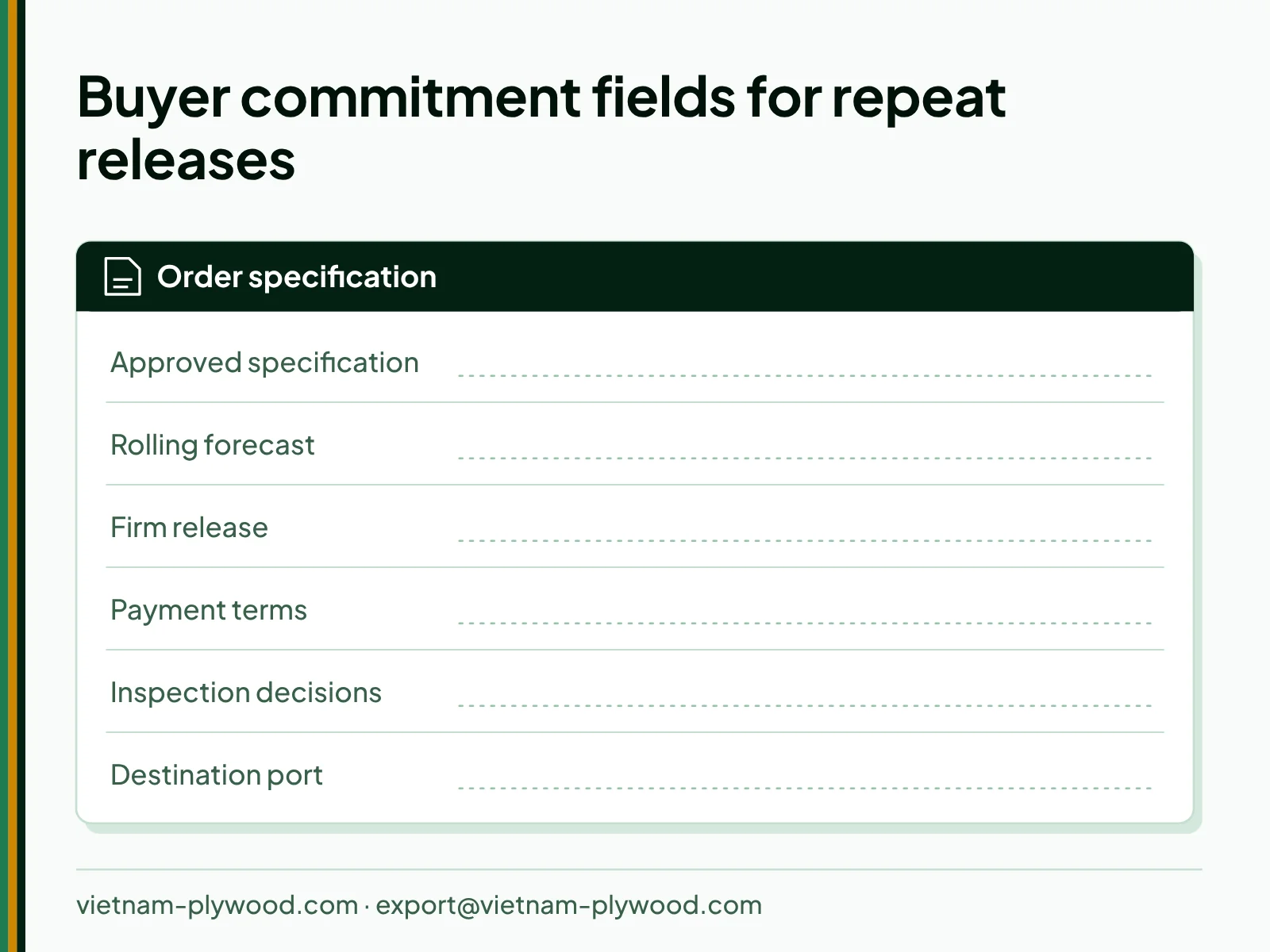
At minimum, record the authorised buyer contact, order currency, delivery term, destination, approval workflow and acceptable inspection evidence. State the notice needed for changes to quantity, core, face or shipping month. Define who pays for buyer-requested changes after a release is accepted and how unshipped quantities are treated at programme end.
Our minimum order is one 40HC; one container can carry several specifications as long as the payload limit holds. Factory lead time runs 15–45 days from receipt of the 30% deposit; the exact figure depends on order size, line loading and what the contract fixes. The remaining 70% is paid on the scan of the bill of lading, by T/T, or by irrevocable sight L/C.
Free samples are available; a first-time buyer pays the courier, and that charge comes off the first confirmed order. A sample approval should identify the physical sample, the written build and the inspector’s acceptance criteria. It is also worth deciding how repeat orders will be handled when a sample is superseded.
The buyer should retain an arrival inspection record for each shipment, including packaging condition, visible panel defects and any measured dimensional deviation. This creates a basis for discussing claims against the agreed build instead of relying on memory.
What should an inspector check before every release ships?
The inspection should compare the actual production lot with the accepted release specification. At the producing factory, a buyer or inspector can witness thickness measurement, face and edge checks, pallet identification and loading against the packing plan.
For sanded furniture panels, measure the ordered ±0.2 or ±0.3 mm tolerance at agreed locations. For commercial and film-faced panels, check ±0.5 mm; packing panels use ±0.5–1.0 mm. Length and width tolerance is ±2 mm. The inspection record should note the method, sample size and actual readings rather than a simple pass label.
Check that the panel face matches the written face species and grade. Confirm core construction on an agreed edge sample and compare it with the approved sample. Record glue and emission as distinct fields: melamine MR and phenolic WBP describe bond systems; E0, E1 and E2 describe emission classes. A request for a United States emissions limit requires separate evidence for CARB P2 or TSCA Title VI as applicable.
If certificates or reports are needed, identify them in the release. Member-factory FSC, CARB P2, ISO 9001, CE and EUTR/EUDR documents are shown with factory details masked, on request. Do not replace the actual lot inspection with a certificate review. A written acceptance protocol should also specify how rejected pallets are segregated and rechecked.
Which shipping papers follow a call-off container?
The shipment document package should identify the same goods and quantities as the accepted call-off. It includes the commercial invoice, packing list, bill of lading (B/L), certificate of origin, phytosanitary and fumigation papers, and agreed order-specific certificates or test reports. EU lots include EUR.1 and the EUTR/EUDR file set; CIF shipments include insurance papers.
For the contract’s trade term, use FOB Hai Phong, CFR (CNF) or CIF as agreed. The International Chamber of Commerce’s Incoterms® 2020 (2020) explains how the chosen rule allocates costs, risks and obligations. Its official explanation is useful when the buyer compares a freight-inclusive quote with a port-of-shipment quote.
The packing list is especially important for mixed releases: it should separate product specifications, pallet quantities and sheet totals. The commercial invoice should follow the accepted commercial terms. After loading, the draft shipping documents come to you for approval, allowing names, destination and quantities to be checked before final issue.
If payment is by irrevocable letter of credit at sight, the buyer should check document wording early. A mismatch between the credit and the agreed shipping documents can delay presentation. The letter-of-credit document guide covers that process in more detail.
How many monthly containers can the programme cover?
A proposed programme can cover multiple monthly containers, with its quantity determined by the accepted allocation and product mix. Furniture and commercial plywood capacity is up to 100 containers a month; construction plywood capacity is up to 140. The schedule should state which production line is assigned to each release.
The buyer should not add the two capacity statements to derive a dedicated allocation. One furniture specification may occupy a different production sequence from a film-faced specification. A rolling forecast should therefore break out containers by build rather than present a single undifferentiated total.
Consider a distributor selling cabinet stock and formwork sheets. Its cabinet releases need the furniture line’s sanded finish and controlled thickness; formwork releases need the construction line’s film and bond selection. Their delivery windows can be coordinated in the programme while retaining separate factory inspection records.
For demand planning, distinguish ordered goods from plywood stock already held by the buyer. Factory production is scheduled against accepted releases; inventory replenishment dates should include the agreed production window and the sea route. From Hai Phong, transit ranges include South-East Asia 5–12 days, Middle East 15–25, US West Coast 20–30, Mediterranean 25–35, Northern Europe 30–40, US East Coast 35–45 and West Africa 35–50, by carrier and route.
A practical review compares the previous forecast with accepted releases and shipped containers. Track changes in specification, inspection findings, document corrections and loading differences. These records give the next quarter’s discussion more substance than an annual volume target alone.
What should be settled before signing?
Settle the product appendix, release authority, capacity schedule and price-review mechanism before the first recurring shipment. An agreement is useful only when its terms can be checked against a real container.
Ask whether the first shipment will be a controlled trial, what findings will permit the regular schedule to begin, and which sample or report becomes the reference. Identify a single owner on each side for specifications and document approval. Define escalation for a missed release date, a changed face grade or a disputed inspection result.
For buyers importing into Europe, the European plywood buying guide provides regional context. Any requested market document should be listed against the actual producing factory and order. Avoid blanket wording that treats every certificate as applicable to every panel.
The schedule should also identify how forecasts are updated and when a proposed revision needs written acceptance. Keep a version history of the approved product appendix. Where the buyer expects more than one delivery term or destination port, identify the relevant term and port on each release rather than relying on a general heading.
What specification should a distributor send first?
Send a build-level specification and a proposed monthly release pattern. That lets Lucy route the enquiry to the appropriate line, check the mix and prepare a sample set against the same fields used for later call-offs.
Application: cabinet panels / commercial packing / concrete formwork
Line or core: furniture—styrax / commercial—acacia / construction—acacia
Glue: MR melamine / WBP phenolic (select required system)
Emission: E0 / E1 / E2 / required market evidence
Face and grade: species or film weight; stated face grade
Thickness and tolerance: 18 mm; ordered tolerance
Size: 1220 × 2440 mm or specified listed/custom cut size
Quantity: 40HC containers by month; firm releases and forecast separate
Destination port: named discharge port; FOB Hai Phong / CFR / CIF
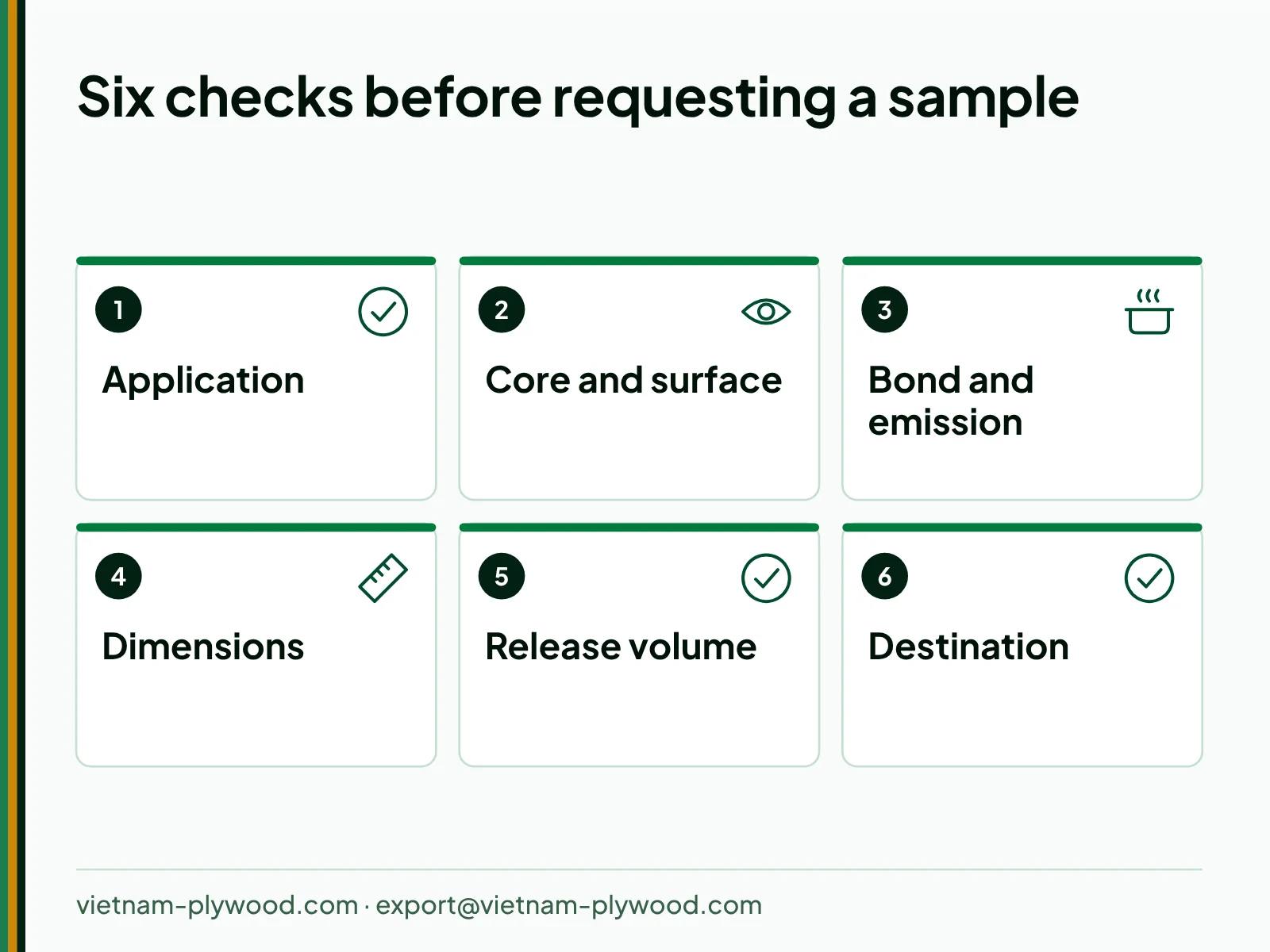
Before sending the request, check these fields against the approved product appendix:
- Application: Identify cabinet, packing or formwork use so the producing line is clear.
- Core and surface: Name the core species and face or film specification separately.
- Bond and emission: Record glue type and emission class in distinct fields.
- Dimensions: State thickness, tolerance and sheet size for each build.
- Release volume: Separate firm container instructions from the rolling forecast.
- Destination: Name the discharge port and agreed delivery term.
Ask Lucy at export@vietnam-plywood.com for a sample set matching the proposed programme.