





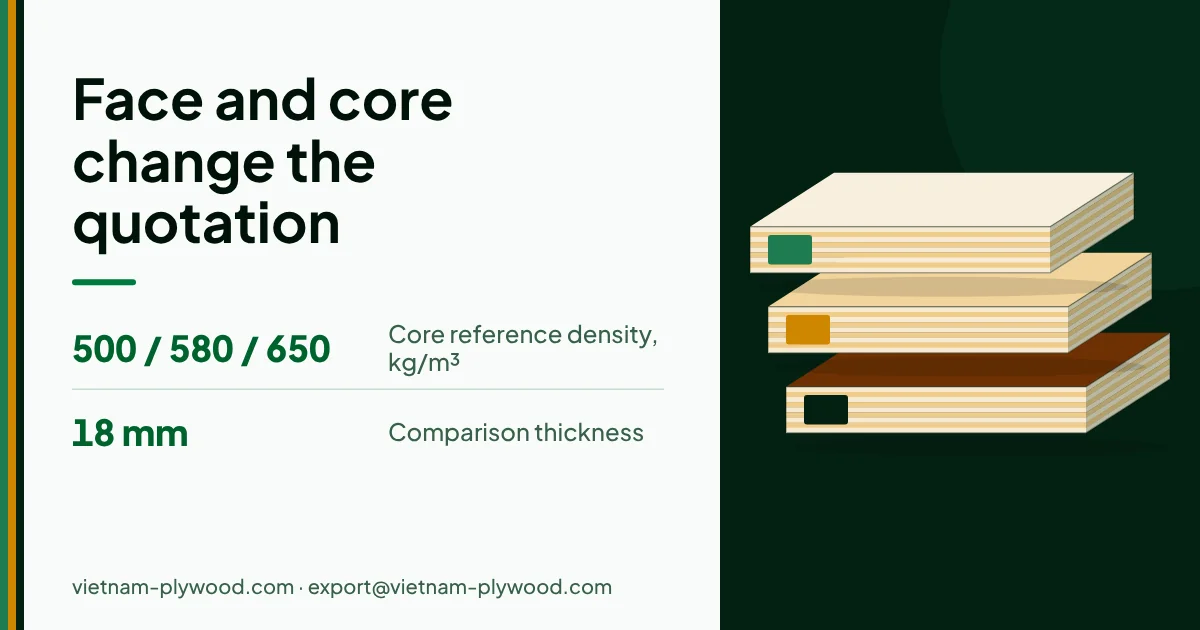
Eucalyptus plywood price depends on whether eucalyptus is the face, the core or both, and on the line making the panel. Choosing the wrong construction can increase machining cost or leave a load outside the buyer’s acceptance specification. HCPLY quotes furniture and commercial builds against separate written requirements rather than one universal eucalyptus figure.
For importers and cabinet manufacturers, the first decision is what the surface must do and what the core must carry. That choice determines which comparison is commercially meaningful.
What is the eucalyptus plywood price from Vietnam?
There is no single quoted eucalyptus plywood price for every build. No eucalyptus-specific starting price is supplied for the specified face and core combinations. HCPLY quotes the actual face, core, glue, grade and finish together before assigning a price.
No dated starting price is provided for this eucalyptus-specific build. A written quotation must identify the face, core, glue, grade and finish before a buyer compares offers.
A buyer comparing offers should ask whether each quotation refers to the same panel construction. A lower number attached to an acacia-core, unsanded commercial panel cannot be compared directly with a full-stitched, sanded eucalyptus-core furniture panel. The export cost breakdown covers the wider components of a delivered plywood purchase.
The unit also matters. A per-sheet figure changes with dimensions and thickness, whereas a per-cubic-metre figure permits a more consistent comparison of panel volume. Even on a volume basis, core density changes freight weight and the number of sheets that fit a container.
Which specifications move the quotation most?
The largest practical differences arise when the buyer changes the production line and core construction, then the face, glue, surface grade and machining requirements. These are quotation drivers rather than published price premiums. The precise order of monetary effects cannot be established without matched factory quotations.
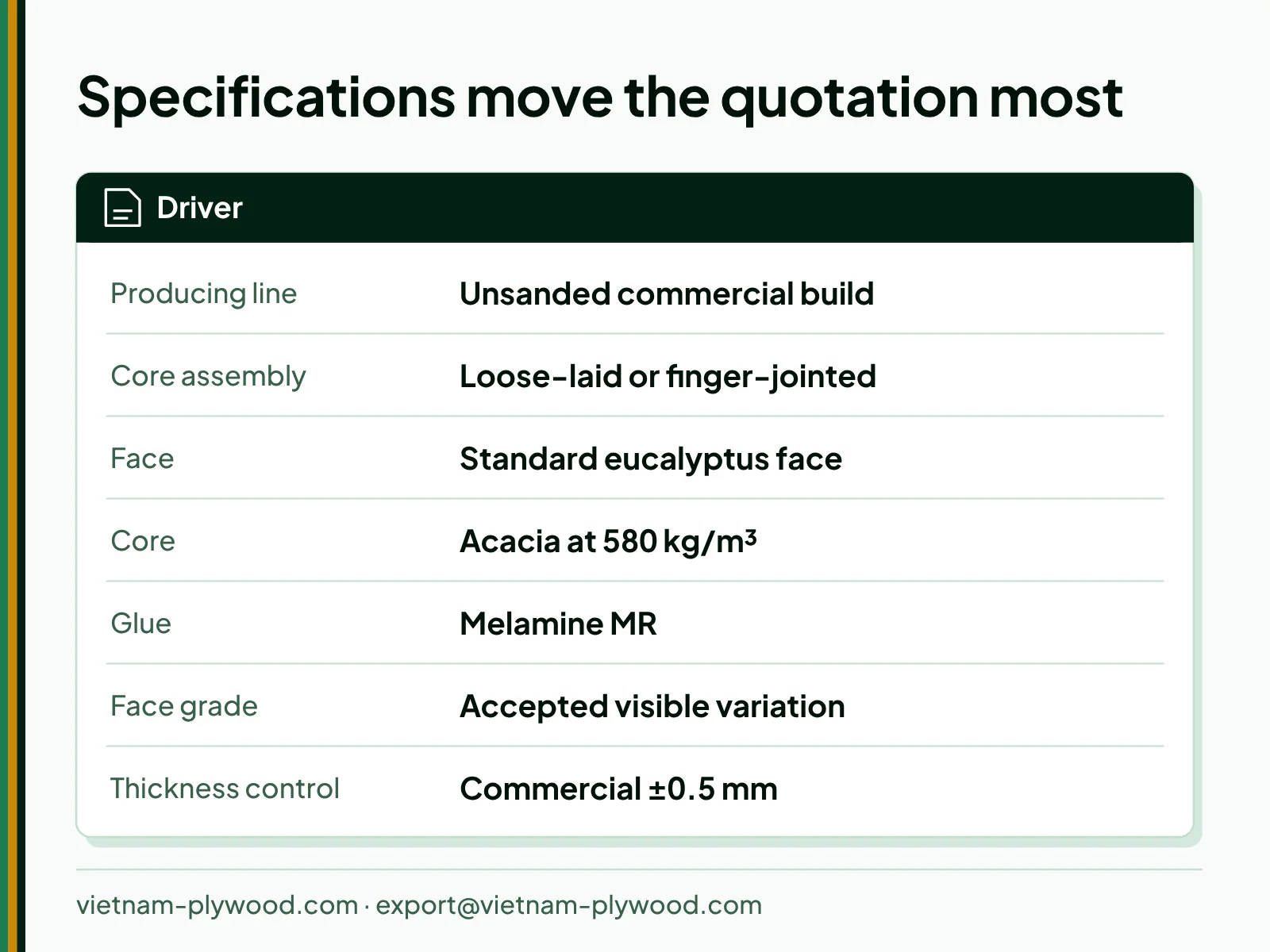
| Driver | Lower-specification comparison | Higher-specification comparison | Why the quote changes |
|---|---|---|---|
| Producing line | Unsanded commercial build | Full-stitched sanded furniture build | Core preparation and surface finishing differ |
| Core assembly | Loose-laid or finger-jointed | Full stitched | Veneer selection and assembly work differ |
| Face | Standard eucalyptus face | Selected imported decorative face | Veneer sourcing and appearance selection differ |
| Core | Acacia at 580 kg/m³ | Eucalyptus at 650 kg/m³ | Material selection and shipped weight differ |
| Glue | Melamine MR | Phenolic WBP | Bonding specification and pressing conditions differ |
| Face grade | Accepted visible variation | Selected A/B face | Veneer sorting and rejection differ |
| Thickness control | Commercial ±0.5 mm | Sanded furniture ±0.2 or ±0.3 mm | Calibration and inspection requirements differ |
The table is a direction-of-specification comparison, not a universal ranking of monetary premiums. A high-grade imported face can alter a quotation substantially, but the size of that difference requires an offer for the exact veneer. Laminated plywood price drivers discusses how surface preparation affects downstream finishing costs.
Do not remove an essential requirement merely to obtain a lower opening figure. An uneven substrate can create more machining work, and an incorrect bond requirement can lead to rejected material. Define the application first, then compare the least elaborate constructions that meet it.
Does eucalyptus mean the face, the core or both?
Eucalyptus can describe the visible face veneer, the internal core, or both. For product naming, the face determines the product name; density follows the core. Those distinctions determine whether two apparent eucalyptus offers are comparable.
A eucalyptus-faced sheet with styrax core has the appearance of eucalyptus on its outer surface, while its reference core density is 500 kg/m³. The same face over eucalyptus core has a reference density of 650 kg/m³. Neither face description alone establishes the complete board weight or grade.
Our furniture line can use eucalyptus or styrax cores under a selected eucalyptus face. Our commercial and packing line uses acacia core and can be specified with a eucalyptus face for a different application. Our construction line uses film faces with acacia or eucalyptus cores; a film-covered panel is sold by its film surface, rather than as exposed eucalyptus-faced furniture plywood.
The eucalyptus plywood product describes the appearance and applications. For price comparison, add the core species and core assembly to the product name. A quote that only says “eucalyptus plywood, 18 mm” leaves out most of the cost-relevant specification.
Is eucalyptus priced differently on the furniture and commercial lines?
Yes: the lines build different products, so their quotations must reflect different core assembly, sanding and tolerances. A furniture build uses full-stitched veneer, a sanded surface and an ordered ±0.2 or ±0.3 mm thickness tolerance. A commercial build uses acacia core, moisture-resistant glue and an unsanded or light-sanded finish with ±0.5 mm tolerance.
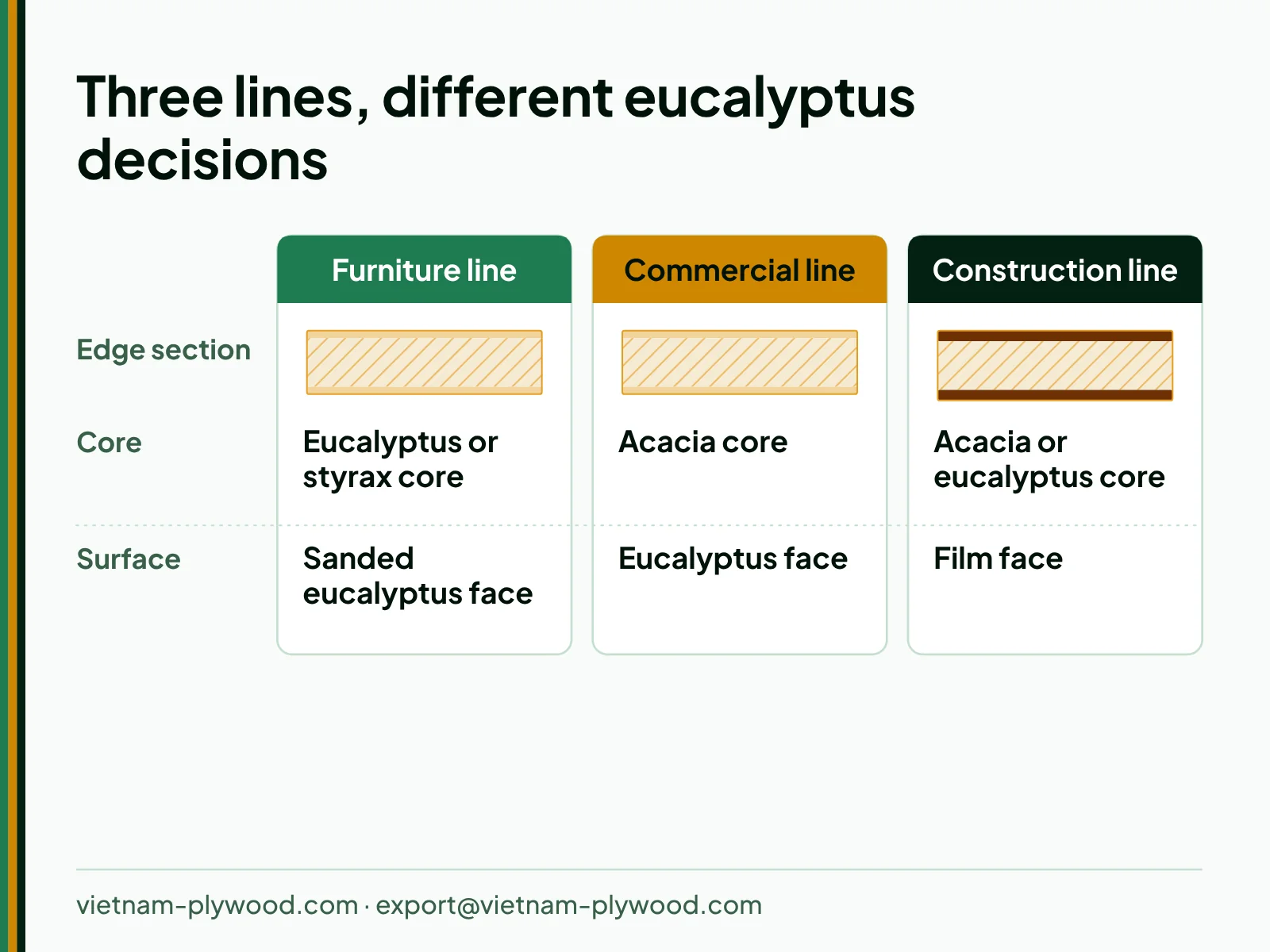
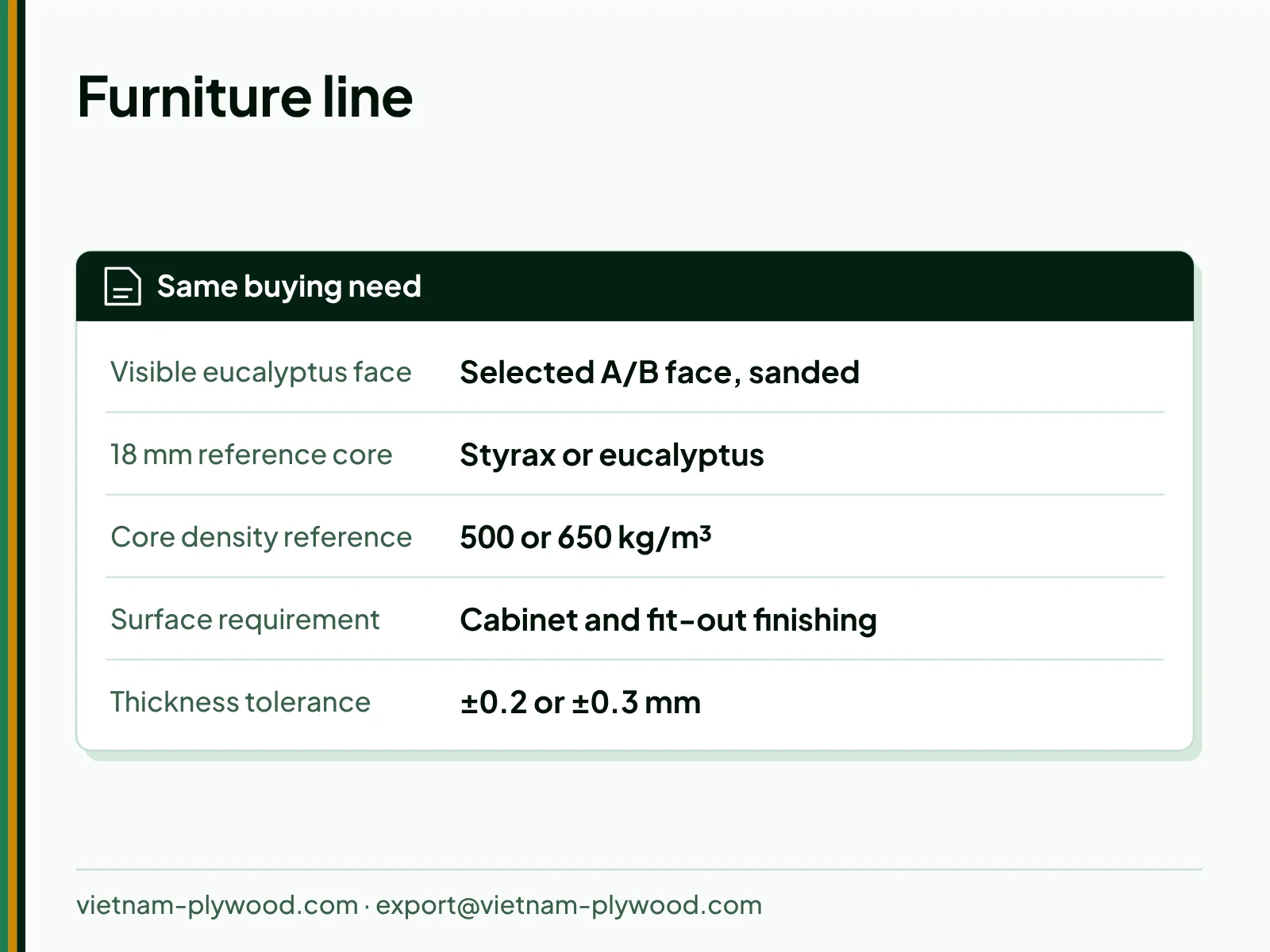
| Same buying need | Furniture line | Commercial and packing line | Construction line |
|---|---|---|---|
| Visible eucalyptus face | Selected A/B face, sanded | Eucalyptus face over acacia, finish agreed | Film face instead of exposed eucalyptus |
| 18 mm reference core | Styrax or eucalyptus | Acacia | Acacia or eucalyptus |
| Core density reference | 500 or 650 kg/m³ | 580 kg/m³ | 580 or 650 kg/m³ |
| Surface requirement | Cabinet and fit-out finishing | General commercial or packing use | Formwork surface release |
| Thickness tolerance | ±0.2 or ±0.3 mm | ±0.5 mm; packing ±0.5–1.0 mm | ±0.5 mm |
| Buyer verdict | Visible furniture and cabinet surfaces | Cost-controlled commercial components | Concrete formwork, not exposed decorative face |
The furniture line is the suitable starting point for a cabinet maker requiring predictable machining and a selected face. The commercial line is the starting point for a distributor buying general-purpose panels with less surface finishing. A contractor specifying concrete contact should discuss the film-faced construction line instead.
A buyer should not interpret a category starting price as the surcharge for changing production lines. No eucalyptus-specific price is provided. Compare complete builds against the same acceptance criteria; the furniture-grade cost article explains the finishing side of that decision.
How do density and sheet weight affect total cost?
Core density affects the physical weight shipped, even when face veneer and thickness remain unchanged. The core densities are styrax 500 kg/m³, acacia 580 kg/m³ and eucalyptus 650 kg/m³. The thin decorative face does not redefine the core-density reference.
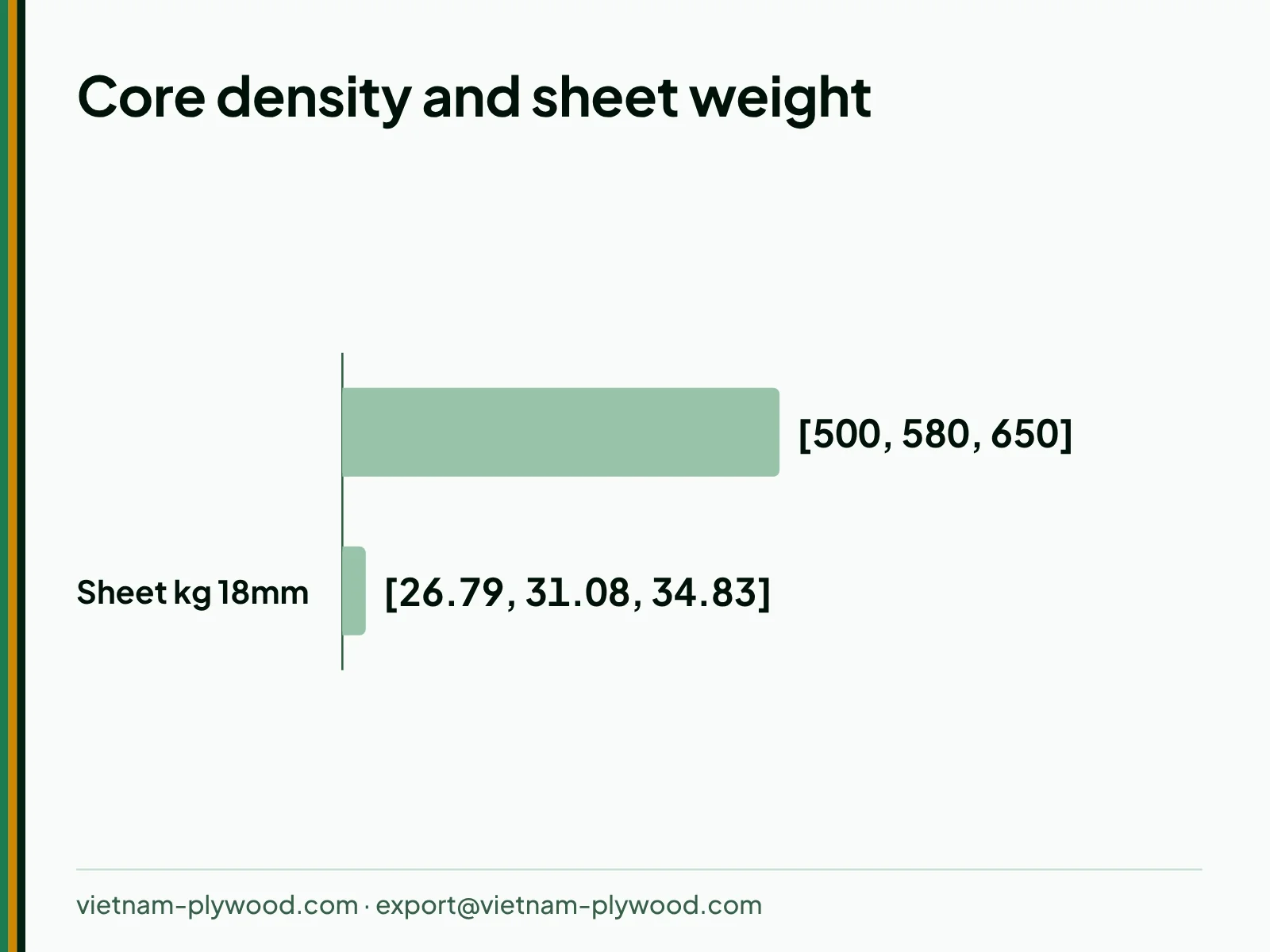
For a 1220 × 2440 × 18 mm sheet, the listed sheet weights are 26.79 kg for styrax, 31.08 kg for acacia and 34.83 kg for eucalyptus. The figures use the stated core densities and exclude packaging.
At the stated pallet configuration for that sheet, a 40-foot high-cube container holds 990 styrax sheets, 880 acacia sheets or 795 eucalyptus sheets. The corresponding cargo weights are 26.52, 27.35 and 27.69 tonnes. The 40HC payload limit is 28.5 tonnes; check pallet and packaging weight in the final loading plan.
The denser core can therefore reduce sheet count per shipment. That matters to a cabinet producer buying by sheet and to a distributor calculating delivered cost per usable panel. For a mixed specification, weight and pallet geometry must be recalculated rather than adding separate full-container capacities. The container packing reference owns the detailed load calculation.
How do glue, emission class and face grade affect the offer?
Glue specifies the bond system; emission class specifies a separate requirement. Our commercial and packing line uses melamine moisture-resistant (MR) glue, associated for this loading configuration with a 12-hour boil specification. Phenolic weather-and-boil-proof (WBP) glue is associated with a 72-hour boil specification. Neither label alone states a formaldehyde-emission class.
We distinguish E0, E1 and E2 emission classes. For furniture orders, the specified E0 or E1 class must appear separately from the glue field. A quotation that says only “waterproof” cannot substitute for the buyer’s required emission evidence.
For United States-bound regulated hardwood plywood, the US Environmental Protection Agency’s 2025 Code of Federal Regulations, 40 CFR Part 770, identifies hardwood plywood with a veneer or composite core among regulated composite wood products. It describes third-party certification requirements. Buyers should establish whether the ordered panel is within scope and obtain the applicable member-factory evidence before committing to an import specification.
Member-factory FSC, CARB P2, ISO 9001 and CE certificates, and EUTR/EUDR documentation, are shown with factory details masked, on request. This statement is not a claim that every possible build has the same certification status. Specify the destination and required documentation in the enquiry.
Eucalyptus face grades A/B describe the visible veneer selection. Common face thickness is 0.2–0.4 mm. Imported faces such as okoume or gurjan are separate appearance decisions; an imported decorative face can command a different quotation even over the same eucalyptus core. Birch plywood cost covers another face-driven buying comparison.
Does an imported face make eucalyptus-core plywood cost more?
An imported face changes the sourcing and appearance specification, so it can change the quoted cost even when the eucalyptus core stays the same. The actual price difference cannot be stated without paired offers for the same size, core construction and grade.
Consider two furniture panels with eucalyptus cores, equal thickness and identical emission requirements. One has an A/B eucalyptus face; the other has an A/B imported decorative face. The buyer is paying for a different surface supply and selection requirement, rather than a different core density.
For painted or concealed cabinet components, the additional decorative veneer may provide little value. For visible doors or fit-out faces, grain and color matching can justify a higher surface specification. The choice should be made from approved face samples and a written acceptance standard.
Melamine, high-pressure laminate (HPL) and other laminate faces are distinct finishing topics, not HCPLY product lines offered here. If downstream finishing will cover the face, tell the producing factory which surface preparation is needed and request an appropriate substrate quotation.
Can different eucalyptus builds share a shipment?
Yes. The minimum order is one 40HC, and one container can carry several specifications as long as the payload limit holds. The final loading plan must account for core density, thickness, pallet dimensions and the 28.5-tonne payload limit.
For example, a distributor might request a furniture specification for visible cabinets and a commercial specification for concealed components. The order can be planned as a mixed container, but the 990, 880 and 795-sheet examples are each separate single-core reference loads. They cannot be added together as though each occupied its own full container.
A sensible request states the desired sheet count for each construction, then asks for a combined packing calculation. At the producing factory, the buyer can inspect the bundles and match their labels against the packing list before loading. This reduces confusion when surfaces look similar but cores differ.
The mixed-container ordering page covers the order arrangement. The several plywood types page addresses how specifications for different applications can be organized without blending their acceptance criteria.
What can an inspector verify before the panels leave?
An inspector can compare the approved specification with physical panels and the loading records at the producing factory. This is especially useful when two eucalyptus-faced panels have different core materials or surface grades.
First, identify the production batch and check the face species and visible A/B selection against the agreed sample. Second, inspect accessible edges for the specified core construction, gaps and jointing. Third, measure thickness at agreed locations against the ordered tolerance, recording individual readings rather than a single average.
For furniture sheets, the tolerance is ±0.2 or ±0.3 mm as ordered. For commercial sheets it is ±0.5 mm; packing may be ±0.5–1.0 mm. Length and width tolerance is ±2 mm. The acceptance record should identify the build and measurement method.
Then verify the glue and emission declarations against the agreed order and applicable test or certificate documents. Visual inspection alone cannot establish an emission class or prove bond performance. Finally, compare pallet counts, dimensions and gross shipping information with the packing list.
HCPLY manages on-site quality control, export documents and loading. Buyers can visit the factory office and inspect goods at the producing factory. The purpose is to witness the agreed checks, not to substitute a visual visit for a laboratory report.
What belongs in the quotation and shipping documents?
A useful quotation identifies the producing line, face and grade, core and construction, glue, emission class, thickness, tolerance, dimensions, quantity, destination and delivery term. Omitting any of these can create two technically different offers under the same product name.
Delivery terms available are FOB Hai Phong, CFR (CNF) or CIF. Factory lead time runs 15–45 days from receipt of the 30% deposit; the exact figure depends on order size, line loading and what the contract fixes. The remaining 70% is paid on the scan of the bill of lading, by T/T, or by irrevocable sight L/C.
The shipment documents include commercial invoice, packing list, bill of lading (B/L), certificate of origin, phytosanitary and fumigation papers, and insurance under CIF. EU lots include EUR.1 where applicable and the EUTR/EUDR file set. The agreed build may also require an FSC claim on sales documents, an emission certificate or test reports. After loading, the draft shipping documents come to you for approval.
The packing list is the shipment document that makes the difference between eucalyptus-core and acacia-core bundles auditable by quantity. The commercial invoice records the agreed commercial description and value. A test report, where required, supports a technical claim; it does not replace the shipment’s quantity record.
How should a buyer compare two quotations fairly?
Compare quotations only after normalizing the full panel specification and delivery basis. A lower FOB figure is not an economic advantage if it refers to a rougher face, looser thickness tolerance or different core than the production process requires.
Start with the final application: visible furniture, concealed cabinet part, commercial distribution or construction formwork. State the core-density and machining needs in measurable terms. Request matching samples for appearance decisions and a written inspection method for dimensions.
Next, put both offers on the same unit, such as US dollars per cubic metre FOB Hai Phong, and calculate the number of usable sheets in the planned container. For delivered comparisons, add the quoted freight and destination charges without assuming that the denser panel loads the same sheet count.
Finally, record which requirements are mandatory and which are optional. If an imported face is optional, request a second quote with eucalyptus face while holding all other fields constant. If full-stitched construction is mandatory for a cabinet part, do not compare it against a loose-laid packing build. Value-grade plywood gives another framework for matching finish to use.
What should go into the first trial-container request?
The first trial-container request should define the end use and a measurable acceptance specification. It should also identify which panel differences the buyer wants to test, rather than asking for an undefined “eucalyptus price.”
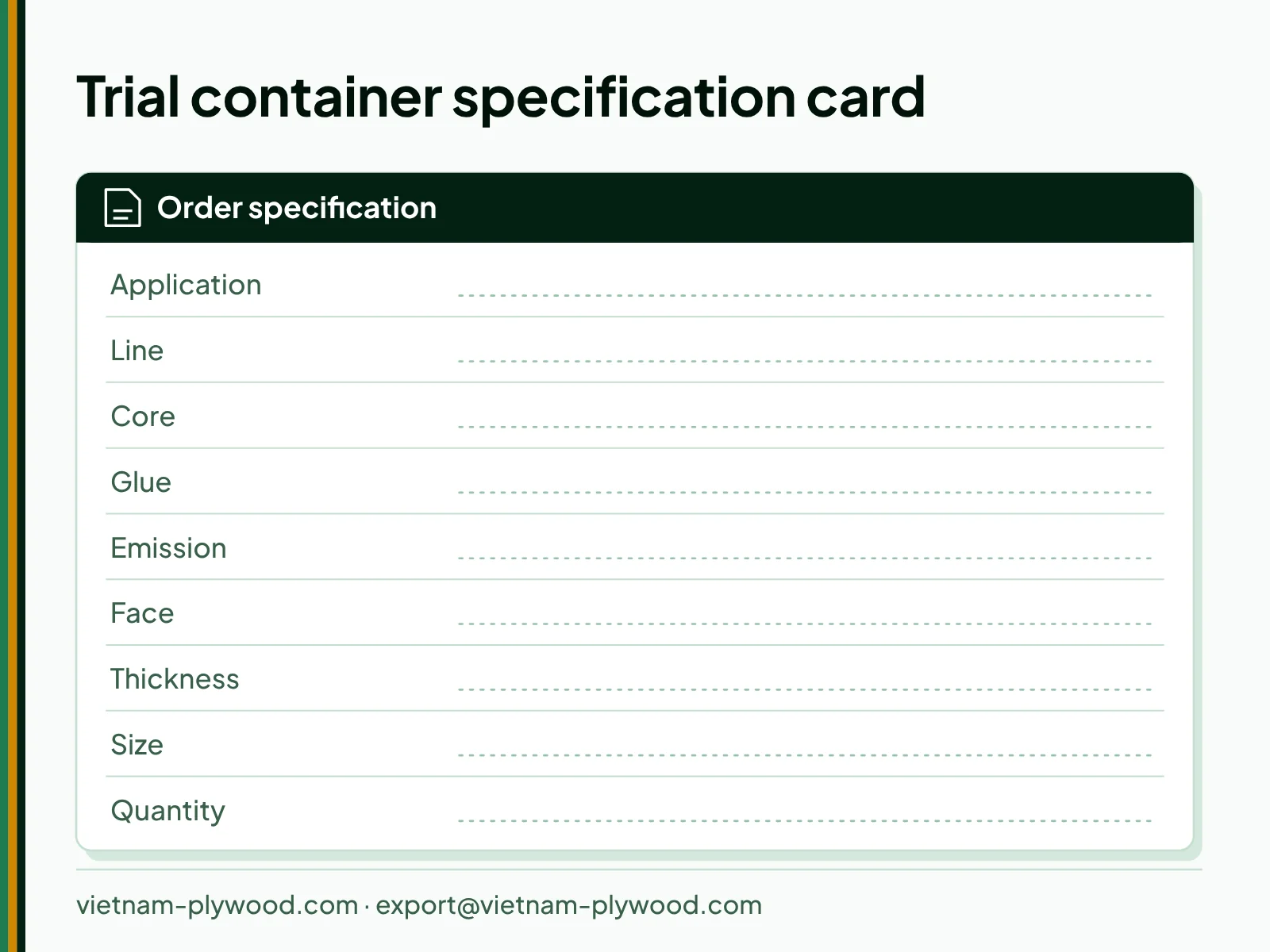
A furniture maker can compare eucalyptus-core and styrax-core furniture panels while keeping face, thickness and grade constant. A distributor can compare eucalyptus-faced furniture and commercial constructions, provided the intended uses and finish requirements are recorded separately. These comparisons isolate a real purchase decision.
Samples cost nothing: a first-time buyer pays the courier, and that charge comes off the first confirmed order. Use the samples to approve appearance and machining suitability before requesting a production quotation. Ask for the appropriate member-factory documentation at the same stage, especially for regulated destinations.
Send the following specification to Lucy at export@vietnam-plywood.com or through the contact page. The proposed trial should be evaluated on received panels, documented tolerances and usable sheet yield, not on an unqualified starting price.
Application: visible cabinet components / commercial panels
Line or core: furniture, eucalyptus core / commercial, acacia core
Glue: melamine MR (or specify phenolic WBP where applicable)
Emission: E1 (or required class and supporting documents)
Face and grade: eucalyptus A/B, approved reference sample
Thickness and tolerance: 18 mm; furniture ±0.3 mm / commercial ±0.5 mm
Size: 1220 × 2440 mm
Quantity: requested sheets by specification, one 40HC total
Destination port: [buyer to specify]
Next step: plan a trial container against the approved written specification and a combined loading calculation.