





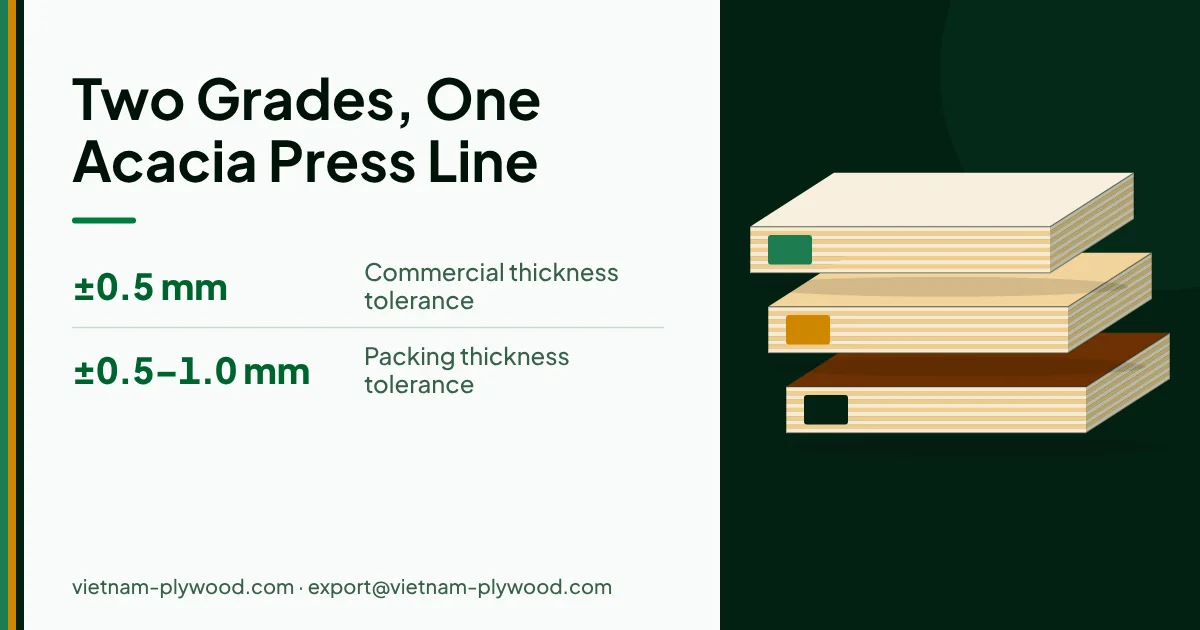
Packing plywood and commercial plywood differ mainly in core assembly, face selection and finishing, even when pressed on the same HCPLY line. A wrong grade choice can increase costs or produce rejected crates and display cases. For packing plywood vs commercial plywood, compare the written construction and acceptance sample before comparing quotations.
What is the difference between packing plywood vs commercial plywood?
Packing plywood is built for crates and industrial protection, while commercial plywood gives a cleaner face and more controlled core for visible or semi-visible work. At HCPLY, both come from our commercial and packing line, using acacia core and moisture-resistant (MR) glue. The difference is the accepted veneer assembly, finish and thickness band written into the order.
The grade label must become a measurable specification. Rough packing faces can cause rejected printed cases; cleaner commercial faces increase hidden-crate costs.
Our commercial plywood range explains the broader product family. This comparison concentrates on two builds made at the same producing factory, so the inspection can compare actual edges, faces and measurements against two approved samples.
Which specification wins for each application?
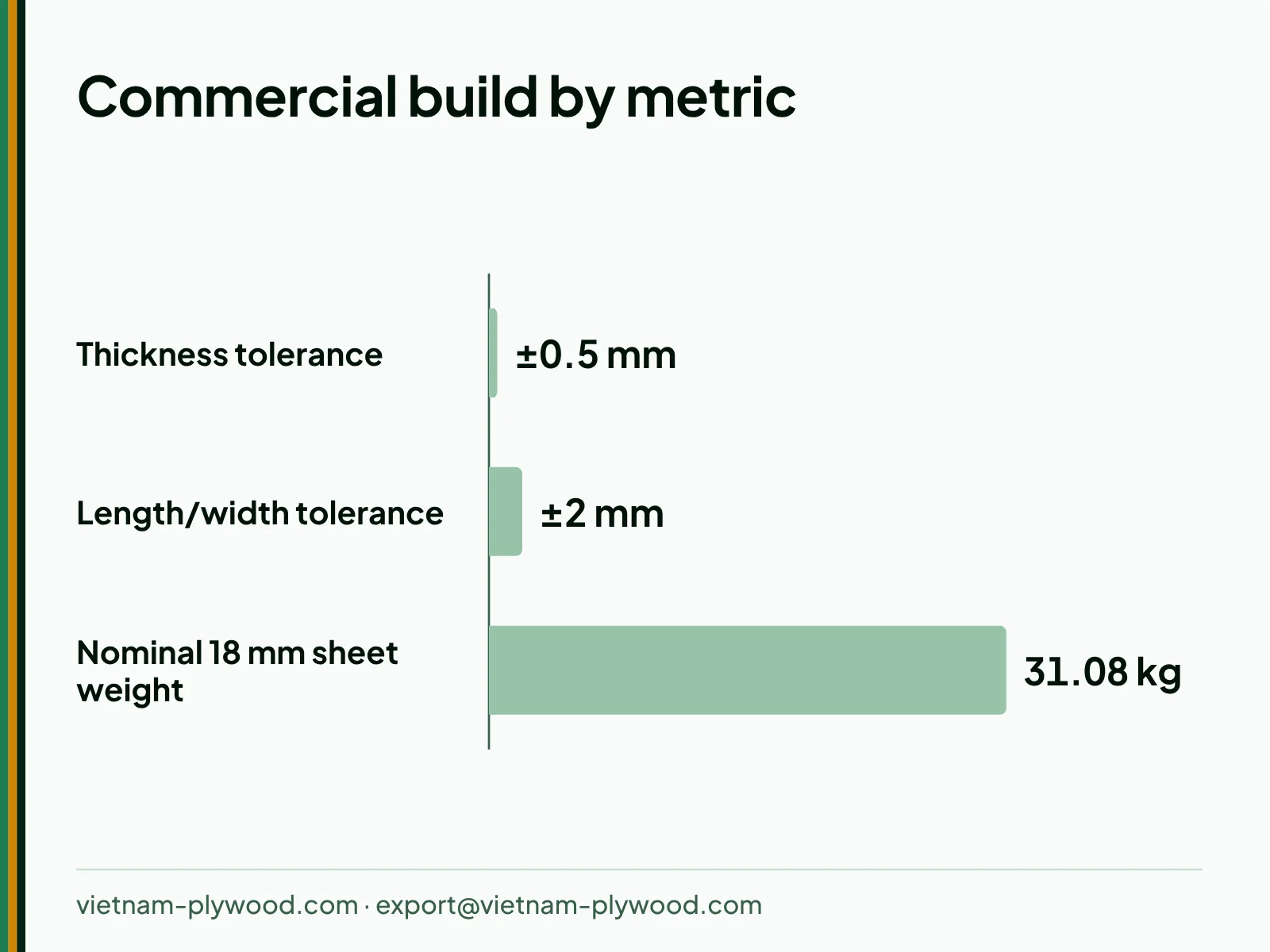
The table compares the same nominal 18 mm, 1220 × 2440 mm acacia panel built to two different purchase orders. The commercial option costs more where core preparation and face selection are tighter; neither grade is a certified structural load rating.
| Metric | Packing build | Commercial build | Verdict by use |
|---|---|---|---|
| Producing line | Commercial and packing | Commercial and packing | Same line; compare the written build |
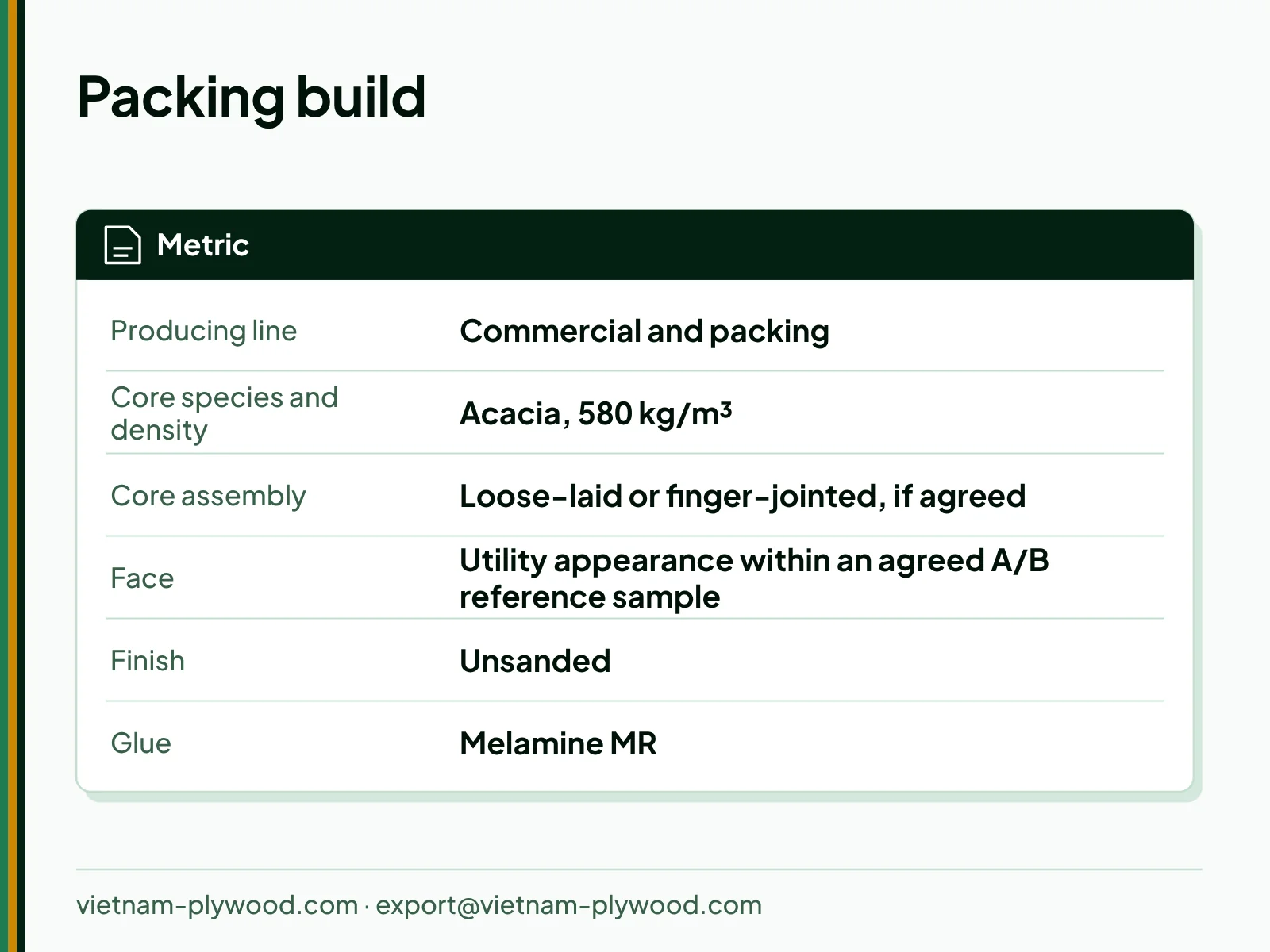
| Core species and density | Acacia, 580 kg/m³ | Acacia, 580 kg/m³ | Equal density; choose by assembly |
| Core assembly | Loose-laid or finger-jointed, if agreed | Edge-trimmed inner veneers with stitched outer layers, if ordered | Commercial for cleaner exposed edges and fastening zones |
| Face | Utility appearance within an agreed A/B reference sample | Cleaner A/B reference sample | Packing for concealed walls; commercial for visible cases |
| Finish | Unsanded | Unsanded or light-sanded | Commercial when a smoother face is specified |
| Glue | Melamine MR | Melamine MR | Neither is automatically a wet-service panel |
| Emission | Class stated on order | Class stated on order | Match destination requirements, not grade name |
| Thickness tolerance | ±0.5–1.0 mm | ±0.5 mm | Commercial where fit-up is tighter |
| Length/width tolerance | ±2 mm | ±2 mm | Equal dimensional requirement |
| Nominal 18 mm sheet weight | 31.08 kg | 31.08 kg | Equal planning weight for equal core and dimensions |
| Intended duty | Crate walls, protective panels, dunnage | Printed cases, shop displays, secondary interior panels | Match finish and joint quality to the job |
A/B describes the agreed face reference, rather than a universal guarantee of identical appearance across every shipment. The actual acceptance sample should show permitted knots, patches, splits and color variation. If a buyer needs a named performance grade, specify the accepted test report separately.
How does the packing core differ from a commercial core?
Packing core accepts a less labor-intensive veneer layout where the crate design tolerates internal joints. Loose-laid strips sit alongside each other; finger-jointed pieces are another build option. Their joint positions deserve particular attention where nails, staples or screws enter the sheet edge.
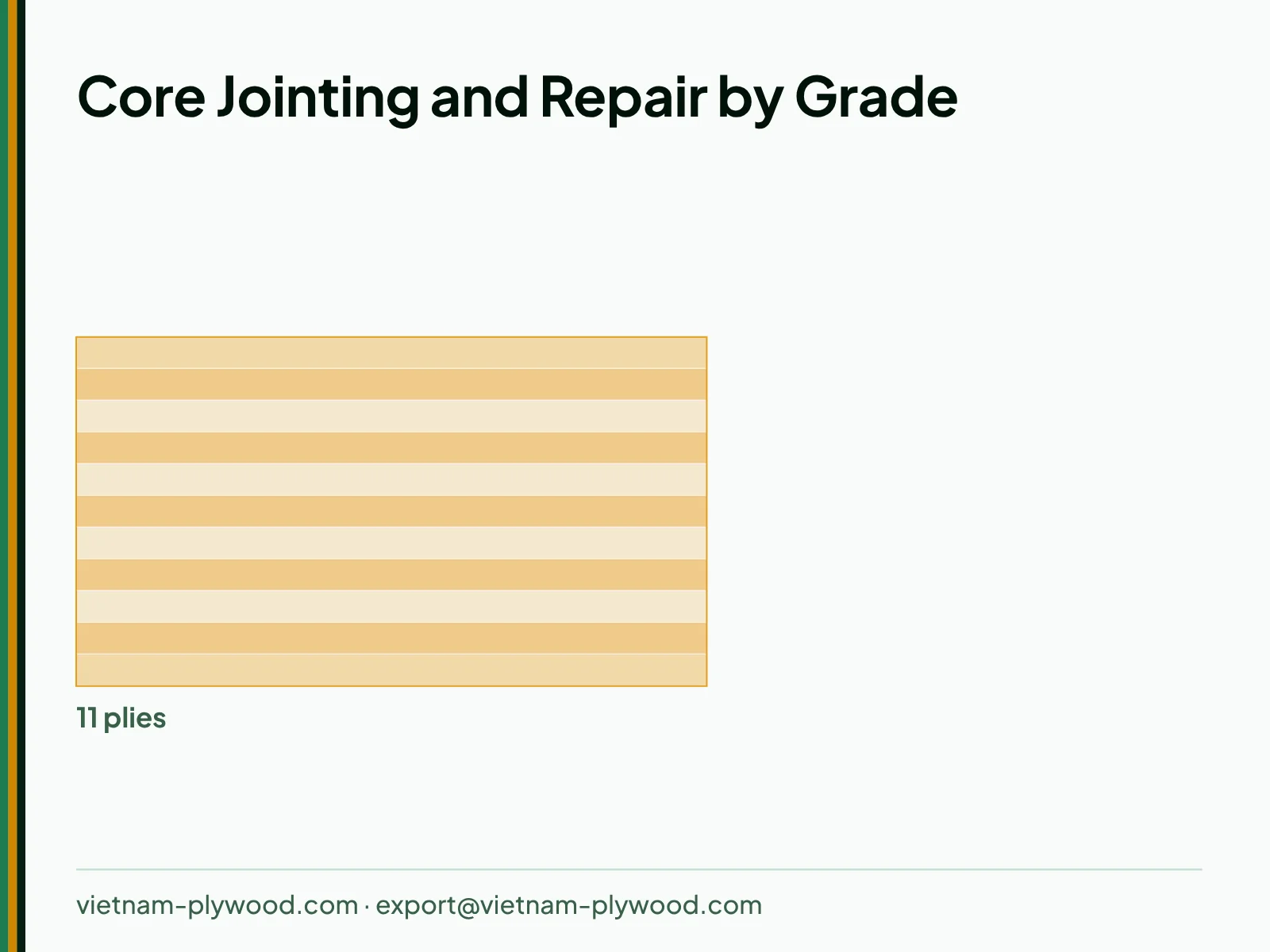
Commercial core can use stitched outer layers and edge-trimmed inner layers. That choice reduces visible discontinuities at the edge and gives a more orderly base beneath a cleaner face. Full stitching is a further core option, associated with our furniture line rather than the default commercial order.
At the producing factory, a buyer can examine the edge of a cut sample from each press batch. Compare open gaps, overlaps, repaired strips and the area where the customer’s fastening pattern falls. A core description without a maximum permitted defect or approved cut-edge sample leaves too much room for disagreement.
For crate designs carrying concentrated machinery loads, the panel alone does not establish safe capacity. The crate engineer must consider batten spacing, fastening pattern, handling method and the complete package. Our heavy-duty plywood specification page addresses stronger application requirements.
Which tolerance and face grade should the order specify?
Packing thickness tolerance is ±0.5–1.0 mm; commercial thickness tolerance is ±0.5 mm. Both use ±2 mm for length and width. Those limits belong on the purchase order alongside nominal thickness, panel size and an agreed face sample.
Available thicknesses run from 3 to 40 mm, including common 3, 5, 9, 12, 15, 18, 21 and 25 mm sizes. The common 18 mm panel contains 11–13 plies because core veneer thickness is 1.4–2.0 mm. Ply count should therefore be recorded with the actual construction rather than inferred from nominal thickness alone.
For faces, bintangor, okoume, poplar, pine and other listed veneers describe the outer species, while acacia describes the core. A face name does not change the core density. Face veneer is commonly 0.2–0.4 mm; the written face reference determines acceptable appearance. A buyer ordering a printed crate should inspect printability on the actual surface, rather than rely on the word commercial.
Our packaging plywood page covers the packing product itself. For repeated cut-panel orders, add a cut list, face orientation and pack identification to the same specification.
Does the glue differ between packing and commercial plywood?
Both builds on this line use melamine MR glue, so glue is not the automatic grade divider. MR means moisture-resistant; the stated melamine system has a 12-hour boil designation. That does not turn either panel into a product specified for continuous outdoor wet exposure.
Glue chemistry and formaldehyde emission class are separate fields. The glue entry describes the bond system; E0, E1 or E2 describes an emission class. An order that merely says “E1 glue” leaves the bond system undefined.
Our construction line instead presses phenolic or melamine film-faced panels with acacia or eucalyptus core. Phenolic weather-and-boil-proof (WBP) glue carries the stated 72-hour boil designation. The choice belongs to the end use and the agreed test requirement, rather than a loose claim that every commercial sheet is waterproof.
Is packing plywood always a lower emission class?
Packing plywood is not automatically assigned a lower emission class than commercial plywood. Specify E0, E1 or E2 separately for the build and destination; the grade name cannot replace a certificate or applicable emissions documentation.
For United States regulated hardwood plywood, the U.S. Environmental Protection Agency’s 2016 formaldehyde rule covers relevant products and provides for third-party certification. The agency explains that regulated hardwood plywood, medium-density fiberboard and particleboard fall within the program; see its Formaldehyde Emission Standards for Composite Wood Products. A packing use does not, by itself, decide whether a particular product falls within a regulatory definition.
For orders requiring CARB P2 or Toxic Substances Control Act (TSCA) Title VI documentation, review the producing member factory’s applicable evidence and the precise panel build. Factory certificates can be shown with factory details masked, on request. A destination-specific regulatory assessment belongs in the importer’s purchasing and compliance process.
When is packing grade enough?
Packing grade is enough when the panel serves as a concealed crate wall or protective separator and the agreed load design tolerates its core joints and rougher surface. It can also suit pallet-related panels where the fastening layout avoids unacceptable gaps.
Commercial grade is the better purchase when a case carries printed identification, exposed edges, a customer-facing surface or tighter assembly fit. Its selected face and more controlled core justify the extra processing cost. For interior installations, the required emissions class and finishing method must be specified independently.
Neither label proves suitability for engineered structural duty. A buyer needing a particular structural or marine classification should obtain a test report the buyer accepts for the actual construction. Our cross-line grade comparison distinguishes these end uses without assigning a grade from a sales name alone.
Trial the buyer’s fasteners and batten spacing before approving recurring orders.
What would our other factory lines build at the same thickness?
Our commercial and packing line presses both grades discussed here, with acacia core, MR glue and unsanded or light-sanded faces. The same nominal thickness can be specified differently on our furniture line or our construction line.
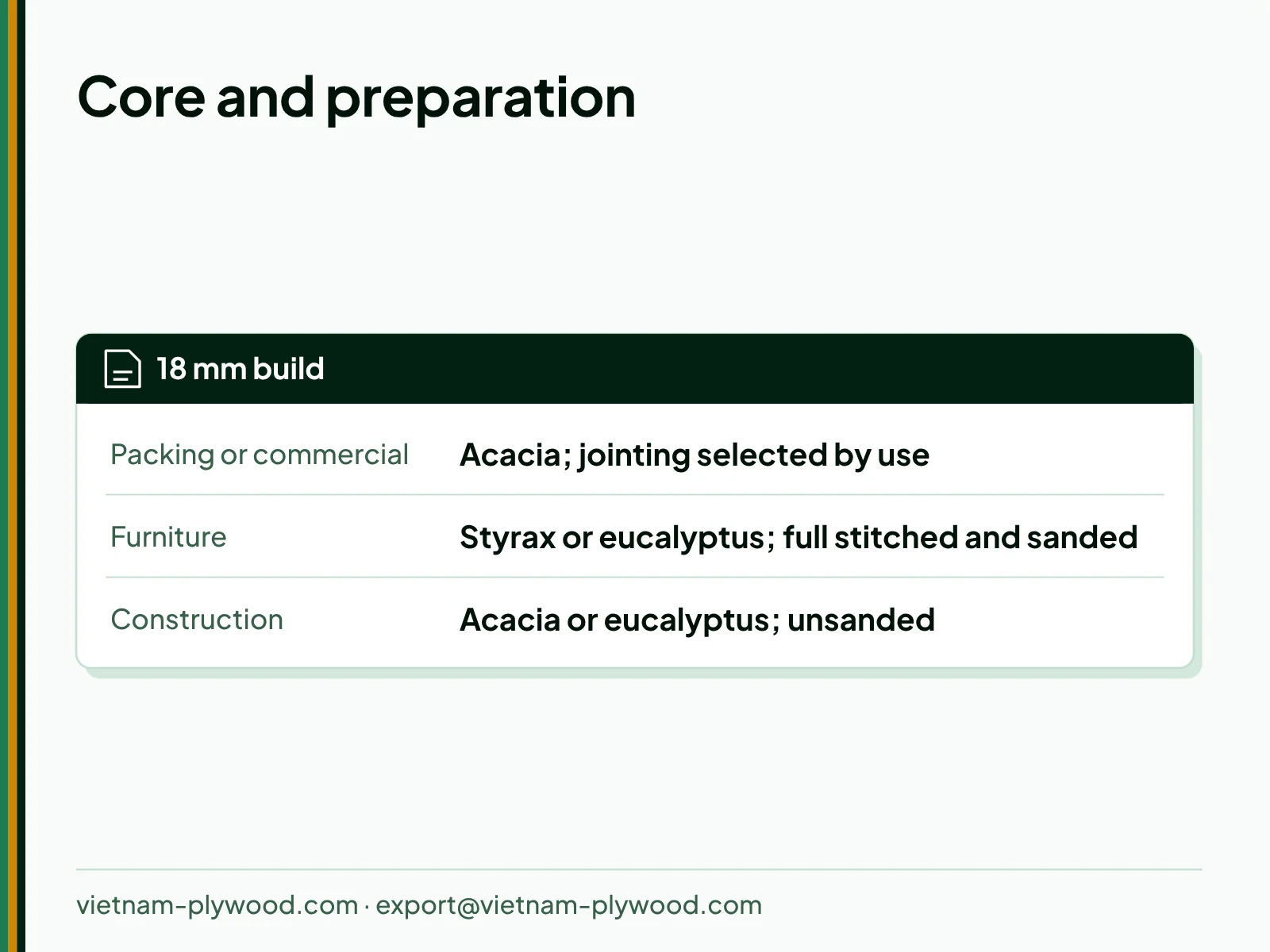
| 18 mm build | Core and preparation | Face and bond | Buyer decision |
|---|---|---|---|
| Packing or commercial | Acacia; jointing selected by use | Raw veneer face; MR | Crates or general-purpose panels |
| Furniture | Styrax or eucalyptus; full stitched and sanded | Selected veneer face; E0/E1 | Cabinets and finer interior work |
| Construction | Acacia or eucalyptus; unsanded | Phenolic or melamine film, including anti-slip | Formwork or textured working surfaces |
Identical nominal thickness does not mean identical construction. HCPLY’s three factories are in Phu Tho and Hai Phong; each order is produced at the factory suited to its specification. Buyers can visit the factory office and inspect goods at the producing factory.
For furniture projects, the lighter styrax core has a density of 500 kg/m³, compared with acacia at 580 kg/m³ and eucalyptus at 650 kg/m³. These are core-density planning figures, rather than independent panel strength ratings.
Can packing and commercial plywood share one 40HC?
Yes. The minimum order is one 40HC, and different specifications can be mixed within its 28.5 t payload limit. Both acacia builds can share a shipment when pallet layout, sheet counts and total weight are reconciled before loading.
For 18 mm, 1220 × 2440 mm acacia panels, the lookup gives 31.08 kg per sheet and 55 sheets per pallet. A full single-specification acacia load has 16 pallets, 880 sheets, 47.15 m³ and 27.35 t, excluding film weight. This is a planning reference for the specified size and core.
For example, eight packing and eight commercial pallets contain 440 sheets each: 880 sheets and 27.35 t total.
For other dimensions, revise the load plan using the container loading reference.
What should an inspector witness before loading?
An inspector should compare the approved packing and commercial reference sheets against the actual production lots. The visit should concentrate on features that distinguish the two orders rather than treating their common acacia core as proof of identical quality.
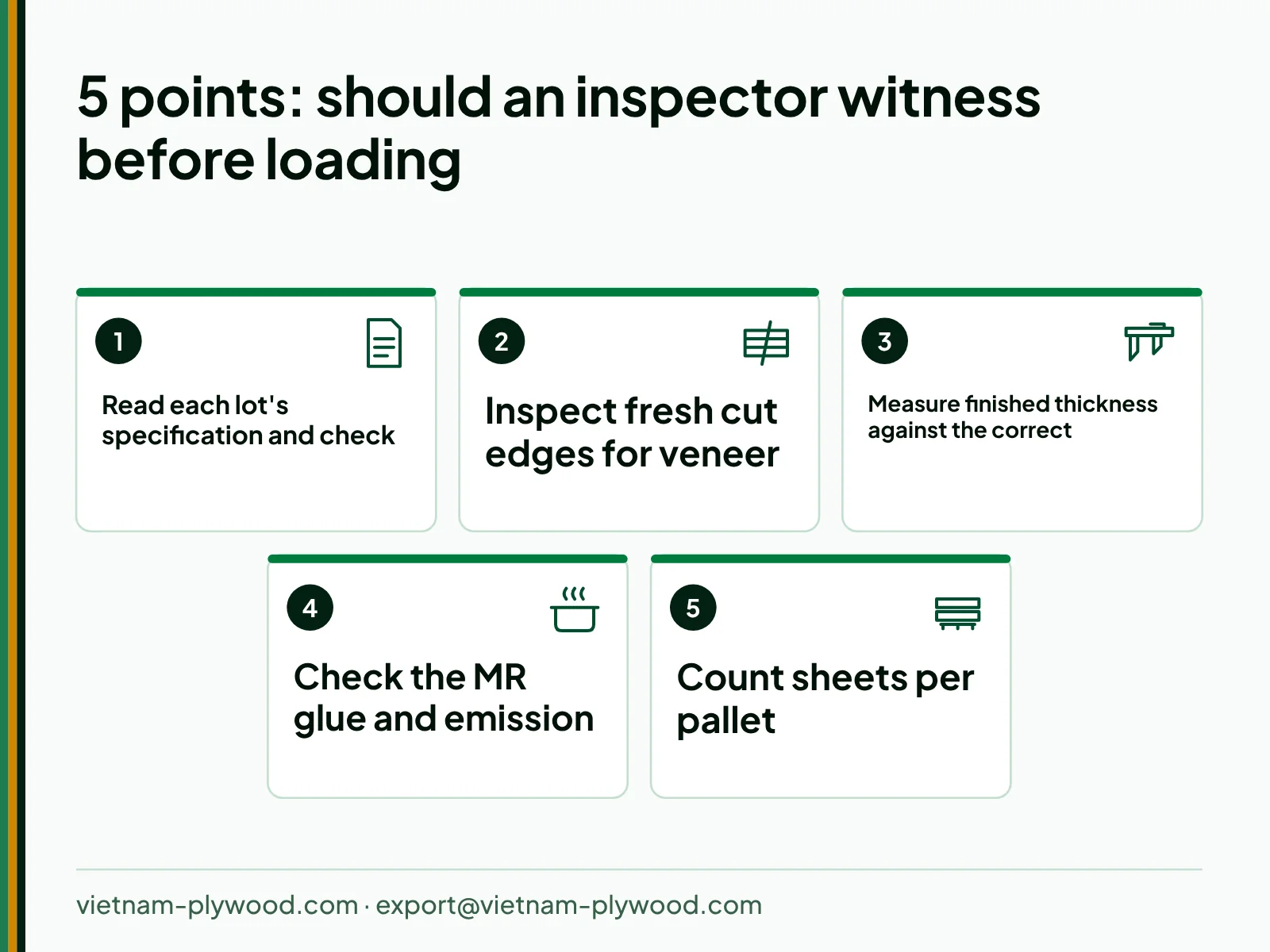
- Read each lot’s specification and check face species, finish and core assembly against its reference sample.
- Inspect fresh cut edges for veneer joints, overlaps, voids and defects near intended fastener positions.
- Measure finished thickness against the correct tolerance band, then check length and width against ±2 mm.
- Check the MR glue and emission fields in the agreed manufacturing and certificate documentation.
- Count sheets per pallet, identify each grade on pack labels and reconcile the load plan before sealing.
HCPLY coordinates specification, on-site quality control, documents and loading. The commercial invoice and packing list distinguish the goods and quantities; the bill of lading records the shipment. After loading, the draft shipping documents come to you for approval.
The shipment document set also includes the certificate of origin, phytosanitary and fumigation papers, applicable insurance under CIF, agreed certificate or test documents and the EUTR/EUDR file set for EU lots. Certificate details from member factories are shown with factory details masked, on request.
How should buyers compare the quotation?
Commercial plywood starts from US$250/m³ FOB Hai Phong (October 2026). That dated starting point is for commercial plywood; packing plywood requires a quotation against the written specification rather than an assumed discount or a copied price.
The strongest cost drivers are core assembly labor and permitted repairs, then face selection and finishing. A commercial build with stitched outer layers, a cleaner face and light sanding costs more than a loose-laid, unsanded packing build because it uses additional selection and processing. Thickness, size, emission documentation and the order mix also affect the quotation.
We ship FOB Hai Phong, or CFR (CNF) or CIF to your port. Factory lead time runs 15–45 days from receipt of the 30% deposit; the exact figure depends on order size, line loading and what the contract fixes. The remaining 70% is paid on the scan of the bill of lading, by T/T, or by irrevocable sight L/C.
Samples cost nothing: a first-time buyer pays the courier, and that charge comes off the first confirmed order. See production lead time for the planning topic, or send the proposed grade split through contact.
What specification should go to the producing factory?
Name the job and separate the two builds. State dimensions and loading assumptions.
Copy these fields into the inquiry and add the fastening layout and destination.
Application: industrial crates / printed cases; fastening and batten layout: [attach]
Line or core: commercial and packing line / acacia core
Glue: melamine MR; emission: [E0, E1 or E2 as required]
Face and grade: [species], A/B reference sample; packing vs commercial finish
Thickness and tolerance: 18 mm; packing ±0.5–1.0 mm / commercial ±0.5 mm
Size: 1220 × 2440 mm; length and width ±2 mm
Quantity: [packing pallets] + [commercial pallets]; total one 40HC
Destination port: [port and country]
Book a factory visit with Lucy at export@vietnam-plywood.com to compare both builds.