





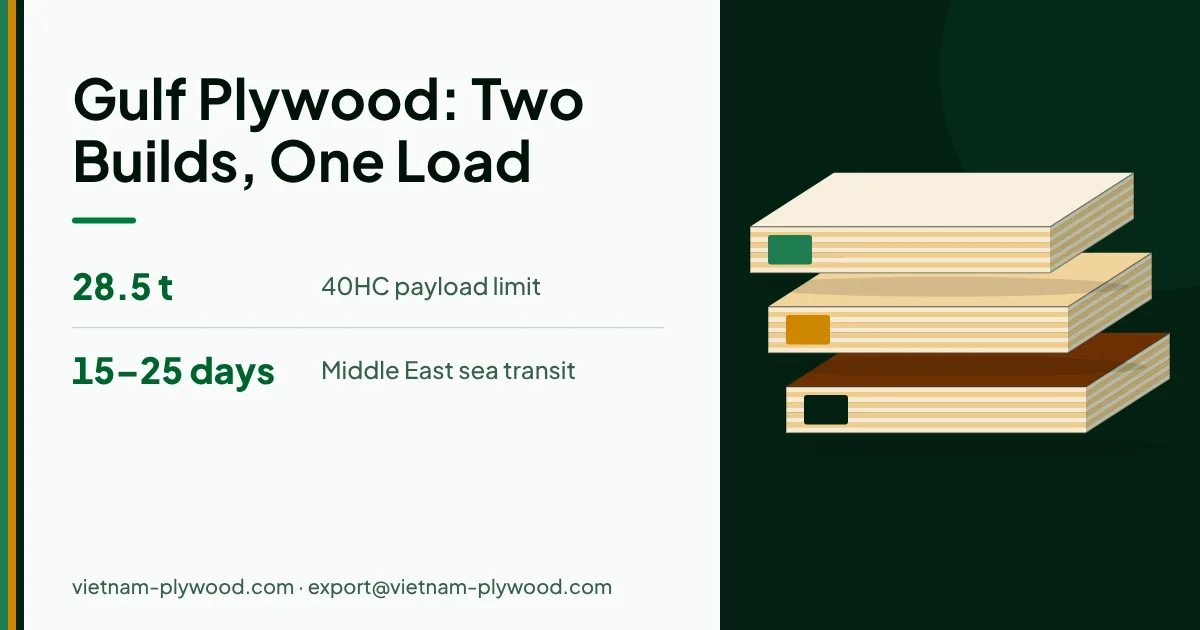
A Gulf plywood container can combine shuttering and furniture panels, but the plywood price in uae must be compared by build and landed cost. Choosing the wrong bond, core or delivery basis can waste money and delay an accepted load. HCPLY prices each specification from the producing line and plans the mixed shipment against its weight limit.
What is the average plywood price in the UAE?
The plywood price in uae has no single defensible average across commercial, shuttering, furniture and marine-labelled sheets. HCPLY’s October 2026 export starting points are from US$250/m³ FOB Hai Phong (October 2026) for commercial plywood and from US$350/m³ FOB Hai Phong (October 2026) for furniture plywood. These are factory-port volume prices, not Dubai retail sheet prices.
A useful average requires matching thickness, sheet dimensions, glue, core construction, face and purchasing channel. A local shelf price includes different services from a container quotation. Compare the same specification and delivery point before deciding which offer is lower.
Dubai plywood sheet price advertisements often combine retail stock, imported panels and different grades. Ask each local seller for a written build and whether the quotation includes delivery, tax and unloading. For a factory order, start with the Vietnam plywood export cost breakdown and add the destination-side costs separately.
Which specifications move a Gulf plywood quote most?
Core construction and bonding specification are major cost drivers, followed by face selection, thickness, finishing and delivery basis. Full-stitched cores require more assembly than loose-laid cores. Phenolic weather-and-boil-proof bonding is a different production specification from moisture-resistant bonding, and a sanded furniture face needs additional finishing.
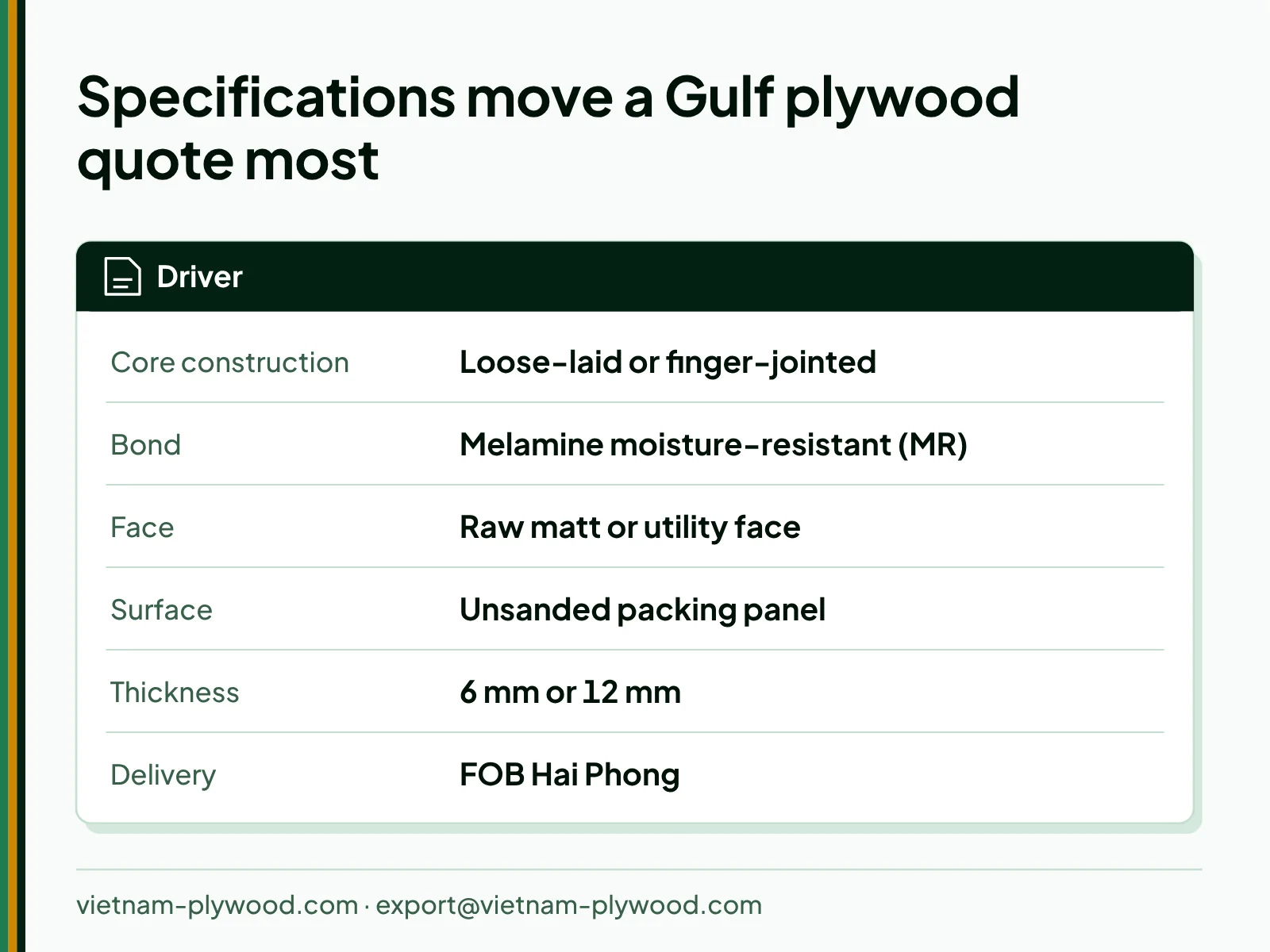
| Driver | Lower-cost comparison | Higher-cost comparison | Buying verdict |
|---|---|---|---|
| Core construction | Loose-laid or finger-jointed | Full stitched | Choose by acceptable internal gaps and intended use |
| Bond | Melamine moisture-resistant (MR) | Phenolic weather and boil proof (WBP) | Specify wet-service requirement separately from price |
| Face | Raw matt or utility face | Selected decorative veneer | Pay for visible appearance only where needed |
| Surface | Unsanded packing panel | Sanded furniture panel | Cabinet machining favours the controlled sanded build |
| Thickness | 6 mm or 12 mm | 18 mm or 25 mm | Compare equivalent area and strength requirements |
| Delivery | FOB Hai Phong | CFR (CNF) or CIF destination | Compare all offers at the same named port |
Emission class is another independent field: E0, E1 or E2 is not a glue type. For US-bound specifications, CARB P2 / TSCA Title VI concerns a third-party-certified emission limit. For a Gulf purchase, specify the buyer’s applicable emission requirement rather than treating a bond label as an emission certificate. Commercial plywood price grades and hardwood face pricing give more detail on those separate choices.
Which factory line makes each panel?
Our construction line presses film-faced shuttering panels; our commercial and packing line makes acacia-core utility sheets; our furniture line makes sanded, full-stitched furniture sheets. The three builds solve different purchasing needs even at the same nominal thickness.
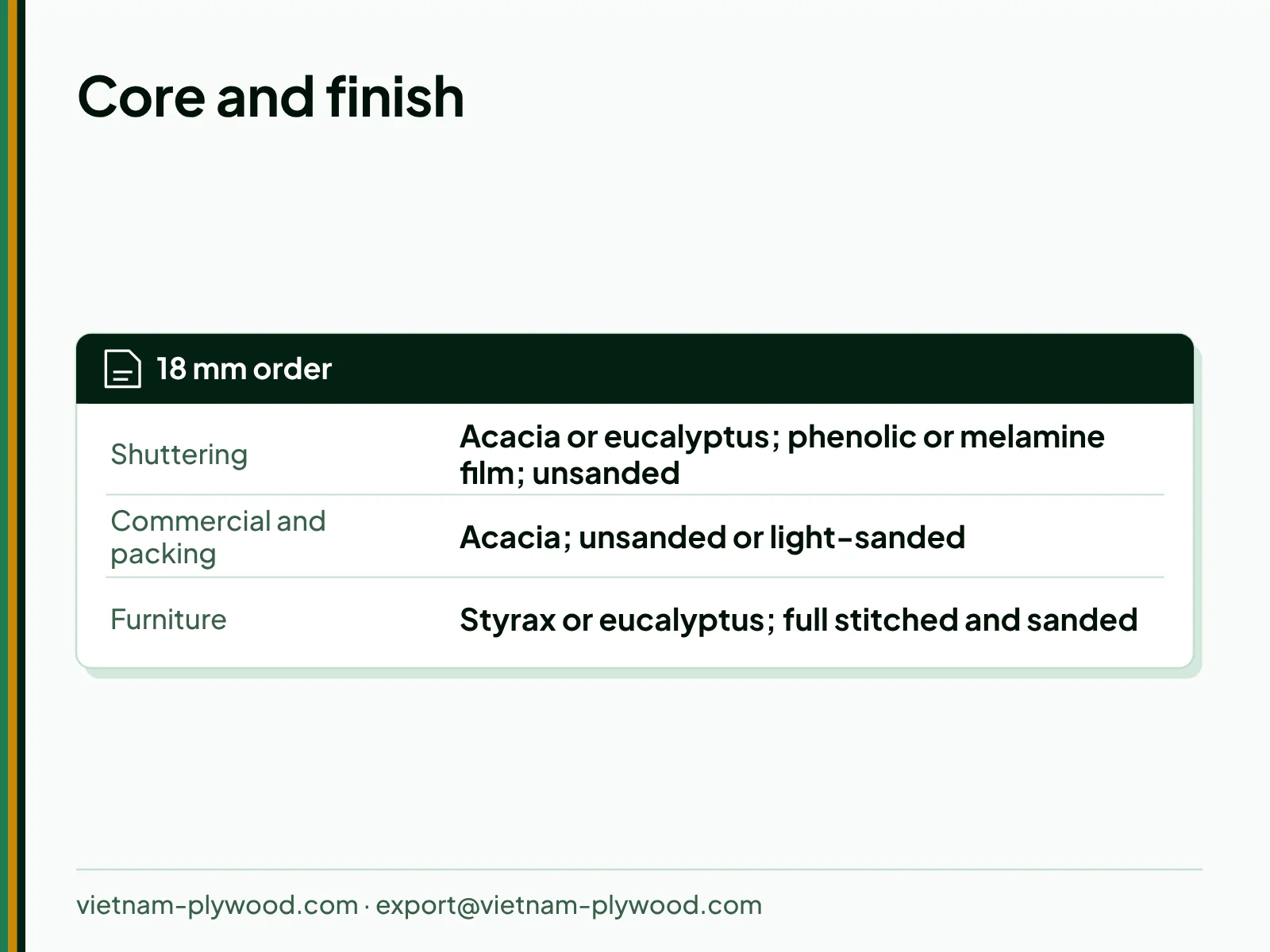
| 18 mm order | Core and finish | Bond or emission field | Suitable Gulf use |
|---|---|---|---|
| Shuttering | Acacia or eucalyptus; phenolic or melamine film; unsanded | MR or WBP as ordered | Concrete formwork |
| Commercial and packing | Acacia; unsanded or light-sanded | MR glue | Packaging, protected utility work |
| Furniture | Styrax or eucalyptus; full stitched and sanded | E0/E1 emission class, glue separately specified | Cabinet and fit-out production |
The furniture build can use bintangor, okoume or engineered veneer faces; birch is a face option, not a birch core. HCPLY does not press birch-core plywood. Compare furniture plywood with commercial and packing plywood before combining requirements into an order.
At the producing factory, a buyer or inspector can witness thickness measurements, inspect exposed edges for gaps and examine the face finish against the approved sample. These checks connect the purchase description to the physical load before dispatch.
How do 12 mm and 18 mm UAE sheet prices compare?
A 12 mm plywood sheet uses less wood volume than an 18 mm sheet of the same length and width, but its quoted price also reflects grade, face and bonding. A plywood sheet price in uae therefore needs a matching build, rather than a simple thickness multiplier.
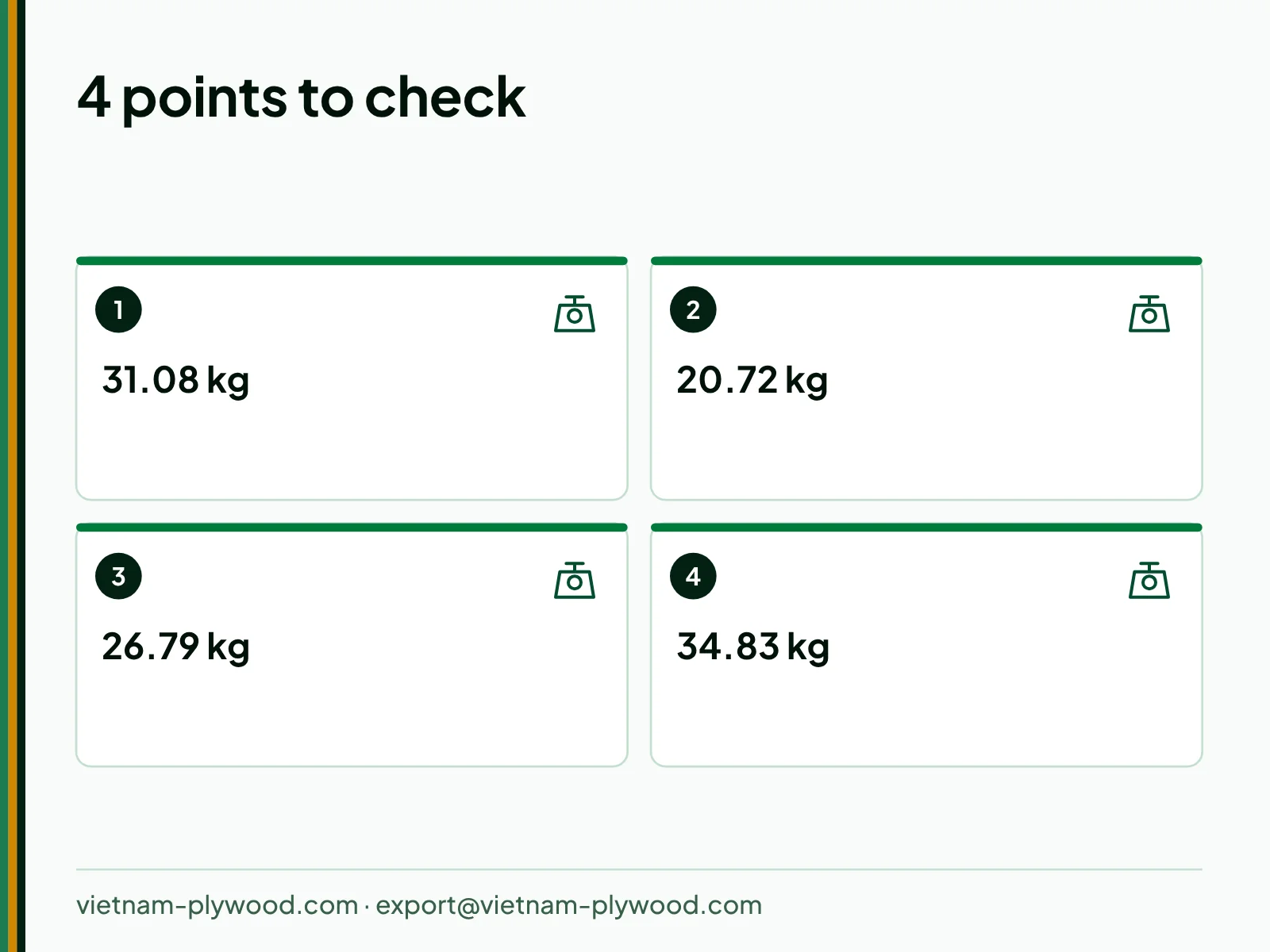
For 1220 × 2440 mm sheets, an 18 mm acacia-core panel weighs 31.08 kg, while a 12 mm acacia-core panel weighs 20.72 kg. At the same 18 mm size, styrax weighs 26.79 kg and eucalyptus 34.83 kg. These are core-based planning weights, excluding film weight.
A Dubai 18mm plywood price is commonly presented per sheet, while a Vietnam factory quotation is commonly presented per cubic metre. Convert the local price to a volume basis using sheet length × width × thickness in metres, then compare identical grades. A 6mm plywood price in uae should receive the same treatment, with the thinner sheet’s packing and handling costs considered separately.
A 12 mm quotation is not a reliable substitute for 18 mm where the engineer or cabinet drawing requires the latter. Thickness tolerance matters too: furniture sanded panels can be ordered at ±0.2 or ±0.3 mm; commercial and film-faced panels at ±0.5 mm. The birch face cost discussion separates appearance from core assumptions.
How does shuttering plywood compare with Dubai stock?
Shuttering plywood price in uae comparisons should start with film, bond, core and intended pour cycle. An imported construction panel can look similar to a local stock sheet while having different edge construction or film weight.
Our construction line offers 120 g/m² standard film, 135 g/m² premium film and 220 g/m² anti-slip film. Anti-slip is a distinct surface choice; it is not an automatic upgrade for every concrete contact face. The same panel must be priced with its required glue system and core construction.
With proper handling, a release agent on every pour and sealed edges including cut edges, melamine-glue film-faced plywood gives about 12–15 pours; phenolic-glue film-faced plywood reaches up to about 25 pours. These conditions matter when comparing cost per pour with a Dubai yard quotation.
Request a delivered-to-site quotation for the local stock and a landed-to-port calculation for the import. Add inland transport, site handling and any cutting or edge treatment to the same comparison. An immediate local purchase can have a timing advantage over a new factory production order.
What does a marine plywood price in the UAE describe?
Marine plywood price uae listings describe several different builds, so the label alone cannot establish a common price. A buyer needs the bond specification, core void acceptance, face grade and test report required for the application.
A marine plywood price in uae or marine plywood price dubai quotation should state whether the intended meaning is phenolic bonding, a particular test method or a named marine standard. HCPLY discusses a marine or BS 1088 build only against a test report the buyer accepts. A phenolic bond by itself does not establish compliance with that standard.
For a marine plywood 18mm prices in uae comparison, record whether the panel is faced, film-faced or raw and whether exposed edges will be sealed. A marine plywood dubai price from a local yard might include stockholding and cutting; a factory offer is based on the agreed written build.
Do not substitute melamine-faced decorative board for a film-faced construction panel. Melamine, high-pressure laminate and laminate faces are relevant market finishes, but they are not separate HCPLY product lines.
Can shuttering and furniture panels share a Gulf container?
Yes. The minimum order is one 40HC, and specifications can be mixed within the 28.5-tonne payload limit. HCPLY can coordinate shuttering, commercial and furniture specifications for the same shipment, with the loading plan checked against weight and pallet dimensions.
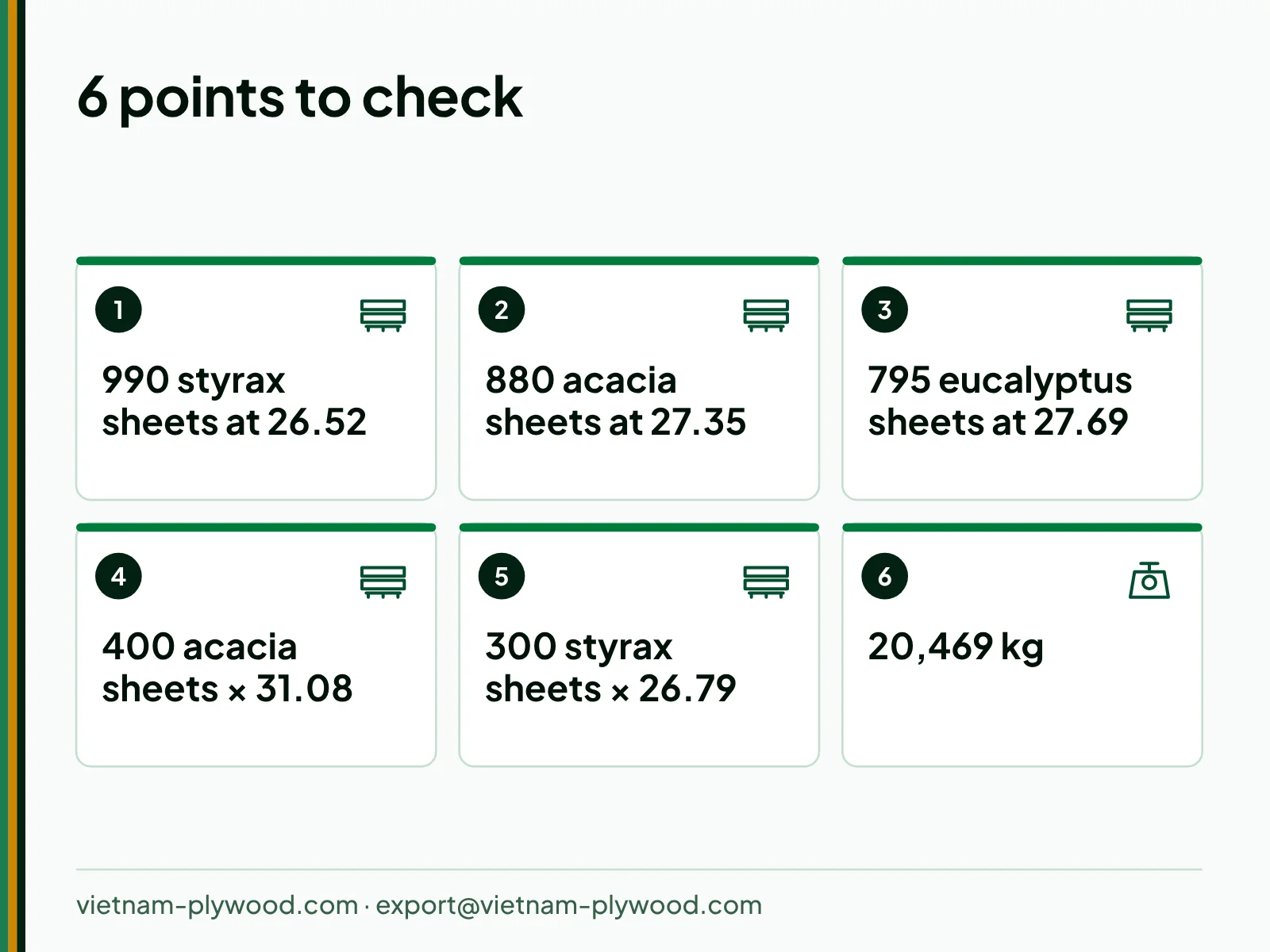
For a full 1220 × 2440 mm, 18 mm single-core reference load, the planning totals are 990 styrax sheets at 26.52 t, 880 acacia sheets at 27.35 t or 795 eucalyptus sheets at 27.69 t. Those are alternative full-load examples, not additive quantities.
A mixed-load calculation starts with each panel’s sheet weight multiplied by its planned sheet count. For example, 400 acacia sheets × 31.08 kg = 12,432 kg and 300 styrax sheets × 26.79 kg = 8,037 kg; the two groups total 20,469 kg before pallets, packaging and any film-weight adjustment. The remaining payload headroom must cover those additional masses and any other goods.
Pallet footprints and stack heights must also fit the actual loading arrangement. Use the container loading calculator for the full packing model rather than treating payload alone as a loading plan. Distributor supply programmes cover repeat purchasing arrangements.
How much does freight to the Gulf add?
Freight adds the carrier’s current ocean charge and destination costs to the FOB factory-port value. A numerical freight surcharge cannot be stated without the shipment’s port, date, container booking and carrier offer.
The planning sea-transit range from Hai Phong to the Middle East is 15–25 days, depending on carrier and route. This is a sailing estimate, separate from production and customs clearance. Production takes 15–45 days after the 30% deposit, depending on quantity, production conditions and agreement.
Ask for FOB Hai Phong, CFR (CNF) and CIF comparisons against the same goods specification. CIF adds the agreed insurance cover; it does not replace destination terminal handling, customs clearance, taxes or inland trucking. A freight quotation should identify its destination port, free-time terms and charge inclusions.
The UAE Federal Tax Authority’s 2024 explanation of taxable supply says that imports are considered in assessing taxable transactions, which may be taxed at 5% or 0% (Federal Tax Authority). Ask the UAE importer to calculate the applicable import VAT treatment and customs charges against the actual declaration.
How do Kuwait and Oman compare with a UAE import?
Plywood price in kuwait and plywood price in oman comparisons require separate destination-port freight and clearance figures. A Dubai yard rate cannot be carried over to Kuwait or Oman without accounting for a different distribution route.
Build three comparable worksheets: the same factory specification and quantity, a current freight offer to each destination, and the local landed or delivered offer in that market. Keep currency, tax treatment, port fees and onward haulage visible as separate fields.
For a UAE distribution hub, a Dubai import may serve a different commercial purpose from a direct Oman or Kuwait shipment. Compare the extra warehouse handling and secondary transport with the direct-route charges. A direct import also requires the receiving buyer to manage customs and destination logistics.
No single Gulf regional average is suitable for a contract decision. Ask the seller for dated quotations in the same unit and with the same delivery basis, then compare each route on its own.
What should the buyer inspect and receive?
The inspection should match the signed build, not merely the trade name printed on an invoice. At the producing factory, the buyer can check the selected face, exposed core edges, thickness readings, film surface and pallet markings before loading.
HCPLY handles specification, on-site quality control, documents and loading. Buyers visit the factory office and inspect goods where their order is produced. The producing factory can show member-factory FSC, CARB P2, ISO 9001 or CE certificates, and EUTR/EUDR documents, with factory details masked, on request, where relevant to the agreed build.
The shipment document package includes a commercial invoice, packing list, bill of lading (B/L), certificate of origin, phytosanitary and fumigation papers, insurance under CIF, and agreed certificate or test-report documents. After loading, the draft shipping documents come to you for approval.
For export settlement, the balance is 70% against the scanned B/L, by telegraphic transfer (T/T) or irrevocable letter of credit at sight. Free samples are available; new buyers book their own courier, and its cost can be credited against a real order.
What specification should go into the quote request?
A useful Gulf quote request fixes the product build and destination before asking for a price. Separate the construction quantity from the furniture or commercial quantity so each production line can cost its own portion.
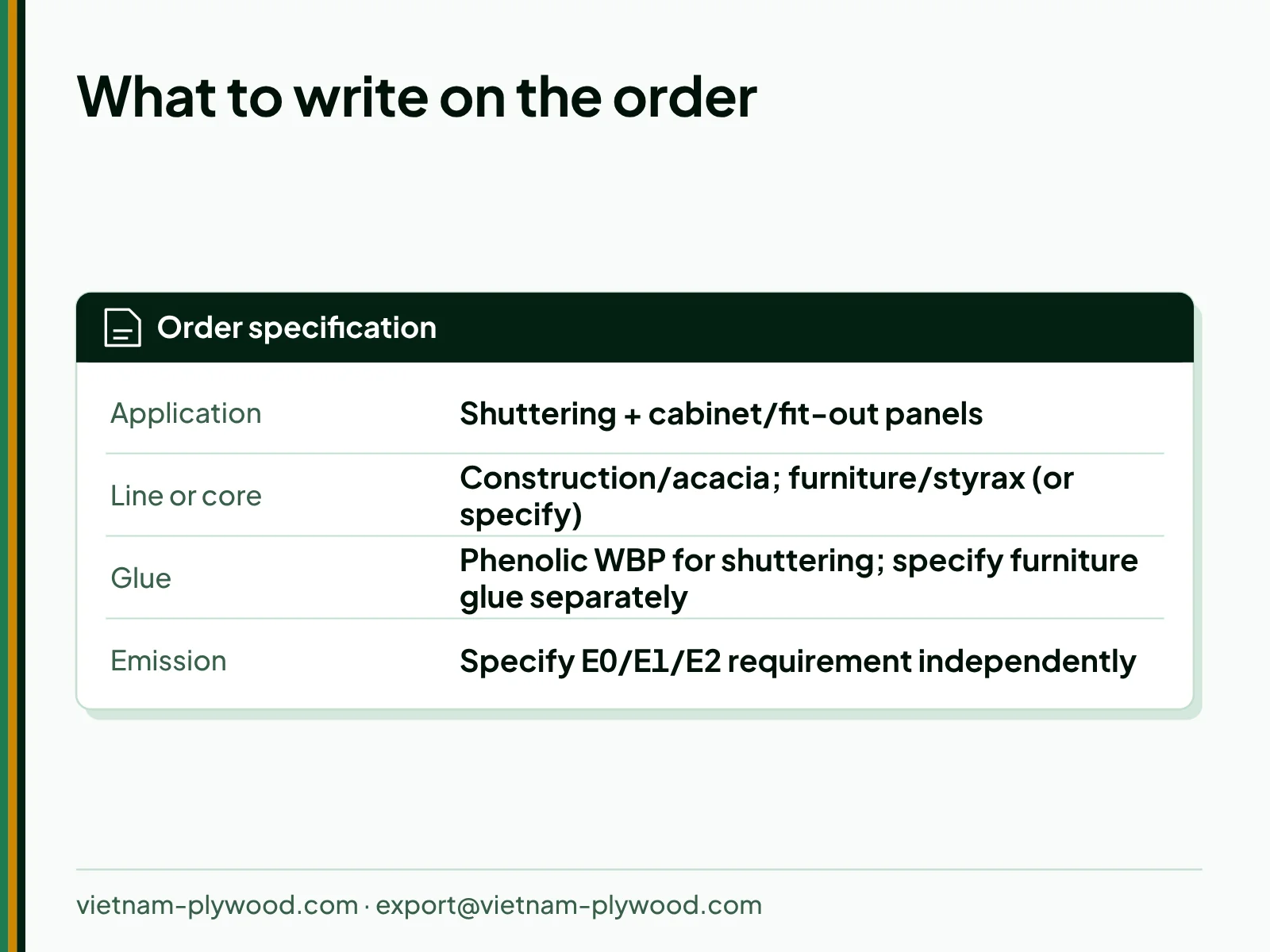
State the application, core, glue and emission class as distinct fields. Include face grade, dimensions, tolerance, quantity and destination port. For a film-faced build, add film weight and whether the surface must be anti-slip; for cabinets, specify the visible face and sanding requirements.
A quotation can then show each product’s factory-port value and a combined freight option for the proposed shipment. This gives the importer a practical basis for comparing Dubai stock, direct UAE imports and alternative Gulf ports.
Application: shuttering + cabinet/fit-out panels
Line or core: construction/acacia; furniture/styrax (or specify)
Glue: phenolic WBP for shuttering; specify furniture glue separately
Emission: specify E0/E1/E2 requirement independently
Face and grade: film weight/surface; furniture veneer and A/B grade
Thickness and tolerance: 18 mm ±0.5 mm; furniture 18 mm ±0.2 mm
Size: 1220 × 2440 mm
Quantity: sheets by build; one mixed 40HC
Destination port: Dubai/Jebel Ali, Kuwait or Oman port (name exact port)
Request the specification sheet from Lucy at export@vietnam-plywood.com.