





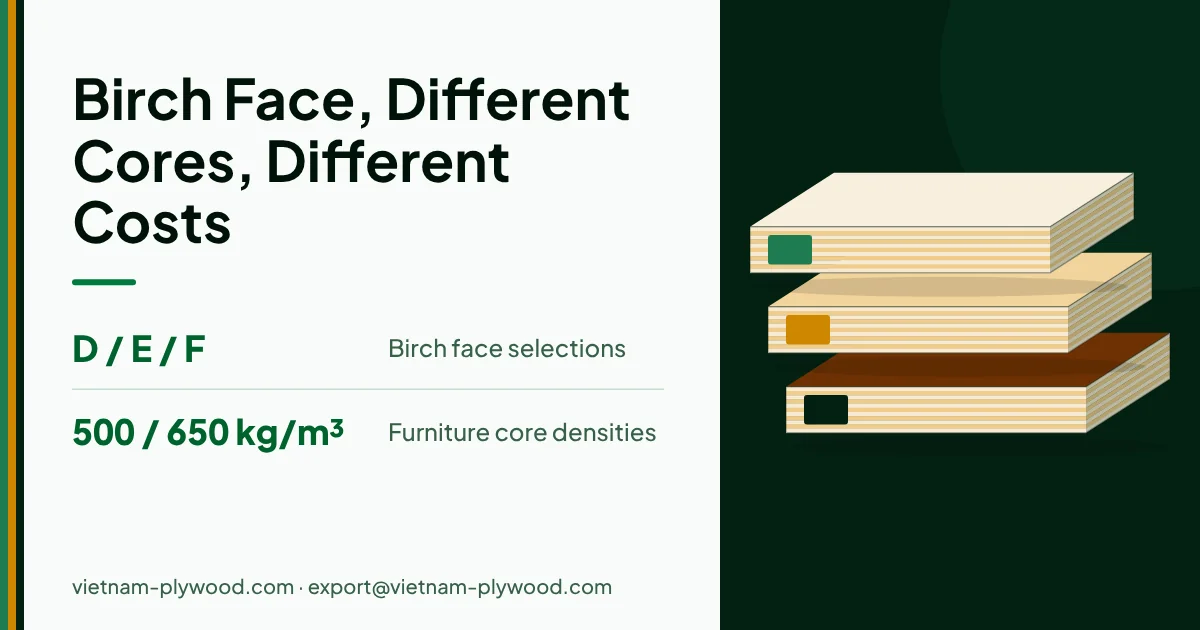
The price of birch plywood from HCPLY follows the birch face grade and the furniture core beneath it, while all-birch is a different, higher-material-input build. Choosing by surface appearance alone can waste finishing money or lead to a rejected cabinet batch. Our furniture line presses birch-face panels over styrax or eucalyptus, not birch throughout.
What determines the price of birch plywood?
The price of birch plywood on our furniture line follows the face grade, core, construction, thickness, and order specification. A birch-face sheet and an all-birch sheet are different products even when their nominal dimensions match. The price comparison starts with what is actually pressed inside the panel, then moves to the surface the cabinet maker will see.
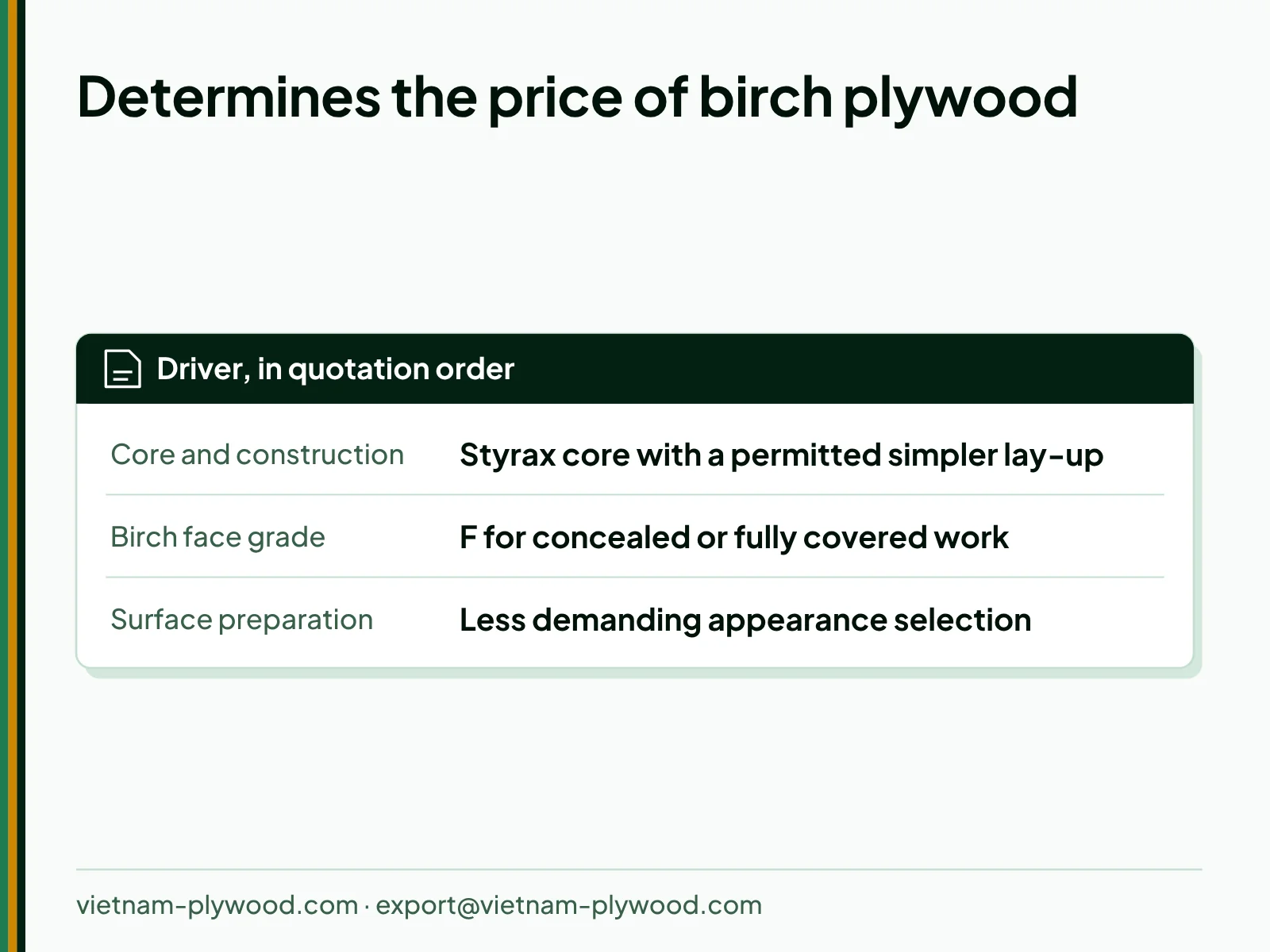
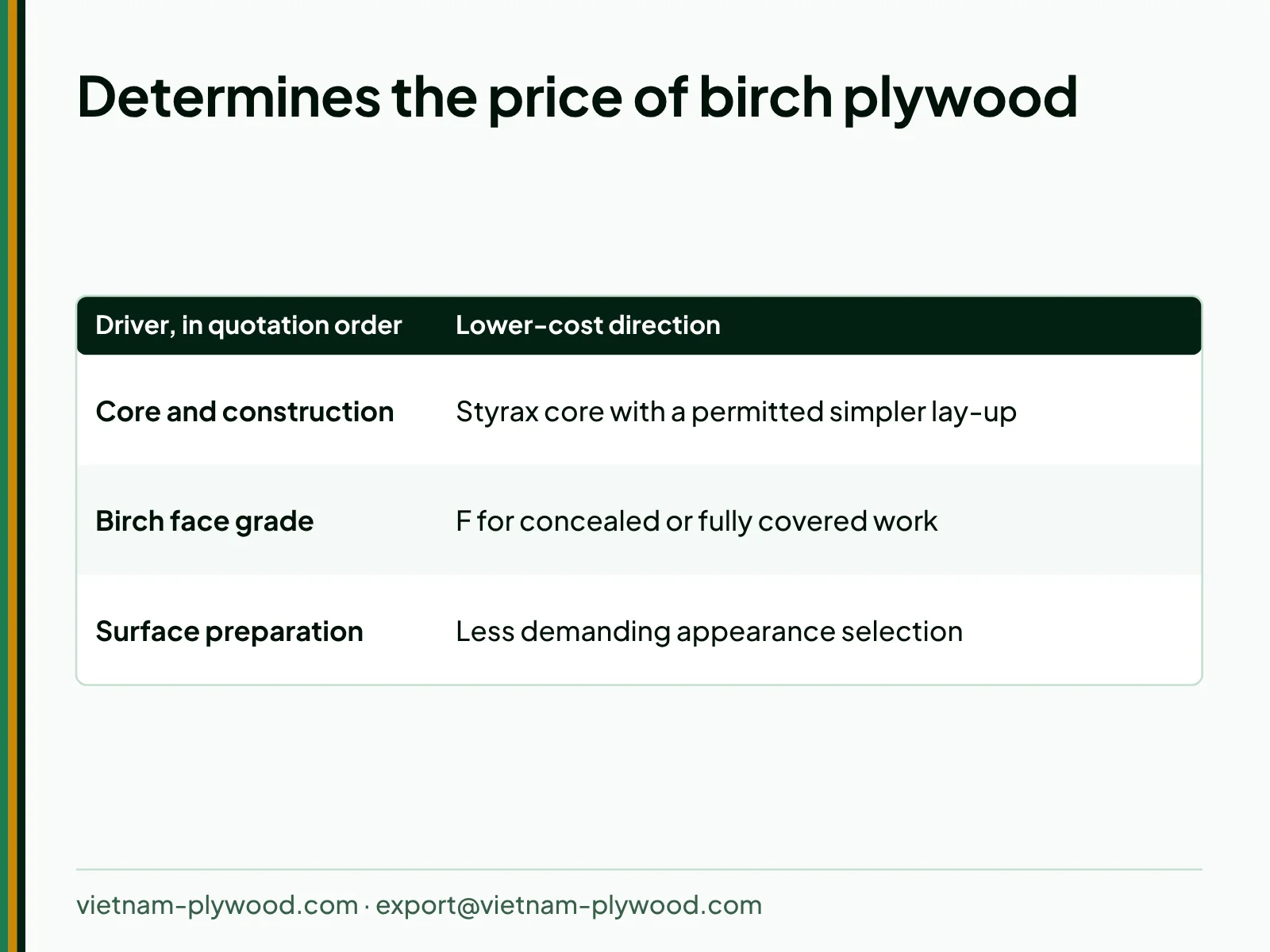
| Driver, in quotation order | Lower-cost direction | Higher-cost direction | Buyer consequence |
|---|---|---|---|
| Core and construction | Styrax core with a permitted simpler lay-up | Eucalyptus core with full stitched construction | Different density, machining response and material input |
| Birch face grade | F for concealed or fully covered work | D for more demanding visible surfaces | Different veneer selection and appearance acceptance |
| Surface preparation | Less demanding appearance selection | Sanded furniture surface with tighter ordered tolerance | Less fitting and finishing rework |
| Thickness and size | Standard size and specified nominal thickness | Thicker or custom-cut panel | More material per sheet or additional cutting |
| Bond and emissions | Specified interior build | Additional agreed bond or emission documentation | Different production and verification requirements |
| Delivery basis | FOB Hai Phong | CFR (CNF) or CIF | Freight and, under CIF, insurance enter the delivered quotation |
These are directional comparisons, not a published price ladder. The actual increment for any row needs a written specification and a current quotation. A premium face over a weak core is often poor value for a machining-intensive cabinet component. Conversely, a concealed back panel need not consume the same selected face veneer as a visible door-side panel.
The broader Vietnam plywood export cost breakdown explains how shipment and specification costs combine. Compare each offer on the same delivery term and volume unit before ranking suppliers.
Why is birch plywood so expensive?
Birch plywood costs more when buyers require selected light-coloured faces, tight surface acceptance and an engineered core. All-birch construction also uses birch veneers throughout, unlike a birch-faced sheet with another species inside. Thickness, bond specification, machining consistency and freight can add further cost. A face-only comparison hides those differences.
The term “birch plywood” can describe more than one construction. A cabinet maker paying for the appearance of birch on an enclosed carcass can choose a birch face over our furniture core. A designer specifying visible striped edges and birch throughout needs a different material, which our furniture line does not press. The second requirement should never be priced as though it were the first.
Market price explainers discuss veneer supply, adhesive, energy, transport and currency as drivers. Those factors help explain changing offers, but its retail and origin price examples are not HCPLY quotations. A buyer should ask which inputs have changed rather than assuming that a rising birch ply price means the same construction has become more valuable.
A price comparison is meaningful only when face grade, core species, lay-up, glue, emission class, tolerance and delivery basis appear together. Otherwise the lower figure can simply describe a different sheet.
How do D, E and F face grades change the quote?
D, E and F are the birch face-grade choices in our specification, with D the more demanding selection and F the less demanding selection. A cleaner requested appearance requires more selective veneer sorting, so a D-face quotation normally sits above an otherwise identical F-face build. We do not publish a fixed surcharge for either step.
A visible cabinet end panel calls for an agreed visual reference, including colour variation, permissible natural marks and face repairs. A fully painted or concealed panel can be assessed against a less restrictive reference. The approved sample defines defect acceptance.
Face and back should be specified separately. Putting a selected face on both sides of a component hidden against a wall can increase input cost without improving the installed appearance. Where both surfaces remain visible, the back-grade decision changes. Inspectors should compare representative sheets under the same lighting and record which face is intended for the finished cabinet.
Our common face veneer thickness is 0.2–0.4 mm. That thin decorative layer names the product, but the material beneath determines most of its mass. It cannot turn a styrax-core panel into an all-birch panel.
Which core sits under the birch face?
Our furniture line presses birch-faced plywood over styrax or eucalyptus cores, with full stitched construction and a sanded surface. Styrax core has a density of 500 kg/m³ and eucalyptus core 650 kg/m³. Density follows the core, not the birch face, so the two panels differ in mass even if they look alike from above.
At 18 mm and 1220 × 2440 mm, the listed sheet weights are 26.79 kg for styrax and 34.83 kg for eucalyptus. They also explain why a quoted container quantity must follow the selected core.
Full stitched core construction is the furniture-line specification. The wider construction hierarchy runs from full stitched, to stitched outer layers with edge-trimmed inner layers, to finger-jointed, then loose-laid. Substituting a less demanding construction can change cost, but it also changes the edge and machining risk. A quote should identify the actual lay-up rather than use a vague “hardwood core” label.
For a birch plywood product specification, state the application and whether exposed edges, CNC routing or edge banding make core consistency especially visible.
How do our three lines compare at the same thickness?
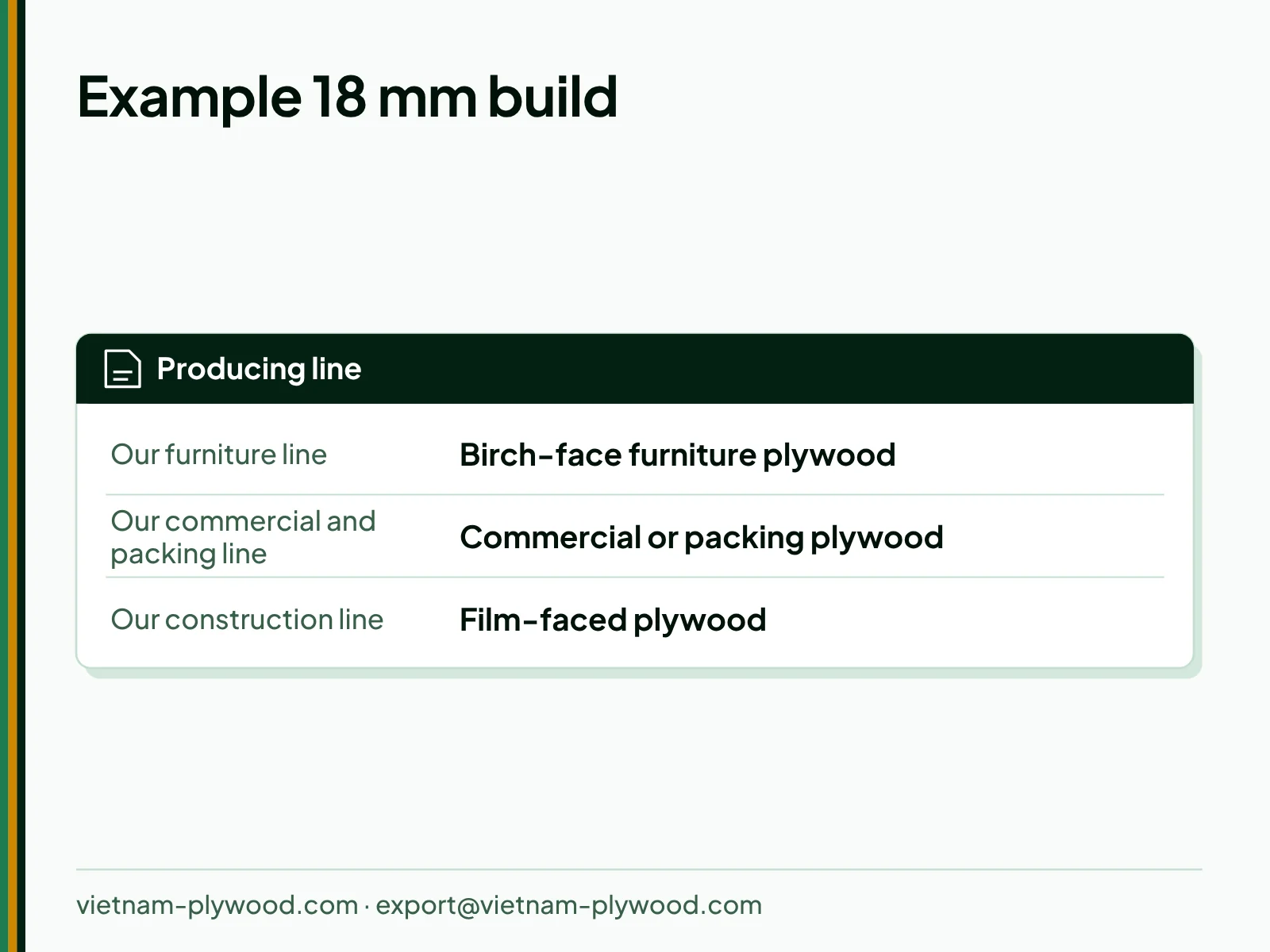
Our three production lines can build different 18 mm panels for different buyers, but only the furniture line builds the birch-face furniture specification described here. Matching thickness does not make the three offers interchangeable.
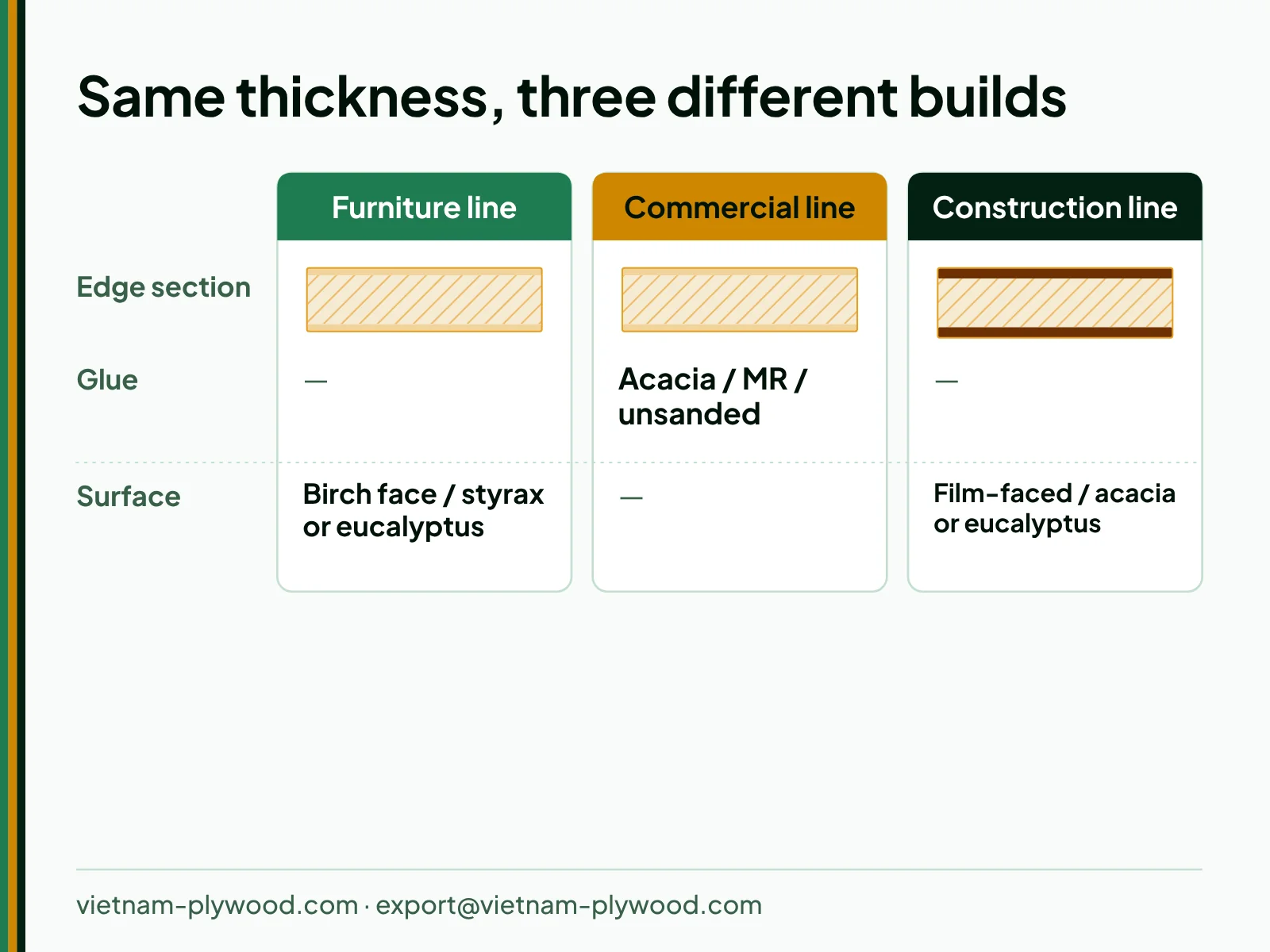
| Producing line | Example 18 mm build | Core and surface | Why a buyer selects it |
|---|---|---|---|
| Our furniture line | Birch-face furniture plywood | Full stitched styrax or eucalyptus; sanded; E0/E1 | Cabinet parts needing an agreed birch appearance |
| Our commercial and packing line | Commercial or packing plywood | Acacia; MR glue; unsanded or light-sanded | Packing and less appearance-sensitive industrial work |
| Our construction line | Film-faced plywood | Acacia or eucalyptus; phenolic or melamine film; unsanded | Concrete formwork or anti-slip work surfaces |
The commercial line uses acacia at 580 kg/m³. The construction line uses film rather than birch veneer.
We do not press birch-core plywood. We also do not offer melamine, high-pressure laminate or other laminate faces as a product line. An importer comparing an all-birch offer with our furniture-line quote must retain that distinction in the purchase order.
Why does Baltic birch cost more than birch-faced plywood?
Baltic birch commonly refers to a panel built from birch veneers throughout, while our birch-faced panel has a birch surface over styrax or eucalyptus. More birch veneer across the thickness raises material exposure and creates a different edge. A Baltic birch plywood cost comparison must therefore compare construction, not just face colour.
Retail Baltic birch collections list multiple thicknesses, prefinished variants and smaller cut sizes. Its retail selection is useful for identifying variants, but a cut-piece retail price is not an export-container benchmark. An all-birch construction differs from a thin birch face over our furniture core.
An all-birch edge can be a deliberate visual feature in shelves, drawers and exposed joinery. If the edge is covered by banding, the buyer should examine whether paying for birch through every ply improves the finished component. There is no universal answer: the edge treatment, drilling pattern, finishing and accepted sample decide the relevant specification.
Do not treat the Baltic grading terms B/BB as synonyms for our D/E/F birch face grades. Ask for the seller’s grading rules, photographs, construction section and acceptance sample. Nominal thickness does not establish comparable acceptance.
What is the dated from-price for 18 mm birch plywood?
There is no published HCPLY from-price for 18 mm birch-faced plywood. A birch-specific starting figure is unavailable, so the birch plywood 18mm price must be quoted against the complete build. Neither a generic furniture starting figure nor a Baltic retail price should be presented as the price of this product.
Request a birch ply 18mm price with the selected D/E/F face grade, core, tolerance and delivery term in writing.
For an 18 mm, 1220 × 2440 mm panel, request quotations per sheet and per cubic metre on identical specifications. The plywood price per cubic metre, square metre and sheet page covers the conversion method.
The common nominal thickness range is 3–40 mm, with 3, 5, 9, 12, 15, 18, 21 and 25 mm frequently specified. An 18 mm furniture sheet has 11–13 plies depending on 1.4–2.0 mm core-veneer thickness. The ordered sanded thickness tolerance is ±0.2 or ±0.3 mm; length and width tolerance is ±2 mm.
A “3/4 birch plywood 4x8 price” request is not automatically the same as an 18 mm, 1220 × 2440 mm export specification. Convert the actual dimensions and verify the required tolerance before comparing the offers.
Can birch panels share a container with other lines?
Yes. Specifications can be mixed within one 40HC container provided the 28.5 t payload limit is respected. A mixed order can combine birch-faced furniture sheets with commercial or film-faced panels, with quantities allocated against each core’s weight and pallet plan.
For 18 mm, 1220 × 2440 mm sheets, the full-load cases are 990 styrax sheets (26.52 t), 880 acacia sheets (27.35 t) and 795 eucalyptus sheets (27.69 t). Their respective pallet counts are 18, 16 and 15, with a 1000 mm stack for styrax and acacia and 970 mm for eucalyptus. Each full-load tonnage is taken from the corresponding core loading table. They are separate planning cases, not quantities to add together.
For a mixed shipment, request a pallet-by-pallet loading plan showing each core, sheet count, pallet footprint and declared shipment mass. Compare the final packing list and loading plan with the 28.5 t payload limit before dispatch.
The mixed-container loading process covers how specifications are combined. The container packing reference owns the full-load sheet-count topic. Buyers with recurring cabinet and packing demand can discuss a distributor supply programme rather than forcing unrelated applications into one panel grade.
Which glue, emissions and tolerances affect cost?
Glue type, emission class and dimensional tolerance must appear as separate quotation fields. The specified bond options identify melamine as MR with a 12-hour boil condition, and phenolic as WBP with a 72-hour boil condition. Those descriptions are bond specifications, not emission classes or a claim that every furniture panel uses either option.
Emission classes are E0, E1 and E2; the furniture line lists E0/E1. CARB P2 and TSCA Title VI concern a United States emission limit with third-party certification. A buyer asking for documentation should identify the exact intended market and agreed build. Member-factory certificates, including FSC, CARB P2, ISO 9001 and CE, are shown with factory details masked, on request; that statement does not establish certification of any individual order.
The producing factory can demonstrate a thickness measurement across representative sheets, a visual face comparison and an edge inspection against the accepted reference. Record the measurement locations and sample identification in the inspection report. A clean face cannot compensate for unacceptable thickness variation during CNC nesting or cabinet assembly.
Our furniture line uses full stitched core and sanding. MR pressing is listed at 110–120 °C and WBP pressing at 130–145 °C for these bonds. These are process ranges, not proof of a completed test on a particular shipment. Any requested bond test report belongs to the agreed build and should be reviewed before acceptance.
How should importers compare landed birch plywood prices?
Compare landed offers by converting each quotation to the same panel specification, quantity and delivery basis. FOB Hai Phong excludes ocean freight and the buyer’s destination charges; CFR (CNF) and CIF add different transport responsibilities. A low FOB figure can be overtaken by freight, handling, duty or a specification mismatch.
The United States Code, 2024 edition, identifies the Harmonized Tariff Schedule under 19 U.S.C. 1202 and describes its periodic publication in the official statutory text. Check the current tariff classification and origin treatment for the actual panel construction before calculating destination duty.
Compare origin documents and delivered terms using UK plywood pricing or Saudi Arabia plywood prices.
The export file includes a commercial invoice, packing list, bill of lading (B/L), certificate of origin, phytosanitary and fumigation papers, and insurance under CIF. EU lots additionally involve EUR.1 where applicable and the EUTR/EUDR file set. After loading, the draft shipping documents come to you for approval. The invoice identifies the sold specification and price basis; the packing list identifies quantities and packing.
What can the buyer inspect before loading?
The buyer can inspect face selection, core construction, dimensions and packing at the producing factory. We manage specification, on-site quality control, documents and loading, while the buyer can visit the factory office and inspect the goods where they are pressed.
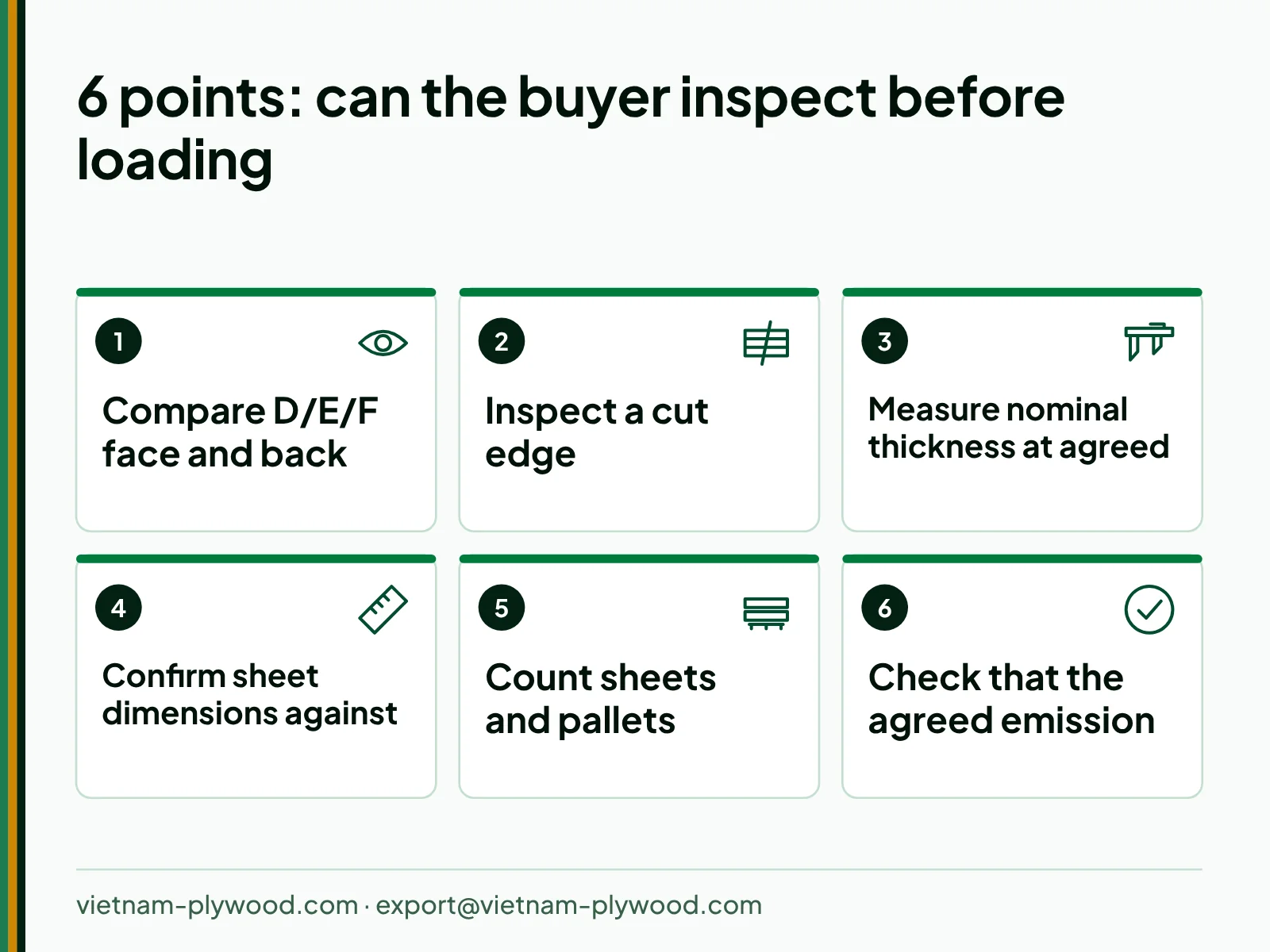
- Compare D/E/F face and back samples against the approved appearance reference, including repaired areas and colour variation.
- Inspect a cut edge for full stitched core, visible gaps and the declared styrax or eucalyptus construction.
- Measure nominal thickness at agreed locations and compare with the ordered ±0.2 or ±0.3 mm tolerance.
- Confirm sheet dimensions against the ordered size and ±2 mm length/width tolerance.
- Count sheets and pallets, identify each specification and reconcile planned mass with the packing list.
- Check that the agreed emission certificate or test report, where ordered, corresponds to the producing factory and actual build.
Our three factories are in Phu Tho and Hai Phong; the producing site ships the order directly.
Minimum order is one 40HC. Factory lead time runs 15–45 days from receipt of the 30% deposit; the exact figure depends on order size, line loading and what the contract fixes. The remaining 70% is paid on the scan of the bill of lading, by T/T, or by irrevocable sight L/C. Free samples are available; new buyers book their own courier, and courier cost can be credited against a real order.
What should a furniture buyer put in the quote request?
A furniture buyer should send the intended component, birch face grade, core, construction, bond, emission class and dimensional acceptance in one written specification. This lets the producing factory quote the requested build rather than infer it from the phrase “birch plywood”.
For visible cabinet work, specify which face remains exposed and whether edge banding hides the core. For concealed components, state whether a lower face grade is acceptable. For repeat production, attach the approved sample reference and inspection criteria so future lots can be checked against the same standard.
If an alternative value-grade plywood is being considered, compare the machining and appearance acceptance first. A lower face selection can reduce veneer input, while a lower core construction can introduce a different manufacturing risk. These are separate decisions.
The following request gives Lucy the build details needed for a product-specific quotation.
Application: Cabinet carcass / visible furniture component [specify]
Line or core: Furniture line; full stitched styrax or eucalyptus [select]
Glue: Specify required bond / agreed test report
Emission: E0 or E1 [select and specify documentation]
Face and grade: Birch face D/E/F [select]; back grade and visual sample
Thickness and tolerance: 18 mm; ±0.2 or ±0.3 mm [select]
Size: 1220 × 2440 mm or specified cut size
Quantity: Sheets / pallets / mixed 40HC allocation
Destination port: [state port]; FOB Hai Phong, CFR (CNF) or CIF [select]
Next step: book a producing-factory visit with Lucy (export@vietnam-plywood.com).