





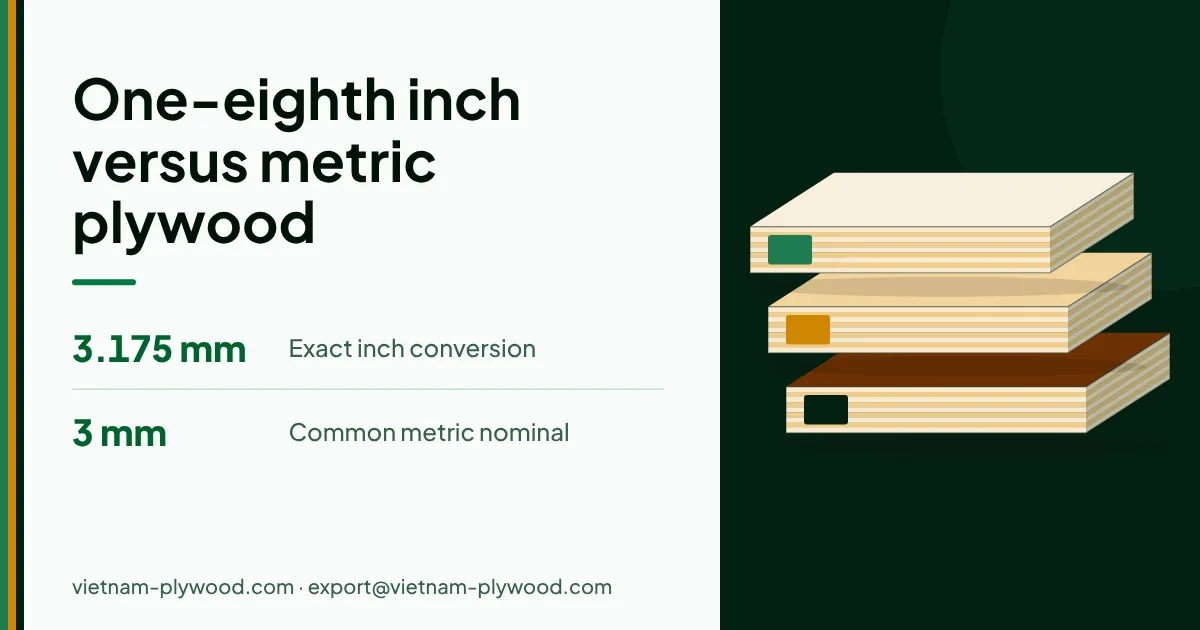
1/8 plywood means 3.175 mm by exact conversion, while a 3 mm metric panel is the closest common HCPLY nominal sheet. A vague inch-only order can cost a cabinet maker rejected panels, rework and lost production days. Specify the finished metric target and its tolerance before pressing.
How thick is 1/8 plywood in millimeters?
1/8 plywood is nominally 3.175 mm thick: one inch is exactly 25.4 mm, and dividing that by eight gives 3.175 mm. A purchase order that says only “1/8 inch” leaves the finished thickness and acceptance range open to interpretation. HCPLY recommends writing the required metric nominal thickness and its tolerance together.
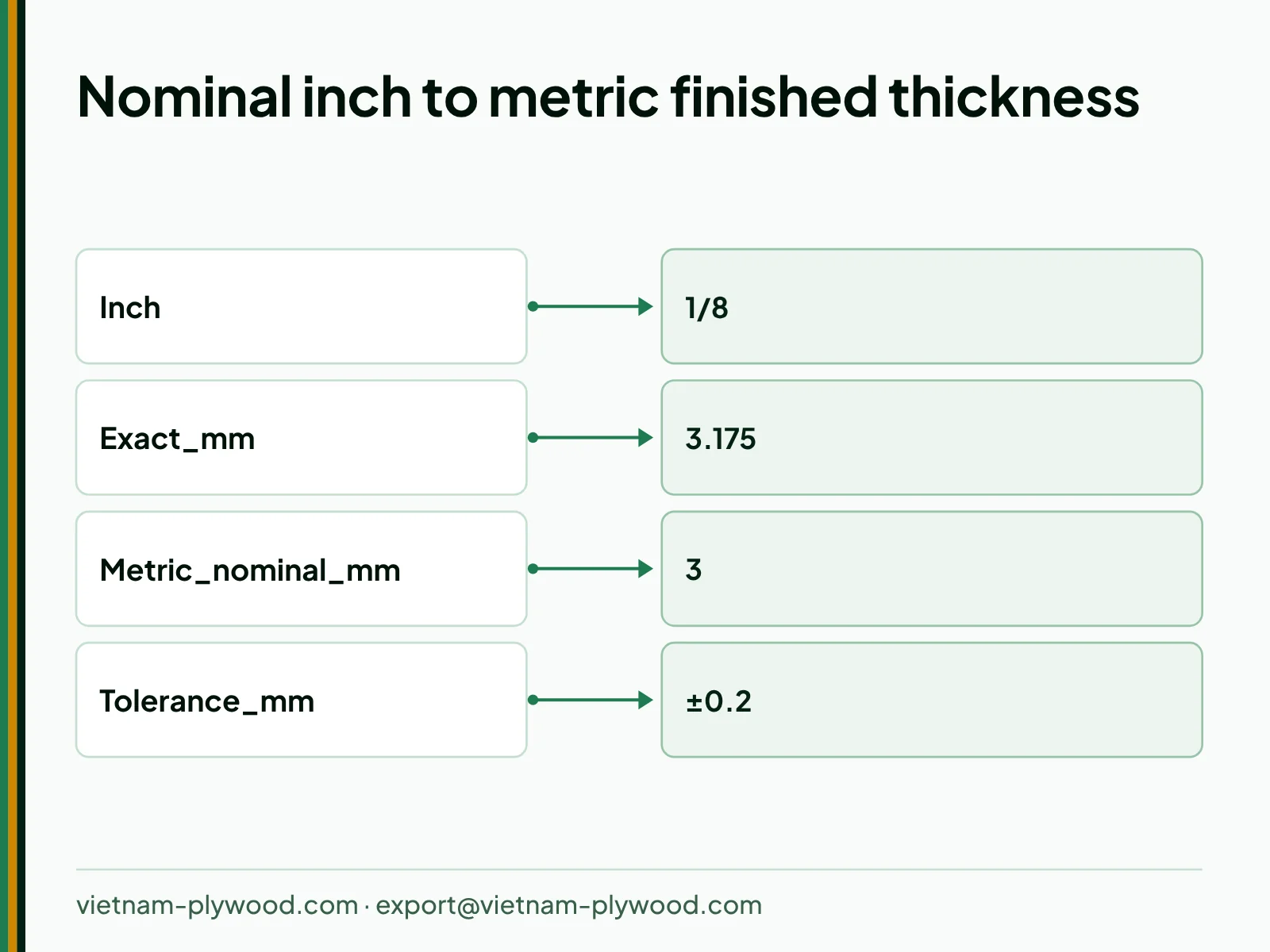
The US National Institute of Standards and Technology (NIST) explains in its SI Units – Length reference, describing the 1959 definition, that an inch equals exactly 25.4 mm. NIST’s official length reference establishes the conversion; it does not establish a plywood manufacturing tolerance.
A nominal imperial label, a metric manufacturing target and a measured finished sheet are different fields. For example, a 3 mm nominal sanded panel ordered at ±0.2 mm has a specified acceptance band of 2.8–3.2 mm. A 3.175 mm exact conversion cannot silently replace that band.
Which metric sheet answers a 1/8 inch order?
A 3 mm nominal sheet is the closest common HCPLY thickness to 1/8 inch. The exact conversion is 3.175 mm, so the buyer must decide whether 3 mm nominal satisfies the assembly drawing. Do not assume that a nominal 1/8th plywood label requires a measured 3.175 mm panel.
Some import catalogs describe approximately 2.7 mm sheets as 1/8in plywood. A 2.7 mm finished target falls outside a 3 mm ±0.2 mm acceptance band. HCPLY’s stated range starts at 3 mm; a 2.7 mm order requires a separate written feasibility decision rather than being represented as standard production.
For comparison, 3 mm plywood is the closest standard specification, while 5 mm plywood and 6 mm plywood address applications needing a thicker panel. Record whether the drawing controls the nominal dimension, the minimum measured thickness, or the final fitted clearance.
What changes between nominal and finished thickness?
Finished thickness is the dimension the receiving inspector measures after pressing and sanding. On our furniture line, the ordered sanded tolerance is ±0.2 mm or ±0.3 mm. These are alternative contract selections, rather than two allowances that apply simultaneously.
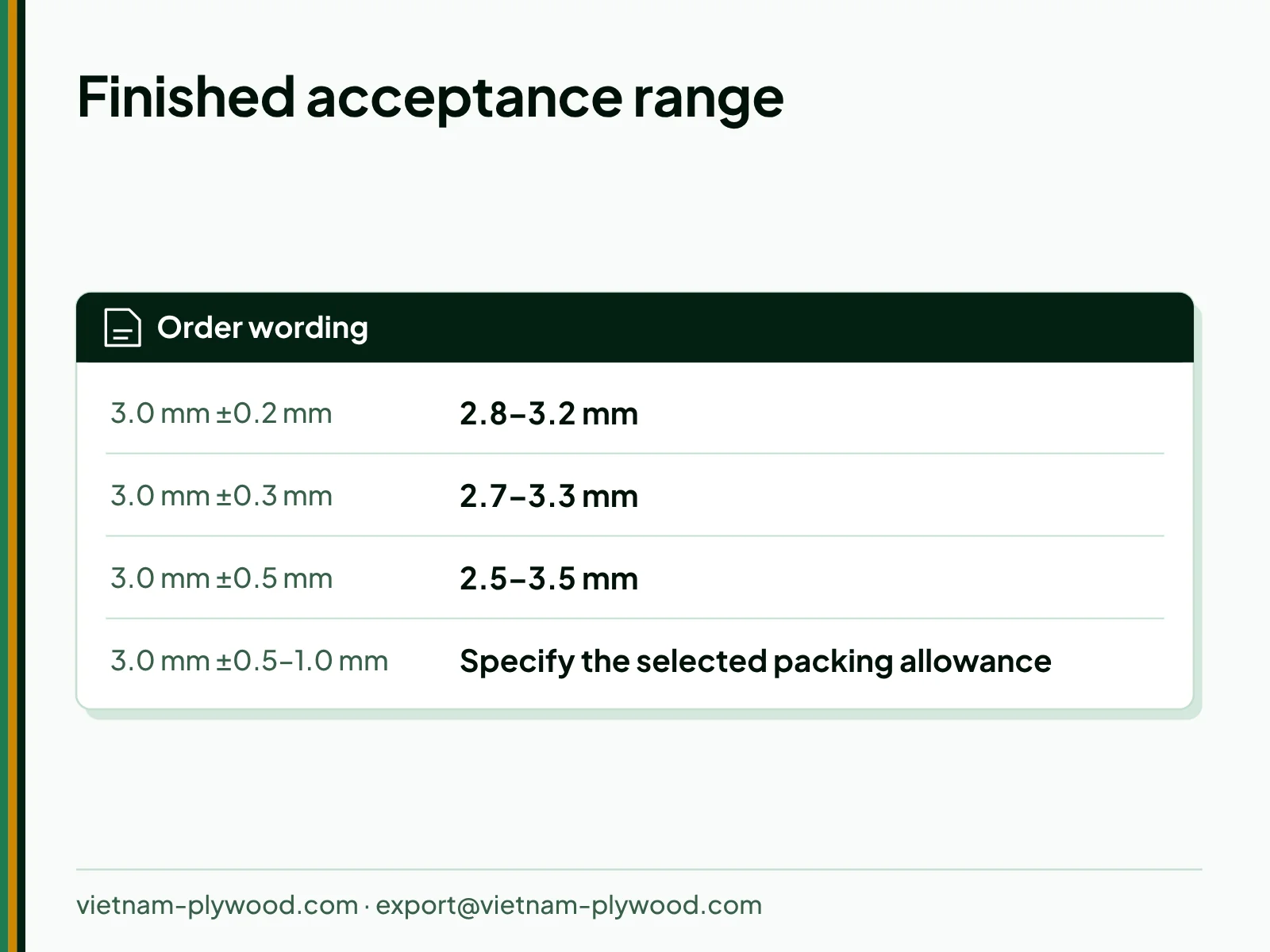
| Order wording | Finished acceptance range | Buying verdict |
|---|---|---|
| 3.0 mm ±0.2 mm | 2.8–3.2 mm | Use when cabinet fit requires the tighter furniture tolerance |
| 3.0 mm ±0.3 mm | 2.7–3.3 mm | Use when the drawing permits the wider furniture tolerance |
| 3.0 mm ±0.5 mm | 2.5–3.5 mm | Commercial or film-faced tolerance, not the first choice for precise inserts |
| 3.0 mm ±0.5–1.0 mm | Specify the selected packing allowance | Packing use needs its own acceptance wording |
The 2.7 mm lower boundary in the second row is an allowed measured limit for that contract, not a promise to manufacture a separate 2.7 mm nominal product. Write one tolerance on the purchase order and repeat it on the inspection sheet.
What is 1/8 inch plywood used for?
Thin plywood at this nominal thickness is used for non-load-bearing cabinet backs, decorative furniture inserts, fitted interior panels and light lining where the support arrangement controls deflection. It is particularly useful when a panel must sit in a groove or behind a frame without adding much depth.
The buyer should specify the unsupported span, fixing method, surface appearance and any downstream coating before selecting a sheet. A 3 mm insert supported on its perimeter has a different duty from a free-spanning shelf. The latter calls for a separate thickness and load assessment, often involving a thicker panel.
For cabinet-back construction choices, see wardrobe back panel options. A face veneer can be selected for visible appearance, while the core selection determines the stated density. A laminated appearance does not itself describe a stronger core or a moisture-resistant bond.
Which factory line presses this thin sheet?
Our furniture line is the relevant route for sanded, appearance-sensitive 3 mm sheets with styrax or eucalyptus core, full stitched construction and E0 or E1 emission specification. HCPLY directs each order to the producing factory that matches the written build.
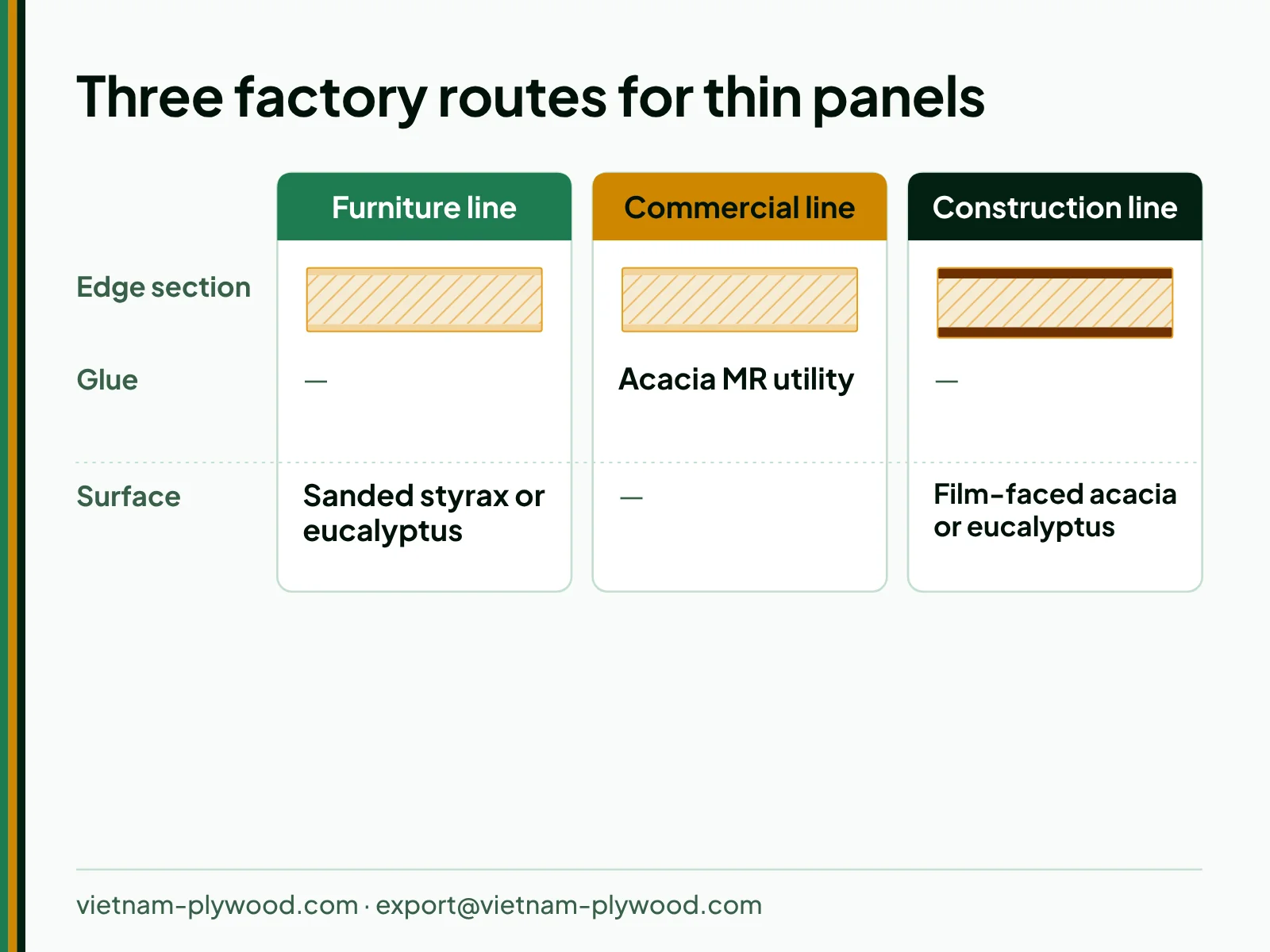
| Factory route | Core and surface | Tolerance | Suitable buying decision |
|---|---|---|---|
| Furniture | Styrax or eucalyptus, full stitched, sanded veneer face | ±0.2 or ±0.3 mm as ordered | Cabinet backs and visible fitted inserts |
| Commercial and packing | Acacia, unsanded or light-sanded, moisture-resistant glue | ±0.5 mm commercial; ±0.5–1.0 mm packing | Protective sheets and packing components |
| Construction | Acacia or eucalyptus, phenolic or melamine film, unsanded | ±0.5 mm | Formwork specifications rather than fine cabinet fitting |
Our commercial and packing line addresses a different finish and fit requirement. Our construction line addresses a film surface and site handling. Compare the three factory-line builds before substituting one route for another.
Can 1/8 inch plywood be supplied as 4x8 sheets?
Yes. The 1220 × 2440 mm panel is the standard metric format used for a nominal 4x8 plywood order. Write the metric dimensions on the purchase order because a literal 48 × 96 inch rectangle converts to 1219.2 × 2438.4 mm, rather than exactly 1220 × 2440 mm.
HCPLY also lists 1250 × 2500, 1220 × 2135, 1220 × 1830, 915 × 2440, 915 × 2135 and 915 × 1830 mm. Length and width tolerance is ±2 mm. Custom cutting is available for agreed dimensions.
A buyer asking for a 1/8 inch plywood 4x8 sheet should specify whether downstream equipment accepts 1220 × 2440 mm, and whether grain direction or face orientation matters. The exact size belongs on both the order and packing list.
How does core choice affect sheet weight and loading?
For 3 mm sheets measuring 1220 × 2440 mm, the core determines the reference sheet weight. Styrax is 500 kg/m³, acacia 580 kg/m³ and eucalyptus 650 kg/m³; the face species does not change the named core density.
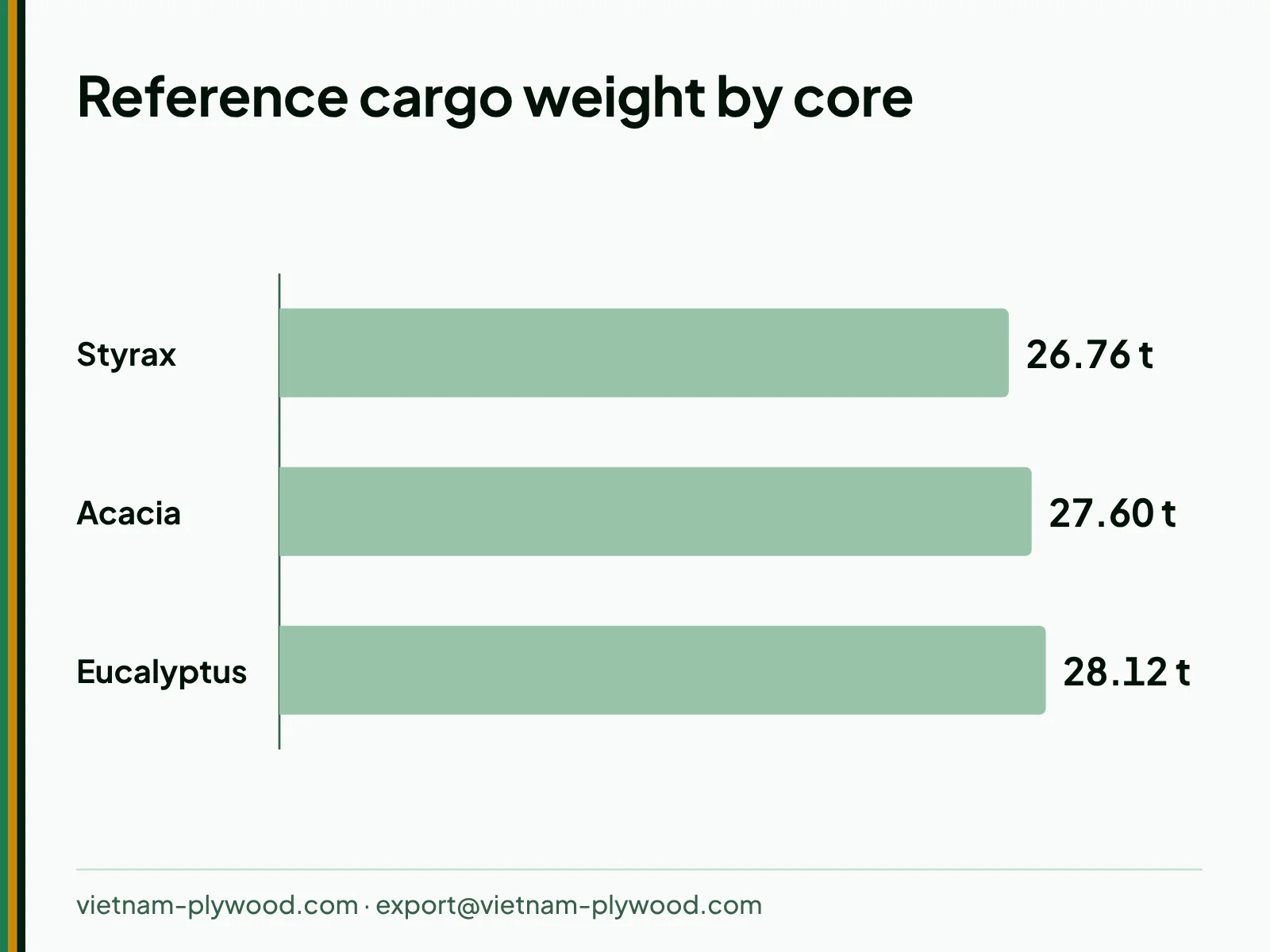
| Core | Reference sheet weight | Full 40HC reference | Reference cargo weight |
|---|---|---|---|
| Styrax | 4.47 kg | 5,994 sheets | 26.76 t |
| Acacia | 5.18 kg | 5,328 sheets | 27.60 t |
| Eucalyptus | 5.80 kg | 4,845 sheets | 28.12 t |
These are full-container reference configurations for 3 mm, 1220 × 2440 mm sheets; they exclude packaging and any film weight. A 40HC payload limit is 28.5 t. Mixed specifications can share a container when the combined load remains within that limit, so an importer can pair thin furniture sheets with another approved build after checking the loading plan.
The final sheet and pallet counts belong in the container loading calculation. Avoid using a full-container reference count as the guaranteed count for a mixed order.
How should the thickness be written on the order?
Write the nominal thickness in millimeters, the finished-sheet tolerance and the inspection method in the same specification. Then place the imperial label in parentheses as a commercial description, not as the governing measurement.
- State the intended application and the measured slot or clearance in the assembly drawing.
- Choose a nominal metric target, such as 3.0 mm, and one permitted tolerance, such as ±0.2 mm.
- Identify the furniture route, core, face grade, sanding and emission class separately.
- Specify 1220 × 2440 mm or the agreed cut size, with the permitted length and width tolerance.
- Approve a sample against the drawing before repeating the exact wording on the purchase order and inspection checklist.
For example, “3.0 mm finished sanded plywood, ±0.2 mm; marketed as nominal 1/8 inch” is clearer than “1/8 4x8 plywood.” A request for 1/8 laminated plywood should identify whether “laminated” means a decorative face, a bonded veneer construction or a downstream surface treatment. Melamine paper, high-pressure laminate and other laminate finishes are distinct topics, not HCPLY product lines.
What can an inspector witness at the producing factory?
The inspector can witness finished-sheet thickness measurements at agreed panel locations and compare the readings with the written acceptance band. At the producing factory, buyers can inspect the goods and meet at the factory office.
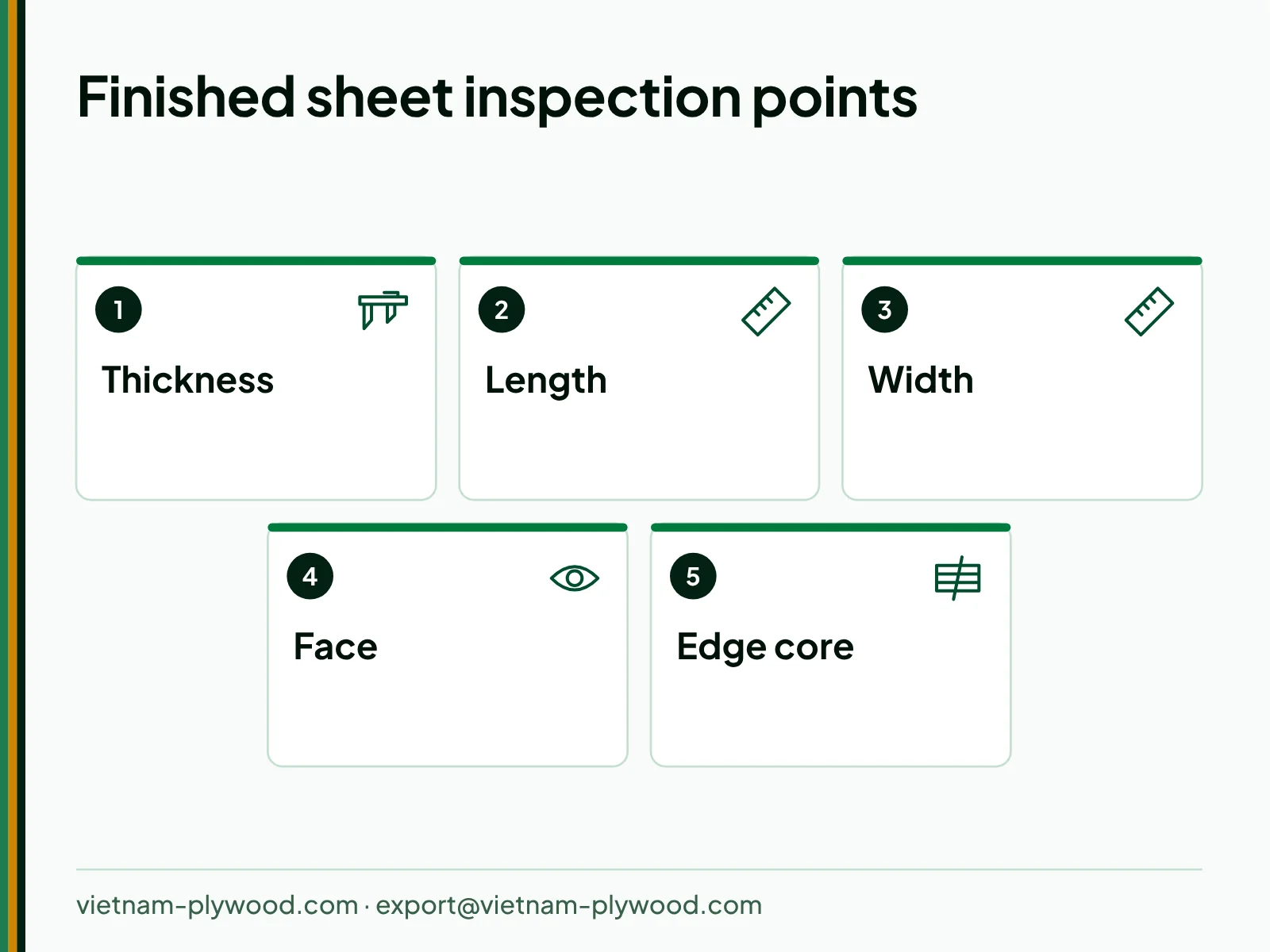
For a sanded furniture sheet, the inspection plan should also cover face grade, visible veneer defects, panel dimensions, core construction at a representative exposed edge and packing identification. A/B are the usual face-grade choices for the listed decorative veneers; birch face grades are D/E/F. The common face veneer thickness is 0.2–0.4 mm.
Agree the sampling locations, instrument and rejection rule before production. A reading within the accepted range should be assessed against the actual contract, not against an unstated retail convention. If an emission certificate or agreed test report is required, identify it by the ordered build.
Which glue and emission fields belong on the sheet?
Glue type and emission class must be separate fields. For a furniture order, E0 or E1 describes the requested emission class; it is not the name of an adhesive. The buyer should write the glue requirement independently from the emission target.
HCPLY’s listed bonding options include melamine moisture-resistant (MR) glue with a 12-hour boil description and phenolic weather-and-boil-proof (WBP) glue with a 72-hour boil description. These process descriptions do not turn a thin furniture panel into a structural or marine-rated product.
For US regulatory requirements, CARB P2 and TSCA Title VI concern emission limits with third-party certification. Member-factory certificate details can be shown with factory details masked, on request. The selected certificate and test-report requirement must match the agreed build.
What should be checked before export?
The commercial invoice and packing list identify the ordered dimensions and quantities, while the bill of lading records the shipment. HCPLY coordinates the specification, on-site quality control, export paperwork and loading from the producing factory, FOB Hai Phong.
The shipment document package includes a certificate of origin, phytosanitary and fumigation papers, plus the certificate documents agreed for the order. For European Union lots, it includes EUR.1 and the EUTR/EUDR file set; insurance is included under CIF. Draft shipping documents are sent for buyer approval after loading.
The minimum order is one 40HC, with mixed specifications within its payload limit. Factory lead time runs 15–45 days from receipt of the 30% deposit; the exact figure depends on order size, line loading and what the contract fixes. The balance is 70% against the scanned bill of lading, by telegraphic transfer or irrevocable letter of credit at sight. We ship FOB Hai Phong, or CFR (CNF) or CIF to your port; see production lead time.
What specification should a buyer send?
Send one written metric specification that identifies the application, finished thickness and acceptance tolerance. For furniture plywood, the indicative starting price is from US$350/m³ FOB Hai Phong (October 2026); the final quotation follows the face, core, tolerance, size and quantity selected.
A tighter sanded tolerance and higher face appearance requirement add processing and selection work compared with a looser, utility-grade sheet. Different core densities also change freight weight. Free samples are available; a first-time buyer pays the courier, and that charge comes off the first confirmed order.
Application: Cabinet back / fitted interior insert
Factory line / core: Furniture / styrax core, full stitched
Glue: Specify required bonding option
Emission: E1
Face and grade: Okoume, A/B; sanded
Finished thickness: 3.0 mm ±0.2 mm (nominal 1/8 inch)
Size: 1220 × 2440 mm; length/width ±2 mm
Quantity: One 40HC, final mix and load plan to be agreed
Destination port: [enter port]
Ask Lucy at contact or export@vietnam-plywood.com for a sample set against this specification.