





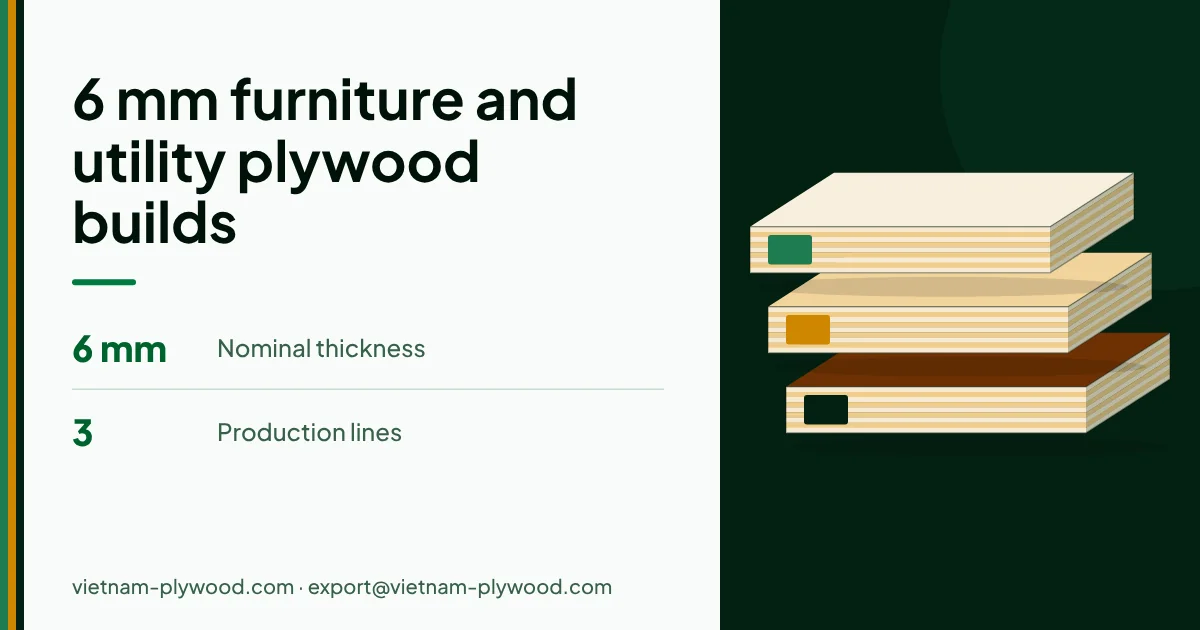
HCPLY makes 6mm ply as a sanded furniture panel or a utility-grade commercial panel, with distinct cores, finishes and tolerances. Choosing the wrong line can mean rejected cabinet components, extra machining and delayed assembly. Six millimetres describes thickness; the full build determines whether the sheet fits the job.
Which 6 mm sizes and factory builds can be specified?
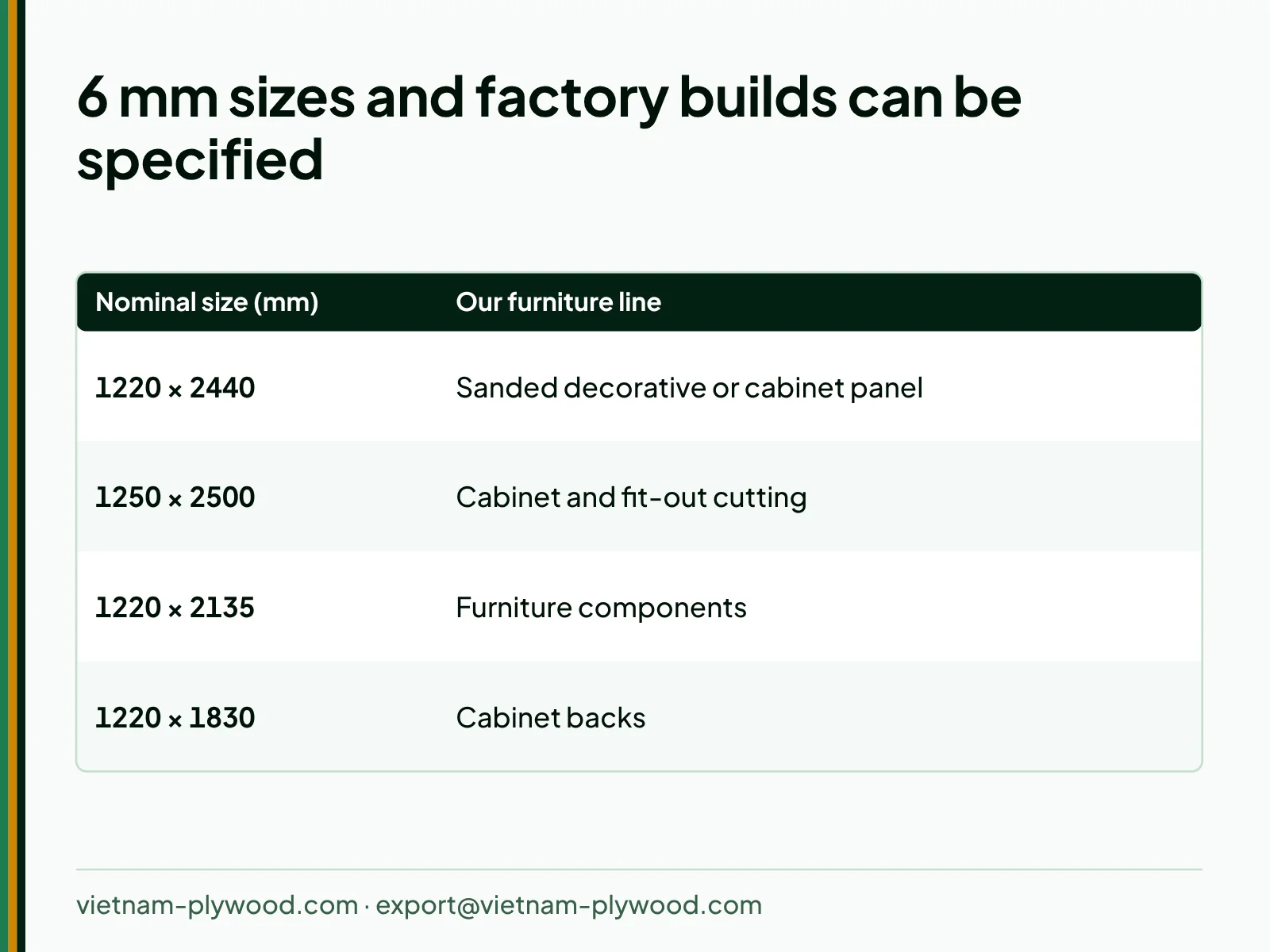
The standard 6 mm sheet formats span cabinet components, distributor stock and utility cutting plans. HCPLY offers the listed sizes across the applicable production specifications, with custom cutting available. A nominal 6 mm thickness alone does not identify the panel construction.
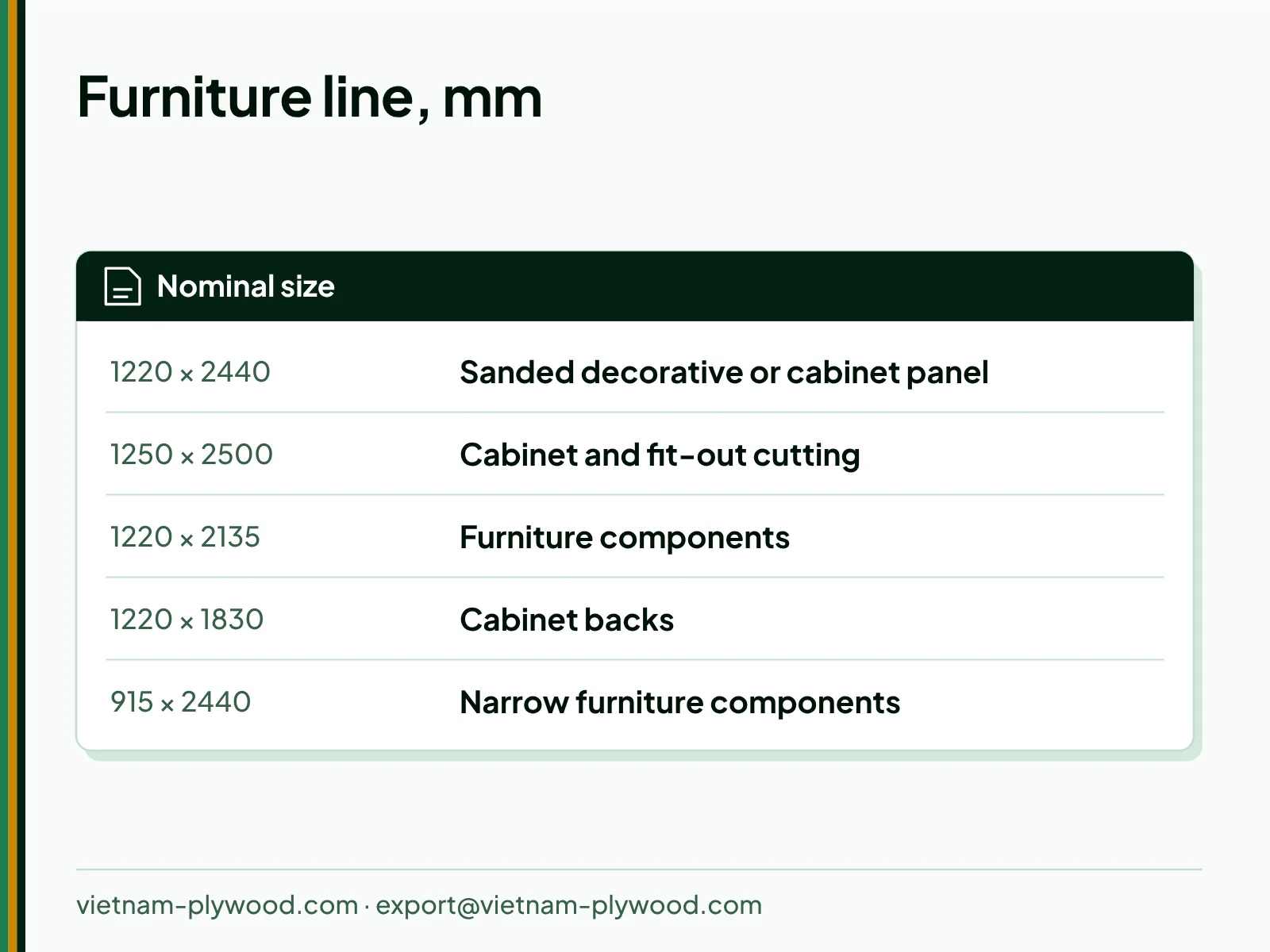
| Nominal size (mm) | Our furniture line | Our commercial and packing line | Our construction line |
|---|---|---|---|
| 1220 × 2440 | Sanded decorative or cabinet panel | Utility or packing panel | Film-faced panel against an agreed build |
| 1250 × 2500 | Cabinet and fit-out cutting | General utility cutting | Film-faced cutting |
| 1220 × 2135 | Furniture components | Utility components | Film-faced components |
| 1220 × 1830 | Cabinet backs | Packing components | Film-faced components |
| 915 × 2440 | Narrow furniture components | Narrow utility panels | Film-faced panels |
| 915 × 2135 | Narrow furniture components | Packing panels | Film-faced panels |
| 915 × 1830 | Small cabinet components | Small utility components | Film-faced panels |
Length and width tolerance is ±2 mm. Furniture sanding tolerance is ±0.2 or ±0.3 mm as ordered; commercial and film-faced tolerance is ±0.5 mm, while packing allows ±0.5–1.0 mm. A buyer specifying a tight groove fit should state the tighter furniture tolerance in the purchase order. See the thin plywood supplier range for adjacent thickness decisions.
The available overall thickness range is 3–40 mm, with common production points at 3, 5, 9, 12, 15, 18, 21 and 25 mm. Six millimetres is a specific requested thickness within that range. For alternative gauges, compare 3 mm plywood, 4 mm plywood and 5 mm plywood before freezing the cutting list.
What is 6mm ply used for?
6mm ply is a thin veneer-built panel used for cabinet backs, drawer bases, decorative inserts and light-duty utility components. Furniture applications favour a sanded, stitched core and a face selected for appearance. Commercial applications prioritise the specified utility finish and practical cutting yield. The attachment method and support spacing must be defined by the furniture or fit-out designer.
For a cabinet back captured in a groove, the first purchasing question is the actual groove clearance. A panel ordered only as “6 mm” could arrive within the wider commercial tolerance and bind during assembly. For an exposed decorative insert, face appearance and consistent sanding matter as much as nominal thickness. Drawer bases require the maker to evaluate span, load and edge support rather than treating thickness as a strength grade.
A thin plywood board can also form a lining, separator or packing component where the buyer accepts the specified finish. Our commercial and packing line is the natural starting point for that application. For furniture back-panel selection and fixing details, consult wardrobe back panel options. Neither application makes a 6 mm sheet a structural panel by itself.
What differs between furniture and commercial 6 mm plywood?
The furniture build prioritises face appearance, stitched veneer construction and controlled sanding; the commercial build prioritises acacia-core utility use. Our construction line is a separate film-faced specification for formwork-related procurement. Each line presses the build suited to its production role.
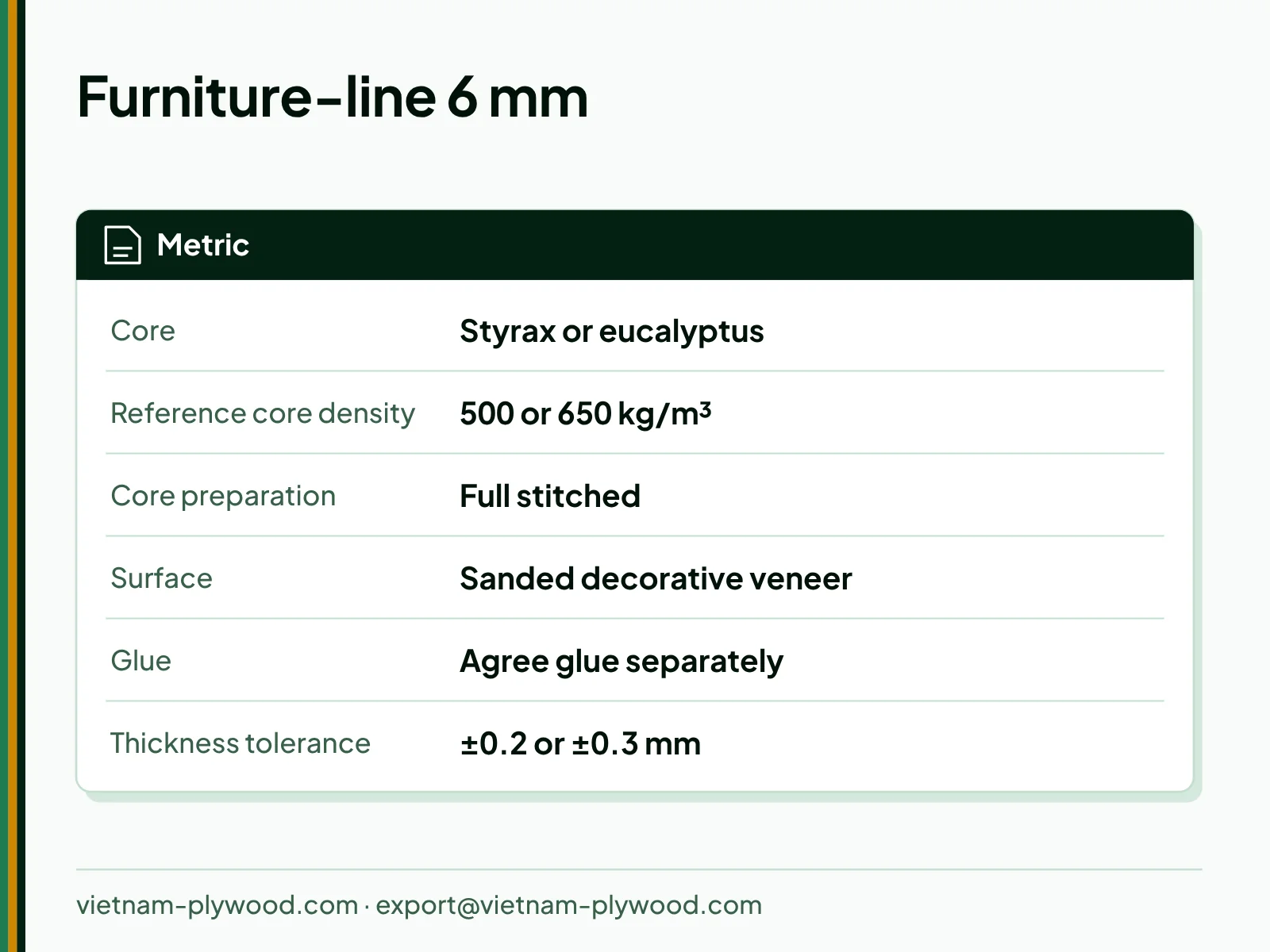
| Metric | Furniture-line 6 mm | Commercial-line 6 mm | Construction-line 6 mm |
|---|---|---|---|
| Core | Styrax or eucalyptus | Acacia | Acacia or eucalyptus |
| Reference core density | 500 or 650 kg/m³ | 580 kg/m³ | 580 or 650 kg/m³ |
| Core preparation | Full stitched | Specify required construction | Specify required construction |
| Surface | Sanded decorative veneer | Unsanded or light-sanded | Phenolic or melamine film, including anti-slip film |
| Glue | Agree glue separately | MR | Phenolic or melamine system |
| Thickness tolerance | ±0.2 or ±0.3 mm | ±0.5 mm | ±0.5 mm |
| Verdict by use | Cabinet backs, drawer bases, visible inserts | Utility linings and packing | Film-faced work where the agreed specification calls for 6 mm |
A furniture maker choosing between 6mm hardwood plywood and a utility panel should first decide whether the face will remain visible. A distributor buying stock should keep the furniture and commercial grades separate in its item codes. Combining them under “plywood sheets 6mm” can conceal sanding, core and emission differences.
The face names the product; the core controls the density reference. A poplar-faced board is therefore not a poplar-core board. That distinction matters in freight planning and in a buyer’s weight-based receiving check.
Which faces and cores are available?
Available face veneers include bintangor, okoume, engineered veneer (EV), gurjan, pine, poplar, eucalyptus, birch and sapele. Common face veneer thickness is 0.2–0.4 mm. Face grade is A/B, except birch faces, which use D/E/F grading. State the desired face and grade explicitly.
The available Vietnamese cores are styrax at 500 kg/m³, acacia at 580 kg/m³ and eucalyptus at 650 kg/m³. Styrax or eucalyptus belongs to our furniture line; acacia belongs to our commercial and packing line. Acacia or eucalyptus can form the construction-line core. Density follows the core rather than the decorative face.
A request for 6mm okoume plywood should therefore identify okoume as the face and choose a furniture-compatible core. The same logic applies to 6mm poplar plywood: poplar identifies the veneer face, while the agreed core determines the weight. For a visible cabinet surface, ask for a physical face sample and grade agreement before approving the order.
The core construction hierarchy runs from full stitched to stitched outer layers with edge-trimmed inner layers, then finger-jointed and loose-laid. The furniture line uses full stitching. A buyer concerned about telegraphing or open joints should describe its acceptance criteria instead of assuming all thin panels share one internal lay-up. We do not press birch-core plywood.
How is 6 mm plywood flatness checked?
Flatness is checked by placing representative sheets on a clean reference surface and inspecting bow, twist and local waviness against the agreed acceptance method. The buyer or third-party inspector can witness this at the producing factory. Record the sampling position and panel condition before taking measurements.
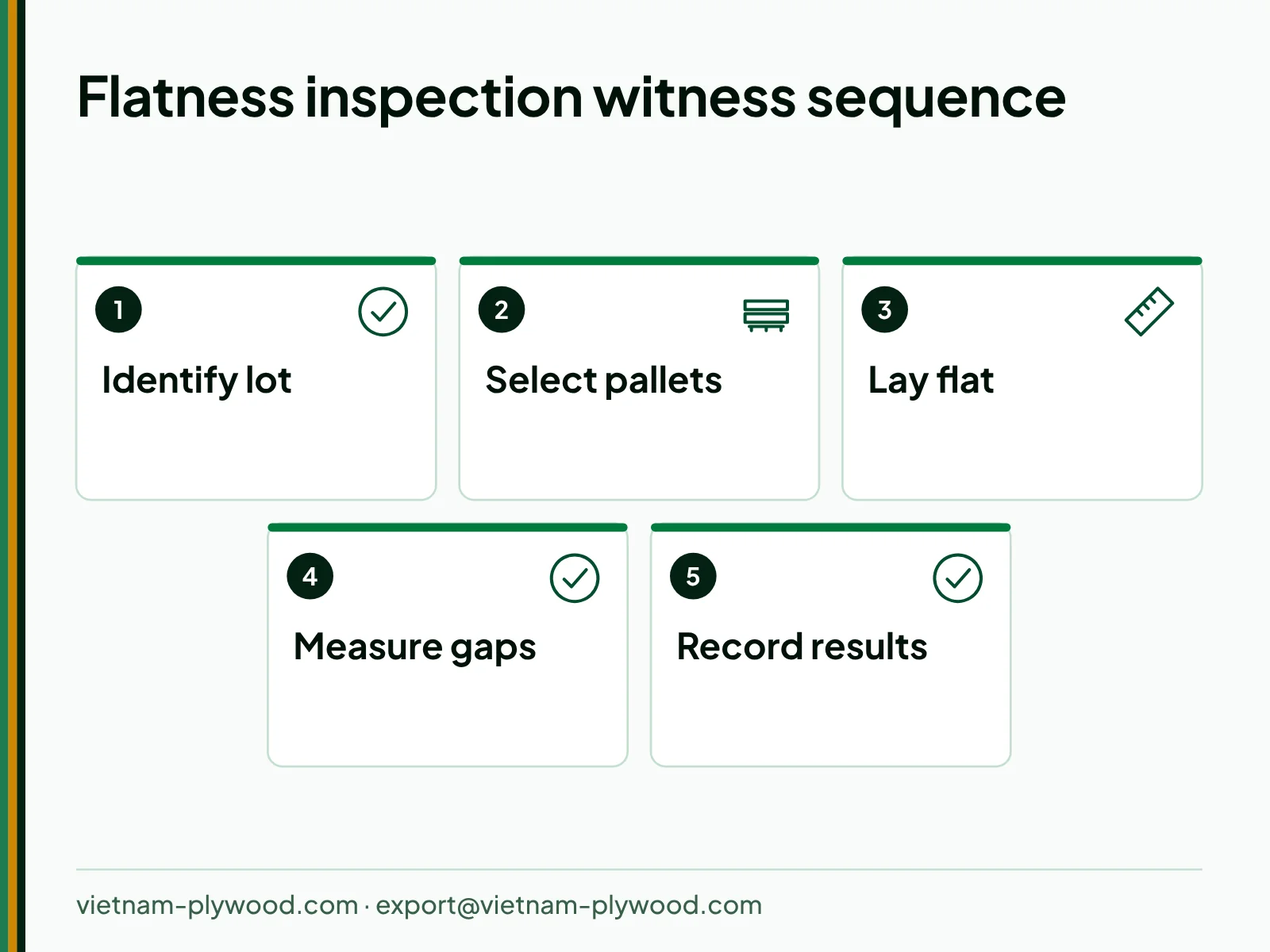
- Identify the lot, face, core, nominal thickness and sanding specification on the inspection record.
- Select sheets from different pallet positions, including upper and lower portions of the stack.
- Place each sheet on a clean, level reference surface without forcing its corners down.
- Observe the sheet edges and corners for bow or twist, and measure gaps using the agreed gauge and locations.
- Check thickness at the specified positions, then inspect both faces for sanding marks, veneer splits and open joints.
- Record readings, photographs and pass/fail decisions against the signed acceptance criteria.
No universal flatness gap limit is supplied for these panels, so the contract must define the measurement method and maximum accepted gap. Thin sheets respond visibly to uneven stacking and local moisture differences. A flatness result without a stated support surface, sheet condition and test position is difficult to reproduce at receiving.
For cabinet backs, trial-fitting a cut sample in the intended groove gives a separate assembly check. It does not replace a recorded panel-level flatness inspection. HCPLY coordinates on-site quality control and the buyer’s inspection visit at the factory office and production location.
Can 6 mm plywood be made with WBP glue?
A phenolic water-boil-proof (WBP) glue specification is available for an agreed construction-line build; it should not be inferred from the 6 mm thickness. Our ordinary commercial build uses moisture-resistant (MR) glue. Glue selection and formaldehyde emission classification are separate purchasing fields.
The stated glue systems are melamine MR with a 12-hour boil reference and phenolic WBP with a 72-hour boil reference. The hot-press ranges are 110–120 °C for MR and 130–145 °C for WBP. These are process specifications, not a declaration that every 6 mm build has passed a buyer’s chosen test protocol.
A buyer asking for “wbp plywood 6mm” should specify phenolic glue, the face or film, core, use conditions and the accepted test report. For film-faced boards, the construction specification also identifies film weight: 120 g/m² standard, 135 g/m² premium or 220 g/m² anti-slip only. Melamine, high-pressure laminate (HPL) and other laminate faces are separate surface topics, not offered product lines here.
Where the buyer uses the term marine or cites BS 1088, acceptance must be against a test report the buyer accepts. A glue label alone does not establish a marine or structural grade. This distinction prevents a purchase order from substituting a broad sales description for an actual performance requirement.
How should emission and documentation requirements be written?
Specify the emission class separately from the glue system, then identify the destination-market evidence required for the agreed build. Furniture panels can be specified as E0 or E1; E2 is also an emission class in the product vocabulary. CARB Phase 2 and Toxic Substances Control Act (TSCA) Title VI are United States regulatory certification requirements, not glue types.
The United States Environmental Protection Agency’s 2025 Code of Federal Regulations, 40 CFR Part 770, defines regulated composite wood products and third-party certification requirements. The official text states: “Composite wood product means hardwood plywood made with a veneer or composite core, medium-density fiberboard, and particleboard.” See the 2025 official regulation.
For a United States furniture-panel order, ask which producing-factory certification and accompanying evidence applies to that exact build. Member-factory FSC, CARB P2, ISO 9001 and CE certificates, along with EUTR/EUDR documents, are shown with factory details masked, on request. Do not replace a lot-specific document request with a generic logo or an emission-class shorthand.
The shipment’s commercial invoice and packing list identify the ordered product and quantities. The bill of lading (B/L) records carriage; a certificate of origin and agreed certificate or test documents accompany the shipment as applicable. EU lots include EUR.1 and the EUTR/EUDR file set. After loading, the draft shipping documents come to you for approval.
How many 6 mm sheets fit in a 40HC?
For 1220 × 2440 mm sheets at 6 mm, the reference full-container quantities are 2,988 styrax, 2,656 acacia or 2,415 eucalyptus sheets. These are core-density calculations excluding film weight. The 40HC payload limit is 28.5 t, so a mixed specification must be checked by total weight rather than sheet count alone.
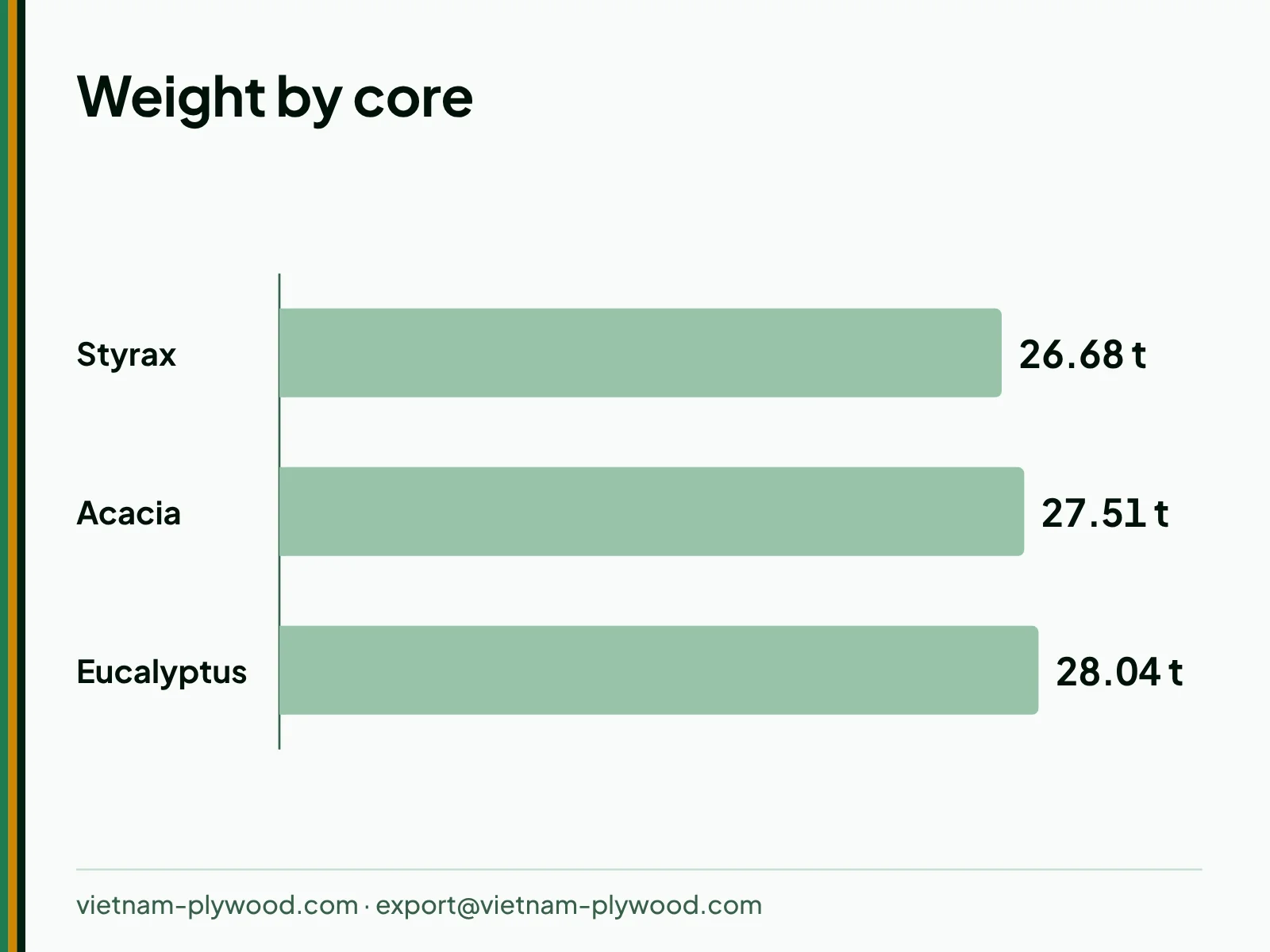
| Core | Sheet weight | Sheets per pallet | Pallets | Full 40HC sheets | Volume | Weight |
|---|---|---|---|---|---|---|
| Styrax | 8.93 kg | 166 | 18 | 2,988 | 53.37 m³ | 26.68 t |
| Acacia | 10.36 kg | 166 | 16 | 2,656 | 47.44 m³ | 27.51 t |
| Eucalyptus | 11.61 kg | 161 | 15 | 2,415 | 43.13 m³ | 28.04 t |
For a mixed-load example, 1,000 styrax sheets weigh 8.93 t and 1,000 acacia sheets weigh 10.36 t, totalling 19.29 t before pallet and other shipment allowances. That arithmetic leaves 9.21 t beneath the stated payload ceiling, but final loading must also account for pallet configuration and actual shipment weights. This demonstrates how a cabinet-back order can share a container with utility panels while retaining distinct specification lines.
The minimum order is one 40HC, and specifications can be mixed within the payload limit. The detailed container calculation and loading topic belongs to container loads and packing. The packing list should distinguish the two cores and their pallet counts for receiving inspection.
How should 6 mm compare with 7 mm and nearby gauges?
Six millimetres is the ordered nominal thickness, while 7mm ply is a different requested gauge and should have its own tolerance agreement. Changing gauge changes groove fit, sheet weight and cutting yield. A cabinet maker should therefore trial the actual panel before approving a replacement thickness.
At 6 mm, a furniture sheet with ±0.2 mm tolerance targets a narrower measured range than commercial plywood with ±0.5 mm tolerance. A nominally similar product from a different line can therefore behave differently in a close-fitting channel. Do not treat a 6 mm nominal label as a promise of identical measured thickness across all grades.
Search descriptions such as “8 x 4 plywood 6mm” usually point to the 1220 × 2440 mm format in this specification. A request written as “6mm hardwood plywood 2400 x 1200” needs its actual cut dimensions stated: the listed standard is 1220 × 2440 mm, with custom cutting available. Agree the finished dimension and ±2 mm length/width tolerance before creating cutting files.
The choice between 5, 6 and 7 mm should follow the assembled product’s clearance and support design. When the drawing calls for 6 mm, replacing it with a thinner sheet solely to reduce mass can affect fit and stiffness. The production team needs the drawing and intended fixing method to quote the correct panel.
What drives the price of a 6 mm build?
A sanded, full-stitched decorative furniture build costs more than an ordinary unsanded commercial utility build because of core preparation, face selection and sanding work. Within furniture specifications, a tighter tolerance and selected face grade add processing and sorting demands. Film type and phenolic glue change the construction-line cost basis.
The practical cost order begins with line and internal construction, then face species and grade, glue system, sanding and thickness tolerance. Sheet format, cutting waste, volume and destination terms also affect the written quotation. There is no universal 6 mm rate across these builds.
A request for a price should include the intended application and full specification rather than only “plywood 6 mm”. A distributor may request separate quotations for furniture and commercial stock at the same nominal size. This preserves a meaningful comparison between the actual goods offered.
Factory lead time runs 15–45 days from receipt of the 30% deposit; the exact figure depends on order size, line loading and what the contract fixes. The remaining 70% is paid on the scan of the bill of lading, by T/T, or by irrevocable sight L/C. We ship FOB Hai Phong, or CFR (CNF) or CIF to your port. See production lead time for the order-planning topic.
What can a buyer inspect at the producing factory?
The buyer can inspect the agreed veneer faces, core preparation, sheet dimensions, sanding and finished-panel flatness at the producing factory. Each order is pressed on the line that matches the specification and shipped directly from that factory. HCPLY manages specification, on-site inspection, documents and loading across our three factories in Phu Tho and Hai Phong.
A useful witness visit starts with the signed order specification, followed by a comparison against labelled work-in-process material. The inspector should look at the core assembly before pressing where production timing permits, then compare finished sheets against the agreed sample. Recording the sheet face, core species and tolerance alongside measurements makes later receiving checks more meaningful.
For a furniture order, focus on full stitching, veneer face consistency, sanding and tight thickness control. For a commercial order, check acacia-core identification, surface finish and the agreed utility-grade acceptance rules. A film-faced order instead requires the correct film type and a separate surface inspection.
Buyers visit the factory office and inspect goods at the producing factory. A pre-shipment report should identify which lots and pallet positions were sampled. Where an outside inspector is engaged, share the agreed acceptance criteria before the visit rather than asking the inspector to invent them on site.
What should the final 6 mm purchase specification contain?
The purchase specification should identify the application, production line, core, glue, emission class, face, grade, tolerance, size, quantity and destination port. These fields let the producing team build the correct board and give the receiving inspector a measurable reference. A single “6mm plywood board” description leaves too many decisions open.
Use separate item lines when buying cabinet backs and commercial utility panels in the same shipment. For the furniture item, record the visible-face requirement and whether the panel fits into a groove. For the commercial item, define the acceptable unsanded or light-sanded surface and the packing or lining purpose.
Samples cost nothing: a first-time buyer pays the courier, and that charge comes off the first confirmed order. Send the specification to Lucy at export@vietnam-plywood.com. The next action is to request the 6 mm specification sheet with the fields below.
Application: cabinet back / drawer base / decorative insert / utility lining
Line or core: furniture—styrax or eucalyptus / commercial—acacia / construction—acacia or eucalyptus
Glue: MR melamine / phenolic WBP as agreed
Emission: E0 / E1 / E2 / destination-market evidence required
Face and grade: species; A/B or birch D/E/F
Thickness and tolerance: 6 mm; ±0.2 / ±0.3 / ±0.5 mm as ordered
Size: 1220 × 2440 mm or specified custom cut
Quantity: sheets and pallet allocation; one 40HC minimum
Destination port: [port name]; FOB Hai Phong / CFR / CIF
Request the spec sheet.