





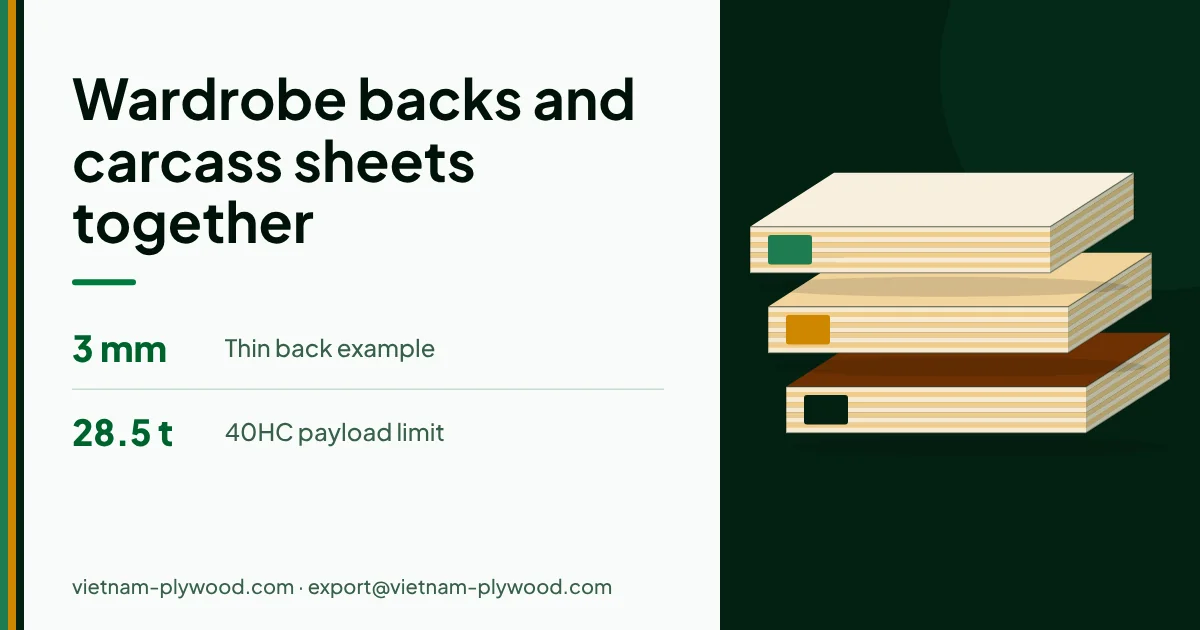
HCPLY presses a wardrobe back panel on our furniture line and can ship thin plywood backs with thicker carcass sheets in one container. A poor thickness or face choice can cause rejected panels, re-machined grooves and extra receiving costs. Start with the back-panel fixing method, then specify the face, thickness, thickness tolerance and a separate flatness acceptance test.
What thickness should a wardrobe back panel use?
A wardrobe back panel can be specified at 3 mm, 5 mm or 6 mm when its edges are captured or adequately supported. The right selection follows the cabinet opening, groove geometry, fixing pattern and handling requirements. A larger unsupported span or a back that contributes to cabinet stiffness needs a separate design review.
A 3 mm panel reduces material mass and leaves more room for the carcass order in the container. A 5 mm panel gives the buyer another option where groove machining or handling makes a thinner sheet less practical. A 6 mm back deserves consideration when the furniture design calls for a stiffer panel, but thickness alone does not establish a load rating.
Our furniture line can press plywood from 3–40 mm, with common thicknesses including 3 mm and 5 mm. For additional thin-panel construction details, see thin plywood supply and the 6 mm plywood specification. Specify the nominal thickness in millimetres rather than ordering by an informal fractional-inch name.
Which face should a wardrobe or cupboard backing board have?
Choose the face according to whether the finished wardrobe exposes the backing board from inside. A visible interior can justify a selected decorative veneer; a fully concealed back can use a simpler agreed face specification.
Our furniture line offers bintangor, okoume, engineered veneer (EV), gurjan, pine, poplar, eucalyptus, birch and sapele faces. Face veneer commonly measures 0.2–0.4 mm. For the named faces other than birch, specify A/B face grades; birch uses D/E/F grades. Do not confuse the face species with the core species or assume that a named face sets the panel density.
High-pressure laminate (HPL) and melamine-faced decorative boards are separate surface systems. They can be discussed when comparing cabinet materials, but HCPLY does not offer HPL or laminate faces as a product line. Likewise, our factories do not press medium-density fibreboard (MDF), oriented strand board (OSB), chipboard or blockboard.
What flatness tolerance belongs on the drawing?
Specify a measured bow and twist limit with the test support, panel orientation and inspection timing. A thickness tolerance cannot substitute for a flatness limit: the former checks the distance between surfaces, while the latter checks panel shape.
Our sanded furniture plywood thickness tolerance is ±0.2 mm or ±0.3 mm as ordered, and the length and width tolerance is ±2 mm. Those values describe dimensional manufacture. They do not establish a numerical bow or twist acceptance threshold for a thin wardrobe backing board.
For flatness, ask the engineering team to define the maximum gap under a straightedge, the straightedge length and the points of measurement. Also define how panels are supported while measuring and whether the test happens after conditioning or directly after unpacking. Without that method, the buyer and producing factory could both report different results for the same sheet.
Which production line makes the back and the carcass?
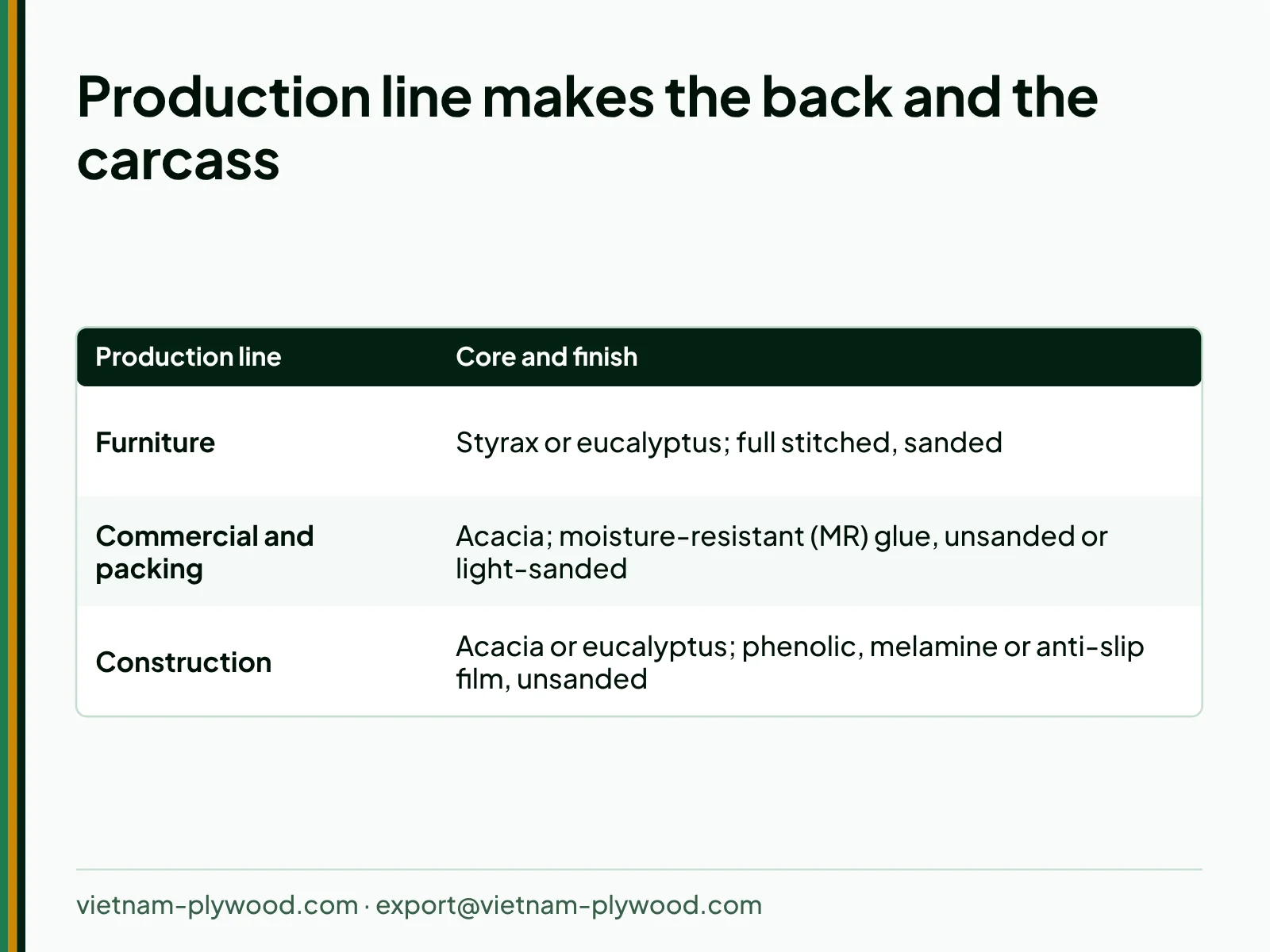
Our furniture line presses the thin wardrobe backs and compatible furniture carcass plywood. Its styrax or eucalyptus cores are full stitched and sanded, with E0 or E1 emission classes specified separately from the glue system.
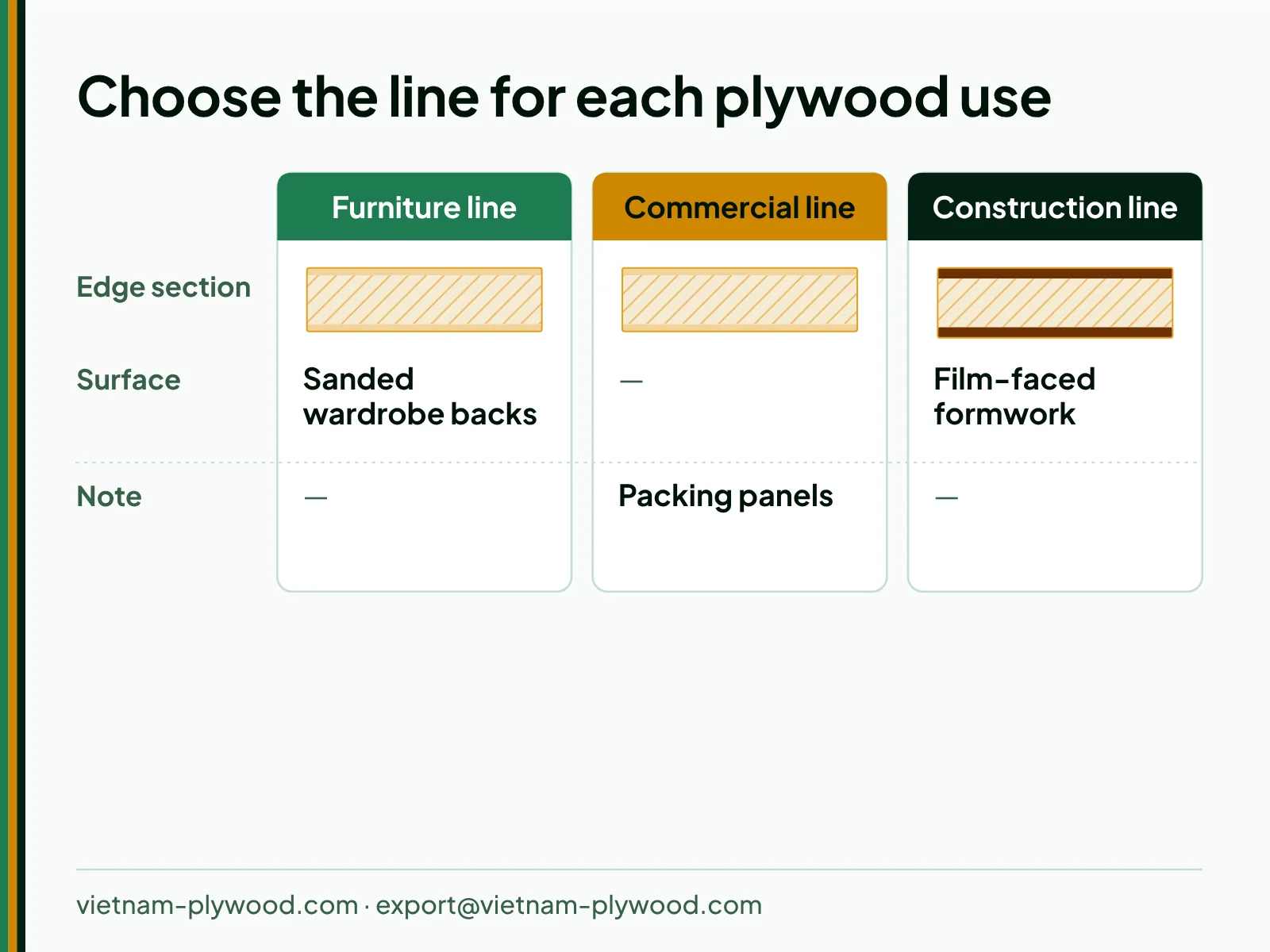
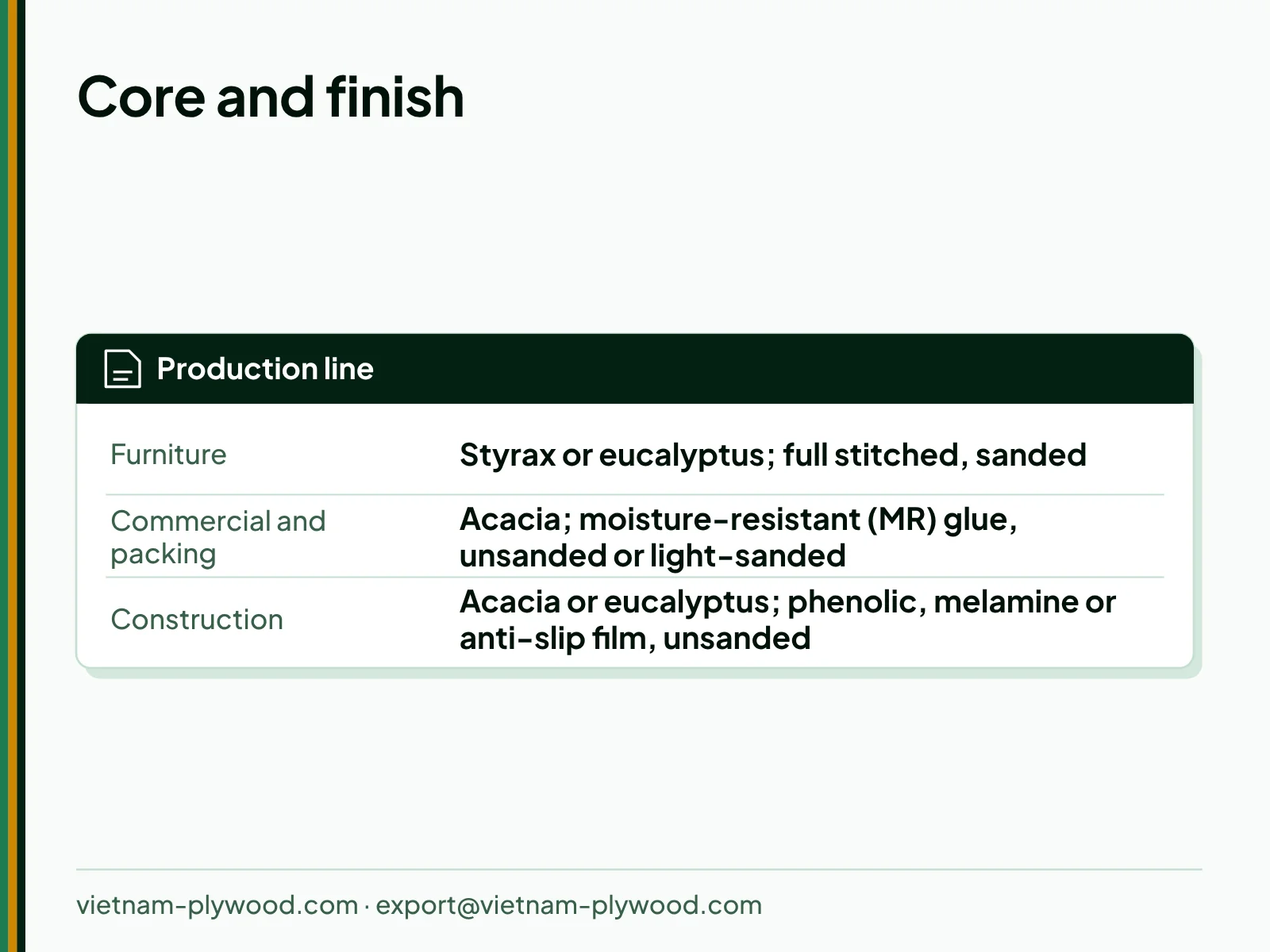
| Production line | Core and finish | Relevant wardrobe decision |
|---|---|---|
| Furniture | Styrax or eucalyptus; full stitched, sanded | Back panels and furniture carcass sheets with controlled thickness |
| Commercial and packing | Acacia; moisture-resistant (MR) glue, unsanded or light-sanded | Packing panels and less appearance-sensitive industrial work, rather than the selected furniture back |
| Construction | Acacia or eucalyptus; phenolic, melamine or anti-slip film, unsanded | Film-faced formwork, rather than an interior wardrobe face |
The distinction matters when two orders share a nominal thickness. A 5 mm panel from a commercial packing specification does not automatically match a sanded 5 mm furniture back in appearance or tolerance. State the application and line on the purchase order so inspection uses the correct acceptance criteria.
HCPLY operates three member factories in Phu Tho and Hai Phong. Each order is produced at the factory matched to its specification and shipped directly from that location. Buyers can visit the factory office and inspect the actual production site.
Can back panels share a container with carcass sheets?
Yes. A mixed order can place thin backs and thicker carcass plywood in one 40HC, provided the loading plan stays within the 28.5 t payload limit. The packing list should identify the thickness, size, core and pallet count for each item.
For 1220 × 2440 mm styrax-core plywood, the reference full-container calculation at 3 mm is 5,994 sheets, 53.53 m³ and 26.76 t. At 18 mm, the reference is 990 sheets, 53.05 m³ and 26.52 t. These are separate full-load examples, not quantities to add together.
A mixed-load plan replaces some thick-sheet pallets with back-panel pallets. The planner then adds the mass and volume of every pallet group, rather than adding two full-container capacities. At 18 mm, one styrax sheet weighs 26.79 kg; at 3 mm, one weighs 4.47 kg. These figures exclude packaging and help explain why the sheet count changes sharply with thickness.
Use the container packing calculator for sheet counts and plywood supply programmes for repeat mixed orders.
Why order plywood backs with the carcass panels?
Ordering both parts together aligns the purchase specification, factory inspection and receiving documentation for a cabinet programme. It also avoids introducing a different board material merely because backing sheets are purchased after the carcass stock arrives.
Local MDF can still be a sensible option where its machining behaviour, finish and local landed cost fit the design. The relevant comparison is the total delivered programme: panel cost, freight allocation, machining changes, rejects, inventory and replacement logistics. A buyer should calculate those items for the actual destination rather than assuming one material always costs less.
Plywood backs have a veneer-based construction that can be specified alongside plywood carcasses. MDF is a fibre-based panel with different machining and edge behaviour. Changing between them can require a fresh groove fit check, fastening trial and finish sample, especially when the original drawing was built around one material.
Put the back and carcass in separate specification rows tied to the same wardrobe model and receiving inspection plan.
How should glue and emission requirements be written?
Write glue and formaldehyde emission class as two independent fields. An E0 or E1 designation concerns emissions; it does not name the adhesive used to bond the veneers.
For plywood, the available glue descriptions include melamine MR with a 12-hour boil specification and phenolic weather-and-boil-proof (WBP) with a 72-hour boil specification. These describe adhesive and boil-test categories, not a wardrobe’s required service environment. Choose the adhesive specification based on the actual exposure conditions and the buyer’s acceptance method.
For US-bound regulated composite wood products, the US Environmental Protection Agency’s 2016 final rule under Toxic Substances Control Act (TSCA) Title VI covers hardwood plywood as well as MDF and particleboard. The EPA rule summary describes third-party certification, labeling and recordkeeping requirements. A US order should identify its applicable certification and documentation requirements explicitly.
Factory certificates including FSC, CARB P2, ISO 9001 and CE, along with EUDR/EUTR documents, are shown with factory details masked, on request. The buyer should request the certificate documents that match the agreed build and destination, rather than treating a glue label as an emissions certificate.
What should an inspector witness at the producing factory?
The inspector should compare the approved back-panel sample and order sheet against the panels being packed. Inspection can cover face appearance, core edges, thickness, dimensions, flatness under the agreed method and pallet identification.
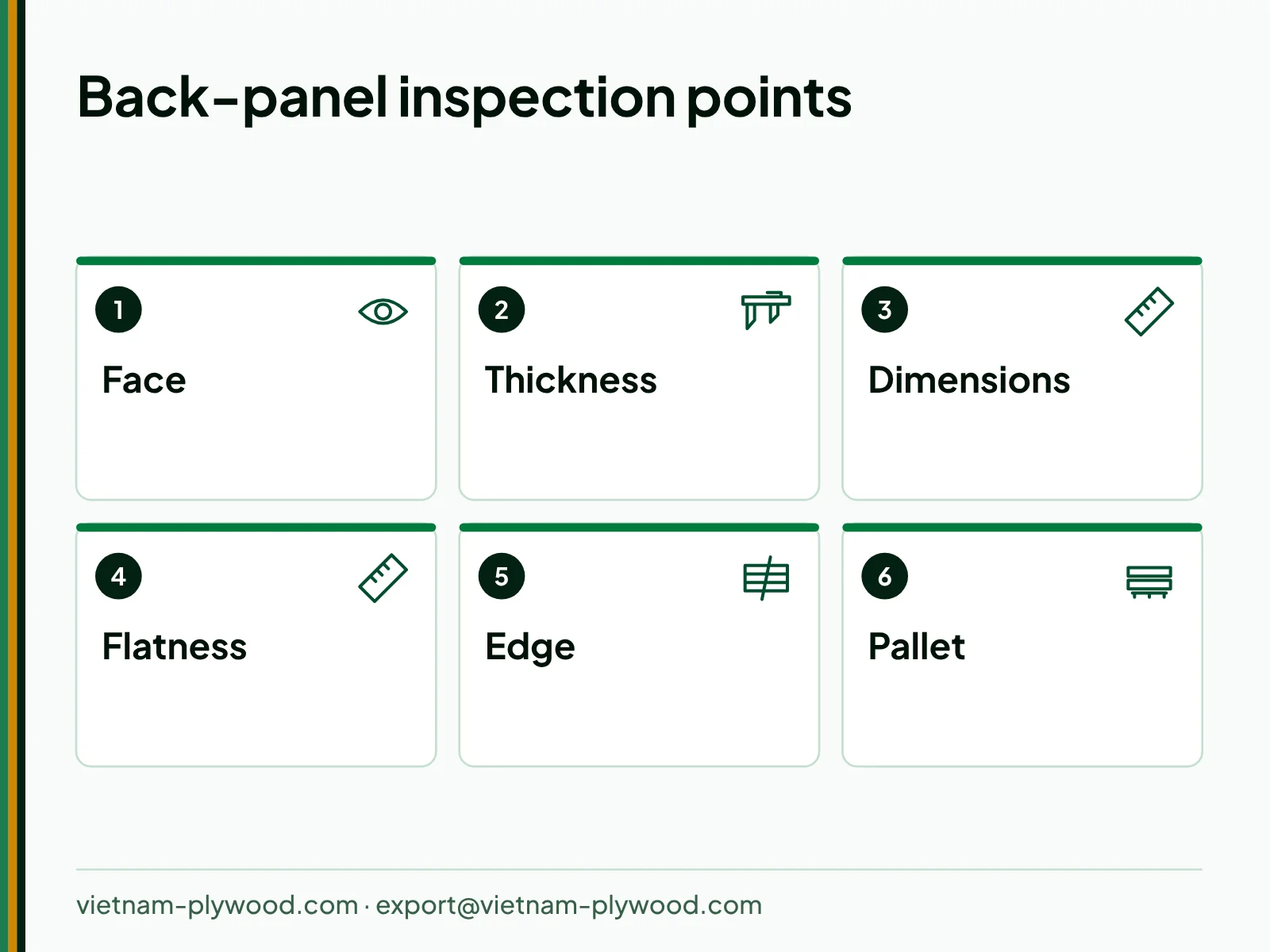
- Select sheets from identified production lots and check the face grade under agreed lighting.
- Measure thickness at agreed positions, recording the selected ±0.2 mm or ±0.3 mm furniture tolerance.
- Check cut length and width against the ±2 mm dimensional tolerance.
- Apply the written straightedge or support method for bow and twist; record measured gaps.
- Inspect exposed edges for construction quality and compare them with the approved sample.
- Match the pallet labels and count to the packing plan for backs and carcass sheets.
The producing factory can show the material in its real packing condition. That is more useful than relying on a loose sample that never went through the same pallet handling. Ask for a joint inspection record that lists any rejected pieces and the agreed disposition before loading.
Which documents identify the mixed shipment?
The packing list identifies the different panel groups, while the commercial invoice records the sale lines and the bill of lading (B/L) records carriage. The shipment document package also includes the certificate of origin, phytosanitary and fumigation papers, and the order’s agreed certificate or test documents.
For European Union lots, the origin document can include EUR.1 and the export package includes the EUTR/EUDR file set. Insurance documents apply under cost, insurance and freight (CIF) terms. After loading, the draft shipping documents come to you for approval.
HCPLY handles specification, on-site quality control, documentation and loading through the export process. The buyer should match the back-panel and carcass line descriptions on the invoice and packing list to the purchase order before approving the drafts.
How do size, cutting and assembly change the order?
Order the back to suit the factory’s cutting plan, then state whether the shipment contains full sheets or custom-cut blanks. Available sheet sizes include 1220 × 2440, 1250 × 2500, 1220 × 2135, 1220 × 1830, 915 × 2440, 915 × 2135 and 915 × 1830 mm. Custom cutting is available.
The furniture maker should compare full-sheet yield with its cabinet models and nesting plan. A narrow back might produce more waste from one stock format than another, even when both formats have the same nominal thickness. For adjacent thickness decisions, review 4 mm plywood and the 3–6 mm UK plywood discussion.
If a design includes a curved cabinet rear, treat that as a separate construction decision rather than assuming a standard back will bend safely. The bendable plywood guide covers that distinct application. A conventional wardrobe back should be assessed in its intended installed geometry.
What drives the quoted cost of the back panel?
Face selection, core construction, sanding and tolerance usually deserve attention before minor packing adjustments. A selected decorative face costs more to produce than a less demanding concealed face because veneer appearance and selection require tighter control. Full-stitched, sanded furniture construction also carries more processing than a basic loose-laid packing build.
Thickness and sheet size then affect material use, sheet yield and shipping density. A tight ordered thickness tolerance adds inspection and process demands. Mixing backs with carcass sheets changes the pallet plan and freight allocation, so quote both line items together against the same destination.
For furniture plywood, the indicative starting point is from US$350/m³ FOB Hai Phong (October 2026). This is a starting figure for furniture plywood, not a specific price for a finished wardrobe back-panel specification. Send the face, thickness, flatness method, size and quantity for a quotation against the agreed build.
What specification should a cabinet buyer send?
Send a written back-panel specification alongside the carcass sheet schedule, with a drawing that identifies the installation method. The minimum order is one 40HC, and specifications can be mixed within the payload limit. Production takes 15–45 days from the 30% deposit, set by order size, line loading and the contract; the 70% balance is against the scanned B/L by T/T or irrevocable letter of credit at sight.
Available delivery terms are FOB Hai Phong, cost and freight (CFR/CNF), or CIF. Samples are free; a first-time buyer pays the courier, and that charge comes off the first confirmed order. For an industrial backing application outside the furniture finish requirement, compare the commercial and packing plywood range.
A usable request separates measurable properties from descriptive preferences. State the flatness test as a buyer-defined acceptance method and attach the cabinet groove drawing. A written schedule also lets the producing factory mark each pallet against the correct cabinet model.
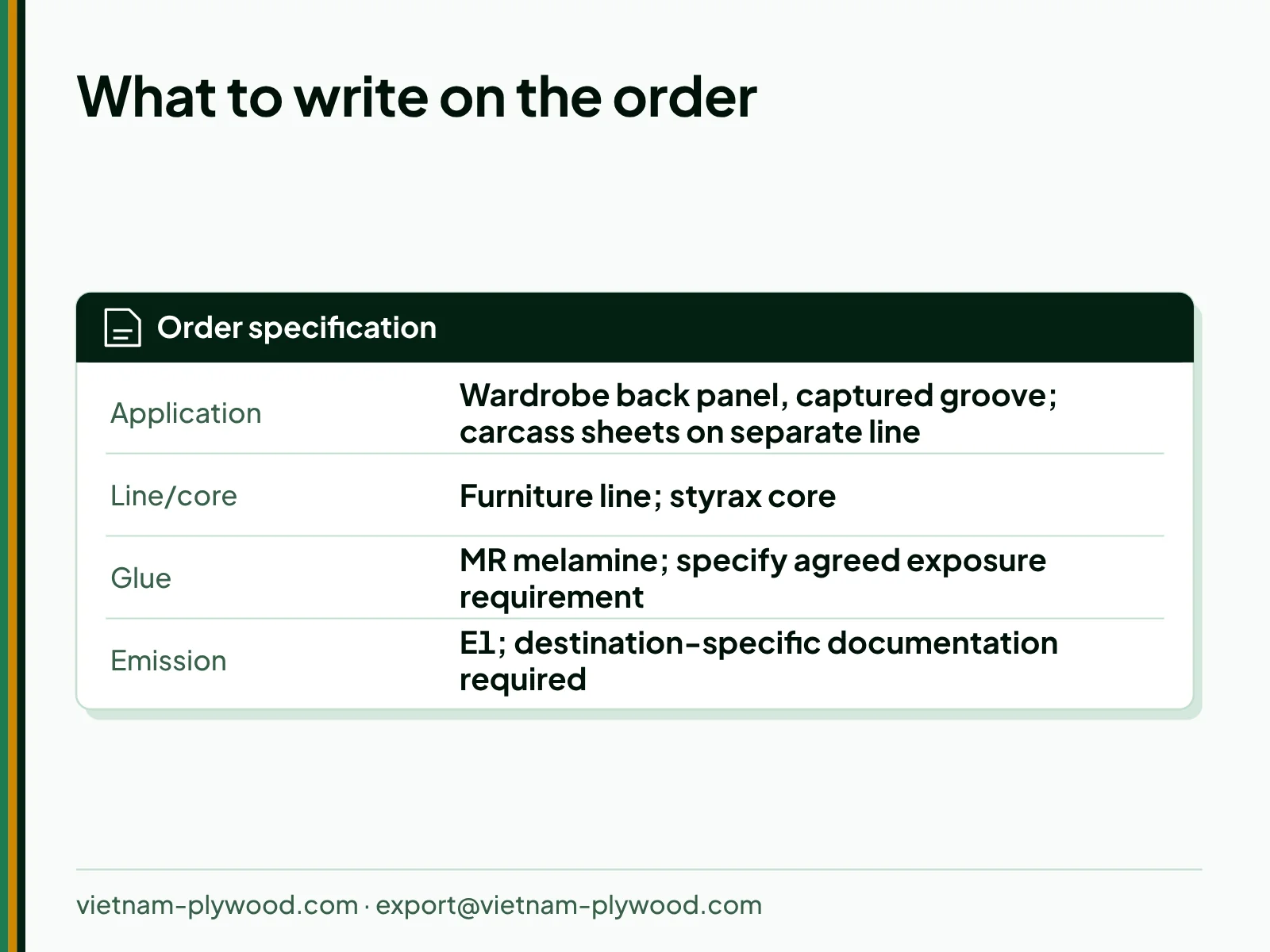
Application: wardrobe back panel, captured groove; carcass sheets on separate line
Line/core: furniture line; styrax core
Glue: MR melamine; specify agreed exposure requirement
Emission: E1; destination-specific documentation required
Face and grade: bintangor A/B; approved appearance sample
Thickness and tolerance: 3 mm; sanded ±0.2 mm
Flatness: buyer drawing defines bow/twist limit and measurement method
Size: 1220 × 2440 mm; custom cuts listed separately
Quantity: back-panel sheets and carcass sheets by thickness and pallet
Destination port: [buyer to enter]
Next step: book a producing-factory visit with Lucy to inspect the back-panel build and packing arrangement before shipment.