





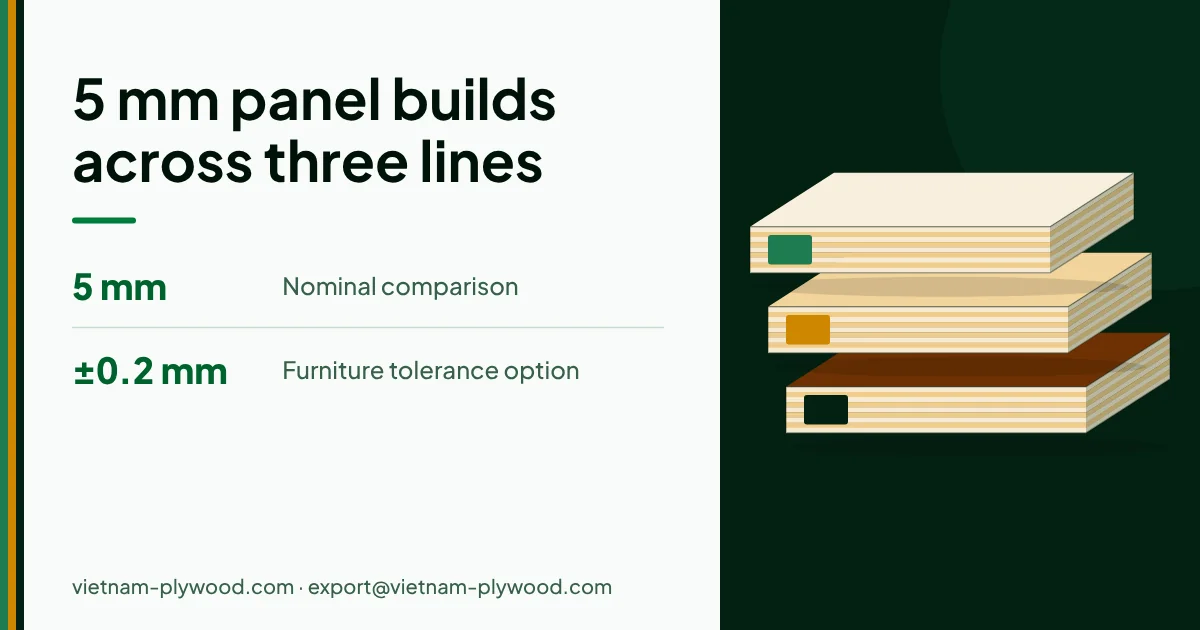
A plywood 5 mm build for cabinet backs and furniture skins is defined by face, core, thickness tolerance and flatness requirements. Choosing a utility sheet for a precision furniture groove can waste machining time and cause a rejected load. HCPLY compares the sanded furniture build with a commercial utility alternative and a film-faced construction build so buyers can specify the right panel.
Which sizes and thicknesses can buyers specify?
A plywood 5 mm order starts with the finished thickness, panel dimensions and intended assembly. HCPLY can build 5 mm panels on different lines, while 5.5 mm should be written explicitly when a buyer requires that nominal dimension. The dimensional schedule below separates available sheet formats from the manufacturing choice.
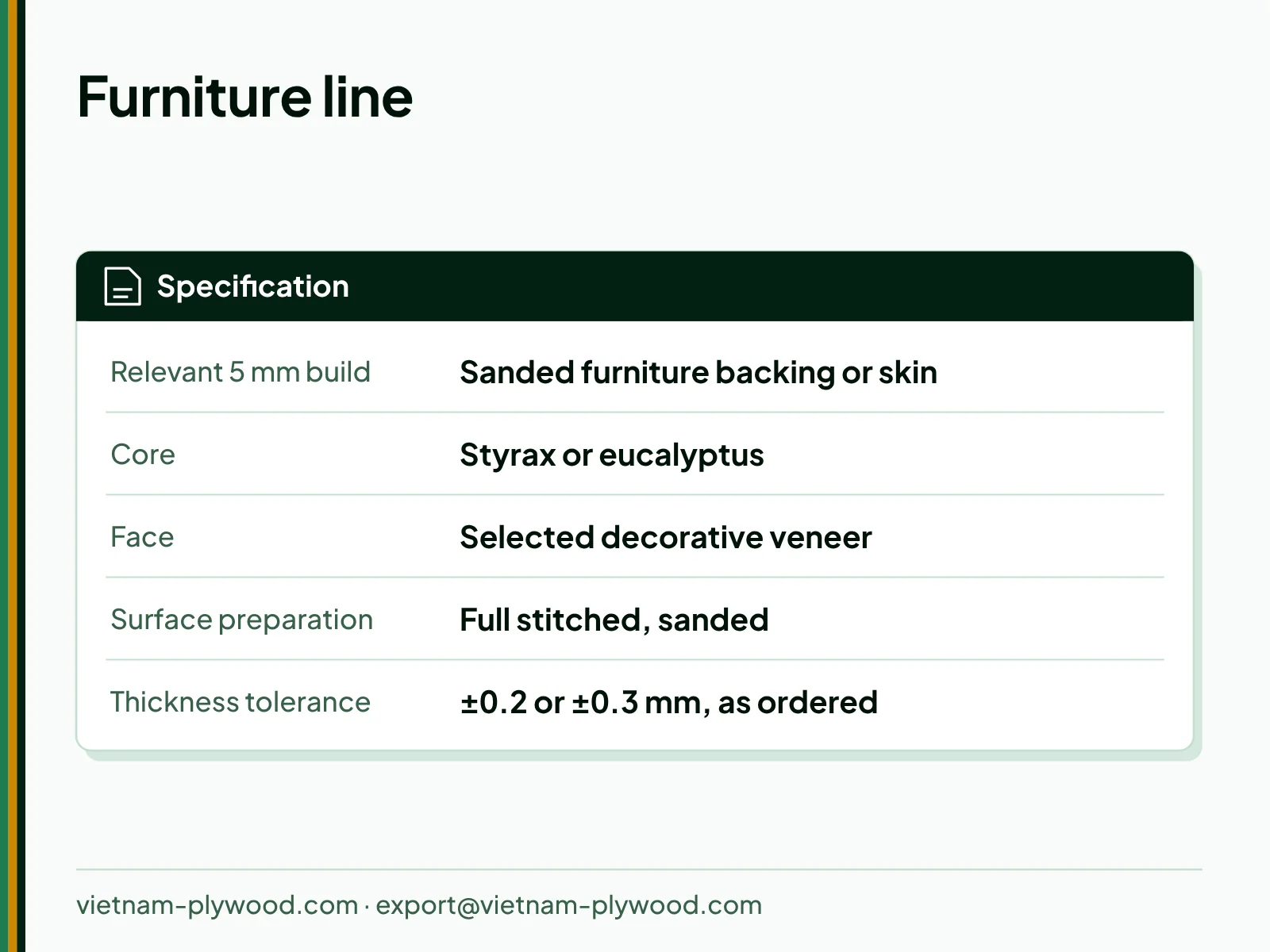
| Specification | Our furniture line | Our commercial and packing line | Our construction line |
|---|---|---|---|
| Relevant 5 mm build | Sanded furniture backing or skin | Utility backing or packing sheet | Film-faced construction sheet |
| Core | Styrax or eucalyptus | Acacia | Acacia or eucalyptus |
| Face | Selected decorative veneer | Raw or utility surface | Phenolic, melamine or anti-slip film |
| Surface preparation | Full stitched, sanded | Unsanded or light-sanded | Unsanded core under film |
| Thickness tolerance | ±0.2 or ±0.3 mm, as ordered | ±0.5 mm; packing ±0.5–1.0 mm | ±0.5 mm |
| Typical verdict | Cabinet backs and visible interior skins | Concealed utility panels and packaging | Formwork-related facing requirements |
Standard panel dimensions are 1220 × 2440, 1250 × 2500, 1220 × 2135, 1220 × 1830, 915 × 2440, 915 × 2135 and 915 × 1830 mm. Custom cutting is available; length and width tolerance is ±2 mm. A request for 5mm hardwood plywood 8x4 should specify 1220 × 2440 mm, rather than assume every market’s nominal 8 × 4 designation identifies an identical finished size.
A request for 5mm hardwood plywood 2400 x 1200 needs those exact dimensions written in the cutting schedule. They differ from the standard 1220 × 2440 mm panel. The thin plywood supplier range covers adjacent thickness choices.
What is the difference between 5 mm and 5.5 mm plywood?
The difference is 0.5 mm in nominal thickness; it can change a groove fit, the clearance behind a cabinet and the total stack dimension. Neither designation establishes the finished thickness tolerance by itself. Write the nominal value and acceptance range together on the purchase specification.
Some sellers describe a 5 mm board as nominal 5.5 mm. That naming convention is a seller-specific description, not permission to substitute one size for the other. A 5.5 mm plywood order needs a separate thickness target and acceptance agreement. The furniture line’s sanded tolerance applies to the thickness actually ordered, rather than converting a 5 mm order into 5.5 mm.
For a rebated cabinet back, the fit should be checked against the minimum and maximum acceptable panel thickness. A laminated or painted surface can also affect the final assembly fit; specify whether measurements refer to the plywood before or after finishing. For an adjacent thinner choice, compare 4 mm plywood and 3 mm plywood.
Is 5 mm plywood the same as 3/16 inch?
No. 3/16 inch equals 4.7625 mm, while 5 mm is a separate nominal thickness. The US National Institute of Standards and Technology explains in its 2025-updated SI Units – Length page that one inch is exactly 25.4 mm. The NIST length definition is the conversion basis.
For US cabinet components, write either 5.0 mm or 3/16 inch with a measurable acceptance band. A purchase order that uses both without defining priority can lead to a rejected groove fit. A nominal inch fraction also says nothing about veneer face quality, core voids or surface sanding.
A 5mm plywood sheet ordered for a pre-machined slot should be sampled against the receiving assembly. This matters most when parts from different suppliers must fit the same cabinet system.
What is 5 mm plywood used for?
Five-millimetre plywood is a thin panel for cabinet backs, wardrobe backs, drawer bottoms supported by their frames, furniture skins and lightweight fit-out infill. The selected face and support spacing determine whether the sheet belongs in a visible or concealed assembly. It is not a substitute for a load-rated panel solely because it has several veneer layers.
Our furniture line makes the stronger specification choice for a decorative back or skin where a sanded surface and controlled thickness matter. A concealed protective backing may instead use our commercial and packing line. A panel intended as a substrate for subsequent decorative finishing needs a face sample and adhesion trial before volume cutting.
Furniture makers should define whether a back is captured in a groove, stapled to a frame or bonded over a continuous substrate. For the broader UK thin-sheet selection, see 3–6 mm plywood.
Which face and core are used in 5 mm hardwood plywood?
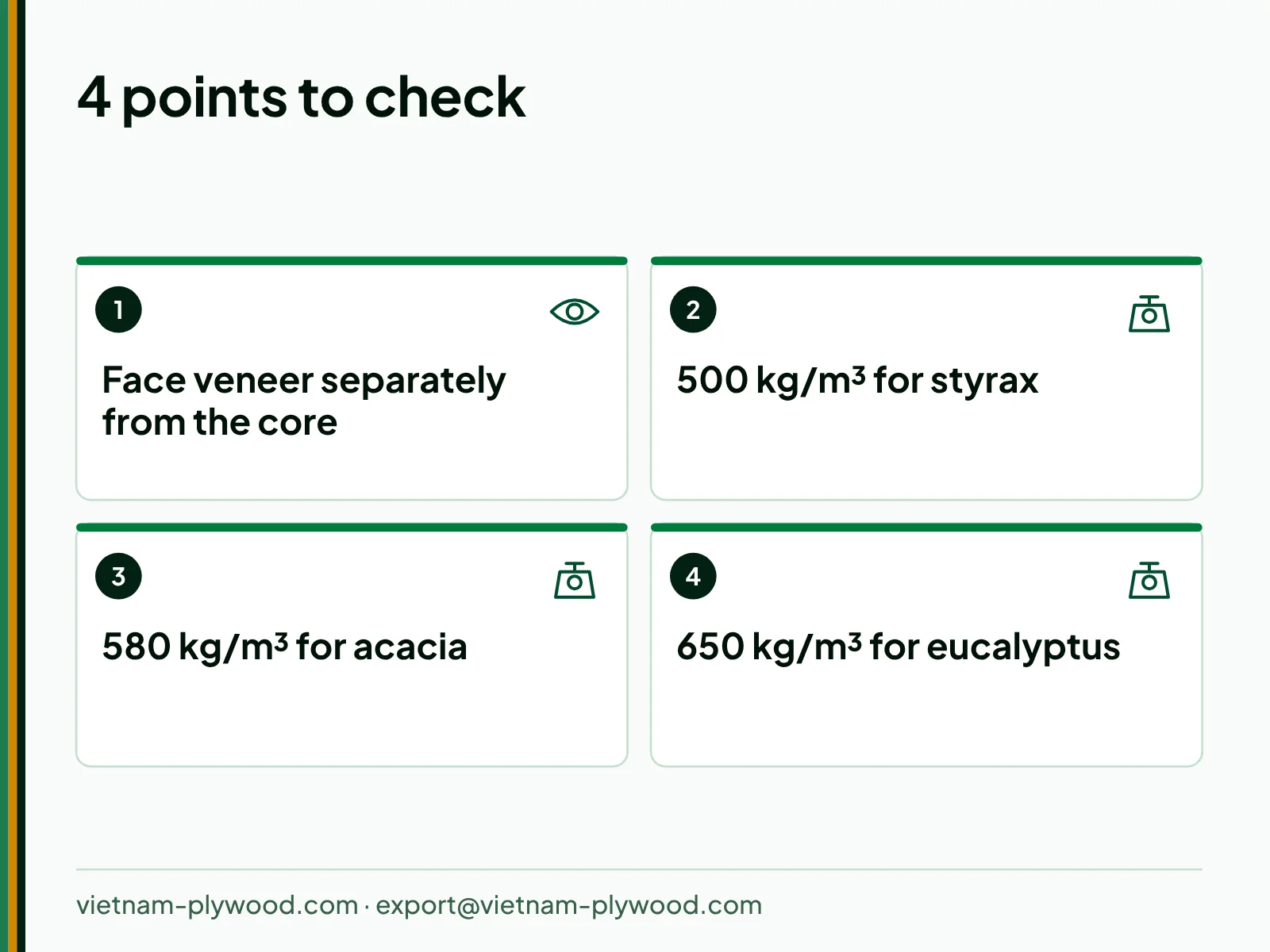
A hardwood plywood 5 mm specification should name the face veneer separately from the core. Our furniture line uses styrax or eucalyptus cores with full stitched construction and a sanded finish. Face options include bintangor, okoume, engineered veneer (EV), gurjan, pine, poplar, eucalyptus, birch and sapele.
The usual face veneer thickness is 0.2–0.4 mm. Face grades are A/B, except birch faces, which use D/E/F designations. Buyers should agree on the visual reference sample, allowable repairs and face orientation before pressing. A species named on the face does not identify the species inside the panel.
Core density is 500 kg/m³ for styrax, 580 kg/m³ for acacia and 650 kg/m³ for eucalyptus. Those are core-based figures. A birch-faced board with a styrax core therefore follows the styrax density, rather than being treated as birch-core plywood. HCPLY does not press birch-core plywood.
The term 5mm laminated plywood can refer to a panel that will receive another surface. Melamine, high-pressure laminate (HPL) and other laminate faces are separate finishing topics, not HCPLY product lines. Define the receiving finish and bonding trial in the order.
How does furniture-grade 5 mm differ from a utility sheet?
Furniture-grade 5 mm prioritizes a selected face, a full stitched core and sanded thickness control. A utility sheet prioritizes the required protective or concealed function, using an acacia core and an unsanded or light-sanded surface. The comparison below makes the purchasing decision observable.
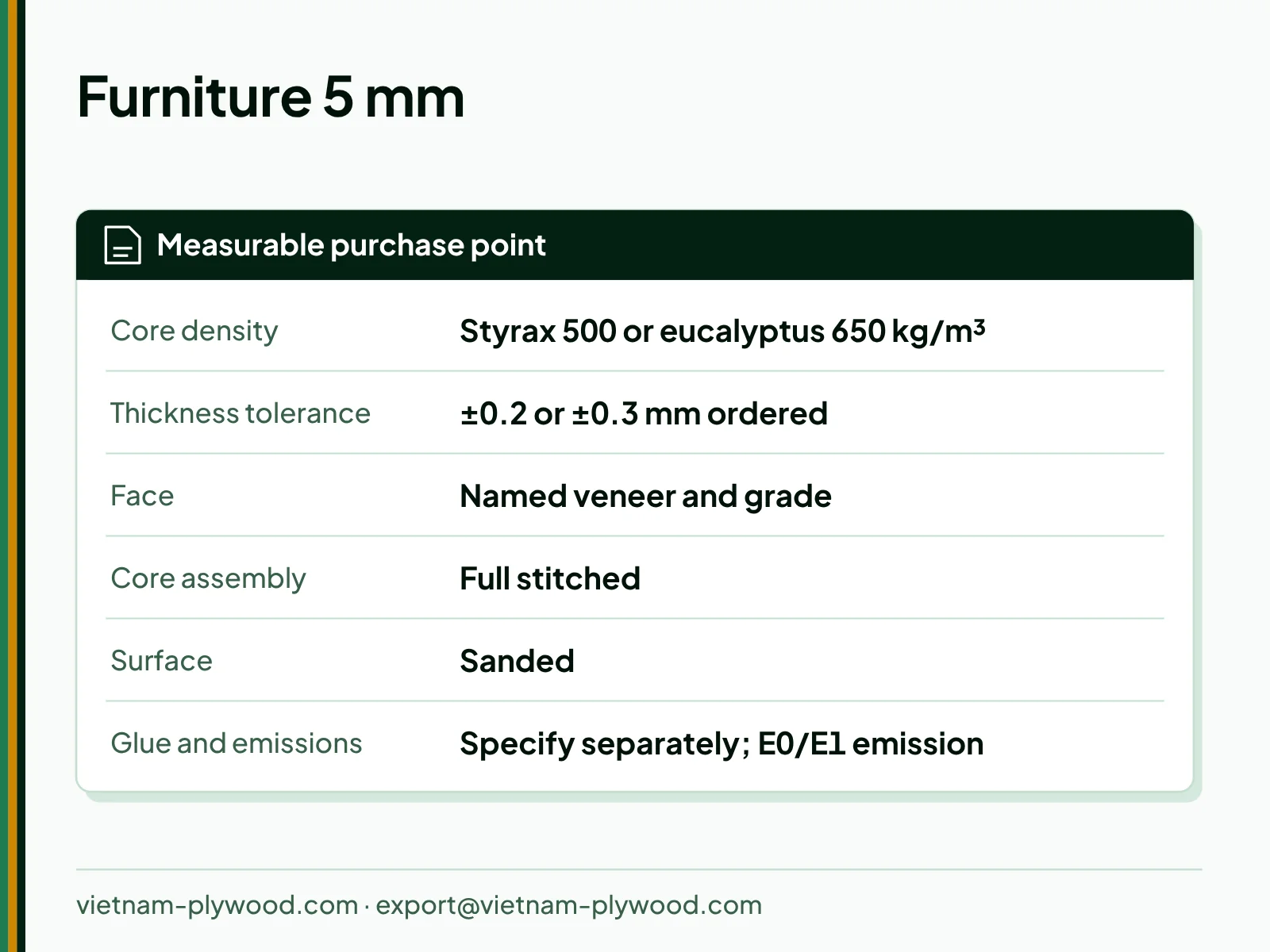
| Measurable purchase point | Furniture 5 mm | Utility 5 mm | Verdict by use |
|---|---|---|---|
| Core density | Styrax 500 or eucalyptus 650 kg/m³ | Acacia 580 kg/m³ | Choose by required weight and construction |
| Thickness tolerance | ±0.2 or ±0.3 mm ordered | ±0.5 mm; packing ±0.5–1.0 mm | Furniture for close-fitting rebates |
| Face | Named veneer and grade | Utility/raw finish | Furniture for visible backing |
| Core assembly | Full stitched | Specify acceptable assembly | Furniture for face-sensitive skins |
| Surface | Sanded | Unsanded or light-sanded | Utility for concealed protective work |
| Glue and emissions | Specify separately; E0/E1 emission | MR glue; emission specified separately | Match receiving-market documentation |
Our construction line would instead press a film-faced panel for its designated job, rather than substitute film for a furniture veneer. Film options are 120 g/m² standard, 135 g/m² premium and 220 g/m² anti-slip only. A fuller comparison across factory lines separates these purchasing paths.
Does 5 mm plywood stay flat?
A 5 mm sheet can remain flat in a supported assembly when veneer balance, core construction, moisture exposure, handling and fixing are controlled. Thickness alone cannot establish a flatness acceptance criterion. Agree on the allowable bow or twist and the measurement setup before manufacturing.
At the producing factory, a buyer or inspector can place sampled sheets on a reference surface, measure corner lift and check thickness at agreed positions. Record sample positions and acceptance criteria in the inspection sheet.
A full stitched core and sanded faces help buyers specify repeatable furniture panels. They do not eliminate the need to test a panel in the actual cabinet frame. Store and acclimatize trial panels under the receiving factory’s conditions before checking assembly fit. For a thicker alternative with a different stiffness requirement, compare 6 mm plywood.
What does a 5 mm sheet weigh in a container?
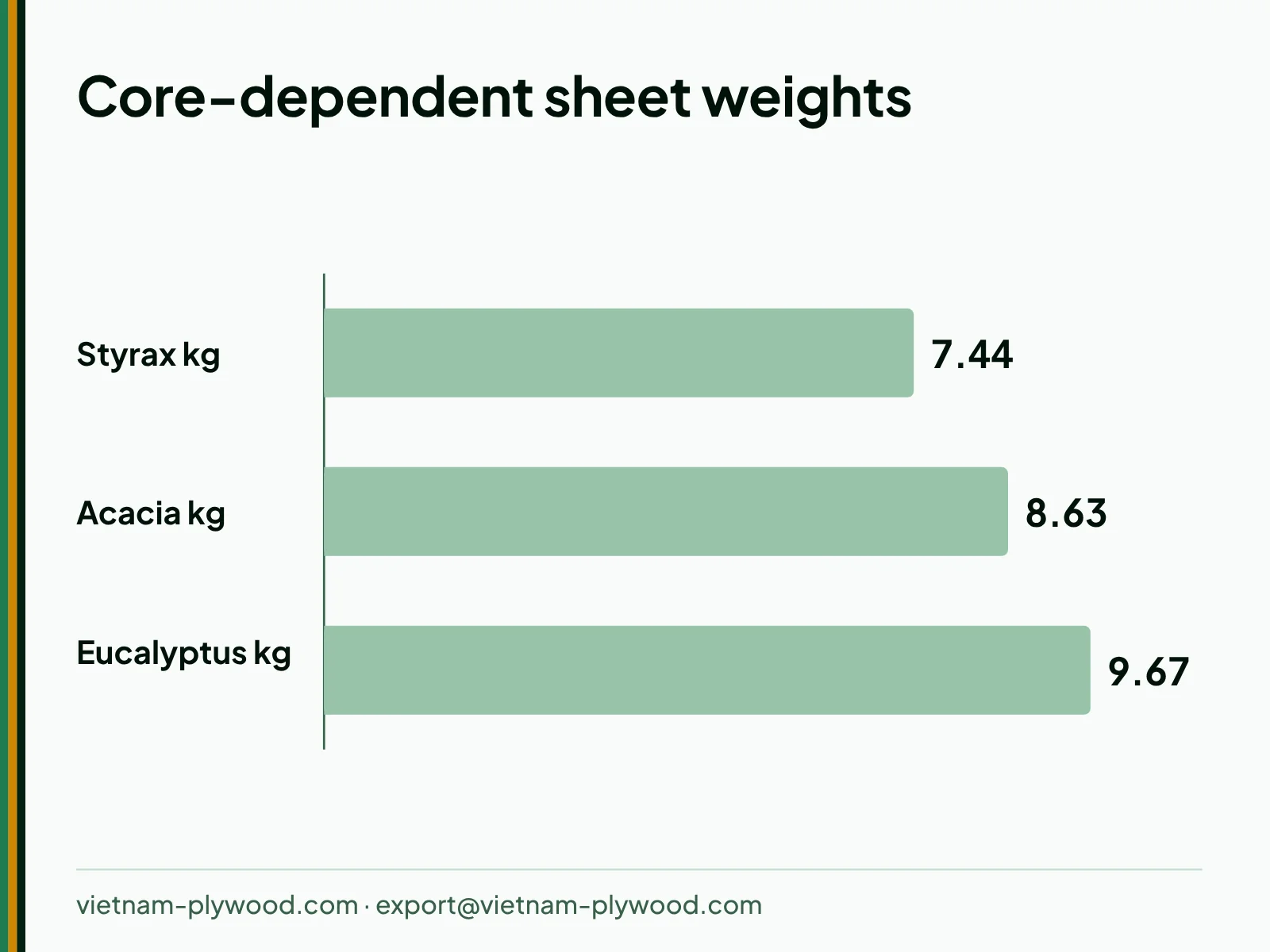
For 1220 × 2440 × 5 mm, a styrax-core sheet weighs 7.44 kg, an acacia-core sheet 8.63 kg and a eucalyptus-core sheet 9.67 kg. These figures exclude added film weight.
| Core | Sheets per pallet | Pallets | Full 40HC sheets | Volume | Load weight |
|---|---|---|---|---|---|
| Styrax | 200 | 18 | 3600 | 53.58 m³ | 26.79 t |
| Acacia | 200 | 16 | 3200 | 47.63 m³ | 27.62 t |
| Eucalyptus | 194 | 15 | 2910 | 43.31 m³ | 28.15 t |
The 40HC payload limit is 28.5 t. Different specifications can share a container when the combined load remains within that limit. For example, a mixed order should count each core’s sheet weight separately, then add pallet and packing considerations to the loading plan. The full-load figures above describe separate single-core loads, rather than a ready-made mixed-load allocation.
The container loading reference covers load planning in more detail. A buyer choosing between light furniture backing and denser utility panels should calculate both the number of sheets and the destination handling requirements.
How can an inspector check a 5 mm order?
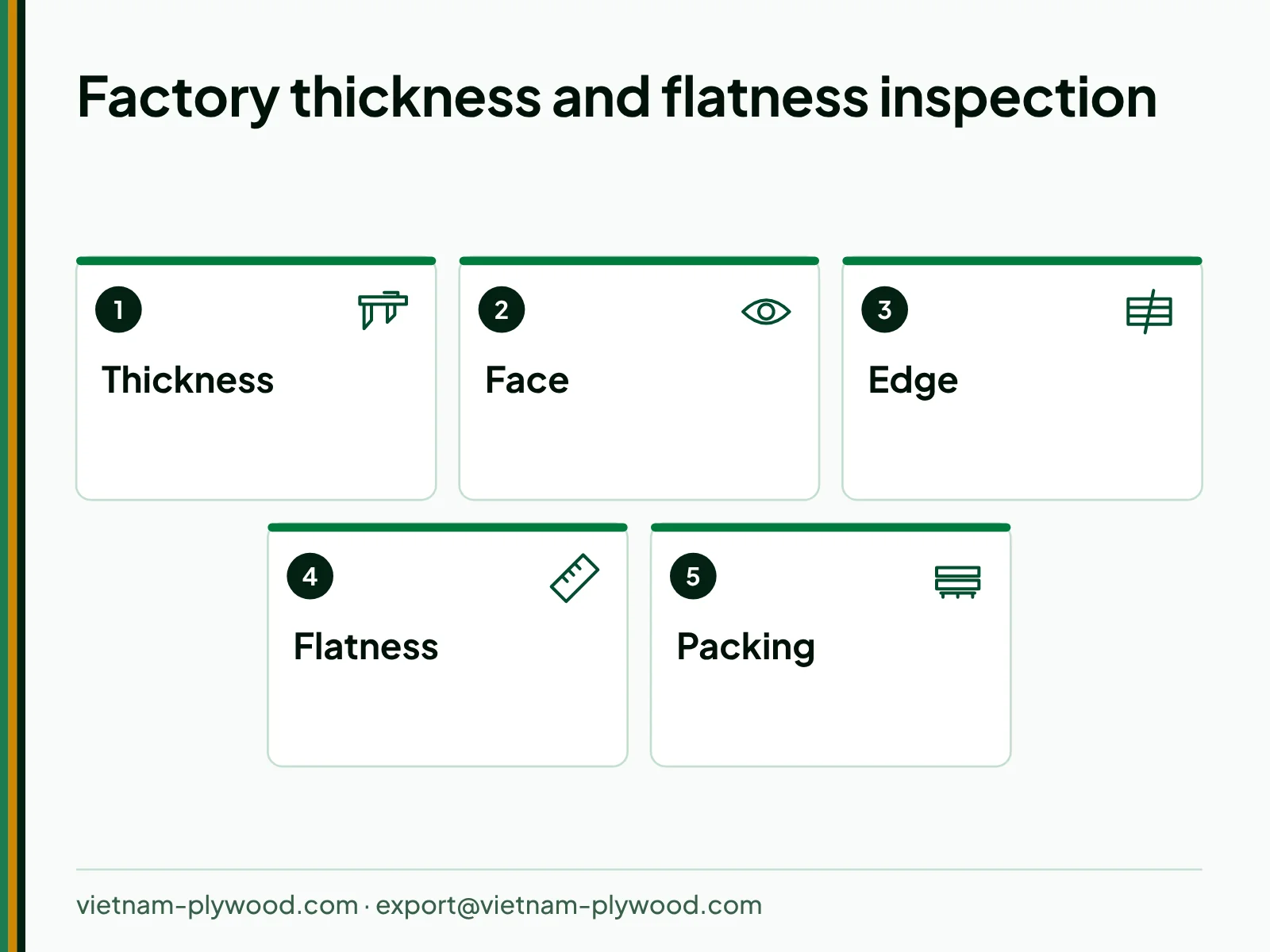
The inspection should compare finished panels with the signed thickness, face, core and flatness criteria. HCPLY coordinates on-site quality control at the producing factory; buyers can inspect there and visit the factory office. Inspection samples should represent the actual pressed lot.
- Match pallet labels and the production sheet to the approved order specification.
- Measure finished thickness across selected panel positions and record the readings against the ordered tolerance.
- Compare the face veneer, grade and sanding with the approved reference sample under agreed lighting.
- Examine selected edges and cut samples for core construction, openings and face-to-core bonding.
- Check panel flatness on the agreed reference surface and test representative pieces in the intended frame.
- Record dimensions, quantity and packing condition before container loading.
Glue and emission are distinct specification fields. Melamine glue is the MR option with a 12-hour boil description; phenolic glue is weather and boil proof (WBP), with a 72-hour boil description. Emission classes are E0, E1 and E2; CARB P2 and TSCA Title VI concern a US emissions limit and third-party certification. Any requested factory certificates are shown with factory details masked, on request.
How should buyers specify finish, glue and documents?
Write the intended use, finished thickness, surface appearance and destination-market documents into the same specification. For a furniture backing, choose the face grade and emission requirement before comparing quotations. For a packing insert, describe the handling and protection duty instead.
Our three factories are in Phu Tho and Hai Phong, with orders produced at the line suited to their specification and shipped directly from that factory. HCPLY manages the export process from specification and factory inspection through loading and documents. Shipment papers include the commercial invoice, packing list, bill of lading (B/L), certificate of origin, relevant phytosanitary and fumigation papers, and order-specific certificates or test reports.
EU lots include the applicable EUR.1 and EUTR/EUDR file set; CIF shipments include insurance papers. After loading, the draft shipping documents come to you for approval. Where a certificate is requested, it belongs to the relevant member factory and is shown with factory details masked, on request. See several plywood types under one supplier for related specification coordination.
What affects the quotation for 5 mm plywood?
Core construction and face selection have the largest effect on the build comparison, followed by sanding and thickness control, glue and emission requirements, cutting, quantity and shipping terms. A full stitched, sanded furniture build costs more to prepare than a basic utility sheet because it uses a more controlled core and surface process. A selected decorative face adds another cost distinction.
The indicative furniture starting point is from US$350/m³ FOB Hai Phong (October 2026). The commercial starting point is from US$250/m³ FOB Hai Phong (October 2026). These are category starting prices, not a fixed quote for every 5 mm face or 5.5 mm order. A written specification allows a quote for the actual build.
The minimum order is one 40HC. Factory lead time runs 15–45 days from receipt of the 30% deposit; the exact figure depends on order size, line loading and what the contract fixes. The remaining 70% is paid on the scan of the bill of lading, by T/T, or by irrevocable sight L/C. We ship FOB Hai Phong, or CFR (CNF) or CIF to your port. Samples cost nothing: a first-time buyer pays the courier, and that charge comes off the first confirmed order.
What specification should a cabinet buyer send?
A complete request identifies the receiving assembly and the exact thickness that fits it. Use the contact page to send the specification to Lucy at export@vietnam-plywood.com.
Application: cabinet backs / furniture skins; fixing method and support spacing
Line or core: furniture line; styrax core (or eucalyptus core)
Glue: specify MR or WBP requirement
Emission: E0 or E1, as required by destination market
Face and grade: named veneer; agreed grade and reference sample
Thickness and tolerance: 5.0 mm ±0.2 mm (or explicitly agreed 5.5 mm target)
Size: 1220 × 2440 mm, or attached cut schedule
Quantity: number of sheets and packing requirement
Destination port: [port and country]
Book a factory visit to inspect the trial build and the producing factory before confirming the order.