





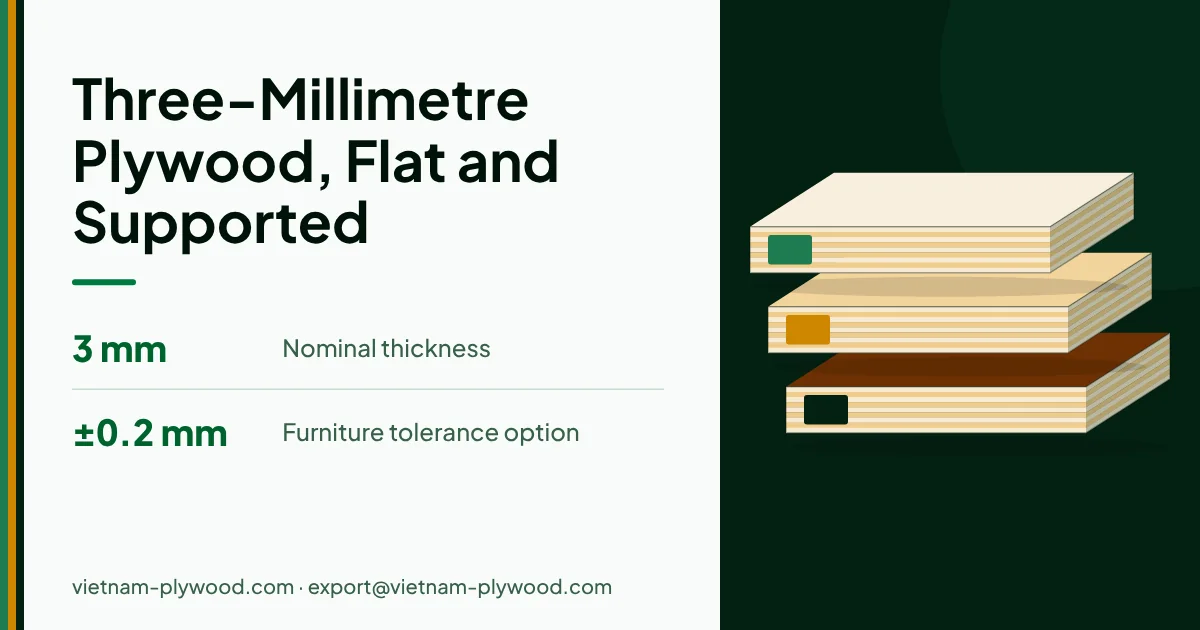
HCPLY makes plywood 3 mm on our furniture line with a balanced face-and-core specification, full-stitched construction and a written thickness tolerance. The wrong face, groove allowance or pallet support can turn thin cabinet components into a rejected load. The decisive choice is the complete layup and handling method, rather than the decorative species alone.
What sizes and tolerances can a 3 mm sheet be ordered in?
A 3 mm panel can be specified across our three production lines, but each line has a different finish, core and thickness tolerance. The size and thickness belong together on the purchase specification: a nominal 3 mm label alone does not describe the finished sheet.
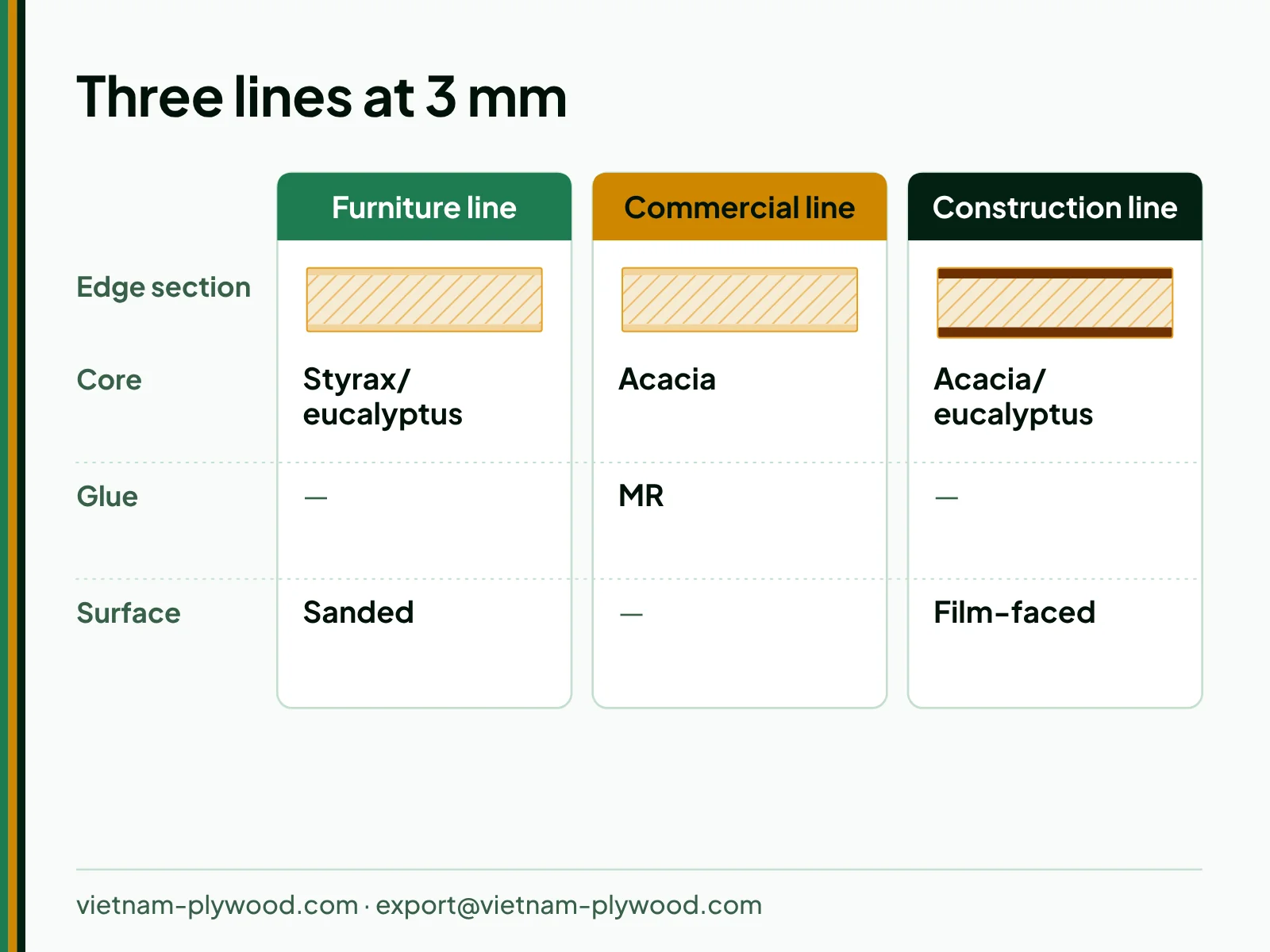
| Line | 3 mm build and intended use | Thickness tolerance | Sheet sizes available |
|---|---|---|---|
| Furniture | Sanded, full-stitched styrax or eucalyptus core; cabinet and furniture parts | ±0.2 mm or ±0.3 mm as ordered | 1220 × 2440, 1250 × 2500, 1220 × 2135 mm and listed alternatives |
| Commercial and packing | Acacia core, moisture-resistant (MR) glue, unsanded or light-sanded; liners and packing | Commercial ±0.5 mm; packing ±0.5–1.0 mm | Same size menu, with custom cutting |
| Construction | Acacia or eucalyptus core, unsanded, phenolic or melamine film; formwork-related applications | ±0.5 mm | Same size menu, with custom cutting |
The remaining listed sizes are 1220 × 1830, 915 × 2440, 915 × 2135 and 915 × 1830 mm. Length and width tolerance is ±2 mm. A request described as 3mm plywood 2400 x 1200 should be converted to an exact production dimension before ordering: 1220 × 2440 mm is a listed size, while 1200 × 2400 mm requires custom cutting.
For the full thickness family and application selection, see our thin plywood supplier overview. The specification should state whether the dimensions refer to finished sheets or cut parts.
Which factory line presses plywood 3 mm?
Our furniture line is the first choice for a visible or precisely fitted 3 mm furniture component. It uses a sanded, full-stitched styrax or eucalyptus core, with the face and emission class specified separately. HCPLY also makes thin commercial and packing panels for less demanding visible surfaces.
The face names the product, while the core determines the density. Thus hardwood plywood 3mm describes a broad market category, whereas a written order should identify both the decorative face and the core species. A birch face does not mean a birch core: we do not press birch-core plywood.
What is 3 mm plywood used for?
Three-millimetre plywood is used for supported drawer bottoms, cabinet backs, door skins and packing liners where low thickness matters more than long unsupported span. The panel needs a fixing and support design suited to its service load. A 3 mm back captured in a cabinet groove is a different duty from a free-spanning shelf.
Thin plywood can also be cut into decorative components or laminated into a curved assembly, but cutting quality and bending radius require application trials. For purpose-built curves, see the bendable plywood guide. For larger supported furniture backs, compare the wardrobe back panel options.
Which face species are available at 3 mm?
Our face menu includes okoume, poplar, bintangor, engineered veneer (EV), gurjan, pine, eucalyptus, birch and sapele. A matt panel means an unfaced raw core. Face veneers commonly measure 0.2–0.4 mm; this is a face-layer range, not a claim about the finished panel thickness.
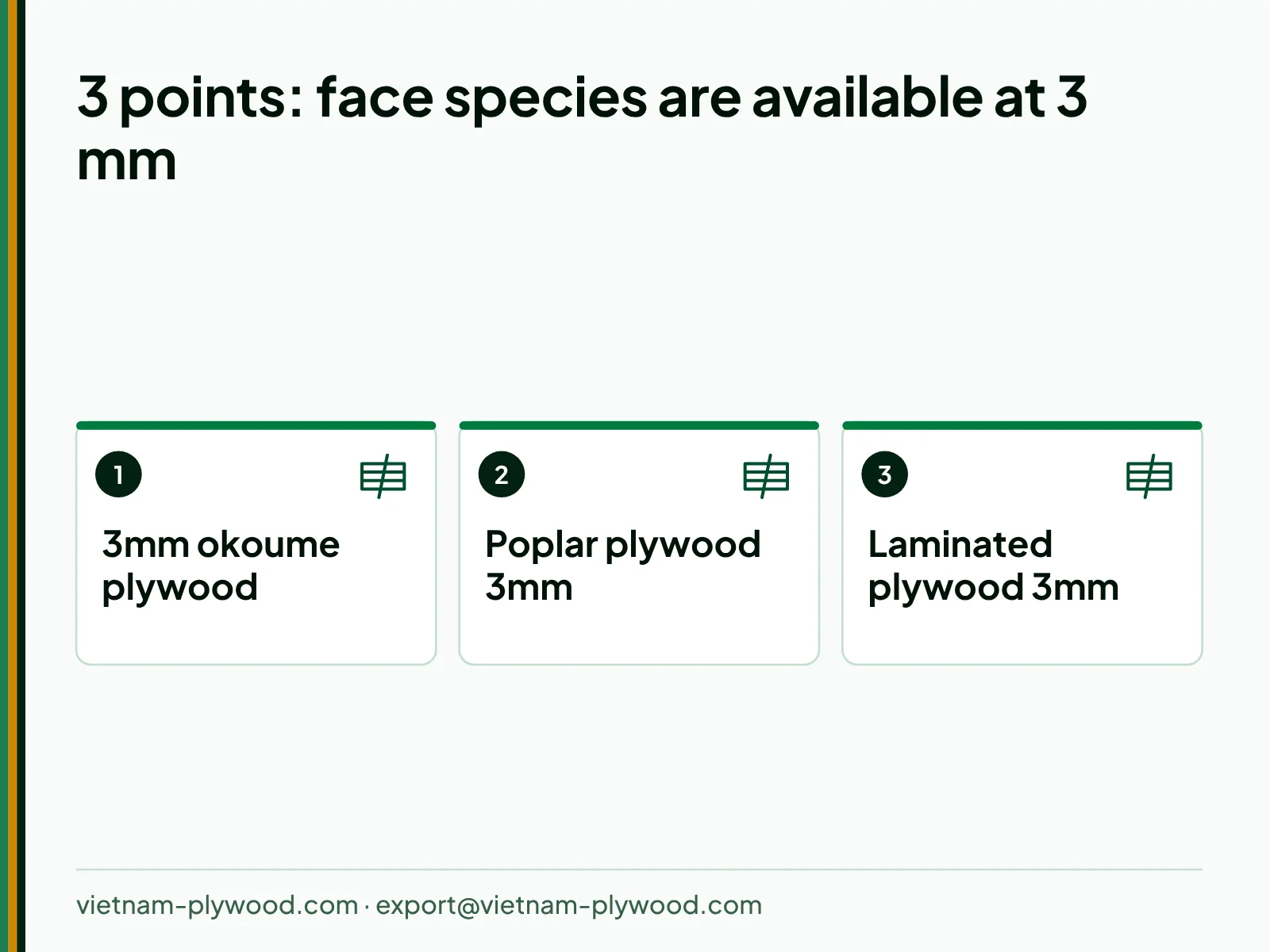
A/B are the face grades for the listed decorative options, while birch faces use D/E/F grading. Specify the intended appearance, acceptable repairs and which side will be exposed. A sample of the ordered face and grade is more useful than a generic photograph of a species.
3mm okoume plywood and poplar plywood 3mm are valid face-led requests. Both should name the Vietnam core separately. Poplar is offered as a face rather than a poplar core. An order for laminated plywood 3mm needs an additional distinction: a decorative veneer face is within our face menu, but melamine, high-pressure laminate (HPL) and other laminate faces are topics we explain rather than products from our lines.
Which faces stay flat at 3 mm?
No face species alone keeps a 3 mm sheet flat. Face balance, core integrity, pressing, moisture exposure and restraint during storage influence whether a thin panel develops bow or twist. An attractive face cannot compensate for an unbalanced construction.
At this thickness, compare okoume, poplar, EV and birch faces by the required finish rather than by a universal flatness ranking. Choose okoume or poplar when their appearance fits the furniture part; EV when a repeatable decorative pattern is wanted; birch when its specified D/E/F appearance is acceptable. None is a substitute for examining actual production sheets.
Our furniture line uses full-stitched core construction. The wider construction ranking runs from full stitched, through stitched outer layers with edge-trimmed inner layers, to finger-jointed and loose-laid cores. Better continuity reduces visible gaps and gives the press a more consistent layup. At 3 mm, the veneer layout should be agreed against the thin final thickness rather than extrapolated from a thick panel.
An inspector can place sample sheets on a clean flat reference surface and record corner lift, visible bow and edge gaps against an agreed acceptance method. The buyer should define the measurement points and flatness limit in the contract; there is no numerical flatness limit in this specification.
What thickness tolerance applies to each sheet?
Our sanded furniture build uses ±0.2 mm or ±0.3 mm, whichever the order selects. For a nominal 3 mm sheet, the selected tolerance should appear on the order and the inspection record. Commercial and film-faced panels use ±0.5 mm; packing uses ±0.5–1.0 mm.
A 3 mm panel should not be specified using the 18 mm ply-count example. Core veneers in the general range are 1.4–2.0 mm, but the actual thin-panel layup must be defined for this product. Request a section sample when ply arrangement affects the end use.
How are 3 mm sheets bundled so they arrive flat?
Flat support across the stack, edge protection and controlled restraint are the packing priorities for 3 mm sheets. The buyer should agree the packaging drawing before production, then witness the finished bundle at the producing factory. A stack that leaves corners unsupported can acquire a shape that is difficult to remove after arrival.
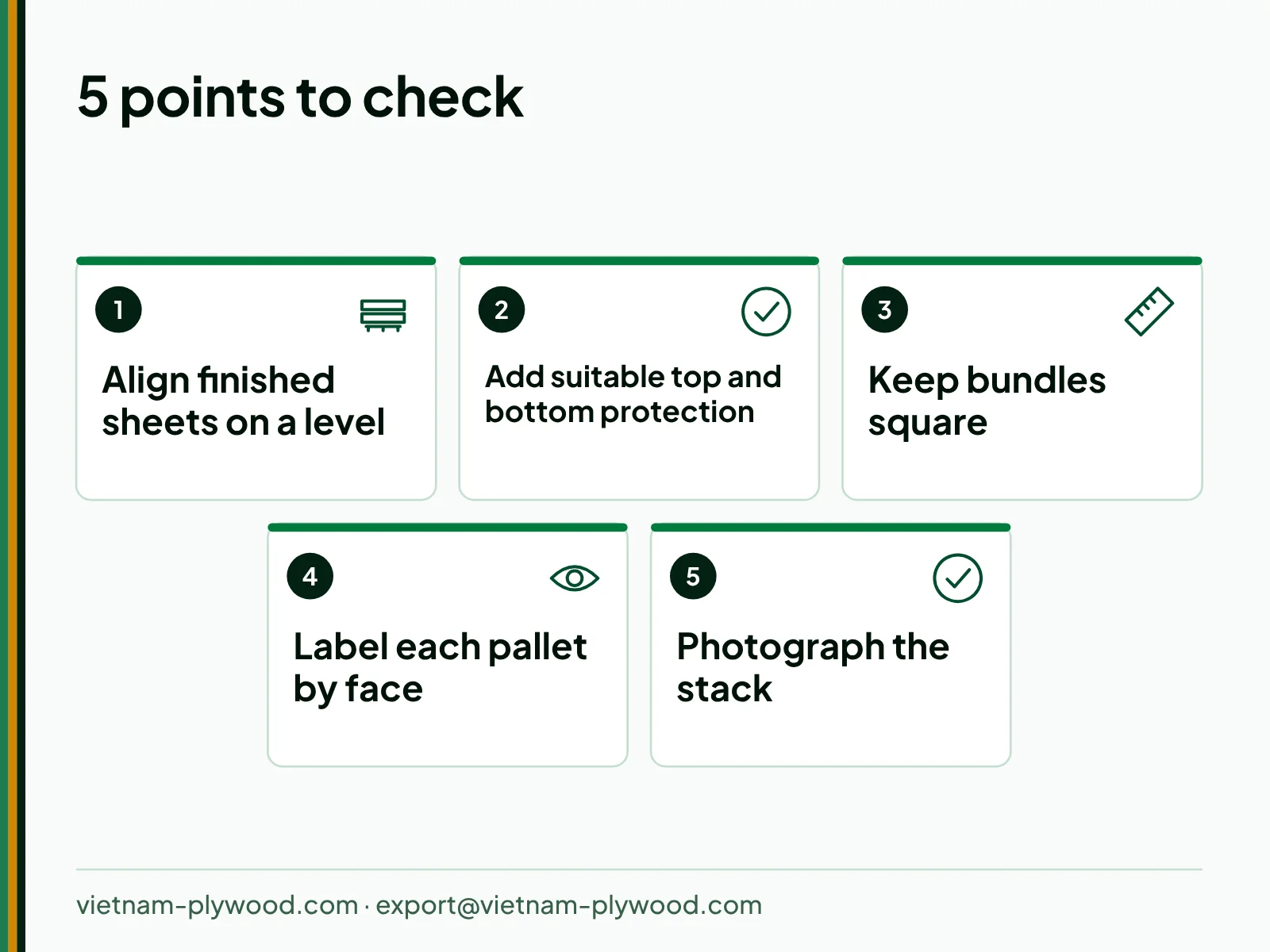
- Align finished sheets on a level, full-support pallet surface, with no projecting corners.
- Add suitable top and bottom protection so straps or wrapping do not press directly into exposed faces.
- Keep bundles square, protect the edges and apply restraint without creating local pressure points.
- Label each pallet by face, core, size, thickness and lot so different specifications remain traceable.
- Photograph the stack, check its alignment and inspect the loaded container before sealing.
These are requested packing controls, not a claim that a particular protective material is standard on every order. Agree the actual pallet drawing, wrapping and acceptance photos with Lucy. Keep the sheets flat and supported after unloading as well; prolonged uneven storage can undo careful packing.
What does 3 mm mean for container weight?
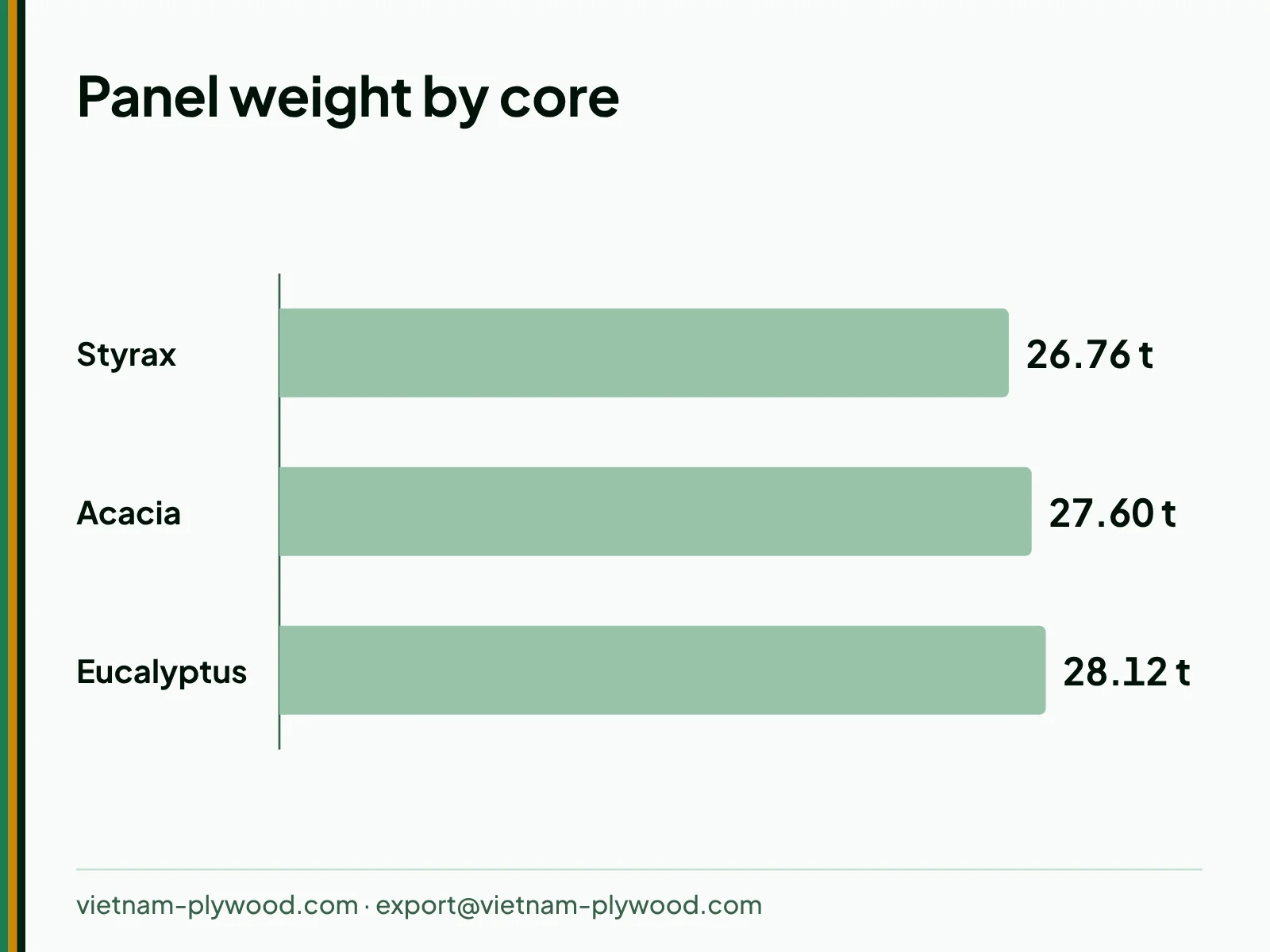
For 1220 × 2440 mm sheets at 3 mm nominal thickness, the core changes both sheet weight and full 40HC quantity. HCPLY uses a 28.5 t payload ceiling in this planning comparison. The figures below exclude any film weight and are the calculated full-load lookups.
| Core | Density | Weight per sheet | Sheets per pallet | Full 40HC | Volume | Panel weight |
|---|---|---|---|---|---|---|
| Styrax | 500 kg/m³ | 4.47 kg | 333 | 5,994 sheets | 53.53 m³ | 26.76 t |
| Acacia | 580 kg/m³ | 5.18 kg | 333 | 5,328 sheets | 47.58 m³ | 27.60 t |
| Eucalyptus | 650 kg/m³ | 5.80 kg | 323 | 4,845 sheets | 43.27 m³ | 28.12 t |
The styrax configuration uses 18 pallets, acacia 16 and eucalyptus 15. A mixed load can combine different specifications within the payload limit, but the pallet plan must be recalculated for the actual mix. For the broader loading method, use container loads.
How should glue and emissions be specified?
Glue type and emission class are separate fields on a 3 mm plywood order. Our furniture line offers E0 or E1 emission classes; MR melamine glue and weather-and-boil-proof (WBP) phenolic glue describe different adhesive performance categories. MR corresponds to a 12-hour boil designation and WBP to 72 hours in our production specification.
For regulated US hardwood plywood, the US Environmental Protection Agency’s 2016 formaldehyde rule requires third-party certification and TSCA Title VI labeling for covered products after the applicable transition. Its official rule summary also addresses laminated products and import recordkeeping. Specify the applicable emission certificate for the actual producing factory and ordered panel rather than treating an E0 or E1 label as a substitute for US compliance.
Member-factory FSC, CARB P2, ISO 9001 and CE documents, and EUTR/EUDR documentation, are shown with factory details masked, on request. Ask for the specific certificate and test-report scope applicable to the agreed build.
How can buyers inspect a thin-panel order?
Inspect 3 mm panels at the producing factory for thickness, face grade, core condition and flatness before loading. HCPLY arranges the specification, on-site quality control, export documents and loading for each order. Buyers can visit the factory office and inspect goods where their order is made.
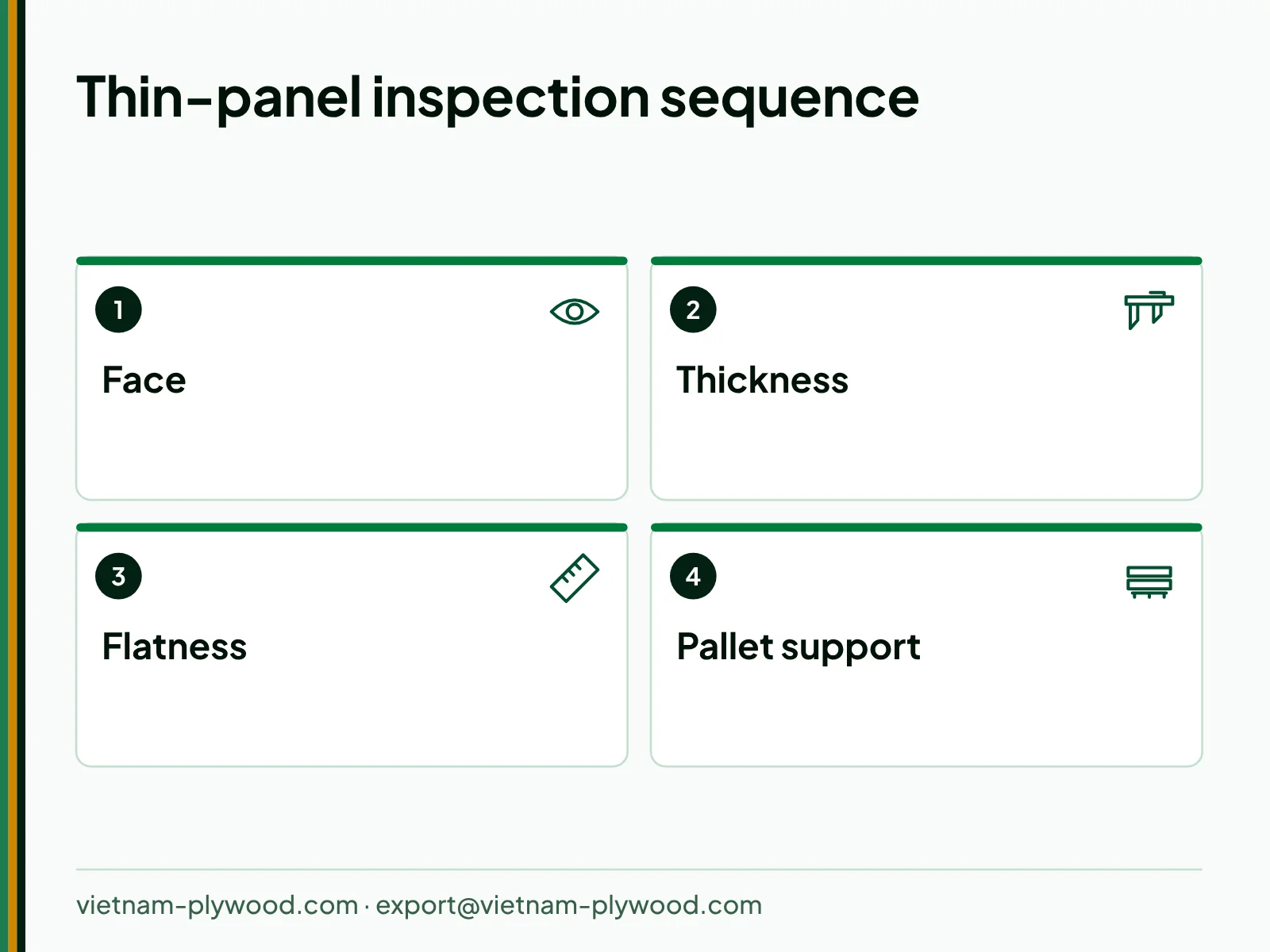
A practical inspection starts with the approved face sample and the signed dimensional tolerance. Select sheets across pallets, check face and back appearance, record thickness at agreed points, examine a clean cross-section and assess bow on a flat reference. Repeat the checks after bundling, when stack support and edge protection can be seen.
Document the sampling plan and rejection thresholds before the inspection date. If an application needs laser cutting, lamination or an unusual bend, conduct a processing trial on the agreed build; thinness alone does not establish machine settings or performance. The 6 mm plywood comparison helps when a thicker supported panel would be more appropriate.
What drives the price of 3 mm plywood?
Face veneer selection, core construction and dimensional finish are the main quotation drivers for a 3 mm furniture panel. A decorative, tightly graded face costs more to select than a concealed-grade face; a full-stitched sanded core requires more preparation than a basic packing build. Tight ±0.2 mm tolerance adds finishing and inspection demands compared with a looser packing tolerance.
Sheet size, custom cutting, protective packing and the quantity of each face specification also affect the quotation. A buyer comparing birch-faced and poplar-faced panels should ask for identical core, glue, tolerance and packing fields; otherwise the apparent face-price difference includes unrelated construction changes.
Send a written build specification for a quotation rather than extrapolating a market retail sheet price to an export container. The separate UK 3–6 mm plywood page addresses regional size terminology.
What paperwork and production route accompany the order?
The export order is produced at the matching factory and shipped directly from it, with FOB Hai Phong, CFR (CNF) or CIF delivery terms available. The minimum order is one 40HC, with mixed specifications permitted within its payload limit. Factory lead time runs 15–45 days from receipt of the 30% deposit; the exact figure depends on order size, line loading and what the contract fixes.
The balance is 70% against the scanned bill of lading (B/L), by telegraphic transfer (T/T) or irrevocable letter of credit (L/C) at sight. Samples are free; new buyers arrange their own courier, and its cost can be credited against a real order. See production lead time for scheduling context.
The shipment documents include commercial invoice, packing list, B/L, certificate of origin, phytosanitary and fumigation papers, and the order’s agreed certificates or test reports. EU lots add EUR.1 and the EUTR/EUDR file set; CIF includes insurance. After loading, the draft shipping documents come to you for approval. The packing list identifies the ordered sheet dimensions and pallet quantities.
What specification should go to Lucy?
Send one complete 3 mm specification that connects the intended use to its face, core, tolerance and packaging. A buyer can then compare a furniture-grade panel with a packing-grade alternative on matching dimensions. The contact page reaches Lucy at export@vietnam-plywood.com.
Application: supported cabinet backs and drawer bottoms
Line or core: furniture line; styrax core, full stitched
Glue: MR melamine
Emission: E1
Face and grade: okoume A/B; state exposed side
Thickness and tolerance: 3 mm, sanded, ±0.2 mm
Size: 1220 × 2440 mm; finished sheet
Quantity: one 40HC; specify pallet breakdown
Destination port: [buyer to enter]
Packing: flat full-support pallets, edge protection, top/bottom boards; inspection photos
Next step: plan a trial container with an agreed face sample, sheet inspection method and pallet drawing before repeating the specification at volume.