





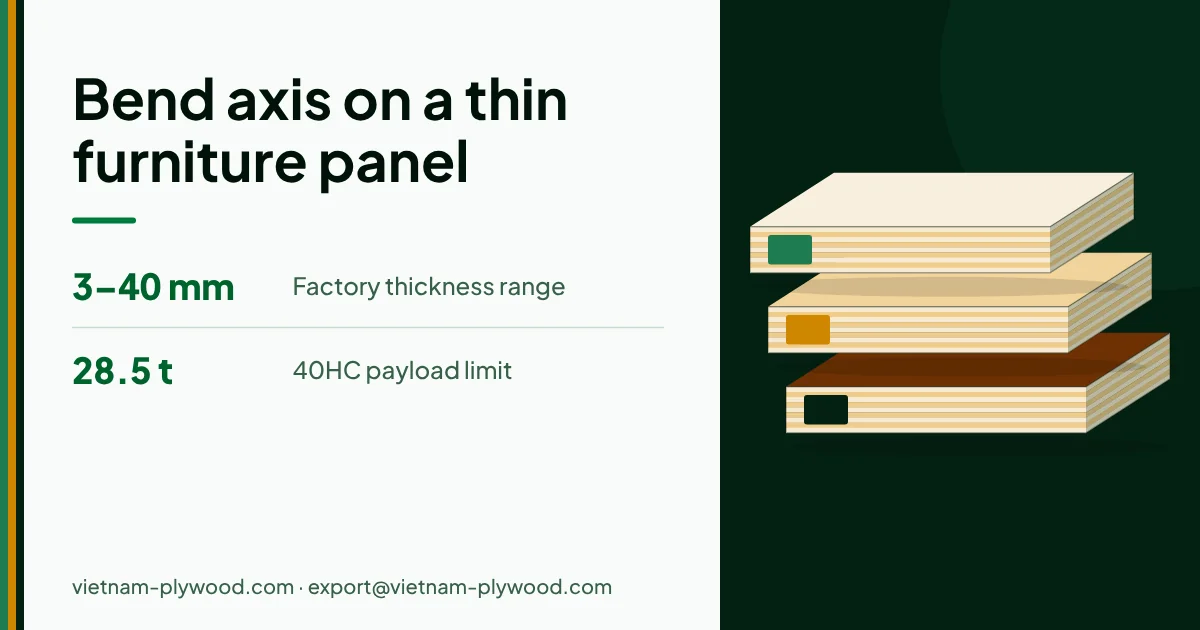
Bendable plywood is a thin veneer panel specified to wrap curved furniture and interior fit-out surfaces. Choosing the wrong bending axis can waste sheets, delay assembly and cause rejected curved parts. HCPLY develops thin-panel specifications through our furniture line, with grain orientation, face finish and inspection points written into the purchase order before pressing.
What is bendable plywood?
Bendable plywood is a thin veneer-based panel designed to flex preferentially around a chosen axis for curved interior work. Its bending behavior comes from veneer orientation, thickness and construction, rather than the name printed on a quotation. A flexible plywood sheet needs a defined bend direction and a sample trial against the actual former before bulk cutting.
The trade also calls it bending plywood, bendy plywood, flexi ply or flexible wood panels. Those labels do not specify the radius a particular sheet will survive. Ordinary cross-laminated furniture plywood can take gentle curves, while a purpose-oriented veneer layup can favor one bending direction. The distinction matters when a cabinet front has a narrow radius but its matching side panels remain flat.
Which thin builds bend along the grain or across it?
The veneer layup and bending axis determine whether a thin panel curves along its long dimension or across its width. Buyers should specify the direction of curvature relative to the sheet edges and the visible face grain. Terms such as long-grain and cross-grain bend can be interpreted differently across catalogs, so a drawing is safer than a label alone.
| Candidate build | Grain and bend instruction | Typical purchasing decision |
|---|---|---|
| Thin furniture panel, 3 mm | State face-grain arrow and the axis of the former | Trial for a shallow decorative curve before committing |
| Thin furniture panel, 5 mm | State whether curvature runs over the 1220 mm or 2440 mm span | Trial when the curve needs a more substantial skin |
| Thicker furniture panel, 9 mm | Specify a generous curve and support geometry | Prefer flat or gently curved backing rather than tight wrapping |
| Purpose-oriented flexible layup | Supply veneer-orientation drawing and required former | Request a witnessed sample trial before production approval |
These are selection routes, not certified minimum-radius values. A 3 mm panel and a 5 mm panel cannot be assigned a common radius without a defined layup and test. Our thin plywood range provides the thickness context; 5 mm plywood covers a common alternative when stiffness matters more than curvature.
How do I write bend direction into an order?
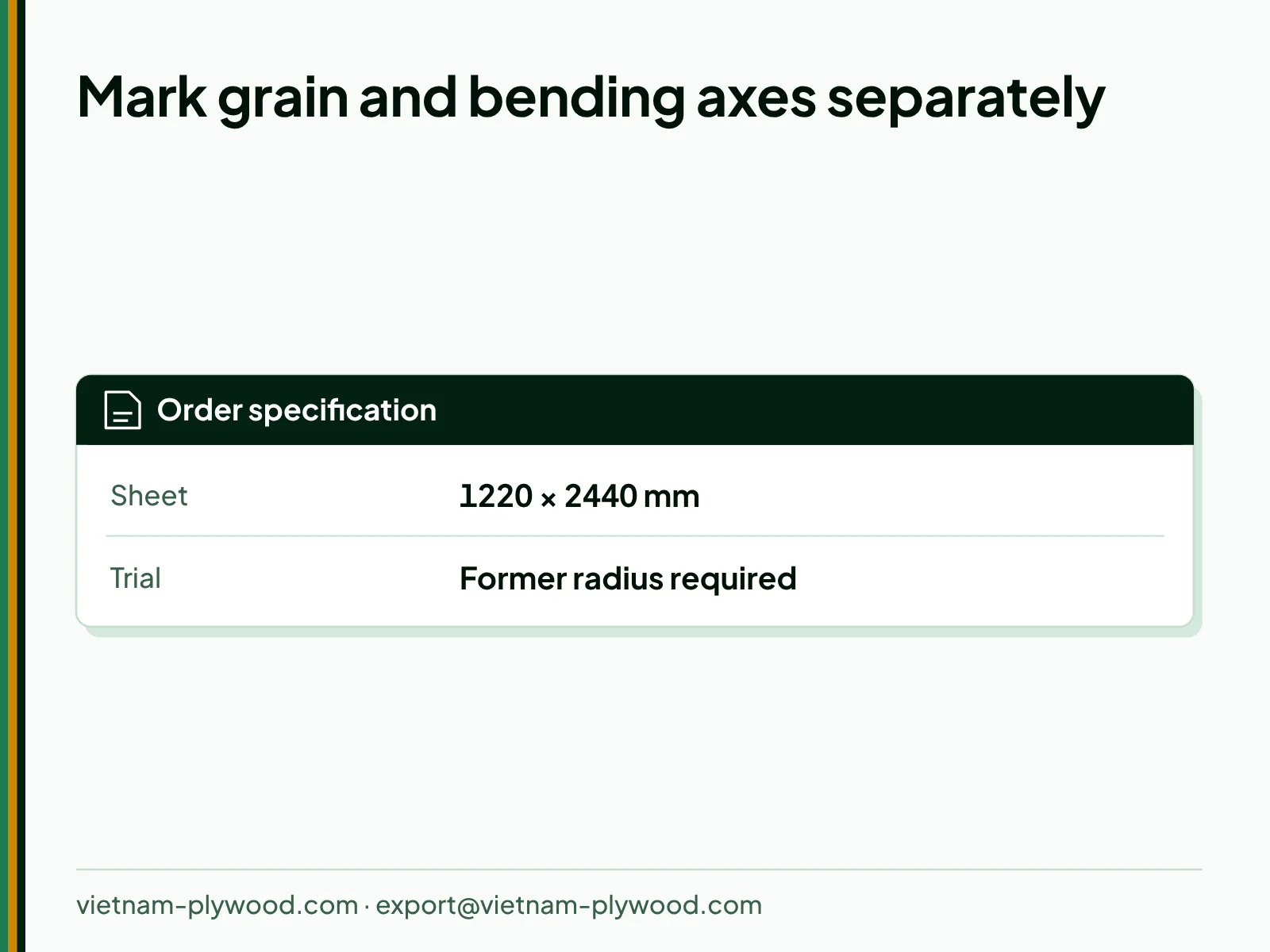
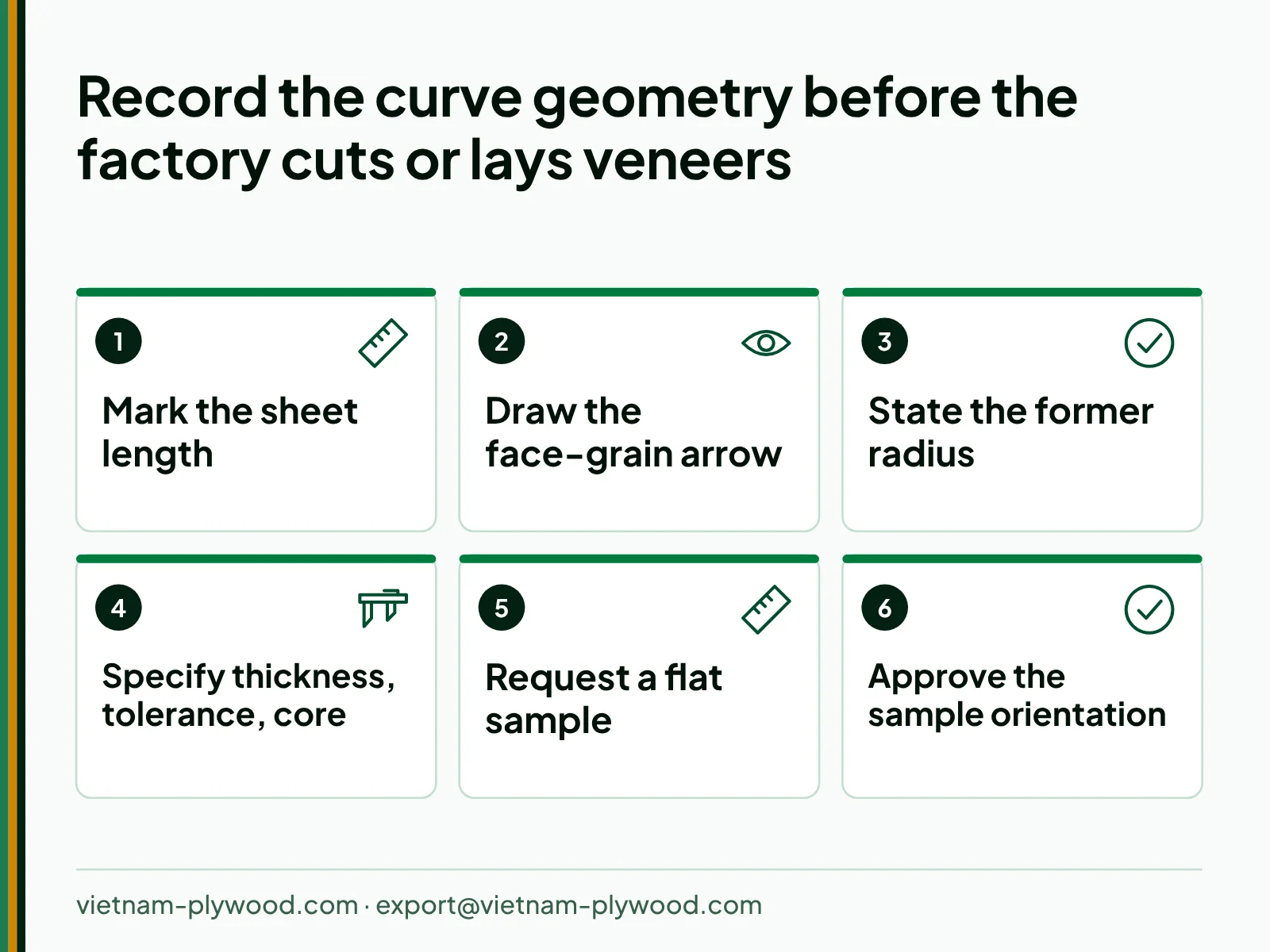
Write the bending axis as a dimensioned arrow on a sheet drawing, then state the former radius and the finished face. A phrase such as “long bend” alone leaves room for a reversed layup. Record the curve geometry before the factory cuts or lays veneers.
- Mark the sheet length and width in millimetres, with the face side identified.
- Draw the face-grain arrow and a separate arrow showing the direction of wrapping.
- State the former radius, arc length and whether the panel remains on a rigid frame.
- Specify thickness, tolerance, core, face grade, glue and emission class independently.
- Request a flat sample and a formed sample evaluated on the actual production former.
- Approve the sample orientation, edge appearance and finishing method in writing.
For example, a 1220 × 2440 mm blank can be oriented to wrap across the 1220 mm dimension or along the 2440 mm dimension. The two orientations create different cutting yields and grain appearances. The drawing should label the concave face, the exposed face and the finished part’s reference edge.
The USDA Forest Service (2021) discusses treatments that change wood-product shape in its specialty treatments chapter. For molded plywood, specify whether veneers are bonded on a curved form or a flat sheet is formed later.
Which factory line makes bendable plywood?
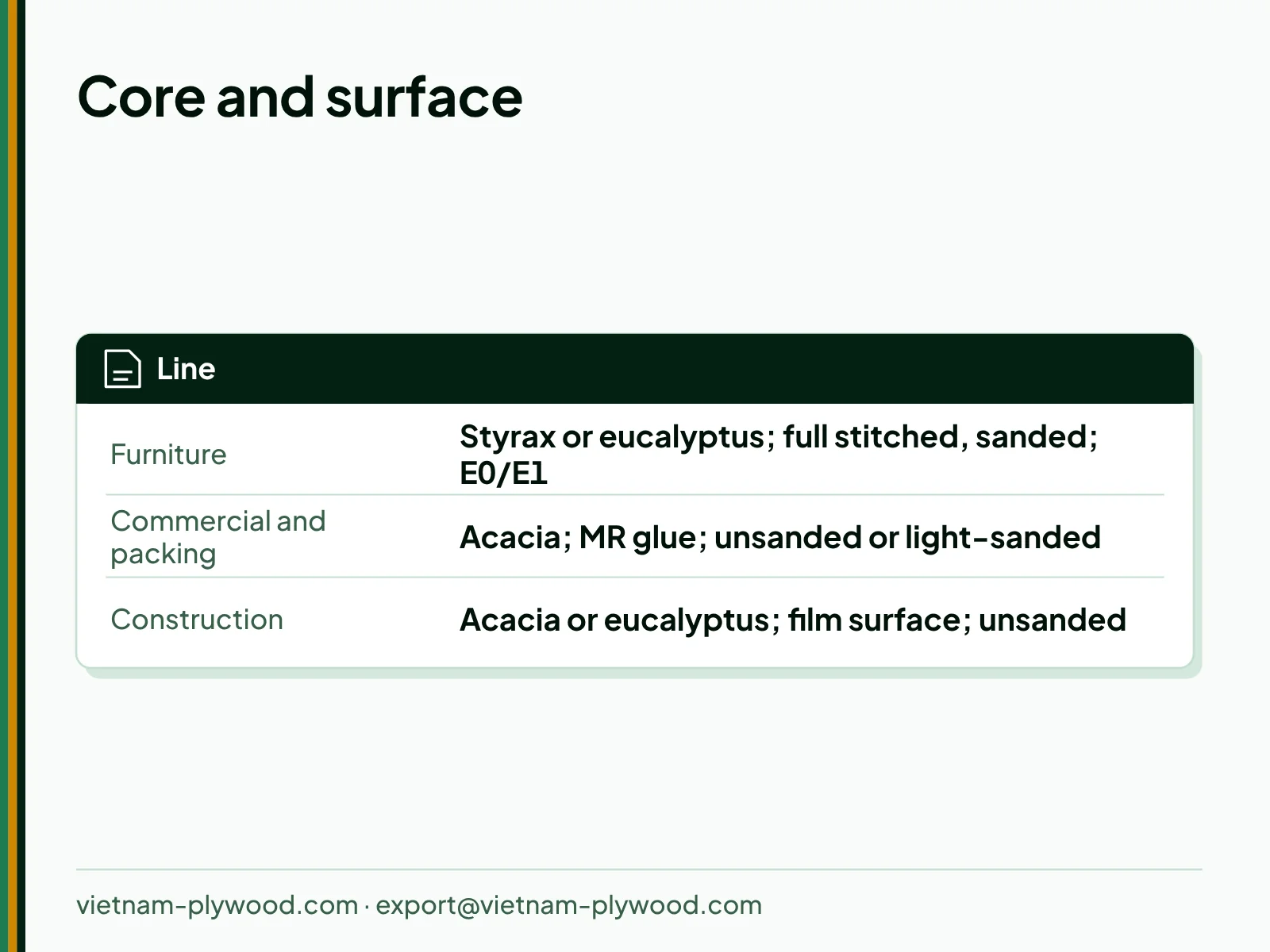
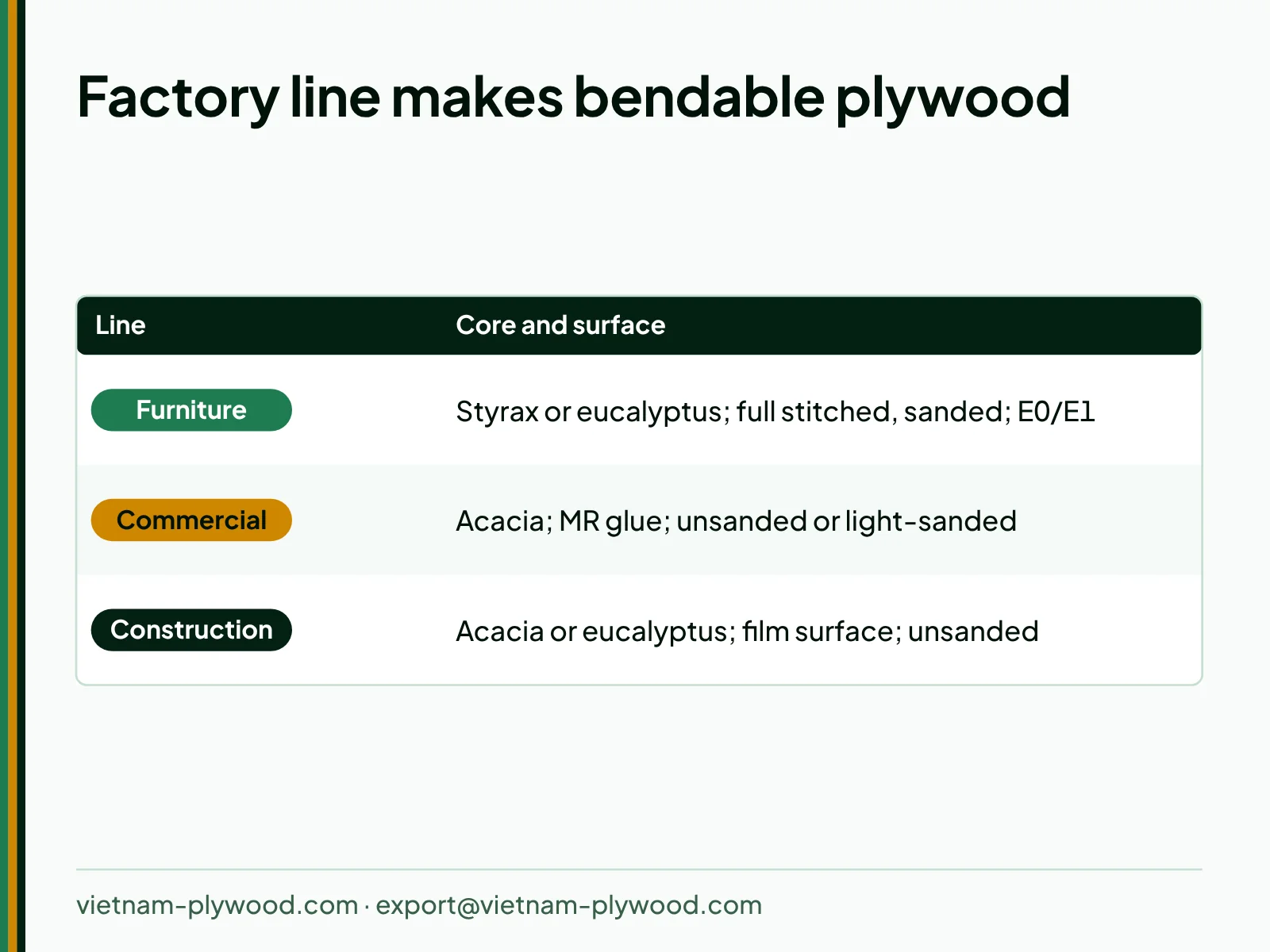
Our furniture line is the line to evaluate a thin curved-furniture panel specification, using styrax or eucalyptus cores with full-stitched construction and sanded surfaces. HCPLY assigns the order to the producing factory after reviewing the intended layup and forming trial. The other lines address different uses and should not be substituted solely because their nominal thickness matches.
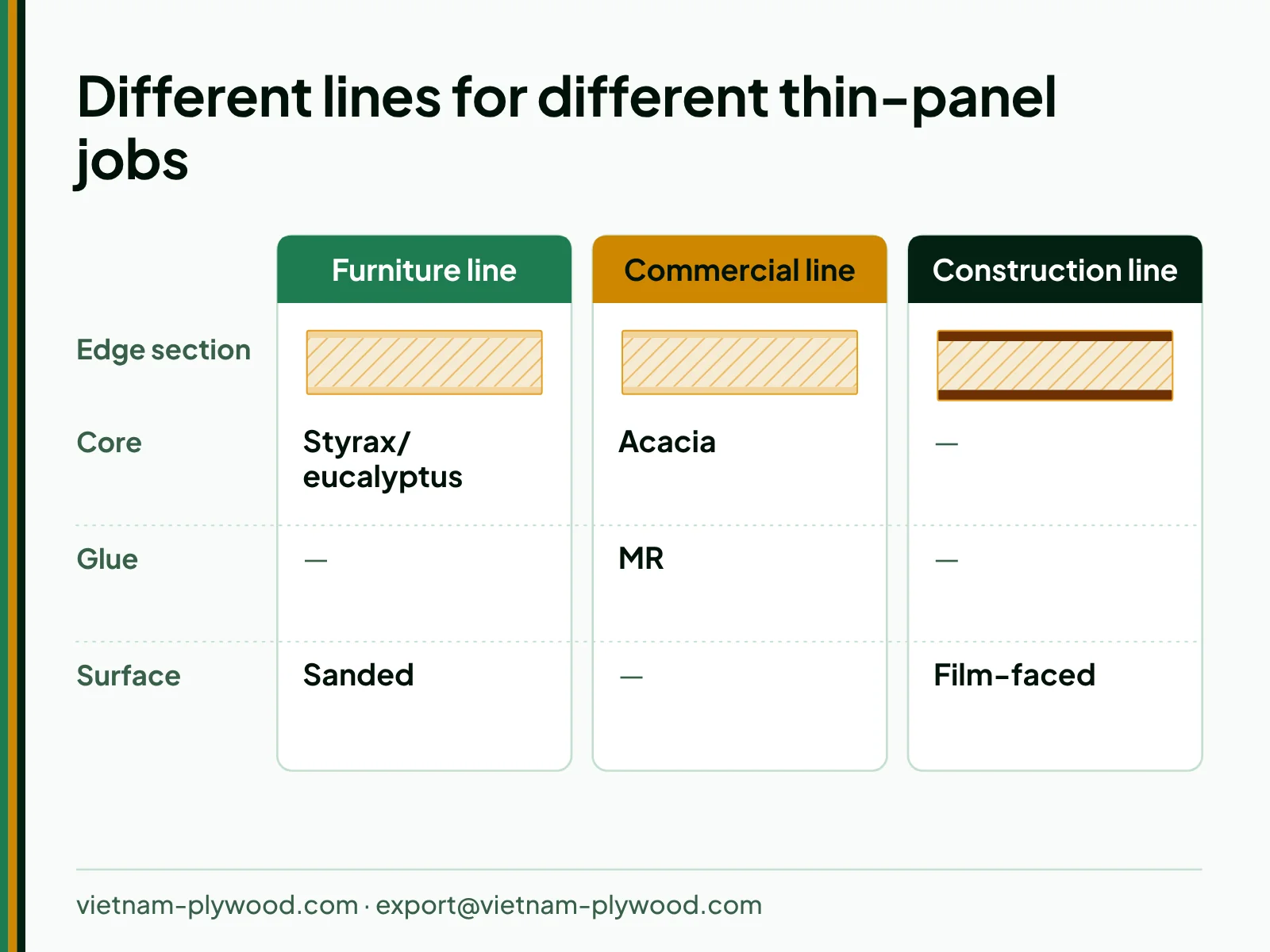
| Line | Core and surface | What the same thin-panel request becomes |
|---|---|---|
| Furniture | Styrax or eucalyptus; full stitched, sanded; E0/E1 | Curved furniture skin or flat cabinet component evaluated against the former |
| Commercial and packing | Acacia; MR glue; unsanded or light-sanded | Packing liner or general commercial panel, rather than the specified visible curved skin |
| Construction | Acacia or eucalyptus; film surface; unsanded | Formwork-facing panel, rather than an interior furniture bend skin |
The furniture specification can use bintangor, okoume, engineered veneer (EV), gurjan, pine, poplar, eucalyptus, birch or sapele faces; the core remains styrax or eucalyptus. Face veneer commonly measures 0.2–0.4 mm. Birch face grades are D/E/F, while the other listed face choices use A/B. A named face is not a claim that the entire core consists of that species.
Our furniture plywood page covers the flat-panel counterpart, while packing or commercial plywood explains the alternative line. HCPLY does not press medium-density fibreboard (MDF), oriented strand board (OSB), chipboard, blockboard, bamboo panels, or birch-core plywood. Those products should not be entered as substitute HCPLY builds.
Can bendable sheets ship with other furniture panels?
Yes. Bendable-sheet specifications can share a 40HC container with other furniture-line panels when the combined load remains within the 28.5 t payload limit. A mixed order should allocate pallets by core density, thickness and destination cutting schedule, rather than counting sheets alone.
At 18 mm and 1220 × 2440 mm, a full styrax-core 40HC reference load is 990 sheets, 53.05 m³ and 26.52 t. The eucalyptus-core counterpart is 795 sheets, 42.60 m³ and 27.69 t. These are reference full loads for those builds, not bend-radius or flexible-layup performance claims. See container loading calculations for the loading topic.
For a mixed container, request a pallet-by-pallet packing plan listing each approved item, its sheet count and its verified load weight. Check the combined load against 28.5 t. The furniture line’s flat panels and bend-oriented thin panels can therefore be planned together, with the actual packing arrangement checked at loading.
What does the producing factory check before release?
The producing factory should compare the approved orientation drawing with the actual veneer layup and a trial formed panel. An inspector can witness the face-grain direction, measure the panel dimensions and observe the sample bending around the agreed former. These checks turn a vague “flexible” label into acceptance criteria.
Thickness tolerance for a sanded furniture build is ±0.2 mm or ±0.3 mm as ordered; length and width tolerance is ±2 mm. Inspectors should record measurements across multiple positions and identify the exact ordered tolerance. The visual review should note face checking, open edges, core gaps and damage after bending.
Glue and emission are separate fields. A melamine adhesive specification is MR with a 12-hour boil condition; a phenolic specification is WBP with a 72-hour boil condition. E0 and E1 describe emission classes for furniture-line panels, not glue names. Any requested emission evidence is reviewed against the agreed build.
Where is flexible plywood used in curved furniture and fit-out?
Flexible plywood serves curved cabinet fronts, reception counters, display plinths, wall returns and decorative ceiling features supported by a suitable framework. These applications need a surface that follows a controlled radius and accepts a consistent finish. The load-bearing frame and fastening design remain separate engineering decisions.
A barrel-front cabinet may use a thin formed skin over ribs while its carcass, shelves and back stay flat. A reception counter may combine a curved front with sanded furniture plywood for its flat working surfaces. For flat cabinet backs, compare the wardrobe back-panel options rather than prescribing a bending panel everywhere.
Bending plywood for furniture should not be specified as structural sheathing, an exposed exterior panel or a tested fire-rated assembly on the strength of its trade name. The panel’s role, environment and fastening details must be shown in the project drawing. A visible interior skin and a structural curved member are different purchase specifications.
How do thickness and face finish affect the curve?
Thinner panels are the first candidates for tighter curves, but the actual limit comes from veneer construction and the forming trial. Thickness alone cannot establish a minimum radius. A smooth visible face also needs a core that does not print defects through the veneer after forming.
The furniture line offers common thicknesses including 3, 5, 9 and 12 mm within its broader 3–40 mm range. For curved skins, start with a thin trial; move to a thicker build only when the required curve and support design permit it. The 4 mm plywood and 2 mm and thinner plywood guides provide adjacent thickness comparisons, without implying that every thickness is a stocked flexible grade.
How does bendable plywood compare with other curved-panel methods?
Bendable plywood is suited to a thin curved skin; other methods can be more appropriate when the curve must carry loads or hold a complex shape independently. The selection should start from the finished part, not from the broad word “flexible.”
| Method | Forming route | Main limitation | Preferred use |
|---|---|---|---|
| Directional flexible plywood | Wrap a prepared thin panel around a former | Direction and radius need sample approval | Smooth supported cylindrical skins |
| Standard cross-laminated plywood | Form a gentle curve or use shaped backing | Greater resistance to tight curvature | Flat and shallow-curved cabinet components |
| Veneers bonded in a mold | Bond separate veneers while held to shape | Dedicated tooling and approval needed | Repeated shaped components |
| Kerf-cut board | Cut grooves into the hidden side | Grooves can weaken the substrate or affect finish | Concealed curved backing |
| MDF flexboard | Bend a scored fibreboard substrate | Different edge and finishing behavior | Painted non-structural interior substrates |
What should a buyer ask before ordering?
Ask for an approved bend-axis drawing, a sample formed on the intended radius and a written finish acceptance standard. These three items reveal whether the supplier and fabricator are describing the same part. The order should also state the destination port and mixed-container allocation.
For procurement scheduling, production is 15–45 days from the 30% deposit, set by order size, line loading and the contract. Balance is 70% against the scanned bill of lading, by telegraphic transfer (T/T) or irrevocable letter of credit (L/C) at sight. We ship FOB Hai Phong, or CFR (CNF) or CIF to your port; the production lead-time guide covers scheduling.
What paperwork follows the approved build?
The shipment document set records the commercial specification, quantities and dispatch details agreed for the order. It includes the commercial invoice, packing list, bill of lading, certificate of origin, phytosanitary and fumigation papers, plus applicable order certificate documents. EU lots include EUR.1 and the EUTR/EUDR file set; CIF shipments include insurance documents.
Factory-held FSC, CARB P2, ISO 9001 and CE documents, when applicable to the member factory and ordered build, are shown with factory details masked, on request. The emission certificate and agreed test reports belong in the order’s supporting evidence. After loading, the draft shipping documents come to you for approval.
What is the next step for a curved-panel order?
Send the drawing and formed-sample requirements before requesting the final quotation. Pricing follows the requested layup, thickness, face selection, tolerance, inspection work and order mix; a purpose-oriented flexible layup requires more development than a standard flat furniture panel. No fixed bendable-panel price is quoted without that written specification.
HCPLY can discuss the proposed build through Lucy at export@vietnam-plywood.com. Buyers can inspect goods at the producing factory and meet at the factory office. The following lines provide a starting format for the purchasing team:
Application: curved cabinet front / fit-out skin; former radius and drawing attached
Line or core: furniture line; styrax or eucalyptus core; proposed veneer layup attached
Glue: melamine MR or phenolic WBP, as specified
Emission: E0 or E1, as specified
Face and grade: named veneer; A/B (birch D/E/F); exposed-face grain arrow attached
Thickness and tolerance: ___ mm; sanded ±0.2 mm or ±0.3 mm as ordered
Size: ___ × ___ mm; bend axis and concave face marked on drawing
Quantity: ___ sheets; mixed furniture-panel allocation if needed
Destination port: ___
Next step: book a factory visit to witness the sample and agree the acceptance checks.