





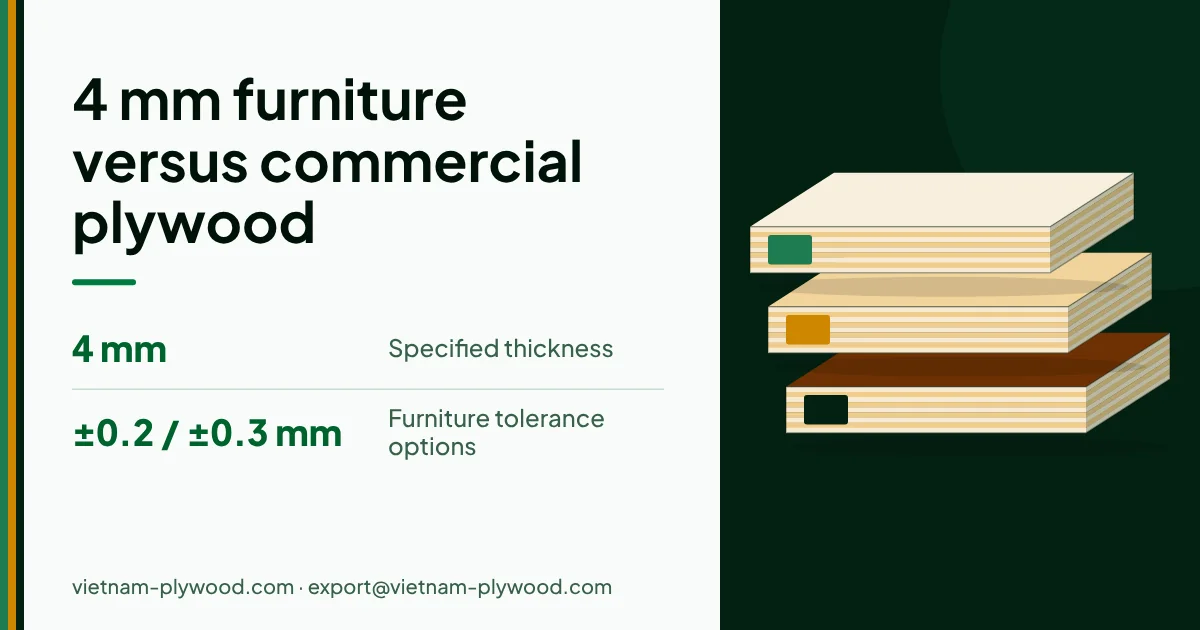
What sizes and tolerances can a 4mm plywood order specify?
4mm plywood is a thin, non-load-bearing sheet specified by face, core, glue, emission class and the receiving factory’s cutting requirements. HCPLY can discuss a 4 mm build on its furniture or commercial and packing line. Choosing an unsuitable core or surface can mean rejected cabinet backs, extra finishing expense and delayed assembly.
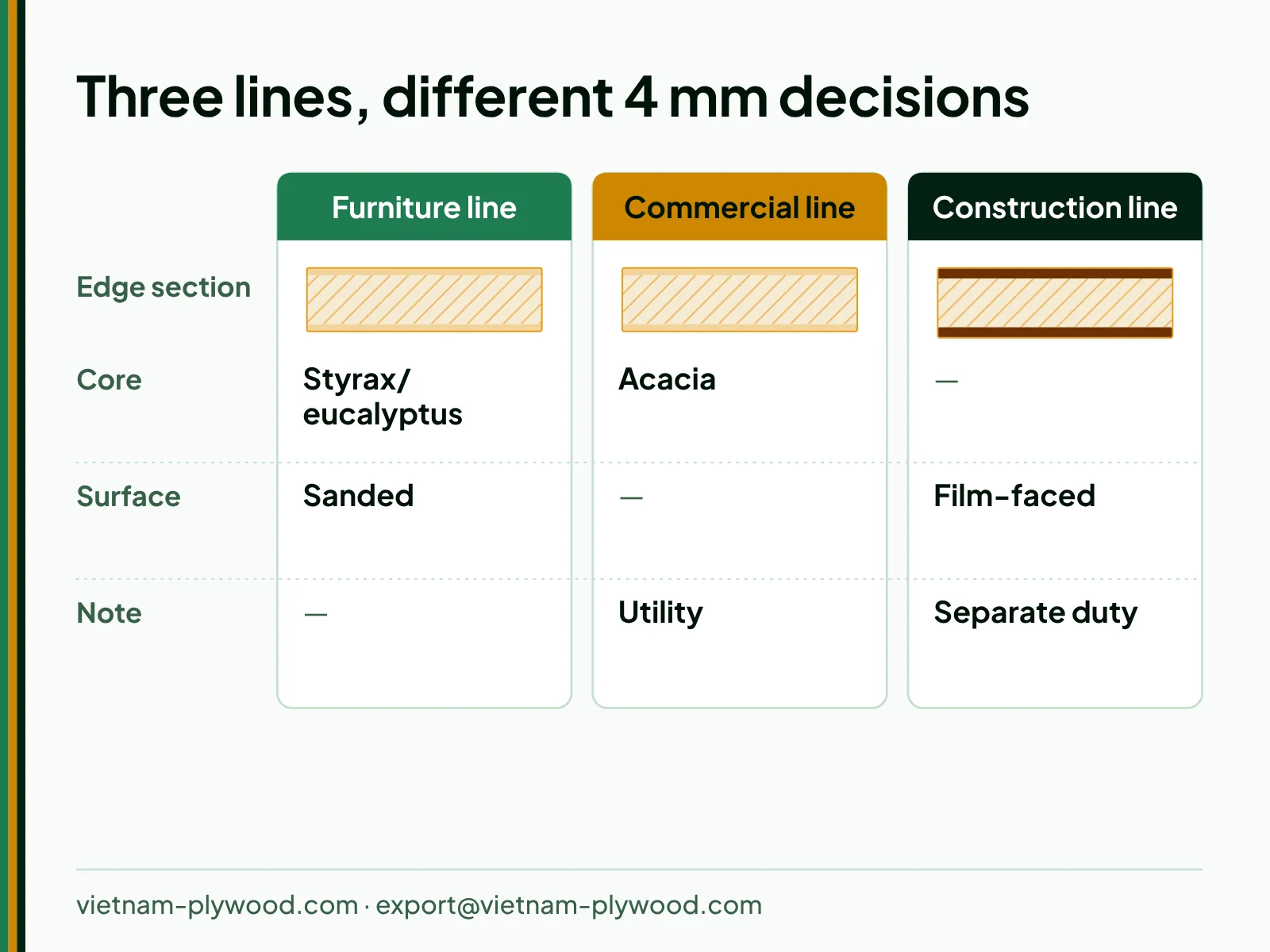
| Dimension or control | Our furniture line | Our commercial and packing line | Our construction line |
|---|---|---|---|
| 4 mm application | Cabinet backs, skins and fit-out liners | Utility liners and protective packing | Film-faced construction panels for a different duty |
| Core | Styrax or eucalyptus | Acacia | Acacia or eucalyptus |
| Surface | Sanded decorative veneer | Raw or light-sanded veneer | Phenolic or melamine film; anti-slip option |
| Thickness tolerance | ±0.2 or ±0.3 mm, as ordered | ±0.5 mm; packing ±0.5–1.0 mm | ±0.5 mm |
| Length and width tolerance | ±2 mm | ±2 mm | ±2 mm |
| Listed sheet formats | 1220×2440, 1250×2500, 1220×2135, 1220×1830 mm | Same listed formats | Same listed formats |
| Other listed formats | 915×2440, 915×2135, 915×1830 mm | Same listed formats | Same listed formats |
Custom cutting is available. A request for 8 x 4 plywood 4mm normally refers to the nominal 1220×2440 mm format. The metric dimensions belong on the purchase specification rather than an approximate imperial description.
For neighbouring thickness choices, see 5 mm plywood and the thin plywood range. A 4 mm ply sheet offers little reserve against bending during handling, so the chosen support and fixing method matters.
What is the difference between furniture-line and commercial-line 4 mm sheets?
Our furniture line builds for a visible or finish-ready surface and closer thickness control. Our commercial and packing line builds for utility coverage where a decorative face is unnecessary. The construction line presses film-faced panels for formwork duty rather than substituting a utility 4 mm sheet for a cabinet skin.
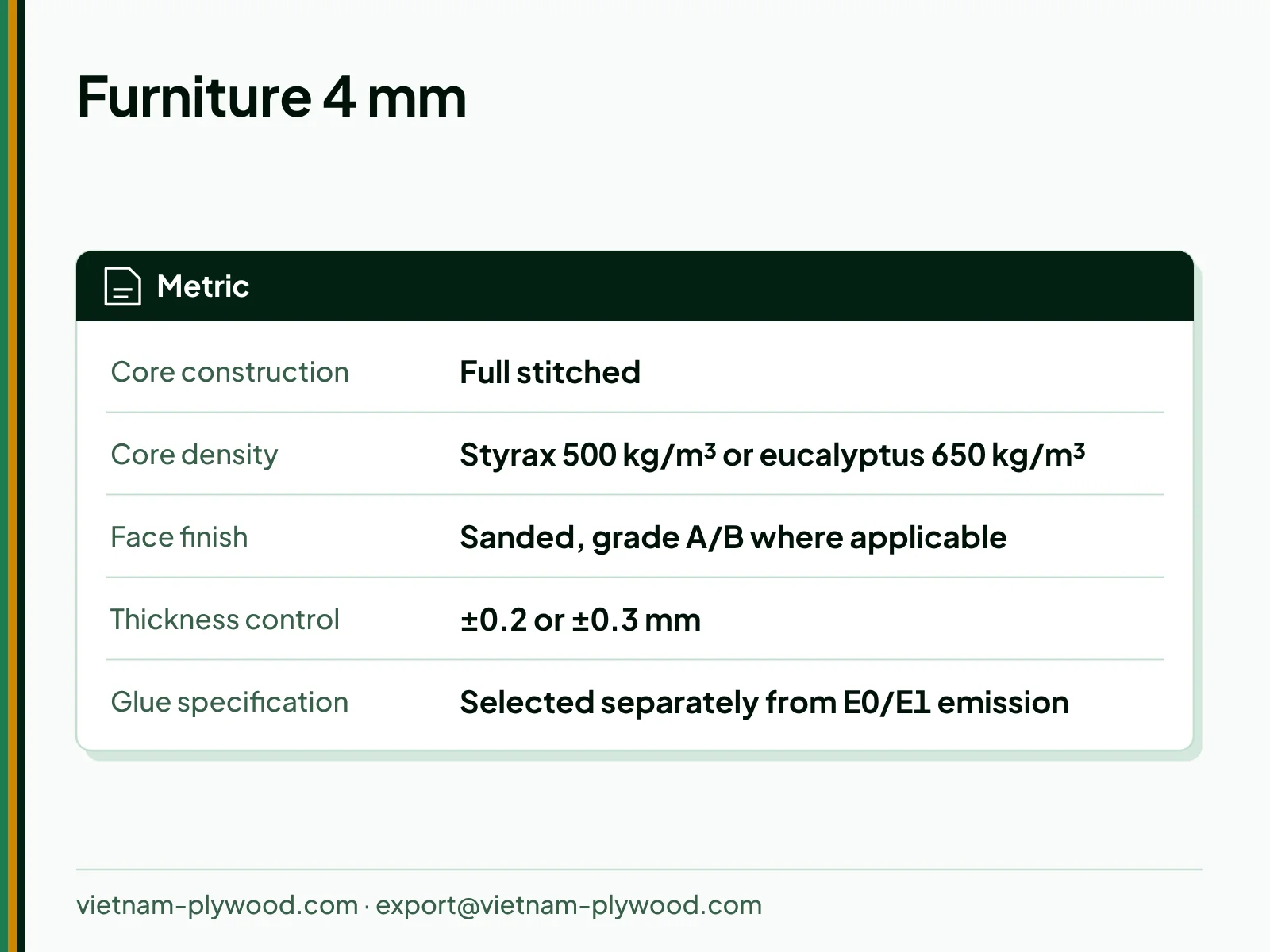
| Metric | Furniture 4 mm | Commercial 4 mm | Verdict by use |
|---|---|---|---|
| Core construction | Full stitched | Selected commercial construction | Furniture for a clean back or skin |
| Core density | Styrax 500 kg/m³ or eucalyptus 650 kg/m³ | Acacia 580 kg/m³ | Select by handling weight and substrate needs |
| Face finish | Sanded, grade A/B where applicable | Unsanded or light-sanded | Furniture for visible or coated faces |
| Thickness control | ±0.2 or ±0.3 mm | ±0.5 mm | Furniture for close-fitting grooves |
| Glue specification | Selected separately from E0/E1 emission | Melamine moisture-resistant (MR) | Match bonding requirement to exposure |
| Typical buying decision | Cabinet and fit-out components | Packing and utility lining | Neither is a structural panel |
The furniture build carries extra preparation in stitching, sanding and surface selection. Commercial plywood prioritises a practical panel for secondary surfaces. A buyer comparing commercial plywood 4mm with a furniture skin should compare the complete specification, not the thickness alone.
The commercial and packing plywood overview explains the utility category; wardrobe back-panel options addresses cabinet-specific alternatives.
What is 4 mm plywood used for?
4 mm plywood is used for supported cabinet backs, furniture skins, fit-out liners, drawer-related non-structural panels and protective packing faces. It works where a frame, groove or backing provides support. Unsupported shelves, floor decking and load-bearing formwork require a separate engineering decision.
Cabinet makers should specify groove fit, visible-face expectations and the assembly method. For a back that will be hidden, an unsanded utility face can be appropriate; a finished interior may justify a sanded decorative veneer. Fit-out makers should state whether a panel will be painted, veneered later or left visible.
Packing buyers often value coverage and handling over appearance. A 4mm plyboard request should identify plywood explicitly: the word plyboard can be used loosely in purchasing correspondence.
For tighter curves or specialised bending, compare the bendable plywood guide. A thinner sheet is not automatically a purpose-made flexible panel.
Which faces and cores can a 4 mm sheet use?
The face names the product; the core determines its density and much of its handling weight. Our furniture line uses styrax or eucalyptus cores, while the commercial and packing line uses acacia. A decorative face should be specified independently of the core.
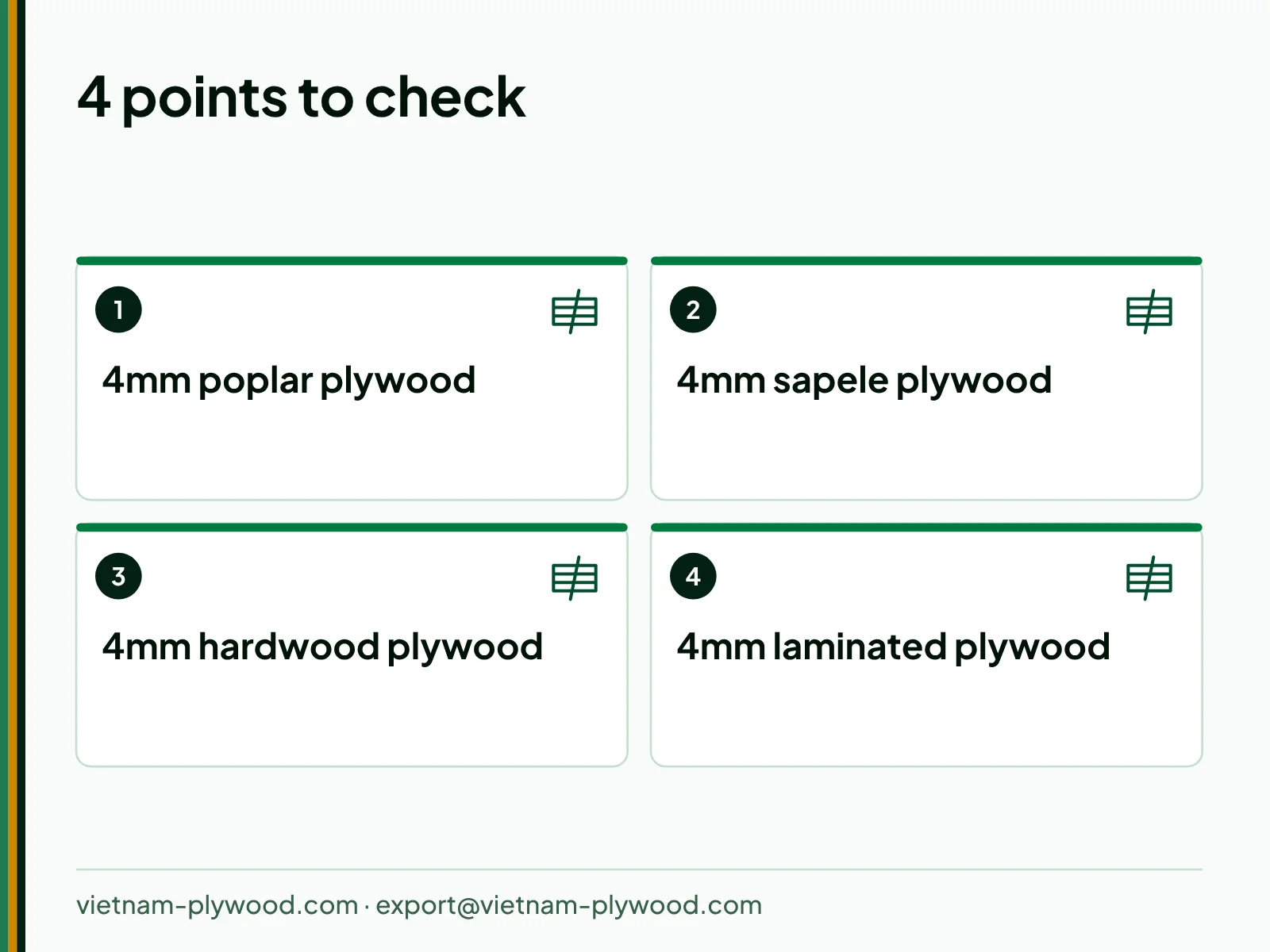
Available face names include bintangor, okoume, engineered veneer (EV), gurjan, pine, poplar, eucalyptus, birch and sapele. Matt means an unfaced raw core. Common face veneer thickness is 0.2–0.4 mm; face grades are A/B, except birch faces, which use D/E/F. Thus 4mm poplar plywood can describe a poplar-faced sheet without implying a poplar core.
The same distinction applies to 4mm sapele plywood and 4mm hardwood plywood. Buyers should name the required visible species, the core and the face grade separately. A birch face does not turn the sheet into birch-core plywood; we do not press birch-core plywood.
A 4mm laminated plywood inquiry also needs clarification: a decorative veneer face is different from a melamine, high-pressure laminate (HPL) or other laminate overlay. We explain those surface categories but do not offer melamine-, HPL- or laminate-faced plywood as an HCPLY product line.
Does 4 mm plywood stay flat?
A 4 mm sheet can stay serviceably flat when its veneer balance, moisture condition, stacking and end-use support match the written specification. Thin panels respond more visibly to uneven moisture exposure and unsupported storage than thicker sheets. No flatness figure is assigned without an agreed inspection method.
At the producing factory, a buyer can witness a practical check: place sampled panels on a known flat support, inspect edge lift and twist, and record the agreed measuring method. Check both faces for uneven appearance, inspect exposed edges for gaps and compare thickness readings across the sheet. Record the sample location and batch identification alongside any observations.
Veneer construction also matters. Full stitched cores have the most controlled internal arrangement in our core-construction hierarchy, followed by stitched outer layers with edge-trimmed inner layers, finger-jointed and loose-laid cores. An attractive face cannot compensate for poor core assembly.
For receiving inspection, support the panel evenly before judging bow or twist. A sheet lifted at one corner can flex under its own weight, so a hand-held impression is not a reliable acceptance test. Agree on the flatness acceptance rule and moisture measurement method before production.
How should glue and emission be written on the specification?
Glue and formaldehyde emission are separate specification fields. Melamine MR glue has a 12-hour boil designation; phenolic weather and boil proof (WBP) glue has a 72-hour boil designation. Those designations do not themselves establish an emission class or a structural rating.
For furniture production, specify E0 or E1 emission class as required by the agreed build. The wider classification includes E2. Where a US-bound hardwood plywood order falls under Toxic Substances Control Act (TSCA) Title VI, third-party certification and applicable compliance documentation need to be addressed in the purchasing file.
The US Environmental Protection Agency’s 2025 Code of Federal Regulations, 40 CFR Part 770, states: “This part contains formaldehyde emission standards, testing and certification provisions, and other requirements for the manufacture (including import), distribution, and sale of composite wood products, component parts that contain composite wood products, and finished goods that contain composite wood products.” See the official regulation.
Factory-held FSC, CARB P2, ISO 9001 and CE documents, plus EUDR/EUTR documents, are shown with factory details masked, on request. The applicable order’s emission certificate or test report must match the producing factory and agreed build.
How is 4 mm plywood packed against breakage in a mixed container?
Thin sheets need flat support, protected corners and controlled movement within a mixed container. The loading plan should keep the 4 mm packs supported across their footprint, prevent concentrated pressure from heavier goods and stop pallets shifting during transport.
- Identify each 4 mm pack by core, face, size, thickness and destination lot.
- Support the full panel footprint on a suitable pallet or continuous bearing surface; avoid unsupported overhang.
- Protect edges and corners, then restrain the stack without bending its top sheets.
- Separate thin-sheet stacks from heavier panels with load-bearing protection designed for the actual weights.
- Check stack stability and restraint at loading, photograph the final arrangement and reconcile counts with the packing list.
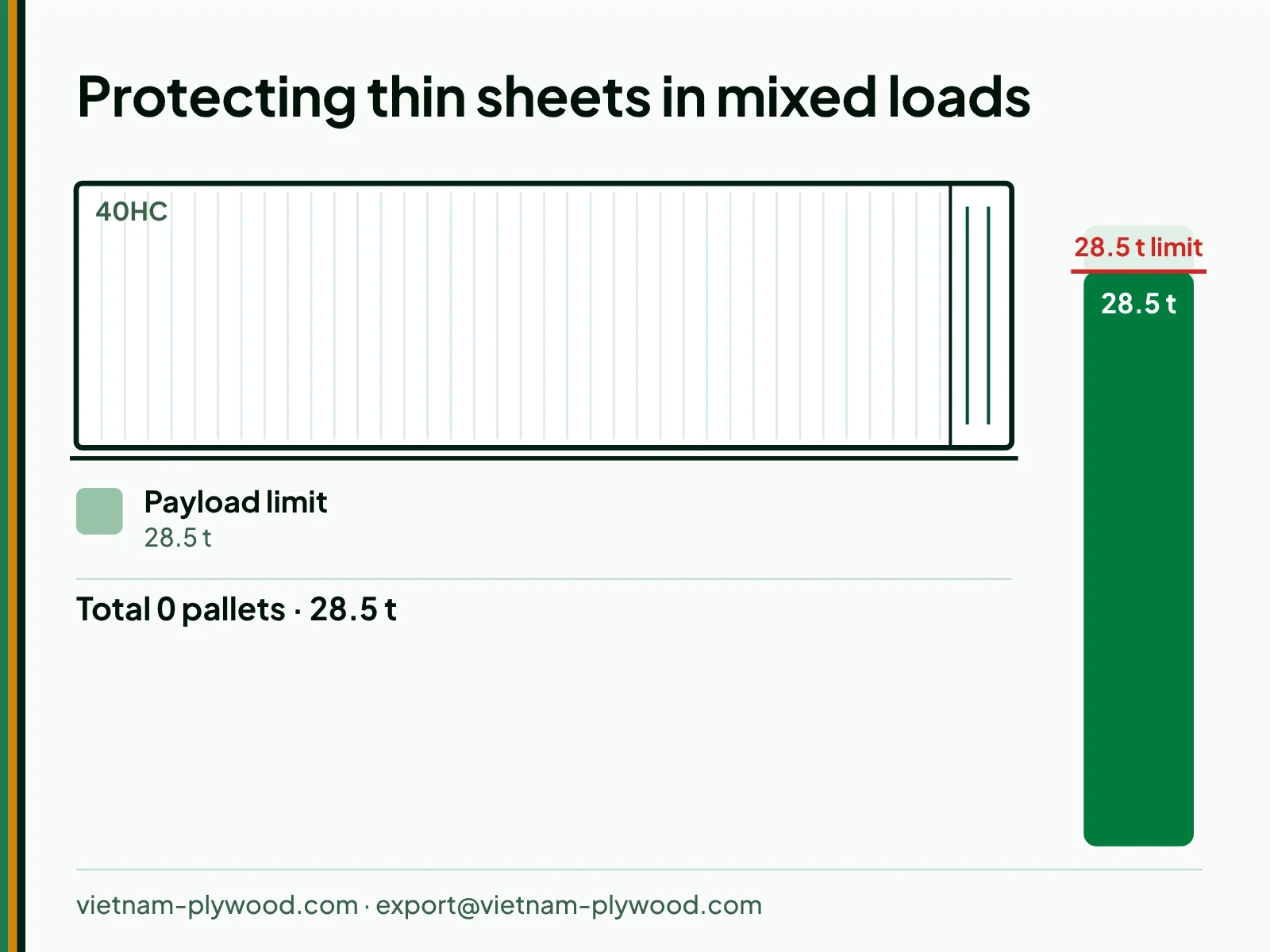
Our minimum order is one 40HC, and specifications can be mixed within its 28.5 t payload limit. The exact 4 mm sheet weight and pallet count need a build-specific calculation; the provided loading lookup covers other thicknesses, not 4 mm. For example, the established 1220×2440 mm, 5 mm reference is 7.44 kg per styrax sheet and 8.63 kg per acacia sheet, before any added packing weight. These are 5 mm references, not claimed 4 mm weights.
See container loading guidance for the load-planning topic. A mixed shipment should be checked by total mass, pallet footprints and handling sequence rather than sheet count alone.
What should an inspector witness before loading?
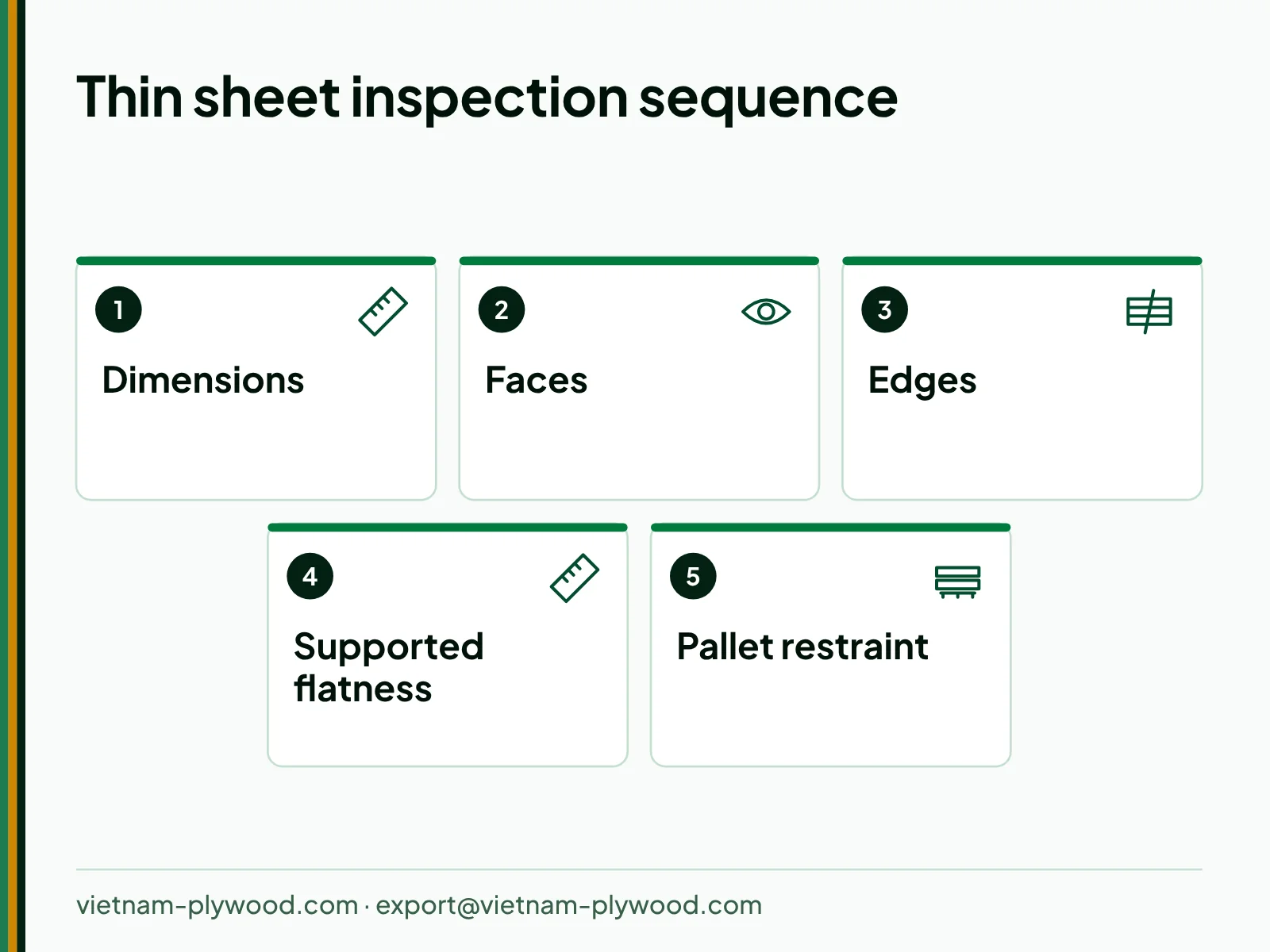
An inspector should compare the actual 4 mm panels against the signed specification and record the observed condition. Start with dimensions and face grade, then inspect exposed edges and supported flatness. Finish by checking pallet protection, pack identity and loading restraints.
A practical inspection record includes thickness measurements at agreed positions, length and width checks, surface defects, veneer joints, edge condition and moisture observations using an agreed method. Sample selection should cover different pallet positions rather than only the top of one stack. Photograph both acceptable and rejected examples with a reference scale.
For the furniture line, pay particular attention to sanding consistency and close-fitting dimensions. For the commercial line, look at utility-face suitability and whether the chosen core construction matches the purchase description. The construction line’s film-faced build calls for different surface and bonding checks; its anti-slip film is a separate use case.
Buyers can visit the factory office and inspect goods at the producing factory. HCPLY coordinates the specification, on-site quality control, documentation and loading from the applicable factory.
What should a 4 mm quotation compare?
A 4 mm quotation should compare the same dimensions, core, face, grade, glue, emission class, thickness tolerance and packing method. The furniture build costs more than a basic commercial build when it requires full stitching, selected decorative veneer and sanding. A tighter tolerance adds manufacturing and rejection-control work.
The largest practical price drivers are core construction and face selection, followed by finishing and tolerance requirements; protective packing and mixed-load complexity also affect the order. There is no published 4 mm-specific price in this quotation framework. Request a written quote against the precise build rather than transferring a starting price from another grade.
We ship FOB Hai Phong, or CFR (CNF) or CIF to your port. Factory lead time runs 15–45 days from receipt of the 30% deposit; the exact figure depends on order size, line loading and what the contract fixes. The 70% balance is against the scanned bill of lading (B/L), by telegraphic transfer (T/T) or irrevocable letter of credit (L/C) at sight.
Samples cost nothing: a first-time buyer pays the courier, and that charge comes off the first confirmed order. One supplier, several plywood types explains the related specification families.
Which export documents identify the 4 mm lot?
The packing list identifies the 4 mm lot’s count and packaging, while the commercial invoice identifies its traded description. The shipment file also includes the B/L, certificate of origin, phytosanitary and fumigation papers, plus insurance under CIF.
For European Union lots, the certificate of origin can be EUR.1 and the EUTR/EUDR file set is included. Order-specific certificate documents can include an FSC claim on sales documents, emission certificate and test reports for the agreed build. After loading, the draft shipping documents come to you for approval.
Keep the line, core, face and size wording consistent between the specification, pallet marks and shipping papers. The producing factory ships directly, with HCPLY handling the export process FOB Hai Phong.
What specification should a buyer send?
A complete inquiry gives the factory enough information to choose the appropriate production line and plan protective packing. State the final application and whether the sheet will be visible, painted or supported in a groove. For thin sheets, include the receiving inspection rule and any stacking restrictions.
A request using plywood 4mm, plywood 4 mm or 4mm plywood 2440 x 1220 should be normalised to one metric specification before pricing. For 4 mm hardwood ply, the face species and core species must both appear; the word hardwood alone is insufficient.
Application: supported cabinet backs / utility liners / other non-structural use
Line or core: furniture—styrax or eucalyptus / commercial—acacia
Glue: MR melamine or agreed phenolic WBP specification
Emission: E0 / E1 / other agreed requirement
Face and grade: species, A/B (birch D/E/F), or matt raw
Thickness and tolerance: 4 mm; ±0.2 / ±0.3 / ±0.5 mm as applicable
Size: 1220 × 2440 mm or specified listed/custom cut size
Quantity: sheets and mixed-container breakdown; minimum one 40HC
Destination port: [port and country]
Request the 4 mm specification sheet from Lucy at export@vietnam-plywood.com through the contact page.