





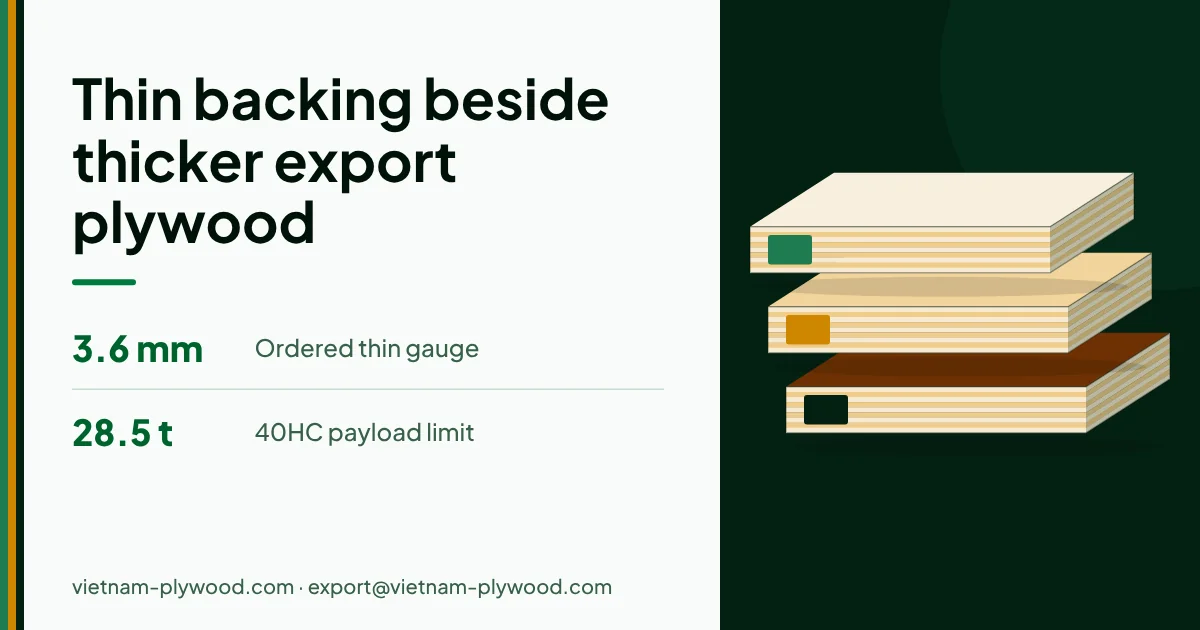
HCPLY can build 3.6 mm ply for UK cabinet backs, supported drawer bases and door skins, then plan it alongside thicker panels in a mixed container. A poorly specified face, core or finished thickness can cause rejected parts, machining delays and avoidable replacement costs. The order should identify the producing line, intended assembly and measurable acceptance limits before production.
Which sizes and thicknesses can the three lines build?
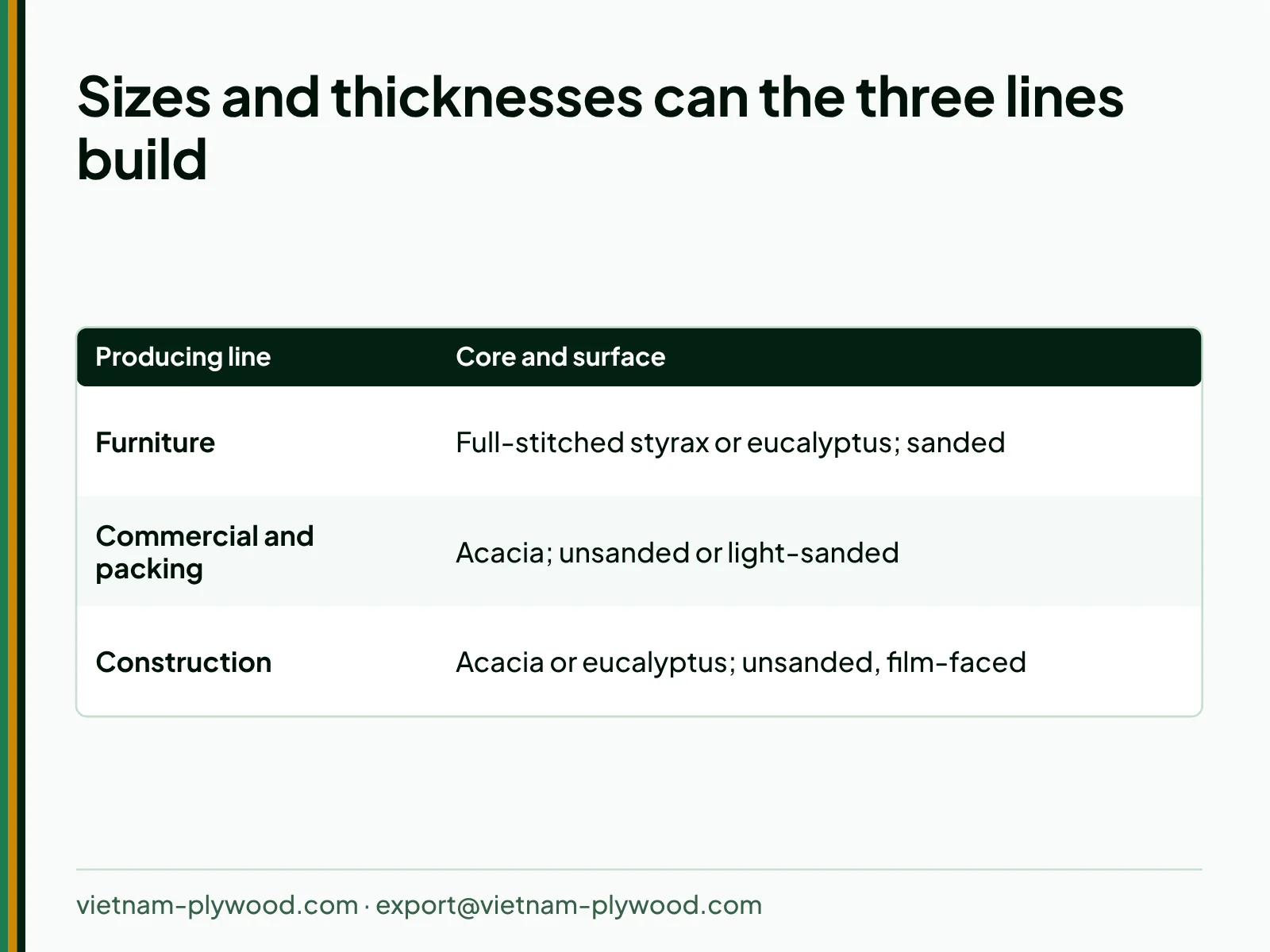
The three lines share a 3–40 mm manufacturing range, while their core preparation and surface finish differ. A 3.6 mm target is within that range; it should be written explicitly rather than treated as interchangeable with the common 3 mm or 5 mm options.
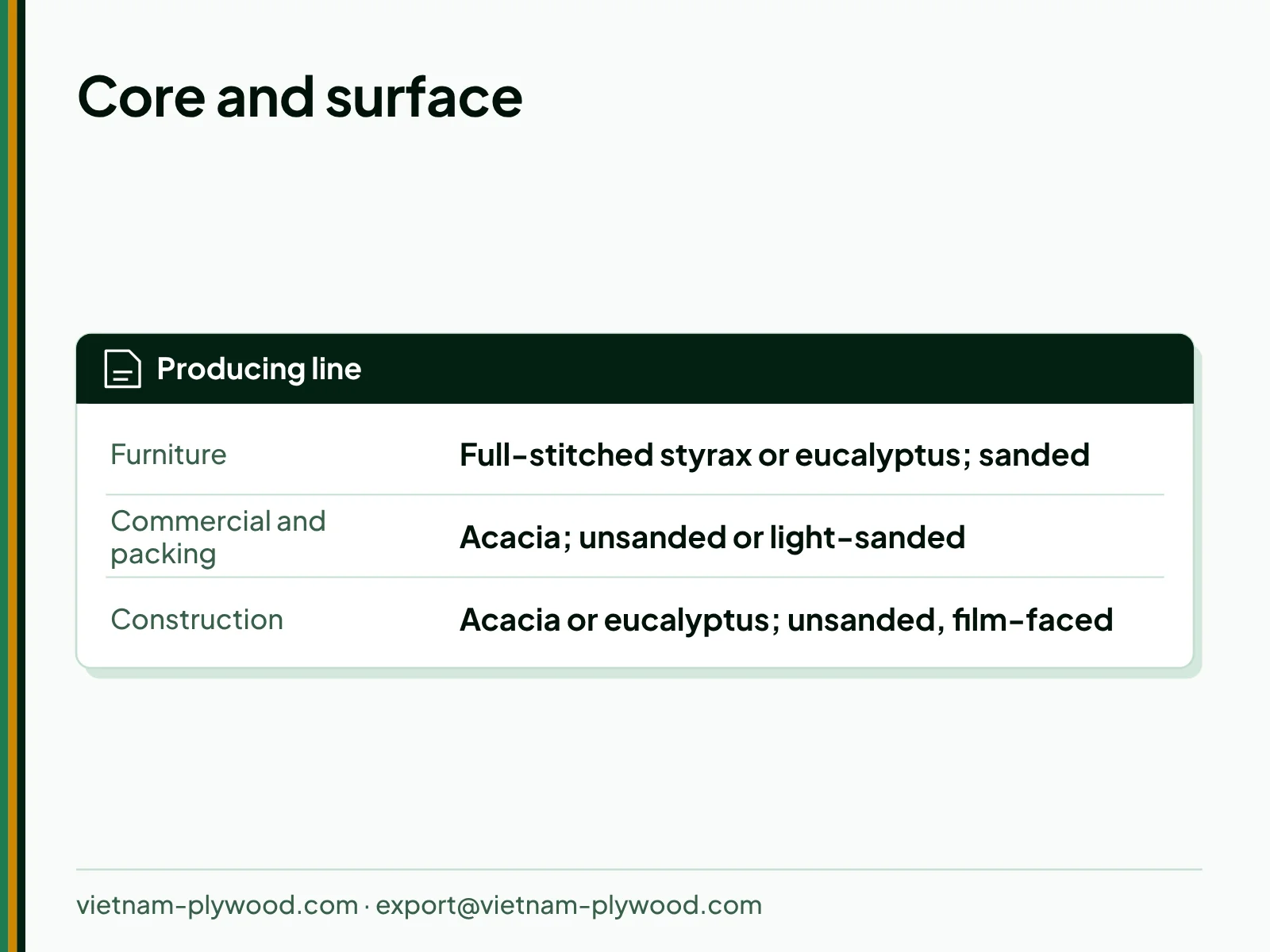
| Producing line | Core and surface | Ordered 3.6 mm tolerance | Sheet-size choices |
|---|---|---|---|
| Furniture | Full-stitched styrax or eucalyptus; sanded | ±0.2 or ±0.3 mm | 1220×2440, 1250×2500 mm and other listed cuts |
| Commercial and packing | Acacia; unsanded or light-sanded | ±0.5 mm commercial; ±0.5–1.0 mm packing | 1220×2440, 1220×2135, 1220×1830 mm and other listed cuts |
| Construction | Acacia or eucalyptus; unsanded, film-faced | ±0.5 mm | 1220×2440, 1250×2500 mm and other listed cuts |
All dimensions are millimetres. Additional sheet formats are 915×2440, 915×2135 and 915×1830 mm; custom cutting is available. Length and width tolerance is ±2 mm. A furniture backing order should state the cut orientation as well as nominal dimensions, especially where parts feed an automated nesting programme.
The thin plywood supplier overview places this gauge beside other thin panel options. The 4 mm plywood and 5 mm plywood pages help purchasing teams compare adjacent nominal thicknesses before approving a drawing.
What is 3.6 mm ply used for in the UK?
3.6 mm ply is a thin plywood gauge used for cabinet backing, supported drawer bottoms, door skins and light interior fit-out components. In each case, the assembly provides much of the restraint against bending. The purchasing decision begins with the joint, fastening method and visible face, rather than the thickness label alone.
Cabinet backs need predictable thickness where the sheet enters a groove or rebate. An unsanded backing can suit a concealed position; a visible cabinet interior calls for a cleaner, controlled face. Drawer bottoms need a defined support arrangement, especially across wider drawers or where the contents are heavy. Door skins need surface consistency and a bonding process suited to the door’s core and press cycle.
A thin sheet also has a different handling risk from a thicker cabinet side. Pallet support, corner protection and handling during unloading should be agreed before packing. For extremely light applications, see 2 mm and thinner plywood; for curved components, use the separate bendable plywood guide.
Which face and core are used in 3.6 mm plywood?
Our furniture line uses full-stitched styrax or eucalyptus cores, while our commercial and packing line uses acacia. The named face is a separate specification field: a bintangor, okoume, engineered veneer (EV), pine or eucalyptus face does not identify the core underneath.
For a visible drawer interior or cabinet back, furniture-grade sanding and a selected face can reduce finishing preparation. Common face veneer thickness is 0.2–0.4 mm. A/B face grades are available for the applicable veneers; birch faces use D/E/F grading instead. The same face can cover different core constructions, so the written order must identify both.
Styrax has a reference density of 500 kg/m³, acacia 580 kg/m³ and eucalyptus 650 kg/m³. These figures describe the core species, not the surface veneer. A denser core increases sheet mass at the same size and nominal thickness; that matters to a furniture maker handling large numbers of thin panels.
Our construction line instead makes phenolic or melamine film-faced panels with acacia or eucalyptus cores. It is the appropriate line for film-faced construction stock, rather than the first choice for a decorative door skin. For the unsanded acacia route, see commercial and packing plywood.
What is the true thickness of 3.6 mm ply?
True thickness is the measured finished panel thickness against the ordered 3.6 mm nominal target. On a sanded furniture order with ±0.2 mm tolerance, the acceptance band is 3.4–3.8 mm; with ±0.3 mm it is 3.3–3.9 mm. The commercial ±0.5 mm band is 3.1–4.1 mm.
Those bands follow directly from the ordered nominal dimension and stated manufacturing tolerances. They are not substitutes for a drawing’s slot clearance or a receiving-inspection sampling plan. A cabinet maker cutting a narrow back-panel groove should select the tolerance first, then validate the groove against measured samples.
Specify where the gauge is taken, how many positions are checked and whether the recorded value is before or after any customer-applied finish. A nominal 3.6 mm sheet with an unspecified tolerance can be unsuitable for a production slot designed around a narrower band. The purchase order should use one acceptance band throughout the sample, inspection and delivery records.
Is 3.6 mm hardwood plywood suitable for drawer bases, backing and door skins?
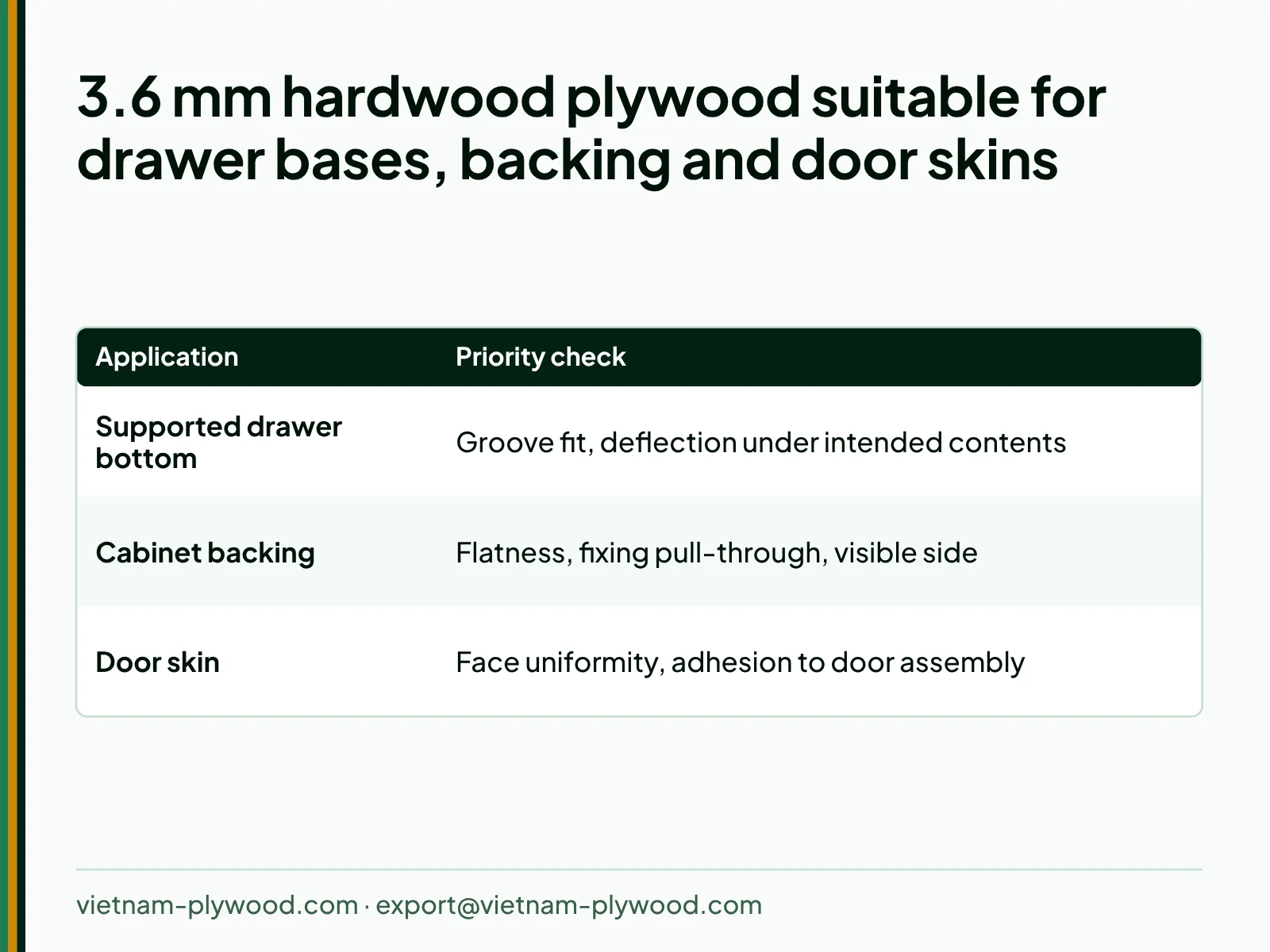
It is suitable as a candidate material when the panel is supported and the final assembly passes the buyer’s own tests. The three applications impose different demands: drawer bases face load and deflection, backing faces fastening and racking, while door skins face appearance and bonding.
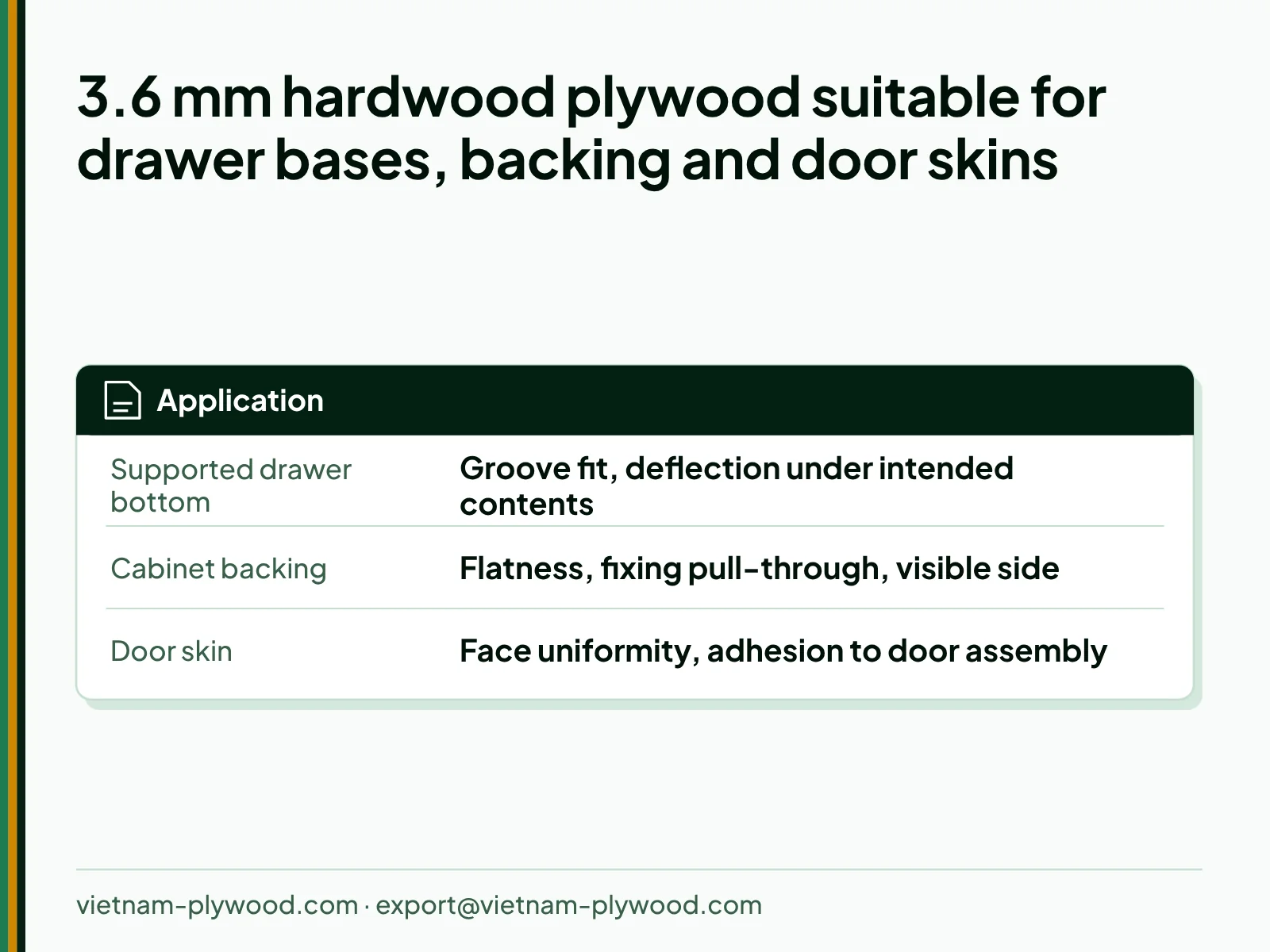
| Application | Priority check | Preferred starting build | Approval decision |
|---|---|---|---|
| Supported drawer bottom | Groove fit, deflection under intended contents | Sanded furniture core, chosen face | Approve after assembled-drawer testing |
| Cabinet backing | Flatness, fixing pull-through, visible side | Furniture for visible backs; commercial for concealed backs | Approve against fixing and finish samples |
| Door skin | Face uniformity, adhesion to door assembly | Sanded furniture line, selected face grade | Approve after pressing and finishing trials |
A hardwood face does not by itself establish a structural performance grade. Where a buyer’s specification requires structural classification, obtain an accepted test report for the agreed build. The same principle applies to any proposed marine designation or BS 1088 reference.
Do not substitute a film-faced construction panel for a decorative face simply because the nominal thickness matches. Surface treatment, intended glue exposure and the next manufacturing operation are distinct requirements. The line decision belongs in the purchase specification.
How should glue and emissions be written on the order?
Glue type and emission class are two separate order fields. Melamine moisture-resistant (MR) glue has a 12-hour boil description; phenolic weather-and-boil-proof (WBP) glue has a 72-hour boil description. These describe adhesive systems and are separate from E0, E1 and E2 emission classes.
The furniture line offers E0/E1 emission options. For a UK furniture component, specify the buyer’s required emission class and the glue system independently. A stronger water-resistance description should not be read as an emission certificate, nor does an emission class establish a weather-exposure rating.
CARB Phase 2 and TSCA Title VI refer to US emission requirements with third-party certification. They should be addressed only when the destination specification actually calls for them. Member-factory FSC, CARB P2, ISO 9001 and CE documentation, together with EUDR/EUTR files, is shown with factory details masked, on request.
Can 3.6 mm sheets ship with thicker furniture or construction panels?
Yes. A 40HC container can mix specifications within its 28.5 t payload limit, provided the final pallet and mass plan is checked. The key decision is how much mass the thicker panels consume before thin backing sheets are allocated to the remaining space.
For a grounded reference, at 1220×2440×18 mm the full-container lookup gives 990 styrax sheets weighing 26.52 t, 880 acacia sheets weighing 27.35 t, or 795 eucalyptus sheets weighing 27.69 t. Those are separate full-load reference cases, not quantities to add together. Their sheet weights are respectively 26.79 kg, 31.08 kg and 34.83 kg.
A mixed-order worksheet starts with the actual quantity of each thicker build. Multiply each sheet count by its corresponding mass, add pallet and packing mass, then compare the total with the payload limit. For the 3.6 mm portion, calculate mass from its agreed dimensions and core density; final packing dimensions must also fit the container.
The reference lookup provides full-load quantities at 3, 5 and 6 mm, but it does not provide a 3.6 mm pallet stack count. A mixed 3.6 mm loading figure therefore needs the actual pallet layout and measured packed height. The detailed container-loading method covers pallet arithmetic and load planning.
How do the three core choices affect container planning?
Core density changes mass even when the face and dimensions match. At the same nominal 3.6 mm gauge, eucalyptus-core panels are heavier than acacia-core panels, which are heavier than styrax-core panels. That difference affects handling and the remaining payload available for thicker stock.
The factory’s 1220×2440 reference uses 18 pallets for styrax, 16 for acacia and 15 for eucalyptus. The corresponding stack-height references are 1000 mm, 1000 mm and 970 mm. These reference constraints are useful when testing a mixed specification, but a split load needs its own pallet distribution.
For example, an order containing 18 mm cabinet panels and thin backing should reserve the thicker pallets first, then allocate the thin stock by both mass and physical footprint. Film-faced construction pallets must be identified separately, including their surface protection requirements. The final packing list should show each thickness and core as a distinct line item so receiving teams can reconcile the shipment.
What can an inspector check at the producing factory?
An inspector can measure thickness, sheet dimensions, face condition and the ordered core construction before loading. HCPLY arranges the visit at the producing factory, where the buyer can inspect the actual goods rather than relying on a generic display sample.
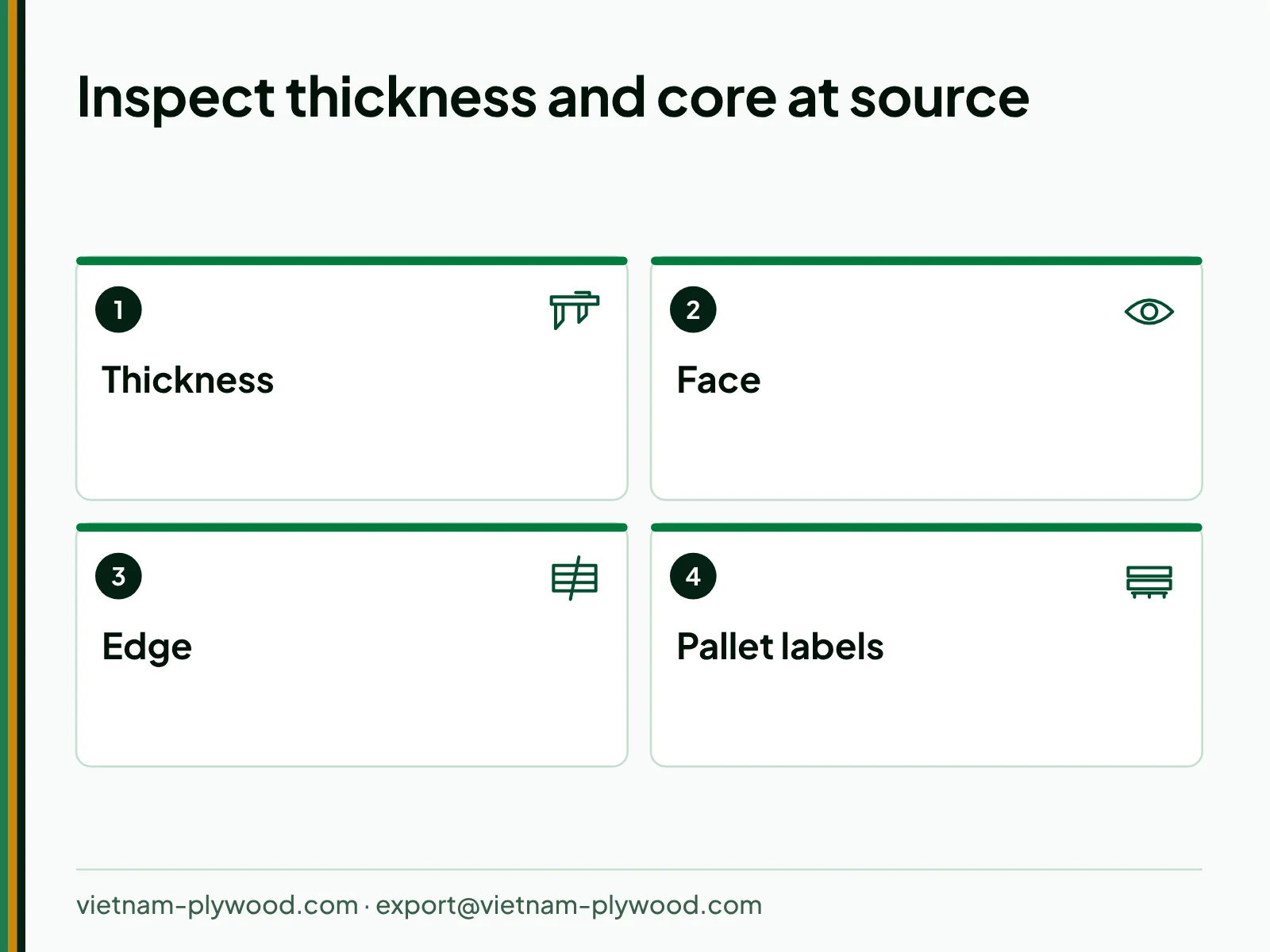
- Compare the production order with the approved drawing, face sample and core species.
- Gauge multiple locations on selected panels and record the finished thickness against the ordered band.
- Check the face grade, sanding, visible defects and panel flatness under agreed inspection conditions.
- Inspect representative edges for core gaps and verify the agreed stitched construction where specified.
- Match pallet labels and packing quantities to the shipment’s loading plan.
Full-stitched construction is the furniture line’s normal route. Other core construction methods include stitched outer layers with edge-trimmed inner veneers, finger-jointed material and loose-laid construction; these should not be treated as equivalent without a written acceptance standard. Photographs and measurements from the inspected batch give the buyer a record for incoming goods control.
Which UK import records belong with the shipment?
Great Britain importers need a timber due-diligence process covering the species, quantity, supplier and country of harvest. The UK Office for Product Safety and Standards and Department for Environment, Food & Rural Affairs guidance, updated in 2025, states that operators must gather that information, assess illegality risk and mitigate identified risk to negligible levels. See the official UK timber-regulations guidance.
HCPLY coordinates the export documents, including commercial invoice, packing list, bill of lading (B/L), certificate of origin, phytosanitary and fumigation papers, and the order’s agreed certificate or test documents. Insurance is included under cost, insurance and freight (CIF) terms. After loading, the draft shipping documents come to you for approval.
The Great Britain rules should not be conflated with the European Union’s timber and deforestation documentation regime. For an EU-bound lot, the document package includes the relevant EUTR/EUDR file set and EUR.1 certificate of origin. The buyer should identify the actual destination market in the purchase order.
How should a UK buyer request a quotation?
A quotation needs the intended application, face grade, core, adhesive, emission class, dimensions, tolerance, quantity and UK destination port. The selected line and the inspection standard should be resolved before pricing, since a full-stitched sanded furniture build costs more to prepare than a simpler unsanded commercial build.
For reference, furniture plywood starts from US$350/m³ FOB Hai Phong (October 2026) and commercial plywood starts from US$250/m³ FOB Hai Phong (October 2026). Those are category starting prices, not a 3.6 mm offer. Face selection, core construction, sanding, tolerance and the mixed-load packing plan all affect the written quotation.
The minimum order is one 40HC. Factory lead time runs 15–45 days from receipt of the 30% deposit; the exact figure depends on order size, line loading and what the contract fixes. The remaining 70% is paid on the scan of the bill of lading, by T/T, or by irrevocable sight L/C. Delivery can be FOB Hai Phong, CFR (CNF) or CIF.
Samples are free; a first-time buyer pays the courier, and that charge comes off the first confirmed order. The specification below can be sent to Lucy at export@vietnam-plywood.com through the contact page.
Application: supported cabinet backing / drawer bottom / door skin
Producing line or core: furniture — styrax or eucalyptus / commercial — acacia
Glue: melamine MR or phenolic WBP, as specified
Emission: E0 or E1, as specified for furniture
Face and grade: [species or EV], [grade], visible side(s)
Thickness and tolerance: 3.6 mm, ±0.2 / ±0.3 / ±0.5 mm as ordered
Size: 1220 × 2440 mm or other listed/custom size
Quantity: [sheets and pallets], plus [thicker panel specifications]
Destination port: [UK port]
Request the 3.6 mm specification sheet and a mixed-container packing proposal.