





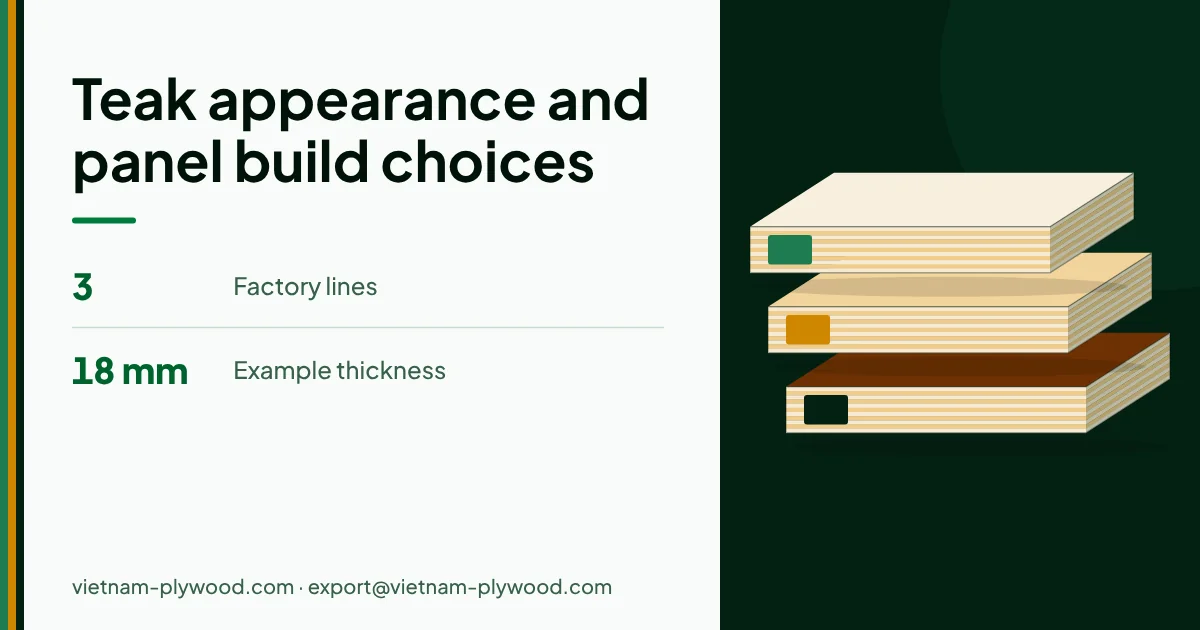
What does plywood teak mean in a purchase specification?
Plywood teak usually means plywood with a teak appearance on its face, but buyers must distinguish natural teak veneer, engineered veneer (EV) with a teak pattern, and plywood intended for marine interiors. These descriptions do not identify the same construction. For HCPLY, the first decision is whether an available EV face meets the visual brief or a separately specified natural teak face is essential.
Natural teak describes the botanical face material. EV teak describes an engineered decorative appearance; its species and construction must be identified in the purchase specification. Marine teak describes an application or claimed performance, which needs an accepted test report for the complete panel. A decorative teak pattern alone cannot establish suitability for wet service.
Our furniture line uses full-stitched, sanded styrax or eucalyptus cores for decorative panels. The standard face list includes EV, but does not list natural teak veneer. Buyers requiring natural teak should request a feasibility assessment rather than treating it as a standard face. For the broader family, compare oak and hardwood veneer plywood.
Which build belongs on each factory line?
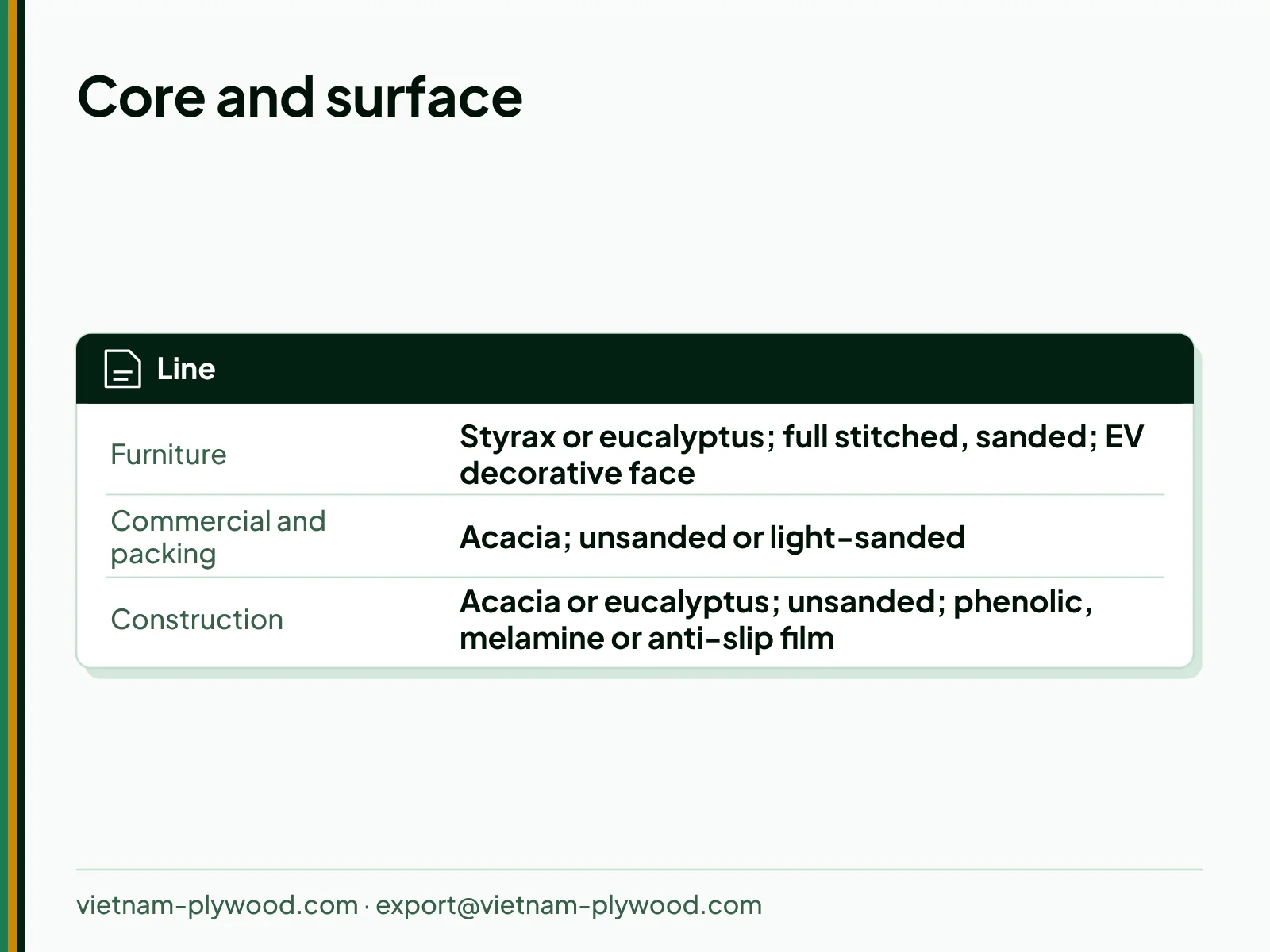
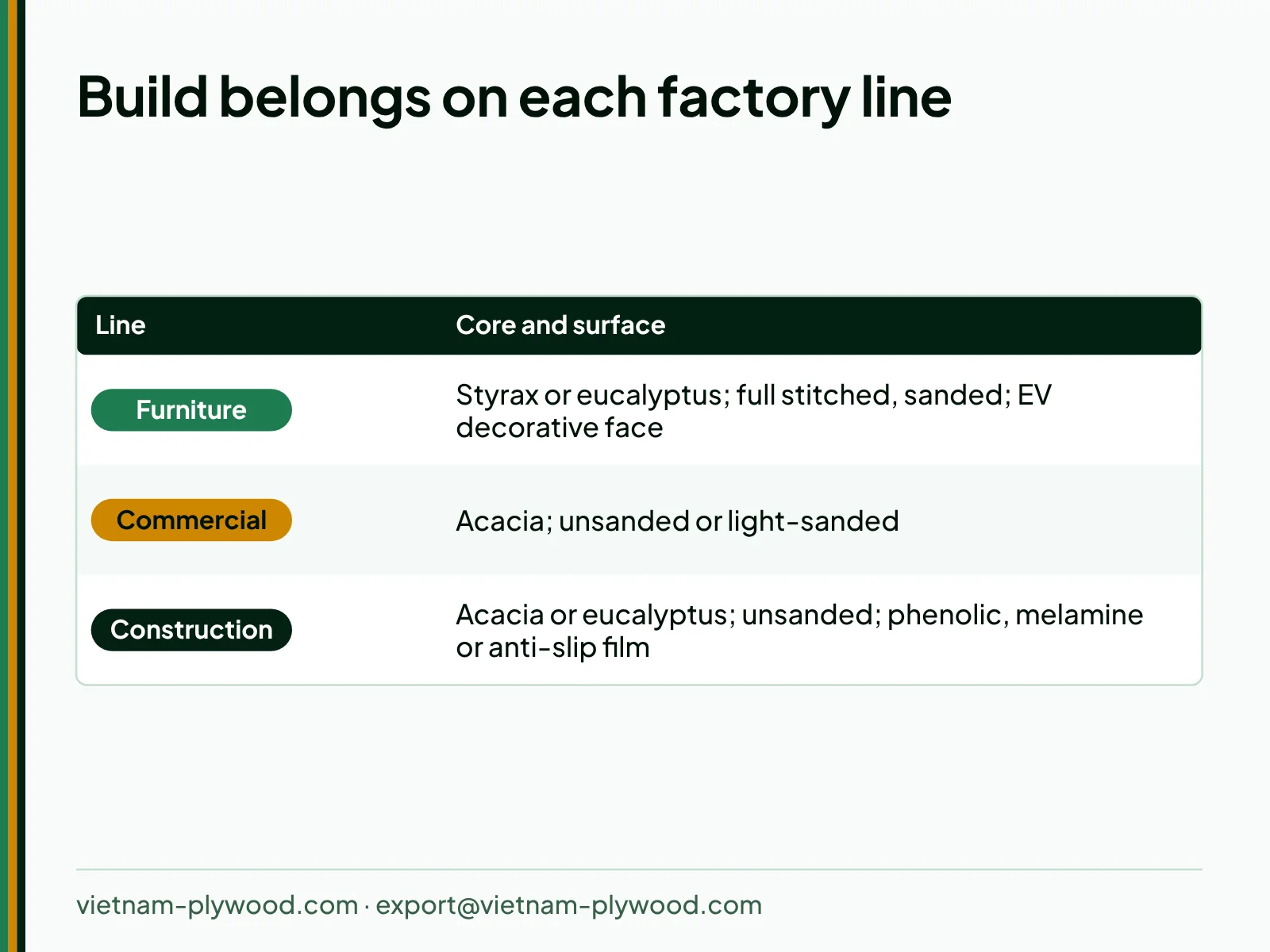
Our furniture line is the relevant starting point for a teak-look cabinet or fit-out panel. The other lines serve different end uses and should not be substituted merely because the nominal thickness matches.
| Line | Core and surface | Glue or finish route | Suitable purchasing decision |
|---|---|---|---|
| Furniture | Styrax or eucalyptus; full stitched, sanded; EV decorative face | E0 or E1 emission class specified separately | Choose for consistent visible cabinet faces and fit-out work |
| Commercial and packing | Acacia; unsanded or light-sanded | Moisture-resistant (MR) glue | Choose for concealed commercial or packing applications, not a finished teak look |
| Construction | Acacia or eucalyptus; unsanded; phenolic, melamine or anti-slip film | Film surface for concrete formwork | Choose for formwork, not a decorative teak face |
The producing factory handles the order and its on-site quality control. HCPLY coordinates specifications, inspection, loading and export documents across our three factories in Phu Tho and Hai Phong. A furniture-panel buyer should compare the visible-face requirements with commercial plywood only when a concealed component is also needed.
Natural teak, EV teak or marine teak: which should a buyer choose?
Choose natural teak veneer when the contract requires the real species and its characteristic grain. Choose EV teak appearance when matching decorative batches matters more than identifying teak as the face species. Choose a marine-specified panel only after defining its intended exposure and the test report the buyer accepts.
For furniture, specify whether the face is one-sided or two-sided, the grain orientation, acceptable color range and the reference sample. The usual face veneer range in HCPLY’s listed furniture constructions is 0.2–0.4 mm; that is not a specification for natural teak. The face grade is A/B for the listed decorative faces, while birch follows D/E/F. No separate teak grading system is claimed.
A marine designation calls for details beyond the surface: adhesive, panel build, edge treatment, exposure and accepted testing. BS 1088 or a marine claim must be evaluated against a test report the buyer accepts. Decorative EV panels should never be relabeled marine merely because the grain resembles teak.
What thickness, size and tolerance should be written?
Specify nominal thickness and its permitted deviation together. Furniture panels can be ordered with a sanded thickness tolerance of ±0.2 mm or ±0.3 mm; commercial and film-faced panels use ±0.5 mm, and packing panels ±0.5–1.0 mm. Length and width tolerance is ±2 mm.
The available thickness range is 3–40 mm, with common selections of 3, 5, 9, 12, 15, 18, 21 and 25 mm. Standard formats include 1220×2440, 1250×2500, 1220×2135, 1220×1830, 915×2440, 915×2135 and 915×1830 mm; custom cutting is available. An 18 mm panel normally has 11–13 plies because core veneer thickness runs 1.4–2.0 mm.
For cabinet carcasses, record machining allowance and edge exposure. For doors and visible panels, record grain direction and matching requirements. The white oak veneer plywood and sapele-faced plywood pages offer alternative decorative directions when teak appearance is not mandatory.
What can share a container with teak-look furniture panels?
A mixed container can carry furniture panels alongside other specifications within the 28.5 t payload limit of a 40HC. The load plan must use the core density of each specification; a teak-look face does not turn a styrax core into teak-density plywood.
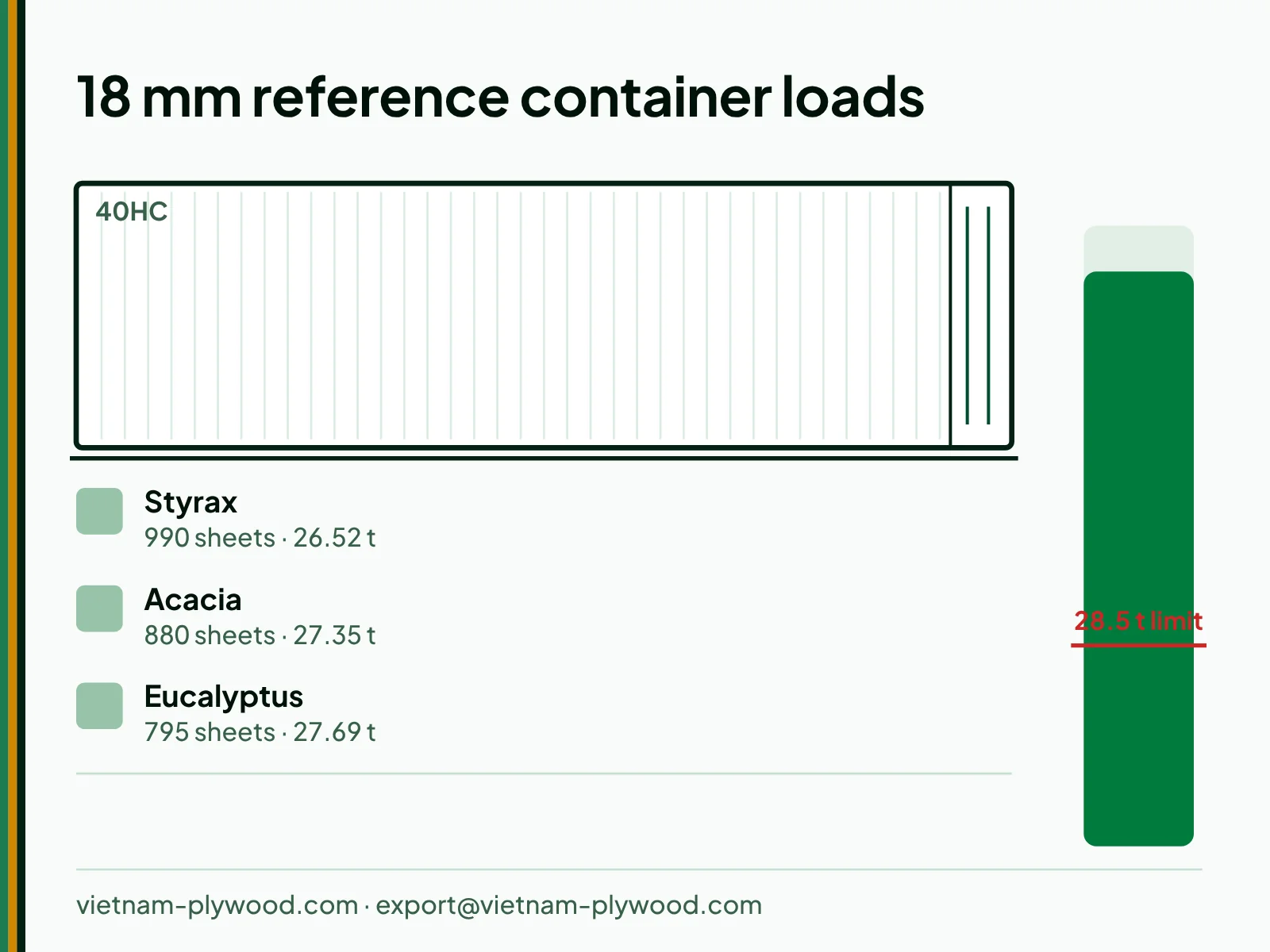
At 18 mm and 1220×2440 mm, the reference furniture styrax-core panel weighs 26.79 kg per sheet. A full styrax load is 990 sheets, 53.05 m³ and 26.52 t. The comparable acacia commercial-core load is 880 sheets, 47.15 m³ and 27.35 t; eucalyptus-core furniture construction is 795 sheets, 42.60 m³ and 27.69 t.
A mixed order might combine EV-faced cabinet sheets and a separate concealed acacia-core specification. Add each group’s sheet count times sheet weight, then account for pallets and other cargo. See container loading calculations for the full load topic. Face type alone is never a reliable weight input.
Can South African importers source teak plywood from Vietnam?
South African importers can request a specification-led quotation for an EV teak-look furniture panel from HCPLY, with the destination port named in the inquiry. A natural teak face or marine construction needs a separate feasibility and evidence review.
Distributors should specify face reference, grade, core, glue, emission class and tolerance. Buyers should also specify whether the panel will be sold as cabinet stock or used for a particular fit-out contract. Do not translate a sample appearance into a species claim on a resale label.
Orders ship from the producing factory under FOB Hai Phong, CFR (CNF) or CIF terms. Freight, import classification, local duties and destination handling should be checked for the named South African port before comparing landed offers.
How should Taiwan teak veneer plywood prices be compared?
A Taiwan-facing teak veneer plywood price comparison starts with face authenticity, face thickness and grade, followed by core construction, sanding and order volume. Natural teak veneer normally costs more than an engineered teak-look face when the real species and visual selection are required; an accepted marine build adds testing and construction requirements. No teak-specific price is quoted here.
The Chinese purchasing phrase 柚木貼皮夾板 can describe teak-veneered plywood, but the buyer should state whether actual teak wood is required. For a cabinet specification, identify whether an EV interpretation is acceptable. HCPLY does not address Taiwan as an established sales market or quote a local delivered price; any inquiry needs its destination port and import requirements.
The reference furniture plywood starting indication is from US$350/m³ FOB Hai Phong (October 2026). That figure is for furniture plywood generally, not a teak-faced quotation. A written build is needed to price any requested teak appearance.
What should Taiwan and Malta distributors check before buying?
Taiwan and Malta distributors should compare a physical reference sample with the agreed production face, then check the same specification against packing labels and documents. The inspection establishes face description, construction and thickness.
At the producing factory, a buyer or inspector can witness face and back sorting, core joint inspection, thickness measurement after sanding and pallet marking. For a decorative order, ask to view sheets from different pallet positions under consistent lighting. Record any accepted variation in the order specification before production.
For Malta, the EU importer’s timber due-diligence obligations also matter. The European Commission’s 2026 EUDR overview identifies wood and relevant derived products in scope and lists application dates of 30 December 2026 for medium and large operators and 30 June 2027 for micro and small enterprises. See the European Commission’s EUDR overview for the applicable framework and transitional rules.
Is marine teak plywood appropriate for a Denmark order?
For a Denmark marine-interior order, specify the installation zone, expected moisture exposure, adhesive system and accepted test report before choosing a panel. A teak-looking decorative face does not establish marine performance.
Our furniture line can be considered for interior decorative work where the written build meets the project specification. A marine or BS 1088 description requires assessment against a test report the buyer accepts. No marine performance is inferred from the EV face or from the word teak in a product name.
Denmark buyers should distinguish cabin furniture, bulkheads and shelving from decks or continuously exposed components. They should also identify the documentary evidence needed for their EU importer obligations. If a different decorative timber appearance works, compare mahogany-faced plywood or ash veneer plywood.
What inspection and export paperwork accompanies the order?
The producing factory can present the agreed sample and show the selected core build, sanded surface and dimensional checks during inspection. A buyer can inspect goods at that factory and visit its factory office. HCPLY manages on-site QC and loading against the written specification.
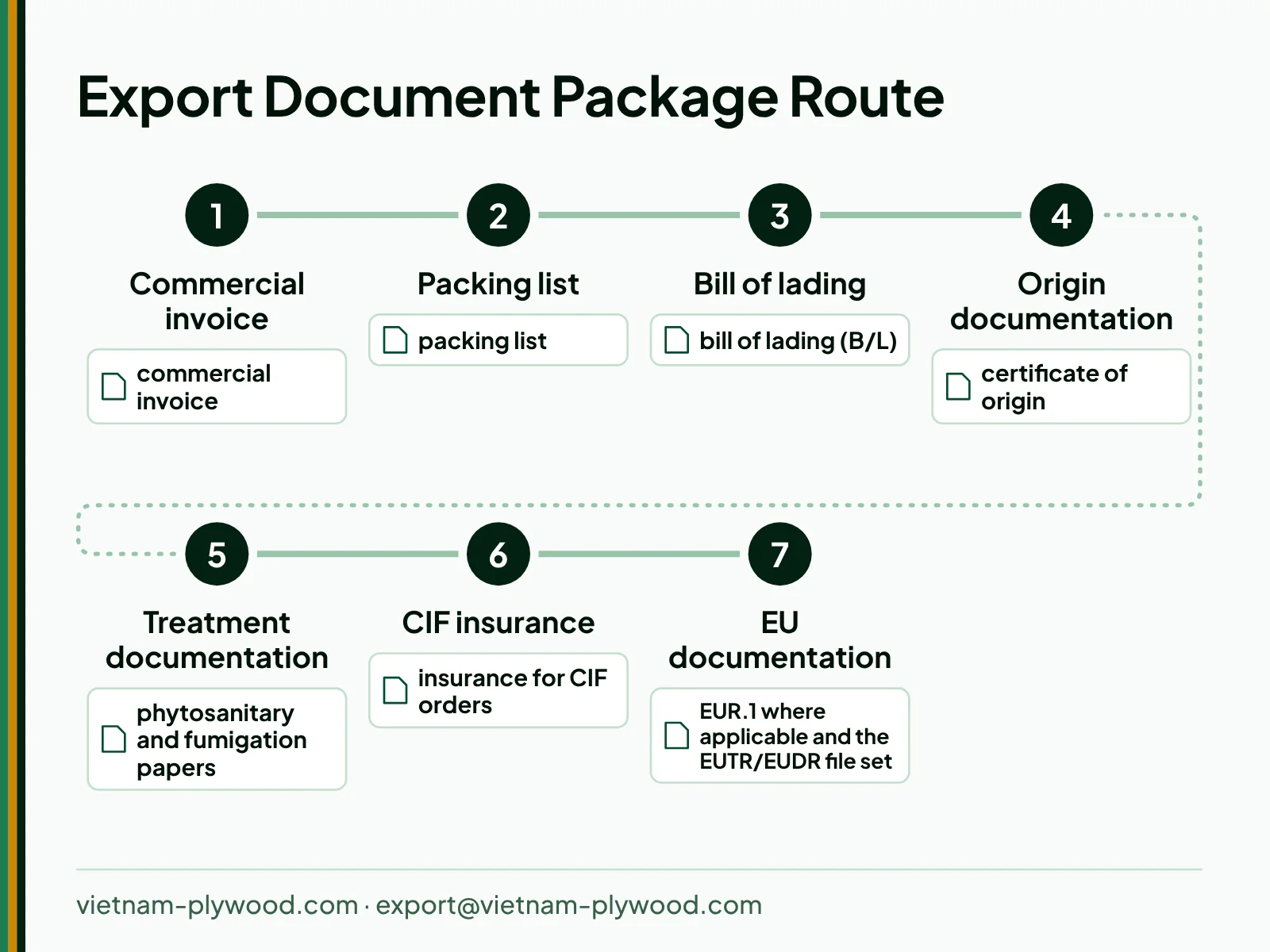
The shipment document package includes a commercial invoice, packing list, bill of lading (B/L), certificate of origin, phytosanitary and fumigation papers, and insurance for CIF orders. EU lots include EUR.1 where applicable and the EUTR/EUDR file set; agreed certificates and test reports are added for the specified build. After loading, the draft shipping documents come to you for approval.
FSC, CARB P2, ISO 9001 and CE documents associated with member factories are shown with factory details masked, on request. Certificate applicability must be matched to the producing factory and order. The production lead-time page explains the wider scheduling topic.
How should a trial container be specified?
Start with one written construction and one accepted visual reference, then separate optional alternatives into distinct line items. The minimum order is one 40HC, with mixed specifications permitted within the payload limit. Production takes 15–45 days from the 30% deposit, set by order size, line loading and the contract.
The remaining 70% is paid on the scan of the bill of lading, by T/T, or by irrevocable sight L/C. Samples cost nothing: a first-time buyer pays the courier, and that charge comes off the first confirmed order. For a teak-look order, mark the sample clearly as EV appearance unless a natural teak construction is separately agreed.
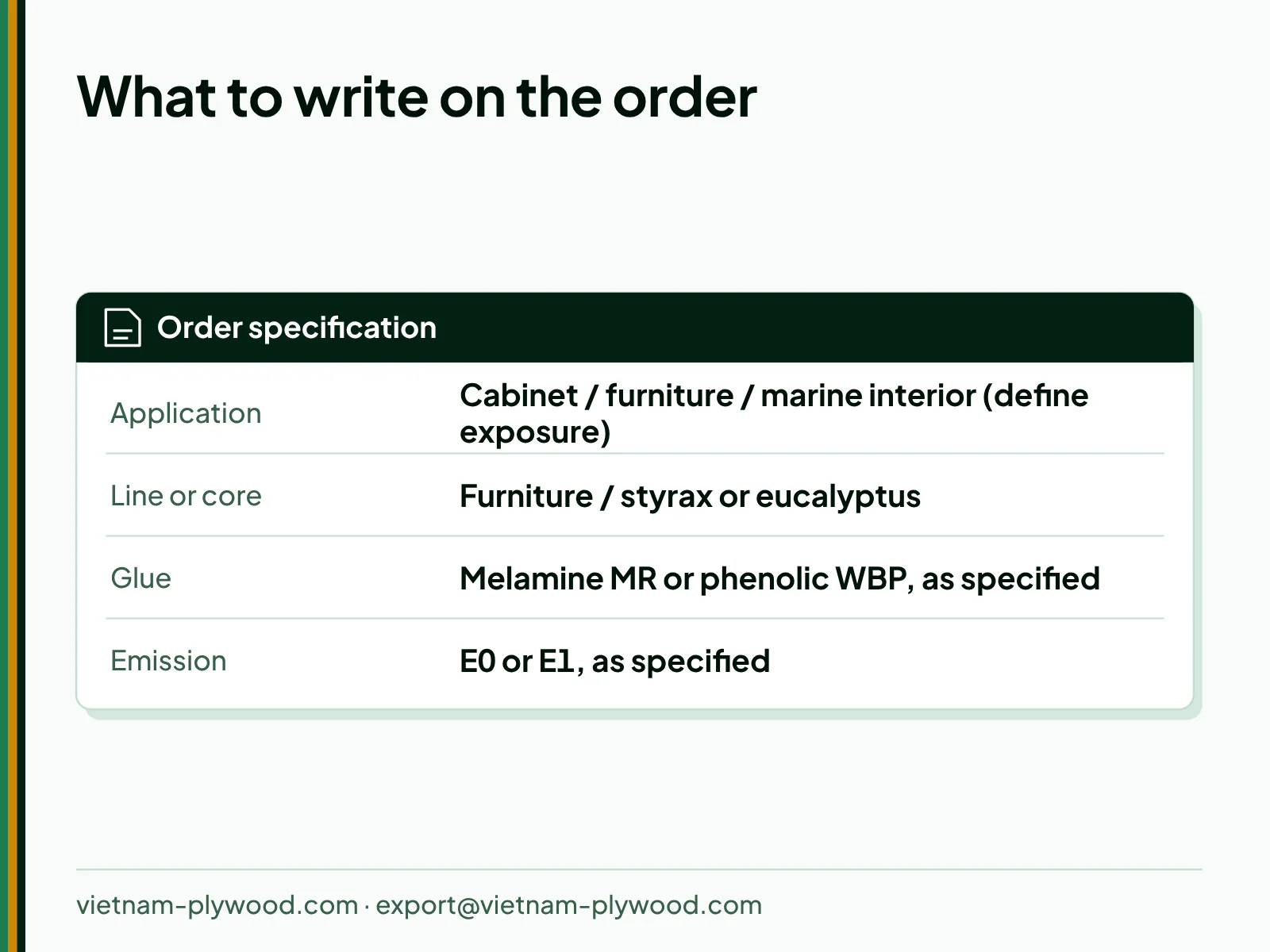
Send Lucy at export@vietnam-plywood.com the following specification through the contact page:
Application: cabinet / furniture / marine interior (define exposure)
Line or core: furniture / styrax or eucalyptus
Glue: melamine MR or phenolic WBP, as specified
Emission: E0 or E1, as specified
Face and grade: EV teak-look reference / A-B; natural teak request separately
Thickness and tolerance: 18 mm / +/-0.2 mm, as ordered
Size: 1220 x 2440 mm
Quantity: sheets and proposed mixed 40HC allocation
Destination port: [named port and country]
Next step: plan a trial container against the approved sample and written specification.