





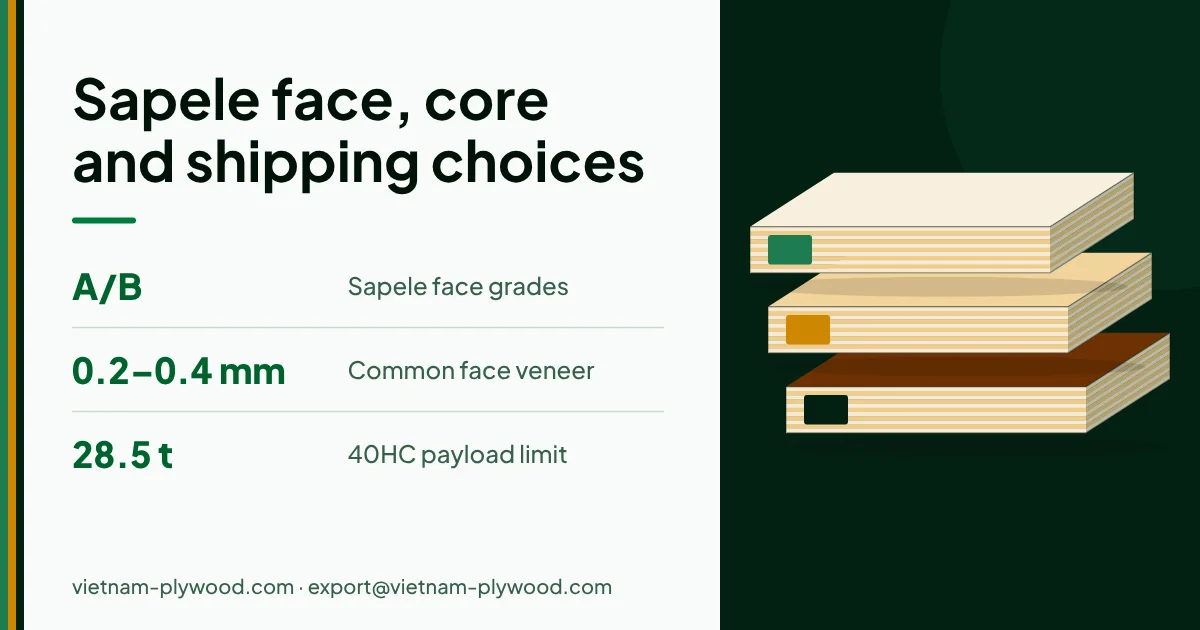
HCPLY makes sapele-faced decorative plywood for furniture, cabinets and visible interior panels, with A/B face grades and styrax or eucalyptus cores. Choosing a face without specifying core, finish and tolerance can cost a rejected load or extra machining days. The sapele veneer gives the appearance; the factory build determines the panel underneath.
What is sapele plywood for export?
Sapele plywood is a decorative plywood panel identified by its sapele face veneer over a separate structural core. HCPLY builds sapele-faced panels on our furniture line in Vietnam for cabinet fronts, fitted interiors and furniture components. The face gives the visible reddish-brown appearance; the core determines panel density and much of its handling weight. Buyers should specify both separately rather than buying by the face name alone.
Sapele is associated with interlocked grain and a ribbon-like figure, especially where veneer cutting brings that pattern forward. For procurement, a photographed sample and an agreed appearance reference are more useful than a broad description such as “mahogany look.” Natural veneer variation matters across adjacent doors and long wall runs. Request a sample set from the intended production build before approving a large decorative schedule.
For a wider comparison of decorative species, see oak and hardwood veneer plywood. The right choice starts with whether the face will remain visible, how many panels must read as one finish, and what the fabricator will do at exposed edges.
Which factory line makes sapele-faced panels?
Our furniture line presses sapele-faced panels with full stitched, sanded styrax or eucalyptus cores and an ordered E0 or E1 emission class. Our commercial and packing line instead makes acacia-core panels with MR glue and an unsanded or light-sanded surface. Our construction line builds film-faced panels with acacia or eucalyptus cores for formwork and related uses.
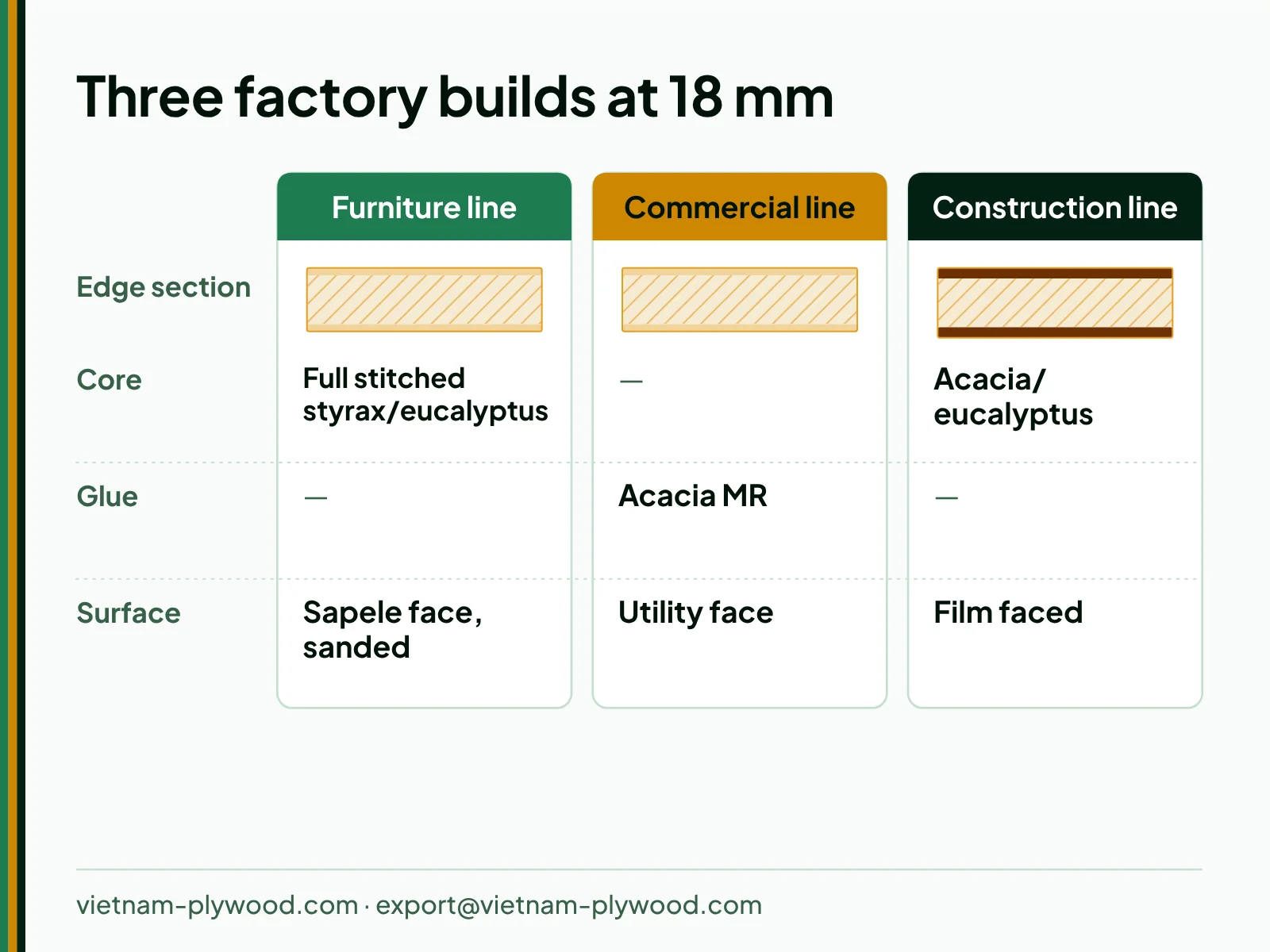
| Build decision | Furniture line: sapele face | Commercial and packing line | Construction line |
|---|---|---|---|
| Intended finish | Visible decorative veneer | Utility or packing surface | Film surface for concrete work |
| Core | Styrax or eucalyptus | Acacia | Acacia or eucalyptus |
| Core assembly | Full stitched | Specify the required assembly | Specify the required assembly |
| Surface | Sanded, A/B face | Unsanded or light-sanded | Unsanded, film covered |
| 18 mm thickness tolerance | ±0.2 or ±0.3 mm as ordered | ±0.5 mm; packing ±0.5–1.0 mm | ±0.5 mm |
| Buying verdict | Cabinet doors, furniture and visible fit-out | Concealed utility or protective packing | Formwork rather than decorative joinery |
These are different manufacturing specifications even when nominal thickness is identical. A distributor carrying several categories can discuss a mixed plywood order while retaining separate specifications for each category. A sapele face does not turn a packing or formwork build into a cabinet-grade panel.
Which sapele face grade should a cabinet buyer specify?
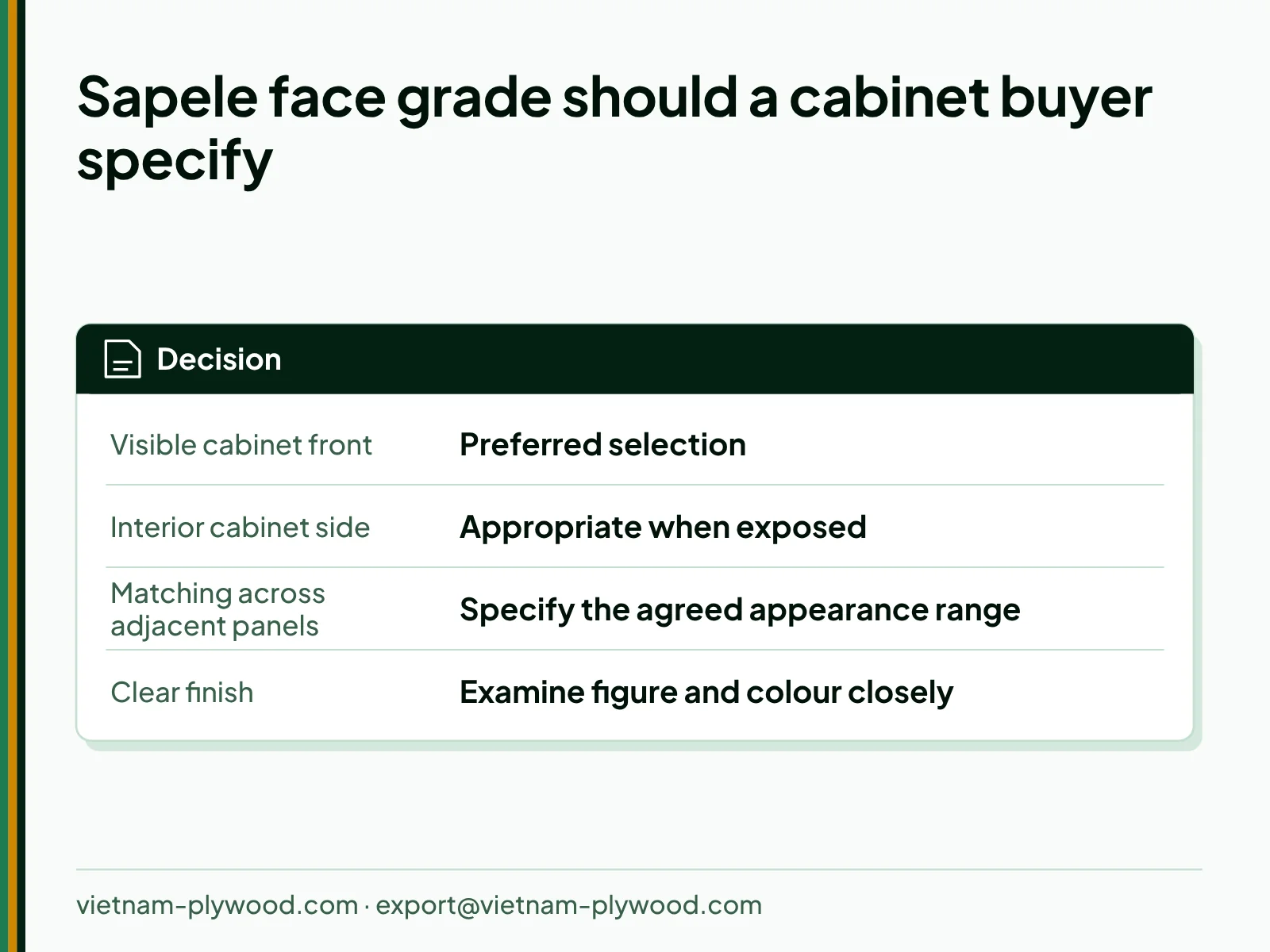
A/B are the available face grades for sapele-faced plywood. Select A for prominent finished faces and B where the visual requirement is less demanding or the surface will be less visible. State the grade for each side in the purchase specification and approve the sample’s colour range, grain character and acceptable repairs.
| Decision | A face | B face | Buyer action |
|---|---|---|---|
| Visible cabinet front | Preferred selection | Review against the finish sample | Approve appearance before cutting |
| Interior cabinet side | Appropriate when exposed | Practical where appearance is secondary | Identify exposed edges and sides |
| Matching across adjacent panels | Specify the agreed appearance range | Wider visual variation may be acceptable | Lay out samples together |
| Clear finish | Examine figure and colour closely | Examine defects under intended finish | Test the actual coating on samples |
Face grading is distinct from core assembly and adhesive selection. An A face can still conceal a core that does not meet the fabricator’s requirements if the order only names the veneer. The usual face veneer thickness is 0.2–0.4 mm; it is a decorative layer, not the density used to calculate shipment weight.
For a different appearance route, compare engineered veneer plywood. Engineered veneer can be considered where a repeatable decorative pattern is more important than natural sapele variation.
What thicknesses and sheet sizes can be ordered?
HCPLY’s panel thickness range is 3–40 mm, with common choices of 3, 5, 9, 12, 15, 18, 21 and 25 mm. For a sanded furniture build, order either ±0.2 mm or ±0.3 mm thickness tolerance. Length and width tolerance is ±2 mm. Write the actual nominal dimensions in millimetres rather than relying on a regional trade nickname.
Available formats include 1220×2440, 1250×2500, 1220×2135, 1220×1830, 915×2440, 915×2135 and 915×1830 mm. Custom cutting is available. The buyer should match panel size to cabinet nesting plans and transport handling before deciding the purchase quantity.
An 18 mm panel has 11–13 plies depending on core veneer thickness, which is 1.4–2.0 mm. Ply count therefore needs to be read alongside core quality and panel thickness. It should not be treated as a standalone proof of finished-panel performance.
How do core, glue and emission choices affect the build?
Choose the core by machining and weight requirements, then specify glue and emission class as separate fields. The furniture line uses full stitched styrax or eucalyptus cores. Styrax has a stated core density of 500 kg/m³; eucalyptus is 650 kg/m³. These values describe the core, not the sapele face.
Core assembly choices, in descending order of construction quality, are full stitched, stitched outer layers with edge-trimmed inner layers, finger-jointed and loose-laid. For furniture faces, full stitching provides the agreed build reference. At the producing factory, an inspector can review exposed panel edges and a representative cut section for gaps, overlaps and joint construction.
Melamine glue is the MR option with a 12-hour boil description; phenolic glue is the WBP, or weather and boil proof, option with a 72-hour boil description. MR pressing is at 110–120 °C and WBP pressing at 130–145 °C. Those process descriptions are separate from an emission classification such as E0 or E1. Neither a glue name nor a face species establishes an emission result.
Can sapele plywood share a 40HC with other panels?
Yes. The minimum order is one 40HC, and different specifications can share a container within its 28.5 t payload limit. For 18 mm, 1220×2440 mm panels, the computed full-container references are 990 styrax-core sheets at 26.52 t, 880 acacia-core sheets at 27.35 t, and 795 eucalyptus-core sheets at 27.69 t. These are alternative full loads, not quantities to add together.
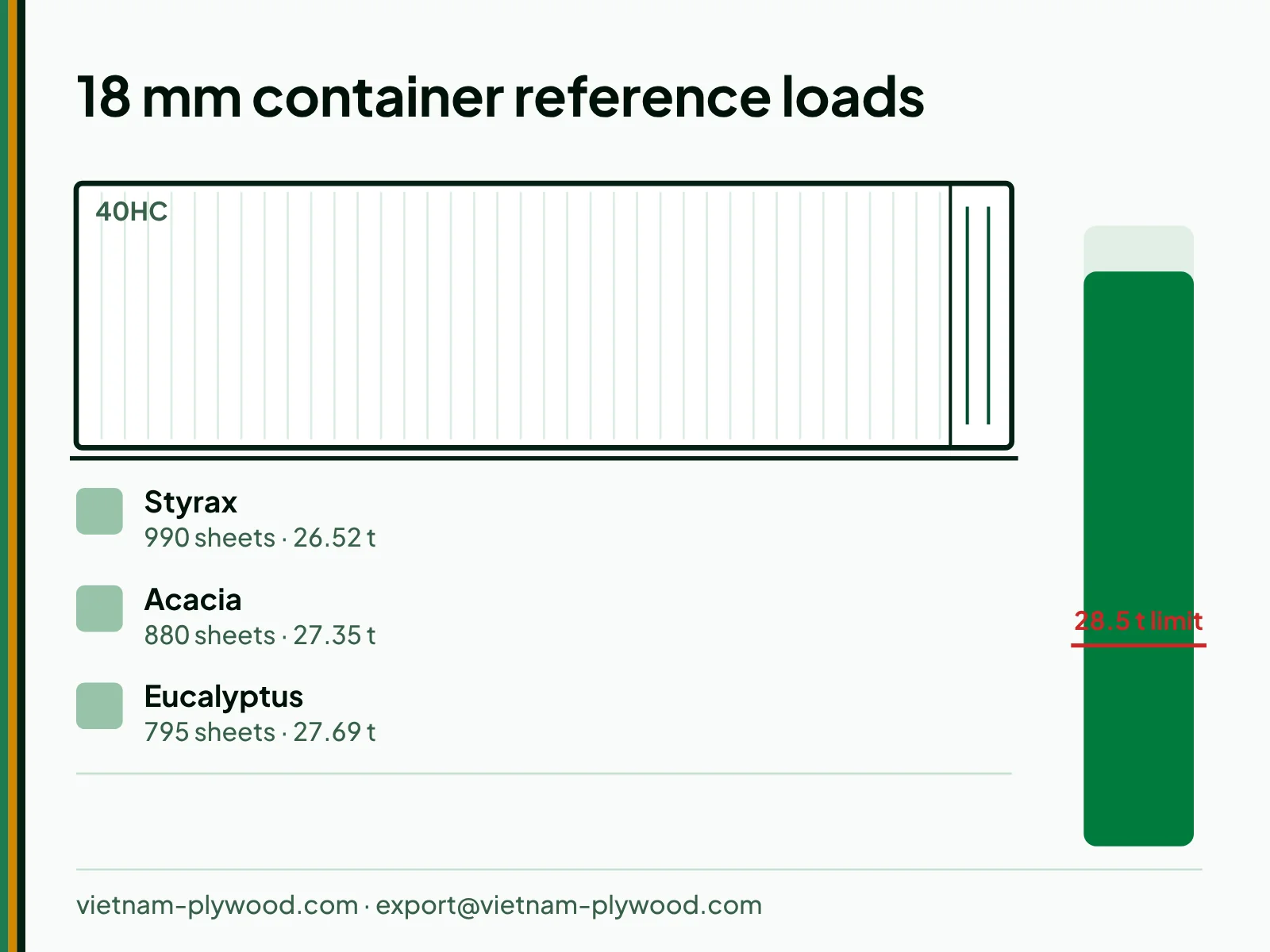
The corresponding individual sheet weights are 26.79 kg, 31.08 kg and 34.83 kg. A mixed order can include sapele-faced furniture panels and acacia-core commercial panels, with the final packing plan based on each specification’s pallets, sheet count and mass. Film-faced panels are another possible category, with film weight accounted for separately from the core-based lookup.
For example, replacing a portion of a styrax-core load with heavier eucalyptus-core sheets changes both pallet availability and payload. The buyer should request a mixed-load packing schedule showing sheet counts by build rather than multiplying the lightest panel’s capacity across every item. The detailed container-load topic belongs to plywood container packing.
What should an inspector check before loading?
Inspect the producing factory’s actual sapele-faced lot against the signed sample and written specification. Start with veneer identity, colour range, grain orientation and agreed A/B appearance. Check the back face separately, then inspect cut edges for the full stitched core construction and visible internal gaps.
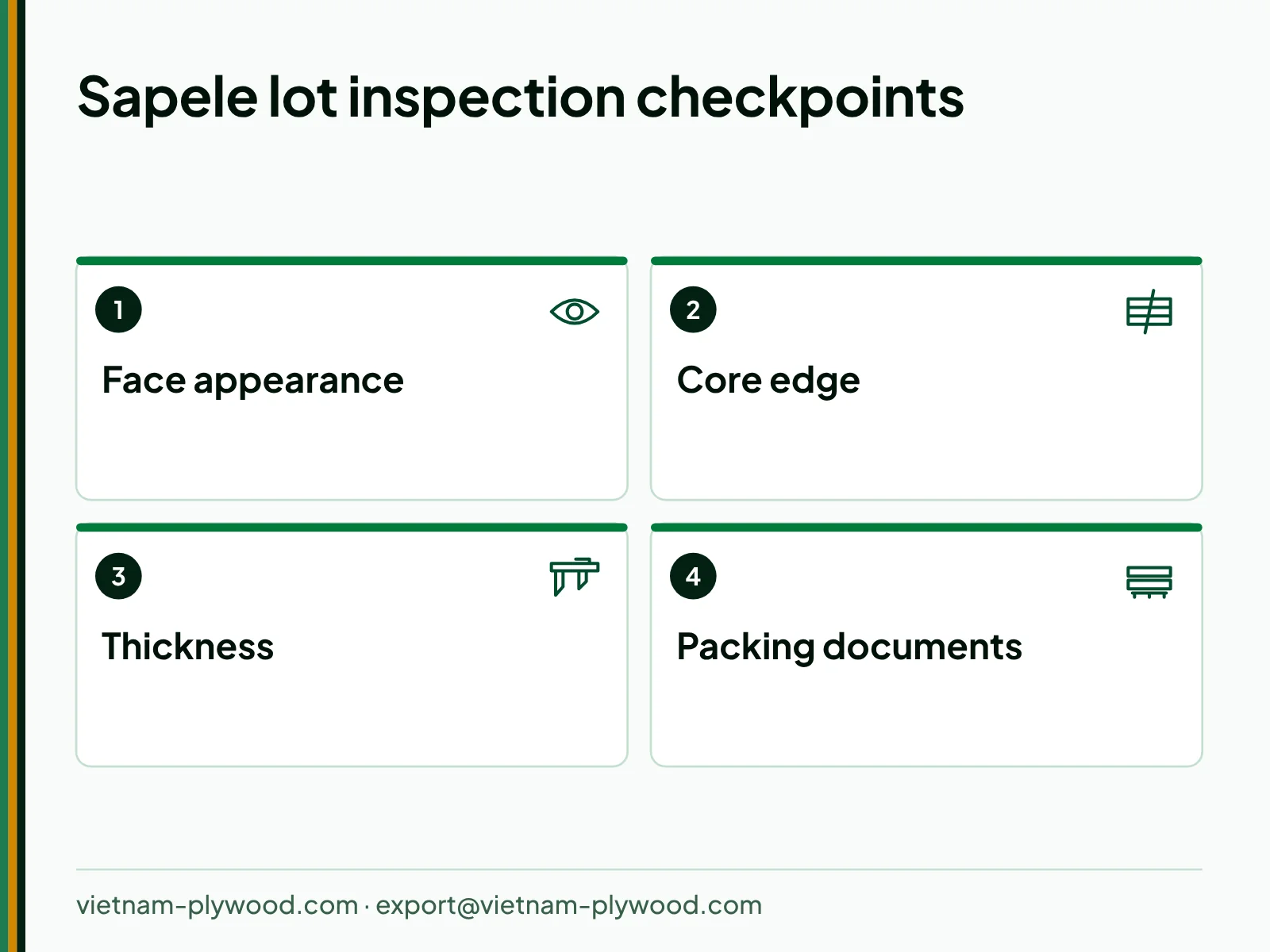
Measure thickness at representative positions using the ordered ±0.2 mm or ±0.3 mm tolerance. Check length and width against ±2 mm. Review sanding consistency under the intended finish and compare panel faces in the same lighting. For cabinets, a small machining and finishing trial can reveal problems that are difficult to see in a stacked pallet.
Check the agreed glue and emission documents against the producing factory and the lot. Record the pallet count, sheet count and markings before loading. Buyers can visit the factory office and inspect the goods at the producing factory; HCPLY coordinates specification, on-site quality control, documents and loading.
Which compliance documents matter for US and EU buyers?
US buyers should establish the applicable formaldehyde requirements before placing the order. The US Environmental Protection Agency’s 2025 Code of Federal Regulations, 40 CFR Part 770, addresses hardwood plywood and third-party certification under TSCA Title VI. Its rule states: “To obtain product certification, a panel producer must apply to an EPA TSCA Title VI TPC.” See the official 2025 regulation.
An E0 or E1 order description is separate from a US TSCA Title VI certification requirement. Ask for the relevant producing-factory evidence for the agreed panel build and market. Member-factory FSC, CARB P2, ISO 9001 and CE documents, together with EUTR/EUDR documents, are shown with factory details masked, on request.
For export shipments, the document set includes a commercial invoice, packing list, bill of lading (B/L), certificate of origin, phytosanitary and fumigation papers, and applicable order-specific certificates or test reports. EU lots include EUR.1 and the EUTR/EUDR file set; CIF shipments include insurance. After loading, the draft shipping documents come to you for approval. Match the invoice description and packing list to the sapele face, core and grade ordered.
How does sapele compare with other decorative faces?
Sapele suits buyers seeking a reddish-brown natural face with visible grain character. The alternative should be chosen from the approved finish sample rather than an assumed equivalence of species names. Different faces can give similar colour impressions while behaving differently under stain or clear coating.
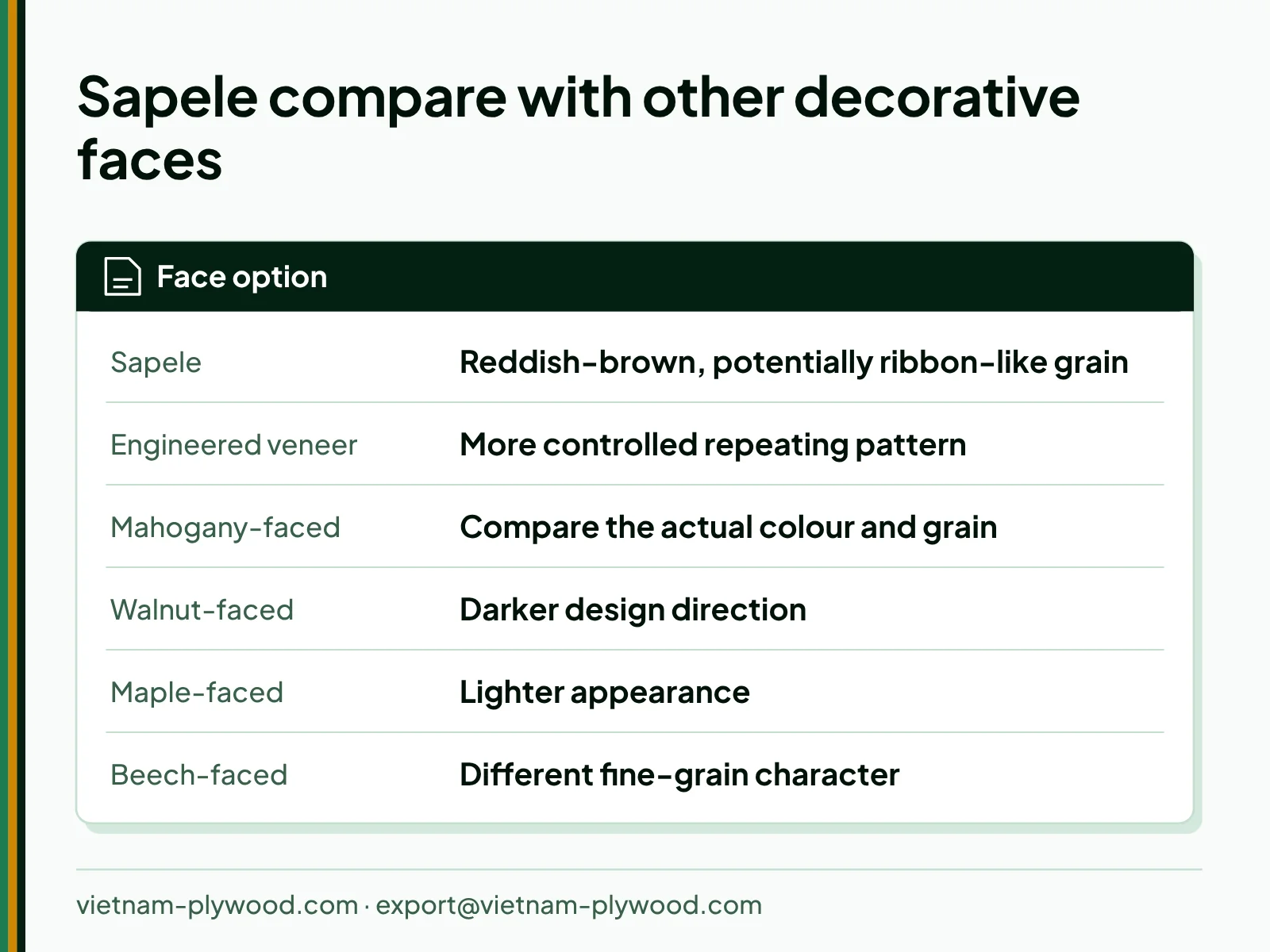
| Face option | Appearance decision | Procurement verdict |
|---|---|---|
| Sapele | Reddish-brown, potentially ribbon-like grain | Use when natural sapele figure is specified |
| Engineered veneer | More controlled repeating pattern | Use for a consistent design brief |
| Mahogany-faced | Compare the actual colour and grain | Sample beside sapele before substitution |
| Walnut-faced | Darker design direction | Review against the finished interior palette |
| Maple-faced | Lighter appearance | Use for a contrasting bright interior |
| Beech-faced | Different fine-grain character | Evaluate in the intended coating system |
See mahogany-faced plywood, walnut veneer plywood, maple veneer plywood and beech-faced plywood for adjacent specification paths. Avoid substituting a different face after finish approval without a new sample sign-off.
What affects the quotation for sapele-faced panels?
Face selection and visual sorting are major cost drivers, followed by core construction, thickness, machining requirements and the agreed glue and emission documents. A carefully selected A face with full stitched, sanded furniture construction costs more to produce than a less demanding decorative selection. A heavier or more tightly specified core can also change material use and freight planning.
Quote requests should state whether both faces remain visible, the approved veneer appearance and the intended finish. An order with mixed dimensions, custom cutting or several panel specifications requires a packing and production plan. Sapele-faced plywood has no published starting figure here; request a quotation against the written specification.
For scheduling, production is 15–45 days from the 30% deposit, set by order size, line loading and the contract. The remaining 70% is paid on the scan of the bill of lading, by T/T, or by irrevocable sight L/C. We ship FOB Hai Phong, or CFR (CNF) or CIF to your port. See plywood production lead time for planning considerations.
How should an importer specify and order the panels?
Send a build description that ties appearance, machining and shipment requirements together. HCPLY produces each order at the factory suited to its specification and ships directly from that factory, FOB Hai Phong. Our three factories are in Phu Tho and Hai Phong, with the furniture line handling the sapele-faced decorative build.
The furniture and commercial plywood capacity is up to 100 containers a month; construction plywood capacity is up to 140. Buyers can request free samples; a first-time buyer pays the courier, and that charge comes off the first confirmed order. Samples should include the approved face appearance and an exposed edge where core assembly matters.
Use the following request as the starting specification, with actual quantities and destination inserted before sending it to Lucy at export@vietnam-plywood.com.
Application: cabinet doors / furniture / interior fit-out
Line or core: furniture line; styrax or eucalyptus, full stitched
Glue: MR melamine or WBP phenolic, as agreed
Emission: E0 or E1; destination-market documents requested
Face and grade: sapele A/B; face/back appearance reference attached
Thickness and tolerance: [mm]; ±0.2 mm or ±0.3 mm
Size: [length × width, mm]
Quantity: [sheets and pallet allocation]; mixed builds if applicable
Destination port: [port and country]; delivery term [FOB/CFR/CIF]
Ask for a sample set through the contact page before approving the production appearance.