





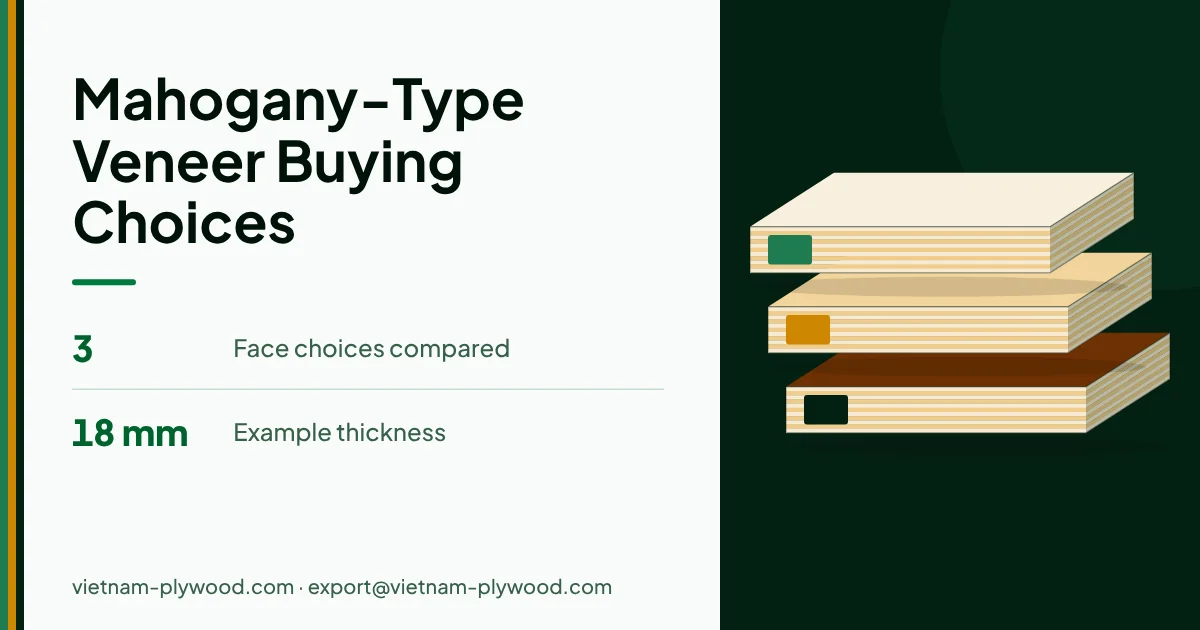
What does mahogany plywood mean on a purchase order?
Mahogany plywood is a trade description that can refer to genuine mahogany veneer or a reddish decorative substitute over a plywood core. For a repeatable furniture order, the purchase order must identify the face species or approved appearance reference, the back grade, and the core construction. HCPLY offers sapele and engineered veneer (EV) faces for this appearance brief; genuine mahogany is not listed among our face options.
A reddish face can have a different grain, finish response, and color range from the sample approved by the designer.
For related species choices, see oak and hardwood veneer plywood and decorative veneer plywood faces. Use a physical reference panel and an agreed viewing condition when the finished appearance drives acceptance.
Genuine mahogany, sapele or EV: which face fits?
For a reddish wood appearance, sapele is the named natural veneer option in our range; EV is the repeat-pattern alternative. Genuine mahogany requires a separately identified botanical species and a different supply specification. None of these names describes the inner core.
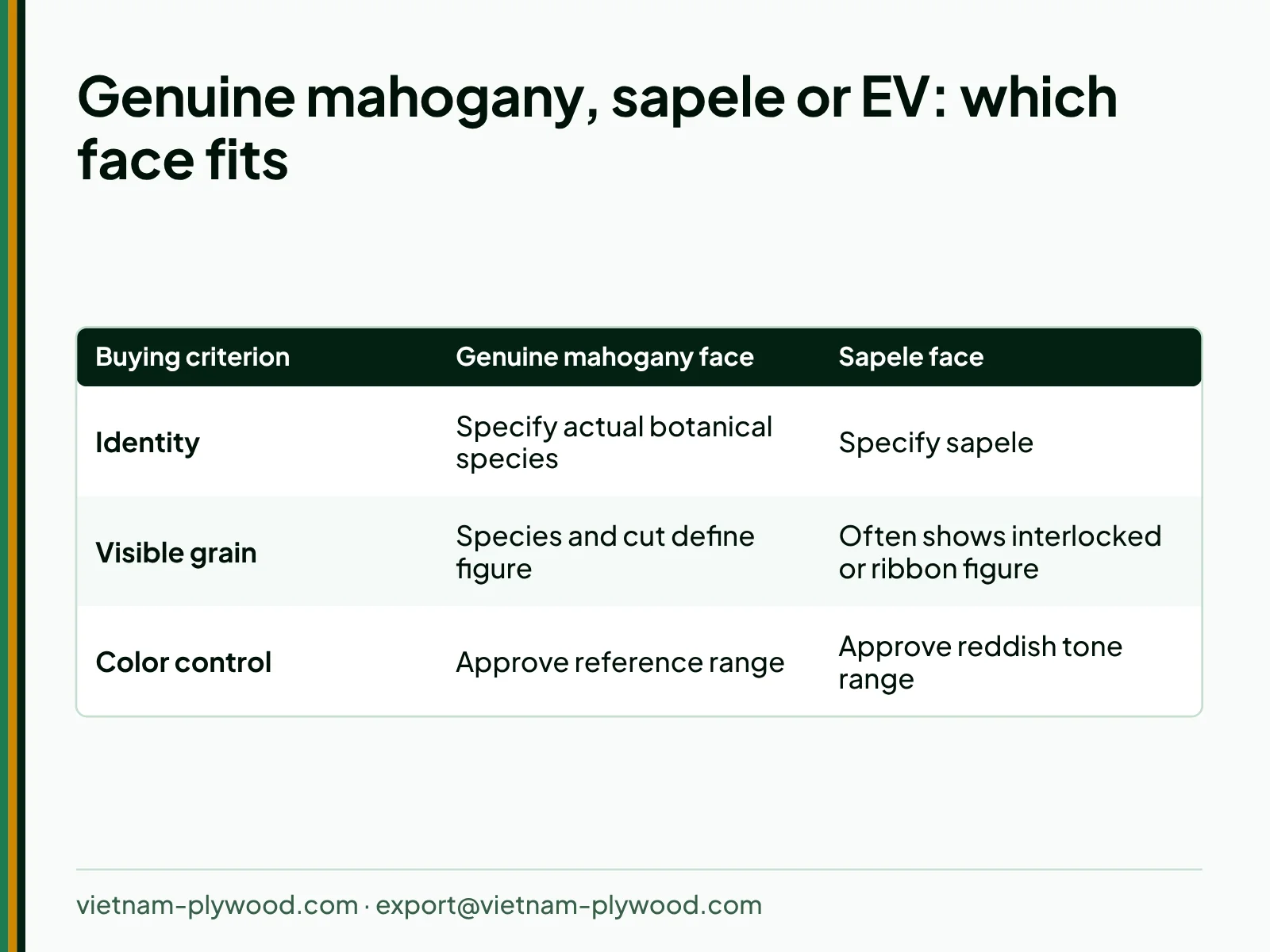
| Buying criterion | Genuine mahogany face | Sapele face | EV face | Verdict by use |
|---|---|---|---|---|
| Identity | Specify actual botanical species | Specify sapele | Specify engineered pattern reference | Species-led architectural schedule: genuine species; HCPLY furniture order: sapele or EV |
| Visible grain | Species and cut define figure | Often shows interlocked or ribbon figure | Designed for a repeatable visual pattern | Natural grain character: sapele; repeated cabinet runs: EV |
| Color control | Approve reference range | Approve reddish tone range | Approve pattern and tone sample | Closely matched modular fronts: EV |
| Procurement check | Species documentation and sample | Named veneer and sample | Pattern code and sample | All require written face acceptance criteria |
| HCPLY build | Not a listed face | Furniture-line veneer face | Furniture-line veneer face | Order sapele or EV for our furniture line |
Sapele is a distinct species, so the commercial description should read sapele-faced plywood rather than genuine mahogany. Our sapele-faced plywood page covers its visual character. For patterned alternatives, review EV plywood from Vietnam.
Which factory line builds the mahogany-type face?
Our furniture line presses sapele- or EV-faced decorative panels on a full-stitched, sanded styrax or eucalyptus core. The other lines are designed around different surface and end-use requirements. This matters when a purchasing team combines decorative sheets with concealed components.
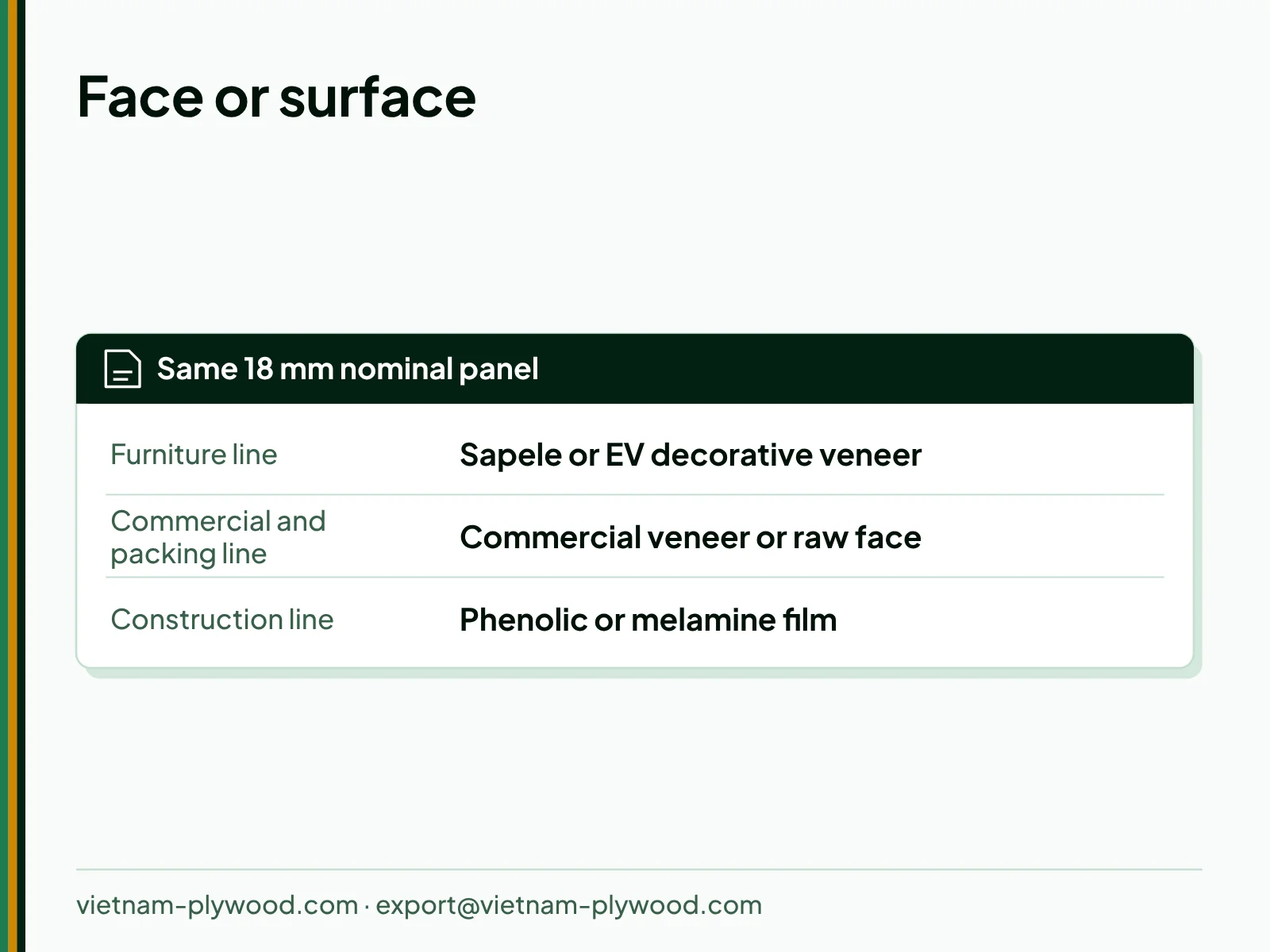
| Same 18 mm nominal panel | Face or surface | Core and construction | Thickness tolerance | Buying verdict |
|---|---|---|---|---|
| Furniture line | Sapele or EV decorative veneer | Styrax or eucalyptus, full stitched, sanded | ±0.2 or ±0.3 mm as ordered | Visible cabinets, doors and fit-out |
| Commercial and packing line | Commercial veneer or raw face | Acacia, MR glue, unsanded or light-sanded | ±0.5 mm; packing ±0.5–1.0 mm | Concealed parts and packaging |
| Construction line | Phenolic or melamine film | Acacia or eucalyptus, unsanded | ±0.5 mm | Concrete formwork, not decorative fronts |
The producing factory makes each order to its approved specification. HCPLY coordinates the specification, on-site quality control, export documents and loading, with shipment directly from that factory. Buyers can visit the factory office and inspect goods where the panels are produced.
For concealed acacia-core options, see packing or commercial plywood.
What thickness, size and face grade should you specify?
For furniture production, specify the actual metric dimensions, face grade, back grade and sanding tolerance together. Our plywood thickness range is 3–40 mm, with common orders at 3, 5, 9, 12, 15, 18, 21 and 25 mm. A nominal thickness without tolerance leaves too much uncertainty for routed grooves.
The standard size options are 1220×2440, 1250×2500, 1220×2135, 1220×1830, 915×2440, 915×2135 and 915×1830 mm. Custom cutting is available. Length and width tolerance is ±2 mm; furniture sanding tolerance is ordered at ±0.2 or ±0.3 mm.
Our common decorative face veneer thickness is 0.2–0.4 mm, with A/B face grades. An A face belongs on visible cabinet doors and wall panels where defects will be noticed. A B face can serve less prominent areas when its approved appearance fits the job. Define the permitted patches, color spread and joint visibility in the approved sample rather than assuming that the grade letter resolves every appearance dispute.
For 18 mm panels, the core normally contains 11–13 plies, depending on the 1.4–2.0 mm core veneer thickness. Ask the inspector to compare the edge construction with the approved section sample. The maple veneer plywood and white oak veneer plywood pages provide other face comparisons.
How should the core and glue be selected?
Use a full-stitched styrax core when lower panel weight matters, or a full-stitched eucalyptus core where a denser construction is specified. The core determines the density: styrax is 500 kg/m³ and eucalyptus is 650 kg/m³. The decorative veneer determines the product name, not its core density.
Core construction is another purchasing field. Full stitched has the highest construction level in our range, followed by stitched outer layers with edge-trimmed inner veneers, finger-jointed, then loose-laid.
Keep adhesive and formaldehyde emission as separate fields. Melamine glue is an MR (moisture-resistant) option with a 12-hour boil condition; phenolic glue is WBP (weather and boil proof) with a 72-hour boil condition. Furniture-line emission classes are E0 or E1. Neither emission class is a glue name, and a boil description alone does not establish suitability for every wet-service application.
For cabinet interiors exposed to occasional humidity, specify the bond requirement and test acceptance separately from the decorative surface. If a buyer asks for a marine or BS 1088 description, assess it only against a test report the buyer accepts. HCPLY does not manufacture birch-core plywood, medium-density fiberboard, oriented strand board, chipboard or blockboard.
Can decorative plywood share a 40HC container?
Yes. Specifications can be mixed within one 40HC container, provided the combined payload remains within 28.5 t. The packing calculation must account for the core density of each group of sheets and the applicable pallet arrangement.
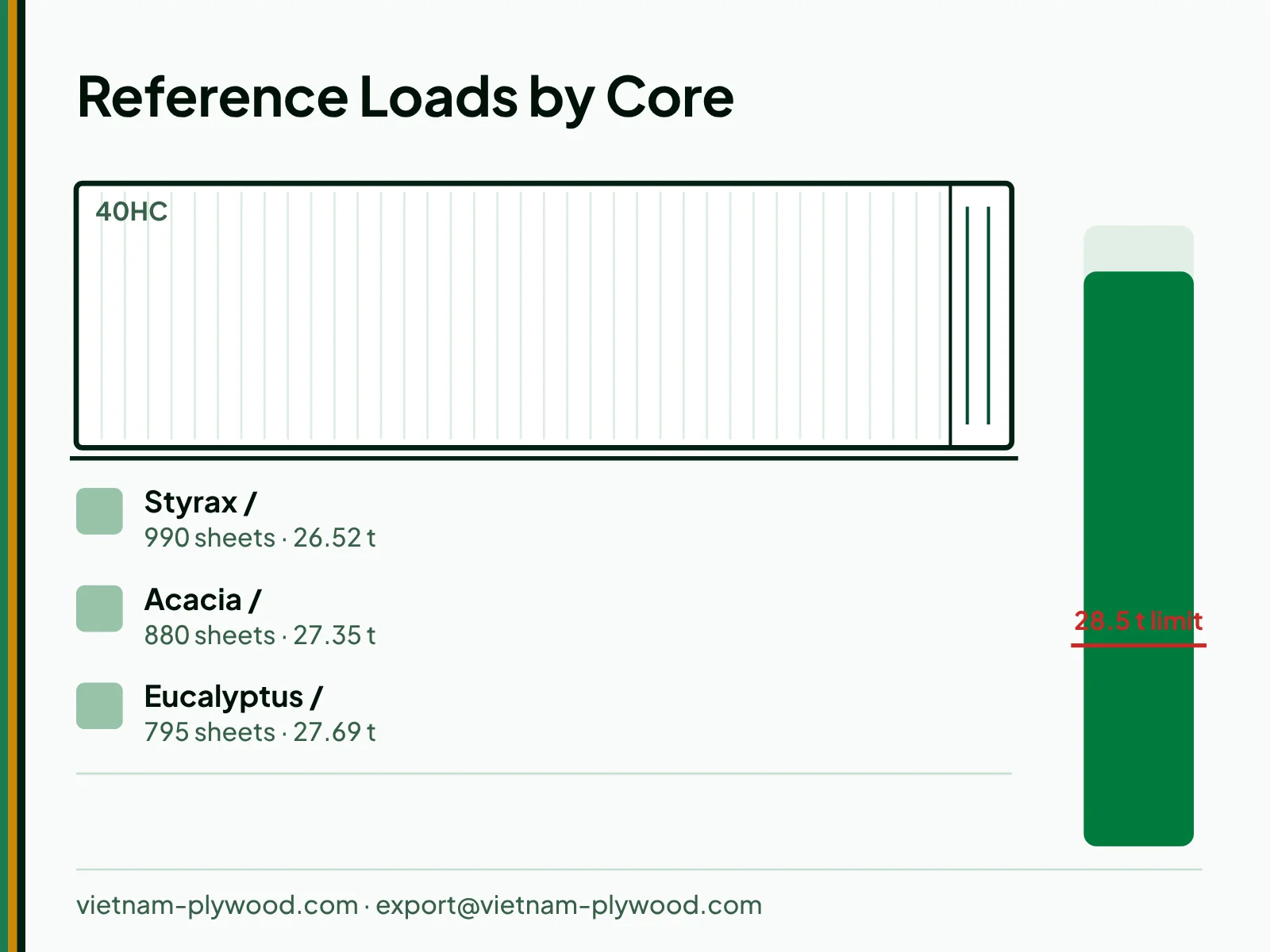
At 18 mm and 1220×2440 mm, a full styrax-core reference is 990 sheets, 53.05 m³ and 26.52 t. The corresponding acacia-core reference is 880 sheets, 47.15 m³ and 27.35 t; eucalyptus-core is 795 sheets, 42.60 m³ and 27.69 t. These are core-based planning figures without decorative film weight.
For example, one 18 mm styrax sheet weighs 26.79 kg, while an acacia sheet weighs 31.08 kg. A buyer mixing furniture and commercial panels should multiply the sheet counts in each group by those weights, then check the combined mass against the payload limit. Pallet allocation and the remaining load space must also be checked for the chosen mix.
The furniture reference uses 18 pallets with 55 sheets per pallet; acacia uses 16 pallets with 55 sheets per pallet. See container loading calculations and several plywood types in one order for the broader loading decision.
What can an inspector check at the producing factory?
The buyer or inspector can witness the face and core checks against the approved reference before loading. For a decorative order, prioritize face identity, veneer continuity, thickness consistency and visible edge construction. These checks address the common causes of disputes after cutting and finishing.
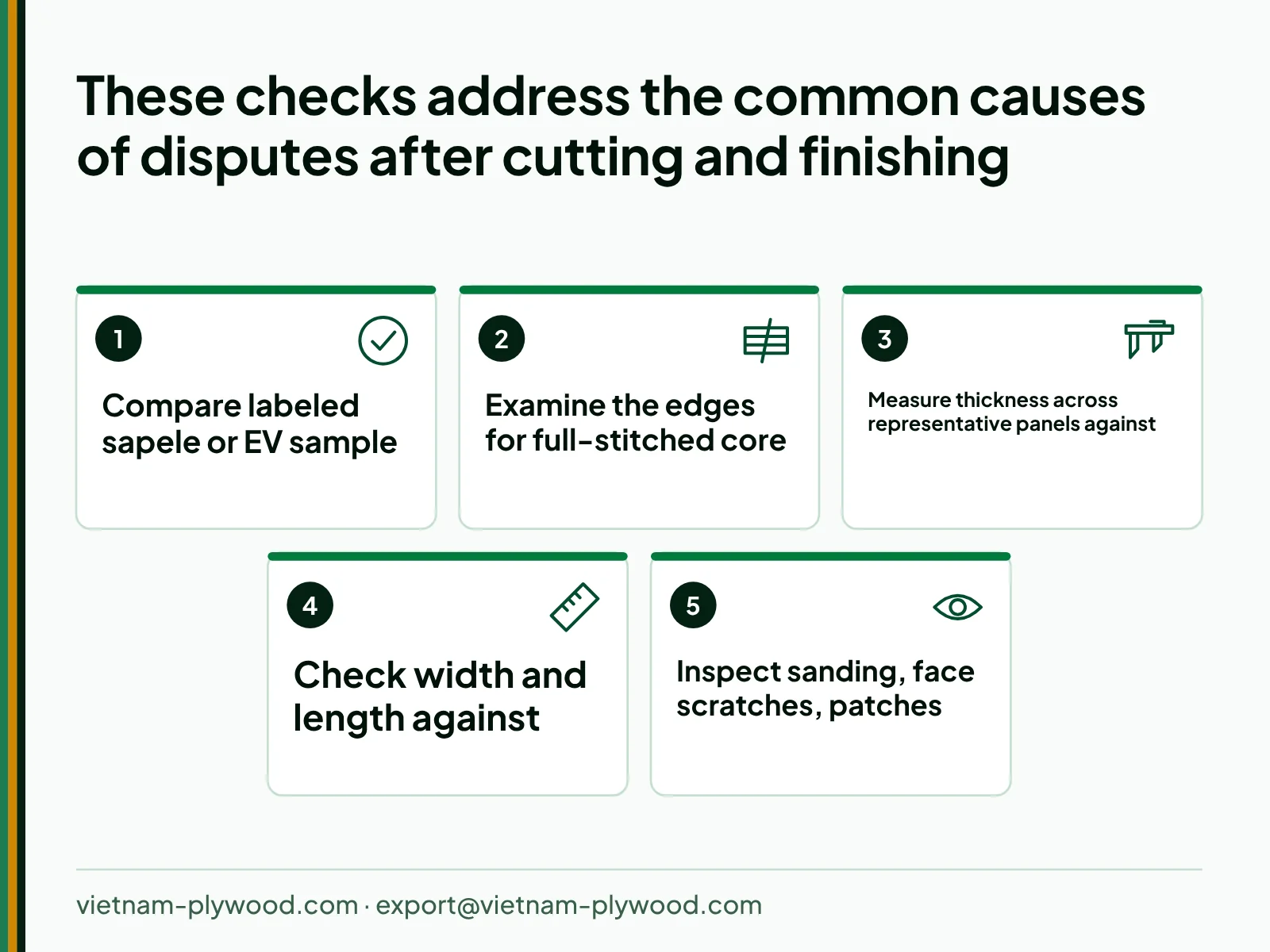
- Compare labeled sapele or EV sample panels with the approved tone, grain and face/back grade.
- Examine the edges for full-stitched core construction, open gaps and unexpected repairs.
- Measure thickness across representative panels against the ordered ±0.2 or ±0.3 mm tolerance.
- Check width and length against the agreed cut size and ±2 mm tolerance.
- Inspect sanding, face scratches, patches, veneer joints and pallet labels before dispatch.
Where a project calls for a particular finish, run a stain or clear-coat trial on the approved sample. Sapele’s interlocked figure can show different light and dark bands as the viewing angle changes. EV has a designed pattern, but color acceptance still needs a reference.
Record the inspected batch, agreed defects and measurement method in the inspection report so the production and receiving teams use the same criteria.
Will mahogany-type plywood stain, machine and stay flat?
A sapele face can show a pronounced figure under a transparent finish, while EV is useful when a repeating decorative pattern is desired. Both should be tested with the buyer’s actual stain, sealer and topcoat before a production run.
For machining, trial the panel with the intended saw blade, router and edge treatment. Inspect the face for tear-out and the edge for exposed gaps after cutting. Veneer thickness also matters: aggressive sanding can cut through a thin decorative face.
Cross-laid plywood construction reduces the large across-grain movement associated with solid wood, but storage and finish balance still affect finished panels. Keep pallets flat and protected from standing water. Apply the finishing schedule to both sides where the application calls for balanced treatment, and check fit after conditioning in the fabrication environment.
A decorative interior face is not an exterior exposure classification. For wet-service requirements, start with the bond specification and accepted test evidence, then decide whether a different panel surface is appropriate.
Which emission and origin papers belong with the order?
For US-bound decorative plywood, specify the applicable formaldehyde certification documents before production. The US Environmental Protection Agency’s 2025 Code of Federal Regulations, 40 CFR Part 770, identifies hardwood plywood with veneer core as a regulated composite wood product and sets its emission limit at 0.05 parts per million under section 770.10. See the official 2025 regulation.
CARB P2 and Toxic Substances Control Act (TSCA) Title VI refer to US emission compliance and third-party certification; they do not describe glue type or veneer grade. Ask for the certificate and test documentation corresponding to the producing factory and the agreed panel build. Member-factory FSC, CARB P2, ISO 9001 and CE documents are shown with factory details masked, on request.
For EU-bound orders, the EUTR/EUDR file set accompanies the relevant shipment documentation. Where species identity matters, record the actual face species separately from the commercial appearance description.
The shipment document set includes commercial invoice, packing list, bill of lading (B/L), certificate of origin (EUR.1 for EU lots), phytosanitary and fumigation papers, and insurance under CIF. Order-specific certificate documents and agreed test reports are included. After loading, the draft shipping documents come to you for approval.
What drives the price of a mahogany-type face?
The main price drivers are face selection and appearance matching, followed by core construction, sanding tolerance, glue and emission specification, thickness, and order mix. A tightly selected natural sapele face with restrictive color matching typically requires more selection work than an ordinary decorative face. Full-stitched sanded furniture panels also require more processing than unsanded commercial panels.
EV can be attractive for repeat-pattern cabinet runs, but a quotation must reflect the chosen pattern and approved sample. Do not assume it is always priced below sapele: a specialized pattern, tighter appearance sorting or small specification split can change the comparison.
HCPLY quotes furniture plywood from US$350/m³ FOB Hai Phong (October 2026). That dated starting figure is for furniture plywood generally, not a fixed sapele or EV price. For comparison, commercial plywood starts from US$250/m³ FOB Hai Phong (October 2026). The decorative-face order needs its own quotation against the agreed build.
Minimum order is one 40HC. Factory lead time runs 15–45 days from receipt of the 30% deposit; the exact figure depends on order size, line loading and what the contract fixes. The remaining 70% is paid on the scan of the bill of lading, by T/T, or by irrevocable sight L/C. We ship FOB Hai Phong, or CFR (CNF) or CIF to your port.
How do you turn a sample into a trial-container order?
Begin with a face reference and a measurable specification, then reserve a trial container for the approved build. A sample approval should identify which face is visible, which back is acceptable, and how color or figure will be judged across a batch.
Free samples are available; a first-time buyer pays the courier, and that charge comes off the first confirmed order. Lucy at export@vietnam-plywood.com can coordinate the sample and quotation for the furniture line.
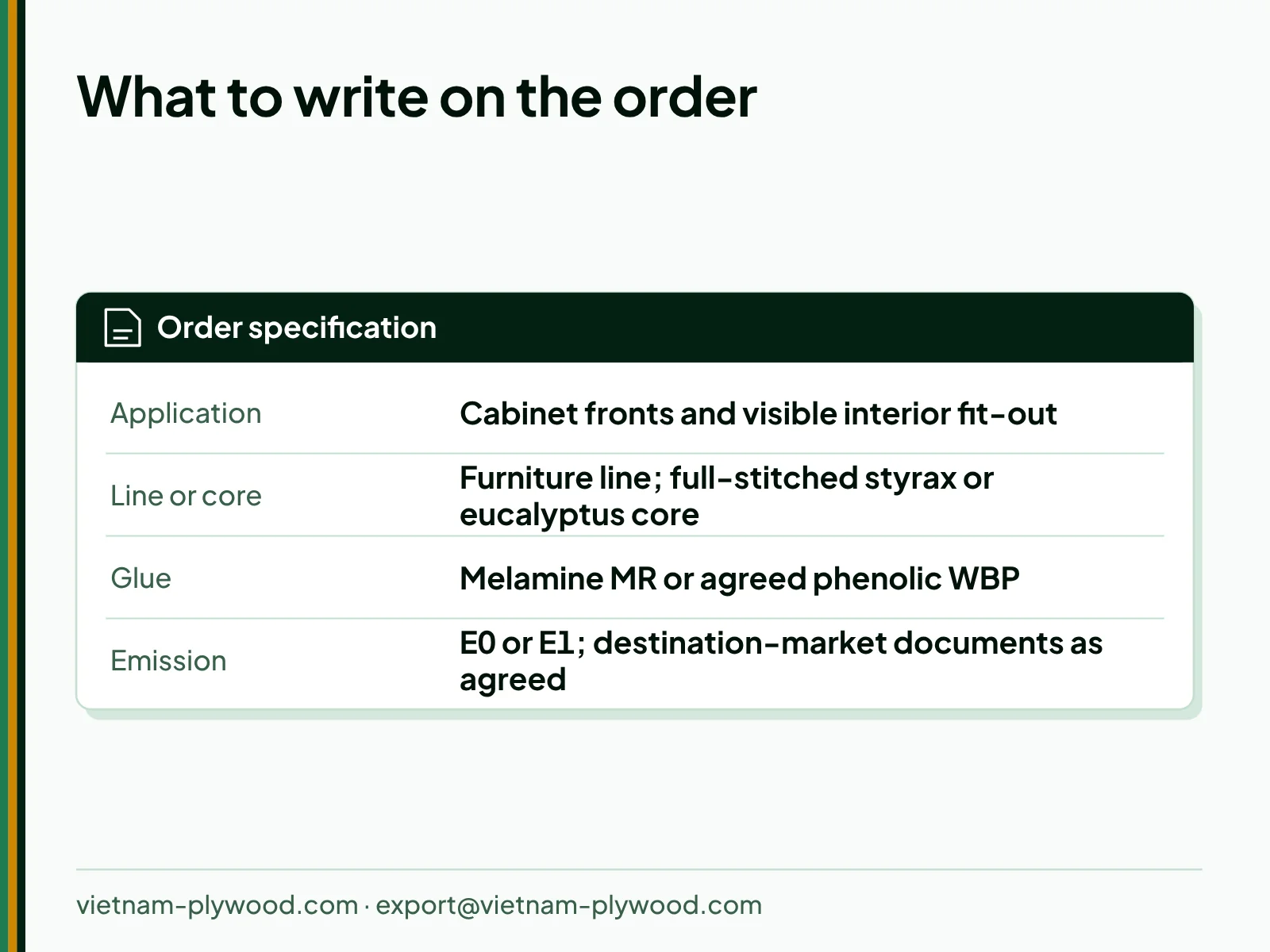
Send the following specification to contact the export team:
Application: cabinet fronts and visible interior fit-out
Line or core: furniture line; full-stitched styrax or eucalyptus core
Glue: melamine MR or agreed phenolic WBP
Emission: E0 or E1; destination-market documents as agreed
Face and grade: sapele A face / agreed back, or EV pattern reference
Thickness and tolerance: 18 mm; ±0.2 or ±0.3 mm as ordered
Size: 1220 × 2440 mm; length/width ±2 mm
Quantity: one 40HC, with specification split if required
Destination port: [buyer to enter]
Next step: plan a trial container against the approved face sample and written inspection criteria.