





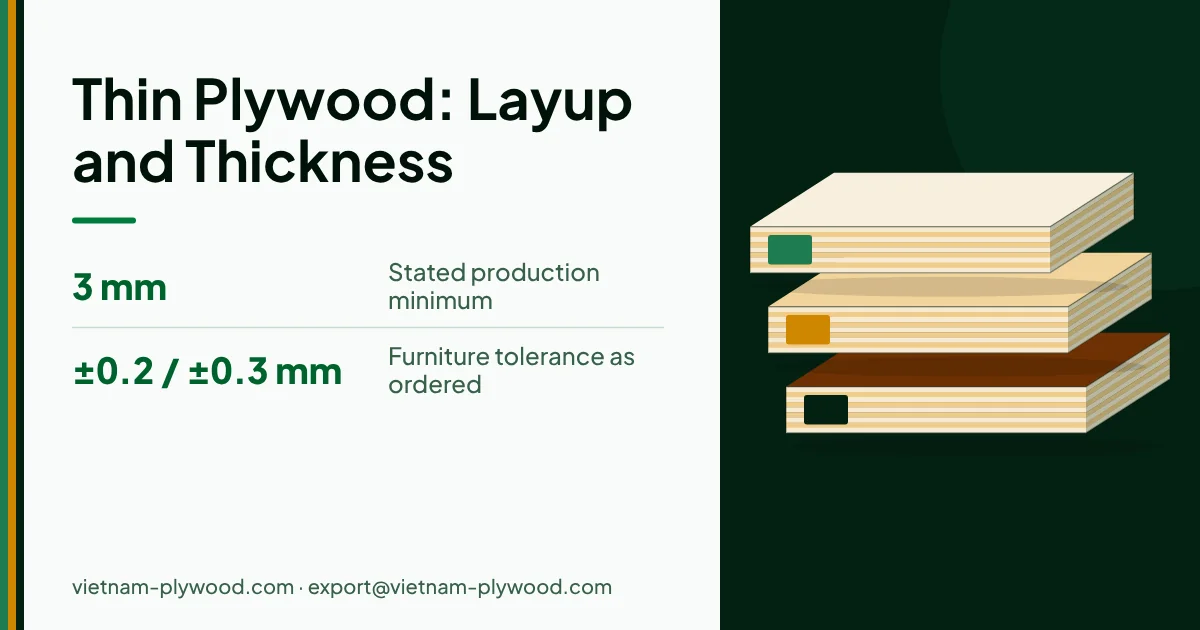
A 2mm plywood panel needs an exceptionally thin, balanced veneer layup; HCPLY’s stated production thickness starts at 3 mm. Specifying an unsupported 2 mm tolerance can mean rejected cabinet parts, revised drawings and lost production days. Furniture buyers should distinguish specialty-market thin sheets from the established export range before approving a purchase specification.
What sizes and thicknesses can the three lines produce?
HCPLY’s stated production range begins at 3 mm. A 2mm plywood enquiry therefore calls for a separate feasibility review rather than an order written against our standard thickness range.
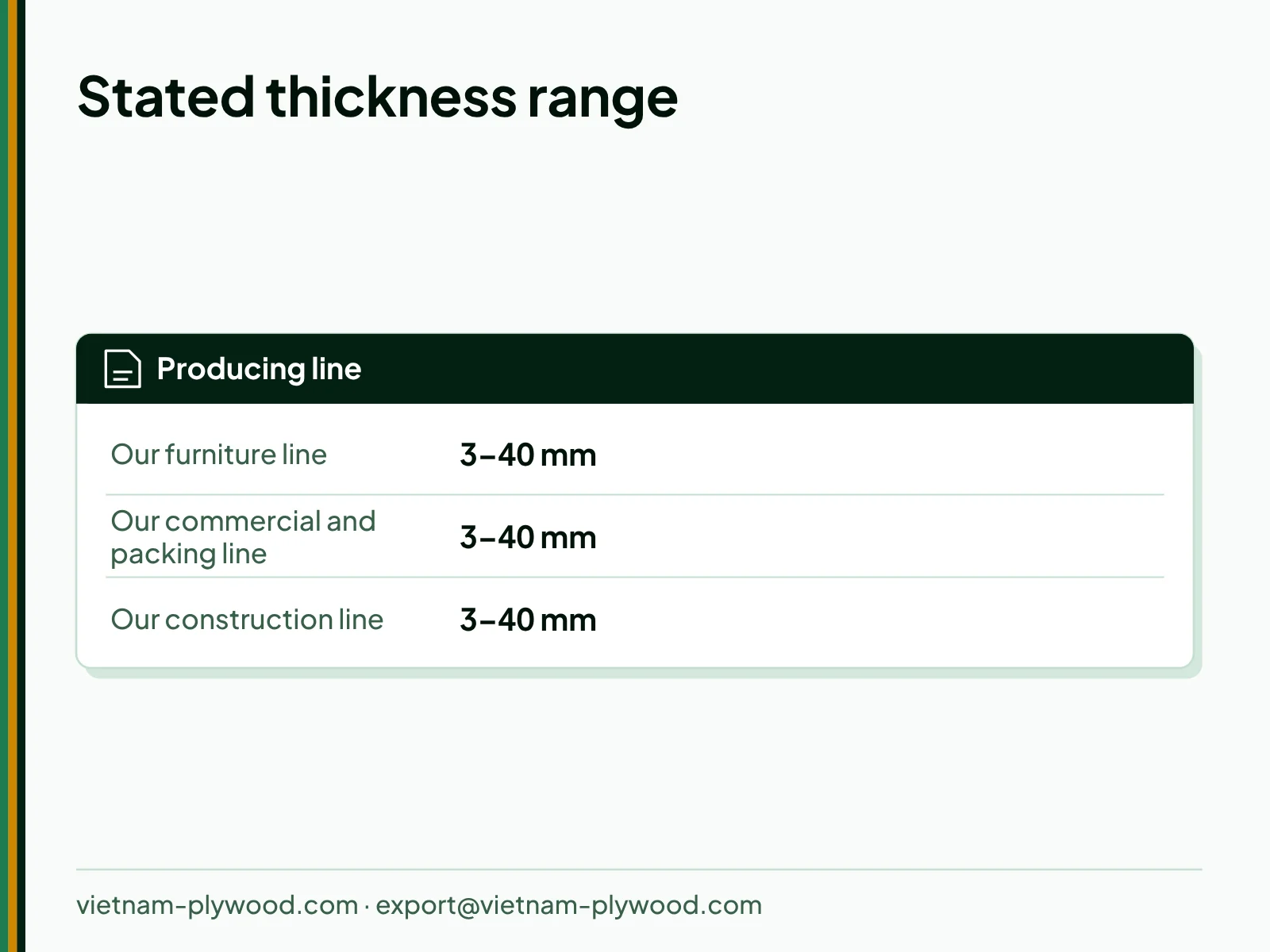
| Producing line | Stated thickness range | Standard sheet sizes | Construction relevant to a thin-panel enquiry |
|---|---|---|---|
| Our furniture line | 3–40 mm | 1220 × 2440; 1250 × 2500 mm | Sanded, full-stitched styrax or eucalyptus core; decorative veneer faces |
| Our commercial and packing line | 3–40 mm | 1220 × 2440; 1220 × 2135 mm | Acacia core, MR glue, unsanded or light-sanded |
| Our construction line | 3–40 mm | 1220 × 2440; 915 × 1830 mm | Acacia or eucalyptus core, unsanded, film-faced |
Other stated sizes include 1220 × 1830, 915 × 2440 and 915 × 2135 mm; custom cutting is available. These dimensions describe established ranges, not an accepted 2 mm manufacturing specification. A buyer comparing small-format specialty panels with export sheets should specify the finished dimensions before discussing veneer selection.
Can 2mm plywood or thinner plywood be made?
Yes, plywood at 2 mm and even below exists in the specialty market, but that does not establish that every plywood production line can make it. HCPLY’s stated thickness range starts at 3 mm. For an order below that limit, the practical decision is whether to investigate a separate construction or specify the established 3 mm furniture build.
The term thinnest plywood sheet has no single universal answer. Specialty catalogues list sheets as thin as 0.4 mm, often in smaller formats and with different constructions from export furniture plywood. A listing for 1.5mm plywood or plywood 1mm therefore establishes a market category, not a manufacturing capability for our factories.
The European Commission’s 2016 Decision 2016/1332 describes plywood as layers glued together, with adjacent grain directions usually at right angles, referring to EN 313. That definition explains why a very thin sheet still needs a considered layup; it does not establish a minimum finished thickness. See the European Commission’s 2016 definition.
Which face and core veneers fit a very thin layup?
A theoretical three-veneer 2 mm layup must fit both face veneers, the cross-grain centre and adhesive into the finished thickness. The usual 0.2–0.4 mm face veneer range leaves little thickness for the centre, especially after pressing and sanding. Our normal core veneer thickness is 1.4–2.0 mm, which does not itself describe a validated centre veneer for a 2 mm finished sheet.
Our furniture line uses styrax or eucalyptus core with full-stitched construction and sanded faces. Bintangor, okoume, engineered veneer (EV), gurjan, pine, poplar, eucalyptus, birch and sapele are named face options across the product range; face availability for a special thin layup must be evaluated separately. Birch face grading uses D/E/F; other named faces use A/B.
Do not substitute a face name for a core specification. The face identifies the product appearance; the core governs the density. A birch-faced sheet is therefore not automatically birch-core plywood. We do not press birch-core plywood. Buyers considering decorative veneer on a rigid cabinet component can start with our thin plywood supplier range and specify the face independently of the core.
How do the three production lines approach the same need?
The furniture line is the starting point for a thin, visible cabinet or fit-out component because its full-stitched, sanded construction addresses appearance and surface consistency. The other lines are designed for different performance priorities.
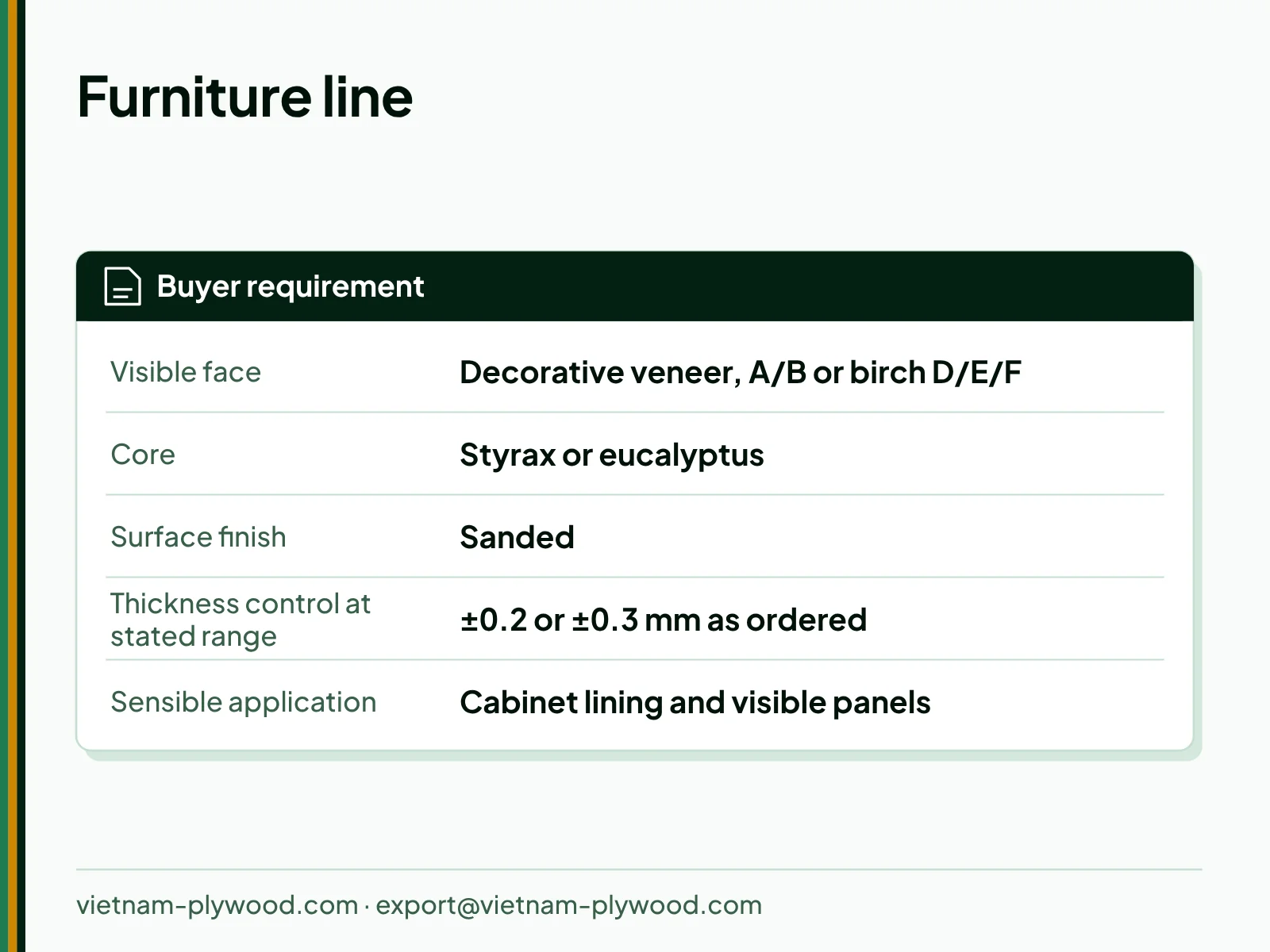
| Buyer requirement | Furniture line | Commercial and packing line | Construction line |
|---|---|---|---|
| Visible face | Decorative veneer, A/B or birch D/E/F | Raw or lightly sanded utility surface | Phenolic or melamine film |
| Core | Styrax or eucalyptus | Acacia | Acacia or eucalyptus |
| Surface finish | Sanded | Unsanded or light-sanded | Unsanded beneath film |
| Thickness control at stated range | ±0.2 or ±0.3 mm as ordered | ±0.5 mm; packing ±0.5–1.0 mm | ±0.5 mm |
| Sensible application | Cabinet lining and visible panels | Packing or concealed utility parts | Formwork surfaces |
A film surface adds a separate material layer and does not solve the veneer geometry of a 2 mm panel. The construction line makes film-faced panels; it is not a substitute thin decorative panel line. For a concealed cabinet back, compare wardrobe back panel options before reducing thickness.
What tolerance can a buyer write for plywood 2 mm?
There is no established HCPLY 2 mm tolerance to put directly into an accepted order. For furniture panels within the stated range, our sanded tolerance is ±0.2 or ±0.3 mm as ordered; length and width tolerance is ±2 mm. Those figures must not be transferred automatically to a 2 mm proposal.
A buyer requesting 2 mm should define nominal thickness, measurement method, permitted minimum and maximum, and the measurement points across a sheet. State whether the figure applies after sanding and conditioning, and how edge measurements are treated. An agreed inspection sample should show whether the proposed layup can hold the requested band.
For a 3 mm furniture order, select the applicable stated tolerance explicitly rather than writing an unspecified ‘standard tolerance’. The difference affects fit in grooves, panel stack-up and rejection decisions. A 2 mm enquiry needs a newly agreed tolerance supported by a physical sample before any bulk commitment.
Does a 2 mm plywood sheet stay flat?
Flatness cannot be inferred from nominal thickness alone. Veneer balance, grain direction, moisture exposure, adhesive distribution and handling all affect the sheet’s response. A very thin panel has less bending stiffness than a thicker panel of otherwise comparable construction, so unsupported storage and installation are especially important.
Specify the intended support pattern: fully bonded backing, continuous grooves, or an unsupported opening. Record the inspection condition, the sheet’s orientation, and the allowable bow or twist with a defined measurement method. A flatness acceptance limit should be agreed on a representative sample rather than borrowed from a thicker panel.
For an application that requires a curve, consult the bendable plywood guide. A panel designed to bend and a panel required to remain flat need different acceptance criteria. Do not treat a thin decorative sheet as a structural member without an accepted test report for that build.
When is 3 mm safer than 2 mm?
Choose 3 mm when the project needs a thickness within HCPLY’s stated manufacturing range, an agreed furniture sanding tolerance, and repeatable export inspection. A 2 mm proposal adds unresolved veneer selection, press response and flatness questions before a purchase order can be accepted.
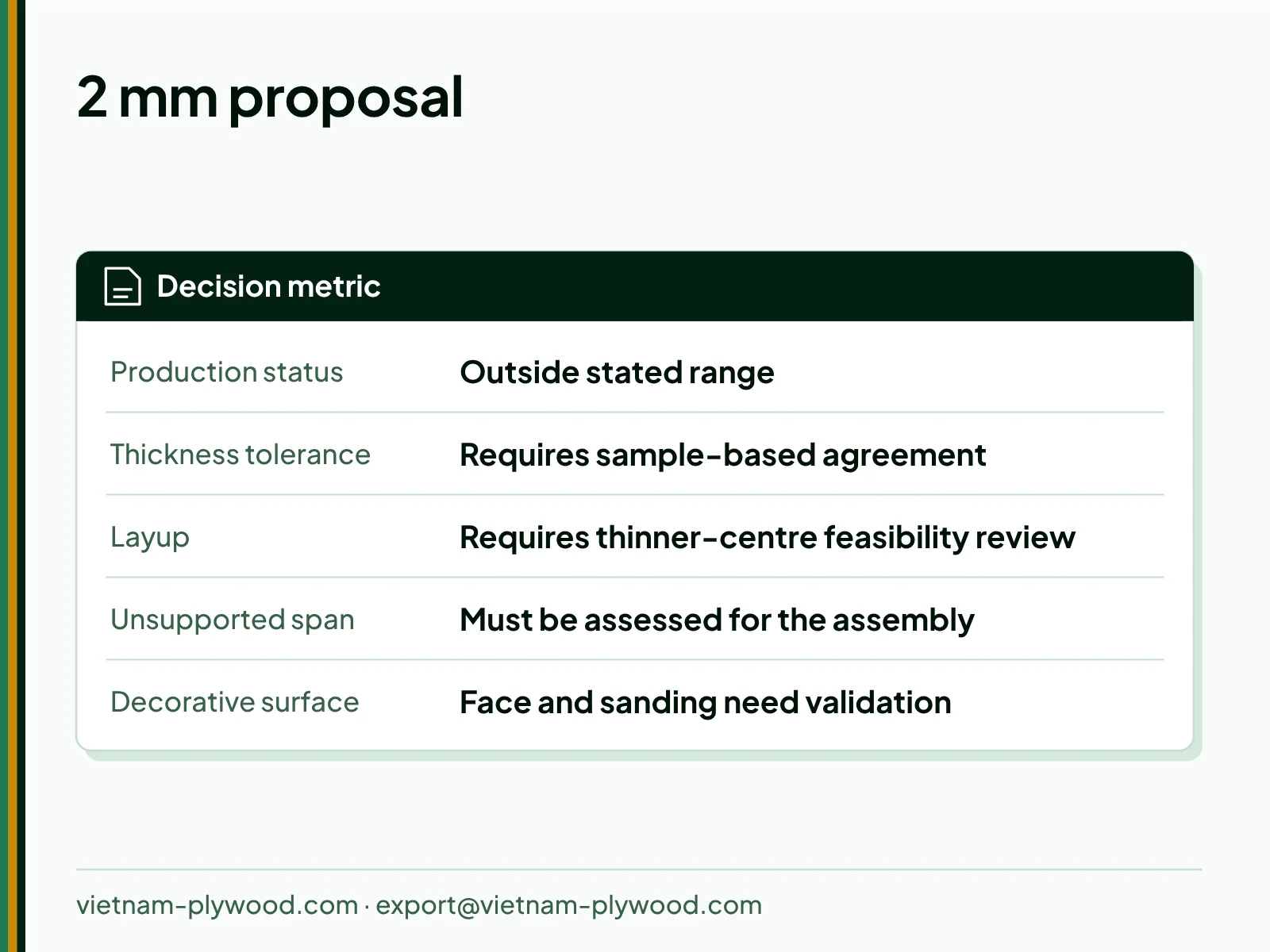
| Decision metric | 2 mm proposal | 3 mm furniture order | Buyer verdict |
|---|---|---|---|
| Production status | Outside stated range | Within stated range | 3 mm for a scheduled export specification |
| Thickness tolerance | Requires sample-based agreement | ±0.2 or ±0.3 mm as ordered | 3 mm for controlled groove fit |
| Layup | Requires thinner-centre feasibility review | Within established furniture range | 3 mm for repeat orders |
| Unsupported span | Must be assessed for the assembly | Still requires application testing | Test either; favour 3 mm where rigidity matters |
| Decorative surface | Face and sanding need validation | Named furniture face options | 3 mm for visible cabinet work |
A thicker panel changes weight and groove dimensions, so the substitution needs the cabinet maker’s drawing approval. For adjacent size choices, see 4 mm plywood and 3–6 mm plywood for the UK.
What can an inspector check at the producing factory?
An inspector can witness finished-sheet thickness measurements, face grading, edge examination and a flatness check against the purchase specification. The visit should take place at the producing factory, where the actual order is pressed, finished and packed.
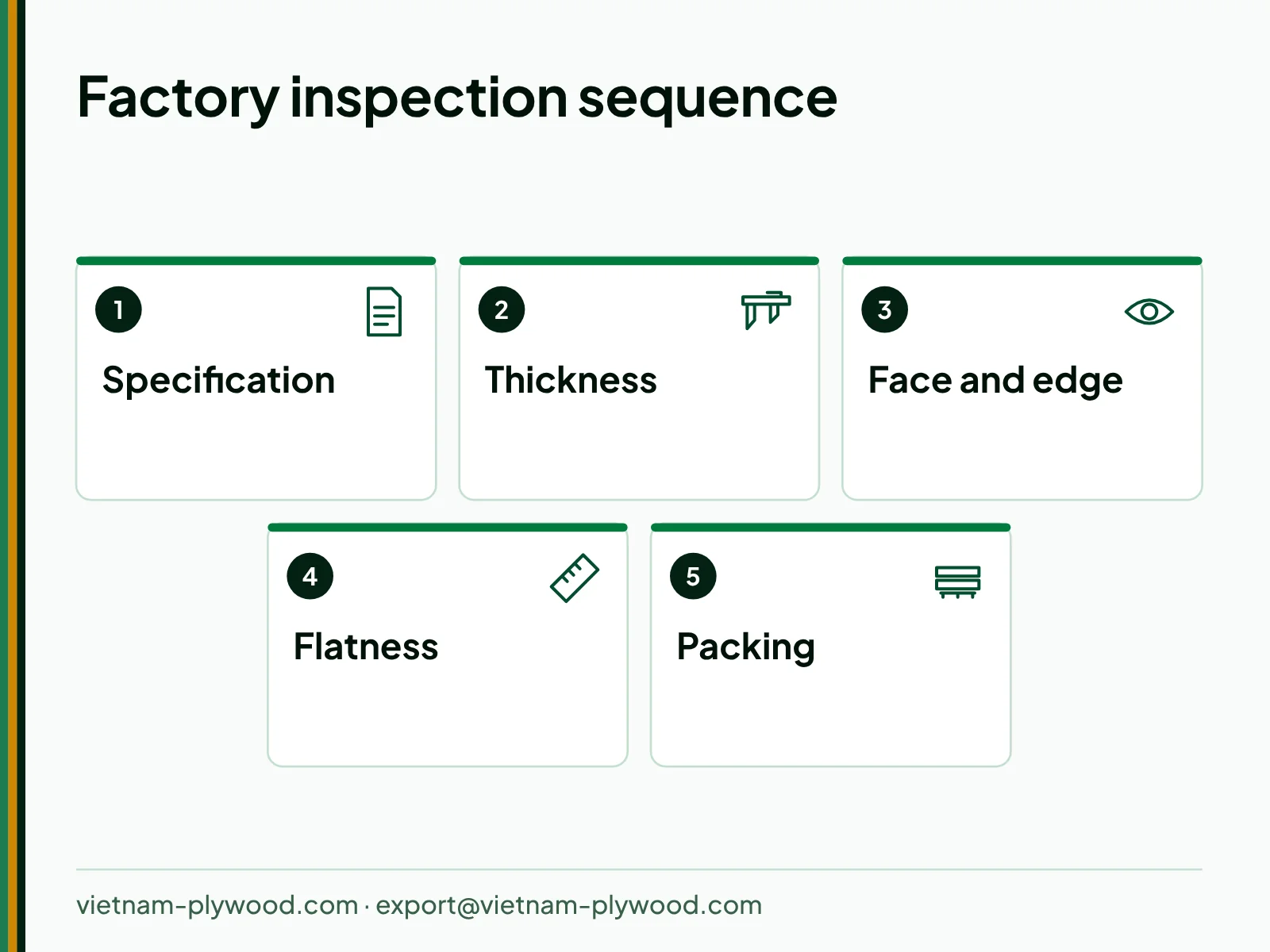
- Match the production sheet and labels to the ordered face, core, glue and emission class.
- Measure finished thickness at agreed locations and record the readings against the signed tolerance.
- Inspect face defects, edge gaps, core continuity and the result of sanding.
- Place representative panels on the agreed support surface and record bow or twist by the agreed method.
- Check sheet dimensions, pallet protection and batch identification before loading.
For a below-range trial, the first inspection question is whether a representative construction and acceptance method have been agreed. HCPLY handles on-site quality control and export loading; buyers may inspect goods and meet the team at the factory office.
Can thin panels share a container with thicker plywood?
Specifications can be mixed in one 40HC within the 28.5 t payload limit. A confirmed 3 mm furniture build can therefore be planned alongside thicker panels, with weight checked by core and sheet size rather than by nominal thickness alone.
For 1220 × 2440 mm sheets at 3 mm, the stated styrax lookup is 4.47 kg per sheet, 333 sheets per pallet, and 5,994 sheets for a full 40HC: 53.53 m³ and 26.76 t. At 18 mm, the styrax lookup is 26.79 kg per sheet; a full 40HC is 990 sheets and 26.52 t. These are separate full-load examples, not an arithmetic claim for a mixed stack.
A mixed plan must add the actual pallet and panel weights and stay below the payload limit. Use the container loading reference for the full-load calculation, or discuss mixed container loads and distributor supply programmes for the purchasing arrangement.
Which glue, emission class and paperwork belong on the order?
Write glue and emission as separate specification fields. Our furniture line uses E0 or E1 emission classes; adhesive choices in the product range include melamine MR and phenolic WBP. MR means moisture-resistant, while WBP means weather and boil proof. A glue description does not establish an emission classification.
For export, the agreed documents include the commercial invoice, packing list, bill of lading (B/L), certificate of origin, applicable phytosanitary and fumigation papers, and order-specific certificates or test reports. EU lots include the EUTR/EUDR file set and EUR.1 where applicable; CIF shipments include insurance. After loading, the draft shipping documents come to you for approval.
Factory-held FSC, CARB P2, ISO 9001 and CE materials, along with EUTR/EUDR documents, are shown with factory details masked, on request. The relevant emission certificate or test report must correspond to the agreed build. Do not assume a document for a standard 3 mm product covers a different proposed layup.
What should an importer request before placing an order?
Start with the assembly drawing, the target finished thickness and the reason a 3 mm panel will not fit. For a 2 mm proposal, ask for a feasibility response identifying the veneer stack, test sample and measurable acceptance criteria. For a standard 3 mm order, request the line specification and the ordered sanding tolerance.
Price is driven first by whether a new thin layup must be developed, then by face selection and grade, core construction, sanding and the inspection requirements. A special thin construction carries more development and handling work than an established 3 mm furniture build. A written quotation should identify these factors rather than imply a standing 2 mm price.
The minimum order is one 40HC, with mixed specifications within the payload limit. Factory lead time runs 15–45 days from receipt of the 30% deposit; the exact figure depends on order size, line loading and what the contract fixes; the The remaining 70% is paid on the scan of the bill of lading, by T/T, or by irrevocable sight L/C. Delivery can be FOB Hai Phong, CFR (CNF) or CIF. Samples are free; new buyers book their courier, and its cost can be credited against a real order.
What specification should the cabinet buyer send?
A usable request separates the proposed thin-panel investigation from an order for established furniture plywood. Include the application, support conditions, visible face and allowable dimensional movement, alongside the normal commercial fields.
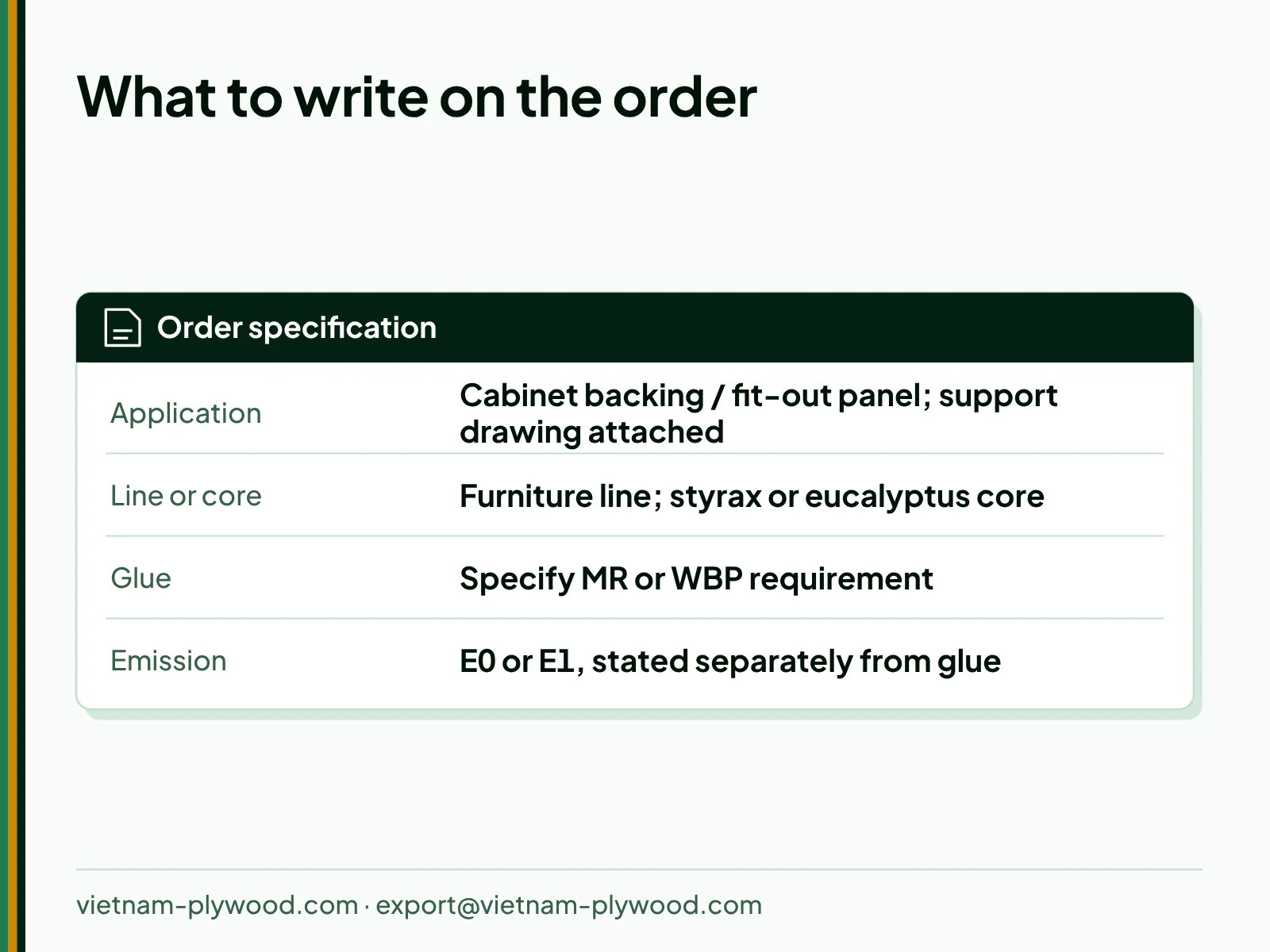
Application: Cabinet backing / fit-out panel; support drawing attached
Line or core: Furniture line; styrax or eucalyptus core
Glue: Specify MR or WBP requirement
Emission: E0 or E1, stated separately from glue
Face and grade: Specify veneer species and A/B; birch D/E/F
Thickness and tolerance: 3 mm, ±0.2 or ±0.3 mm as ordered;
  OR 2 mm feasibility enquiry with proposed measurement and flatness criteria
Size: Specify finished length × width in mm
Quantity: One 40HC minimum; list mixed specifications if needed
Destination port: State named destination port
Request the 2 mm feasibility or 3 mm furniture specification sheet from Lucy at export@vietnam-plywood.com.