





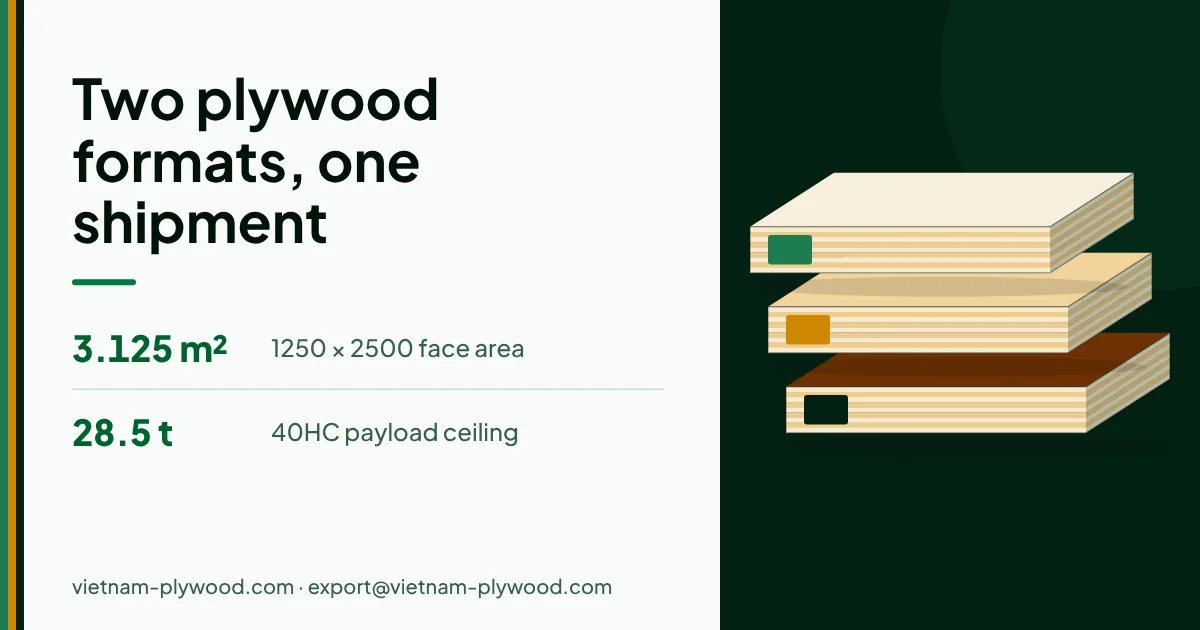
HCPLY can press both 1250 × 2500 mm and 1220 × 2440 mm plywood and mix them in a container when the pallet plan fits the payload. Choosing the wrong format costs cutting yield, extra joints or a rejected shipment. The right choice starts with the finished component or slab module, then the core, face and loading plan.
What changes between plywood 2500 x 1250 and 1220 x 2440?
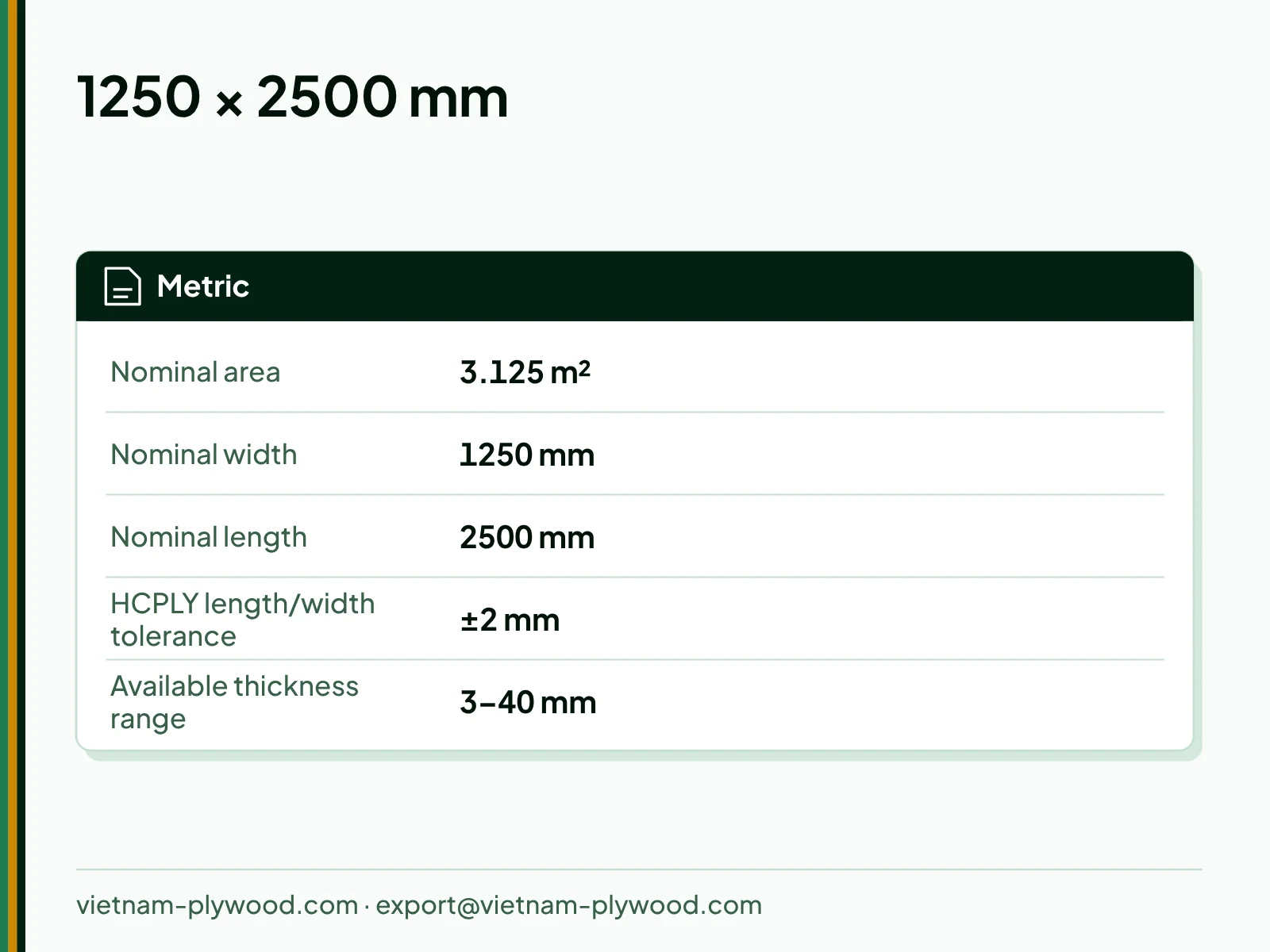
Plywood 2500 x 1250 covers 3.125 m² per sheet, against 2.9768 m² for 1220 x 2440. The larger format adds 148,200 mm² of face area, approximately 4.98% more. For cabinet nests or slab modules built around metric dimensions, that difference can remove a seam or a narrow infill strip. It also changes cutting yield and sheet weight.
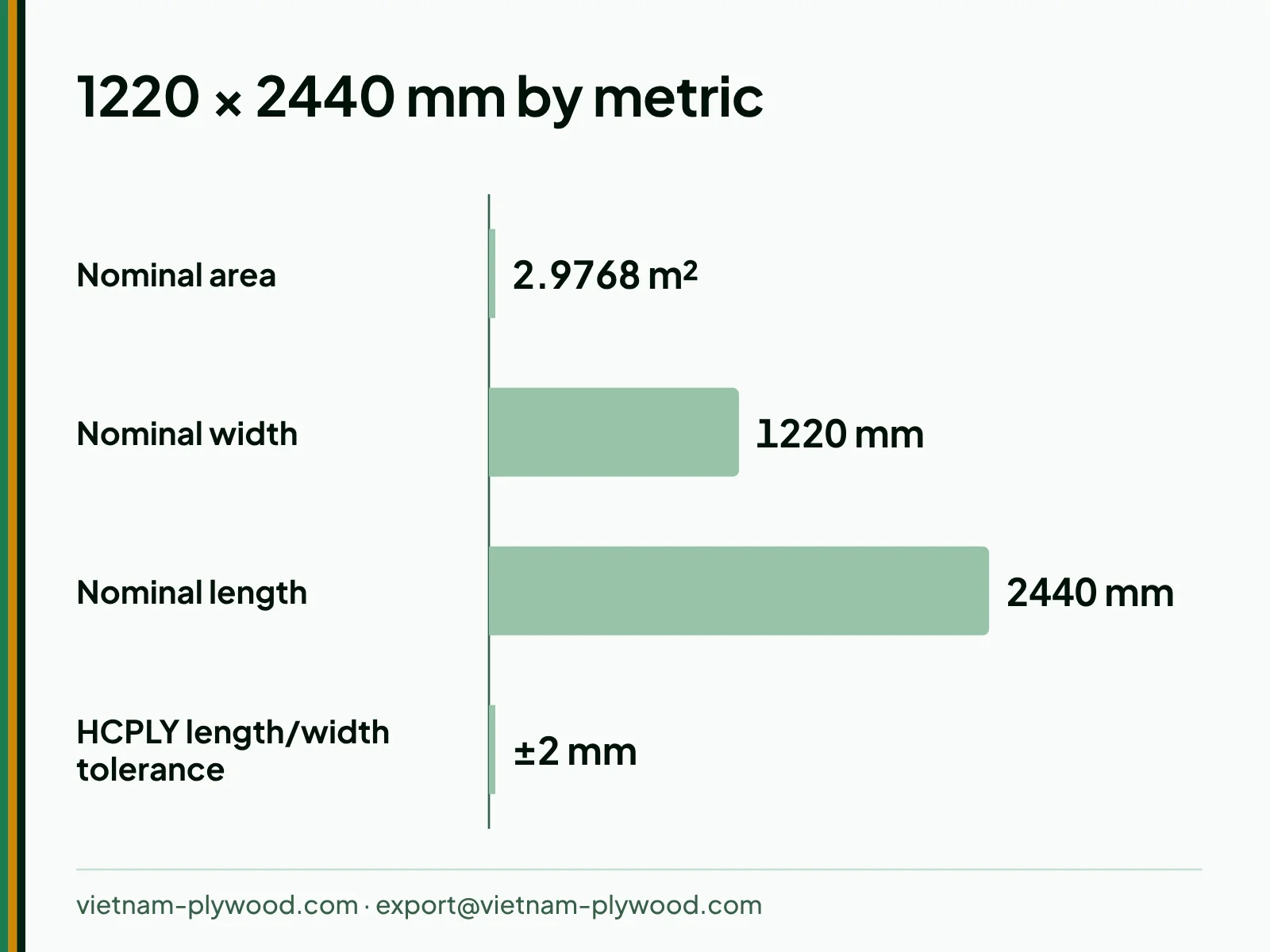
| Metric | 1250 × 2500 mm | 1220 × 2440 mm | Buying verdict |
|---|---|---|---|
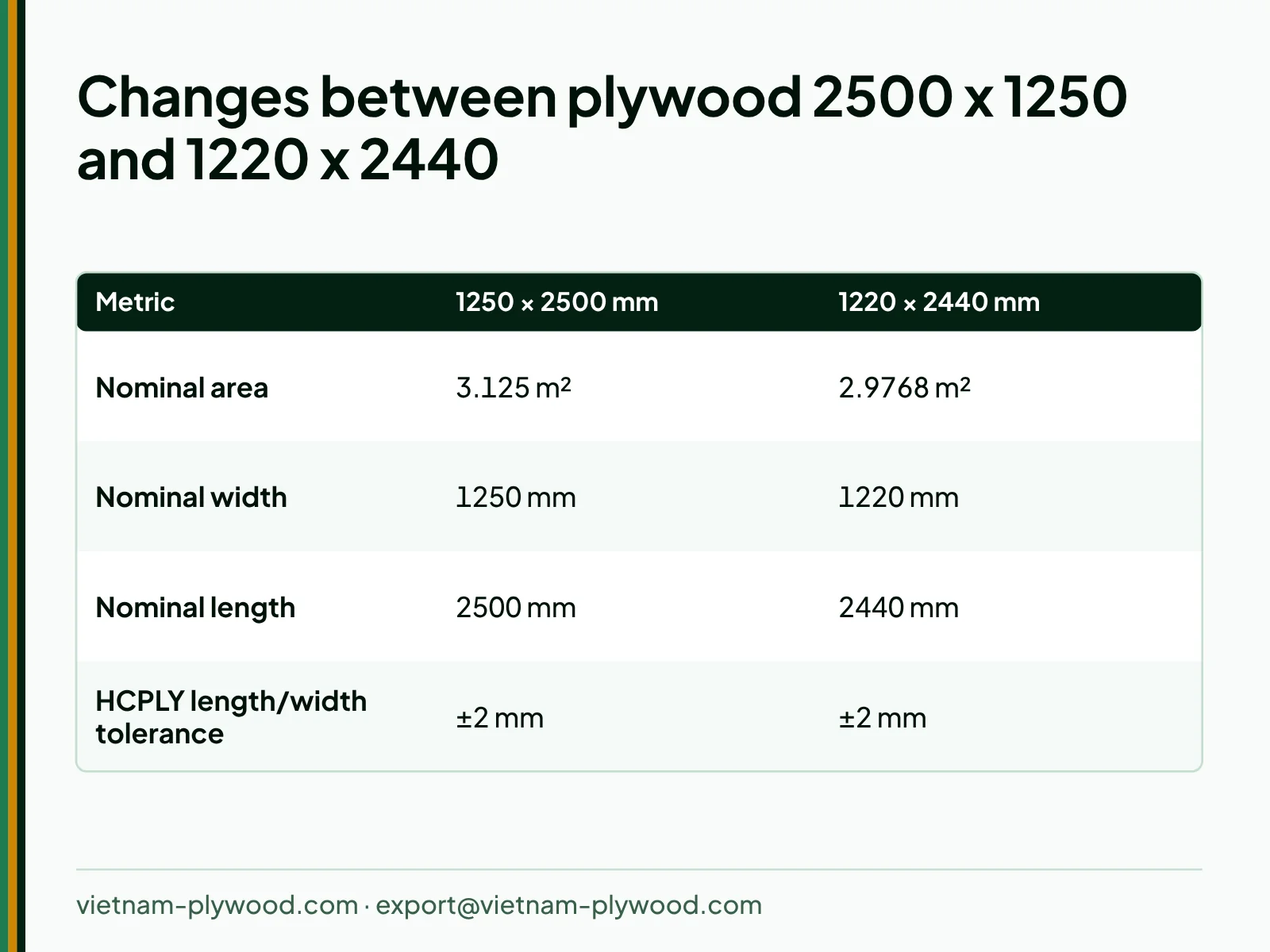
| Nominal area | 3.125 m² | 2.9768 m² | Larger format for metric cutting layouts |
| Nominal width | 1250 mm | 1220 mm | Match the actual cutting plan |
| Nominal length | 2500 mm | 2440 mm | Match slab or furniture module |
| HCPLY length/width tolerance | ±2 mm | ±2 mm | Inspect both against the order |
| Available thickness range | 3–40 mm | 3–40 mm | Specify the build, not size alone |
Neither format automatically produces less waste. Run the cutting list against both rectangles, including kerf, edge trimming and grain direction. See our plywood sheet dimensions overview and actual 4×8 dimensions for the naming difference.
Can a Vietnam manufacturer supply 1250 × 2500 plywood?
Yes. HCPLY manufactures 1250 × 2500 mm plywood through the producing factory matched to the ordered construction. Our three factories in Phu Tho and Hai Phong cover furniture, commercial and packing, and film-faced construction builds. Orders ship directly from the producing factory, FOB Hai Phong.
A buyer can visit the factory office, examine the actual press output and inspect the packed lot at the producing factory. Specify 1250 × 2500 mm explicitly and consider cut-to-size plywood for finished blanks.
Which plywood types come in the European format?
The 1250 × 2500 mm format can be built for cabinet faces, general packing or film-faced concrete work. The producing line determines core preparation, surface and inspection priorities.
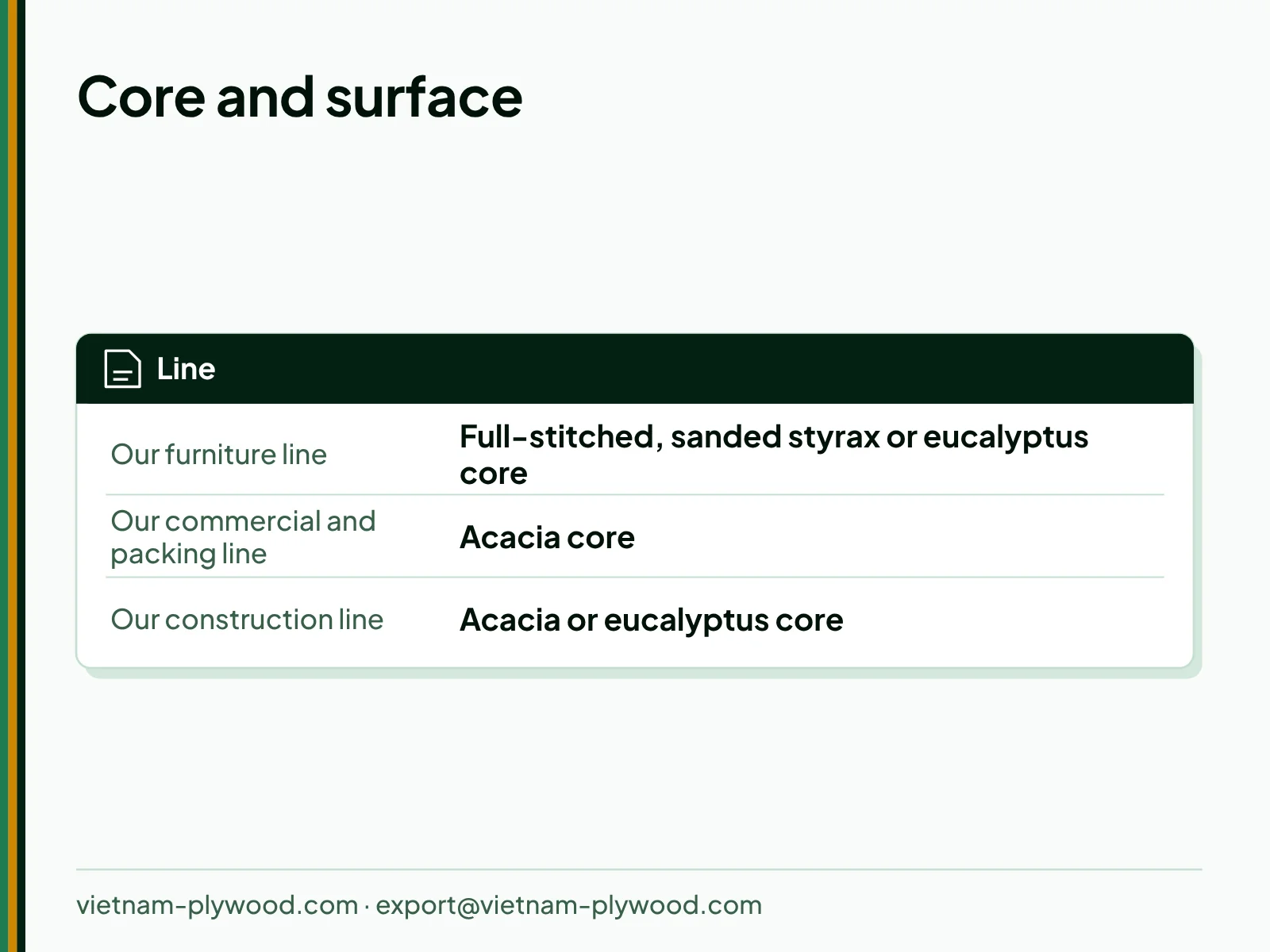
| Line | Core and surface | Typical use | What the other lines build instead |
|---|---|---|---|
| Our furniture line | Full-stitched, sanded styrax or eucalyptus core; selected veneer face | Cabinet and fit-out panels | Commercial line makes utility or packing boards |
| Our commercial and packing line | Acacia core, MR glue, unsanded or light-sanded | Packing and general-purpose boards | Furniture line targets visible faces and tighter sanding |
| Our construction line | Acacia or eucalyptus core; phenolic or melamine film, including anti-slip | Slab formwork and working surfaces | Furniture line makes veneered interior panels |
Face choices include bintangor, okoume, engineered veneer (EV), gurjan, pine, poplar, eucalyptus, birch and sapele; matt means an unfaced raw core. Face grades are A/B, except birch faces designated D/E/F. The face names the product, while the core determines its nominal density. We do not press birch-core plywood, medium-density overlay (MDO) or high-density overlay (HDO) panels.
What should furniture and formwork buyers specify differently?
Furniture buyers should start with the cutting nest, visible face, sanding and emission class. Our furniture line uses styrax or eucalyptus cores, full stitching and E0 or E1 emission classes. Common face veneer thickness is 0.2–0.4 mm. The ordered sanded thickness tolerance is ±0.2 or ±0.3 mm.
Formwork buyers should start with slab module, film surface, glue and edge sealing. Our construction line uses acacia or eucalyptus cores with unsanded construction and ±0.5 mm thickness tolerance. Film choices are 120 g/m² standard, 135 g/m² premium and 220 g/m² for anti-slip only. A 1250 mm module helps only where the formwork layout and support spacing accept it.
For construction procurement, use the construction project supply specification route. For alternative larger formats, compare 5×10 plywood sheets and jumbo plywood sheets.
Does the larger sheet change the price?
Yes, sheet area, press loading and usable cutting yield can change the quotation. First compare the same core, glue, face, thickness and grade; a larger rectangle consumes more wood per sheet. Next compare press and trimming yield for the required format. Finally compare packing and payload efficiency for the actual mix.
A full-stitched, sanded furniture build costs more to prepare than a loose-laid utility core because stitching and finishing add operations. A premium film specification adds surface material relative to standard film. These are build comparisons, not a fixed surcharge for 1250 × 2500 mm.
The commercial plywood starting reference is from US$250/m³ FOB Hai Phong (October 2026); the furniture plywood reference is from US$350/m³ FOB Hai Phong (October 2026). A European-format quote is calculated from the written specification, including format yield. Film-faced and other grades need their own quotation; there is no universal per-sheet figure.
Can 1250 × 2500 and 1220 × 2440 share one container?
Yes. Different sizes and specifications can share a 40-foot high-cube container (40HC) within its 28.5 t payload limit. The packing plan must account for each core density, pallet count and stack height. Mixed-format loading should be calculated pallet by pallet rather than applying a full-container sheet count to both sizes.
For an 18 mm 1220 × 2440 mm reference load, styrax gives 990 sheets and 26.52 t; acacia gives 880 sheets and 27.35 t; eucalyptus gives 795 sheets and 27.69 t. The respective sheet weights are 26.79 kg, 31.08 kg and 34.83 kg. These figures exclude film weight.
For 1250 × 2500 mm, the nominal 18 mm acacia sheet weighs 1.25 × 2.50 × 0.018 × 580 = 32.625 kg. Its acacia pallet stack height is 970 mm, giving floor(970 ÷ 18) = 53 sheets per pallet. This is a planning calculation; a mixed load still needs a pallet layout and a weight sum before booking. See container load planning for the full-format loading topic.
How does the format affect press yield and production?
The format changes veneer layup, trimming and saleable press yield. The producing factory plans press loading to the ordered dimensions.
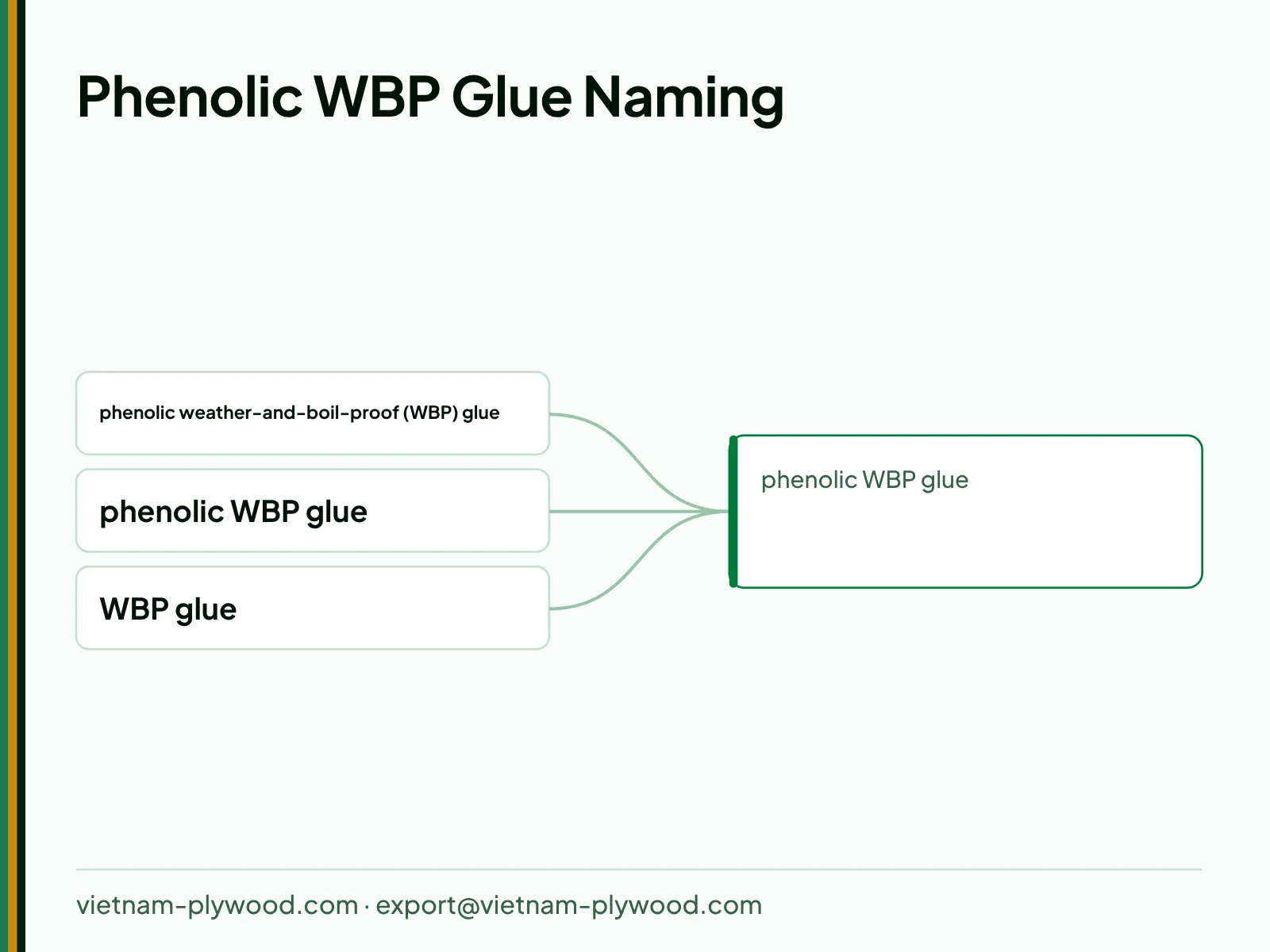
For MR glue, hot pressing is at 110–120 °C; for phenolic weather-and-boil-proof (WBP) glue, it is 130–145 °C. Glue and emission class are separate specification fields. Melamine MR glue is associated with a 12-hour boil specification; phenolic WBP with a 72-hour boil specification. Neither boil designation substitutes for a buyer-accepted test report.
Production takes 15–45 days from the 30% deposit, set by order size, line loading and the contract. See plywood production lead time for scheduling context.
Why do European furniture buyers select 2500 × 1250?
European cabinet and fit-out buyers select this format when metric nesting, door heights or component widths make the larger rectangle more useful. The decision belongs in a cutting-yield comparison using the actual bill of materials. Extra face area can also increase waste where the cutting pattern fits the smaller board better.
The Vietnam plywood sizes overview compares other formats for importers.
Why do European formwork buyers select this size?
Formwork buyers choose 1250 × 2500 mm when slab bays, formwork drawings and joint positions align with that panel. Fewer joints can reduce sealing work in a compatible layout, while an incompatible module increases offcuts. Film type, glue, edge treatment and support design still govern suitability.
The European Commission’s 2026 construction-products standards page explains that harmonised-standard references are published and withdrawn through Official Journal implementing decisions. Sheet dimensions alone do not establish construction-product compliance; the project team must identify the applicable intended use and supporting documents. See the European Commission construction-products standards page.
With proper handling, a release agent on every pour and sealed edges, including cut edges, melamine-glue film-faced panels achieve about 12–15 pours; phenolic-glue panels up to about 25 pours. These conditions should be written into the formwork handling instructions.
What can an inspector check before loading?
An inspector can measure dimensions against the ordered tolerances and examine face, edges, core and pallet marks.
Ask to witness measurements on panels from the actual production lot and match pallet marks to the packing list. Inspect sanding on furniture boards and film condition on construction boards against the signed specification.
Which documents accompany a mixed-format shipment?
The packing list records sizes, sheet counts and pallets, making it the main shipment document for distinguishing the two formats. The commercial invoice and bill of lading (B/L) identify the shipment; the certificate of origin is EUR.1 for European Union lots. Phytosanitary and fumigation papers, order-specific certificate documents and the European Union Timber Regulation/Deforestation Regulation (EUTR/EUDR) file set complete the applicable paperwork. Insurance is included under CIF.
Member-factory FSC, CARB P2, ISO 9001 and CE certificates can be shown with factory details masked, on request. Agreed emission certificates, test reports and any FSC claim on sales documents belong with the order’s certificate papers. After loading, the draft shipping documents come to you for approval.
We ship FOB Hai Phong, or CFR (CNF) or CIF to your port. The remaining 70% is paid on the scan of the bill of lading, by T/T, or by irrevocable sight L/C. Samples are free; new buyers book their courier, and its cost can be credited against a real order.
What should the first specification request contain?
Start with the finished cutting or slab module and identify which format belongs to each application. Give the quantity by size, rather than one combined sheet count. A mixed order starts at one 40HC, with the payload checked across all pallets.
Send Lucy at export@vietnam-plywood.com the following specification for the producing factory to review. Factory-office visits and inspection at the producing factory can then be arranged against that build.
Application: cabinet components / slab formwork / packing
Line or core: furniture styrax / furniture eucalyptus / commercial acacia / construction acacia or eucalyptus
Glue: melamine MR / phenolic WBP
Emission: E0 / E1 / E2 / agreed US certification requirement
Face and grade: species, A/B or birch D/E/F; film type and weight if applicable
Thickness and tolerance: ___ mm; ___ mm
Size: 1250 x 2500 mm ___ sheets; 1220 x 2440 mm ___ sheets
Quantity: ___ pallets / ___ sheets by build
Destination port: ___
Next step: book a factory visit to inspect the proposed format and producing line.