





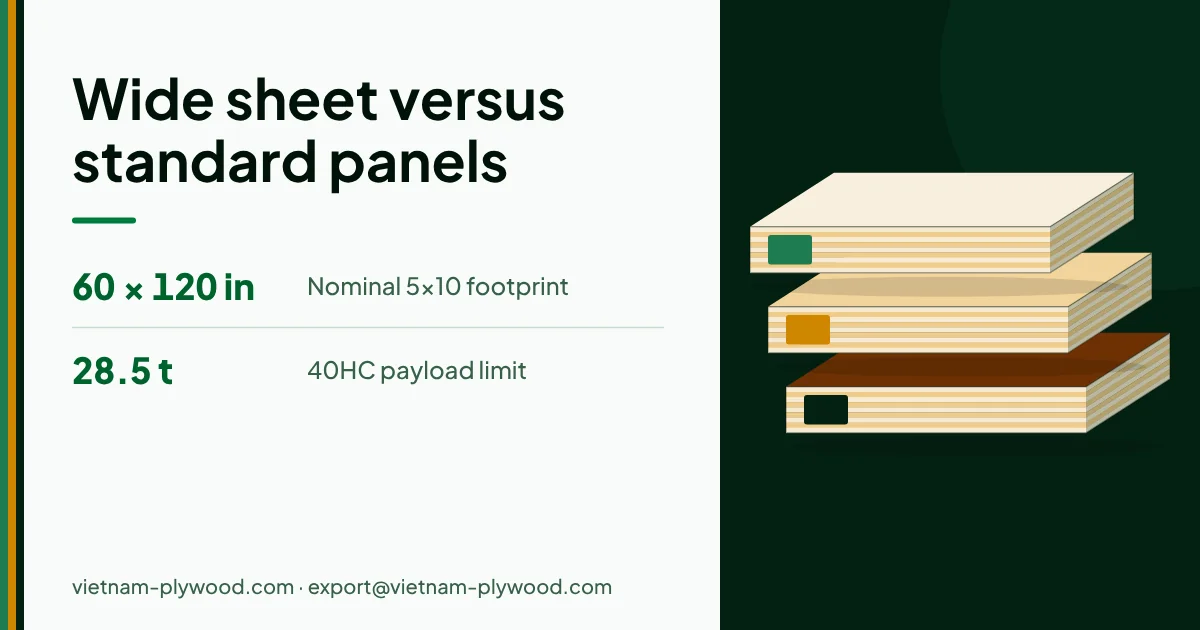
A 5x10 plywood sheet earns a press run when one uninterrupted wide panel saves more joining and finishing work than the run adds in cost. Ordering the wrong footprint can waste a cutting schedule, delay production or leave a load that cannot pass the container door. HCPLY assesses the finished part, producing line and loading method before treating a nominal wide format as an orderable sheet.
What size is 5x10 plywood in millimetres?
5x10 plywood means a nominal five-foot by ten-foot panel: 60 × 120 inches, exactly 1524 × 3048 mm by conversion. In plywood trade descriptions, 1525 × 3050 mm is a common rounded metric designation. A 1500 × 3000 mm panel is a different finished size. Specify the actual millimetre dimensions and acceptance tolerance, rather than relying on the feet-based name.
The US National Institute of Standards and Technology (NIST), on its SI Units – Length page updated in 2025, states: “The value for the inch, derived from the value of the Yard effective July 1, 1959, is exactly equivalent to 25.4 mm.” See the NIST length definition. This is a unit conversion; it does not designate a plywood factory’s cutting size.
The reverse name, 10x5 plywood sheet or 10 x 5 plywood sheets, means the same footprint. Specify width × length and grain direction.
HCPLY’s listed production sizes include 1220 × 2440 and 1250 × 2500 mm, plus smaller formats; custom cutting is available. Neither 1525 × 3050 nor 1500 × 3000 mm is a listed standard production size. A cut-to-size service cannot create a wider panel from narrower pressed stock. For the base range, see plywood sheet dimensions and the Vietnam size overview.
When does one wide sheet beat two 4x8 sheets?
One wide sheet wins when the part requires a continuous face wider or longer than the standard blank and the extra press-run expense is justified by avoided seams. Two 4x8 sheets win when the drawing permits a joint or smaller components can be nested efficiently from stocked formats. Compare the finished cut list, rather than the headline sheet area alone.
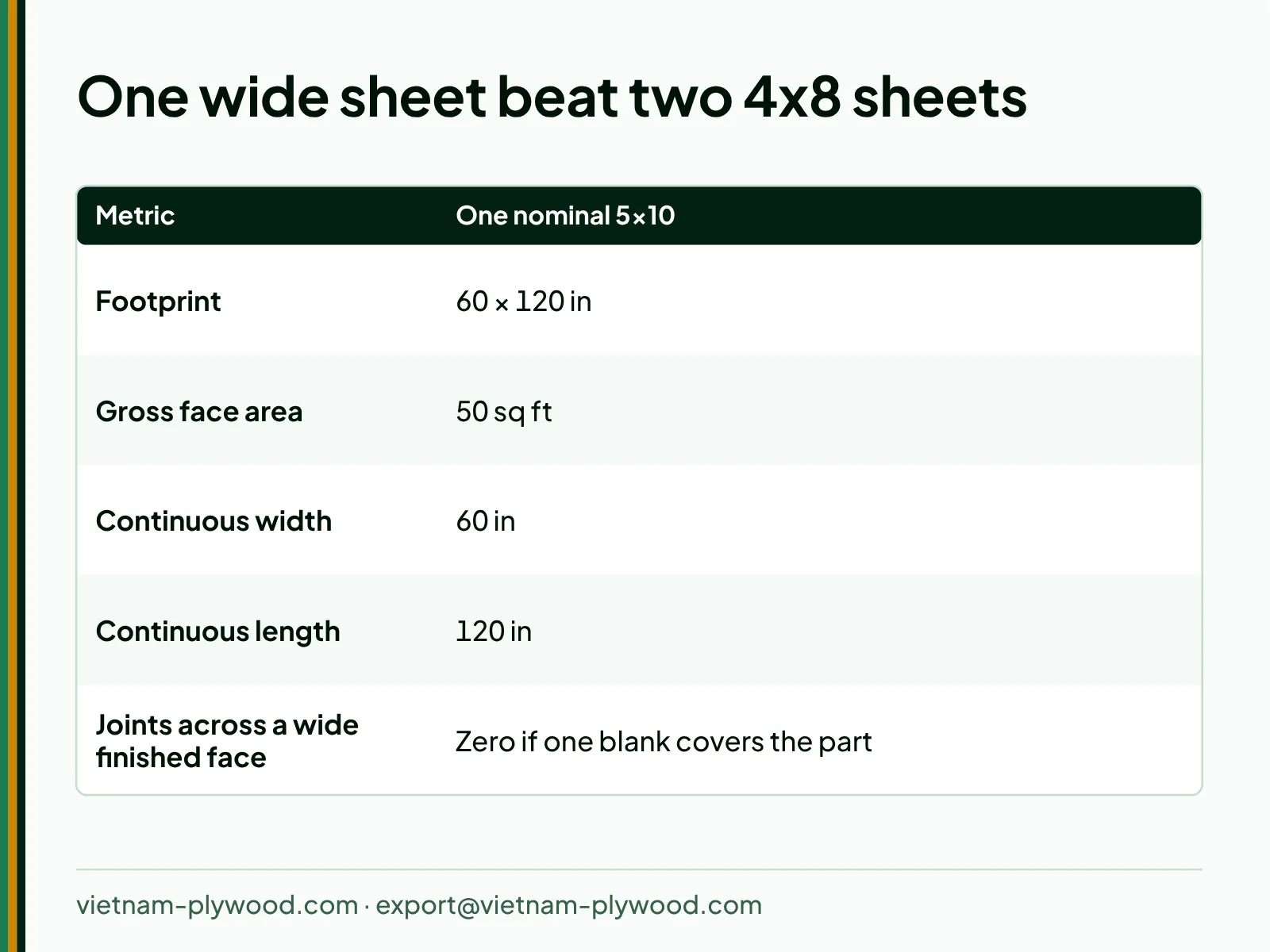
| Metric | One nominal 5×10 | Two nominal 4×8 sheets | Verdict by use |
|---|---|---|---|
| Footprint | 60 × 120 in | Two at 48 × 96 in | Wide panel for a single continuous face |
| Gross face area | 50 sq ft | 64 sq ft combined | Two 4×8s for total area without seam restrictions |
| Continuous width | 60 in | 48 in per unjoined sheet | 5×10 for a wide cabinet or wall component |
| Continuous length | 120 in | 96 in per unjoined sheet | 5×10 for a long unbroken part |
| Joints across a wide finished face | Zero if one blank covers the part | At least one if the part exceeds 4×8 | 5×10 when visible joints are unacceptable |
| Production route | Proposed special press format | Listed 1220 × 2440 mm format | 4×8 for simpler scheduling |
| Handling footprint | Requires wide-pallet and machine checks | Standard-format equipment often suits | 4×8 for existing racks and saw beds |
A 5×10 sheet has less total area than two 4×8 sheets. Its value comes from usable continuous area, which matters for a full-height cabinet side, uninterrupted wall lining or large formwork face. If the part can be divided at a hidden framing member, the wider blank may produce more waste.
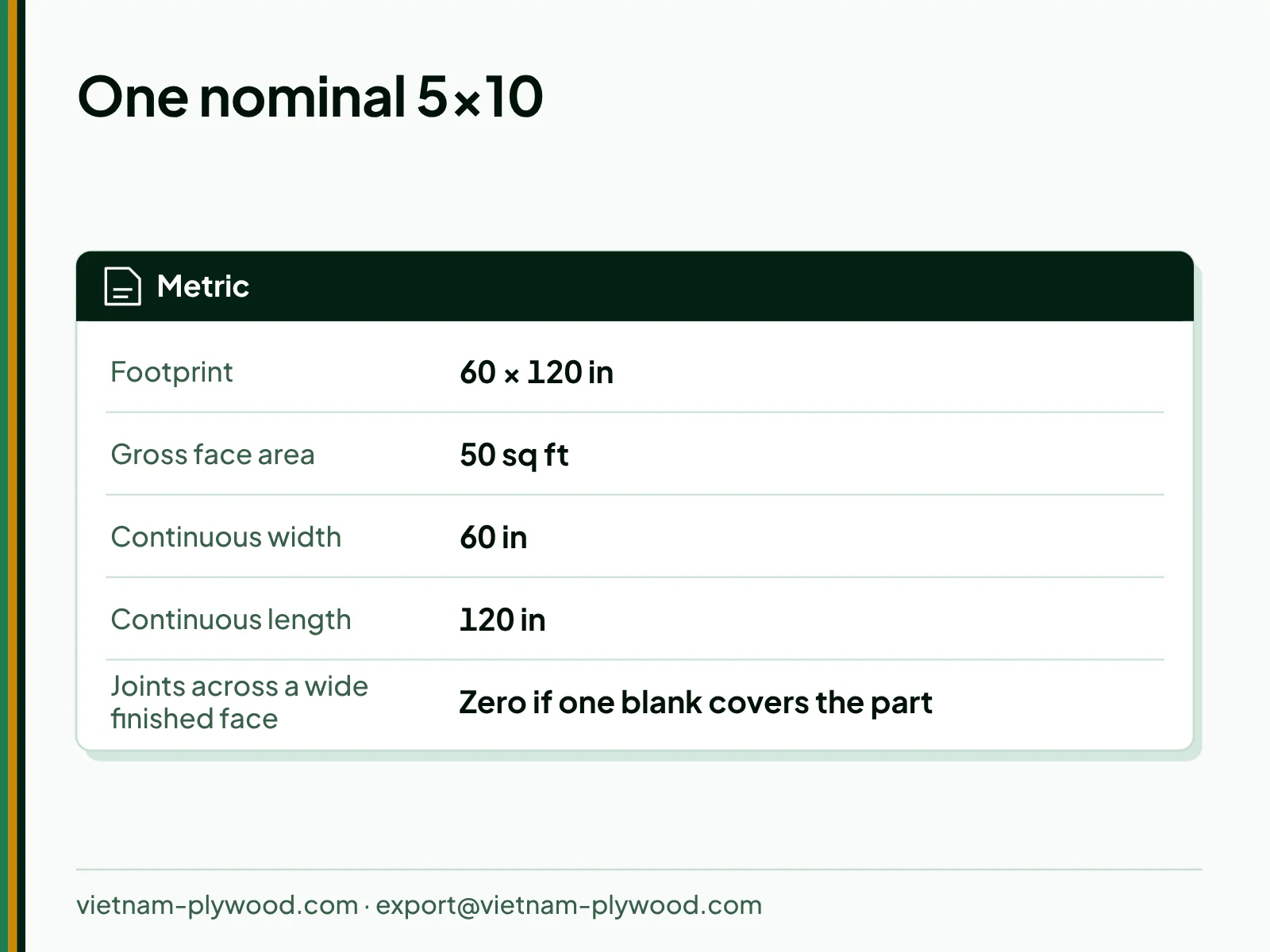
Before choosing, compare a cutting diagram for each format. Include kerf, grain orientation, edge trimming and any visible joint location. A 5×10 panel cannot be assumed to improve structural capacity; the structural design and an accepted test report govern that question. The 4x8 actual-size explanation helps prevent nominal-size mistakes.
Which HCPLY line would make a wide furniture or formwork panel?
Our furniture line is the relevant starting point for a sanded decorative panel, while our construction line is the relevant starting point for a film-faced formwork panel. Our commercial and packing line is the starting point for a raw packing-grade requirement. A wide press opening has to be checked separately on the proposed producing line.
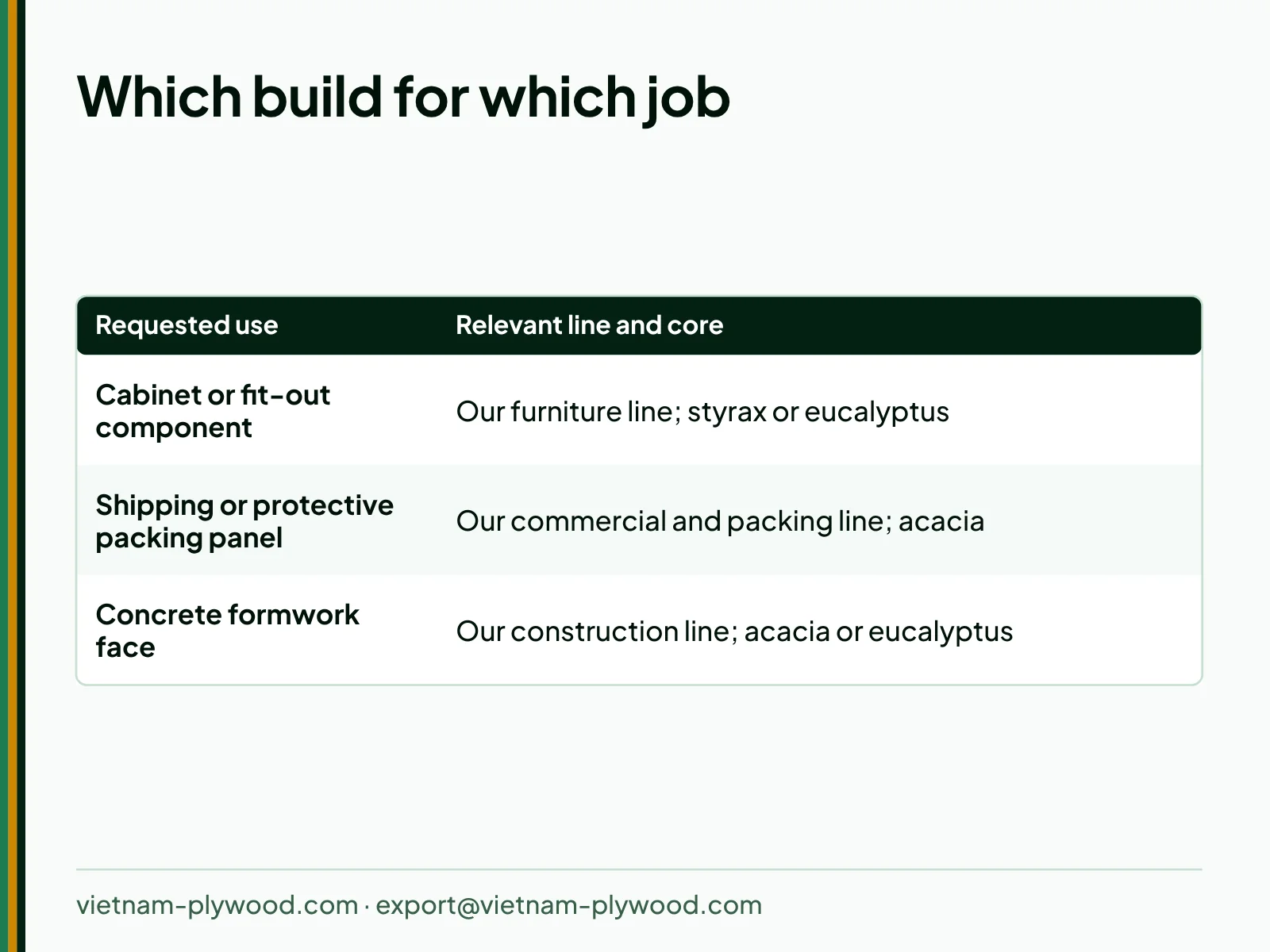
| Requested use | Relevant line and core | Face, glue and finish | Wide-format decision |
|---|---|---|---|
| Cabinet or fit-out component | Our furniture line; styrax or eucalyptus | Sanded, full-stitched core; E0 or E1 emission class | Check press platen, veneer layup, sanding and trim width |
| Shipping or protective packing panel | Our commercial and packing line; acacia | MR glue; unsanded or light-sanded | Check wide layup and pallet economics |
| Concrete formwork face | Our construction line; acacia or eucalyptus | Phenolic or melamine film; unsanded core | Check film handling, platen, edge sealing and loading |
Our three factories operate in Phu Tho and Hai Phong, and each order is produced at the factory matching its specification. For a proposed wide sheet, HCPLY checks whether the intended line can press the entire footprint. The answer must come from that equipment check, rather than from the availability of a standard 1250 × 2500 mm panel.
Does 5x10 plywood need a special press run?
Treat a 5×10 format as a special press-run request because it is outside the listed standard sheet sizes. The producing factory must verify press platen coverage, veneer preparation, film or face application, trimming and stacking before an offer can specify the format. A special cut after pressing cannot replace an undersized press blank.
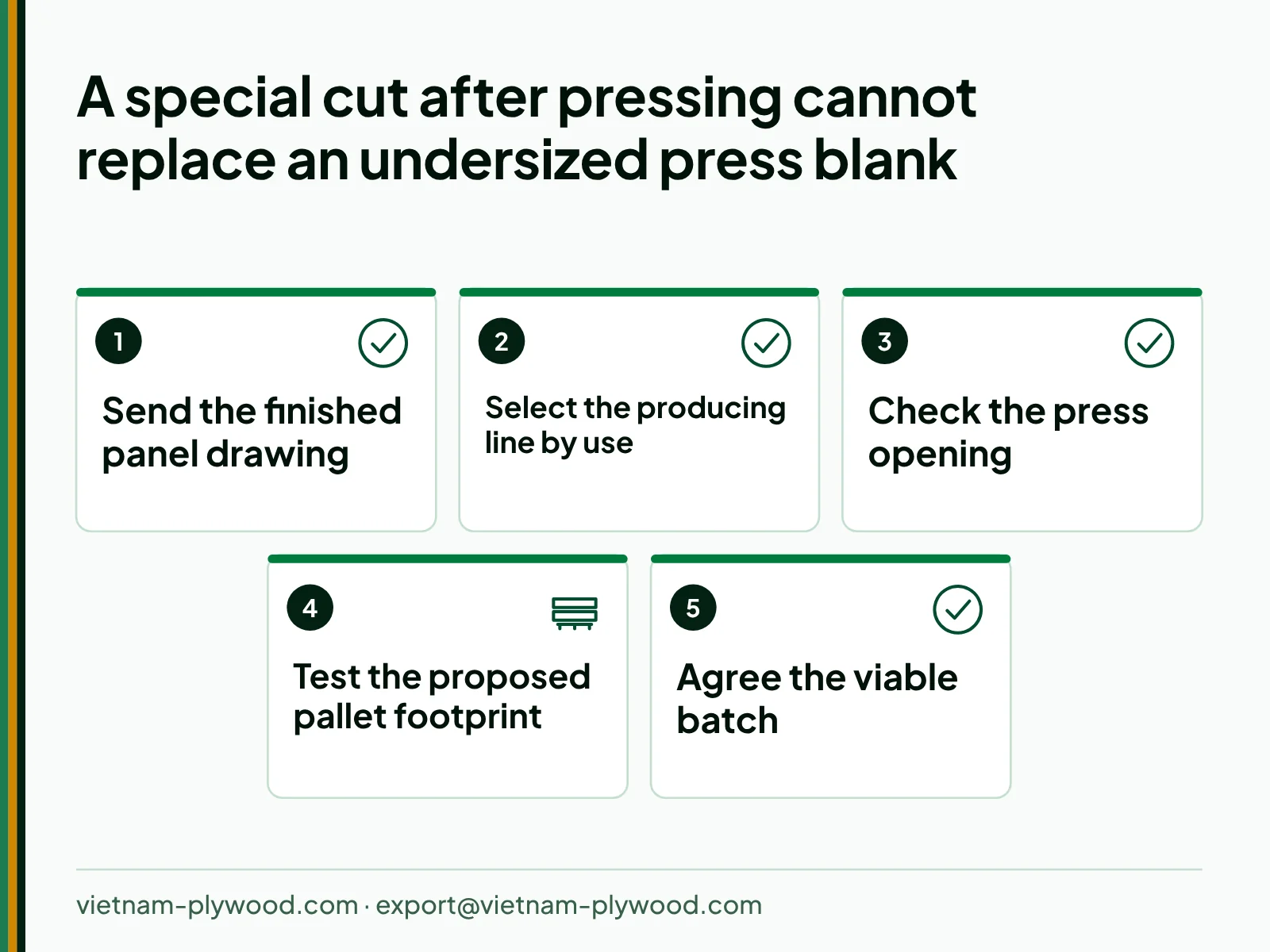
- Send the finished panel drawing, width × length, thickness, grain direction and allowed dimensional deviation.
- Select the producing line by use, core, glue, emission requirement and face or film specification.
- Check the press opening, veneer assembly, finishing equipment and inspection points against the wide blank.
- Test the proposed pallet footprint and container access before fixing a production batch.
- Agree the viable batch, production slot, packing plan and quotation in writing.
What do MOQ and lead time mean for a wide-sheet order?
The export minimum is one 40HC, and mixed specifications can share a container within the payload limit. A jumbo plywood sheets request still needs a viable factory batch and a checked loading pattern. The container minimum alone does not establish that a wide format fits the available press.
Factory lead time runs 15–45 days from receipt of the 30% deposit; the exact figure depends on order size, line loading and what the contract fixes. A special run needs a slot after equipment and material feasibility are checked. For standard scheduling context, use plywood production lead time and distributor supply programmes.
The balance is 70% against the scanned bill of lading (B/L), by telegraphic transfer (T/T) or irrevocable letter of credit at sight. Delivery can be FOB Hai Phong, cost and freight (CFR/CNF), or cost, insurance and freight (CIF). These terms describe the export transaction; the order must still identify the actual producing factory and sheet format.
How are wide plywood sheets packed and loaded?
Wide sheets need a new pallet and loading drawing; standard 4×8 pallet counts cannot be transferred to a 5×10 footprint. The 40HC payload limit is 28.5 tonnes, but the door opening, internal width, pallet support and forklift route can constrain a load before that mass is reached. Ask for stack orientation and review container loads and packing.
For comparison, at the listed 1220 × 2440 mm size and 18 mm thickness, the computed full-container figures are 990 styrax-core sheets at 26.52 t, 880 acacia-core sheets at 27.35 t, or 795 eucalyptus-core sheets at 27.69 t. These figures exclude film weight and apply to that standard footprint only. They demonstrate why core selection changes a load plan even at identical thickness.
A buyer can witness a dry-fit of the proposed pallet or an equivalent dimensional check against the loading opening. Record measured stack height, width and length, then compare the measurements with the loading drawing. Do not derive a 5×10 container sheet count by multiplying the 4×8 result by an area ratio.
What thickness, glue and face should the order specify?
Specify thickness, core, bond type, emission class and face independently. HCPLY’s thickness range is 3–40 mm, with common selections of 3, 5, 9, 12, 15, 18, 21 and 25 mm. The proposed 5×10 footprint needs its own production feasibility review at the chosen thickness.
For sanded furniture plywood, the ordered thickness tolerance is ±0.2 or ±0.3 mm. Commercial and film-faced panels use ±0.5 mm; packing plywood uses ±0.5–1.0 mm. Listed length and width tolerance is ±2 mm, and the requested wide-format acceptance dimensions should be written explicitly into the purchase specification.
Melamine glue is MR with a 12-hour boil description; phenolic glue is WBP (weather and boil proof) with a 72-hour boil description. Glue chemistry and formaldehyde emission class are separate fields. E0, E1 and E2 are emission classes; a US CARB P2 or TSCA Title VI request concerns a limit with third-party certification.
For construction faces, film weight is 120 g/m² standard, 135 g/m² premium or 220 g/m² anti-slip only. The buyer should state which face contacts concrete and whether anti-slip is required on the exposed working surface. A wide panel without a documented facing and edge treatment can be the wrong formwork build.
Can 5x8 plywood be ordered instead?
5x8 plywood is a distinct proposed wide format, nominally 60 × 96 inches, rather than a short name for 5×10. Its usual trade description is 1525 × 2440 mm, while 5 x 8 plywood and 10x5 plywood refer to different footprints. Request the exact millimetre dimensions and orientation for each line item.
A cut-to-size plywood supply request for 5×8 may solve a width problem without needing a ten-foot length. For a cabinet front wider than a 4×8 blank but shorter than eight feet, the shorter wide panel could reduce offcuts. It still requires a press-width check because the listed standard 1220 mm and 1250 mm widths do not reach five feet.
What should the buyer inspect at the producing factory?
The buyer or inspector should witness the checks that make the wide format commercially useful: finished dimensions, thickness, edge condition and packing fit. A measured panel establishes whether the ordered cutting size was produced; a press or loading statement alone does not establish that result.
Check the finished panel at several positions for thickness and at both ends for width. Measure both diagonals when squareness affects a cabinet nesting program, and inspect the long edges for handling damage. On a film-faced build, inspect the film continuity and sealed cut edges before pallets are wrapped.
Buyers visit the factory office and inspect goods at the producing factory. HCPLY coordinates specification, on-site quality control, export documents and loading. Member-factory certificates such as FSC, CARB P2, ISO 9001 and CE, along with EUTR/EUDR documents, are shown with factory details masked, on request; a requested claim belongs to the agreed producing factory and build.
Which export document records the wide-sheet specification?
The packing list should identify the shipped dimensions, thickness, sheet and pallet quantities for the agreed wide-format build. Match it against the commercial invoice and the buyer-approved drawing before the shipping documents are finalised. A mismatch between the packing list and physical pallets can delay acceptance at destination.
The shipment document set includes the commercial invoice, packing list, B/L, certificate of origin, phytosanitary and fumigation papers, and applicable order certificates or test reports. EU lots use EUR.1 and the EUTR/EUDR file set; CIF shipments include insurance. After loading, the draft shipping documents come to you for approval.
How should a buyer compare the quoted wide-sheet cost?
Compare the special-run quotation with the installed cost of two standard sheets, including joint fabrication, trimming waste, finishing and unloading. A dedicated wide press run is likely to cost more to set up than a routine standard-format run because equipment and batch scheduling must be checked. The larger sheet can still win when the joint is unacceptable.
The main cost drivers, in decision order, are press-format feasibility and batch size, then core construction and face finish, then thickness and packing requirements. Full-stitched, sanded furniture construction demands more preparation than a raw packing build. A film-faced formwork specification adds its own film and edge requirements; quote it against its written build rather than a decorative face comparison.
The two dated reference starting prices apply to standard product categories: commercial plywood from US$250/m³ FOB Hai Phong (October 2026) and furniture plywood from US$350/m³ FOB Hai Phong (October 2026). They are not a 5×10 quotation. Send the finished dimensions, intended use and batch quantity for a price specific to the wide-sheet run.
What specification should go to the factory?
A useful request identifies the exact wide footprint, producing-line intent and destination port before the factory assesses the run. Send one specification for each distinct face, core or thickness combination. Attach a nesting drawing where the unbroken width or length is the reason for buying the larger panel.
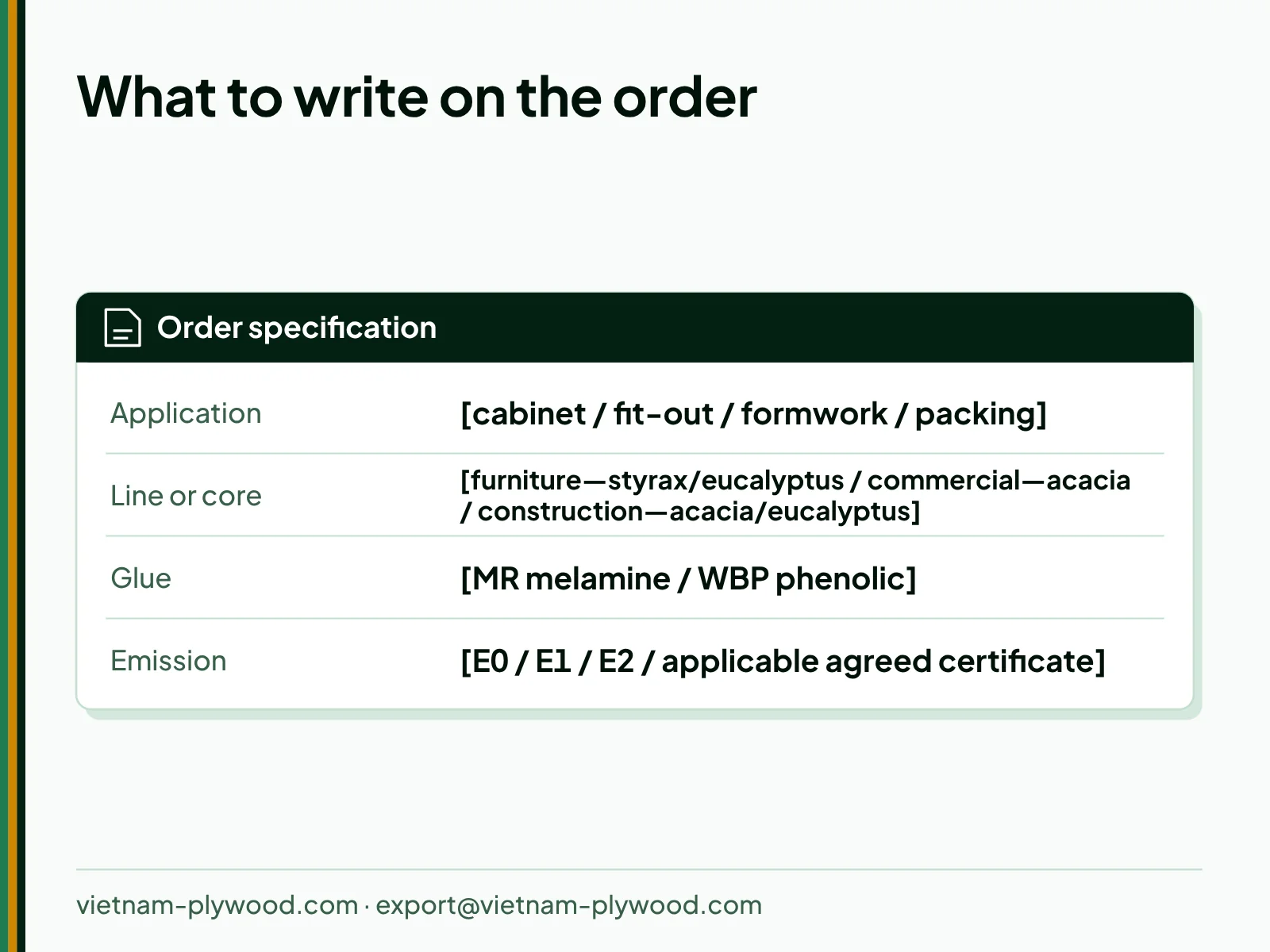
Application: [cabinet / fit-out / formwork / packing]
Line or core: [furniture—styrax/eucalyptus / commercial—acacia / construction—acacia/eucalyptus]
Glue: [MR melamine / WBP phenolic]
Emission: [E0 / E1 / E2 / applicable agreed certificate]
Face and grade: [veneer species and A/B; birch D/E/F / film type and weight]
Thickness and tolerance: [mm; applicable ordered tolerance]
Size: [1525 × 3050 / 1500 × 3000 / 1525 × 2440 / exact custom mm; width × length]
Quantity: [sheets per build and proposed 40HC mix]
Destination port: [port and country]
Request the spec sheet from Lucy at export@vietnam-plywood.com with the drawing and desired loading arrangement.