





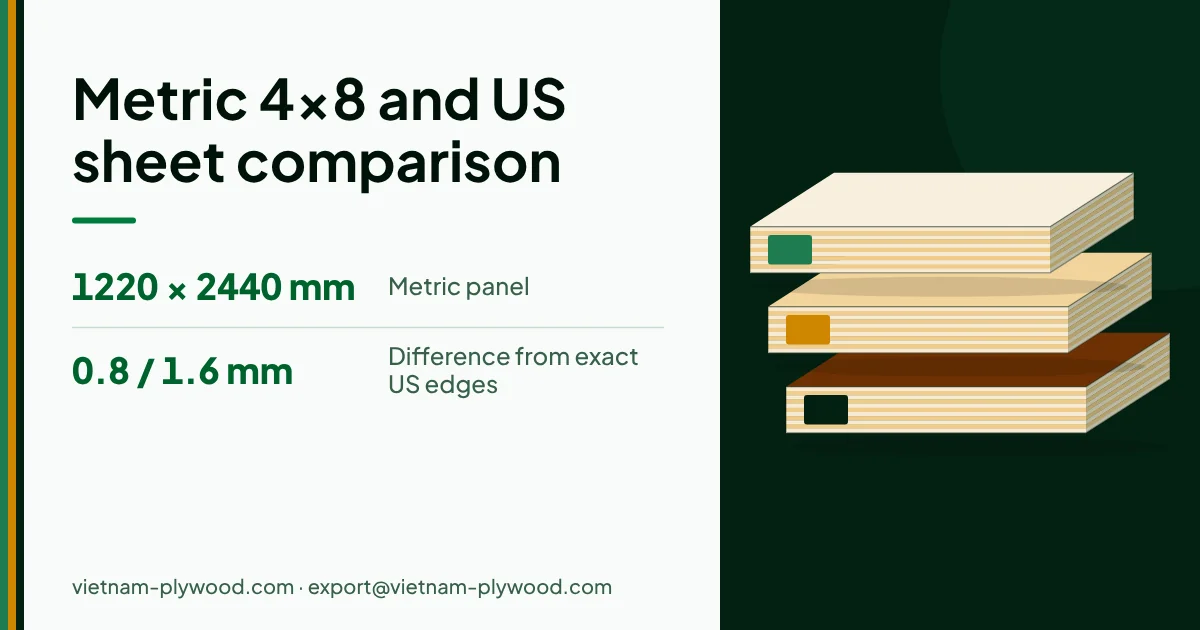
8x4 plywood sheets from HCPLY are pressed to a 1220 × 2440 mm metric target across our plywood lines. Confusing that target with an exact US 48 × 96-inch blank can waste cutting stock, delay production or lead to a rejected shipment. The finished dimension, thickness tolerance and core build belong on the same purchase order.
What is the actual size of 8x4 plywood sheets?
8x4 plywood sheets from HCPLY use a finished metric target of 1220 × 2440 mm, with length and width tolerance ±2 mm. The order should state those dimensions explicitly. An imperial 48 × 96-inch requirement is slightly smaller, so a drawing that treats the labels as identical can produce an incorrect cutting layout.
The short edge is 1220 mm and the long edge is 2440 mm. Thickness is specified separately, in millimetres, with its own tolerance. This format is the starting point for our plywood sheet dimensions specifications, including cabinet, packing and formwork orders.
An order written only as “4x8” leaves the receiving team to interpret whether the buyer expects an exact imperial footprint or a metric export sheet. Record the finished dimensions on the purchase order, cutting schedule and inspection sheet. The same dimensions should appear on the packing list.
Is an 8x4 sheet the same as a 4x8 sheet?
Yes. In plywood trade usage, 8x4 and 4x8 describe the same rectangular sheet with its long and short edges named in reverse order. 2440 × 1220 mm and 1220 × 2440 mm describe the same metric footprint.
For a factory cutting plan, orientation can still matter. A decorative face has a grain direction, and a cabinet maker may need the long edge aligned with the face grain. The dimensional shorthand alone does not state grain direction or face orientation.
Use length × width in millimetres, then specify grain direction on the drawing where appearance matters. That avoids rotating a veneer layout incorrectly when panels are nested for cabinet doors or fit-out components.
How does metric 1220 × 2440 differ from US 48 × 96 inches?
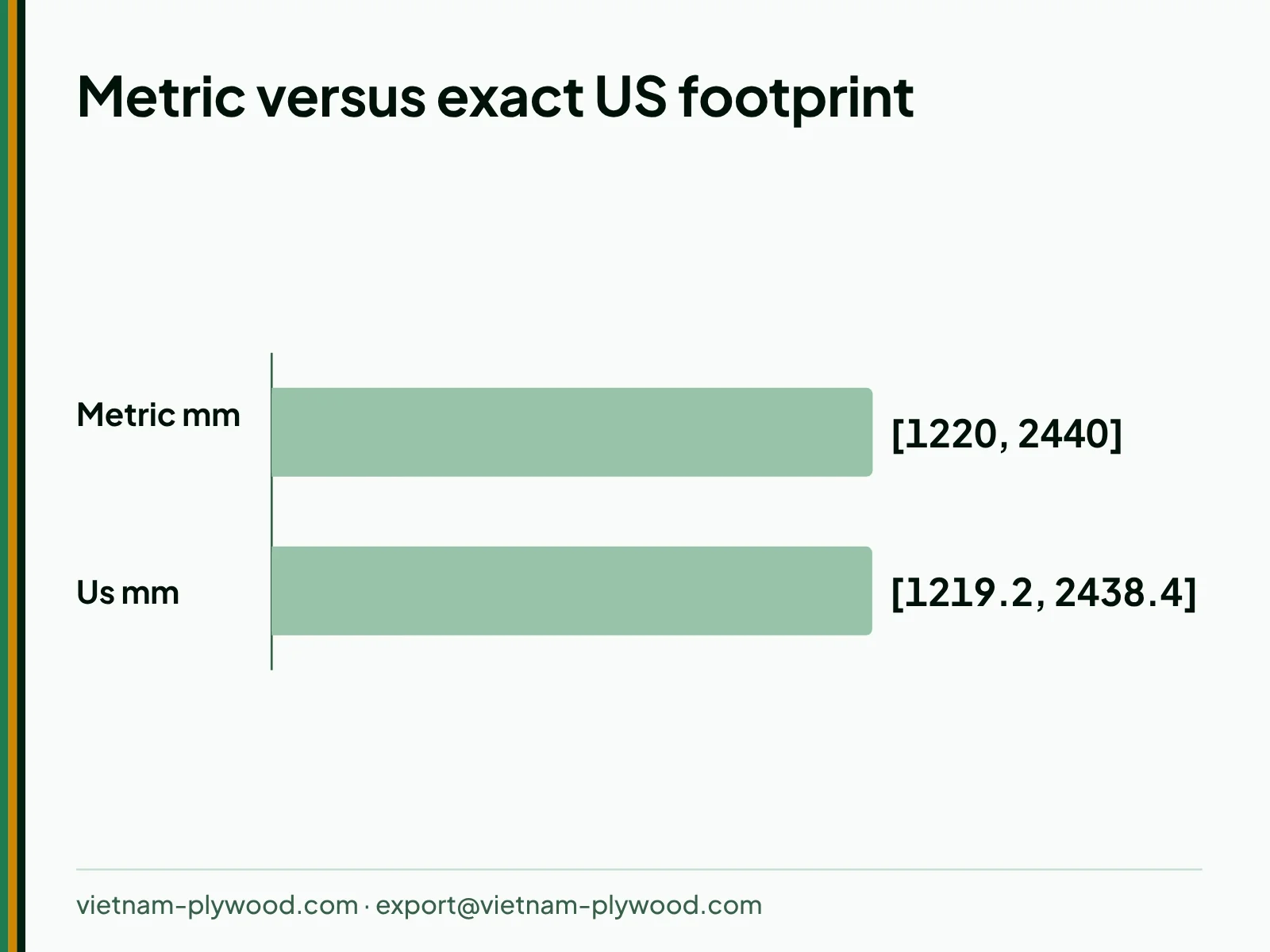
The exact US 48 × 96-inch rectangle converts to 1219.2 × 2438.4 mm. Our metric sheet target is therefore 0.8 mm wider and 1.6 mm longer. The National Institute of Standards and Technology (NIST), in its 2009 SI Units—Length explanation, states: “The value for the inch, derived from the value of the Yard effective July 1, 1959, is exactly equivalent to 25.4 mm.” See NIST’s length conversion explanation.
| Measurement | Exact US 48 × 96 in | HCPLY metric 4x8 target | Buying implication |
|---|---|---|---|
| Short edge | 1219.2 mm | 1220 mm | Check the CNC nest and finished trim |
| Long edge | 2438.4 mm | 2440 mm | Allow for the longer starting blank |
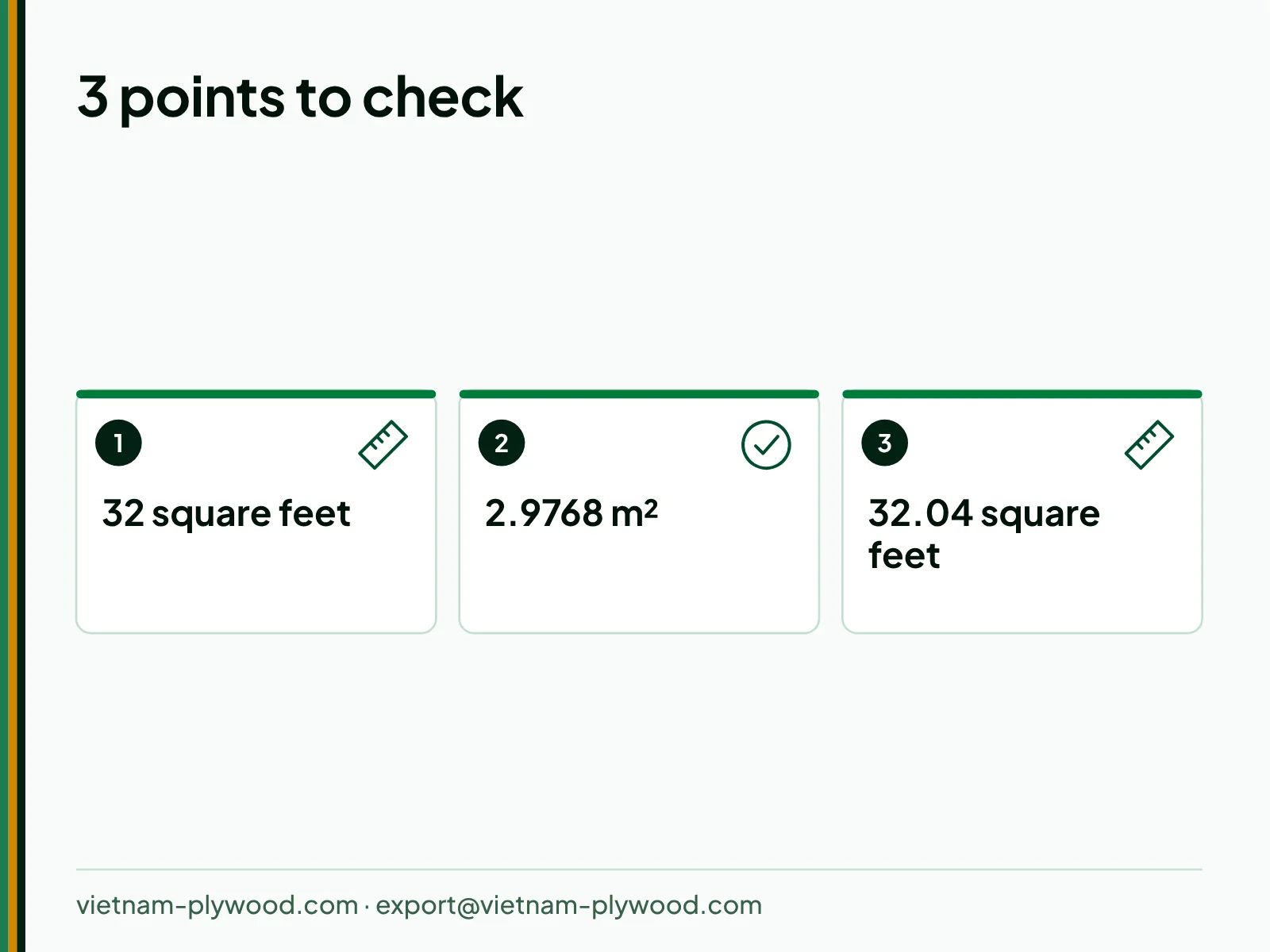
| Area | 32 sq ft | 2.9768 m², approximately 32.04 sq ft | Use the stated unit in take-offs |
| Length/width tolerance | Set by the US purchase specification | ±2 mm | Inspect against the contracted target |
The ±2 mm manufacturing tolerance is separate from the nominal conversion difference. A metric panel at the low end of its permitted width is smaller than its target. Specify a minimum usable blank if the cutting programme cannot accept that range.
The broader Vietnam plywood sizes comparison explains other metric formats; a cut-to-size plywood specification is more suitable when the final blank must match a particular machine envelope.
How many square feet does one 4x8 sheet cover?
A true 48 × 96-inch sheet covers 32 square feet. A 1220 × 2440 mm sheet covers 2.9768 m², or approximately 32.04 square feet. For an order take-off, use the actual ordered millimetre dimensions rather than rounding every sheet to 32 square feet.
Surface area does not tell you the plywood volume or shipment weight. Volume also requires thickness, and weight depends on the core density. For example, a 1220 × 2440 × 18 mm sheet has a different handling weight on styrax, acacia and eucalyptus cores.
A cutting yield estimate must also deduct saw kerf, edge trimming, face defects permitted by grade and grain-direction restrictions. Area alone cannot establish the number of finished cabinet parts from each sheet.
Which 4x8 builds come from each factory line?
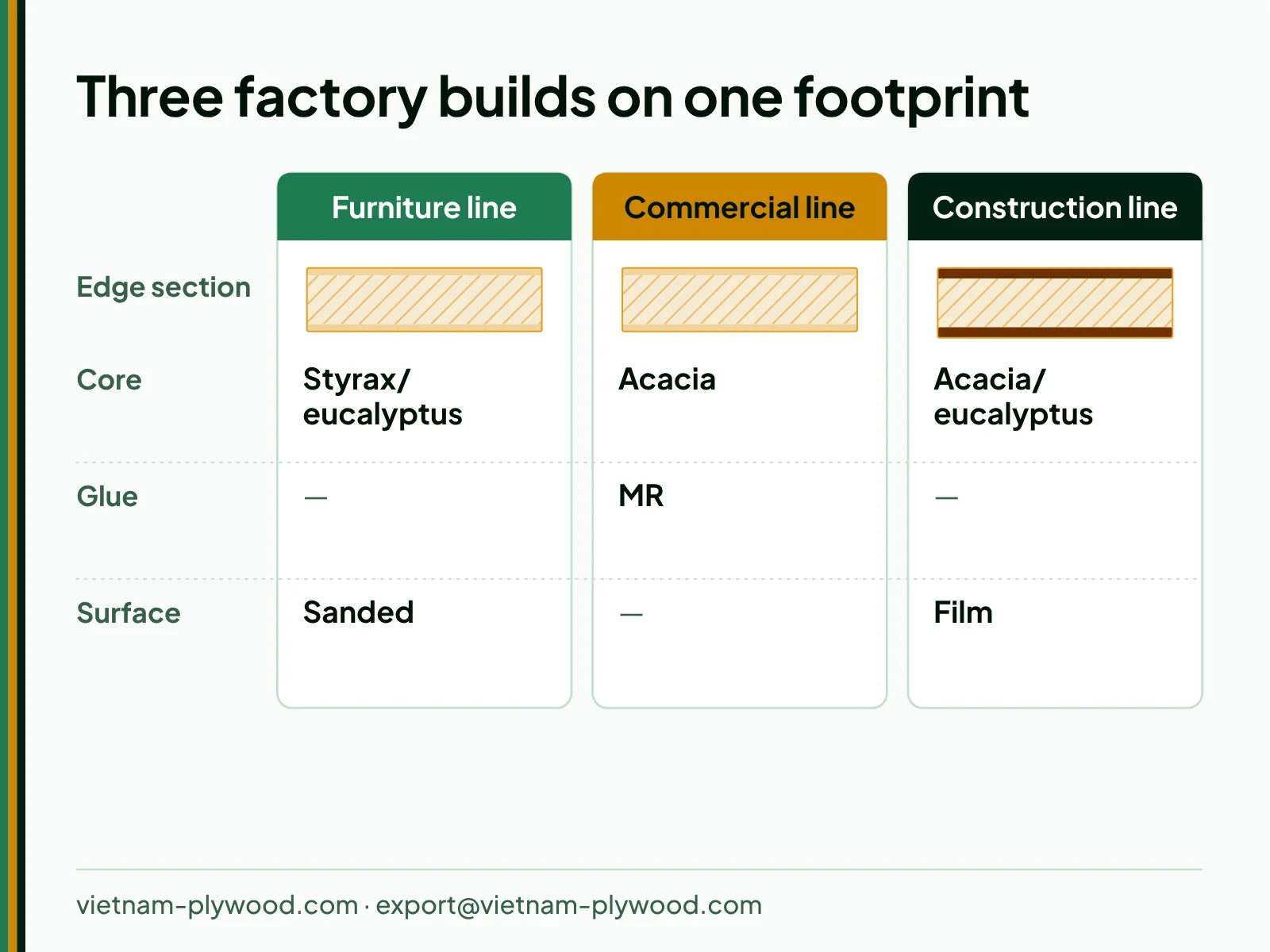
Our furniture line presses sanded, full-stitched plywood with styrax or eucalyptus cores for furniture and cabinet applications. The commercial and packing line presses acacia-core boards with moisture-resistant (MR) glue for commercial and packing work. Our construction line presses film-faced and anti-slip panels with acacia or eucalyptus cores for formwork.
| Specification field | Furniture line | Commercial and packing line | Construction line |
|---|---|---|---|
| Core | Styrax or eucalyptus | Acacia | Acacia or eucalyptus |
| Surface | Sanded decorative veneer | Unfaced matt or specified veneer, unsanded or light-sanded | Phenolic or melamine film; anti-slip option |
| Construction | Full stitched | Build matched to packing or commercial use | Unsanded film-faced build |
| Emission / glue | E0 or E1 emission, glue separately specified | MR glue | Glue and film specified separately |
| Thickness tolerance | ±0.2 or ±0.3 mm as ordered | Commercial ±0.5 mm; packing ±0.5–1.0 mm | ±0.5 mm |
| Primary use | Cabinet parts and furniture | Crates, industrial packing and commercial panels | Concrete formwork and working surfaces |
The same footprint can therefore serve different applications without implying interchangeable performance. A cabinet maker needs the veneer grade and thickness accuracy; a packing buyer often prioritises the core build and handling requirements. A formwork buyer needs the film, glue and working conditions defined.
For cross-line selection, see compare plywood grades across factory lines. The producing factory is chosen by the ordered specification, and the buyer can inspect there.
Which face, grade and thickness should the drawing name?
Choose the face from the intended finish and name the core independently. HCPLY face options include bintangor, okoume, engineered veneer (EV), gurjan, pine, poplar, eucalyptus, birch and sapele. A poplar face does not imply a poplar core.
Buyers sometimes ask for poplar plywood 4x8, 4x8 maple plywood, white oak plywood 4x8, red oak plywood 4x8 or walnut veneer plywood 4 x8. In our range, poplar is a face option; maple, oak and walnut are not listed face options. Send the intended visual sample or approved veneer description rather than treating those market names as equivalent products.
Decorative face veneer commonly measures 0.2–0.4 mm. Face grades are A/B, while birch faces use D/E/F grades. The face name and grade should be on the purchase order, with front and back identified where appearance requirements differ.
Thickness runs from 3 to 40 mm, with common selections of 3, 5, 9, 12, 15, 18, 21 and 25 mm. An 18 mm build uses 11–13 plies, according to core veneer thickness. Never substitute an inch fraction for the agreed finished millimetre thickness.
Why is 1220 × 2440 the default mixed-container format?
The 1220 × 2440 mm footprint lets buyers combine compatible specifications within one 40-foot high-cube (40HC) order while keeping pallet planning on a common sheet module. The minimum order is one 40HC; mixed specifications are permitted within the 28.5-tonne payload limit.
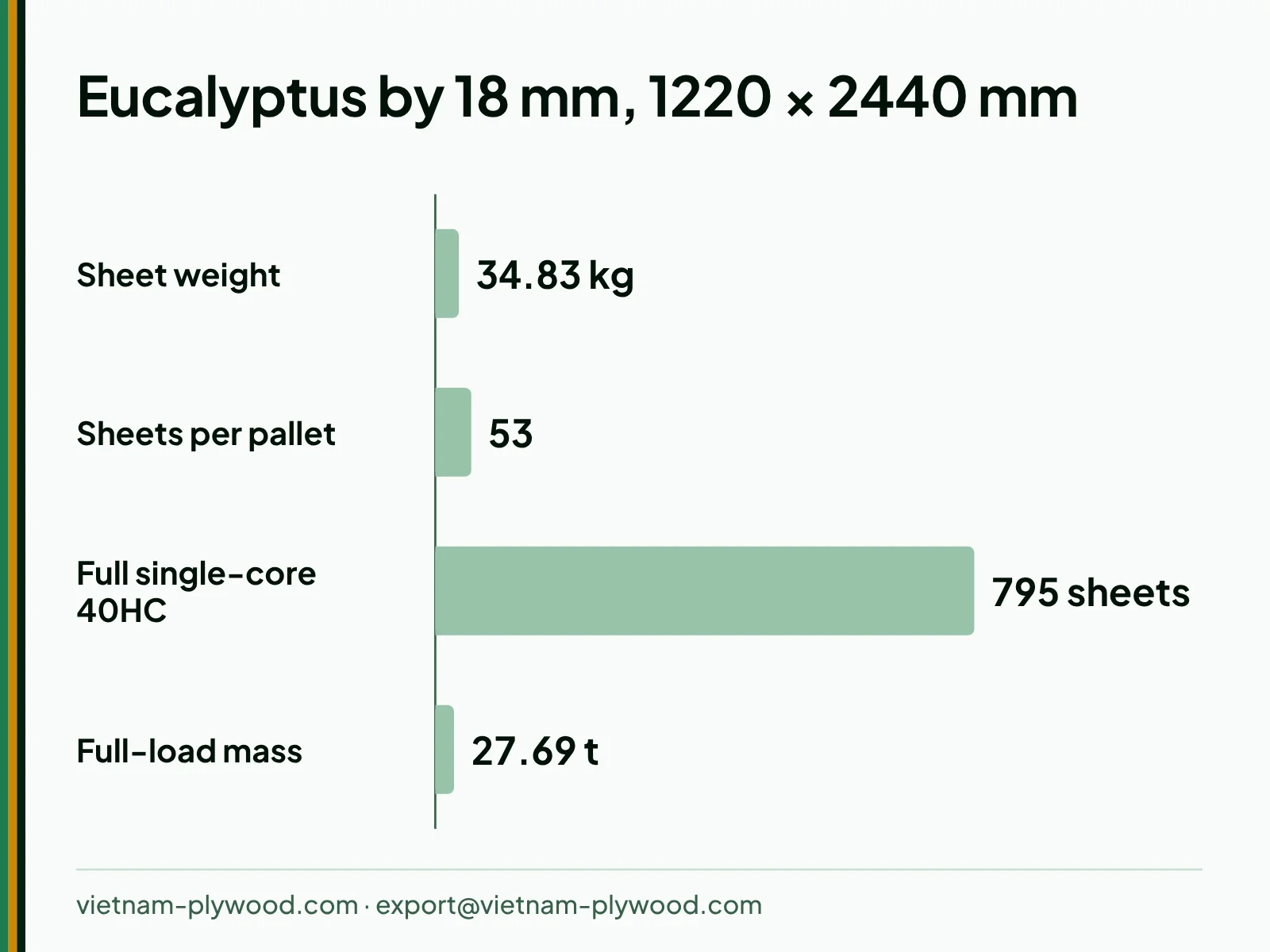
At 18 mm, a styrax-core sheet weighs 26.79 kg, an acacia-core sheet 31.08 kg, and a eucalyptus-core sheet 34.83 kg, excluding film weight. Those differences affect the remaining payload when furniture, commercial and construction builds share the shipment.
| 18 mm, 1220 × 2440 mm | Styrax | Acacia | Eucalyptus |
|---|---|---|---|
| Sheet weight | 26.79 kg | 31.08 kg | 34.83 kg |
| Sheets per pallet | 55 | 55 | 53 |
| Full single-core 40HC | 990 sheets | 880 sheets | 795 sheets |
| Full-load mass | 26.52 t | 27.35 t | 27.69 t |
These full-load figures describe separate uniform-core loading plans, rather than a promise that their sheet counts can be added together. A mixed order requires its own pallet and weight schedule. The container loading guide owns the detailed loading calculations.
A mixed container works when each pallet is identified by its own core, thickness, face and quantity. Matching footprints simplify counting and segregation, but the load still needs a specification-by-specification weight check.
How do glue, film and emission requirements change the build?
Glue type and emission class are separate fields in the specification. Melamine glue is the MR option with a 12-hour boil description; phenolic glue is the weather-and-boil-proof (WBP) option with a 72-hour boil description. Those descriptions identify the stated glue options, not a structural grade or marine approval.
Furniture emission options include E0 and E1. E2 is another emission class, while CARB P2 and TSCA Title VI refer to US emissions limits with third-party certification requirements. An emission designation cannot replace a glue specification.
For film-faced orders, standard film is 120 g/m², premium film 135 g/m², and anti-slip film 220 g/m². These film weights describe surface construction and do not change the core-density label. Film weight is excluded from the sheet-weight lookup above.
HCPLY does not press medium-density fibreboard (MDF), oriented strand board (OSB), chipboard, blockboard, bamboo panels, MDO or HDO. If an enquiry names one of those products, the buyer should select a plywood build from our actual range or use a different product specification.
What should an inspector check at the producing factory?
The inspector should check the 1220 × 2440 mm finished footprint against ±2 mm, then check thickness against the tolerance written for that line. These are measurable acceptance points before the pallets are loaded.
Start by matching the factory production sheet to the purchase order: line, core, face, grade, glue, emission, thickness and quantity. Then sample finished panels across the production lot rather than checking a single convenient board. Record the measured short edge, long edge and thickness with the panel identification.
For a sanded furniture order, check face appearance and thickness consistency. For packing, inspect core construction and edge condition against the approved build. For construction panels, inspect film coverage, surface finish and cut-edge treatment as agreed.
The buyer can visit the factory office and inspect goods at the producing factory. Factory certificates, including applicable FSC, CARB P2, ISO 9001 and CE materials, are shown with factory details masked, on request. Test reports and certificate documents must match the agreed build and destination requirements.
Can you order 1220 × 2440 plywood from Vietnam by container?
Yes. HCPLY produces the metric 4x8 format through its factories in Phu Tho and Hai Phong and arranges direct shipment from the producing factory. Our furniture and commercial plywood capacity is up to 100 containers a month; construction plywood is up to 140.
Orders are specified by the line and finished dimensions, then priced against the complete build. Indicative starting prices are from US$250/m³ FOB Hai Phong (October 2026) for commercial plywood and from US$350/m³ FOB Hai Phong (October 2026) for furniture plywood. Face grade, core construction, glue, emission requirements, thickness, quantity and shipment terms affect the quotation.
Factory lead time runs 15–45 days from receipt of the 30% deposit; the exact figure depends on order size, line loading and what the contract fixes. The balance is 70% against the scanned bill of lading (B/L), by telegraphic transfer (T/T) or irrevocable letter of credit (L/C) at sight. We ship FOB Hai Phong, or CFR (CNF) or CIF to your port.
Free samples are available; a first-time buyer pays the courier, and that charge comes off the first confirmed order. Specify the destination port when requesting the sample and commercial quotation.
Which shipping documents identify the ordered sheet size?
The packing list identifies the shipped sheet dimensions, thickness, pallet quantities and lot breakdown; the commercial invoice carries the corresponding commercial description. The bill of lading covers shipment transport, while the certificate of origin supports the stated origin.
The shipment documents include the commercial invoice, packing list, B/L, certificate of origin (EUR.1 for EU lots), phytosanitary and fumigation papers, insurance under CIF, and the order’s certificate documents. EU lots also carry the EUTR/EUDR file set. After loading, the draft shipping documents come to you for approval.
Check that the dimensions in the approved packing list match the purchase order’s metric target. A 48 × 96-inch shorthand in an email should never override the signed 1220 × 2440 mm specification. The same rule applies to thickness and face grade.
What specification should you send for a 4x8 quotation?
Send a complete metric specification with the application and destination port. The line choice follows the intended use; face and core should be stated as different fields. A drawing can identify the grain direction and any required finished cut sizes.
For projects that need a wider module, compare 5x10 plywood sheets and jumbo plywood sheets before finalising the cutting layout. Those formats need their own pallet plan rather than assuming the 4x8 loading figures apply.
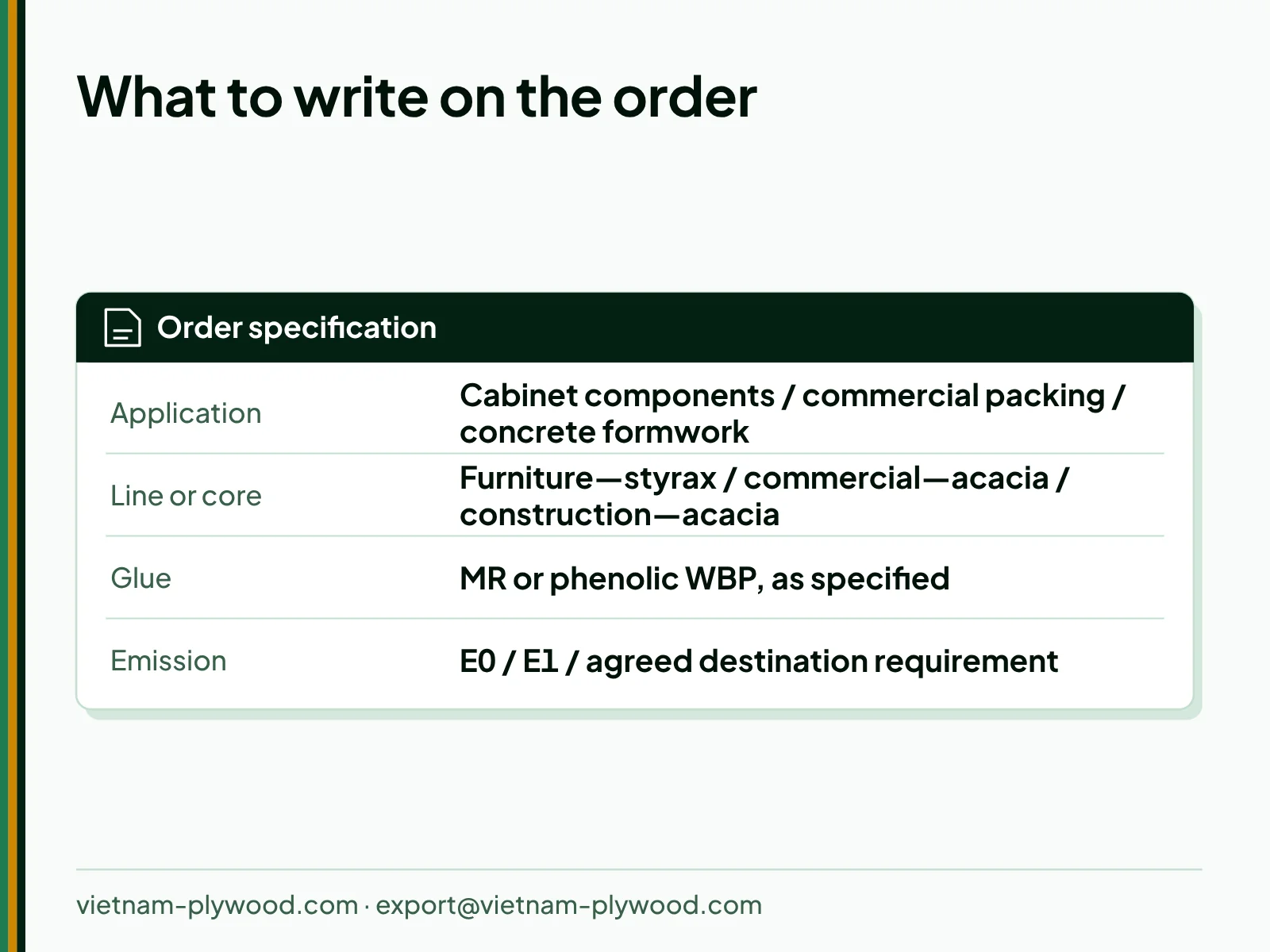
Application: cabinet components / commercial packing / concrete formwork
Line or core: furniture—styrax / commercial—acacia / construction—acacia
Glue: MR or phenolic WBP, as specified
Emission: E0 / E1 / agreed destination requirement
Face and grade: named veneer A/B (birch D/E/F) or specified film
Thickness and tolerance: 18 mm; line-specific tolerance
Size: 1220 × 2440 mm; length and width ±2 mm
Quantity: sheets and pallets within one 40HC
Destination port: [port, country]
Request the 1220 × 2440 mm spec sheet from Lucy at export@vietnam-plywood.com through the contact page.