





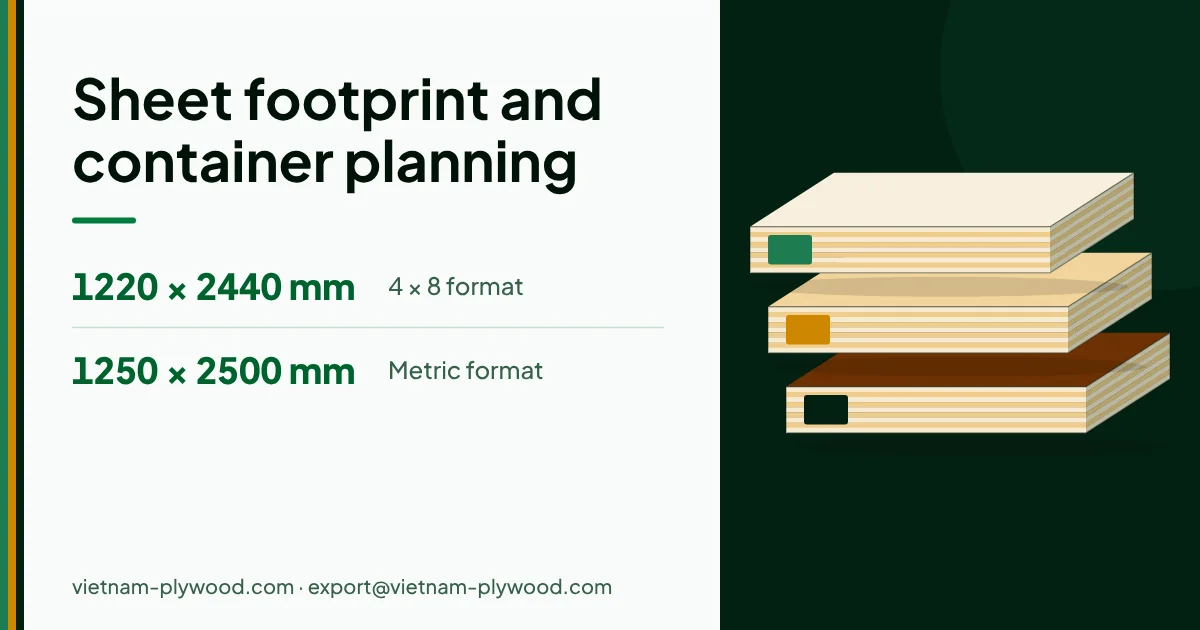
Plywood sheet size changes cutting yield and container loading even when thickness stays fixed. A wrong footprint wastes purchased area, complicates pallet planning and can hold up a downstream production run. HCPLY produces specified sheets through its furniture, commercial and packing, and construction lines, with the finished dimensions written in millimetres.
What plywood size should an importer specify?
Plywood size starts with the finished sheet footprint: 1220 × 2440 mm is the familiar 4 × 8 trade format, while 1250 × 2500 mm serves metric cutting plans. Shorter and narrower formats are also available. Ordering the wrong footprint wastes cutting area, changes pallet totals and can delay a distributor’s delivery schedule.
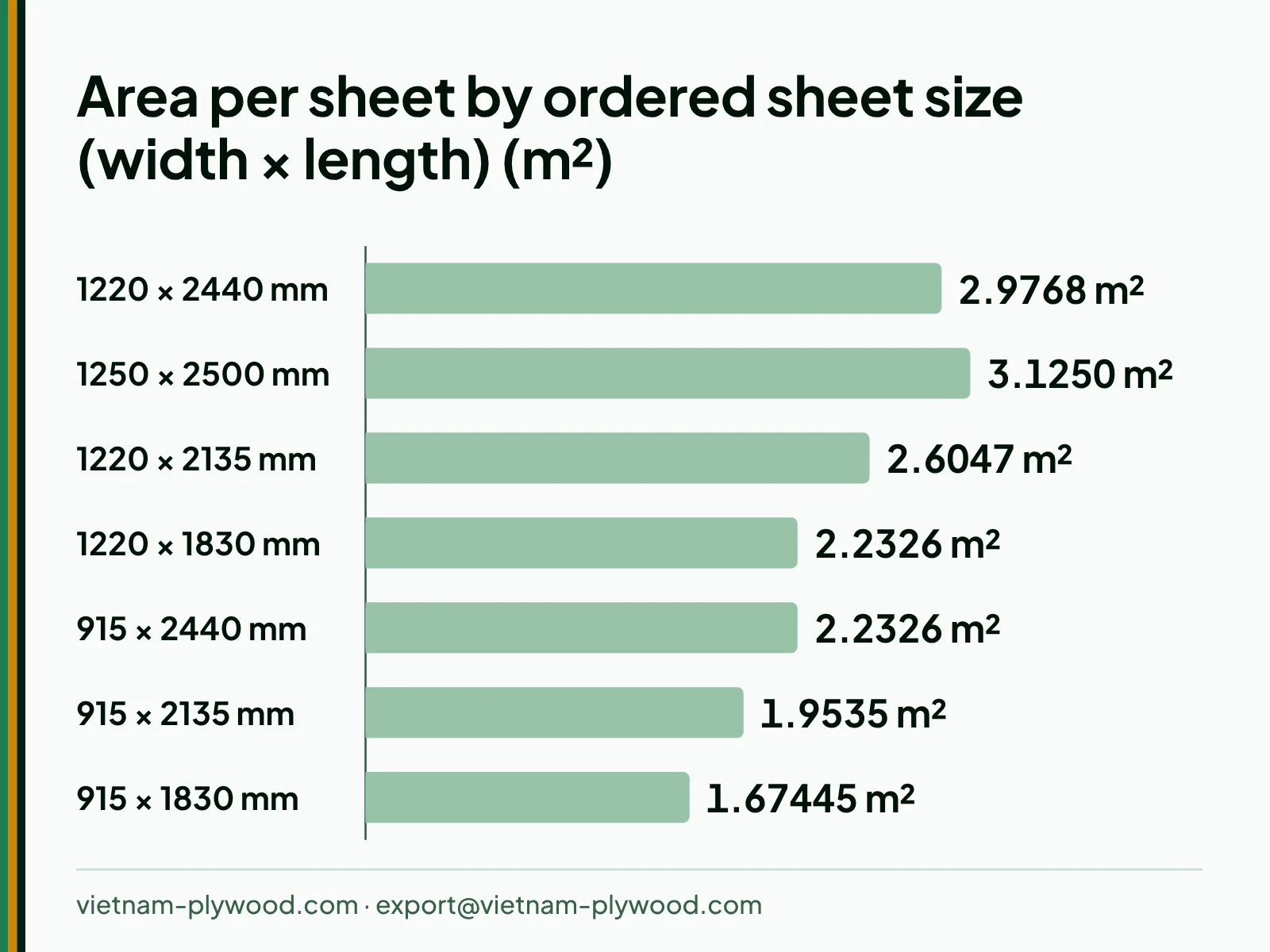
| Ordered sheet size (width × length) | Area per sheet | Typical specification route | Production line choice |
|---|---|---|---|
| 1220 × 2440 mm | 2.9768 m² | 4 × 8 trade format | Furniture, commercial and packing, construction |
| 1250 × 2500 mm | 3.1250 m² | Metric-format cutting | Furniture, commercial and packing, construction |
| 1220 × 2135 mm | 2.6047 m² | Shorter local-format requirement | Match line to end use |
| 1220 × 1830 mm | 2.2326 m² | Shorter furniture or packing parts | Match line to end use |
| 915 × 2440 mm | 2.2326 m² | Narrow-panel requirement | Match line to end use |
| 915 × 2135 mm | 1.9535 m² | Narrow, shorter panels | Match line to end use |
| 915 × 1830 mm | 1.67445 m² | Compact local-format specification | Match line to end use |
These are orderable finished formats, with length and width tolerance of ±2 mm. Custom cutting is available against a written cutting list. The footprint alone does not assign the production line: the application, core construction and surface finish do.
For adjacent format decisions, see our Sizes & Specs articles and plywood sizes and thickness specification guide.
What are the dimensions of a plywood sheet in mm, metres and feet?
The common standard plywood dimensions are 1220 × 2440 mm, or 1.22 × 2.44 m; the metric alternative is 1250 × 2500 mm, or 1.25 × 2.50 m. A sheet’s length is the second dimension in our width-by-length notation.
A 1220 × 2440 mm sheet is called 4 × 8 feet commercially, although its exact metric dimensions differ slightly from four and eight international feet. A 1250 × 2500 mm sheet is approximately 49.21 × 98.43 inches. The US National Institute of Standards and Technology conversion adopted in the 2025 Code of Federal Regulations, 16 CFR §500.19, is the basis for translating inch-based orders into metric cutting instructions: the official conversion provision.
A buyer should put the exact millimetres on the purchase specification, even where the warehouse uses the shorthand 4 × 8. A nominal trade name is useful for ordering conversations, but the saw programme, pallet label and inspection record need one numerical target. See the actual 4 × 8 sheet format for the detailed distinction.
Which sheet format belongs in each destination market?
The destination’s cutting equipment and downstream stock programme decide the format. A 1220 × 2440 mm specification fits many inch-based distribution lists; 1250 × 2500 mm fits buyers working from metric nesting drawings. Shorter 915 mm-wide formats can fit an established local bill of materials without forcing a distributor to recut every panel.
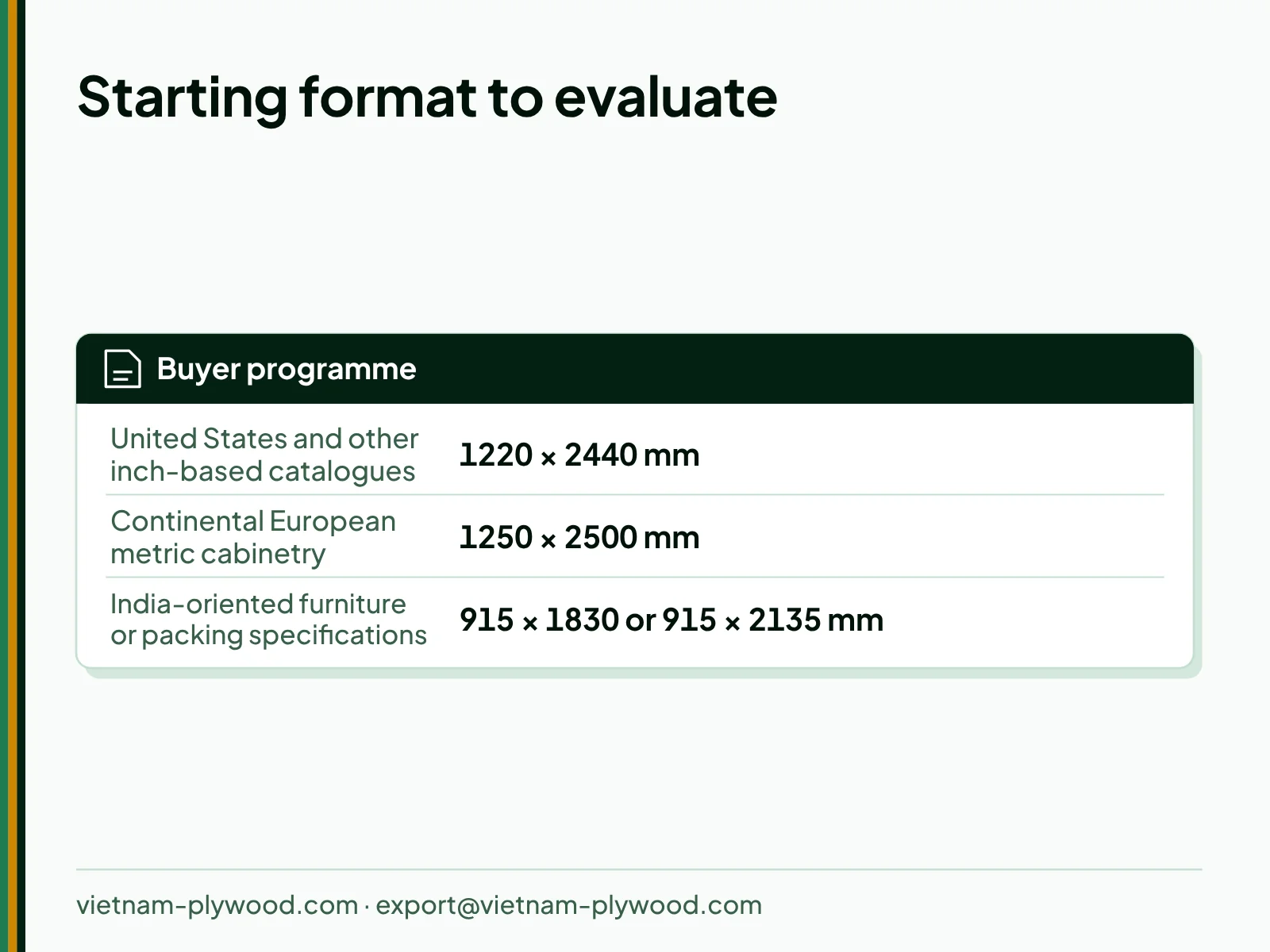
| Buyer programme | Starting format to evaluate | Decision before ordering |
|---|---|---|
| United States and other inch-based catalogues | 1220 × 2440 mm | Confirm the actual millimetre dimensions against customer drawings |
| Continental European metric cabinetry | 1250 × 2500 mm | Check nesting yield, rack capacity and edge allowance |
| India-oriented furniture or packing specifications | 915 × 1830 or 915 × 2135 mm | Confirm local finished size and pallet arrangement |
| Regional fit-out or packing orders | 1220 × 1830 or 1220 × 2135 mm | Compare shorter blanks against the full-sheet cut plan |
These are procurement starting points, not exclusive national standards. Local sizes should be written on the order rather than inferred from a destination name. The Vietnam plywood sizes reference explains how local descriptions map to factory dimensions.
Some catalogues also describe 5 × 5, 4 × 10 and 5 × 10 sheets. Those formats should not be mistaken for this page’s stated standard production list. Read our separate 5 × 10 plywood overview and large plywood sheet overview before requesting an exceptional footprint.
Which of our lines presses each size?
All three factories can be specified against the listed sheet formats, with the producing factory selected by construction and use. Our furniture line builds sanded, full-stitched styrax or eucalyptus core panels. Our commercial and packing line builds acacia-core panels with moisture-resistant (MR) glue and an unsanded or light-sanded surface. Our construction line presses film-faced acacia or eucalyptus core panels.
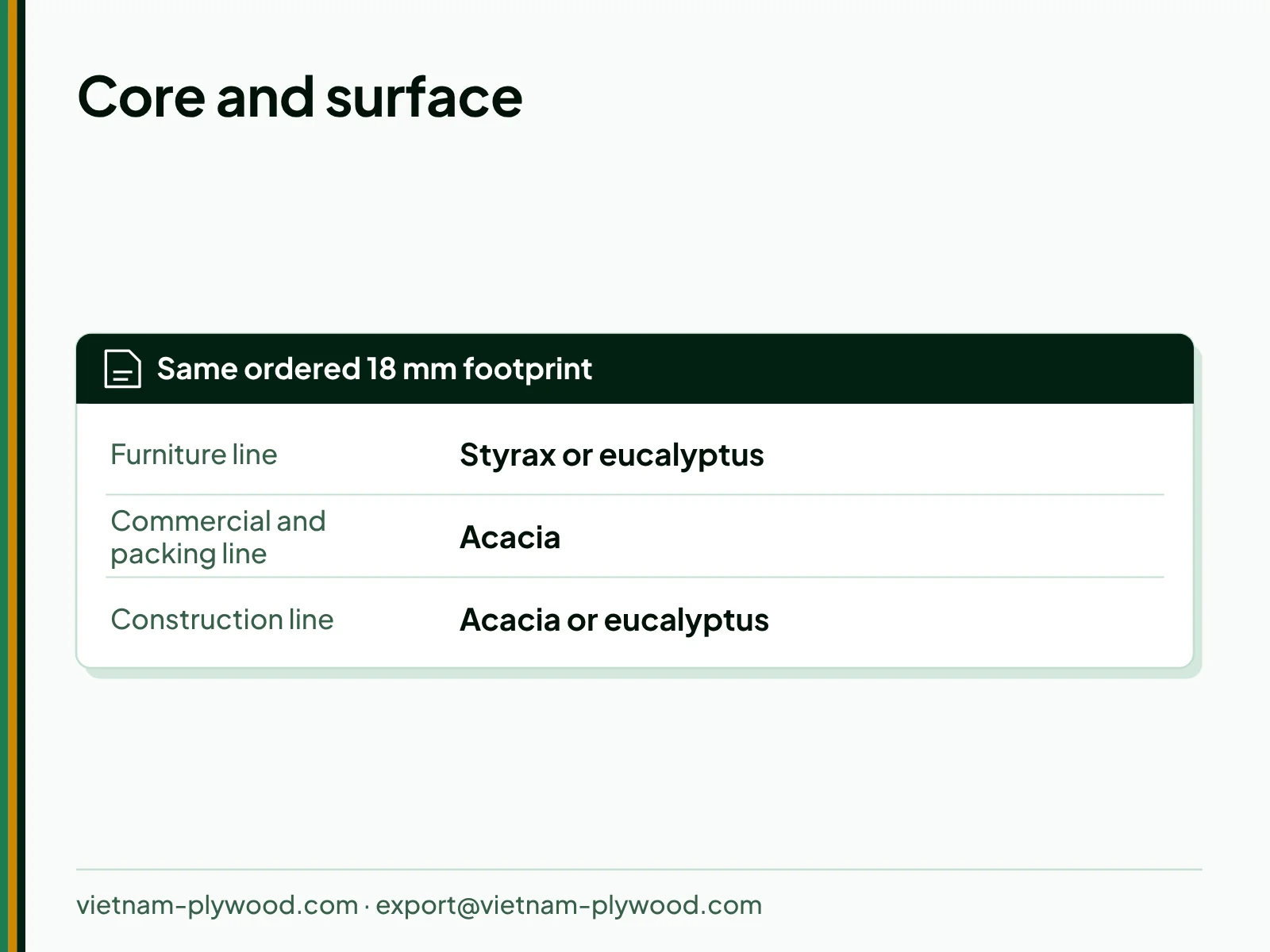
| Same ordered 18 mm footprint | Core and surface | Thickness tolerance | Suitable buying use |
|---|---|---|---|
| Furniture line | Styrax or eucalyptus; full stitched, sanded; E0/E1 emission class | ±0.2 or ±0.3 mm as ordered | Cabinet parts, fit-out and visible furniture substrates |
| Commercial and packing line | Acacia; MR glue; unsanded or light-sanded | Commercial ±0.5 mm; packing ±0.5–1.0 mm | Distribution stock, cases and packing blanks |
| Construction line | Acacia or eucalyptus; phenolic, melamine or anti-slip film; unsanded core | ±0.5 mm | Concrete formwork and site handling |
A cabinet maker buying an 18 mm sheet can choose a sanded furniture build for close-fitting joinery. A crate producer using that same footprint can specify a packing build with a different surface and tolerance. A formwork yard needs a film face and a construction build rather than a decorative veneer.
For the commercial route, see packing or commercial plywood. For repeat distributor specifications, see plywood supply programmes.
How does thickness change the usable sheet?
Thickness is specified separately from the length and width. The stated thickness range is 3–40 mm, with common selections of 3, 5, 9, 12, 15, 18, 21 and 25 mm. The finished thickness tolerance depends on which line produces the sheet and the ordered surface treatment.
| Common thickness | Procurement consideration |
|---|---|
| 3 or 5 mm | Thin backing and light components; check support and cutting stability |
| 9 or 12 mm | Partition, cabinet and packing components; match the joint detail |
| 15 or 18 mm | Cabinet parts, packing or formwork; choose the appropriate build |
| 21 or 25 mm | Thicker industrial components; validate support and weight requirements |
An 18 mm panel uses 11–13 veneer plies, depending on the 1.4–2.0 mm core veneer thickness. The number of plies alone does not establish an accepted structural rating. A drawing calling for an inch nominal thickness must be converted into an agreed millimetre target and tolerance; an inspector should never substitute an unrelated retail nominal-to-actual chart.
Glue and emission are separate fields. Melamine MR and phenolic water-boil-proof (WBP) describe bonding systems, while E0, E1 and E2 describe emission classes. CARB Phase 2 / TSCA Title VI concerns a US emission limit and third-party certification. For load-bearing use, pair dimensions with the strength checking procedure.
How does sheet size change cutting yield?
Cutting yield changes when the blank dimensions change relative to the component layout, saw kerf and edge-trim allowance. A larger sheet has more gross area, but that area is useful only when the nesting plan places more acceptable parts within its borders.
For a simple comparison, 1220 × 2440 mm gives 2.9768 m² gross area; 1250 × 2500 mm gives 3.125 m². The metric format adds 0.1482 m² per sheet, approximately 4.98% more gross area. That difference is an area calculation, not a claim about finished-part yield.
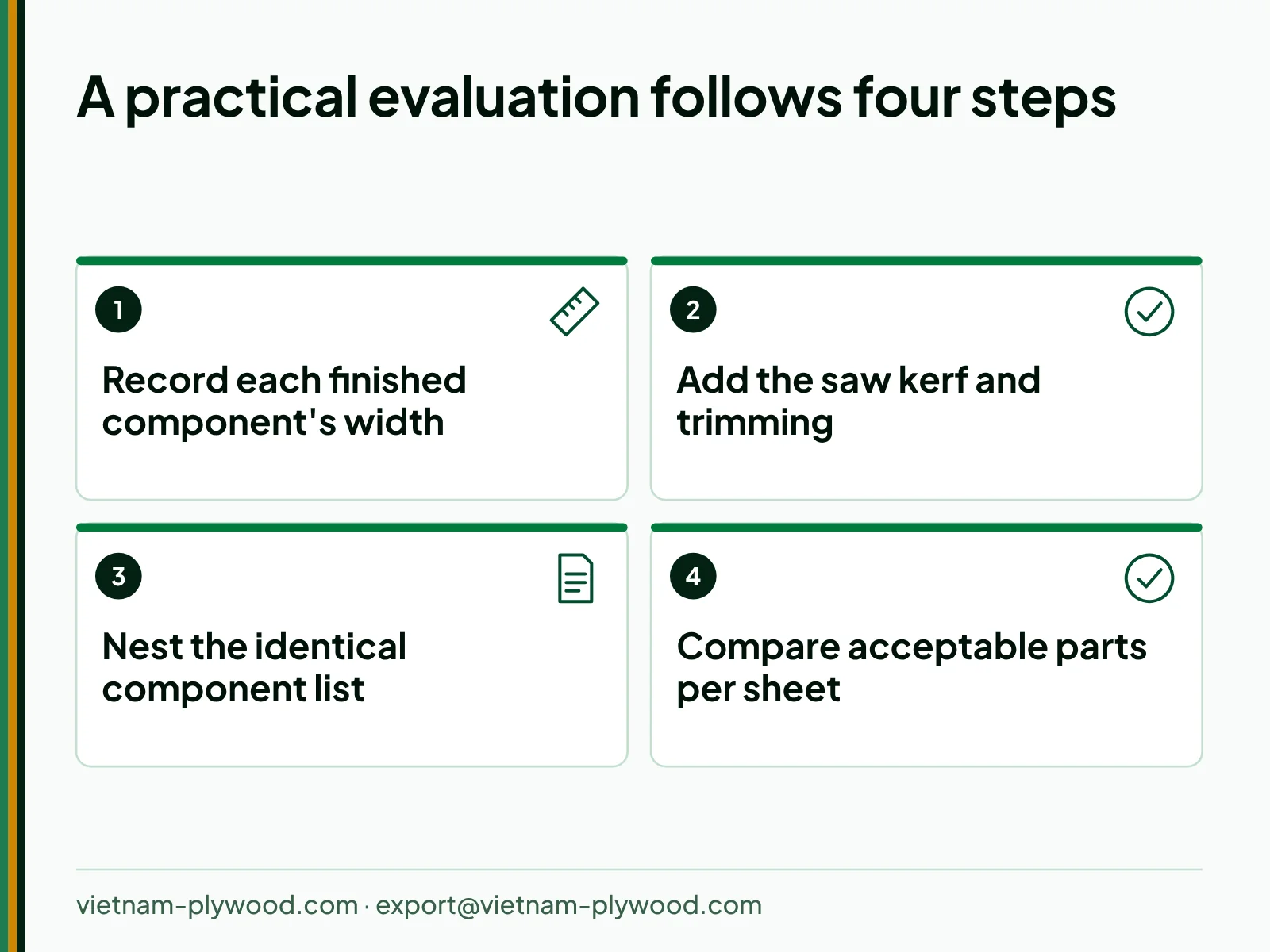
A practical evaluation follows four steps:
- Record each finished component’s width, length, quantity and grain-direction constraint.
- Add the saw kerf and trimming allowance used by the buyer’s equipment.
- Nest the identical component list on both exact sheet footprints, preserving face direction where needed.
- Compare acceptable parts per sheet, offcut area and total purchased sheets; then check pallet and freight consequences.
A long cabinet side can fit in one orientation but fail after rotation if veneer direction is fixed. Conversely, a shorter blank can reduce trimming when the parts are short. If the order includes cut-to-size blanks, send the nesting drawing to our cut-to-size plywood team so the requested delivered dimensions are explicit.
How does plywood size change container count?
Sheet footprint affects cubic metres per sheet, pallet stack count and payload. For 1220 × 2440 mm sheets, the stated 40-foot high-cube (40HC) lookup is calculated using core density, pallet limits and stack height; film weight is excluded. The container payload limit is 28.5 tonnes.
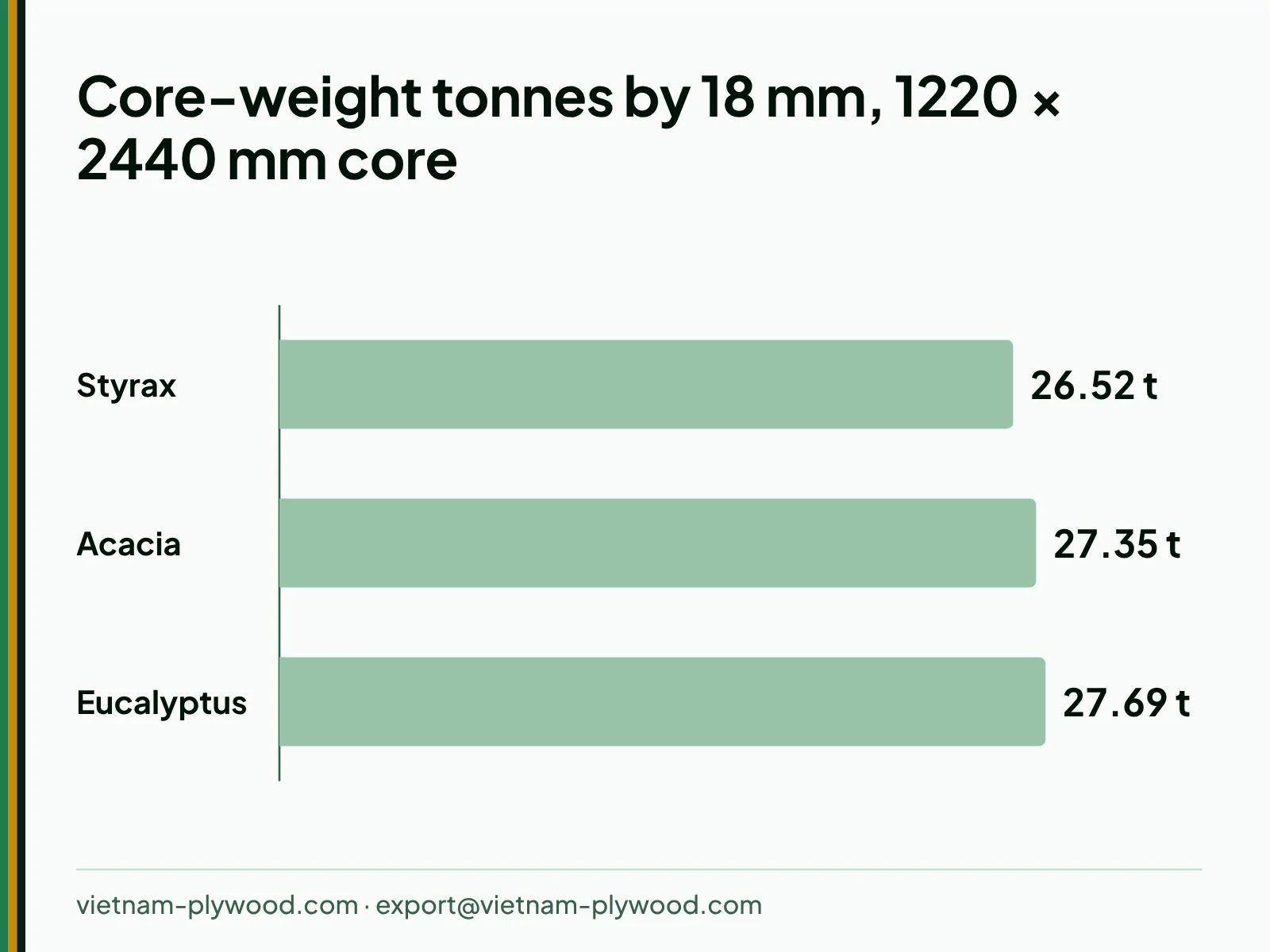
| 18 mm, 1220 × 2440 mm core | Sheet weight | Sheets per pallet | Full 40HC sheets | Full load volume | Core-weight tonnes |
|---|---|---|---|---|---|
| Styrax | 26.79 kg | 55 | 990 | 53.05 m³ | 26.52 t |
| Acacia | 31.08 kg | 55 | 880 | 47.15 m³ | 27.35 t |
| Eucalyptus | 34.83 kg | 53 | 795 | 42.60 m³ | 27.69 t |
The core densities are 500 kg/m³ for styrax, 580 kg/m³ for acacia and 650 kg/m³ for eucalyptus. Therefore identical sheet dimensions do not produce identical loaded sheet counts. At 18 mm, the lighter styrax load holds more sheets, while the denser eucalyptus load reaches a comparable payload with fewer sheets.
For 1250 × 2500 mm, the stated stack heights are 1000 mm for styrax, 970 mm for acacia and 900 mm for eucalyptus; the corresponding pallet allocations remain 18, 16 and 15. An exact count for that footprint needs the packing calculation and final order mix, rather than copying the 1220 × 2440 mm lookup. Use the container load calculator for the dedicated loading question and the core-and-thickness weight table for comparison.
The minimum order is one 40HC; one container can carry several specifications as long as the payload limit holds. A mixed furniture and packing order needs separate pallet counts and weights before loading. Different specifications do not share the same assumed sheet weight.
What does a buyer inspect at the producing factory?
The buyer or appointed inspector can witness sheet dimensions, thickness and pallet identity at the producing factory. HCPLY handles specification, on-site quality control, export documents and loading, with buyers visiting the factory office and inspecting goods where they are made.
Start with the signed specification and choose panels from separate pallet positions. Measure width and length along the relevant edges against the ordered footprint and ±2 mm tolerance. Check the diagonal comparison for squareness against the buyer’s drawing, using the squareness criterion agreed in the drawing.
Then measure thickness at recorded positions away from damaged edges. Apply the furniture, commercial, packing or construction tolerance actually written on the order. Inspect the face, edge joints and core build against the sample, and confirm that a film-faced order has the specified film description.
Finally, reconcile pallet labels, sheet count and net loading weight against the packing list. After loading, the draft shipping documents come to you for approval. The commercial invoice, packing list and bill of lading (B/L) identify the shipment; the packing list is the document that carries the dimensional and quantity breakdown.
How do face, core and glue affect a size specification?
The product name follows the face, while density follows the core. A bintangor-faced panel with styrax core and a bintangor-faced panel with eucalyptus core can have the same dimensions yet different weight and cutting characteristics.
Available face descriptions include bintangor, okoume, engineered veneer (EV), gurjan, pine, poplar, eucalyptus, birch and sapele; matt means an unfaced raw core. Common face veneer thickness is 0.2–0.4 mm. Face grades A/B are used except that birch is described only as D/E/F.
The core construction order, from higher to lower build quality, is full stitched, stitched outer layers with edge-trimmed inner layers, finger-jointed, then loose-laid. The furniture line uses full-stitched construction. A buyer concerned about machined edges should specify the core build alongside dimensions, because an outer-face photograph cannot establish internal joint quality.
We do not press birch-core plywood, medium-density fibreboard (MDF), oriented strand board (OSB), chipboard, blockboard, bamboo, medium-density overlay (MDO), high-density overlay (HDO) or three-ply spruce panels. Melamine, high-pressure laminate (HPL) and other laminate faces are separate product topics, outside our production lines. A request for marine or BS 1088 performance needs a test report the buyer accepts; the sheet dimensions alone cannot establish that designation.
What should the order and shipping papers say?
The written order should state width × length × thickness in millimetres, each tolerance, the intended line and the face/core build. It should also state the quantity by specification so the packing list can identify the exact pallets that enter the shipment.
We ship FOB Hai Phong, or CFR (CNF) or CIF to your port. Factory lead time runs 15–45 days from receipt of the 30% deposit; the exact figure depends on order size, line loading and what the contract fixes. The remaining 70% is paid on the scan of the bill of lading, by T/T, or by irrevocable sight L/C.
The shipment documents include commercial invoice, packing list, B/L, certificate of origin (EUR.1 for EU lots), phytosanitary and fumigation papers, and insurance under CIF. Agreed certificate documents and test reports accompany the order, with the EUTR/EUDR file set for EU lots. Member-factory certificates, including FSC, CARB P2, ISO 9001 and CE, are shown with factory details masked, on request.
For a size change after a cutting plan has been approved, revise the specification and packing calculation together. A new footprint can alter the number of pallets even if the ordered cubic metres remain the same.
Which specification details prevent a wrong-size order?
A complete size request gives the finished dimensions, intended application, build, tolerance and destination. It also distinguishes a full sheet from factory-cut components, so the invoice description matches the delivered item.
Do not send only “4 × 8, 18 mm” if the receiving workshop needs an exact edge dimension. Record whether 1220 × 2440 mm is the target and whether the furniture tolerance of ±0.2 or ±0.3 mm is required. A distributor stocking both 1220 × 2440 and 1250 × 2500 mm should assign separate stock-keeping descriptions.
For a water-exposed application, “waterproof plywood size” is a dimensional question plus a bond and performance question. Specify the glue system and accepted test evidence independently. A film face can be specified as 120 g/m² standard, 135 g/m² premium or 220 g/m² anti-slip; the 220 g/m² option is anti-slip only.
Use the following order-ready request as a starting point. It keeps the cut plan, factory selection and packing calculation tied to the same dimensions.
Application: Cabinet components for distributor stock
Line or core: Furniture line; styrax core; full stitched
Glue: Melamine MR
Emission: E1
Face and grade: Bintangor A/B
Thickness and tolerance: 18 mm; ±0.2 mm
Size (width × length): 1220 × 2440 mm; ±2 mm
Quantity: One 40HC; confirm specification mix by pallet
Destination port: [insert receiving port]
Ask Lucy at export@vietnam-plywood.com for a sample set matched to the written dimensions and face specification. Samples cost nothing: a first-time buyer pays the courier, and that charge comes off the first confirmed order. Request the sample set.