





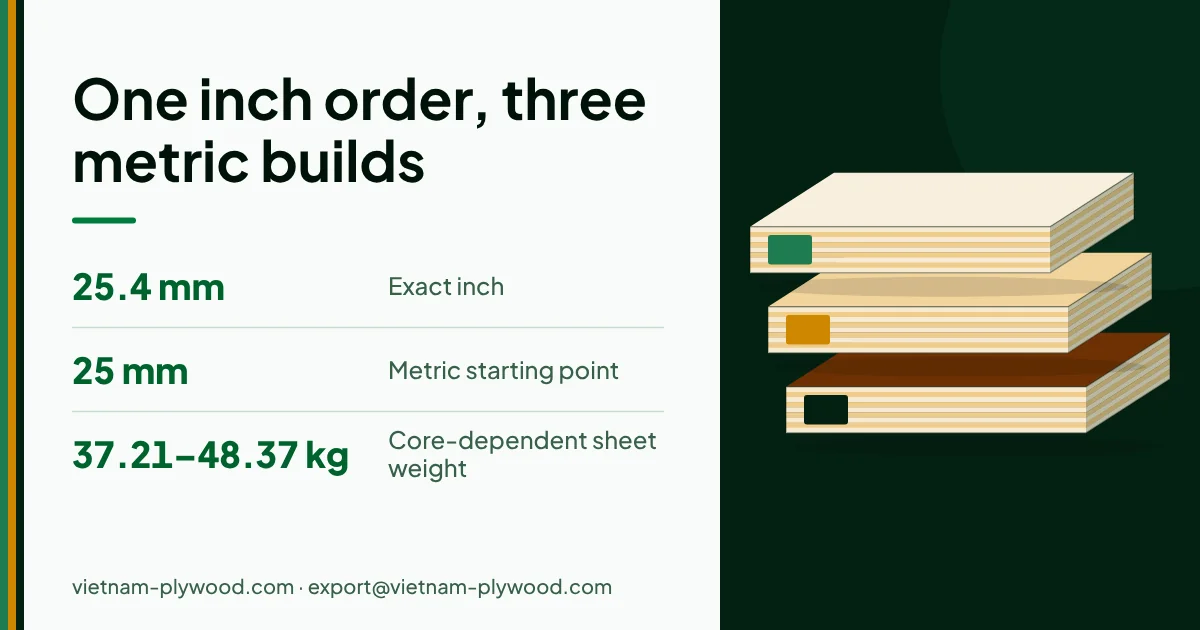
A nominal 1 inch plywood order at HCPLY starts with a 25 mm metric specification, with the producing line and tolerance chosen for the application. A mistaken inch-to-millimetre assumption can cause rejected cabinet components, rework and delayed loading. The exact inch is 25.4 mm.
What sizes can be ordered across the three lines?
A 25 mm panel can be specified in each of our three factories, with the producing factory selected by application and build. The sizes below are metric order dimensions; a buyer using “1 plywood 4x8” should write 1220 × 2440 mm rather than rely on the shorthand.
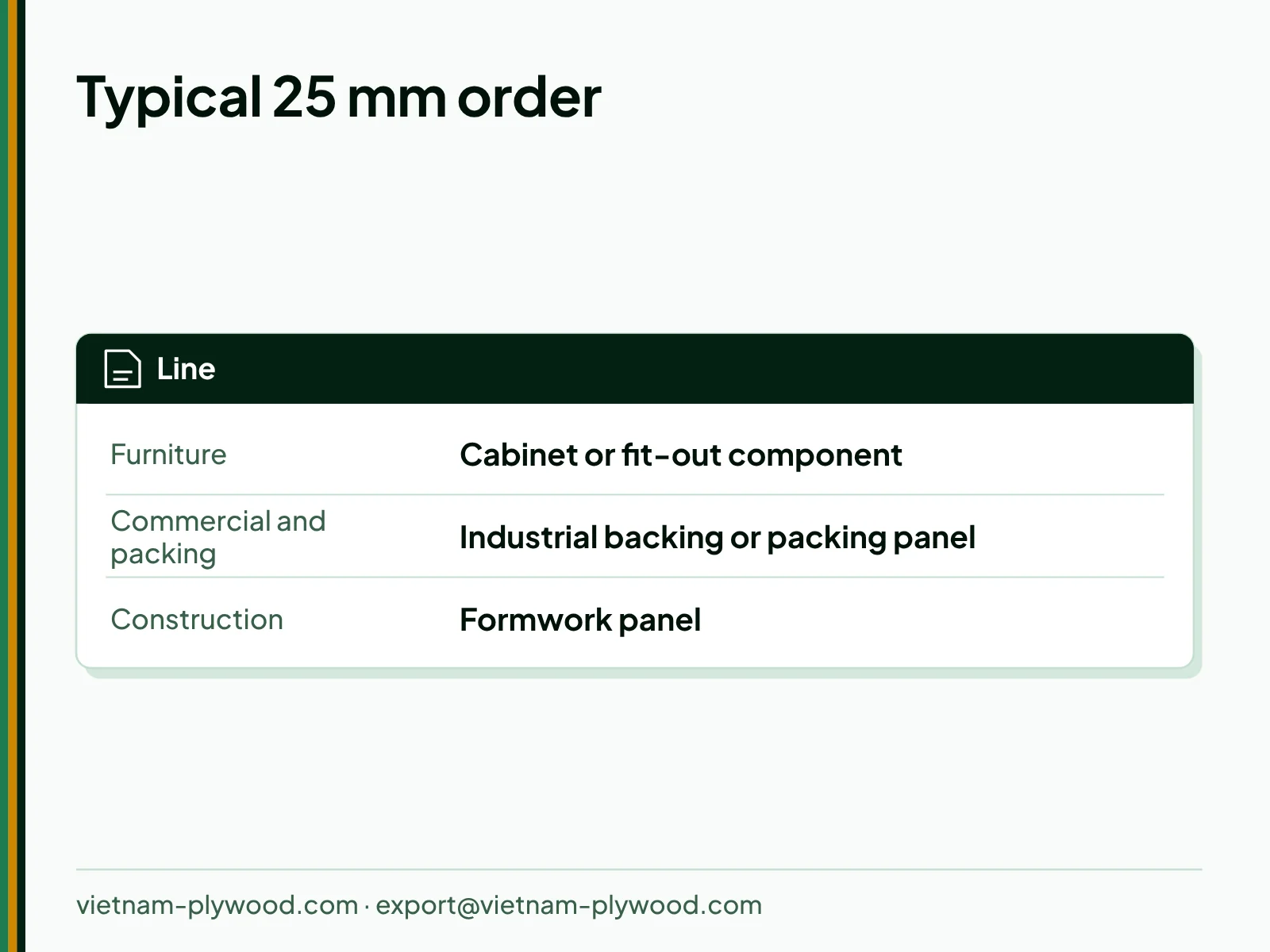
| Line | Typical 25 mm order | Core and surface | Thickness tolerance | Size choices |
|---|---|---|---|---|
| Furniture | Cabinet or fit-out component | Full-stitched styrax or eucalyptus, sanded veneer face | ±0.2 or ±0.3 mm as ordered | 1220 × 2440; 1250 × 2500 mm |
| Commercial and packing | Industrial backing or packing panel | Acacia, unsanded or light-sanded | ±0.5 mm commercial; ±0.5–1.0 mm packing | 1220 × 2440; 1220 × 2135 mm |
| Construction | Formwork panel | Acacia or eucalyptus, film face, unsanded core | ±0.5 mm | 1220 × 2440; 1250 × 2500 mm |
Other available formats include 1220 × 1830, 915 × 2440, 915 × 2135 and 915 × 1830 mm; custom cutting is available. Length and width tolerance is ±2 mm. Specify the destination market’s cut-list dimensions separately from the nominal inch label. For a broader size comparison, see the plywood sizes and thickness specification guide.
How thick is 1 inch plywood in millimetres?
One inch is exactly 25.4 mm. For an HCPLY 1 inch plywood inquiry, 25 mm is the usual metric starting point, measuring 0.4 mm below an exact inch before manufacturing tolerance. The drawing must state nominal or finished thickness.
The US National Institute of Standards and Technology (NIST), in its SI Units – Length explanation of the 1959 definition, states that the inch is exactly equivalent to 25.4 mm (NIST, SI Units – Length). That conversion establishes the measurement, while the purchase specification establishes the acceptable finished panel. A 25 mm board should never be described as measuring exactly 25.4 mm.
When a component enters a groove, meets a metal bracket or aligns with an existing panel, record the required minimum and maximum finished thickness. A nominal label alone cannot establish fit.
Which metric thickness meets a 1 inch plywood order?
For most metric procurement schedules, specify 25 mm and the applicable manufacturing tolerance. The 25 mm choice is 0.4 mm below 25.4 mm nominally; acceptance must be based on the actual drawing and measured range.
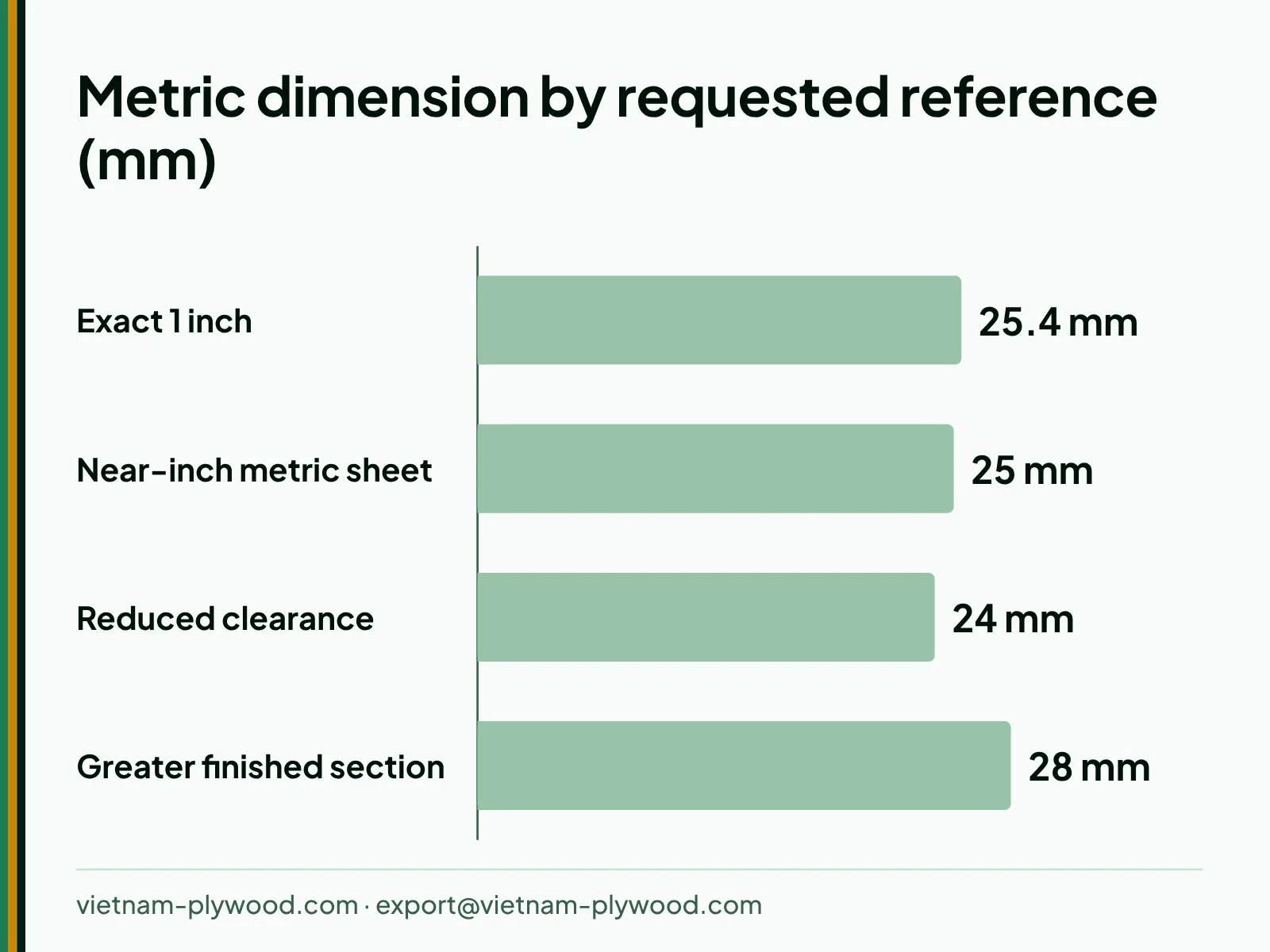
| Requested reference | Metric dimension | Difference from 25.4 mm | Buying decision |
|---|---|---|---|
| Exact 1 inch | 25.4 mm | 0 mm | Write 25.4 mm and an acceptance band if exact fit matters |
| Near-inch metric sheet | 25 mm | −0.4 mm | Starting specification for furniture, commercial or formwork orders |
| Reduced clearance | 24 mm | −1.4 mm | Use when an existing slot or mating part requires a thinner panel |
| Greater finished section | 28 mm | +2.6 mm | Use when the drawing requires added material and clearance permits |
The 25 mm plywood specification covers the build details. For a thinner panel family, compare 12 mm plywood; for thicker engineering choices, see 30–40–50 mm plywood.
When is 24 mm or 28 mm a closer match?
A 24 mm sheet is a closer functional match when the finished assembly has less available space; 28 mm is closer when a design requires a thicker finished section. Neither is mathematically closer to 25.4 mm than 25 mm.
Use 24 mm only after checking the smallest allowed thickness against the cabinet rebate, edge treatment and fastening detail. Choose 28 mm only after checking adjacent hardware, clearance and the required mechanical design. Both thicknesses sit inside our 3–40 mm manufacturing range; write the chosen dimension explicitly on the order.
For a 1 ply board inquiry, specify panel construction; see ply count. Thickness alone does not establish load rating.
Which factory line builds 1 inch plywood?
The line follows the finished use, rather than the inch label. Our furniture line makes sanded, full-stitched styrax- or eucalyptus-core panels for cabinet and fit-out work. Our commercial and packing line makes acacia-core boards for industrial and packing applications. Our construction line makes film-faced acacia- or eucalyptus-core panels for formwork.
Furniture buyers can select bintangor, okoume, engineered veneer, gurjan, pine, poplar, eucalyptus, birch or sapele faces; the core remains the field used for density and weight. A matt specification denotes an unfaced raw core. Common face veneer is 0.2–0.4 mm; A/B grades apply to the listed non-birch faces, while birch uses D/E/F grades.
A film-faced build instead specifies 120 g/m² standard film, 135 g/m² premium film or 220 g/m² anti-slip film. Those are surface weights, separate from the core-only shipping weights below. Our furniture plywood page covers the appearance-led option; construction project supply addresses the formwork route.
How much does a 1 inch plywood sheet weigh?
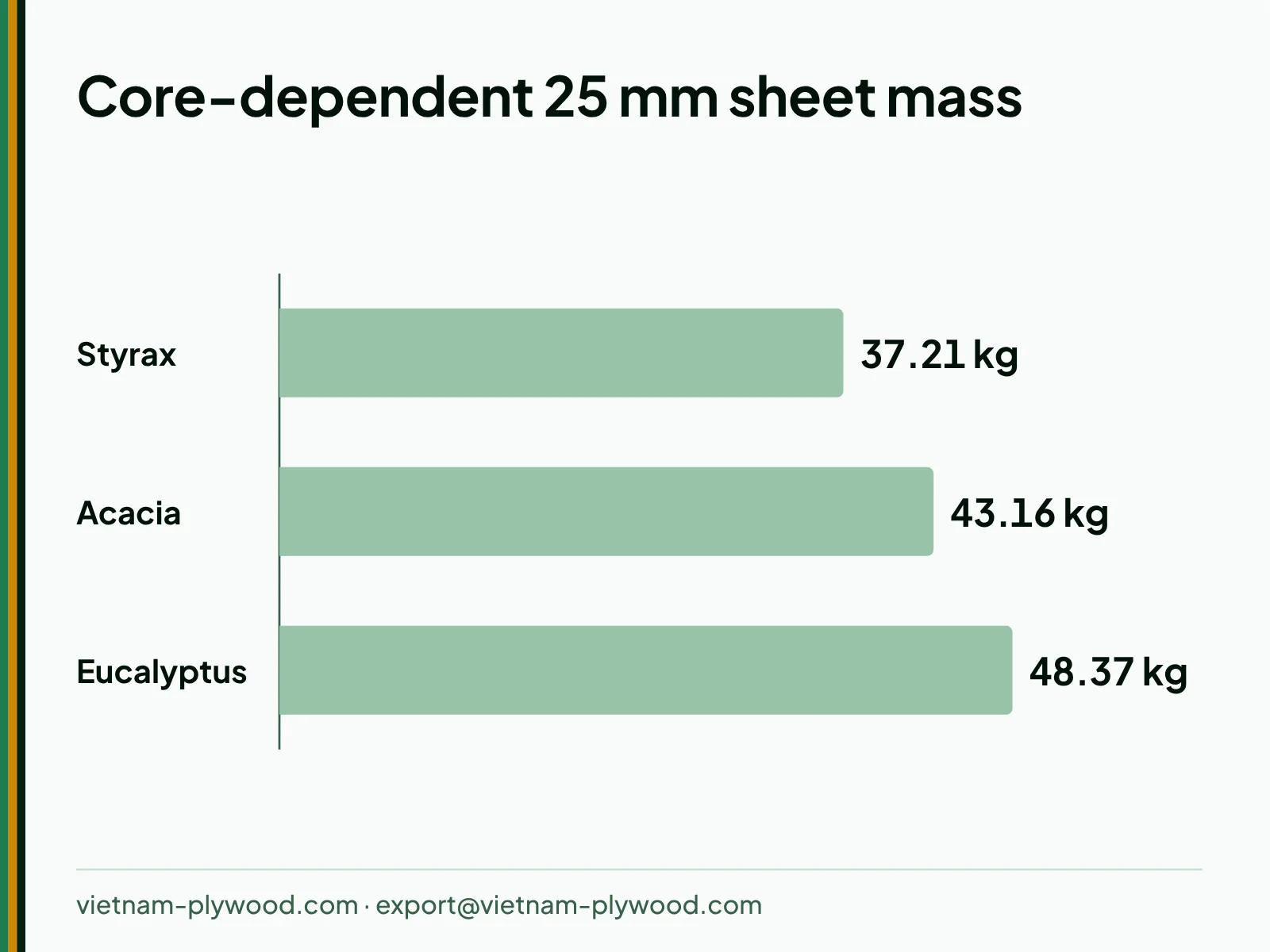
At 25 mm and 1220 × 2440 mm, a styrax-core sheet weighs 37.21 kg, an acacia-core sheet 43.16 kg and a eucalyptus-core sheet 48.37 kg. These are core-density calculations, excluding film weight, and distinguish panel weight by core rather than visible face.
| Core | Density | 25 mm sheet weight | Sheets per pallet | Full 40HC sheets | Full load mass |
|---|---|---|---|---|---|
| Styrax | 500 kg/m³ | 37.21 kg | 40 | 720 | 26.79 t |
| Acacia | 580 kg/m³ | 43.16 kg | 40 | 640 | 27.62 t |
| Eucalyptus | 650 kg/m³ | 48.37 kg | 38 | 570 | 27.57 t |
The 40HC payload limit is 28.5 t. Pallet configurations differ by core. For loading details, see container packing.
Can different 25 mm builds share a container?
Yes. Specifications can be mixed in one 40HC within the 28.5 t payload limit, provided the loading plan accounts for each core’s weight and pallet stack. For a 25 mm 1220 × 2440 mm full load, the styrax configuration is 720 sheets at 26.79 t, while acacia is 640 sheets at 27.62 t.
Mixed orders identify each build on the packing list; account separately for packaging and film.
For mixed-load ordering, see mixed container loads of plywood. The final pallet allocation belongs on the order and loading plan, rather than being inferred from a generic sheet count.
What thickness tolerance should be planned?
For 25 mm sanded furniture plywood, order either ±0.2 mm or ±0.3 mm. Commercial and film-faced plywood use ±0.5 mm; packing plywood uses ±0.5–1.0 mm. These are different acceptance bands and must be written into the purchase specification.
At a 25 mm target, ±0.2 mm means 24.8–25.2 mm, whereas ±0.5 mm means 24.5–25.5 mm. A drawing requiring at least 25.4 mm needs a different acceptance range.
Inspect representative sheets against the agreed tolerance.
Which glue, emission and core details belong on the order?
Glue type and emission class are separate order fields. The furniture line uses full-stitched sanded styrax or eucalyptus cores with E0 or E1 emission classes. The commercial and packing line uses acacia core with moisture-resistant (MR) glue. Film-faced construction builds use phenolic or melamine film and the specified core.
Melamine MR bonding is described by a 12-hour boil condition; phenolic weather-and-boil-proof (WBP) bonding by a 72-hour boil condition. Those terms describe glue performance, rather than a universal structural or marine grade. If a buyer requires a marine or structural designation, it must be evaluated against a test report the buyer accepts.
Core assembly can be full stitched, stitched outer layers with edge-trimmed inner layers, finger-jointed or loose-laid. HCPLY does not press birch-core plywood, medium-density fiberboard (MDF), oriented strand board (OSB), chipboard or blockboard.
What can the buyer inspect at the producing factory?
A buyer can witness thickness checks, surface grading and the agreed core-construction inspection at the producing factory. The factory office receives visitors, while the actual goods are inspected where they are made.
For a cabinet order, inspect the sanded face, edge continuity and caliper readings against the specified ±0.2 or ±0.3 mm band. For a commercial packing order, inspect the acacia core, surface condition and the wider packing tolerance if selected. For formwork, check film identification, edge condition and thickness against the construction specification.
Record sampled pallets and readings. Member-factory certificates are shown with factory details masked, on request.
What changes the quotation and shipping documents?
The largest quotation drivers are the selected core construction and finish, then glue, emission requirement, thickness tolerance and cut size. Full-stitched sanded furniture panels cost more to make than loose-laid unsanded packing panels because of core preparation and surface work. Film specification and any accepted testing requirement also affect a construction quote.
The minimum order is one 40HC. Factory lead time runs 15–45 days from receipt of the 30% deposit; the exact figure depends on order size, line loading and what the contract fixes. The balance is 70% against the scanned bill of lading (B/L), by telegraphic transfer (T/T) or irrevocable letter of credit (L/C) at sight. We ship FOB Hai Phong, or CFR (CNF) or CIF to your port.
The export document set includes commercial invoice, packing list, B/L, certificate of origin (EUR.1 for European Union lots), phytosanitary and fumigation papers, insurance under CIF, agreed certificate or test documents, and the EUTR/EUDR file set for EU lots. After loading, the draft shipping documents come to you for approval. The packing list is the key record linking 25 mm specifications, quantities and pallet identification.
What should the 1 inch plywood inquiry say?
Write the metric thickness and its tolerance first, followed by application and the actual core and surface requirements. This gives the producing line a measurable target and keeps a nominal inch request from becoming a fit dispute.
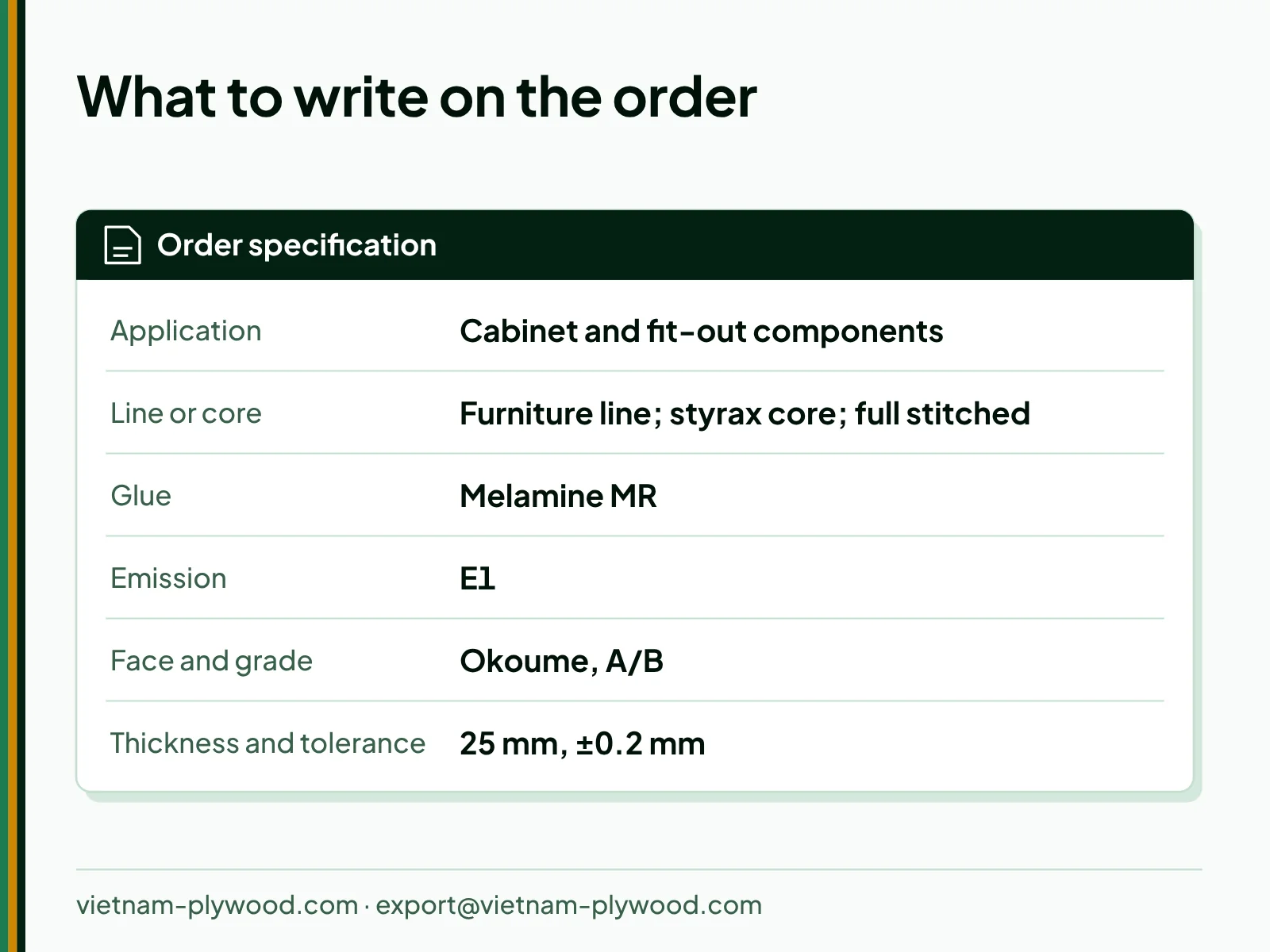
Application: Cabinet and fit-out components
Line or core: Furniture line; styrax core; full stitched
Glue: Melamine MR
Emission: E1
Face and grade: Okoume, A/B
Thickness and tolerance: 25 mm, ±0.2 mm
Size: 1220 × 2440 mm
Quantity: One 40HC, final mix by approved packing plan
Destination port: [buyer to enter]
Ask Lucy at export@vietnam-plywood.com for a sample set through contact. Samples cost nothing: a first-time buyer pays the courier, and that charge comes off the first confirmed order.