





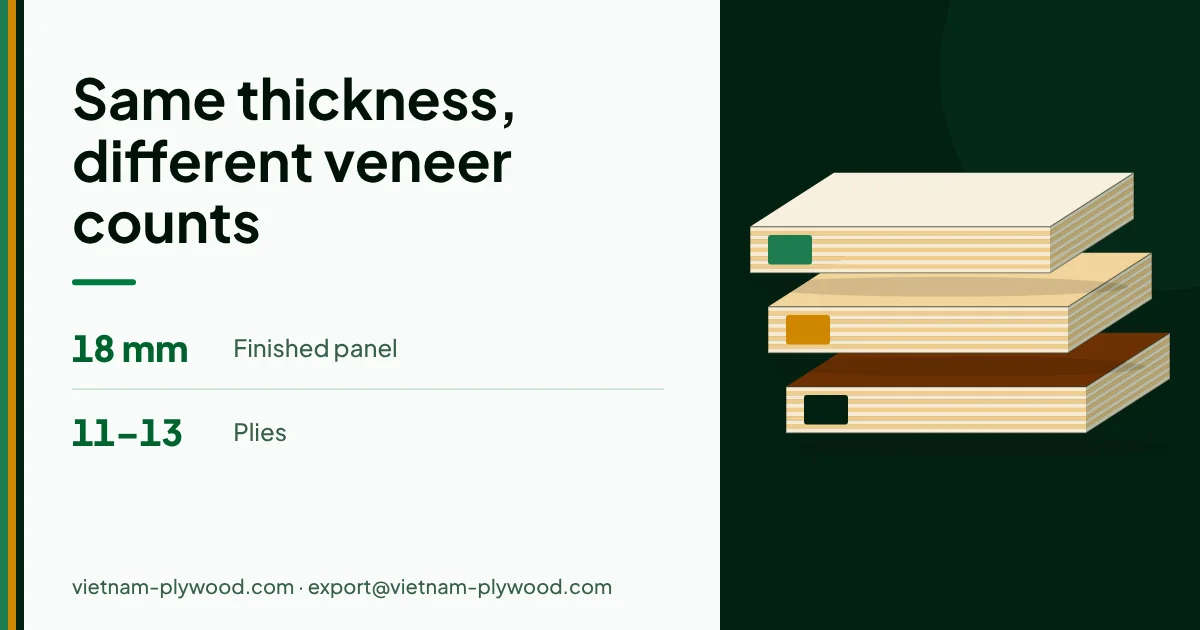
An 18 mm sheet can contain 11–13 layers of plywood at HCPLY, depending on the veneer build. A wrong count or poorly defined core can cost a cabinet maker rejected material and production days. Our three factories make different panel specifications, so buyers should specify the ply count alongside the finished thickness and inspect the actual section before accepting a shipment.
How many layers of plywood are in 18 mm?
An 18 mm plywood sheet has 11–13 plies, including its face veneers. The precise count follows the selected veneer thickness and lay-up. Two sheets measuring 18 mm can therefore contain different numbers of wood plies. Specify a minimum count alongside core construction, glue and thickness tolerance so the producing factory can check the actual build.
For furniture cabinets, 18 mm plywood is a common specification starting point. The number of plies alone does not establish bond quality or machining performance. We can record the lay-up on the order and present an edge section for inspection.
How can three factory lines build the same thickness?
At 18 mm, the requested application determines the line, core and surface treatment. The following comparison shows the different specifications a buyer can order; 11–13 plies is our 18 mm range, rather than a separately verified count for each line.
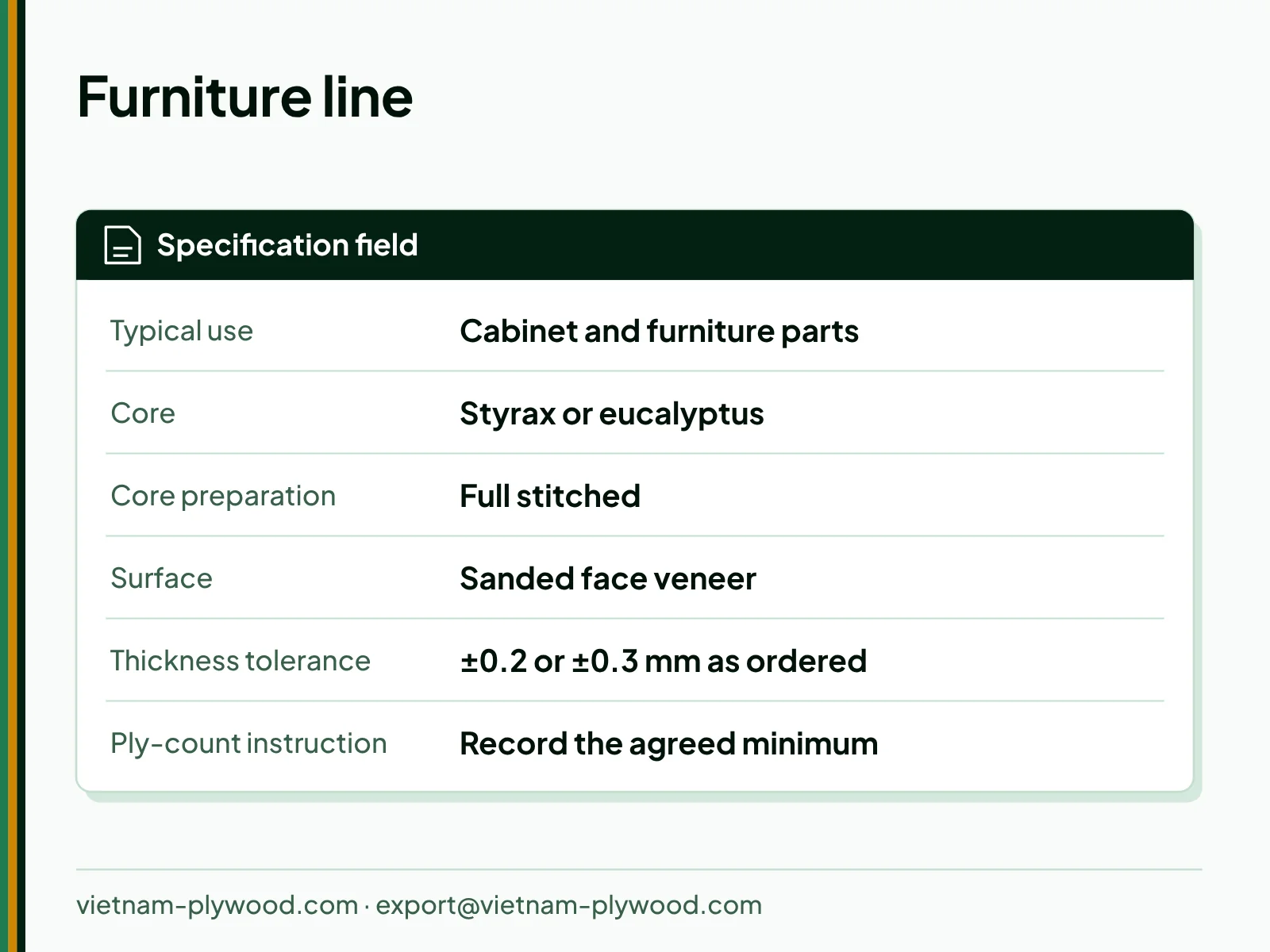
| Specification field | Our furniture line | Our commercial and packing line | Our construction line |
|---|---|---|---|
| Typical use | Cabinet and furniture parts | Commercial panels and crates | Concrete formwork |
| Core | Styrax or eucalyptus | Acacia | Acacia or eucalyptus |
| Core preparation | Full stitched | Selected core construction per order | Selected core construction per order |
| Surface | Sanded face veneer | Unsanded or light-sanded | Phenolic, melamine or anti-slip film |
| Thickness tolerance | ±0.2 or ±0.3 mm as ordered | Commercial ±0.5 mm; packing ±0.5–1.0 mm | ±0.5 mm |
| Ply-count instruction | Record the agreed minimum | Record the agreed minimum | Record the agreed minimum |
Our furniture line presses a stitched, sanded panel for cabinet machining. Our commercial and packing line instead prepares acacia-core boards for packing or commercial use. Our construction line presses film-faced panels for formwork; its film weight is a separate specification from veneer count. See the furniture plywood range and construction project plywood for application details.
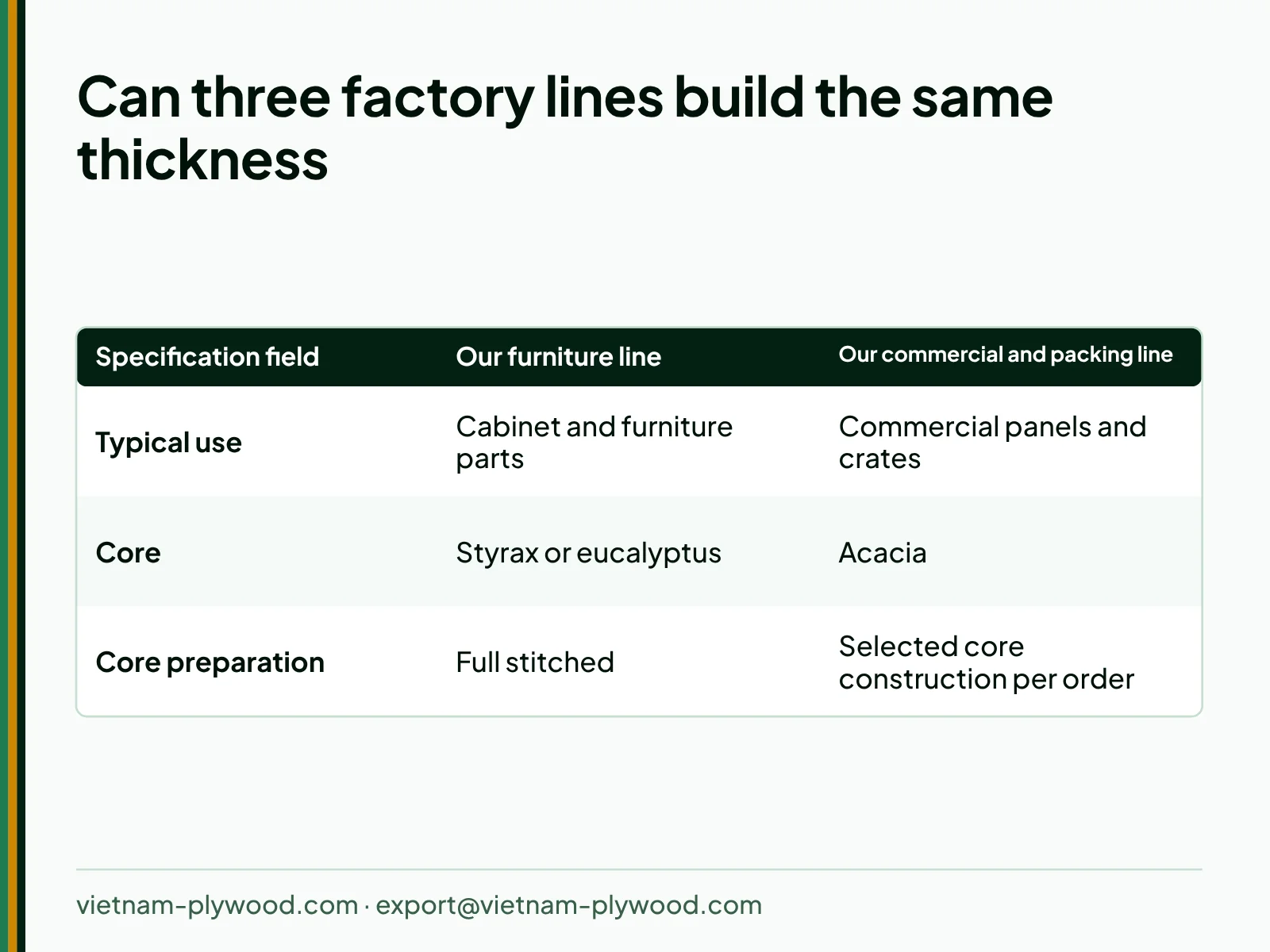
An inspector can compare exposed edges from the producing factory with the approved section drawing.
Why can equal-thickness sheets have different ply counts?
Equal finished thickness does not prescribe equal veneer count. A thinner core veneer permits more interfaces within the same thickness; thicker veneers permit fewer. Our core veneer thickness is 1.4–2.0 mm, while common decorative face veneer is 0.2–0.4 mm. The selected lay-up and final sanding also affect the finished measurement.
A simple division of 18 mm by one veneer thickness cannot determine the final count. It omits face veneers, glue lines, pressing and sanding. Compare an approved cross-section rather than relying on an arithmetic shortcut. The plywood sizes and thickness specification guide explains how dimensional tolerance belongs in the same purchase specification.
The APA — The Engineered Wood Association 2011 Sanded Plywood Product Guide explains that a cross-laminated layer can consist of more than one ply. That distinction matters when a supplier reports a layer count rather than the number of individual veneer sheets. APA’s 2011 guide provides the terminology.
What is the difference between a ply and a layer?
A ply is one individual veneer sheet; a layer is a grain-orientation group that can contain more than one ply. In ordinary purchasing conversations, the words are often treated as interchangeable. That can produce a disagreement when a section has adjacent parallel-grain veneers.
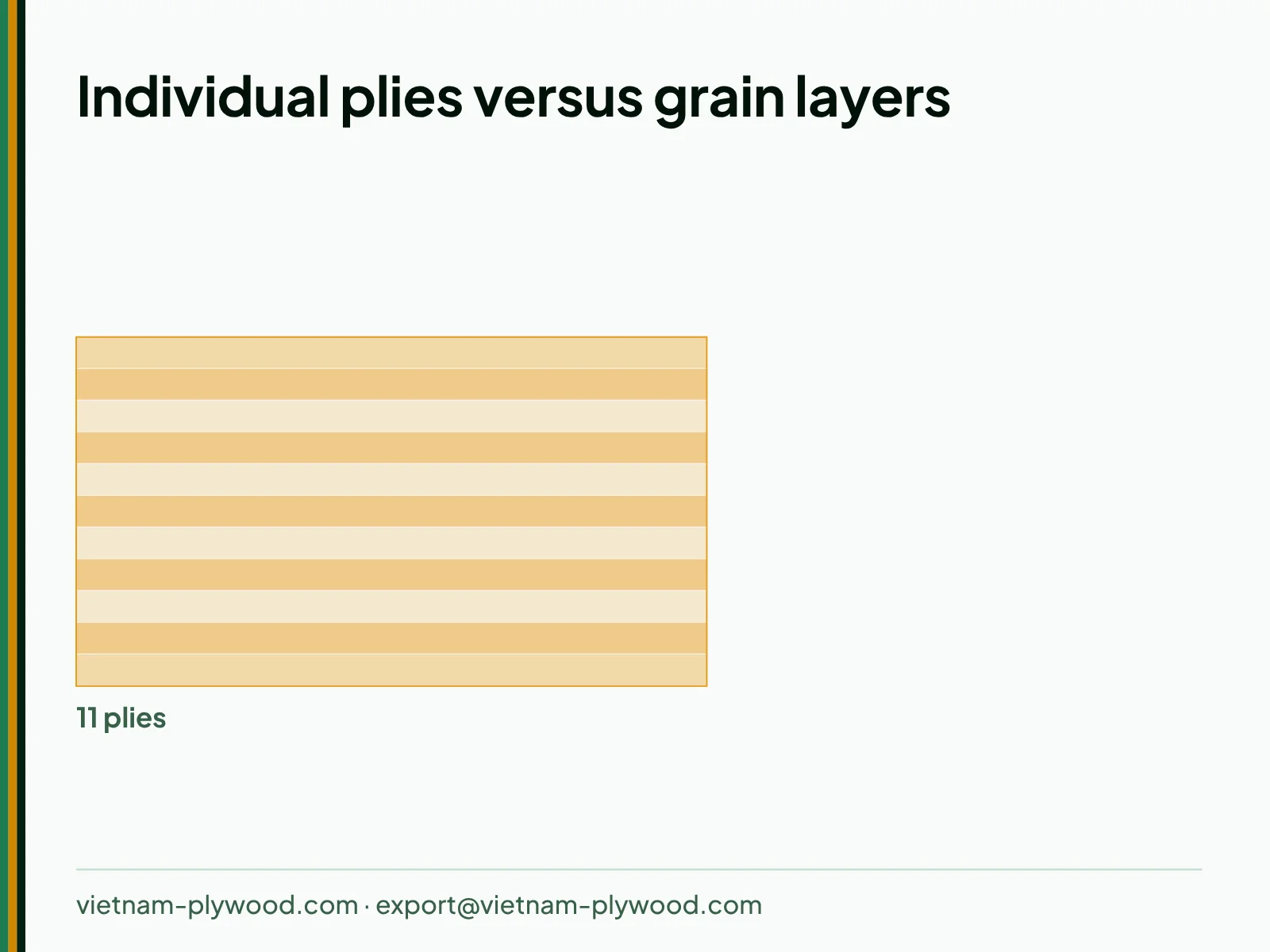
Specify individual veneer plies, including face and back, if the purchase order is meant to control the physical sheet count. Ask for a separate drawing of grain directions when the plywood structure is relevant to machining or performance. A balanced arrangement commonly alternates grain direction, with a center and matching outer arrangement.
The APA — The Engineered Wood Association 2011 Sanded Plywood Product Guide distinguishes individual plies from cross-laminated layers, which can contain more than one ply. The terms triply plywood and 3-ply board refer to a construction description, not an automatic finished thickness.
How many plies are in 1/2 inch plywood?
There is no universal ply count for nominal 1/2-inch plywood. One-half inch is 12.7 mm, while a 12 mm metric panel is a different ordered thickness. The veneer schedule, face build and applicable product specification decide the actual count.
For a metric purchase, state 12 mm and the required tolerance rather than converting the nominal inch label without checking. We offer 12 mm among its common thicknesses; the 12 mm ply count should be agreed from the proposed lay-up. Request a lay-up drawing and minimum count before production. The 12 mm plywood specification is a useful companion when comparing thickness choices.
An 8 ply wood description is also insufficient by itself: determine whether eight means individual veneers or grain-orientation layers, and whether the face veneers were included.
How many layers are in 3/4 inch birch plywood?
A 3/4-inch birch plywood label does not establish a universal number of layers. Three-quarter inch is 19.05 mm, which is different from HCPLY’s 18 mm metric option. Birch-faced plywood can have a non-birch core, and the face name does not identify the core species.
Our furniture line can build a birch face, with its specified D/E/F face grade, over an approved styrax or eucalyptus furniture core. We do not press birch-core plywood. Our 18 mm build has 11–13 plies, but that range must not be presented as a verified count for every 3/4-inch birch panel sold elsewhere.
For cabinet orders, compare finished thickness, face grade, veneer schedule, edge appearance and the agreed machining needs. A claim such as 7 ply 3/4 plywood should trigger a request for the section drawing and product specification, rather than an assumption about suitability.
How thick is 3-ply or 5-ply plywood?
Three-ply and five-ply describe counts, not finished panel thicknesses. A 5 ply board can be made from veneers of different thicknesses, so 5 ply plywood thickness cannot be inferred from the label alone. The same applies to 7 ply plywood and other counts.
Our available finished thickness range is 3–40 mm, with common options of 3, 5, 9, 12, 15, 18, 21 and 25 mm. These are finished dimensions, not a promise that each thickness corresponds to a particular number of plies. For thin stock, the veneer schedule and required face finish need explicit approval.
Buyers comparing 15 mm plywood with a five-ply proposal should ask for the finished thickness and the section drawing separately. A seven-ply panel and a five-ply panel could have different core materials, glue schedules and surface preparation. Those differences matter more than the abbreviated label alone.
Does a higher ply count make plywood better?
A higher count can provide more, thinner veneers, but it does not automatically make a better panel. Veneer integrity, core joints, bond quality, grain arrangement and dimensional control must also meet the intended use. Compare 5 ply vs 7 ply plywood only after holding these other variables constant.
For our core construction, the specified quality order runs from full stitched, to stitched outer layers with edge-trimmed inner veneers, to finger-jointed, then loose-laid. This hierarchy concerns the core arrangement, independently of the total ply count. For cabinets, a full-stitched core with a suitable face can be preferable to a higher-count panel containing unacceptable gaps.
Glue and emission must be written as separate fields. Melamine glue is MR with a 12-hour boil specification; phenolic glue is WBP (weather and boil proof) with a 72-hour boil specification. Emission classes E0, E1 and E2 describe a different requirement. A buyer seeking a particular bond test should specify the accepted report and test conditions.
How does a factory inspector verify minimum ply count?
The producing factory can expose a representative panel edge and count individual veneers against the agreed lay-up. This is a practical acceptance check that should be agreed before production, including sampling locations and how disputed counts are resolved.
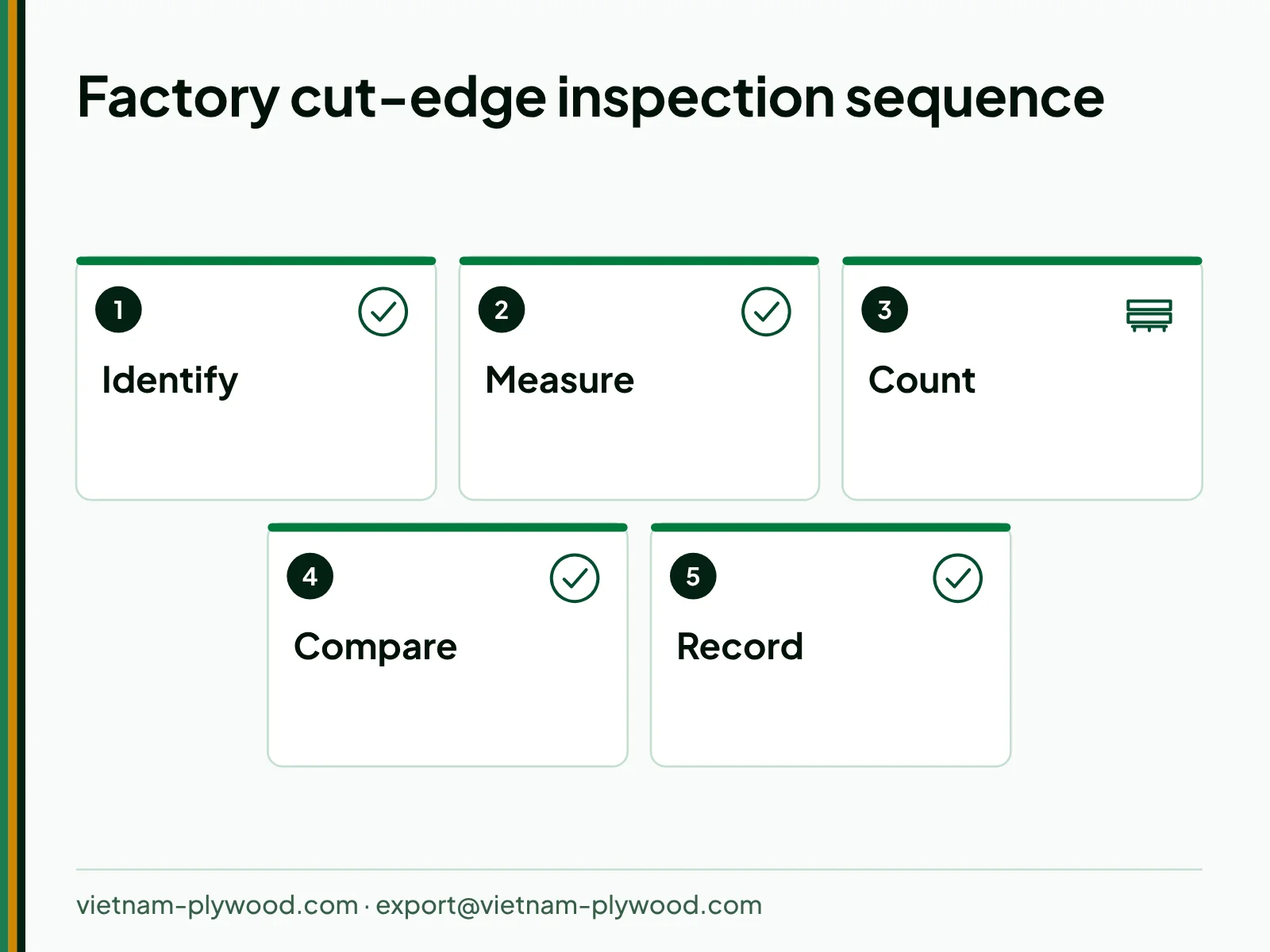
- Match the sampled panel to the order, thickness, face, core and production lot.
- Measure finished thickness with the agreed tolerance and record the reading.
- Inspect a clean cut edge; count each individual veneer, including the two faces.
- Record the count and visible core joints against the approved lay-up drawing.
- Photograph the edge with the panel identification and record the acceptance decision.
A visible glue line does not always prove a new grain-orientation layer. The inspector should check for paired or parallel-grain veneers when the distinction matters. Our on-site QC can prepare the record for buyer inspection at the producing factory. Buyers visit the factory office and inspect goods where their order is made.
The agreed build’s test reports can accompany the shipment’s certificate documents when specified. A ply-count inspection record is a production acceptance record; it should not be confused with an emission certificate or an unrelated performance rating.
How should the minimum ply count appear on an order?
Write the minimum as a count of individual veneer sheets including both faces, and attach an approved cross-section. Then specify core construction and thickness tolerance so the factory can apply the same acceptance rule during pressing and final inspection.
For example, an 18 mm furniture order could call for at least 11 individual plies, a full-stitched styrax core and a sanded surface with ±0.2 mm tolerance. That example selects a minimum within HCPLY’s stated 11–13-ply range; the final approved build remains the contractual reference. Face species and grade, glue, emission class and dimensions belong on the same order.
Specify whether the buyer or their appointed inspector witnesses sampling, and how many sections the agreed inspection plan requires. Without an agreed sampling plan, one photographed edge cannot represent every sheet in a shipment.
Can different ply-count builds share a shipment?
Different approved specifications can share one 40HC container within the 28.5 t payload limit. That lets a buyer combine cabinet panels and packing panels when the loading plan respects each core’s weight and pallet count. We ship the order directly from the producing factory, FOB Hai Phong.
At 18 mm and 1220 × 2440 mm, a styrax-core sheet weighs 26.79 kg; an acacia-core sheet weighs 31.08 kg; an eucalyptus-core sheet weighs 34.83 kg. Full 40HC reference loads are 990, 880 and 795 sheets respectively, with total weights of 26.52 t, 27.35 t and 27.69 t. These figures exclude film weight.
For mixed orders, list each build and its sheet count on the packing plan, then check pallets and payload together. The mixed-container loading guide covers the commercial decision, while container packing calculations owns the detailed loading topic. One contract can cover mixed specifications with one set of export documents.
What should the buyer ask for next?
Ask for a sample set showing the proposed ply counts and clean cut edges, together with the approved specification. This gives the cabinet maker or importer a physical reference before the full order is pressed.
Minimum order is one 40HC, with specifications mixed within the payload limit. Factory lead time runs 15–45 days from receipt of the 30% deposit; the exact figure depends on order size, line loading and what the contract fixes. The remaining 70% is paid on the scan of the bill of lading, by T/T, or by irrevocable sight L/C. We ship FOB Hai Phong, or CFR (CNF) or CIF to your port.
Samples cost nothing: a first-time buyer pays the courier, and that charge comes off the first confirmed order. Lucy at export@vietnam-plywood.com can review the specification and sample request. The export documents include a commercial invoice, packing list and bill of lading, with the remaining origin and certificate papers according to the agreed shipment.
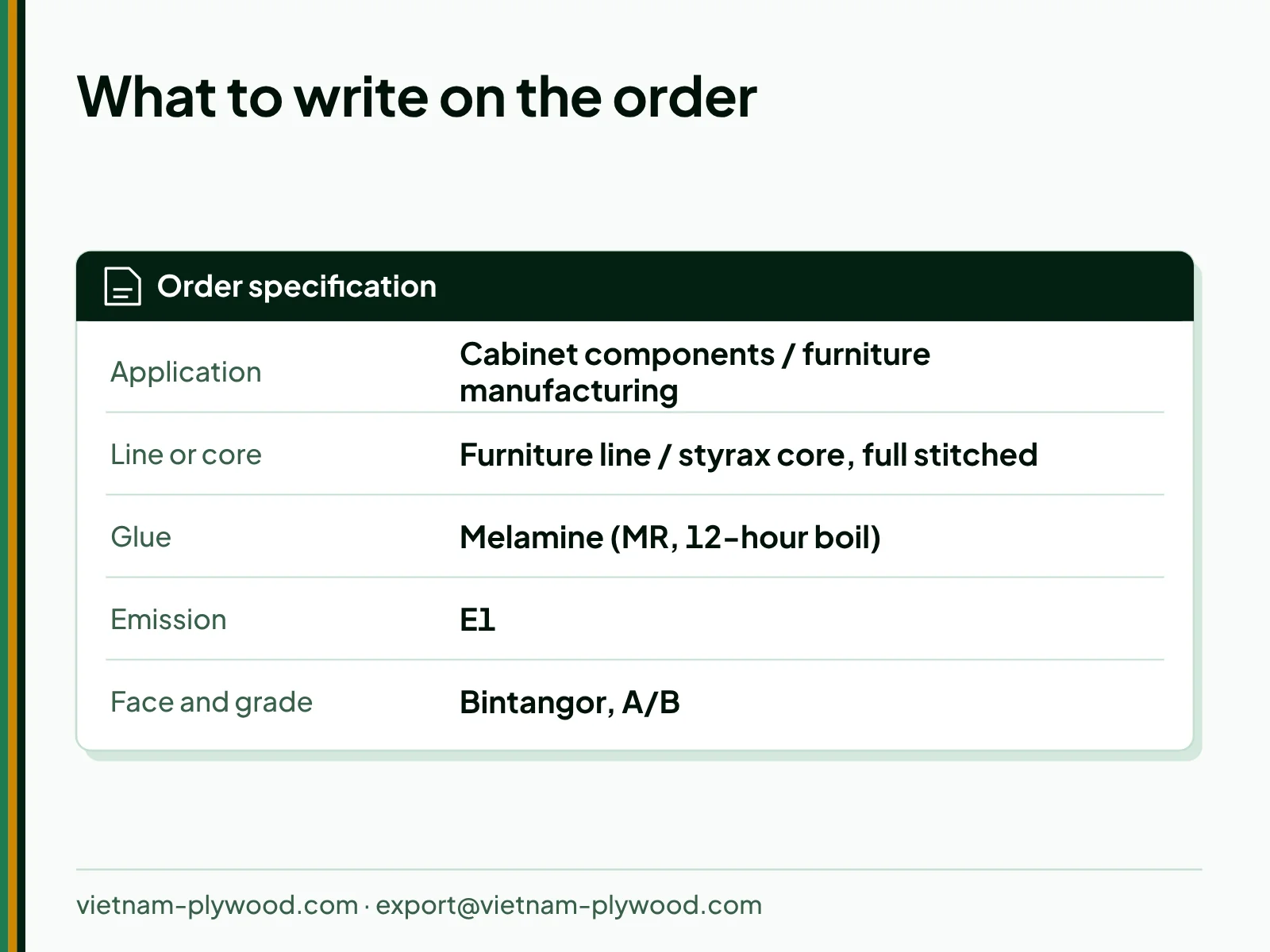
Application: Cabinet components / furniture manufacturing
Line or core: Furniture line / styrax core, full stitched
Glue: Melamine (MR, 12-hour boil)
Emission: E1
Face and grade: Bintangor, A/B
Thickness and tolerance: 18 mm, ±0.2 mm
Ply count: Minimum 11 individual veneers, faces included; approved lay-up attached
Size: 1220 × 2440 mm
Quantity: One 40HC, final mix specified in packing plan
Destination port: [buyer to enter]
Ask for a sample set with the cut-edge section and agreed lay-up.