





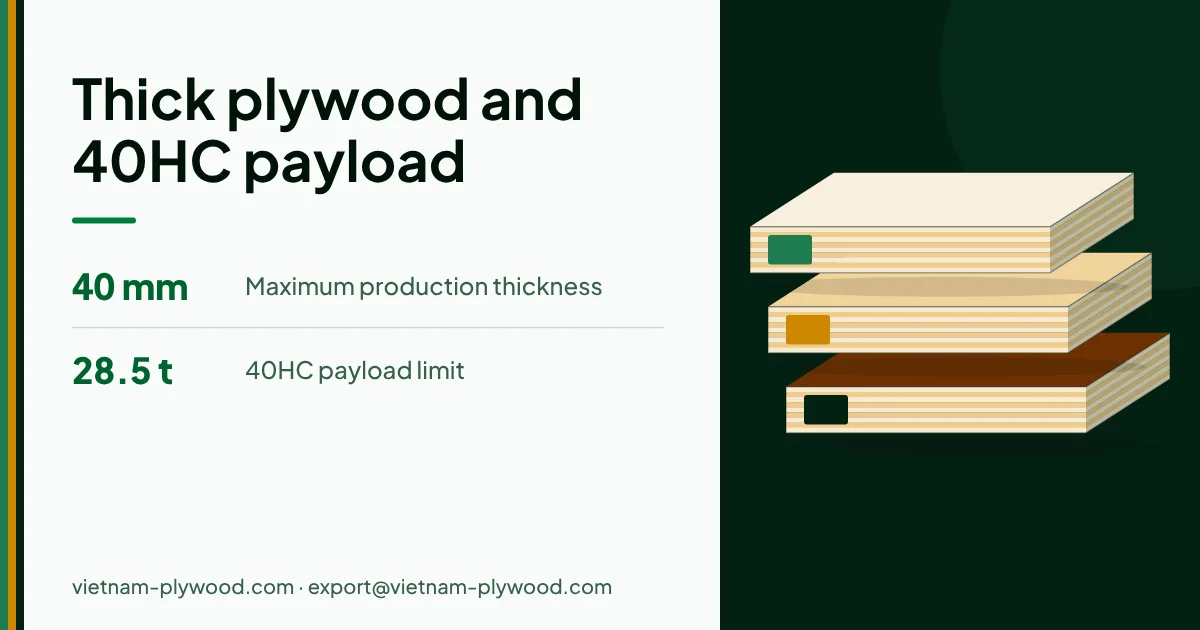
HCPLY makes plywood up to 40 mm thick; above 30 mm, the core build and sheet mass shape both the order and its 40HC load. A mismatched thickness or density can cost extra freight, machining time or a rejected delivery. The thickest plywood choice starts with application, finished tolerance and the producing line.
What is the thickest plywood available?
The thickest plywood on HCPLY production lines is 40 mm. Our specified range is 3–40 mm, so 30 mm plywood and 40mm plywood can be discussed against an actual factory build; 50 mm is outside that range. Thickness alone cannot establish bending capacity, suitability for a worktop or allowable floor load. The application, core construction, bonding and support arrangement belong in the same purchase specification.
Commercial catalogues list thicknesses beyond 40 mm, including 44 mm and 54 mm categories, but those listings describe different products and supply routes. The plywood size and thickness specification guide covers the broader range, while this page concentrates on extra-thick procurement.
A request for the thickest plywood sheet should state whether 40 mm is the required finished dimension or a nominal purchasing description. That distinction changes sanding allowance, inspection readings and whether a replacement panel fits an existing assembly.
Which factory line presses extra-thick plywood?
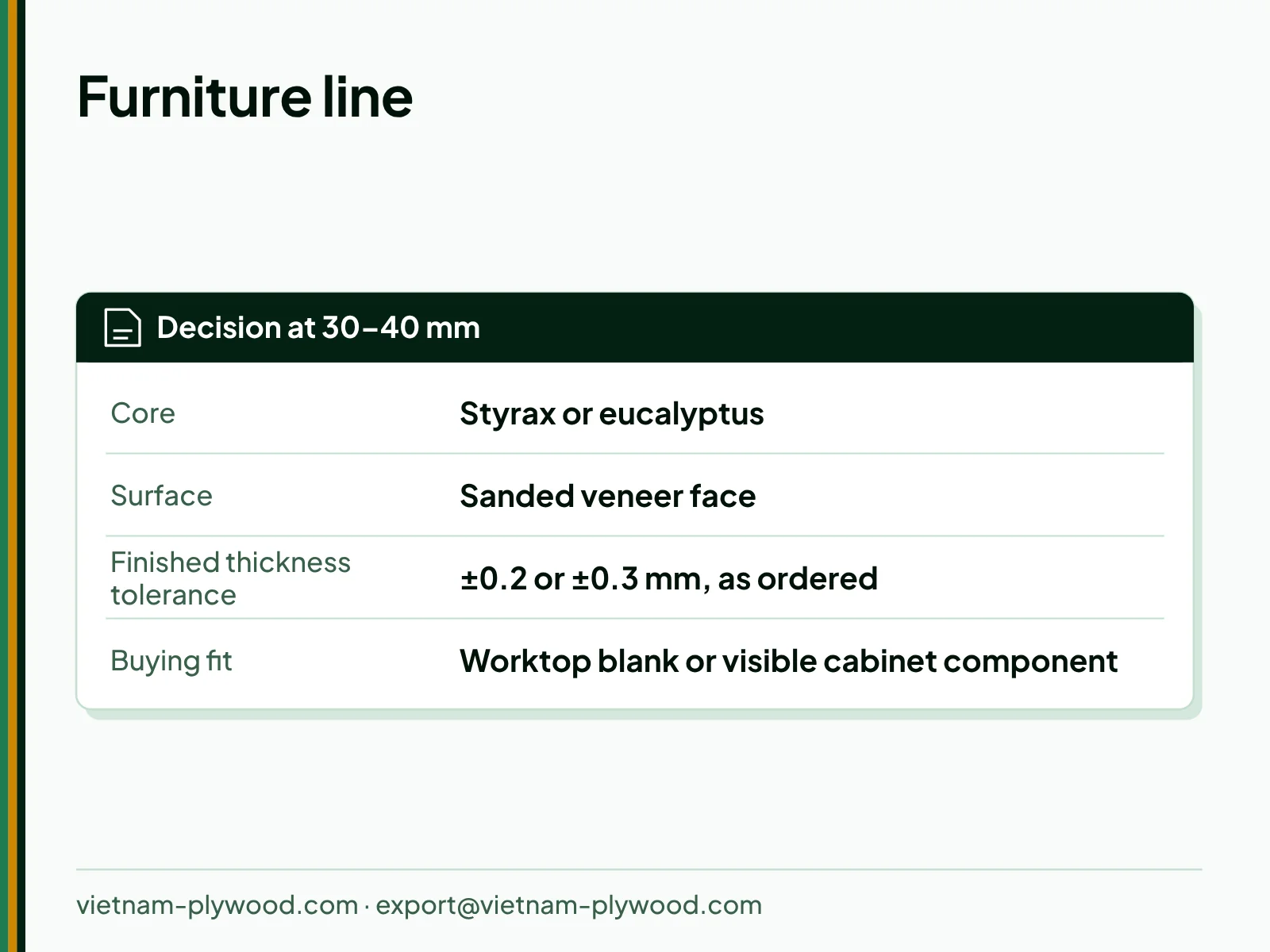
Our furniture line is the first route for a thick, sanded panel intended for a visible worktop or cabinet component. It uses styrax or eucalyptus cores, full stitched construction and an E0 or E1 emission specification. Our commercial and packing line builds acacia-core material with moisture-resistant (MR) glue, usually unsanded or light-sanded. Our construction line presses film-faced material for formwork-related specifications, with acacia or eucalyptus cores.
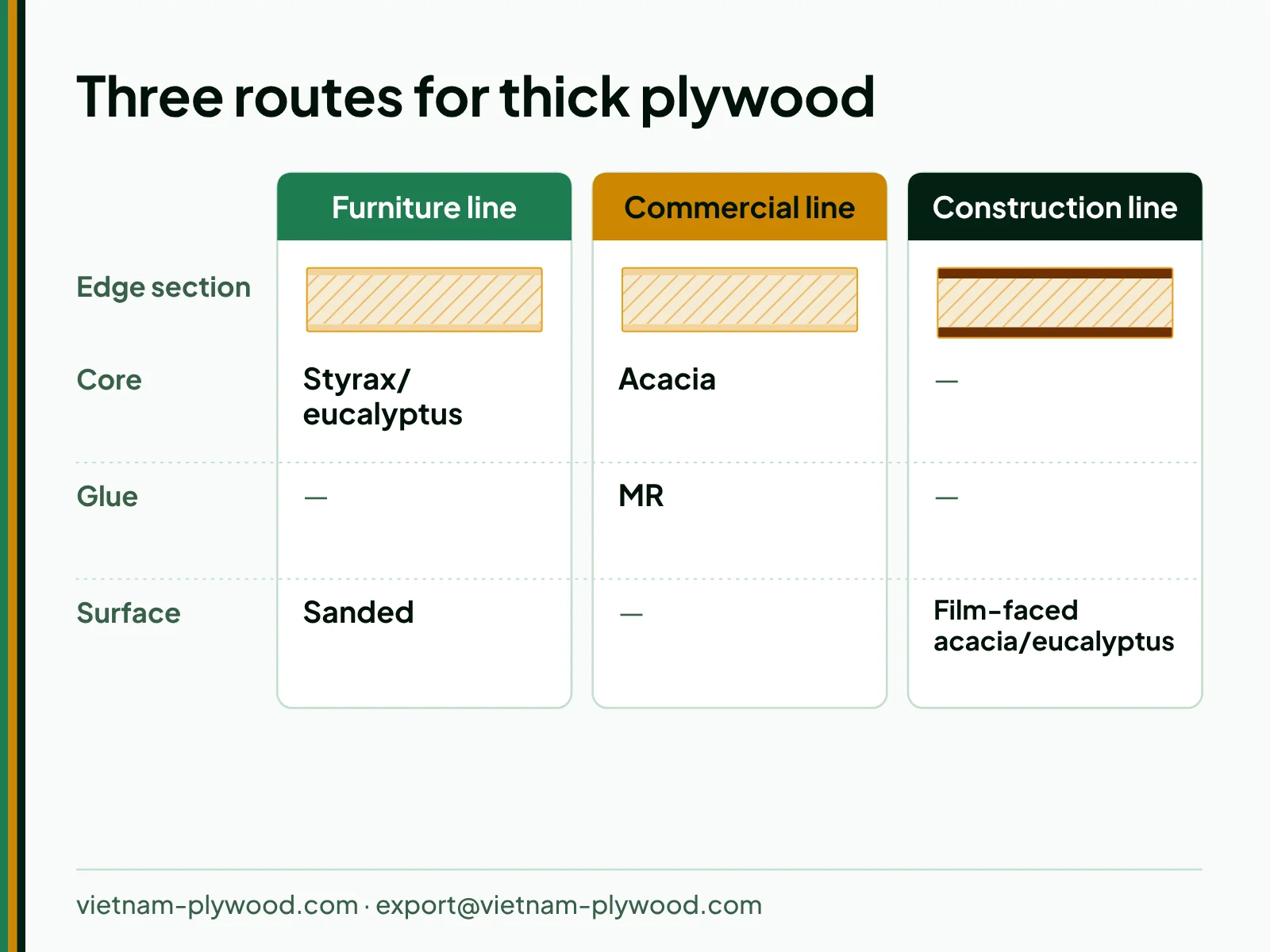
| Decision at 30–40 mm | Furniture line | Commercial and packing line | Construction line |
|---|---|---|---|
| Core | Styrax or eucalyptus | Acacia | Acacia or eucalyptus |
| Surface | Sanded veneer face | Raw or lightly sanded | Phenolic, melamine or anti-slip film |
| Finished thickness tolerance | ±0.2 or ±0.3 mm, as ordered | ±0.5 mm commercial; ±0.5–1.0 mm packing | ±0.5 mm |
| Buying fit | Worktop blank or visible cabinet component | Heavy packing component | Formwork deck or protected working surface |
These are manufacturing routes, not interchangeable strength ratings. An engineer must establish the load, span, fixings and support conditions for heavy floors or heavy forms. The comparison of grades across factory lines helps separate finish requirements from construction requirements.
How is plywood over 30 mm pressed and bonded?
A thick panel starts with a veneer layup that reaches the specified finished thickness after pressing and any sanding. Core veneers are 1.4–2.0 mm thick, so ply count changes with veneer selection and compression. A buyer should request a section sample or layup drawing rather than extrapolate a fixed ply count from a thinner sheet.
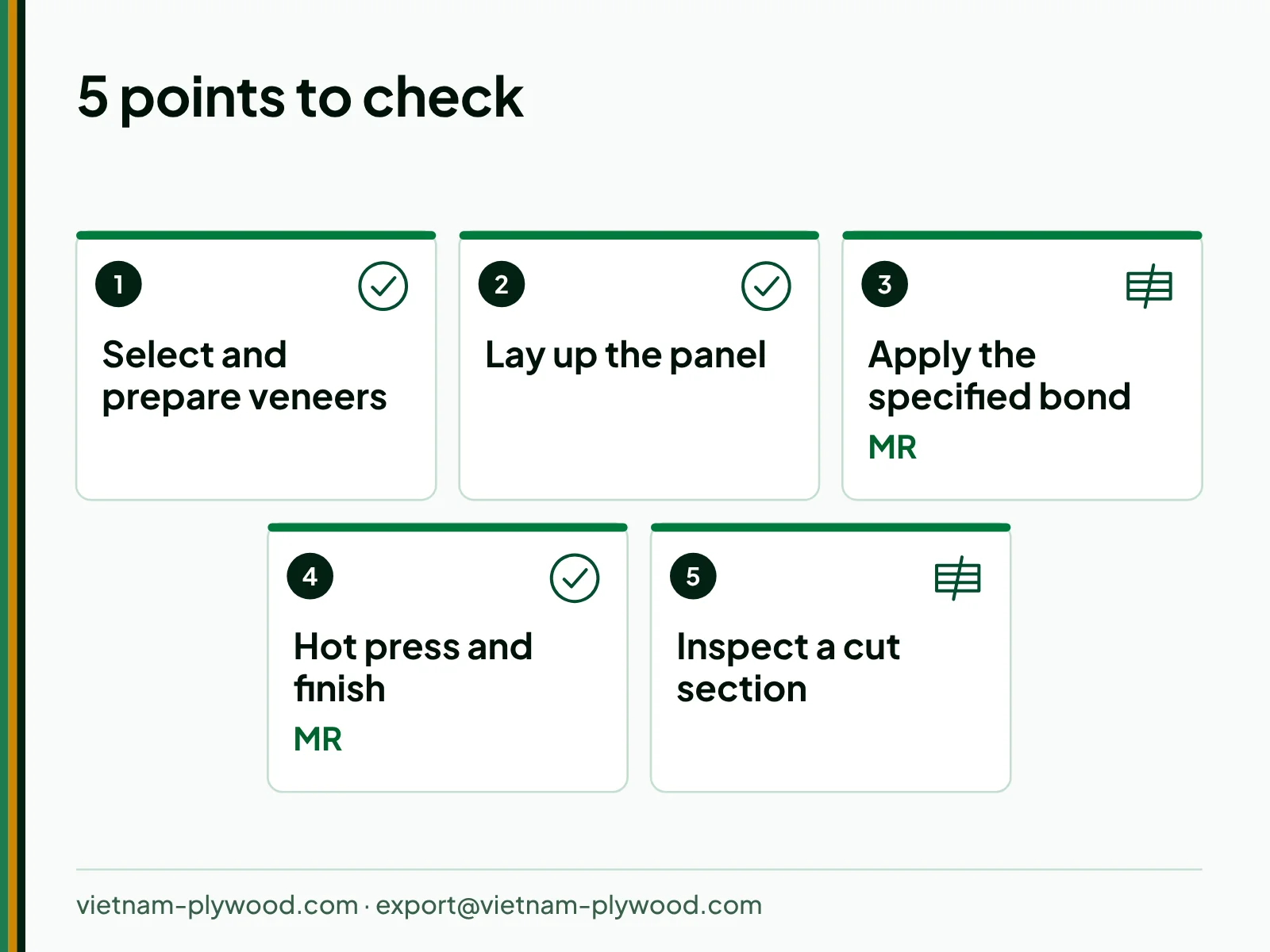
- Select and prepare veneers. The producing factory selects the stated core and arranges cross-grained layers. Full stitched construction is the preferred route when a continuous, even core is required.
- Lay up the panel. Veneers are assembled to the target build, with core joints distributed and face/back choices recorded. The layup must match the intended finish and machining.
- Apply the specified bond. Melamine MR glue is associated with a 12-hour boil specification; phenolic weather-and-boil-proof (WBP) glue with a 72-hour boil specification. These are bond descriptions, not emission classes.
- Hot press and finish. MR pressing uses 110–120 °C and WBP pressing 130–145 °C. The producing factory checks the finished dimensions after pressing, cooling and any sanding.
- Inspect a cut section. The buyer can examine gaps, overlap, joint distribution and glue-line continuity before approving the production lot.
Press temperature alone is insufficient to establish bond quality: pressing schedule, moisture, glue application and panel thickness must work together. For a purchase requiring a named bond-performance criterion, specify an agreed test report and acceptance rule. See the furniture plywood build for the sanded route.
What are 30 mm, 40 mm and 50 mm plywood used for?
30 mm ply is a specification option for substantial furniture components, built-up work surfaces and industrial packing pieces. A 30mm ply board can also serve as a thick substrate where machining allowance and a stable face matter. Its application still requires a load and fastening design.
40 mm is the upper end of our production range. It suits discussion of heavier worktop blanks, thick cabinet parts and selected formwork components where the engineer has specified the required support system. A thick section can reduce deflection in some arrangements, but it adds mass and does not replace structural verification.
50 mm plywood is a market enquiry outside our 3–40 mm production range. If a project drawing calls for 50 mm, the buyer should decide whether that dimension is a finished composite assembly, a laminated buildup or a single panel requirement. We do not present an assembled 50 mm substitute as a factory-pressed 50 mm sheet.
Are extra-thick panels suitable for worktops?
A thick sanded furniture panel is a practical starting specification for a worktop substrate when the finish, edge profile and supports are defined. The furniture route can use bintangor, okoume, engineered veneer, gurjan, pine, poplar, eucalyptus, birch or sapele faces. A panel is named for its face; core density follows the inner wood, not that visible veneer.
Common face veneer thickness is 0.2–0.4 mm. A/B are the general face grades; birch face grading uses D/E/F. For a high-visibility worktop, ask for an approved face sample and define acceptable repairs, patches and colour variation in the order.
The exposed edge deserves a separate decision. A thick plywood edge shows the core layers and any local joint defects. If the buyer plans a profiled or exposed edge, full stitched core and a witnessed cut-section check are more useful than judging the surface alone. Sanded thickness tolerance can be ordered at ±0.2 or ±0.3 mm, and the finished dimension must appear on the drawing.
Can thick plywood serve heavy floors or heavy forms?
A heavy floor or formwork deck needs an engineered load-and-span decision before its plywood thickness is chosen. The construction line can build film-faced panels with acacia or eucalyptus cores, including anti-slip film for a specified walking surface. Film weight describes the facing: 120 g/m² standard, 135 g/m² premium or 220 g/m² anti-slip only.
Film-faced material should be evaluated for the actual support spacing, concentrated loads, wet conditions and handling cycle. A thicker sheet can carry greater self-weight into the formwork system, so lifting arrangements and supporting members also need review. No structural grade follows automatically from the word heavy-duty or from a 40 mm thickness.
For film-faced reuse planning, with proper handling, a release agent on every pour and sealed edges including cut edges, melamine-glue film-faced gives about 12–15 pours; phenolic-glue film-faced up to about 25 pours. Those conditions should be written into the site method rather than treated as a property of thickness alone. Compare thinner options in the 20 mm plywood and 22 mm plywood specifications.
How does thickness change a 40HC payload?
The 40HC payload limit is 28.5 t. For the same sheet footprint and core density, each increase in thickness increases mass per sheet; the stack also holds fewer sheets. Container planning therefore needs both pallet geometry and the weight calculation, rather than a sheet count alone.
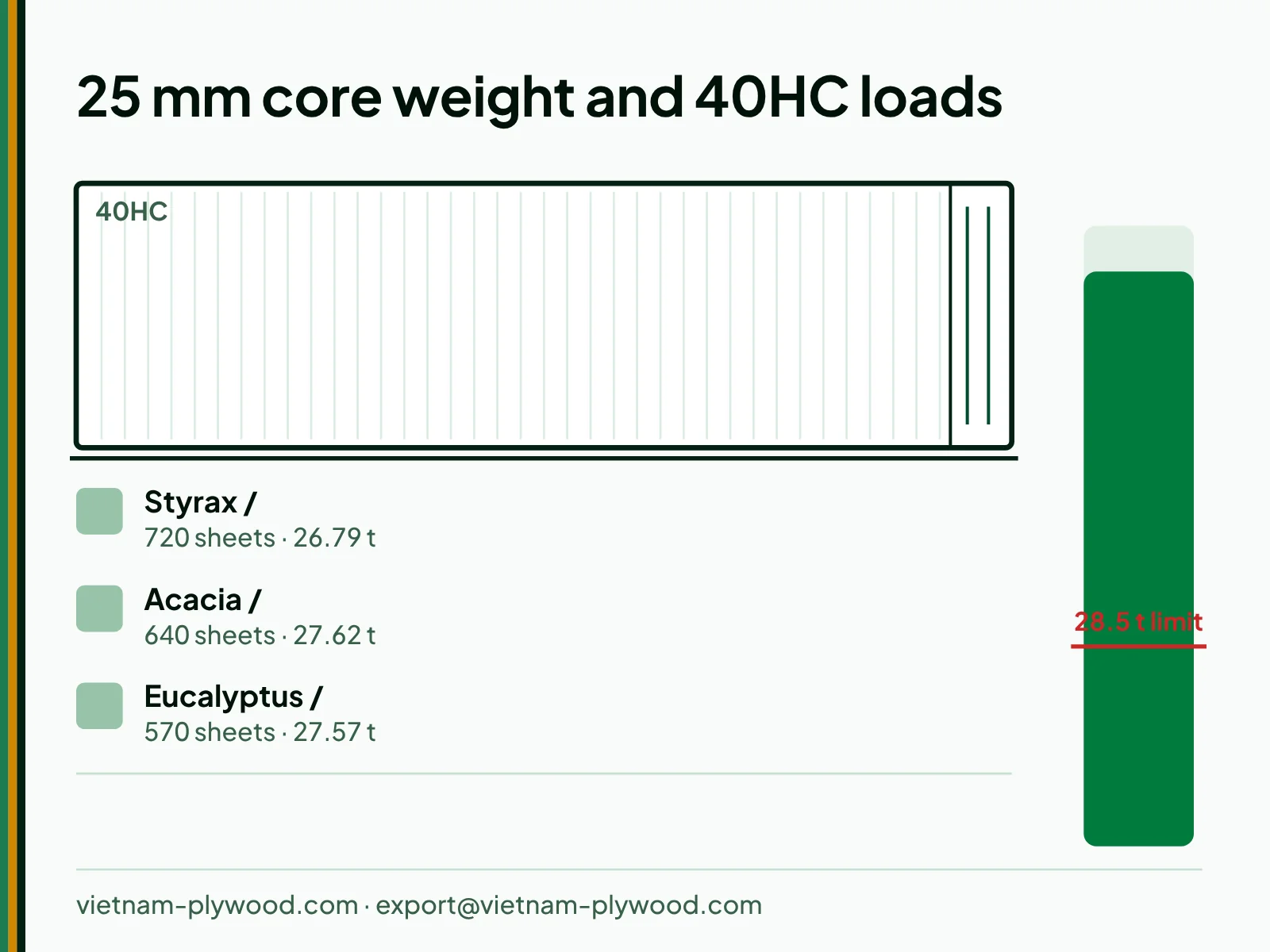
At 1220 × 2440 mm, the published packing lookup gives the following 25 mm reference. These are core-weight calculations without film weight:
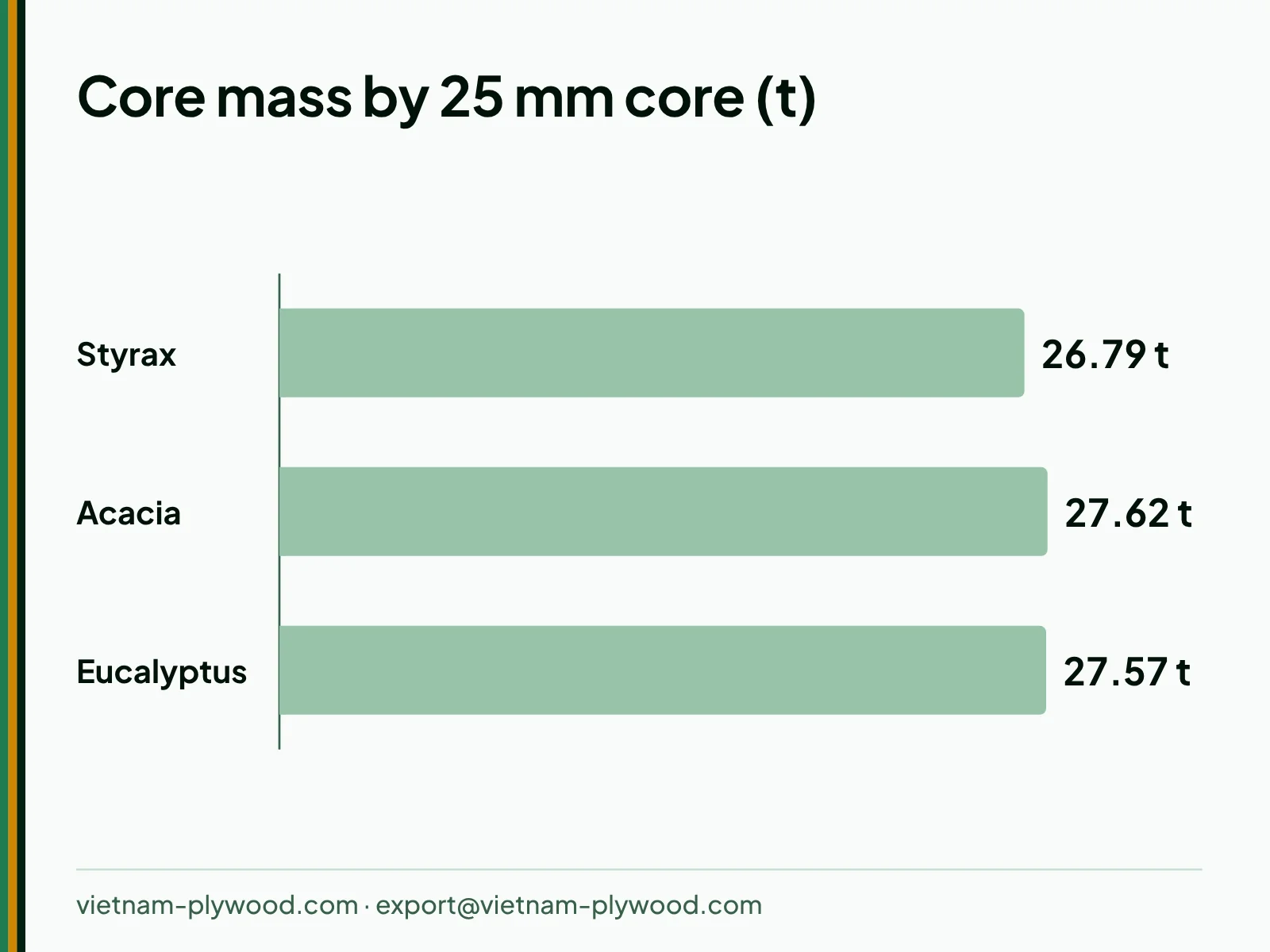
| 25 mm core | Sheet mass | Sheets per pallet | Full 40HC | Volume | Core mass |
|---|---|---|---|---|---|
| Styrax | 37.21 kg | 40 | 720 sheets | 53.58 m³ | 26.79 t |
| Acacia | 43.16 kg | 40 | 640 sheets | 47.63 m³ | 27.62 t |
| Eucalyptus | 48.37 kg | 38 | 570 sheets | 42.42 m³ | 27.57 t |
The same 18 mm footprint has 990 styrax, 880 acacia or 795 eucalyptus sheets in the corresponding full 40HC lookup. That contrast shows why thickness and core cannot be separated when estimating logistics. For 30 mm and 40 mm, a load plan must calculate actual pallet stacks, panel count, gross weights and any packaging allowance before booking; the table does not supply those final loads.
Specifications can share a container within the payload limit, but a mixed order needs a line-by-line packing plan. The container load calculation covers the detailed loading question. HCPLY ships directly from the producing factory under FOB Hai Phong, with CFR (CNF) and CIF also available.
Which dimensions and tolerances should the buyer specify?
Finished thickness and acceptable deviation should be stated in millimetres on the purchase order. Available sheet sizes include 1220 × 2440, 1250 × 2500, 1220 × 2135, 1220 × 1830, 915 × 2440, 915 × 2135 and 915 × 1830 mm; custom cutting is available. Length and width tolerance is ±2 mm.
For a machined worktop blank, the sanding requirement should be matched to the drawing before veneer selection. For packing components, a broader thickness band can be appropriate when the mating part permits it. Film-faced formwork should use its specified finished thickness and tolerance rather than assume that film weight makes a panel thicker by a fixed amount.
The 2025 US Code of Federal Regulations, 40 CFR Part 770, describes formaldehyde standards, testing and certification for covered composite wood products. It distinguishes covered hardwood plywood from specified excluded structural products; emission compliance is therefore a separate procurement field from glue selection (official regulation). For the dimensional acceptance plan, use the thickness tolerance guide.
What can an inspector check at the producing factory?
A witnessed inspection should follow the actual order drawing and record measured results against its acceptance limits. The buyer can visit the factory office, then inspect the lot at the producing factory. The most useful extra-thick checks cover the panel interior as well as its visible face.
Inspectors can select panels across pallets, measure thickness at agreed points and compare the readings with the specified tolerance. They can inspect cut edges for open joints, veneer overlap and uneven compression. They can also compare the surface and film selection against an approved reference, and review the agreed bond-test paperwork.
Certificate documents for the relevant member factory can be shown with factory details masked, on request. That review is separate from deciding whether the exact ordered build meets a project specification.
How should an extra-thick order and quotation be compared?
Start with the written build, then compare factory quotations on the same unit, size, core and finishing assumptions. Full stitched construction costs more than stitched outer layers with edge-trimmed inner layers; finger-jointed and loose-laid construction sit below those options in the stated core hierarchy. Additional sanding, tighter tolerance and selected faces add processing or material requirements.
For extra-thick furniture work, core quality and face selection should be decided before comparing finishing allowances. For film-faced work, the film specification and glue system affect the comparison. Ask for a quotation against the exact build rather than applying a generic per-sheet price to different cores and thicknesses.
The minimum order is one 40HC, with mixed specifications permitted within its payload limit. Factory lead time runs 15–45 days from receipt of the 30% deposit; the exact figure depends on order size, line loading and what the contract fixes. The balance is 70% against the scanned bill of lading, by telegraphic transfer (T/T) or irrevocable letter of credit (L/C) at sight. Samples are free; new buyers book their courier, and the courier cost can be credited against a real order.
Which documents accompany the shipment?
The packing list identifies the shipped quantities and dimensions, making it the key reconciliation document for extra-thick panels. The export set also includes the commercial invoice, bill of lading (B/L), certificate of origin, phytosanitary and fumigation papers, and insurance under CIF. European Union lots use EUR.1 where applicable and the EUTR/EUDR file set.
Order-specific documents include any agreed FSC claim on sales documents, emission certificate or test report for the build. After loading, the draft shipping documents come to you for approval. HCPLY manages specification, on-site quality control, documents and loading across our three factories.
What specification should you send before a factory visit?
A useful enquiry states the finished dimension, intended duty, core, glue, face and inspection conditions in the same record. It also identifies whether the buyer wants a sanded visible face, a packing panel or a film-faced formwork surface. HCPLY can then route the enquiry to the appropriate production line and prepare a sample discussion.
Application: [worktop / heavy floor / formwork / packing component]
Line or core: [furniture styrax/eucalyptus / commercial acacia / construction acacia/eucalyptus]
Glue: [melamine MR / phenolic WBP]
Emission: [E0 / E1 / E2 / applicable agreed certification]
Face and grade: [species or film type / grade]
Thickness and tolerance: [30 or 40 mm finished / tolerance]
Size: [length × width in mm]
Quantity: [sheets and proposed 40HC mix]
Destination port: [port and country]
Next step: book a factory visit with Lucy at export@vietnam-plywood.com to review the producing line and inspect the proposed build.