





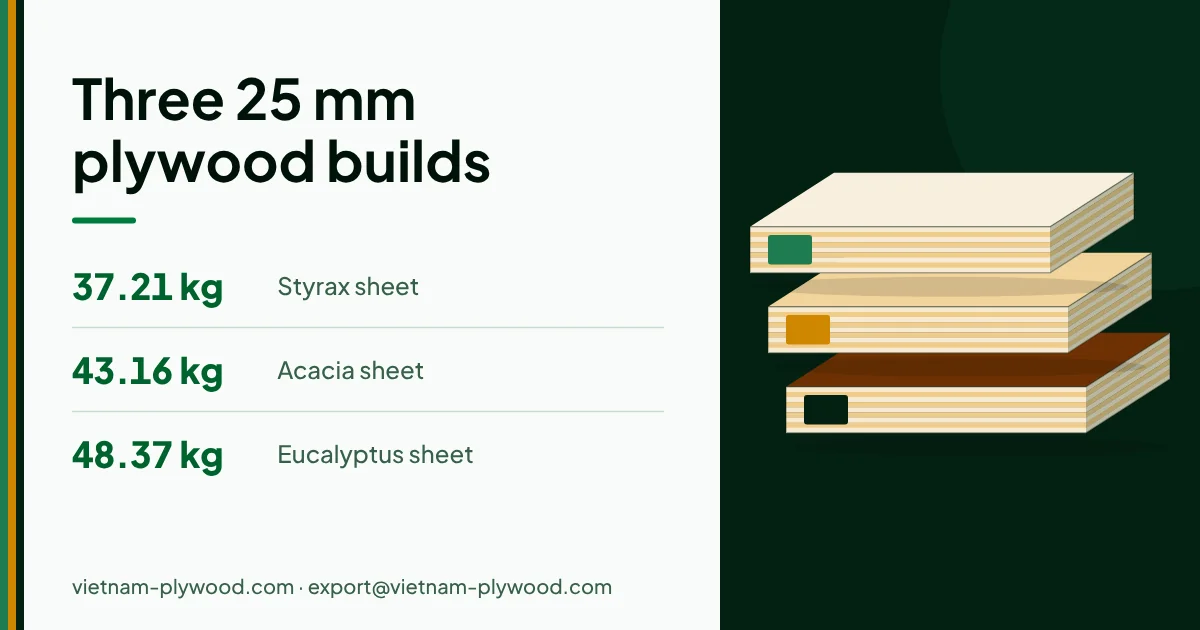
HCPLY presses 25 mm plywood on three production lines, with different cores and surfaces for furniture, packing and construction work. Choosing the wrong core or tolerance adds processing cost, delays assembly or produces a rejected container load. A ply 25mm purchase therefore starts with its application, actual sheet weight and the receiving factory’s specification.
What sizes and thicknesses can each line press?
All three lines work within the 3–40 mm thickness range, including 25 mm and the neighbouring 24 mm and 28 mm specifications. The standard dimension menu is shared, while finishing and thickness tolerance change with the production line. This is the starting point for a sizes and thickness specification.
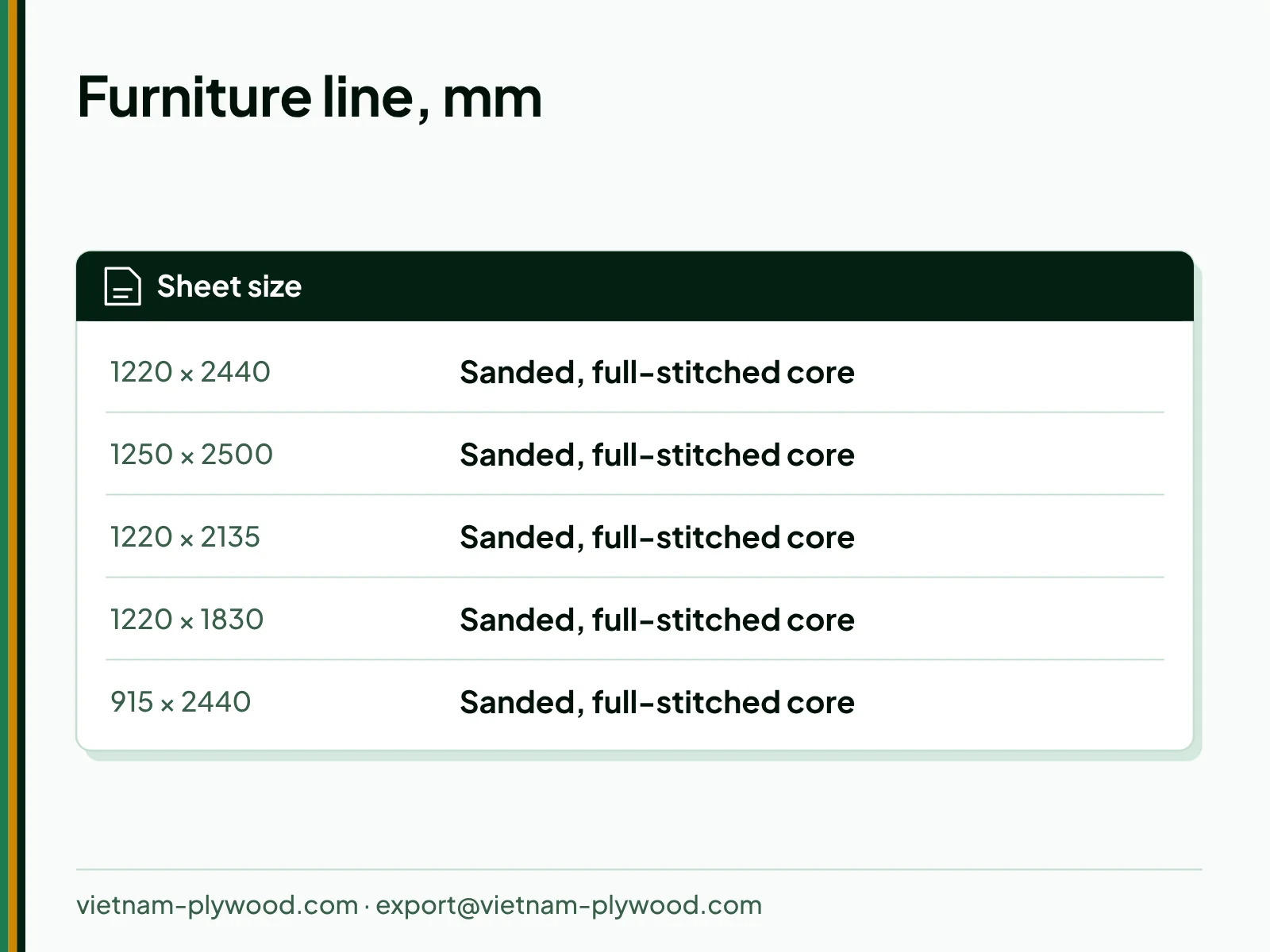
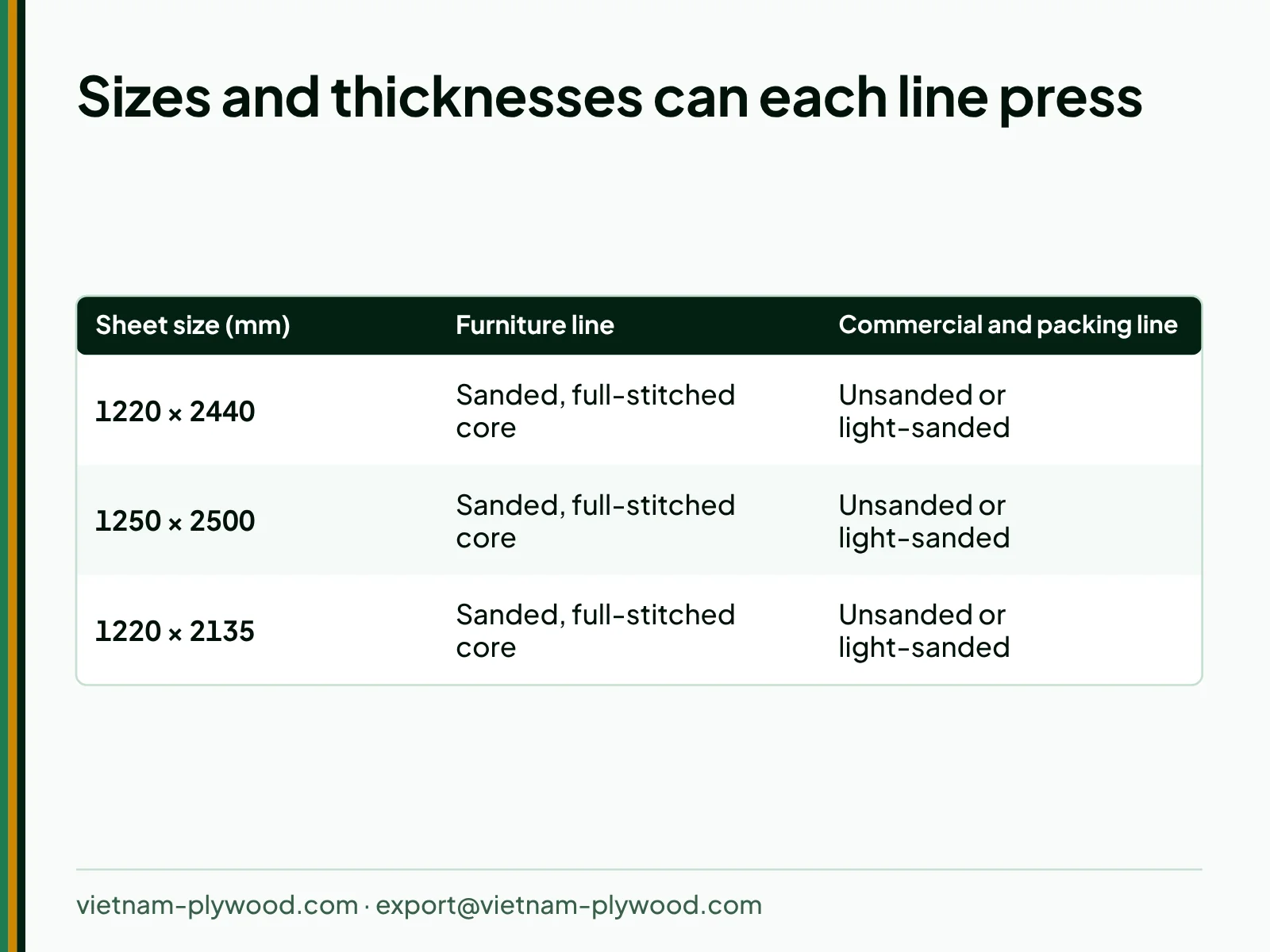
| Sheet size (mm) | Furniture line | Commercial and packing line | Construction line |
|---|---|---|---|
| 1220 × 2440 | Sanded, full-stitched core | Unsanded or light-sanded | Unsanded, film-faced |
| 1250 × 2500 | Sanded, full-stitched core | Unsanded or light-sanded | Unsanded, film-faced |
| 1220 × 2135 | Sanded, full-stitched core | Unsanded or light-sanded | Unsanded, film-faced |
| 1220 × 1830 | Sanded, full-stitched core | Unsanded or light-sanded | Unsanded, film-faced |
| 915 × 2440 | Sanded, full-stitched core | Unsanded or light-sanded | Unsanded, film-faced |
| 915 × 2135 | Sanded, full-stitched core | Unsanded or light-sanded | Unsanded, film-faced |
| 915 × 1830 | Sanded, full-stitched core | Unsanded or light-sanded | Unsanded, film-faced |
Custom cutting is available. Length and width tolerance is ±2 mm. For 25 mm furniture sheets, specify either ±0.2 mm or ±0.3 mm sanded thickness tolerance; commercial and film-faced panels use ±0.5 mm, while packing panels use ±0.5–1.0 mm. A 25mm plywood board intended for precision cabinet assembly needs a different inspection instruction from a heavy packing floor.
Which HCPLY line builds 25 mm plywood?
Our furniture line builds the sanded decorative option, our commercial and packing line builds the acacia utility option, and our construction line builds film-faced panels. The producing factory in Phu Tho or Hai Phong handles the actual order and inspection. Buyers can inspect goods there and meet at its factory office.
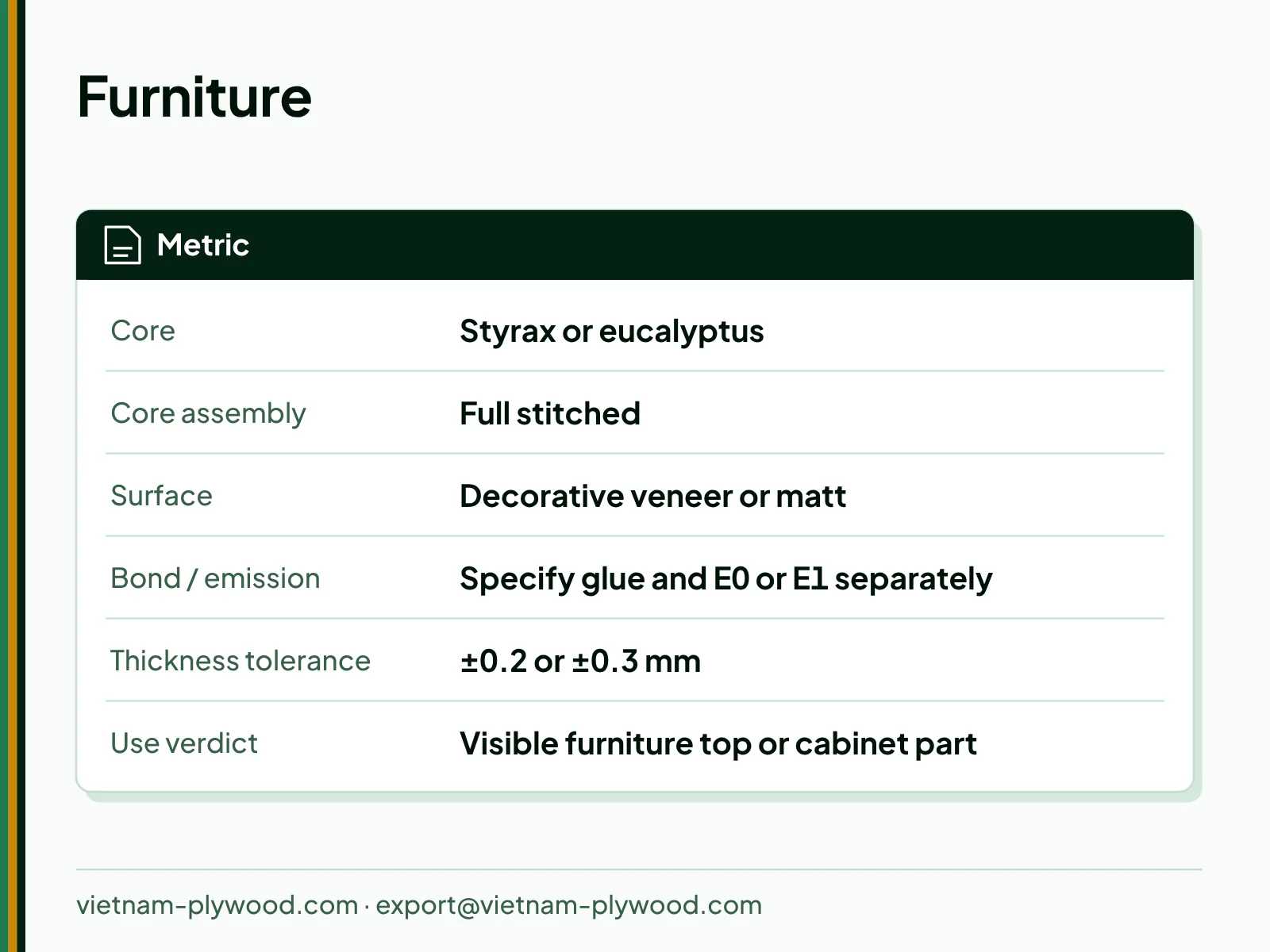
| Metric | Furniture | Commercial and packing | Construction |
|---|---|---|---|
| Core | Styrax or eucalyptus | Acacia | Acacia or eucalyptus |
| Core assembly | Full stitched | Order-defined utility assembly | Order-defined film-faced assembly |
| Surface | Decorative veneer or matt | Raw, unsanded or light-sanded | Phenolic or melamine film; anti-slip option |
| Bond / emission | Specify glue and E0 or E1 separately | MR glue; emission specified separately | Specify melamine MR or phenolic WBP bonding |
| Thickness tolerance | ±0.2 or ±0.3 mm | ±0.5 mm commercial; ±0.5–1.0 mm packing | ±0.5 mm |
| Use verdict | Visible furniture top or cabinet part | Industrial packing floor or utility panel | Thick concrete form or grip surface |
A buyer asking for 25mm hardwood plywood should name the core and face independently. A birch, sapele or okoume face does not make a birch-core panel: our core species are styrax, acacia and eucalyptus. See furniture plywood for the decorative construction route.
What is 25 mm plywood used for?
25 mm plywood serves furniture tops, cabinet and fit-out parts, industrial floors and thick formwork where the buyer has designed for the load and support spacing. A thick sheet alone does not establish a structural grade. Select the face, bonding, edge treatment and acceptance tests against the actual working conditions.
For furniture tops, sanded full-stitched construction helps maintain a predictable machining surface and clean exposed edges. Specify face grade A/B for applicable decorative veneers; birch faces use D/E/F grading instead. Common face veneer thickness is 0.2–0.4 mm. Furniture customers who need a thinner assembly can compare 18 mm plywood before committing to the heavier build.
For industrial floors and packing bases, acacia provides a utility core and an unsanded or light-sanded face. The buyer should define point loads, contact conditions and fastening details before treating the panel as a floor. For concrete forms, the construction line presses film-faced sheets, with the formwork designer setting spans and supports. Thicker 30–40 mm options are a separate comparison when the application calls for greater section depth.
How much does a 25 mm plywood sheet weigh?
At 1220 × 2440 × 25 mm, a styrax-core sheet weighs 37.21 kg, an acacia-core sheet 43.16 kg and a eucalyptus-core sheet 48.37 kg. These are core-density calculations and exclude film weight. The face name is therefore a poor substitute for a core specification when freight mass matters.
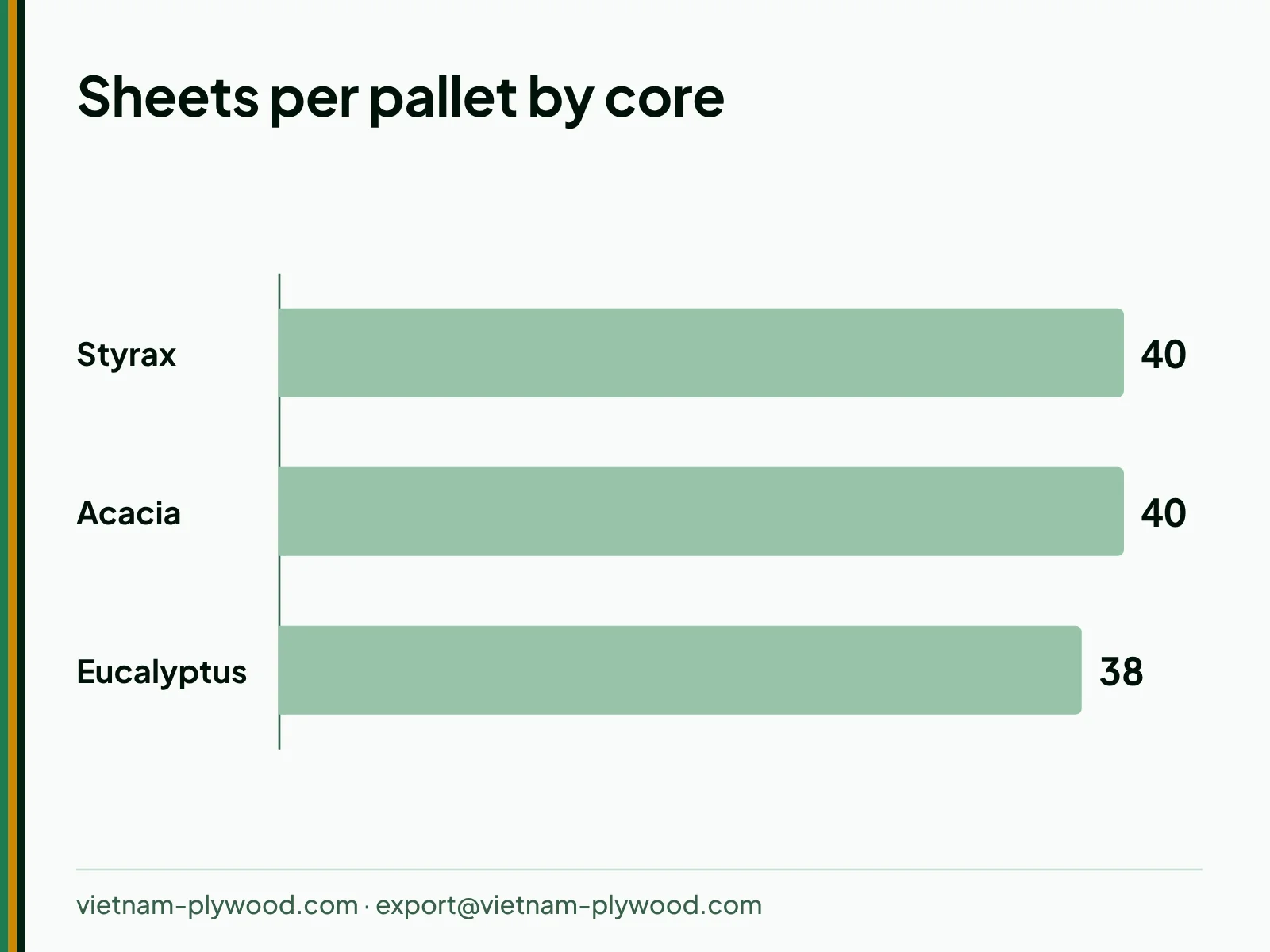
| Core | Density | Weight per 25 mm sheet | Sheets per pallet |
|---|---|---|---|
| Styrax | 500 kg/m³ | 37.21 kg | 40 |
| Acacia | 580 kg/m³ | 43.16 kg | 40 |
| Eucalyptus | 650 kg/m³ | 48.37 kg | 38 |
A 25mm hardwood ply offer should state the actual core species, rather than a broad hardwood label. The denser eucalyptus option carries more weight per sheet, even with the same external dimensions. Film-faced sheets also carry a surface layer; quote and packing checks should identify it separately from these core-based weights.
How does the 40HC payload limit cap 25 mm loading?
A 40HC has a 28.5 t payload limit in our loading model. At 1220 × 2440 × 25 mm, the full configurations are 720 styrax sheets, 640 acacia sheets or 570 eucalyptus sheets. Pallet height and core density together determine the stated counts; a container cannot be planned by cubic metres alone.
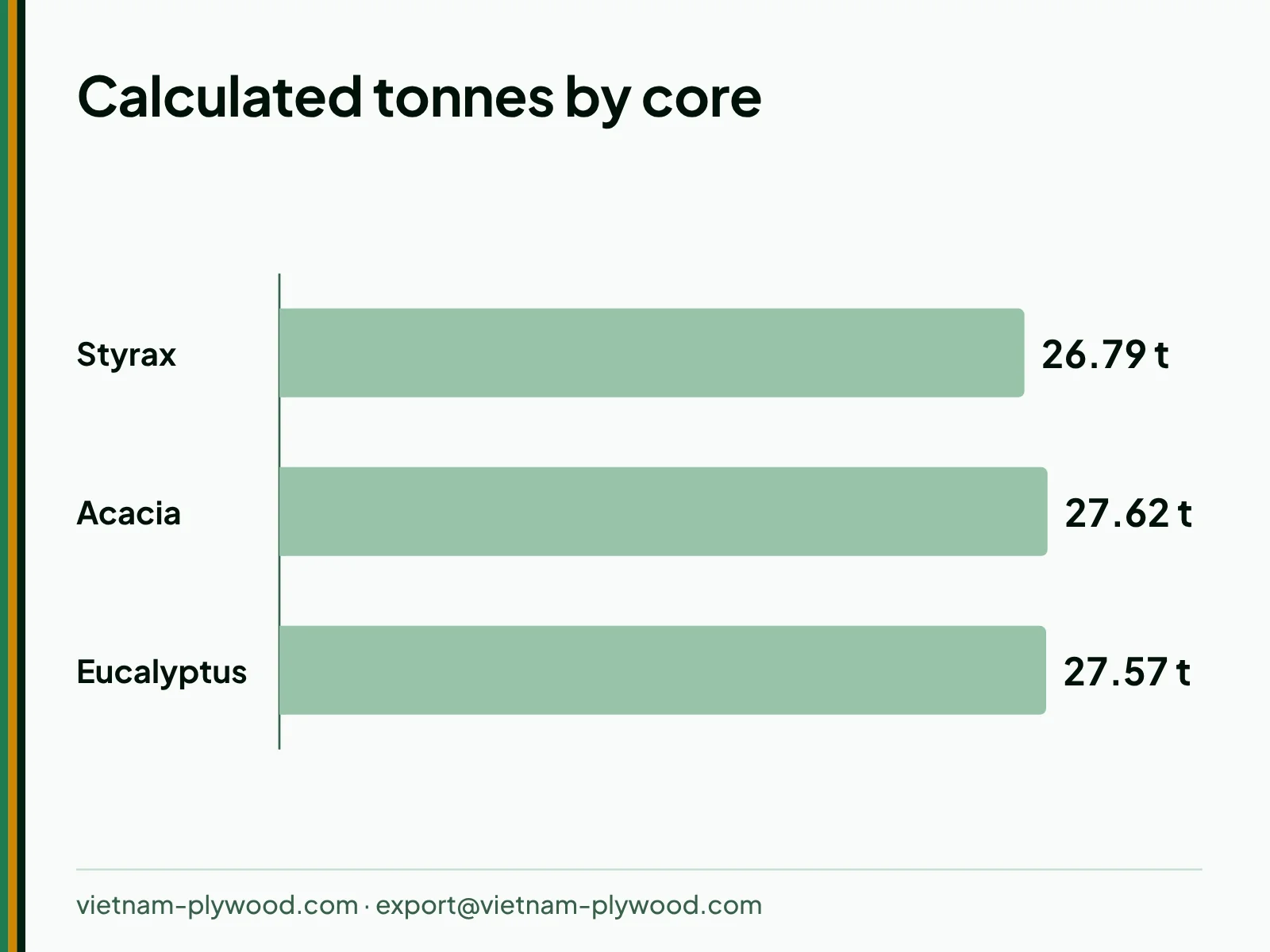
| Core | Pallets | Total sheets | Loaded volume | Calculated tonnes |
|---|---|---|---|---|
| Styrax | 18 | 720 | 53.58 m³ | 26.79 t |
| Acacia | 16 | 640 | 47.63 m³ | 27.62 t |
| Eucalyptus | 15 | 570 | 42.42 m³ | 27.57 t |
These figures are for the stated sheet size and core, before adding film weight. For a mixed container, combine the actual planned pallet masses and keep the total within 28.5 t. A furniture allocation and a packing allocation can share a shipment when their combined mass and stacking plan fit. The mixed-container specification route covers combining builds, while container load calculations cover other sheet sizes and thicknesses.
Request a packing plan for the actual order mix; do not extrapolate these counts to another size.
Can 24 mm or 28 mm replace 25 mm plywood?
Both 24 mm and 28 mm fall within our 3–40 mm manufacturing thickness range, but neither should be substituted without a revised drawing and tolerance instruction. The decision belongs to the finished assembly, machining allowance and load design. A nominal difference can change joint fit, stack height and container quantity.
A 24 mm plywood sheet can suit a drawing dimensioned around 24 mm, particularly when a customer wants a thinner assembly. A 28 mm plywood sheet offers a thicker section for a design that explicitly calls for it. Neither change alone proves a higher safe load or a particular span; those decisions require project-specific engineering evidence.
For cabinet makers, compare the drawing’s finished thickness against the sanded tolerance. For packing buyers, compare load distribution and the allowed packing tolerance. For formwork yards, compare support spacing, film specification and edge sealing requirements. The 25 mm loading figures above must not be copied into a 24 mm or 28 mm purchase order.
Which glue, emission class and surface belong in the order?
Glue type and formaldehyde emission class are separate specification fields. Melamine bonding is MR, with a 12-hour boil condition; phenolic bonding is WBP (weather and boil proof), with a 72-hour boil condition. The corresponding hot-press ranges are 110–120 °C for MR and 130–145 °C for WBP.
Furniture orders can specify E0 or E1 emission classes, while other orders should state their required class independently of the glue. E2 is another emission class. For US-bound products, CARB P2 and TSCA Title VI refer to a third-party-certified emissions limit, rather than a glue type. Factory certificate documents for FSC, CARB P2, ISO 9001 or CE are shown with factory details masked, on request.
Film-faced construction orders use 120 g/m² standard film or 135 g/m² premium film; 220 g/m² applies only to anti-slip film. With proper handling, a release agent on every pour and sealed edges including cut edges, melamine-glue film-faced panels give about 12–15 pours, while phenolic-glue panels reach up to about 25 pours. These conditions belong in the formwork operating specification.
What can an inspector check at the producing factory?
An inspector can compare the order sheet with measured thickness, panel dimensions, face appearance, core edges and the prepared pallet count. The inspection should distinguish a surface defect from an internal core-construction issue. Buyers can witness these checks at the producing factory before the shipment is loaded.
First, identify the intended build from the order: decorative full-stitched furniture, acacia utility or film-faced construction. Next, measure panels against the agreed thickness tolerance and ±2 mm length-and-width tolerance. Inspect edge sections for the specified construction, including whether the order calls for full stitching, stitched outer layers with edge-trimmed inner veneers, finger-jointed construction or loose-laid construction.
Finally, compare the pallet tally and actual markings against the packing list draft. For a 25 mm sheet, the recorded core and dimensions must match the weight basis used in the load plan. This inspection sequence gives a distributor evidence tied to the goods actually leaving the factory, rather than to a generic 25 mm sample.
What should a 25 mm quotation compare?
The strongest price drivers are core construction and species, followed by face quality, bonding system, surface treatment and finishing tolerance. Full-stitched sanded furniture construction costs more than a simpler utility build because it requires tighter veneer selection and additional finishing. Premium film and anti-slip surfaces also add work compared with a basic unsanded panel.
For a furniture specification, the indicative starting point is from US$350/m³ FOB Hai Phong (October 2026). For commercial plywood, it is from US$250/m³ FOB Hai Phong (October 2026). A construction, packing-specific or custom 25 mm grade needs a written quotation against its exact build; these starting points are not a price for every variant.
The minimum order is one 40HC, and specifications can be mixed within its payload limit. Production takes 15–45 days from the 30% deposit, set by order size, line loading and the contract. The 70% balance is against the scanned bill of lading, by telegraphic transfer (T/T) or irrevocable letter of credit at sight. Terms are FOB Hai Phong, CFR (CNF) or CIF.
Which export documents cover the 25 mm specification?
The packing list records the shipped quantities and helps reconcile 25 mm pallet counts with the commercial invoice and bill of lading. The shipment document set also includes a certificate of origin, EUR.1 for EU lots, phytosanitary and fumigation papers, and insurance under CIF. Order-specific documents include an FSC claim on sales documents, an emission certificate or test reports for the agreed build.
For EU lots, the EUTR/EUDR file set accompanies the order documentation. The European Commission’s 2026 EU Deforestation Regulation overview identifies wood and certain wood-derived products within the regulation’s product scope; see the European Commission overview. The applicable importer requirements should be assessed against the actual product and shipment date.
After loading, the draft shipping documents come to you for approval. HCPLY manages specification, on-site quality control, documents and loading through the export process, with shipment directly from the factory that made the goods.
What should the buyer send for a 25 mm sample set?
Send the intended application and a written build specification before comparing samples. A sample should represent the same core, face, bonding and thickness tolerance as the intended shipment. Free samples are available; a first-time buyer pays the courier, and that charge comes off the first confirmed order.
A useful request distinguishes a 25 mm furniture top from an industrial floor and a film-faced form. For a distributor evaluating both furniture and construction products, list the builds separately so the factory can prepare matching pieces. Smaller 12 mm plywood and 8 mm plywood may be useful comparison references for a range review.
Application: furniture top / industrial floor / thick formwork
Line or core: furniture—styrax or eucalyptus / packing—acacia / construction—acacia or eucalyptus
Glue: melamine MR / phenolic WBP, as required
Emission: E0 / E1 / E2 or destination-specific requirement
Face and grade: veneer species and grade / matt / film type and weight
Thickness and tolerance: 25 mm; ordered tolerance (or specify 24 mm / 28 mm)
Size: 1220 × 2440 mm or listed alternative
Quantity: sheets and proposed 40HC mix
Destination port: [port]
Ask Lucy at export@vietnam-plywood.com for a 25 mm sample set against that specification.