





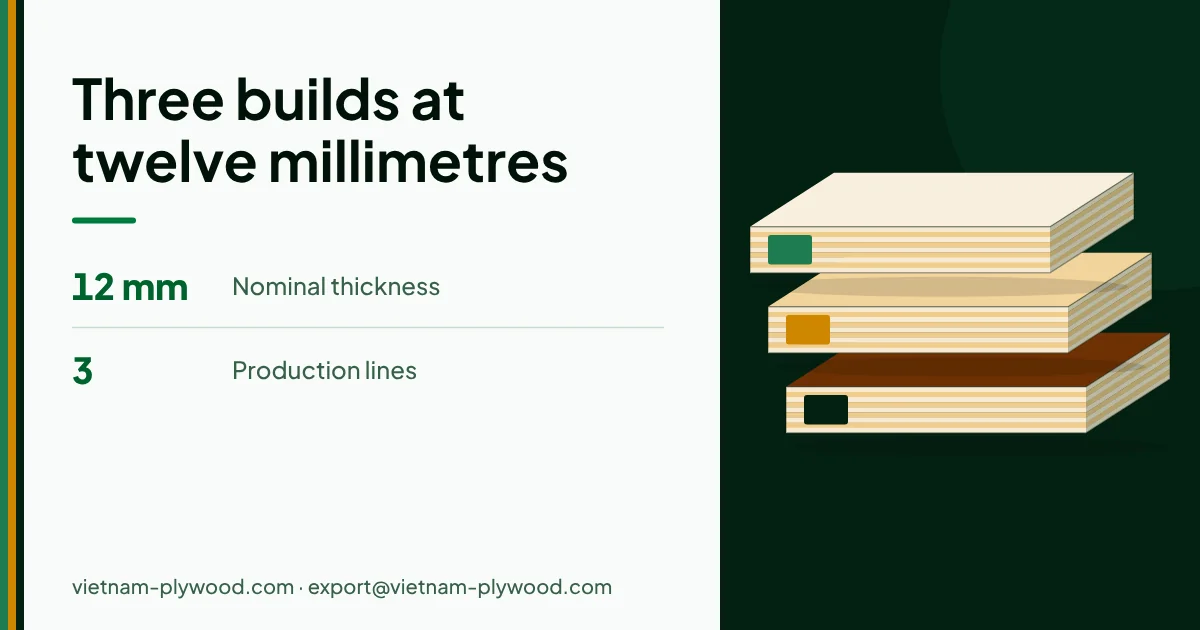
HCPLY makes ply 12mm in three different builds: sanded furniture plywood, commercial packing plywood and film-faced construction plywood. Choosing the wrong build can waste machining time, raise costs or lead to a rejected load. The dimensions may match, but core, face, glue and thickness tolerance must follow the intended application.
What sizes can ply 12mm be ordered in?
Ply 12mm is available across our furniture, commercial and packing, and construction lines in the listed sheet formats, with custom cutting available. The nominal 12 mm thickness must be paired with the correct line tolerance. A cut-size drawing should state finished dimensions and the permitted variation, rather than treating an 8 × 4 description as a cutting instruction.
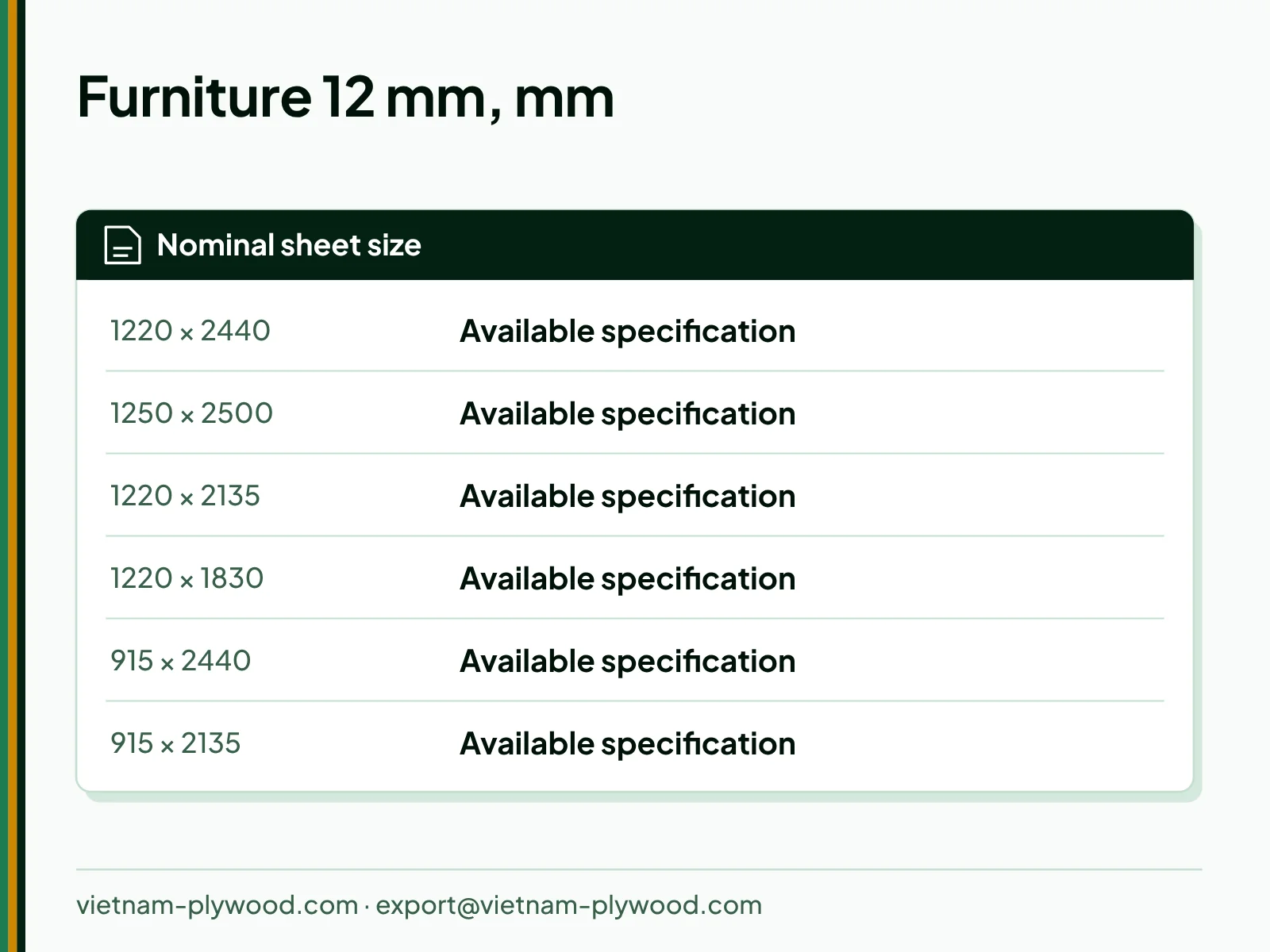
| Nominal sheet size (mm) | Furniture 12 mm | Commercial/packing 12 mm | Film-faced 12 mm | Ordering note |
|---|---|---|---|---|
| 1220 × 2440 | Available specification | Available specification | Available specification | Common nominal 8 × 4 format |
| 1250 × 2500 | Available specification | Available specification | Available specification | Different yield from 1220 × 2440 |
| 1220 × 2135 | Available specification | Available specification | Available specification | State orientation of face grain |
| 1220 × 1830 | Available specification | Available specification | Available specification | Check packing dimensions |
| 915 × 2440 | Available specification | Available specification | Available specification | Narrow-width sheet |
| 915 × 2135 | Available specification | Available specification | Available specification | Narrow-width sheet |
| 915 × 1830 | Available specification | Available specification | Available specification | Narrow, shorter sheet |
All three lines have a length and width tolerance of ±2 mm. A requested 2400 × 1200 mm finished sheet is a custom-cut size, not the same as the nominal 1220 × 2440 mm stock format. Specify whether the drawing calls for the exact cut dimensions or the common nominal format. See the plywood sizes and thickness specification guide for the broader dimensional framework.
A buyer ordering plywood 8 x 4 12mm should identify which convention the purchasing system uses. Converting feet to millimetres without a written finished-size requirement can create rejected panels at the receiving dock.
How do the three 12 mm factory builds differ?
The same 12 mm callout covers three distinct panels: sanded interior furniture plywood, unsanded commercial packing plywood, and film-faced construction plywood. We direct each specification to the producing factory equipped for that build, rather than substituting a face or glue after quotation.
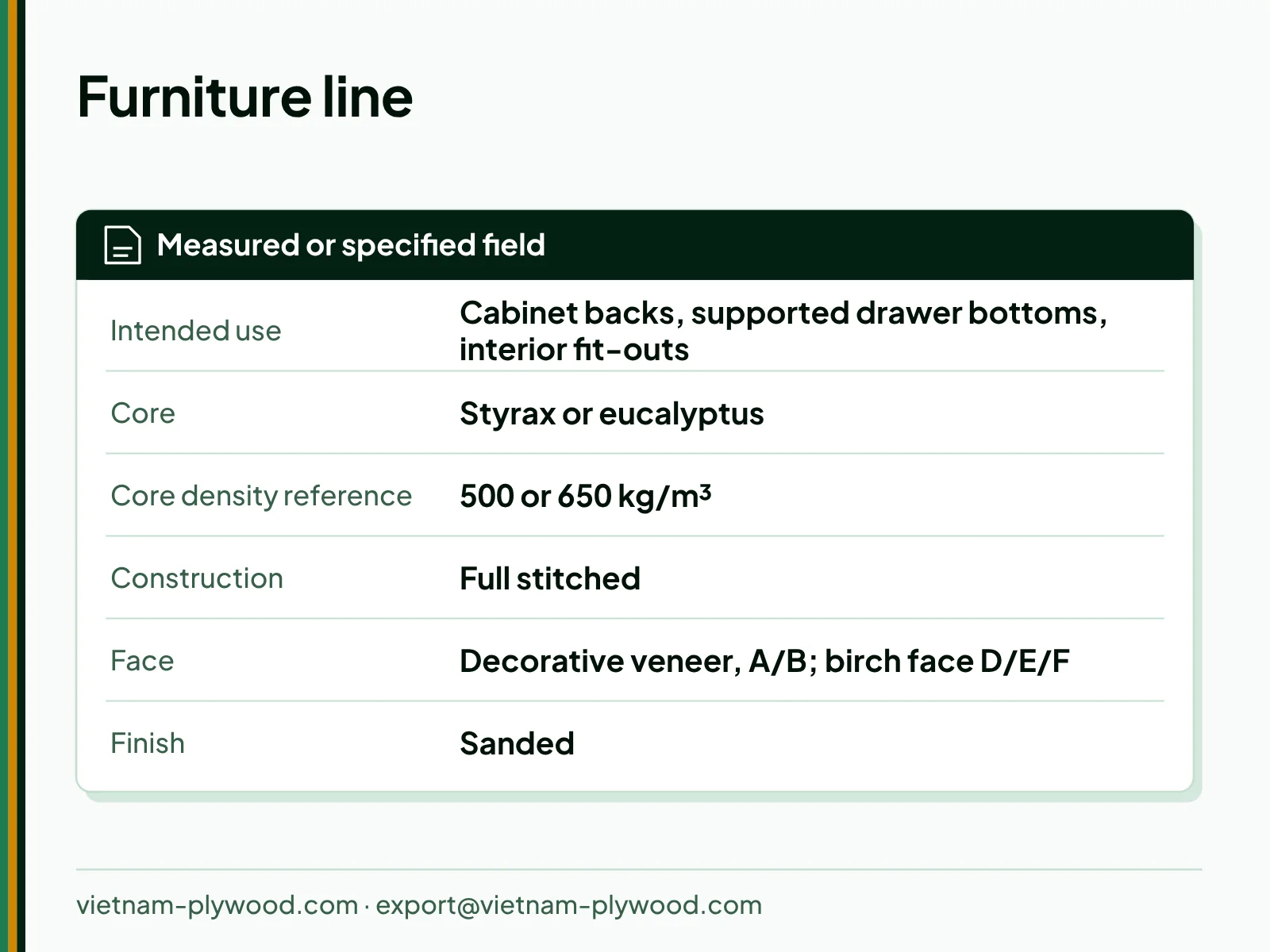
| Measured or specified field | Our furniture line | Our commercial and packing line | Our construction line |
|---|---|---|---|
| Intended use | Cabinet backs, supported drawer bottoms, interior fit-outs | Cases, crates, industrial packing | Small-pour formwork, subject to engineering approval |
| Core | Styrax or eucalyptus | Acacia | Acacia or eucalyptus |
| Core density reference | 500 or 650 kg/m³ | 580 kg/m³ | 580 or 650 kg/m³ |
| Construction | Full stitched | Specify accepted core construction | Specify accepted core construction |
| Face | Decorative veneer, A/B; birch face D/E/F | Raw matt or specified veneer | Phenolic, melamine or anti-slip film |
| Finish | Sanded | Unsanded or light-sanded | Unsanded under film |
| Thickness tolerance | ±0.2 or ±0.3 mm as ordered | ±0.5 mm; packing ±0.5–1.0 mm | ±0.5 mm |
| Glue / emission | Specify glue separately; E0 or E1 | MR glue; specify emission separately | Specify melamine MR or phenolic WBP |
| Verdict by use | Choose for visible interior work and controlled machining | Choose for industrial packing | Choose for concrete-contact surfaces after formwork design checks |
A cabinet maker gains little from buying a film surface intended for concrete. A packing company should not pay for furniture sanding without a packing-related reason. Conversely, substituting packing-grade sheets into a cabinet cutting program risks an unacceptable edge or machining fit. Our furniture plywood page covers the interior specification in greater detail.
What does 12 mm plywood do in furniture and cabinetry?
A 12 mm furniture panel suits supported cabinet backs, drawer bottoms and interior partitions where the furniture design assigns the load to surrounding members. Our furniture line uses full-stitched styrax or eucalyptus cores, sanded faces and an E0 or E1 emission class. The drawing should specify fixing method, unsupported span and expected load before accepting the thickness.
Face veneer names describe the surface, not the core species. Available face names include bintangor, okoume, engineered veneer (EV), gurjan, pine, poplar, eucalyptus, birch and sapele. A birch-faced 12 mm panel can therefore have a styrax or eucalyptus core; our factories do not press birch-core plywood. A typical face veneer is 0.2–0.4 mm, so the veneer name alone does not establish bending capacity.
A/B are the available face grades except birch, which uses D/E/F. Buyers should attach a face sample or agreed grading reference to their order.
For shelves, do not assign a load rating from thickness alone. Span, support spacing, edge reinforcement, fastener positions and moisture exposure govern the design. Where the assembly calls for a heavier panel, compare 15 mm plywood and 18 mm plywood before approving production.
What is 12 mm commercial plywood used for?
Our commercial and packing line makes 12 mm acacia-core sheets for cases, crate sides, partitions and industrial packaging. The line uses moisture-resistant (MR) glue and an unsanded or light-sanded finish. Buyers should choose the core-joint acceptance criteria and edge condition according to how the case will be handled.
Commercial plywood 12mm is a purchasing category, not a promise that every board has a furniture face or a structural classification. A packing case may value consistent cutting and fastener placement more than decorative grain. For an exposed interior component, however, the furniture build is the more appropriate starting specification.
Core construction options range from full stitched through stitched outer layers with edge-trimmed inner veneers, finger-jointed cores and loose-laid veneers. These are not interchangeable grades. Specify which construction is acceptable, then ask the producing factory to expose a representative edge during inspection.
Packaging engineers should separately check case framing, handling loads, humidity and fastening patterns. A packing buyer can combine different specifications within the permitted container payload, but must identify each stack in the packing list.
Is 12 mm film-faced plywood suitable for small pours?
A 12 mm film-faced sheet can be considered for small concrete pours only when the formwork designer checks support spacing, wet-concrete pressure, deflection and fastening. The thickness alone provides no approved pour-height or span rating. Our construction line presses film-faced panels with acacia or eucalyptus cores.
The standard film is 120 g/m², premium film 135 g/m², and anti-slip film 220 g/m² only. For concrete-contact formwork, specify the release-agent practice, edge sealing and cut-edge treatment in the method statement.
The available glue choices are melamine MR, described as a 12-hour boil, and phenolic water-and-boil-proof (WBP), described as a 72-hour boil. A structural grade requires a test report the buyer accepts. With proper handling, a release agent on every pour and sealed edges including cut edges, melamine-glue film-faced plywood is described at about 12–15 pours and phenolic-glue film-faced plywood up to about 25 pours. Actual site use must follow the agreed formwork procedure.
For a larger load or span, assess 18 mm plywood or 20 mm plywood alongside the engineer’s formwork design. No 12 mm sheet should be sold as structural plywood 12mm without a test report the buyer accepts for the claimed structural performance.
Which glue and emission class should a 12 mm order specify?
Glue type and formaldehyde emission class are separate order fields. An MR or WBP designation describes adhesive performance; E0, E1 and E2 describe emission classes. Writing “E0 glue” combines two different properties and leaves the bonding requirement unresolved.
For furniture, specify the required glue and E0 or E1 class as separate lines. For commercial packing, our acacia-core line uses MR glue. For construction, choose the melamine MR or phenolic WBP build according to the exposure and formwork specification. MR hot pressing uses 110–120 °C; WBP hot pressing uses 130–145 °C.
For regulated US hardwood plywood, the US Environmental Protection Agency (EPA), in its TSCA Title VI implementation guidance, lists a formaldehyde emission limit of 0.05 ppm for hardwood plywood. It also distinguishes regulated hardwood plywood from excluded structural plywood and certain wood packaging. The EPA’s official regulated-stakeholder guidance explains these categories; a marketing label alone cannot determine applicability.
CARB Phase 2 (CARB P2) and TSCA Title VI requirements involve third-party certification where applicable. Certificate materials from member factories, including FSC, CARB P2, ISO 9001, CE and EU timber due-diligence documents, are shown with factory details masked, on request. The order should name the applicable product, destination requirements and evidence expected, without treating a glue code as an emission certificate.
How tight should 12 mm thickness tolerance be?
A 12 mm nominal board can be accepted at different measured thicknesses depending on its producing line and ordered tolerance. For sanded furniture panels, the choice is ±0.2 or ±0.3 mm as ordered. Commercial and film-faced panels use ±0.5 mm; packing panels use ±0.5–1.0 mm.
A cabinet groove designed for a narrow fit should use the furniture tolerance and a measurement plan. An industrial crate side may allow the wider packing tolerance if the case design accepts it. Film-faced sheets should be checked against the agreed nominal thickness and measurement locations, rather than assuming that film weight changes the stated tolerance.
The buyer’s inspection instruction should define the number of panels sampled, where the caliper touches, and how results are recorded. Set the sampling count in the purchase inspection plan before production. The thickness tolerance explanation gives a fuller method for documenting acceptance.
Thickness does not specify ply count by itself. Veneers in the core range from 1.4–2.0 mm, so the layer count should be verified against an agreed cross-section rather than copied from a different thickness.
Is hardwood plywood 12 mm different from commercial plywood?
Hardwood plywood 12 mm usually describes a panel category or intended finish, while commercial plywood identifies a purchasing build. Neither label by itself specifies the core species, adhesive, face grade or thickness tolerance.
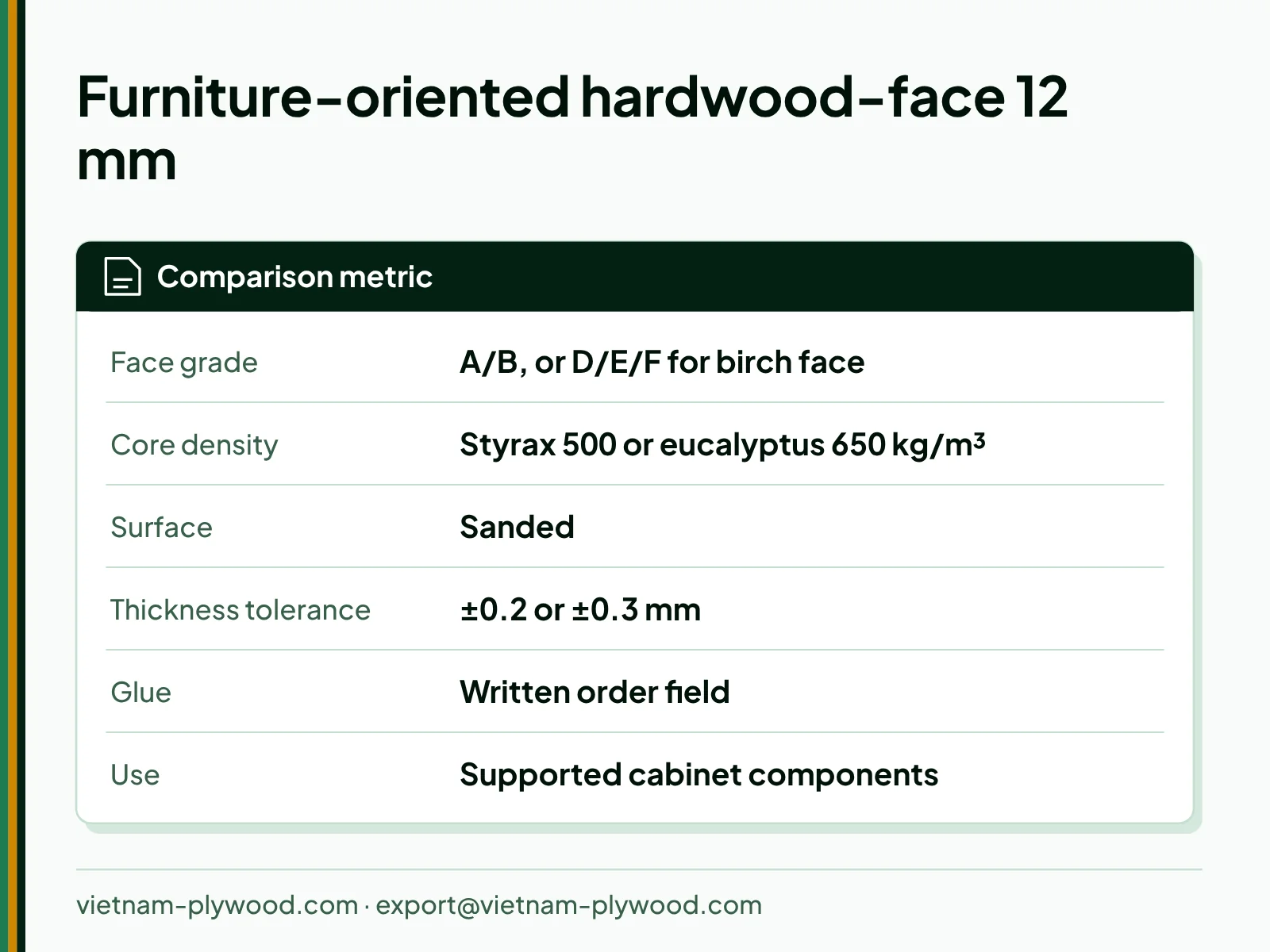
| Comparison metric | Furniture-oriented hardwood-face 12 mm | Commercial 12 mm | Buying verdict |
|---|---|---|---|
| Face grade | A/B, or D/E/F for birch face | Specify face or raw matt | Furniture for decorative visibility |
| Core density | Styrax 500 or eucalyptus 650 kg/m³ | Acacia 580 kg/m³ | Calculate weight from actual core |
| Surface | Sanded | Unsanded or light-sanded | Furniture for close machining and finishing |
| Thickness tolerance | ±0.2 or ±0.3 mm | ±0.5 mm | Furniture for controlled rebates |
| Glue | Written order field | MR | Match moisture exposure |
| Use | Supported cabinet components | Industrial packing | Match the end-use drawing |
A request for poplar plywood 12mm needs similar care. Poplar is an available face veneer, but it is not one of our listed cores. Likewise, a birch face does not make a birch-core board. Matt means an unfaced raw core; it is not a separate tree species.
The term laminated plywood 12mm may mean a plywood panel prepared for a later laminate or a panel already surfaced with melamine or high-pressure laminate (HPL). Our furniture line supplies the plywood substrate; melamine, HPL and decorative laminate faces are topics to specify with the downstream finisher, not offered product lines. Buyers of laminated plywood sheets 12mm should name the surface system and who applies it.
How many 12 mm sheets fit a 40HC?
A 12 mm 1220 × 2440 mm load calculates to 1,494 styrax-core sheets, 1,328 acacia-core sheets or 1,200 eucalyptus-core sheets under the stated pallet and stack-height assumptions. The counts use the stated pallet and stack-height conditions. The 40HC payload limit is 28.5 tonnes, and each loading plan must be checked against it.
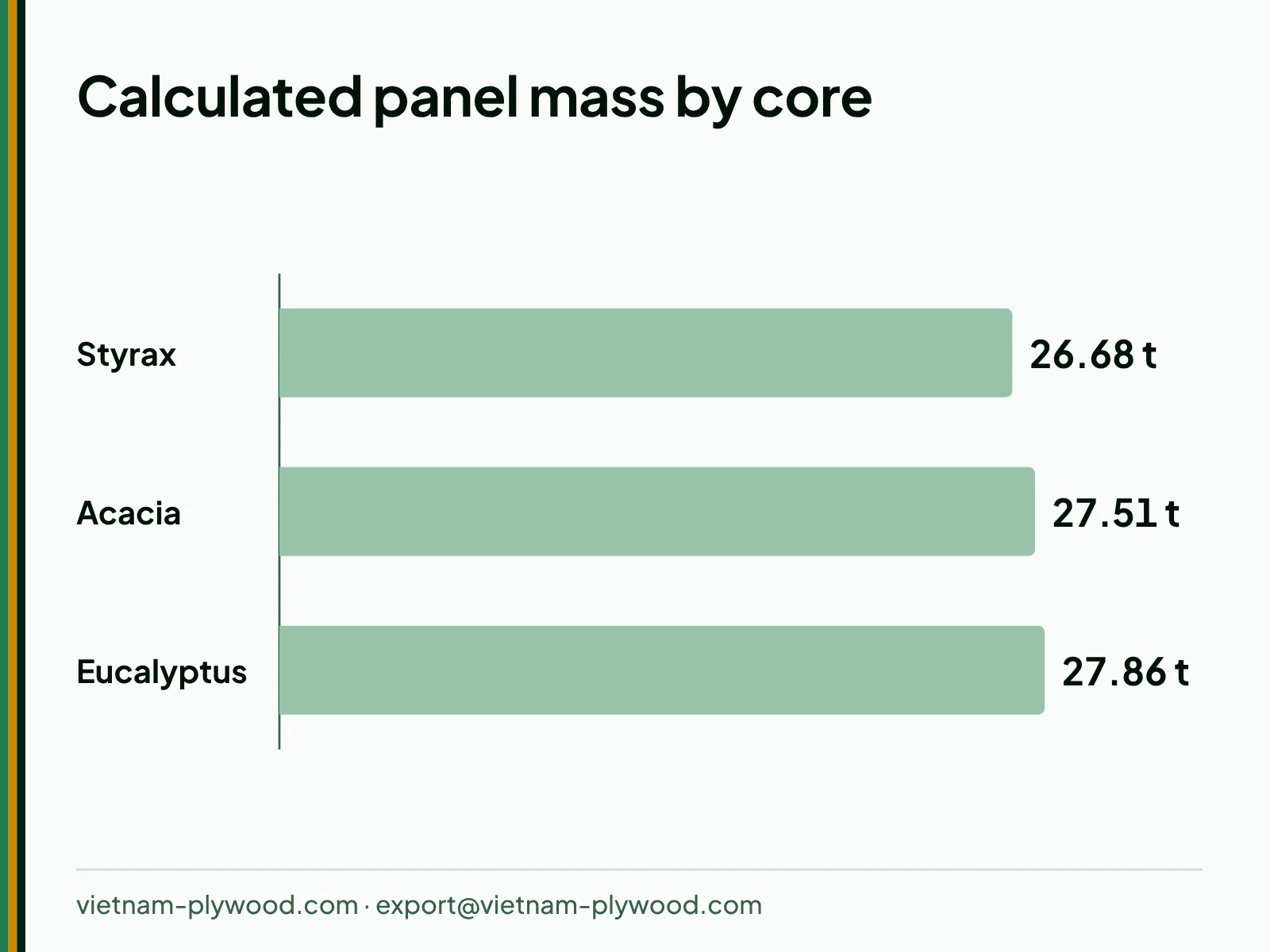
| Core | Density | Pallets | Stack height | Sheets per pallet | Calculated sheets | Calculated panel mass |
|---|---|---|---|---|---|---|
| Styrax | 500 kg/m³ | 18 | 1000 mm | 83 | 1,494 | 26.68 t |
| Acacia | 580 kg/m³ | 16 | 1000 mm | 83 | 1,328 | 27.51 t |
| Eucalyptus | 650 kg/m³ | 15 | 970 mm | 80 | 1,200 | 27.86 t |
For 1220 × 2440 × 12 mm sheets, the listed sheet weights are 17.86 kg for styrax, 20.72 kg for acacia and 23.22 kg for eucalyptus. The corresponding full-load panel volumes are 53.37 m³, 47.44 m³ and 42.87 m³.
Mixed specifications can share a container when the combined gross load respects the payload limit. A buyer could allocate part of a load to 12 mm furniture panels and the balance to packing sheets, but the actual mix needs pallet tare weights and a final stowage plan. The full loading method belongs to container packing and sheet counts.
What can an inspector verify at the producing factory?
An inspector can check the written 12 mm specification against marked pallets, measured panels, face samples and representative core edges at the producing factory. HCPLY handles on-site quality control, export documents and loading, with buyers visiting the factory office and inspecting goods where they are made.
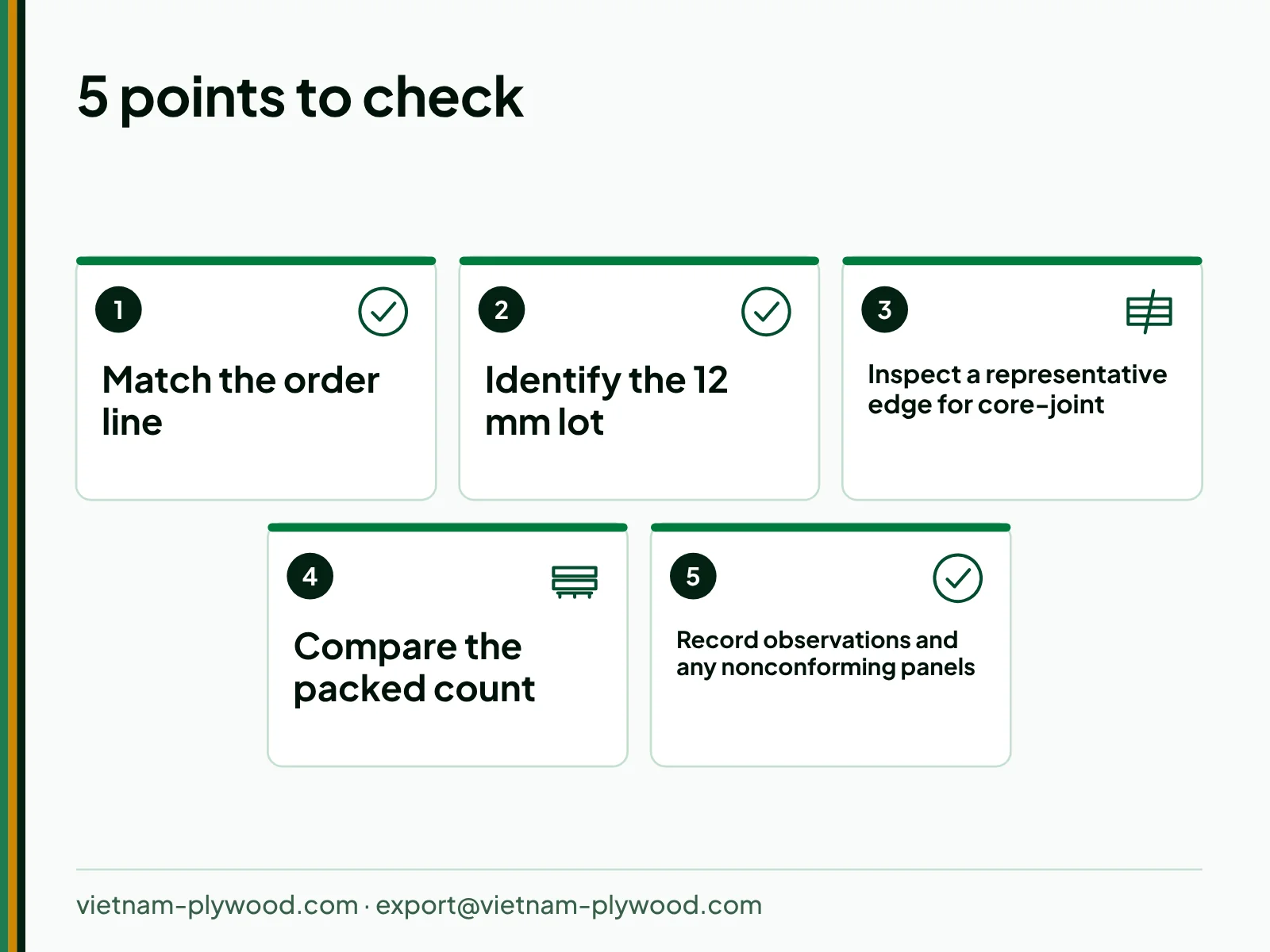
- Match the order line to the factory’s build sheet: core, face, glue, emission field and finish.
- Identify the 12 mm lot and measure thickness and length/width against the agreed tolerances.
- Inspect a representative edge for core-joint construction and a face for grade and sanding or film condition.
- Compare the packed count, pallet markings and mixed-spec allocation with the packing list.
- Record observations and any nonconforming panels before the lot is released for loading.
Visual inspection cannot establish a structural rating, a formaldehyde result or a boil-test result. Those claims need the relevant reports for the agreed build.
The commercial invoice and packing list identify the shipped specification and quantities. The bill of lading (B/L) records shipment; certificate of origin, applicable phytosanitary and fumigation papers, and the order’s certificate documents complete the shipment file. For European Union lots, EUR.1 and the EUTR/EUDR file set are included as applicable; insurance is part of CIF shipments. After loading, the draft shipping documents come to you for approval.
What drives a 12 mm plywood quotation?
Core, face, core construction, finish, glue, tolerance and shipment mix drive a 12 mm quotation. A full-stitched sanded furniture build normally costs more to produce than a simpler unsanded packing build because it adds core preparation and surface processing. A film-faced build adds film and its own adhesive and pressing requirements, so its price must be quoted against the chosen film and glue.
The indicative commercial plywood starting price is from US$250/m³ FOB Hai Phong (October 2026). This is a category starting price, not a 12 mm offer or a price list. The furniture plywood starting price is from US$350/m³ FOB Hai Phong (October 2026). Film-faced plywood is quoted against its specified core, film and glue.
The minimum order is one 40HC; one container can carry several specifications as long as the payload limit holds. Factory lead time runs 15–45 days from receipt of the 30% deposit; the exact figure depends on order size, line loading and what the contract fixes. The remaining 70% is paid on the scan of the bill of lading, by T/T, or by irrevocable sight L/C. We ship FOB Hai Phong, or CFR (CNF) or CIF to your port.
Samples cost nothing: a first-time buyer pays the courier, and that charge comes off the first confirmed order. See plywood supply programmes for distributor planning. A firm quotation needs the complete written 12 mm build and destination port.
What should the 12 mm purchase specification contain?
A purchase specification should name the application first, then define the line, core, adhesive, emission class, face, measured tolerance, finished size and shipment quantity. This prevents a nominal thickness from becoming the only common field between buyer and factory.
For a furniture back, include whether the face will be visible, how the edge will be treated, and the required machining fit. For a packing case, attach the case drawing and the accepted core-joint construction. For film-faced formwork, attach the formwork engineer’s acceptance requirements and the release-agent and edge-sealing plan.
Our three member factories are in Phu Tho and Hai Phong. Our furniture line and our commercial and packing line handle their respective plywood builds, while our construction line handles film-faced work. Each order is produced and shipped directly from the appropriate factory, with export coordination through Lucy.
Use this request format when contacting the export team:
Application: supported cabinet back / packing case / small-pour formwork
Line or core: furniture—styrax / commercial—acacia / construction—acacia
Glue: specified MR or WBP build
Emission: E0 / E1 / E2 or destination-specific evidence request
Face and grade: veneer name and A/B; birch face D/E/F; or film weight
Thickness and tolerance: 12 mm nominal; specify ±0.2 / ±0.3 / ±0.5 / ±0.5–1.0 mm as applicable
Size: 1220 × 2440 mm nominal or finished custom-cut drawing
Quantity: sheets, pallet allocation and total 40HC mix
Destination port: named receiving port and requested delivery term
Request the 12 mm specification sheet from Lucy or export@vietnam-plywood.com.