





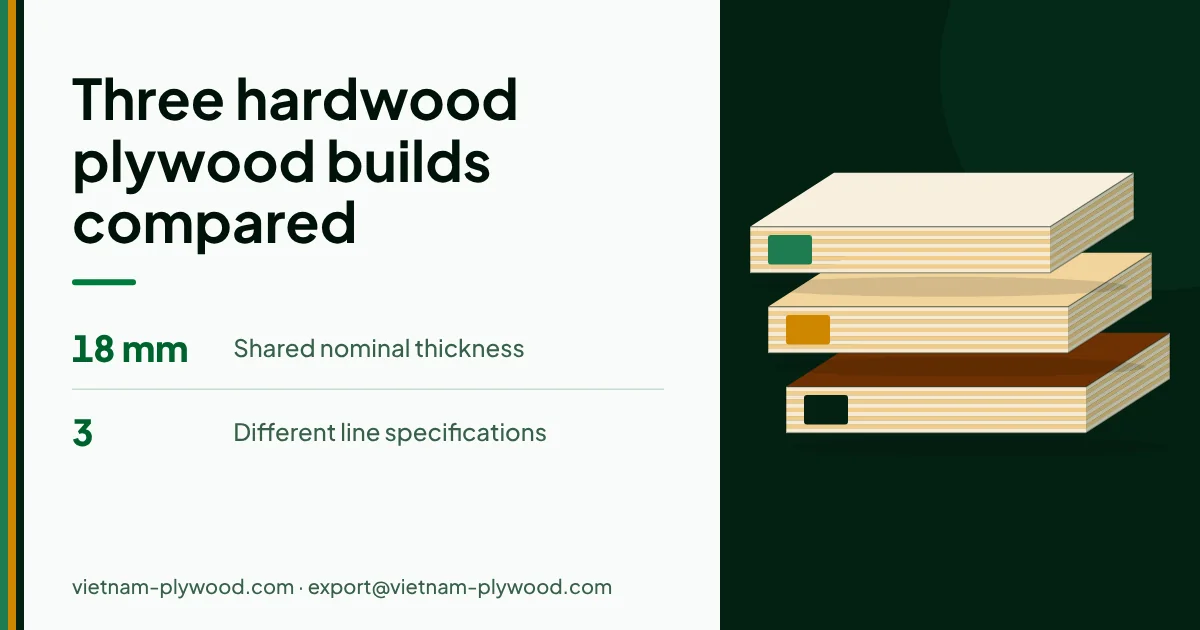
Hardwood plywood is a face-selected veneer panel whose core, bonding and finish must match the job. A wrong face or core can waste machining time, raise material cost or cause a rejected load. HCPLY compares furniture, commercial and construction builds at the same nominal thickness so importers can specify the panel they actually need.
What is hardwood plywood?
Hardwood plywood is a layered wood panel selected primarily for its hardwood or decorative face, with veneers bonded around a core. Its face determines appearance and commercial naming; its core determines much of its weight and machining behavior. The same named face can cover quite different inner constructions. Specify both rather than ordering on the species name alone.
The U.S. Department of Commerce’s 2017 Federal Register notice describes hardwood and decorative plywood as multilayered veneered panels with a core and a hardwood face or back, within that particular trade investigation’s scope. That trade definition is broader than a purchasing specification and should not be treated as a product certification. U.S. Department of Commerce, 2017.
A plywood hardwood face might be okoume, bintangor, gurjan or engineered veneer (EV). The material behind it can be styrax, eucalyptus or acacia veneer. A hardwood sheet named after its face therefore tells only part of the story. For background on how veneer is made and described, see the wood veneer sheet guide and our plywood types library.
How do three factory lines build the same thickness?
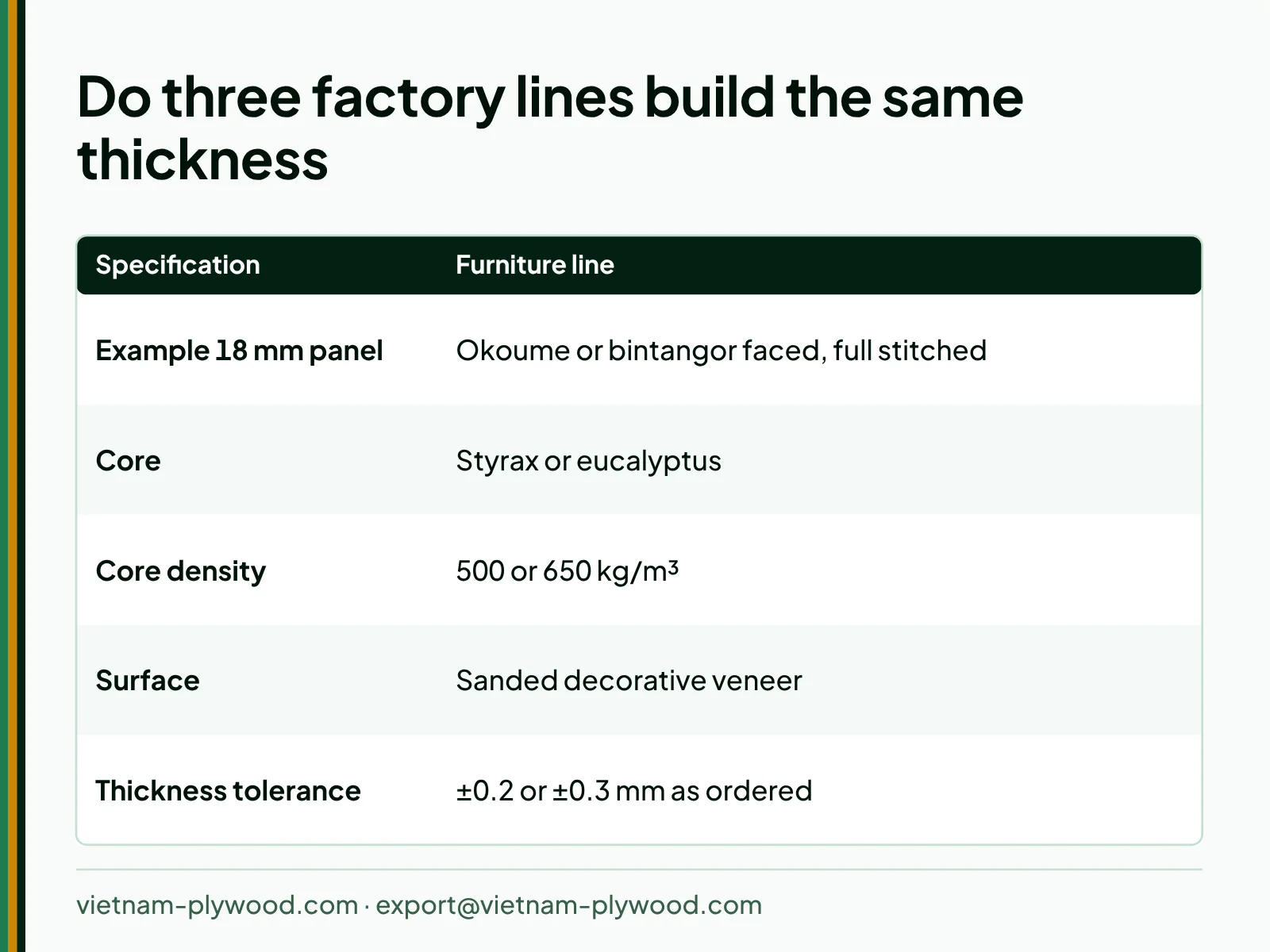
At 18 mm nominal thickness, our furniture line prioritizes a stitched, sanded core and a selected visible face. Our commercial and packing line builds a more economical utility panel with an acacia core. Our construction line presses a film-faced panel for formwork or handling surfaces, where the film is the working face.
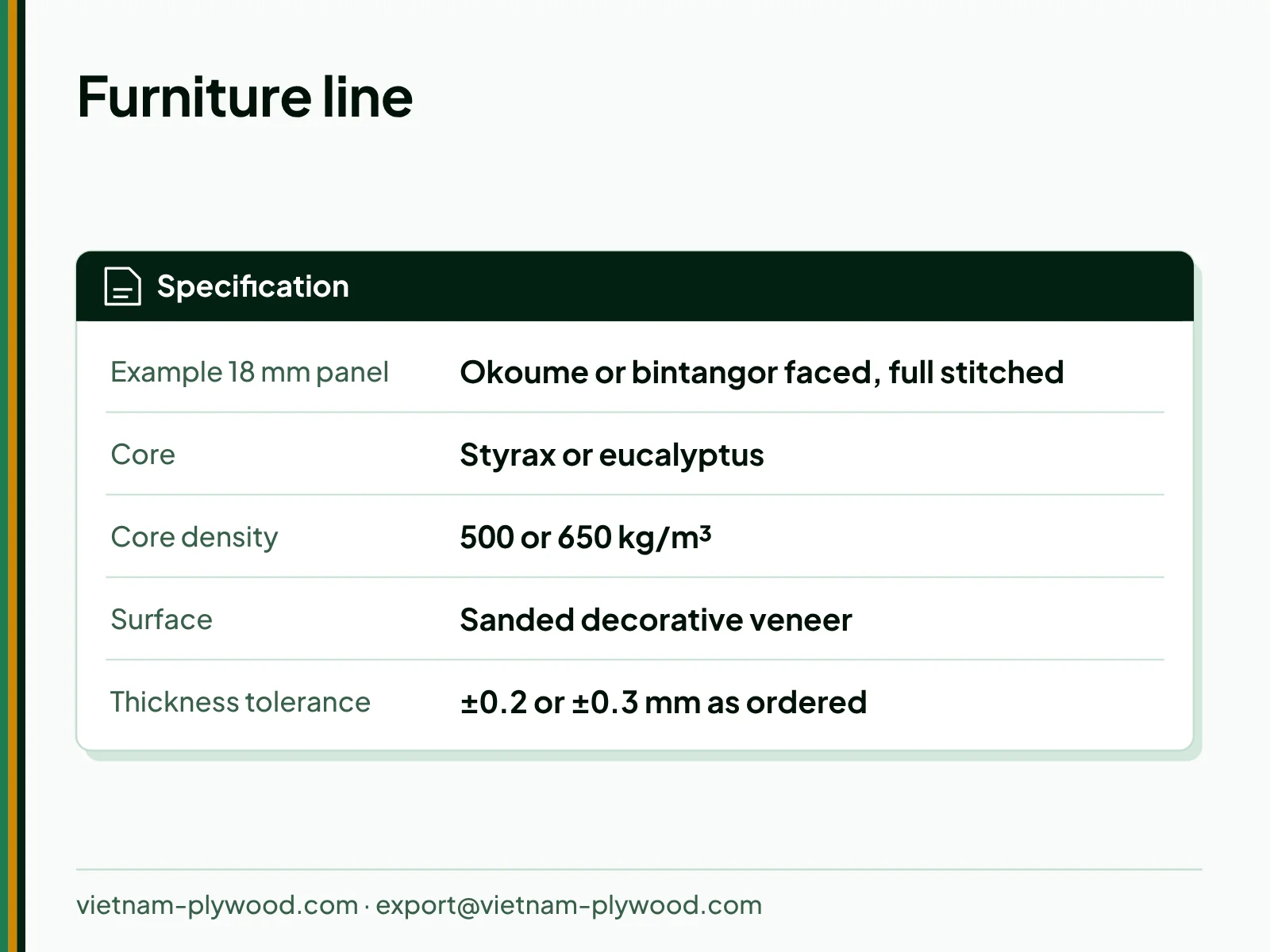
| Specification | Furniture line | Commercial and packing line | Construction line |
|---|---|---|---|
| Example 18 mm panel | Okoume or bintangor faced, full stitched | Utility face on acacia, light-sanded or unsanded | Phenolic or melamine film over hardwood veneer core |
| Core | Styrax or eucalyptus | Acacia | Acacia or eucalyptus |
| Core density | 500 or 650 kg/m³ | 580 kg/m³ | 580 or 650 kg/m³ |
| Surface | Sanded decorative veneer | Unsanded or light-sanded | 120 g/m² standard film, 135 g/m² premium or 220 g/m² anti-slip film |
| Thickness tolerance | ±0.2 or ±0.3 mm as ordered | ±0.5 mm; packing ±0.5–1.0 mm | ±0.5 mm |
| Suitable use | Cabinet faces, furniture components, visible fit-out | Packing, covered components, utility panels | Concrete formwork, temporary work surfaces |
The furniture build spends more effort on the visible face, core stitching and sanding. The utility build favors material efficiency where an exposed finish is unnecessary. Film-faced plywood addresses repeated contact with concrete or site handling rather than decorative grain. See grades across factory lines for the buying implications.
These are alternative builds, not interchangeable approvals for a structural design. A construction engineer must select required performance evidence for the intended load. The producing factory can show the layup and finished panel for inspection before shipment.
What is hardwood plywood used for?
Hardwood plywood is used for cabinet carcasses, furniture panels, fit-out joinery, display fixtures and selected industrial applications. The appropriate build changes with whether the face remains visible, receives a finish, or is covered in service.
Cabinet makers usually place face consistency, machining quality and thickness repeatability ahead of a low initial panel price. A sanded, full-stitched core helps keep an exposed edge or routed component predictable. The buyer still needs to define acceptable patches, repairs, color variation and face grade in the purchase specification.
Distributors supplying a mixed customer base often need separate furniture and utility grades. For covered cabinet backs, shipping protection or industrial packing, the commercial build can avoid paying for a decorative finish that will never be seen. Our commercial plywood specification explains that product category.
For shuttering and site work, our construction line makes film-faced panels with acacia or eucalyptus cores. Film, edge treatment, glue system and site handling matter more than an attractive woodgrain. Read the construction project supply overview when the job is formwork rather than furniture.
Hardwood-faced plywood is not automatically a structural-grade panel. It should not be substituted for an engineered load-bearing product on appearance alone. This distinction is explored in hardwood plywood vs softwood plywood.
What types of hardwood plywood can a buyer specify?
Buyers can classify hardwood plywood by visible face, core construction, adhesive, surface preparation and intended application. Those dimensions are more useful for procurement than a single broad product label.
Decorative faced: Okoume, bintangor, gurjan, sapele or EV faces suit different visual specifications. A/B are the available face-grade labels for these faces; samples and an agreed acceptance reference should define their appearance.
Utility faced: A lower-visibility face on an acacia core suits packing and covered applications. The commercial line uses moisture-resistant (MR) glue and offers unsanded or light-sanded surfaces. It is a different product choice from a sanded furniture face.
Raw core: Matt plywood is an unfaced raw-core product for buyers planning their own subsequent treatment. It is explained in the matt plywood guide. Melamine, high-pressure laminate (HPL) and other laminate faces are separate finishing topics, not HCPLY product lines.
Film faced: The construction build uses phenolic or melamine film, including anti-slip film where specified. Film weight is a separate field from adhesive type. A dark film does not prove a phenolic bond or a particular strength class.
Some catalogues also group hardwood plywood by regional species names, such as lauan plywood and meranti plywood. These names need a written face species and core description before they become usable purchasing specifications.
Which tropical hardwood faces and cores are available?
Our available faces include bintangor, okoume, gurjan, EV, eucalyptus and sapele, alongside pine, poplar and birch options. The face is the naming field, while the core comes from a separate list. Typical face veneer thickness is 0.2–0.4 mm.
For tropical hardwood plywood, ask for a physical face reference rather than assuming all reddish or pale veneers are equivalent. Grain figure, color range and veneer matching affect whether panels can be assembled into adjacent cabinet doors. The grade should be tied to the buyer’s visual acceptance sample.
Our furniture line uses styrax or eucalyptus cores; our commercial and packing line uses acacia. Our construction line uses acacia or eucalyptus beneath film. The core density figures are 500 kg/m³ for styrax, 580 kg/m³ for acacia and 650 kg/m³ for eucalyptus. They are core-based calculation inputs, not a density claim for every finished face combination.
Birch is available as a face, with D/E/F face grades for this face. We do not press birch-core plywood. The poplar vs birch face comparison helps separate veneer appearance from the panel’s inner species.
How do thickness, ply count and core quality change the order?
Thickness, tolerance and veneer layup affect machining fit, edge appearance and acceptance at delivery. The available nominal thickness range is 3–40 mm, with common orders at 3, 5, 9, 12, 15, 18, 21 and 25 mm.
At 18 mm, the layup uses 11–13 plies because individual core veneers are 1.4–2.0 mm thick. More plies alone do not establish better performance. The quality of each joint, the face bonding and the final press and sanding conditions also matter.
Core constructions follow a practical order for face-critical work: full stitched; stitched outer layers with edge-trimmed inner veneers; finger-jointed; then loose-laid. The furniture line specifies full stitching. A buyer should state the accepted construction and inspect the edges of representative panels rather than rely on the ply count alone.
Available sheet sizes are 1220×2440, 1250×2500, 1220×2135, 1220×1830, 915×2440, 915×2135 and 915×1830 mm, with custom cutting available. Length and width tolerance is ±2 mm. A CNC nesting plan should account for both dimensional tolerance and the actual finished thickness.
At 1220×2440×18 mm, sheet weights are 26.79 kg for styrax, 31.08 kg for acacia and 34.83 kg for eucalyptus, excluding film weight.
Which glue and emission documents should be specified?
Glue performance and formaldehyde emission are separate specification fields. For adhesive, melamine MR is described by a 12-hour boil condition; phenolic weather-and-boil-proof (WBP) by a 72-hour boil condition. Those descriptions do not replace an agreed test report for the ordered build.
For emissions, E0, E1 and E2 are class labels. California Air Resources Board Phase 2 (CARB P2) and U.S. Toxic Substances Control Act Title VI are U.S. limits involving third-party certification.
A furniture importer should specify the required emissions basis independently of adhesive type. Do not substitute a boiling-water description for an emissions report, or an E1 label for a U.S. third-party certification claim. The agreed build and destination requirements determine which evidence is needed.
FSC, CARB P2, ISO 9001 and CE certificates, and European Union Timber Regulation (EUTR) or Deforestation Regulation (EUDR) documents, belong to the member factories and are shown with factory details masked, on request. Any claim on shipment paperwork must match the actual producing factory and agreed goods.
Can one order compare three builds of one thickness?
One 40-foot high-cube container (40HC) can mix specifications within its 28.5 t payload limit. This lets a buyer compare 18 mm furniture, commercial and film-faced builds under a coordinated purchase, provided the packing plan fits the weight ceiling.
For 1220×2440×18 mm panels, the loading reference is 990 styrax-core sheets, 880 acacia-core sheets or 795 eucalyptus-core sheets in a single-core load. The pallet counts are respectively 18, 16 and 15. The respective full-load weights are 26.52 t, 27.35 t and 27.69 t.
For a mixed trial, ask the producing factory for a pallet-by-pallet loading plan showing each build’s sheet count, core, pallet weight and total cargo mass. Check the plan against the 28.5 t payload limit before loading.
The container loads reference owns detailed sheet-count planning. A mixed order can compare surface and machining outcomes, but it should record which sheets came from which build. The buyer should keep those samples separate during the trial.
What can an inspector check at the producing factory?
An inspector can check the agreed face, edge layup, dimensions, finish and packing against the signed specification. The most useful visit combines a sample comparison with random checks of finished production goods.
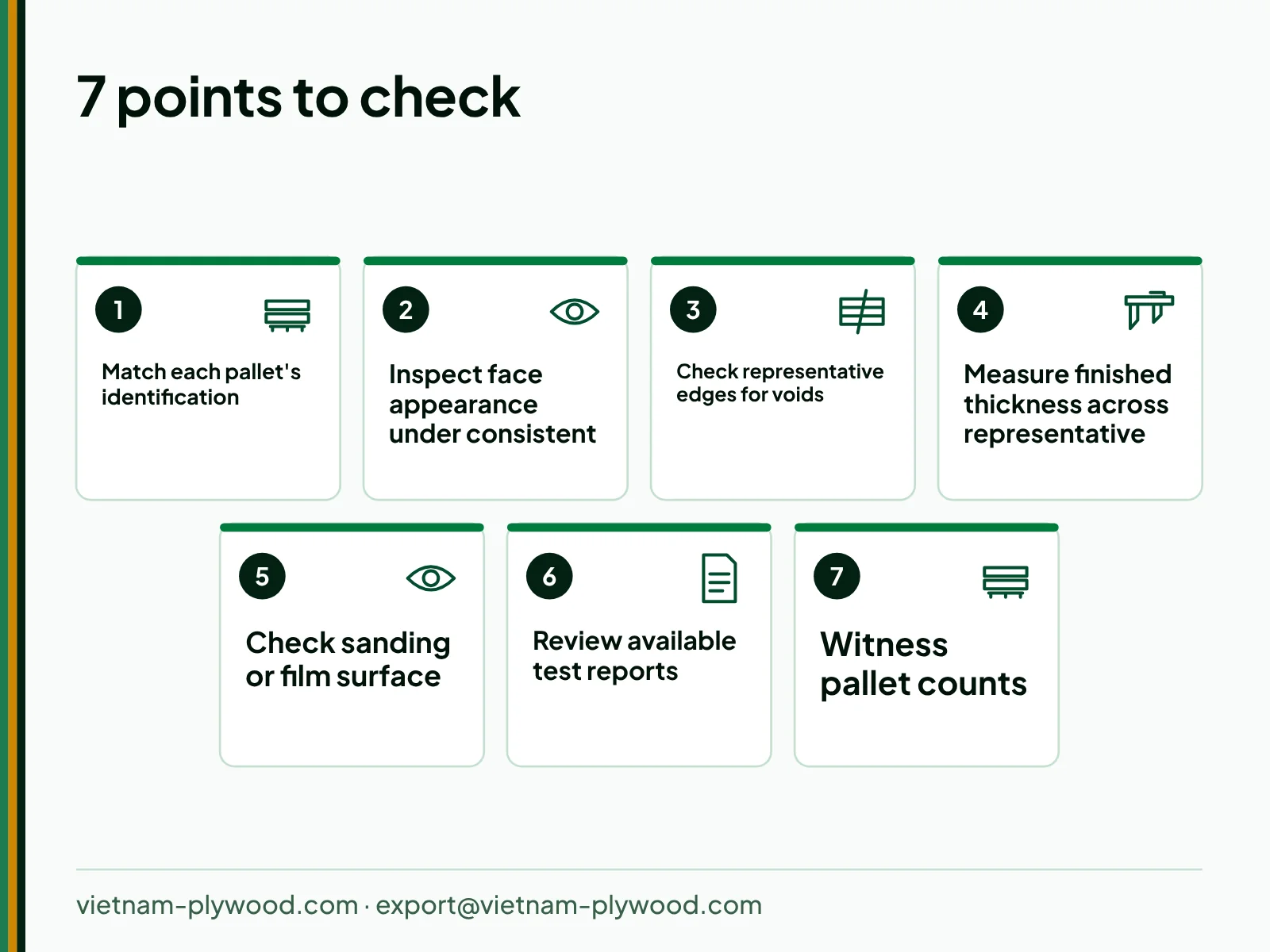
- Match each pallet’s identification to its order line, face, core, thickness and intended use.
- Inspect face appearance under consistent lighting against the approved reference and note visible repairs or defects.
- Check representative edges for voids, overlap and joint construction; compare with the agreed core category.
- Measure finished thickness across representative sheets and verify length and width against the stated tolerances.
- Check sanding or film surface, film weight identification and cut-edge treatment where applicable.
- Review available test reports and certificate documents against the exact producing factory and ordered build.
- Witness pallet counts, protection and loading records before dispatch.
Buyers visit the factory office and inspect goods at the producing factory. HCPLY coordinates on-site quality control and the export documentation. The purpose of inspection is to catch a mismatch while the goods can still be segregated or corrected.
How should buyers compare price and purchasing terms?
Core preparation and visible-face quality usually drive the furniture build above a utility commercial build, while film, adhesive and site-use requirements drive construction quotes differently. A sanded, full-stitched decorative panel involves more face selection and finishing than an unsanded utility panel. A heavier core also changes freight utilization even when the nominal dimensions match.
The indicative starting point for commercial plywood is from US$250/m³ FOB Hai Phong (October 2026). The furniture plywood starting point is from US$350/m³ FOB Hai Phong (October 2026). Film-faced and specific hardwood-face grades require a written specification and quotation.
Minimum order: one 40HC; one container can carry several specifications as long as the payload limit holds. Production: 15–45 days from the 30% deposit, set by order size, line loading and the contract. The remaining 70% is paid on the scan of the bill of lading, by T/T, or by irrevocable sight L/C. Shipping: FOB Hai Phong, or CFR (CNF) or CIF to your port.
Samples: free; a first-time buyer pays the courier, and that charge comes off the first confirmed order. The buyer should request matching samples of each proposed build and identify the machining or appearance test planned for each sample.
Which shipping documents record the agreed hardwood build?
The commercial invoice and packing list identify what was sold and loaded, while agreed test and certificate documents substantiate specified attributes. The bill of lading (B/L) records the shipment. For EU lots, the certificate of origin may be EUR.1 and the EUTR/EUDR file set is included as applicable to the shipment.
The shipment paperwork comprises the commercial invoice, packing list, B/L, certificate of origin, phytosanitary and fumigation papers, insurance under CIF, plus the order’s certificate documents. These can include an FSC claim on sales documents, emission certificate and test reports for the agreed build. After loading, the draft shipping documents come to you for approval.
A useful order schedule identifies face species and grade, core, glue, emission field, dimensions and tolerance for every line item. Those fields should carry through to the invoice or packing references and the supporting evidence. This reduces ambiguity when several hardwood plywood types travel together.
What should a buyer send before requesting a trial container?
Send a specification that identifies the application, visible face, inner construction and acceptance checks. Include a destination port so the quote can use the requested delivery term. A label such as “hardwood ply sheets” alone leaves too many variables open.
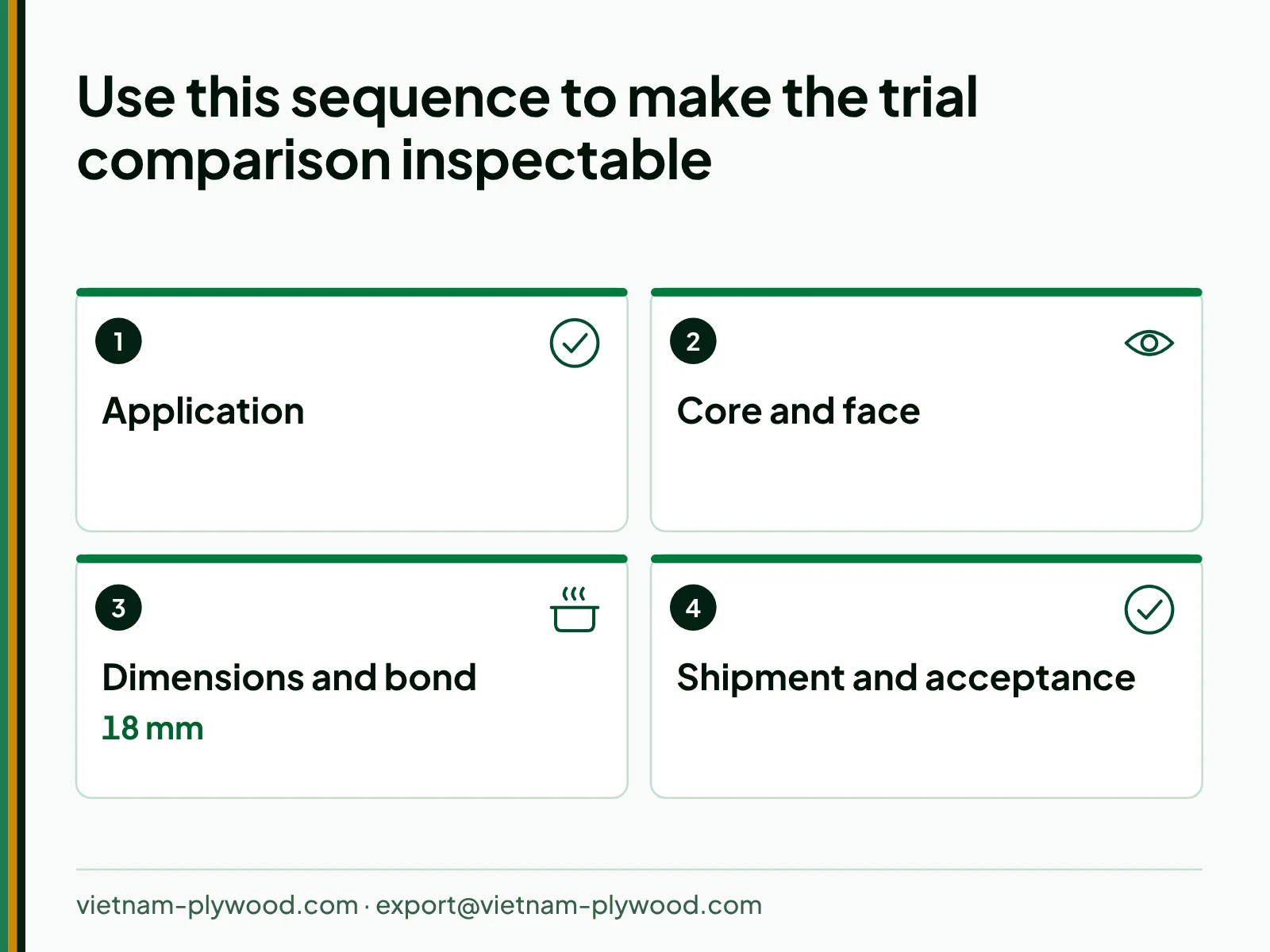
Use this sequence to make the trial comparison inspectable:
- Application: Assign each build to cabinet doors, covered components or formwork, matching the uses in the specification.
- Core and face: Pair the furniture, commercial or construction line with its listed core and the required decorative, utility or film face.
- Dimensions and bond: Record the 18 mm thickness, the tolerance for each build, the sheet size, glue and separate emission requirement.
- Shipment and acceptance: State the quantity per build, destination port and checks for face appearance, core edges, thickness and packing.
Application: cabinet doors / covered components / formwork trial
Line or core: furniture—styrax / commercial—acacia / construction—eucalyptus
Glue: MR melamine or WBP phenolic, as specified per line
Emission: E0 / E1 / E2 or required third-party emissions basis
Face and grade: okoume A/B / utility face A/B / film type and weight
Thickness and tolerance: 18 mm; ±0.2 mm / ±0.5 mm per build
Size: 1220 × 2440 mm
Quantity: sheet count per build, within one 40HC payload
Destination port: [named port]
Plan a trial container with Lucy at export@vietnam-plywood.com through the contact page, using the same thickness and separate acceptance criteria for each build.