





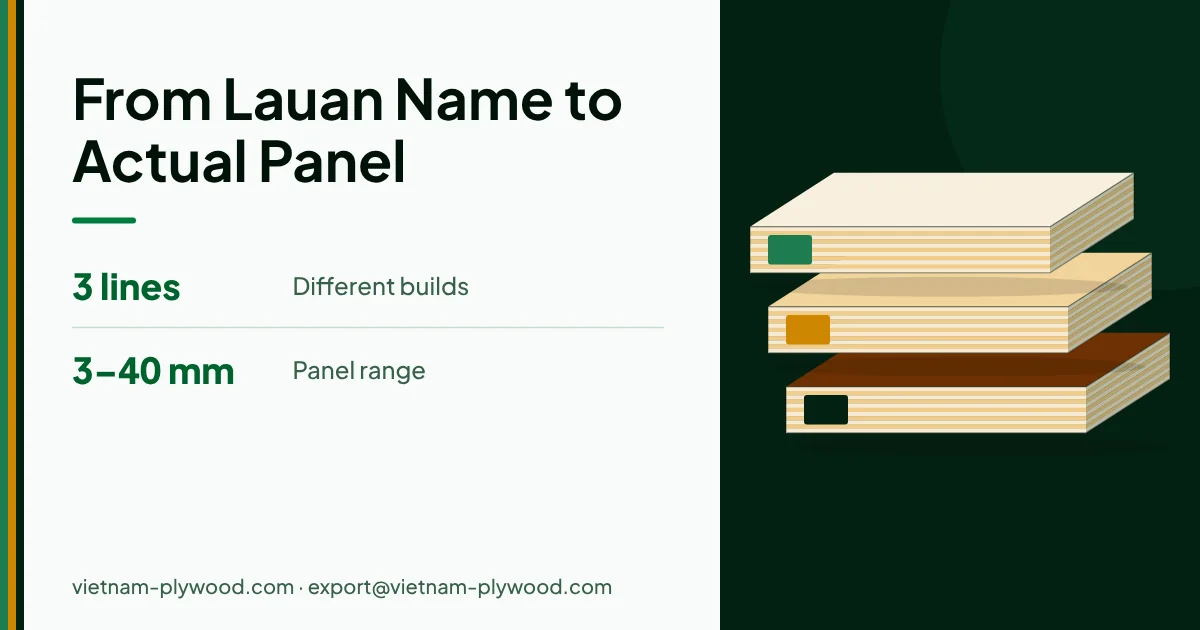
Lauan plywood is a legacy trade description that HCPLY converts into a named face, core and manufacturing specification for Vietnam export orders. A mistaken species or grade can cost a rejected load, rework and lost production days. For door, cabinet and RV buyers, the practical choice is to define the actual panel rather than order by the old name alone.
What is lauan plywood?
Lauan plywood is a layered wood panel historically associated with tropical hardwoods sold as lauan or luan, particularly Philippine Shorea-group timbers. In current purchasing, however, the name alone cannot identify the actual face veneer, inner core, adhesive, or intended service. A workable purchase order describes those components separately and asks for traceable species information.
The terms luan plywood, lauan, luan board, and luan panels often appear interchangeably in legacy specifications. They describe a commercial expectation of a thin, workable interior panel more readily than a complete modern manufacturing specification. The hardwood plywood guide explains the wider panel categories; this page addresses the ambiguity in the old name.
Plywood is made from veneer layers bonded with alternating grain directions. A thin decorative face can determine appearance while the core determines much of the panel’s mass and handling. Consequently, a buyer asking for a reddish lauan appearance might need a specified veneer over a different, explicitly named core.
Is lauan the same as Philippine mahogany?
Lauan overlaps with the historical trade expression Philippine mahogany, but neither expression identifies a single botanical species. The United States Department of Agriculture’s Wood Handbook distinguishes true mahogany from Asian timbers marketed under the Philippine mahogany name. The older expression commonly refers to Shorea-related commercial groups, while true mahogany belongs to Swietenia.
This matters when a purchase team inherits drawings that say “philippine mahogany wood.” The drawing might describe a colour and grain expectation, a particular veneer, or a legacy panel category. None of those interpretations automatically establishes the species used in the new shipment.
Meranti, seraya, lauan and related regional names overlap in trade, but their meanings are not identical across origins and sellers. For a more detailed naming comparison, see the meranti plywood guide. When an exact timber identity matters, write the accepted botanical name and origin in the purchasing record.
What does a lauan plywood order buy today?
An order headed “lauan plywood” buys only the specifications written beneath that heading. HCPLY translates the request into a face, core, grade, adhesive, emission class, thickness, dimensions and application before selecting a producing line. A historic trade word cannot stand in for these decisions.
For example, an importer seeking thin interior door components might prioritise an even sanded face and a stitched core. A packing buyer using the same old term could instead want a lightly sanded acacia panel. A contractor ordering a formwork board requires a film-faced construction specification, which is a different product altogether.
HCPLY does not list a lauan-species face. An alternative must use its actual face name and receive buyer approval.
Which thin face and core do our lines press?
Our furniture line is the appropriate route for a sanded, thin interior panel with a named decorative face. Our commercial and packing line produces acacia-core panels with a different surface and glue specification. Our construction line makes film-faced panels for concrete work, rather than decorative lauan panelling.
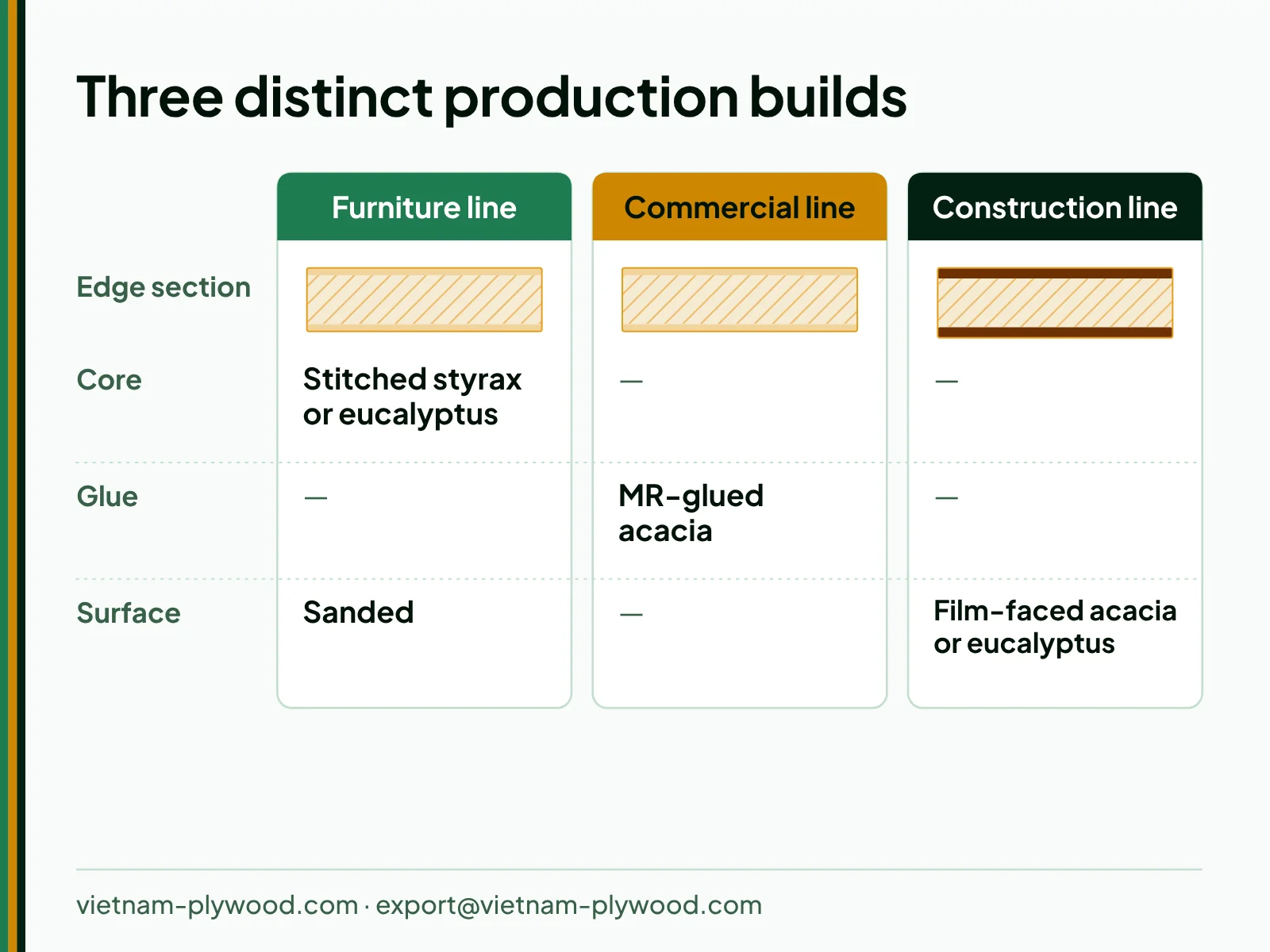
| Order requirement | Producing line | Face and core | Surface and tolerance | Buyer verdict |
|---|---|---|---|---|
| Thin interior door or cabinet component | Furniture | Bintangor, okoume, poplar or engineered veneer face; styrax or eucalyptus core | Sanded; ±0.2 or ±0.3 mm as ordered | Start here for a visible or finish-ready face |
| Backing or packing component | Commercial and packing | Named available face or matt raw core; acacia core | Unsanded or light-sanded; commercial ±0.5 mm, packing ±0.5–1.0 mm | Choose when appearance is secondary |
| Concrete form surface | Construction | Phenolic, melamine or anti-slip film; acacia or eucalyptus core | Unsanded; ±0.5 mm | Different end use; do not substitute for door skin |
Available named faces include bintangor, okoume, engineered veneer (EV), gurjan, pine, poplar, eucalyptus, birch and sapele. A face veneer commonly measures 0.2–0.4 mm. Birch face grades are D/E/F; other named veneer faces use A/B grades. A panel’s product name follows its face, while its density follows the core.
For visual selection, compare poplar, birch and okoume faces and request matched samples before writing the final appearance description.
What thickness and dimensions belong on the order?
Specify a measured thickness and tolerance rather than “thin lauan.” Our panel range is 3–40 mm, with 3, 5 and 9 mm among the common thin options. Standard sheet formats include 1220×2440, 1250×2500 and 1220×2135 mm; custom cutting is available.
The factory uses veneer layers of approximately 1.4–2.0 mm in the core, so the finished ply count follows the veneer build. For reference, an 18 mm panel uses 11–13 plies. A buyer should not copy a historical ply count into a thin-panel order without matching the finished construction.
Door processors should state the maximum permitted thickness variation at the machining stage. RV interior fabricators should add panel flatness, surface finish and edge requirements to their approved sample criteria. An underlayment buyer must provide the flooring-system manufacturer’s acceptance requirements rather than assuming a decorative plywood grade qualifies.
What is lauan plywood used for in doors, underlayment and RVs?
Lauan panels are commonly specified for interior door skins or cores, furniture backs, cabinet components, wall linings and recreational-vehicle interior panels. Lauan flooring usually means a thin underlayment layer beneath a separate finish, rather than a finished structural floor. These applications demand different acceptance tests.
For door work, the decisive factors are face uniformity, machining behaviour, bonding and compatibility with the door assembly. For RV interiors, weight, panel finish, fastening and humidity exposure deserve separate review. For floor underlayment, the floor-covering supplier’s written panel and fastening requirements control acceptance.
A thin face does not establish load-bearing capacity or flooring approval. Follow the assembly requirements and compare hardwood versus softwood plywood.
Which glue and emission fields should the buyer state?
Glue type and formaldehyde emission class are separate purchase-order fields. Our commercial line uses moisture-resistant (MR) glue, while the furniture line offers E0 or E1 emission classes. Specify the adhesive and emission requirement independently, with the agreed test evidence.
The available glue descriptions are melamine MR with a 12-hour boil condition and phenolic weather-and-boil-proof (WBP) with a 72-hour boil condition. MR hot pressing runs at 110–120 °C and WBP at 130–145 °C. Those process descriptions do not themselves establish a flooring approval or a structural grade.
For United States buyers, CARB Phase 2 and Toxic Substances Control Act Title VI involve emission limits and third-party certification. Relevant member-factory documents can be shown with factory details masked, on request. The buyer should identify the exact product scope and documentary requirement before production.
Why must the order name the real species?
The real face and core species must be named because a trade label cannot support species-level traceability. A purchaser who writes only “lauan” risks approving the wrong face, receiving inconsistent colour, or preparing inaccurate import declarations. A precise schedule separates commercial description from botanical identification.
Use a short naming crosswalk in the order:
| Legacy wording | Purchasing replacement | What to check |
|---|---|---|
| “Lauan plywood” | Named face species or veneer type, named core and panel construction | Sample, species record and factory build sheet |
| “Philippine mahogany look” | Approved colour/grain sample plus named face | Appearance against the accepted sample |
| “Luan board for doors” | Door application, thickness, tolerance, surface and glue | Door-process trial and face inspection |
| “Luan flooring” | Underlayment application plus flooring-system requirements | Written system acceptance before ordering |
A botanical identification cannot be inferred from a colour photograph or a sales label. When the original design requires a particular Shorea species, request that species specifically; do not replace it with a look-alike without a design approval.
Why must shipping documents match the species named?
Shipping paperwork must reflect the actual material in the shipment so import declarations and commercial descriptions remain consistent. A 2022 United States Department of Agriculture notice explains that Lacey Act plant declarations require scientific names, quantities, values and countries of harvest. See the official USDA notice.
A 2026 U.S. Customs and Border Protection notice likewise lists genus, species, quantity, intended use, treatment and origin among importer-document details for wood shipments. See the official import notice. Applicability depends on the actual product classification and import requirements, so the importer should establish its filing route before the goods ship.
For each shipment, HCPLY coordinates the commercial invoice, packing list, bill of lading (B/L), certificate of origin, relevant phytosanitary and fumigation papers, and agreed product certificates or reports. EU lots add the EUTR/EUDR file set and EUR.1 where applicable; CIF shipments include insurance. After loading, the draft shipping documents come to you for approval.
The invoice’s commercial name can retain the buyer’s familiar wording alongside a precise material description. The species records and declaration data must describe the real veneers and cores. A buyer or inspector can compare the approved species schedule, veneer identification records, production batch and carton or pallet marks at the producing factory.
How should a trial container be planned?
A trial container can combine thin interior specifications within the payload limit, provided the order identifies each build and its quantities. One 40HC is the minimum order, and the payload ceiling is 28.5 t. Mixing specifications requires a loading plan based on core density, thickness and pallet allocation.
For an 18 mm, 1220×2440 mm reference, styrax-core panels weigh 26.79 kg per sheet, acacia-core panels 31.08 kg, and eucalyptus-core panels 34.83 kg. Their respective full-container reference counts are 990, 880 and 795 sheets. Those figures exclude film weight; they are reference builds rather than a thin-lauan order recommendation.
For a thin example, 3 mm styrax-core panels weigh 4.47 kg per sheet, compared with 5.18 kg for acacia core and 5.80 kg for eucalyptus core at 1220×2440 mm. That difference is relevant to RV weight budgets and mixed-load planning. Use the container loading reference for the full sheet-count treatment and mixed-container ordering for combining builds.
What can an inspector witness at the factory?
An inspector can witness veneer selection, core assembly, sanding and final thickness checks at the producing factory. For a lauan-named order, the key test is whether the approved face and core are actually the ones recorded on the specification. The inspection should connect physical panels with the batch documents.
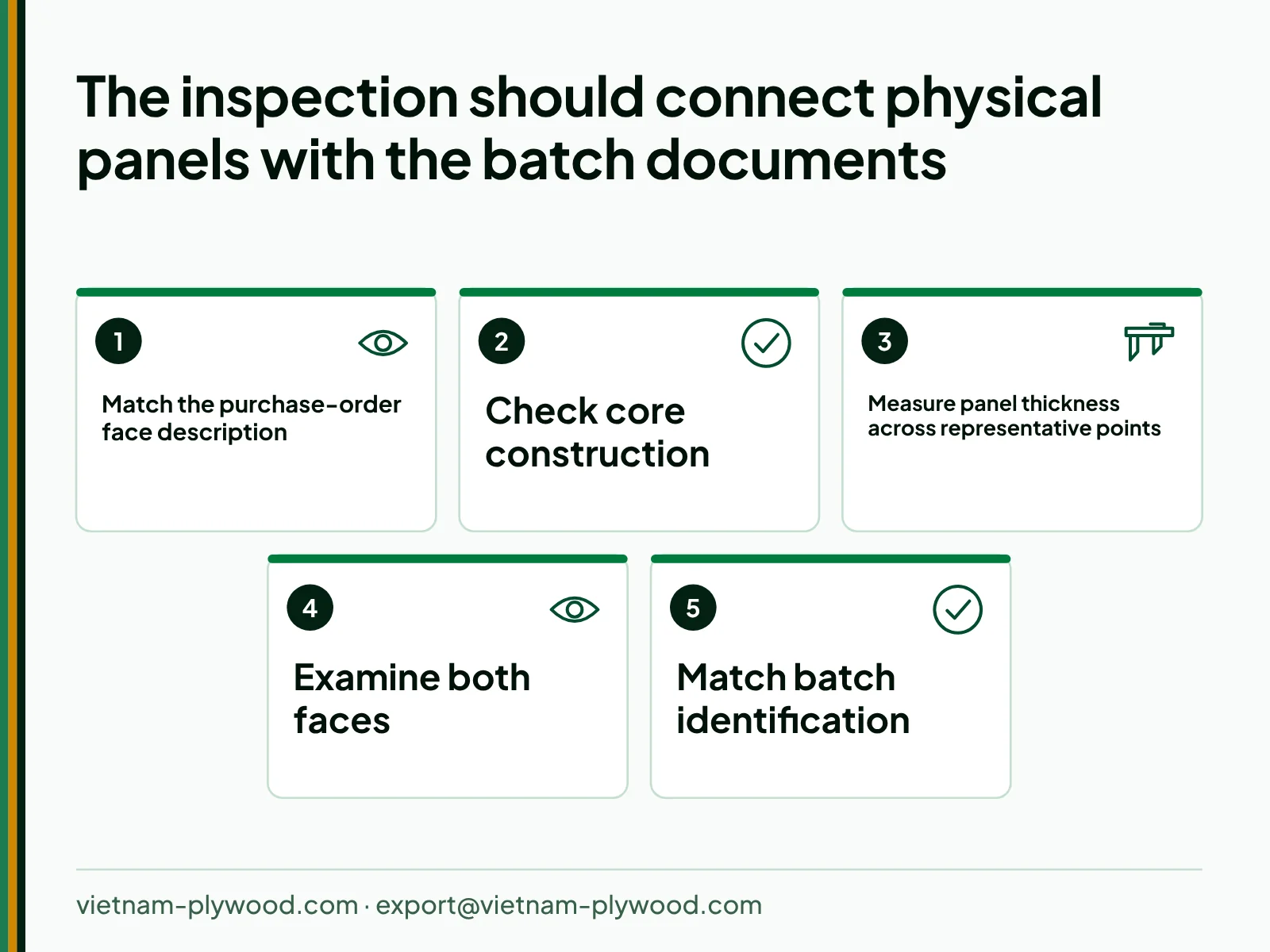
- Match the purchase-order face description and approved sample to the veneers being assembled.
- Check core construction: full stitched, stitched outer layers with edge-trimmed inner veneers, finger-jointed or loose-laid.
- Measure panel thickness across representative points and compare with the ordered tolerance.
- Examine both faces, edges, sanding and visible voids against the approved grade and sample.
- Match batch identification, packing marks and the shipment’s species schedule before loading.
Our furniture line uses full-stitched, sanded construction; the commercial and packing line uses a different core and finish specification. Buyers visit the factory office and inspect goods at the producing factory. HCPLY manages on-site quality control and export coordination from the line selected for the order.
How do buyers request a quotation and trial?
A usable quotation begins with a written application and an approved material identity. For a furniture-grade alternative to legacy lauan, the named face, stitched core, sanding and emission class drive the build. For commercial backing, the acacia core, MR glue and surface requirement drive the comparison.
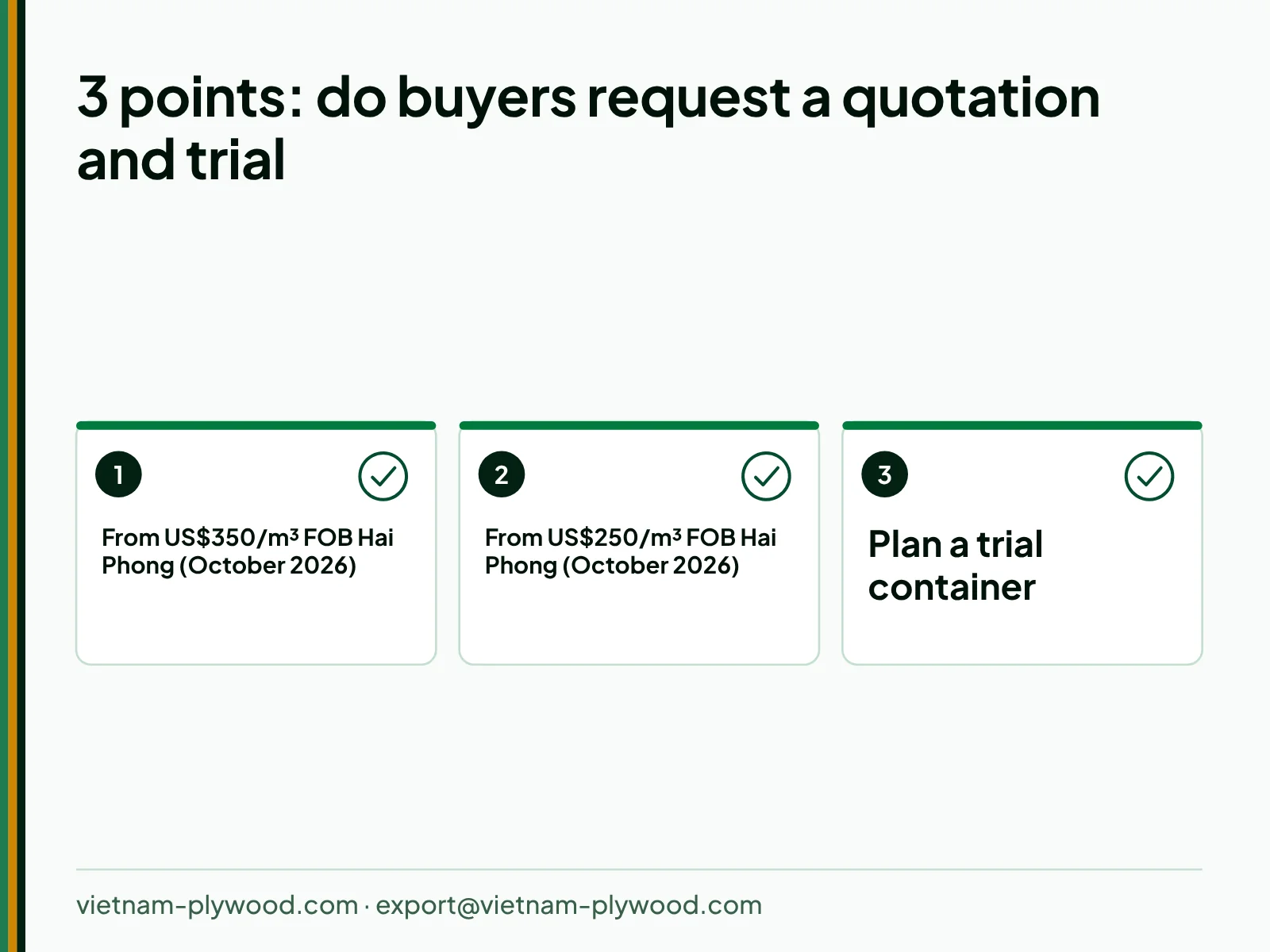
Indicative furniture plywood starts from US$350/m³ FOB Hai Phong (October 2026); commercial plywood starts from US$250/m³ FOB Hai Phong (October 2026). These are category starting prices, not a quoted price for a lauan-species panel. Veneer choice, core assembly, thickness, finishing and documentary requirements determine the actual quotation.
Factory lead time runs 15–45 days from receipt of the 30% deposit; the exact figure depends on order size, line loading and what the contract fixes. The remaining 70% is paid on the scan of the bill of lading, by T/T, or by irrevocable sight L/C. We ship FOB Hai Phong, or CFR (CNF) or CIF to your port. Samples cost nothing: a first-time buyer pays the courier, and that charge comes off the first confirmed order.
For repeat procurement, the distributor supply programmes page explains ordering continuity. Send Lucy at export@vietnam-plywood.com the following schedule through the contact page:
Application: interior door component / cabinet backing / RV lining / underlayment
Producing line or core: furniture—styrax or eucalyptus / commercial—acacia
Glue: MR melamine / phenolic WBP, as specified
Emission: E0 / E1 / other agreed requirement
Face and grade: named veneer species or EV; A/B (birch D/E/F); approved sample
Thickness and tolerance: ___ mm; ___ mm
Sheet size: ___ × ___ mm
Quantity: ___ sheets / ___ m³, by specification
Destination port: ___
Next step: plan a trial container against this written specification and an approved sample.