





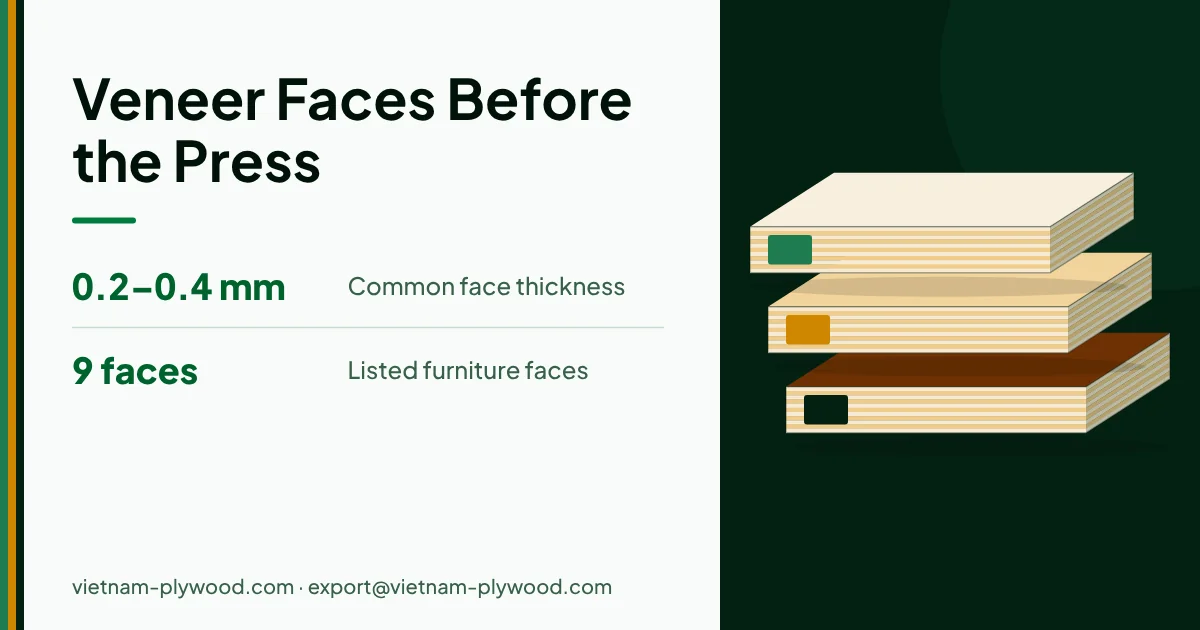
Real wood veneer on plywood is a genuine timber face bonded to a specified core; not every loose veneer-sheet species reaches HCPLY’s furniture press. A mistaken face choice can mean rejected cabinet panels, replacement costs and lost production days. This guide separates market veneer terms from the faces our furniture line builds and shows how to approve a lot before pressing.
What is real wood veneer?
Real wood veneer is a thin layer sliced or peeled from timber and used as a decorative or functional face. On plywood, that layer is bonded to a built-up wood core. Loose veneer sheets differ from finished plywood panels in core, backing and glue specification.
The U.S. Department of Agriculture Forest Service’s 2024 research paper distinguishes veneer sheets under tariff heading 4408 from plywood and veneered panels under heading 4412 (USDA Forest Service, 2024). That classification distinction is useful when writing a product description, although the importer’s customs classification must follow the finished goods.
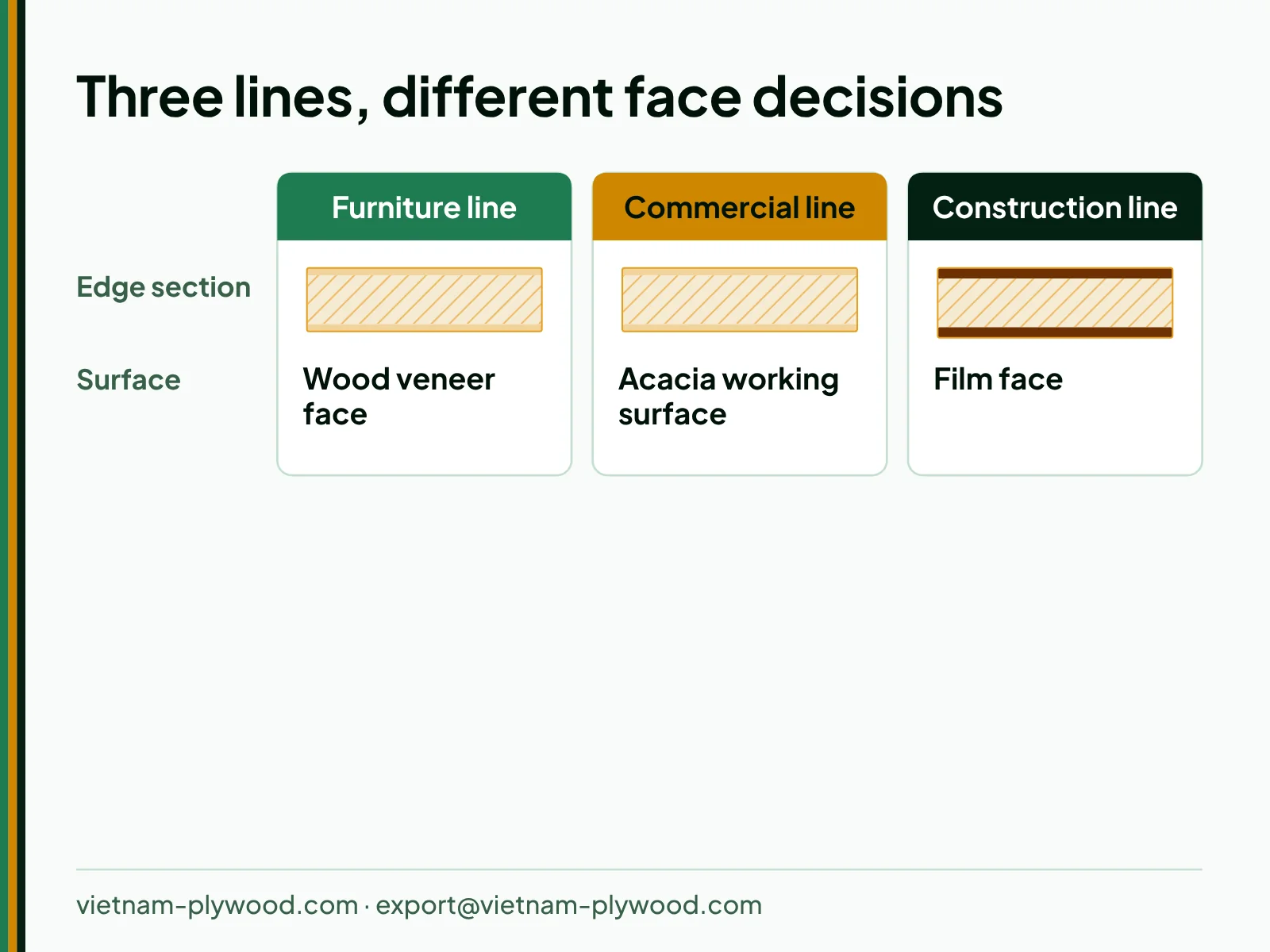
We press face veneers onto plywood on our furniture line. For the wider taxonomy, see Plywood Types and the face veneer guide.
Is oak veneer real wood?
Oak veneer is real wood when the visible layer is sliced or peeled oak timber. A printed oak pattern, a coloured laminate or a decorative paper is a different face material. An oak-looking surface does not identify the wood species by appearance alone.
Oak and walnut are common names in the broader veneer-sheet market, but neither is on our furniture line’s stated face list. For a purchase requiring an oak or walnut face, record that requirement explicitly rather than substituting a similarly coloured species. Melamine, high-pressure laminate (HPL) and other laminate faces are separate product topics, not our product lines.
Specify whether the order requires loose veneer, faced plywood or an oak appearance.
Which veneers reach our furniture plywood faces?
Our furniture line uses bintangor, okoume, engineered veneer (EV), gurjan, pine, poplar, eucalyptus, birch or sapele faces. The usual face veneer thickness is 0.2–0.4 mm, and the named face describes the surface rather than the core. Furniture cores are full stitched, sanded styrax or eucalyptus, with E0 or E1 emission classes.
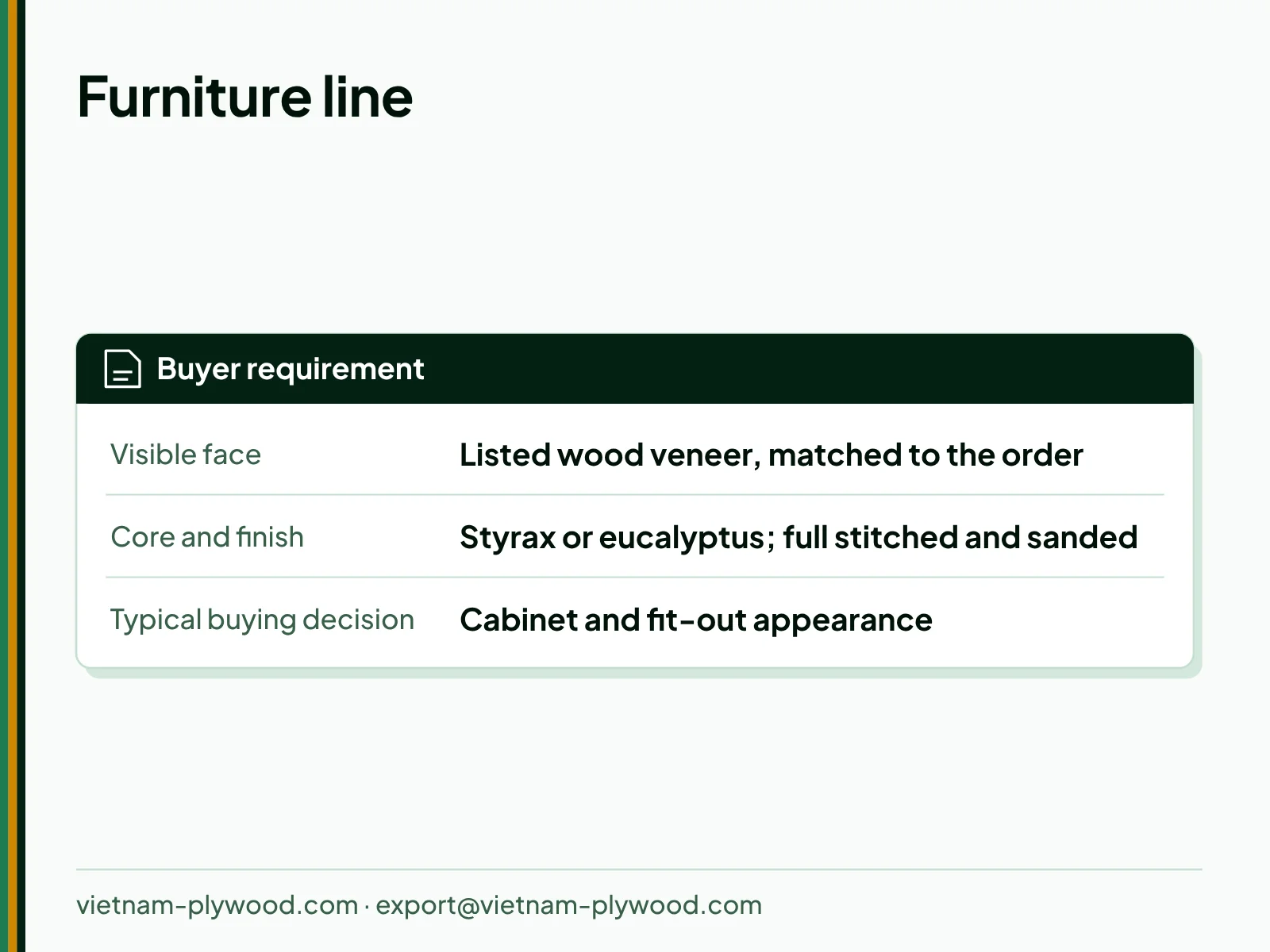
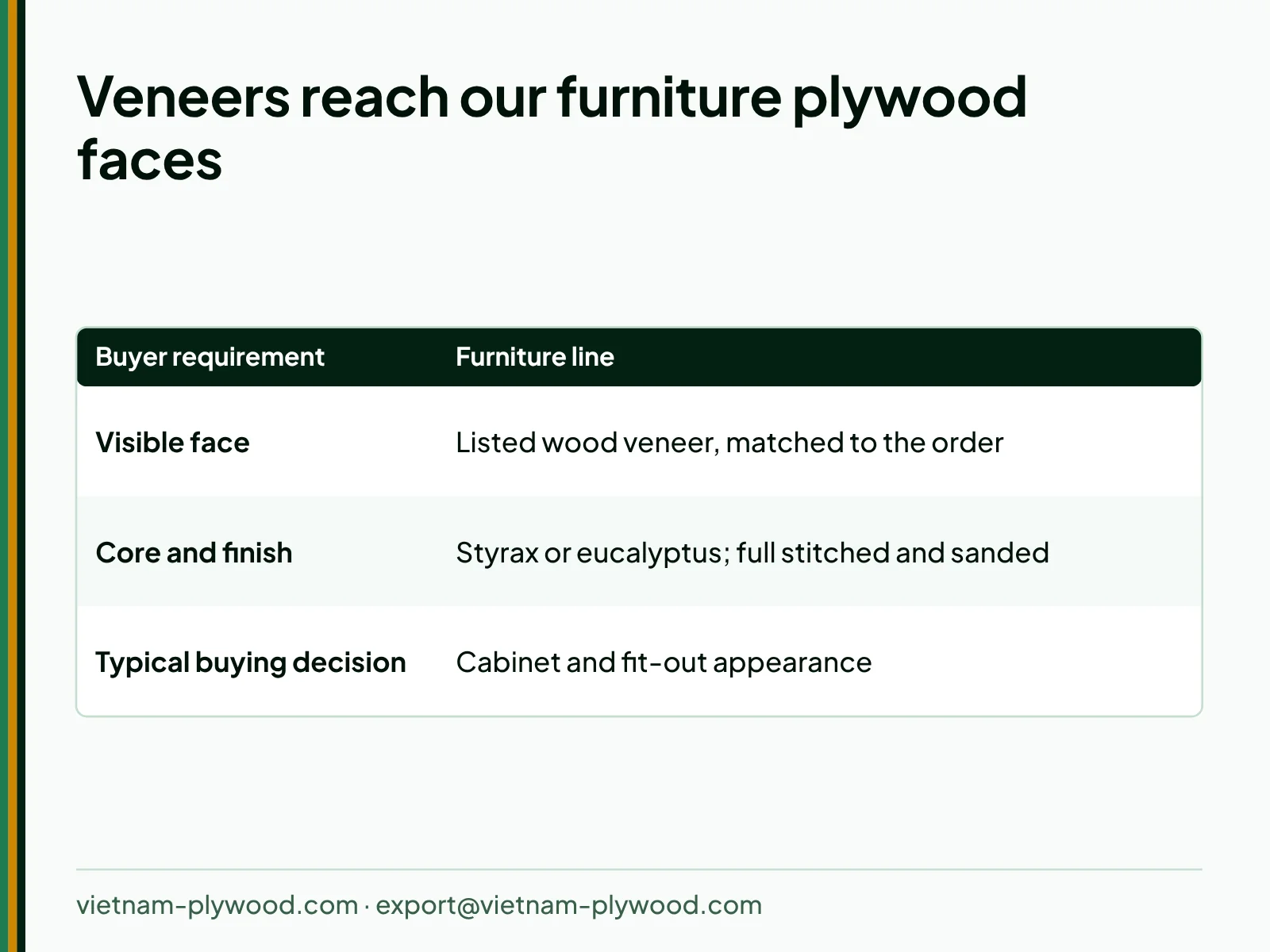
| Buyer requirement | Furniture line | Commercial and packing line | Construction line |
|---|---|---|---|
| Visible face | Listed wood veneer, matched to the order | Acacia-core working or packing surface | Phenolic or melamine film; anti-slip film option |
| Core and finish | Styrax or eucalyptus; full stitched and sanded | Acacia; unsanded or light-sanded | Acacia or eucalyptus; unsanded |
| Typical buying decision | Cabinet and fit-out appearance | Packing or commercial utility | Formwork surface and handling |
A cabinet face belongs on our furniture line. Our commercial and packing line builds acacia-core plywood with moisture-resistant (MR) glue; our construction line presses film-faced panels instead. The EV plywood product and birch alternatives explain two routes for appearance-led specifications.
Face grade A/B applies to the listed faces other than birch; birch uses D/E/F. A grade letter must therefore travel with the species and the buyer’s agreed visual sample.
Can birch or walnut veneer cover 4 x 8 plywood sheets?
Birch veneer is on our face list; walnut veneer sheets are a separate market product and are not on that list. For a nominal 4 x 8 request, write the actual millimetre dimensions: 1220 × 2440 mm is one of our panel sizes. This prevents a nominal-size label from concealing a cutting or fit-out mismatch.
Birch-faced panels should be specified with the D/E/F face grade, core, glue and finish requirements. For colour selection, compare natural birch versus white birch faces before approving a lot. If the design calls for a walnut look, do not rename EV or another face as walnut: approve the actual face species or engineered pattern by sample.
Other listed sizes include 1250 × 2500 mm and 1220 × 2135 mm. Custom cutting is available. Record size on the purchase specification and inspection record.
What does crown cut veneer mean?
Crown cut veneer describes a slicing pattern that produces arching, cathedral-like grain figures across the face. It describes how the log is cut, rather than a species or an automatic face grade. A straight-grain or quarter-cut appearance is a different visual selection.
When a drawing says veneer crown cut, pair the cut description with an approved reference sample, permitted figure variation and matching direction. Specify whether adjacent cabinet doors should be sequentially matched or simply similar in tone. Species alone cannot resolve matching.
Crown cut is a market specification term; it is not a separately stated HCPLY face option. The producing factory should work from an agreed visual reference before any matching instruction becomes an acceptance criterion.
What are bleached veneer and black veneer sheets?
Bleached veneer is wood veneer treated to lighten or equalise its natural colour. Black veneer sheets can refer to dyed wood veneer or a dark decorative face, so the phrase alone does not identify the material. Neither treatment is a separately stated face option on our furniture line.
A buyer requesting bleached veneer should define the target tone, whether grain remains visible and which finish will be applied after pressing. For a dark face, specify natural species, dyed veneer or printed surface as distinct alternatives. The physical sample should show colour and grain.
Veneer colours change the visual brief, but they do not change the density assigned to the plywood core. For finished-surface alternatives, consult prefinished plywood options.
How is a face lot matched before pressing?
A face lot is matched against the approved species, grade, grain and colour reference before it enters the press. Our on-site quality-control team can arrange a buyer inspection at the producing factory. The acceptance record should identify the lot being checked and the approved reference.
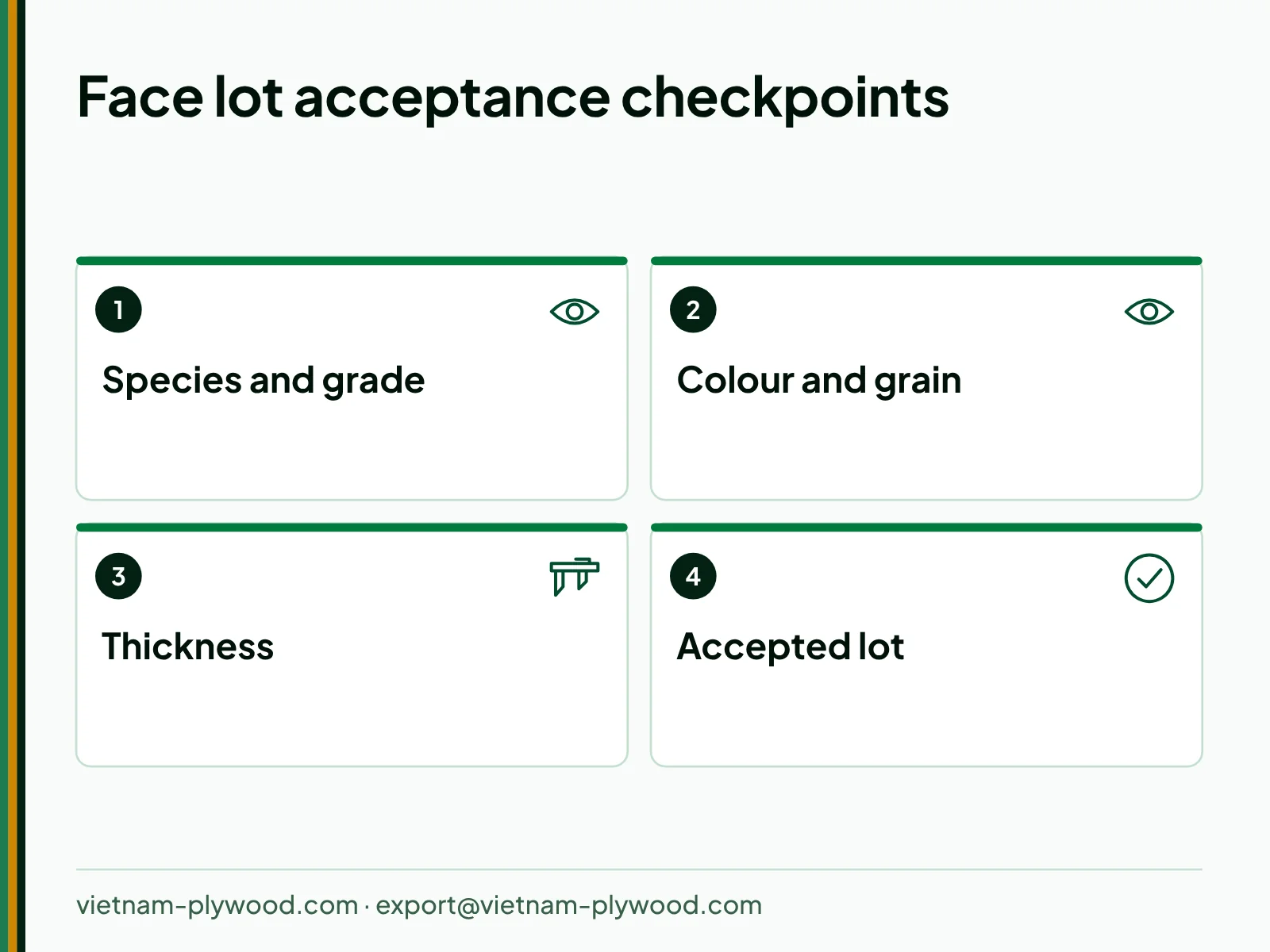
- Identify the face species and requested grade on the order and sample label.
- Lay out representative sheets under consistent lighting to compare colour, figure and visible repairs.
- Check grain direction, adjacent-sheet matching and the agreed cut appearance against the reference.
- Measure the specified face thickness at the agreed inspection points and record deviations.
- Separate rejected faces before lay-up; record the accepted lot for pressing and later panel inspection.
For cabinet programmes, request a physical sample set from the intended face lot.
Which thickness and tolerance belong on the order?
A face specification needs both the veneer thickness and the finished panel thickness. Our usual face veneer is 0.2–0.4 mm; finished plywood is available from 3–40 mm, with common selections including 9, 12, 15 and 18 mm. The veneer thickness guide treats face measurement separately.
For furniture plywood, specify a sanded thickness tolerance of ±0.2 mm or ±0.3 mm as ordered. Length and width tolerance is ±2 mm. An 18 mm core construction commonly contains 11–13 plies, reflecting the thickness of individual core veneers.
The face cannot be evaluated from the overall thickness alone. An inspector should check the finished panel against its tolerance and inspect exposed edges for core construction. Sanding tolerance matters alongside visual matching.
How does the face choice affect a container?
The face names the panel, but the core drives the stated density and loading weight. At 18 mm and 1220 × 2440 mm, a styrax-core sheet weighs 26.79 kg, an acacia-core sheet 31.08 kg and a eucalyptus-core sheet 34.83 kg, excluding film weight. Those differences affect a mixed load even when the face appears similar.
A full 40HC reference load at that size and thickness is 990 styrax-core sheets at 26.52 t, 880 acacia-core sheets at 27.35 t or 795 eucalyptus-core sheets at 27.69 t. The payload limit is 28.5 t. Specifications can share a container within that limit; plan a mixed shipment by adding each line’s sheet weights and pallet arrangement.
The mixed-container guide covers combining specifications; container loading figures belong to the packing reference. Face appearance alone is not a sound loading calculation.
Which records follow the approved face?
The order specification and agreed face sample establish the acceptance reference. For shipment, the packing list identifies the goods and quantities, while the commercial invoice describes the invoiced build. We handle the export documentation and loading from the producing factory, with FOB Hai Phong as the factory-direct route.
The shipment document set includes the invoice, packing list, bill of lading, certificate of origin, relevant phytosanitary and fumigation papers, and the order’s agreed certificate or test documents. For European Union lots, the file includes the EUTR/EUDR documents and EUR.1 where applicable. Member-factory certificates can be shown with factory details masked, on request.
After loading, the draft shipping documents come to you for approval. Record the approved face designation consistently across the order and shipment papers to avoid disputes at receiving inspection.
What should a buyer send for a veneer-faced plywood quotation?
Send the actual face species, visual reference, grade and panel build before requesting a quotation. Face availability, matching effort, core selection, thickness and finishing requirements are the main pricing drivers. A more selective face match requires additional sorting compared with a broadly accepted natural figure.
For furniture plywood, the indicative starting point is from US$350/m³ FOB Hai Phong (October 2026). This starting figure is for furniture plywood, rather than a separate quote for birch, walnut, bleached or crown-cut faces. The written specification determines the quotation.
The minimum order is one 40HC, with mixed specifications allowed within the payload limit. Production takes 15–45 days from the 30% deposit, set by order size, line loading and the contract. The remaining 70% is payable against the scanned bill of lading by telegraphic transfer or irrevocable letter of credit at sight. See production lead time and export-ready commercial plywood for related buying decisions.
What specification should be sent for sample approval?
A useful request fixes the face’s identity and visual acceptance before production. Include a physical sample reference where grain, colour or matching has commercial consequences. Send the following lines to Lucy at export@vietnam-plywood.com, then request a sample set from the producing factory.
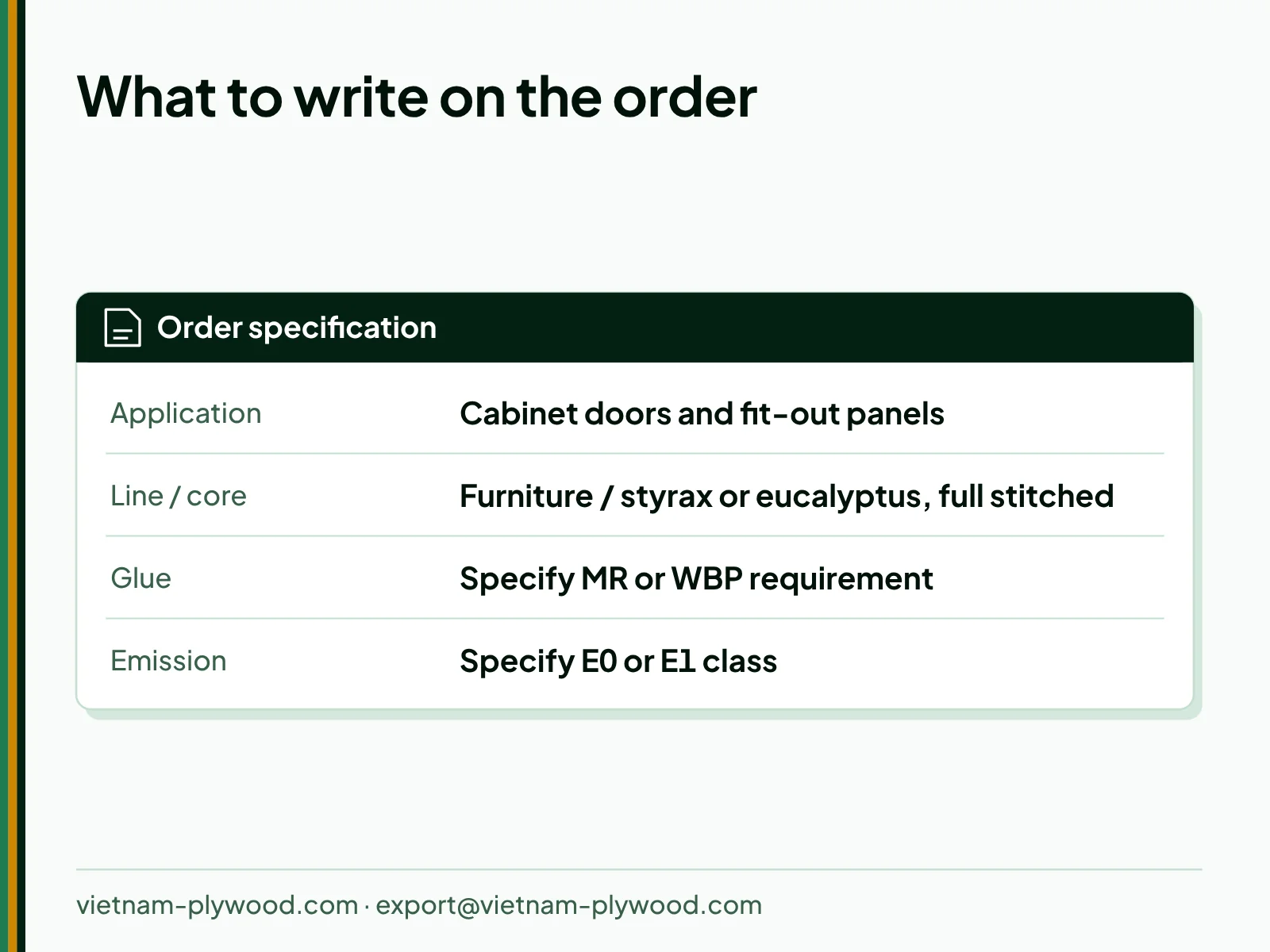
Application: Cabinet doors and fit-out panels
Line / core: Furniture / styrax or eucalyptus, full stitched
Glue: Specify MR or WBP requirement
Emission: Specify E0 or E1 class
Face and grade: Species, applicable grade, cut, grain and approved sample
Face thickness: Specify within agreed face build
Panel thickness / tolerance: e.g. 18 mm / ±0.2 mm sanded
Sheet size: e.g. 1220 × 2440 mm
Quantity: Sheets and container mix
Destination port: [port and country]
Ask for a sample set showing the proposed face lot, grain direction and colour range before approving the order.