





Meranti plywood specifications can be matched to bintangor, okoume or EV faces on HCPLY furniture panels when the buyer approves the new appearance. A wrong face or core choice can cost a rejected load, rework and lost production days. The original meranti sample should govern colour acceptance; the purchase order should separately identify grade, bond, core and tolerance.
What is meranti plywood?
Meranti plywood is a veneer-faced panel named for meranti, a commercial grouping of Shorea hardwoods, rather than a promise about its internal core. Red and light meranti are appearance descriptions that require a physical reference. Buyers should separate the face species, colour range, construction, bond and acceptance criteria before requesting a replacement.
The United States Department of Agriculture Forest Service’s Wood Handbook (2021, General Technical Report FPL–GTR–282) provides the technical publication reference for wood materials. Species names alone cannot establish the properties of a finished plywood build. See the 2021 USDA Wood Handbook record.
Dark red meranti ranges from medium to deep red and dark brown, sometimes with a purple cast. Light red meranti has a much wider range, including pale pink and brown. The difference matters on adjacent cabinet doors: two panels sold under the same broad name can look unrelated after a clear finish.
A meranti board specification should identify whether the buyer wants a reddish face, a particular grain, or a genuine Shorea veneer. Those are different procurement requirements. For a wider species discussion, see our hardwood plywood guide.
Is meranti-faced plywood still available from Vietnam?
Meranti-faced plywood can still appear in commercial offers, but we do not list meranti among the faces our lines press. We therefore treat a meranti enquiry as a face-matching exercise rather than quote an unverified meranti species. The available reference sample determines whether an alternative is commercially acceptable.
A supplier listing or an old product photograph cannot establish the species in a current shipment. An advertised meranti marine designation is not a universal specification for every meranti panel. Any such claim must be checked against the actual lot and the buyer’s acceptance document.
Ask whether “meranti” on the purchase order means botanical identity or the appearance traditionally bought under that name. If identity is mandatory, do not silently substitute bintangor, okoume or engineered veneer. If colour and surface are the actual purchasing criteria, request labelled face samples and a written approval record before production.
The alternative must also preserve the agreed panel thickness, bond type, surface grade and intended indoor application. A matching reddish face cannot rescue a wrong core construction or a bond unsuitable for the specified service conditions.
Which faces do our lines quote in place of meranti?
HCPLY’s furniture line quotes bintangor, okoume or engineered veneer (EV) against an approved meranti colour reference. The choice is based on appearance and the requested finish, while the core and bond are specified separately. Our commercial and packing line can quote a simpler acacia-core panel where the appearance requirement permits it.
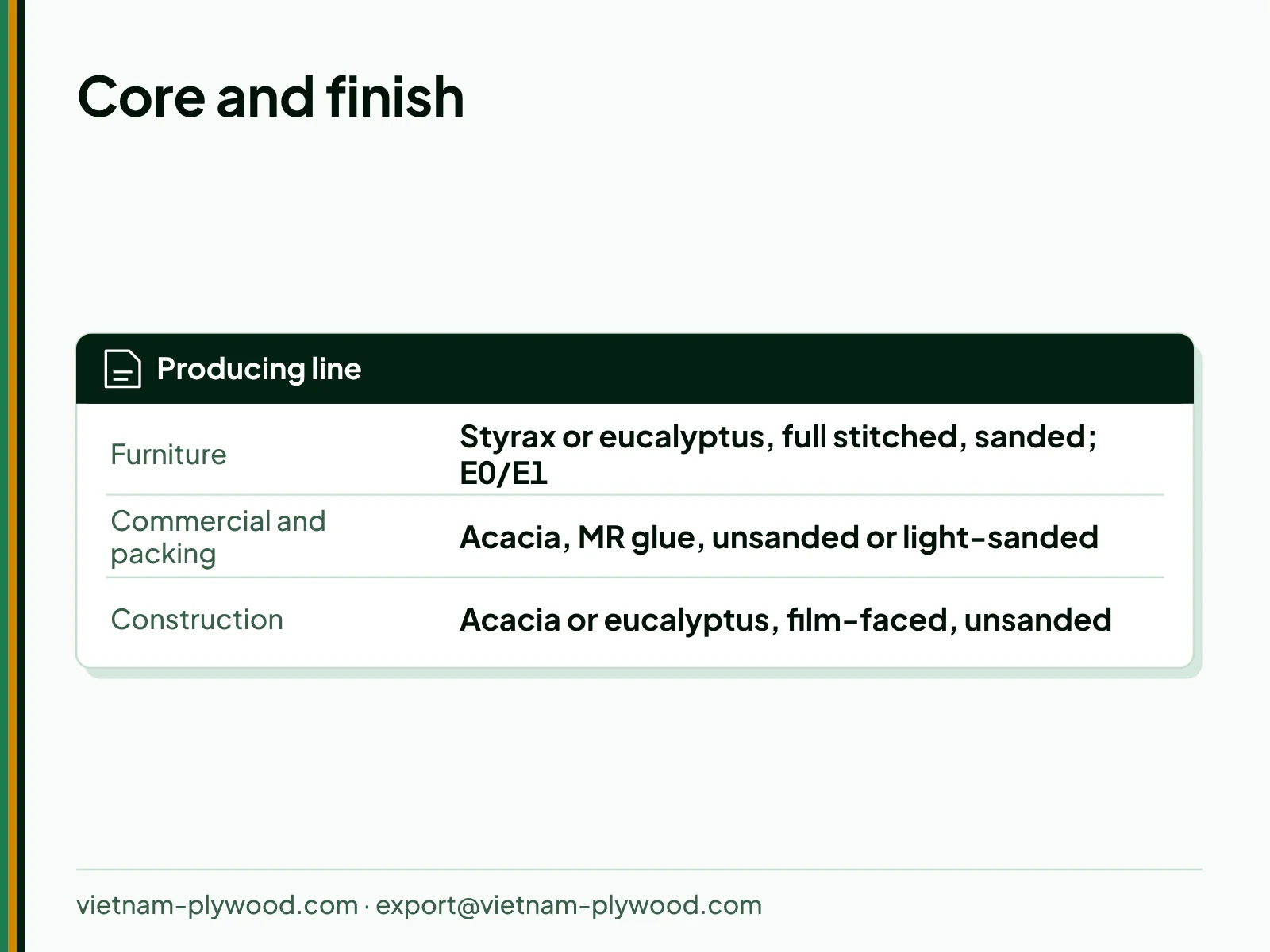
| Producing line | Core and finish | Typical replacement conversation | What the other line would build instead |
|---|---|---|---|
| Furniture | Styrax or eucalyptus, full stitched, sanded; E0/E1 | Bintangor, okoume or EV face against a signed colour sample | Commercial line prioritises a utility acacia core and less surface preparation |
| Commercial and packing | Acacia, MR glue, unsanded or light-sanded | Face selection only where the intended appearance and finish are compatible | Furniture line builds the sanded decorative specification |
| Construction | Acacia or eucalyptus, film-faced, unsanded | No exposed meranti-look veneer in this build | Furniture line handles decorative face matching |
The table describes the different manufacturing choices, not three interchangeable grades of meranti ply. For a side-by-side view of line specifications, use compare plywood grades across factory lines. Our bintangor plywood specification is the closest starting point when the reference sample is reddish.
The face names describe what the customer sees; density follows the core. A bintangor-faced styrax panel uses the styrax core density in shipment arithmetic. Calling the entire panel “meranti density” would conceal that distinction.
How do red and light meranti compare with bintangor, okoume and EV?
A reddish bintangor face is the first visual candidate for a red-meranti brief; okoume is a candidate for a lighter, warmer brief; EV is useful when repeated visual pattern is the priority. None is a botanical replacement for meranti. Final approval must come from actual face samples under the buyer’s finish.
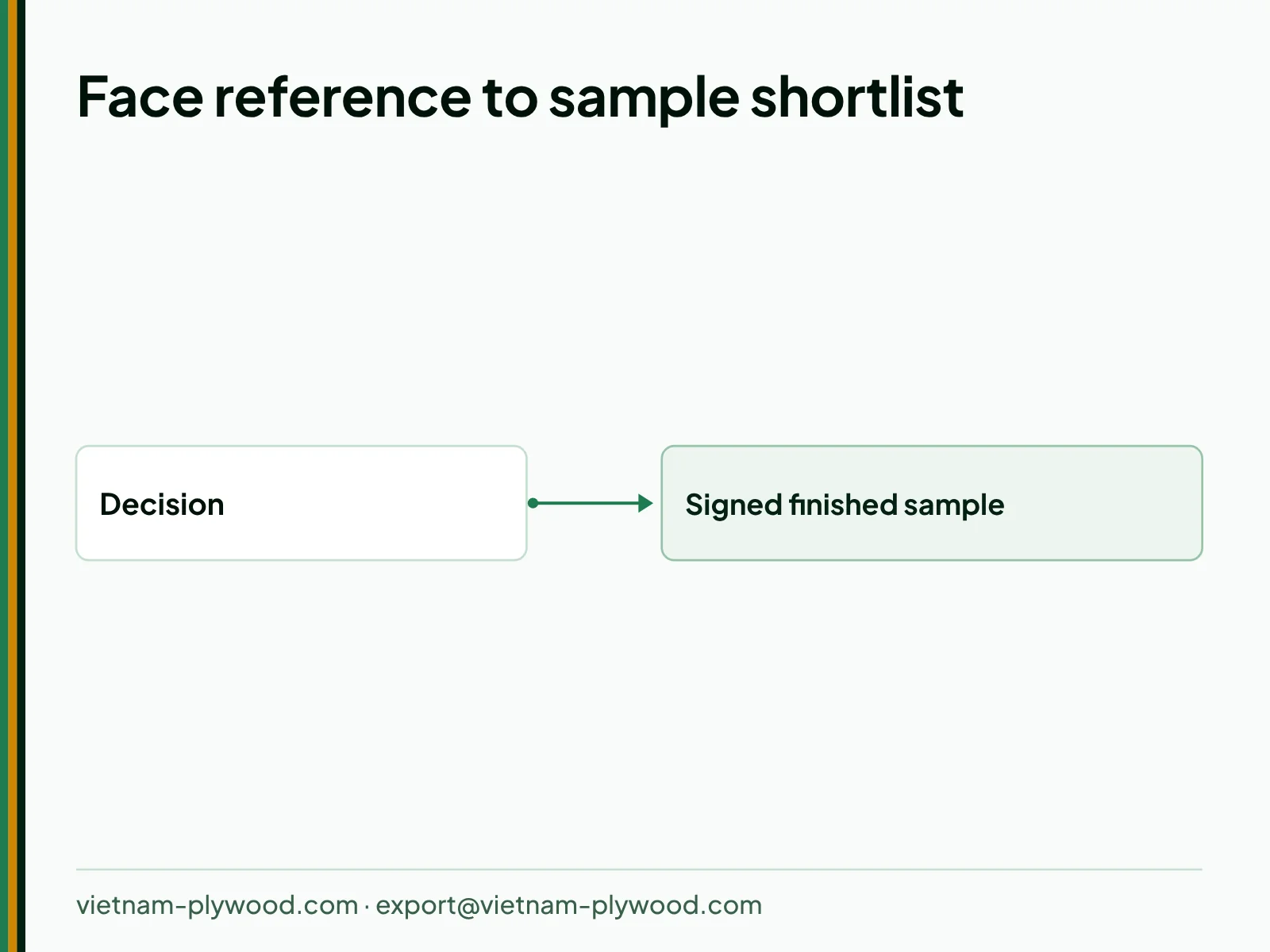
| Face reference | Colour target to inspect | Grade decision | Verdict by use |
|---|---|---|---|
| Dark red meranti reference | Deep red to reddish brown; possible purple cast | Define allowable light and dark pieces | Reference for darker cabinetry, not an offered face |
| Light red meranti reference | Pale pink through brown; wide natural range | Fix the acceptable range with samples | Reference for lighter fit-out panels |
| Bintangor | Reddish tone; compare undertone with reference | Specify A/B and visible defects | First trial for red-toned decorative cabinets |
| Okoume | Light pinkish to warm reddish tone; inspect actual veneer | Specify A/B and colour sorting | Trial for lighter cabinetry and paint-ready fit-out |
| EV | Engineered pattern and controlled visual repeat | Specify A/B and approved pattern | Trial for repeatable decorative runs, not species authenticity |
The colour descriptors for the offered faces are selection targets, not fixed shades. Natural veneer changes across logs and after finishing. The buyer should inspect both raw and finished samples using the intended coating, since stain can amplify a mismatch that looked minor on bare wood.
Our common face veneer thickness is 0.2–0.4 mm. A thicker-looking grain photograph does not prove a thicker veneer. Request a cross-section check and a written face-thickness specification where sanding allowance or surface preparation matters.
A/B is the available face-grade vocabulary for these faces. Define the permitted knots, patches, splits, colour bands and repairs in the signed sample or order schedule; an A/B label alone is not a photographic acceptance standard. See the face-veneer comparison for other appearance choices.
What is the difference between meranti and okoume plywood?
Meranti identifies a Shorea face group, whereas okoume identifies a different veneer face. Neither name fixes the panel’s core, glue or emission class. For a furniture buyer, the practical difference starts with colour approval and continues through the written build.
A dark red meranti reference can be considerably deeper than the okoume sample available for a production lot. Light red meranti can overlap visually with a pinkish okoume selection, but overlap is not equivalence. A customer who specifies “okoume vs meranti plywood” should send a retained meranti sample rather than rely on catalogue names.
Core construction can dominate machining and edge appearance. A full-stitched core gives the furniture line a different starting point from a loose-laid or finger-jointed utility core. When a cabinet maker edge-bands, routes or drills the sheet, core gaps and thickness variation may matter more than the face’s trade name.
Glue is another independent field. Melamine glue is described as MR with a 12-hour boil condition for this build; phenolic glue is described as WBP with a 72-hour boil condition. Those conditions do not turn a decorative face into a marine-grade panel. Emission class, such as E0 or E1, is separately specified. Luan plywood terminology can help buyers disentangle related trade names.
Which thickness, grade and core should the replacement use?
Start with the original panel’s measured thickness and edge construction, then write the substitute around the same fabrication requirements. We offer thicknesses from 3–40 mm, with common selections of 3, 5, 9, 12, 15, 18, 21 and 25 mm. The specified tolerance must accompany the nominal thickness.
For sanded furniture plywood, order ±0.2 mm or ±0.3 mm thickness tolerance. Commercial and film-faced plywood use ±0.5 mm, while packing plywood uses ±0.5–1.0 mm. Length and width tolerance is ±2 mm. A cabinet programme designed around tightly fitted grooves should not accept a packing tolerance merely because the face looks similar.
Available sizes include 1220×2440, 1250×2500, 1220×2135, 1220×1830, 915×2440, 915×2135 and 915×1830 mm; custom cutting is available. Write dimensions in millimetres to avoid mixing nominal imperial references with the actual cutting instruction.
At 18 mm, a core can contain 11–13 plies because the individual core veneer thickness is 1.4–2.0 mm. Ply count alone is not a quality grade. Ask to inspect voids, stitching, repairs and the edge profile, then link the approved core construction to the purchase specification.
For cabinets with visible edges, choose the full-stitched furniture build and specify the face sample. For hidden packaging applications, the commercial build may be sufficient when the customer accepts its surface and tolerance. The hardwood versus softwood plywood comparison covers broader construction differences.
How can a meranti buyer switch the spec without surprises?
A safe substitution is a documented change to face, grade and acceptance samples while keeping every functional requirement visible. The purchasing team should record exactly which old meranti requirement is being replaced. Production should begin only after the buyer accepts the new reference.
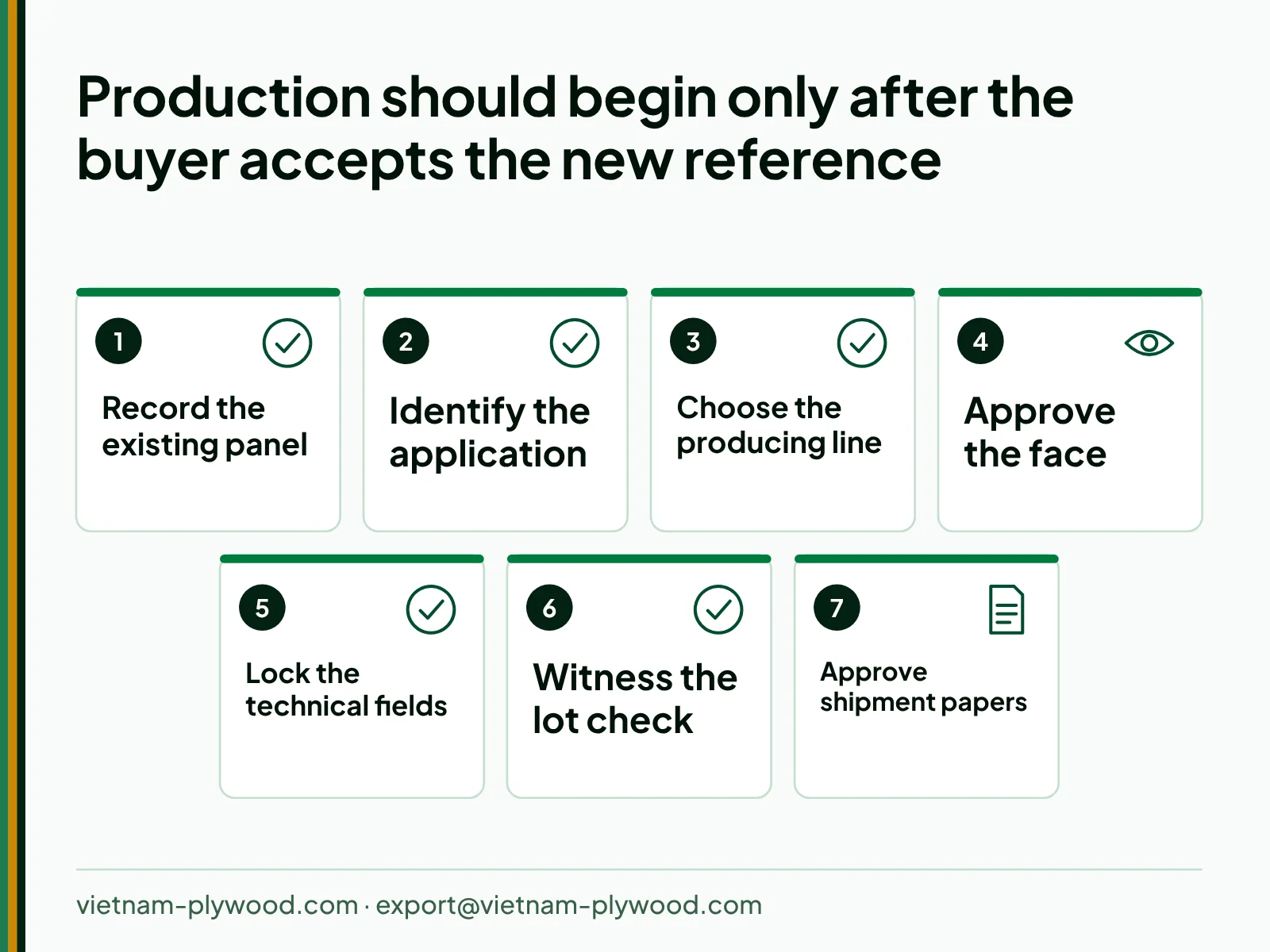
- Record the existing panel. Keep a labelled offcut, the previous purchase order and photographs of both sides and an exposed edge. Note whether the original requirement named Shorea or only a meranti appearance.
- Identify the application. Separate visible cabinet doors, hidden carcasses, painted components and export packing. The same reddish face does not create the same acceptable build for all uses.
- Choose the producing line. Request a sanded full-stitched furniture build for decorative work, or a commercial build when utility appearance is acceptable.
- Approve the face. Compare bintangor, okoume and EV samples in the actual finish. Mark the approved front, back, colour range, repairs and grain direction.
- Lock the technical fields. Write core, glue, emission, grade, dimensions, thickness tolerance and quantity as separate entries. Do not infer one field from another.
- Witness the lot check. Compare random finished panels with the retained sample, inspect edges and record measured thicknesses at the producing factory.
- Approve shipment papers. Check that the invoice, packing list and order-specific certificate documents describe the agreed replacement, rather than repeating the old meranti name.
A switch made only in an email subject is difficult to audit. A signed sample and revised specification give both sides an objective basis for resolving a colour dispute. The same practice applies to repeat orders when a veneer lot changes.
What can an inspector check at the producing factory?
An inspector can compare the approved face sample against finished sheets, measure thickness and check the visible core at panel edges. Those observations directly test the specification most likely to cause a rejected decorative load. The check should be recorded against the particular production lot.
At the producing factory, first identify the approved reference and inspect face colour in consistent lighting. Check the front and back separately, including grade, repairs, open splits and grain orientation. Compare panels from different pallet positions rather than selecting only the top sheet.
Next, use a calibrated measuring tool to record thickness at agreed positions and compare with the ordered tolerance. Inspect the cut edge for core gaps, veneer overlaps and the requested full-stitched construction. A visual inspection cannot establish glue-boil performance or emission compliance; those require an accepted test report or relevant certificate documentation.
Our export team coordinates on-site quality control, documentation and loading. Buyers may visit the factory office and inspect goods at the producing factory. The inspector should retain photographs of sample labels, measured readings and pallet identification, then report exceptions before the load is released.
Where a certificate is required, documents belonging to member factories can be shown with factory details masked, on request. FSC, CARB P2, ISO 9001 and CE should never be inferred from a face species or from an unrelated production lot.
How does core choice change container loading?
Core density changes the payload calculation even when the face, size and thickness stay the same. For a 40HC container with a 28.5 t payload limit, our reference calculation for 18 mm sheets at 1220×2440 mm gives 990 styrax-core, 880 acacia-core or 795 eucalyptus-core sheets.
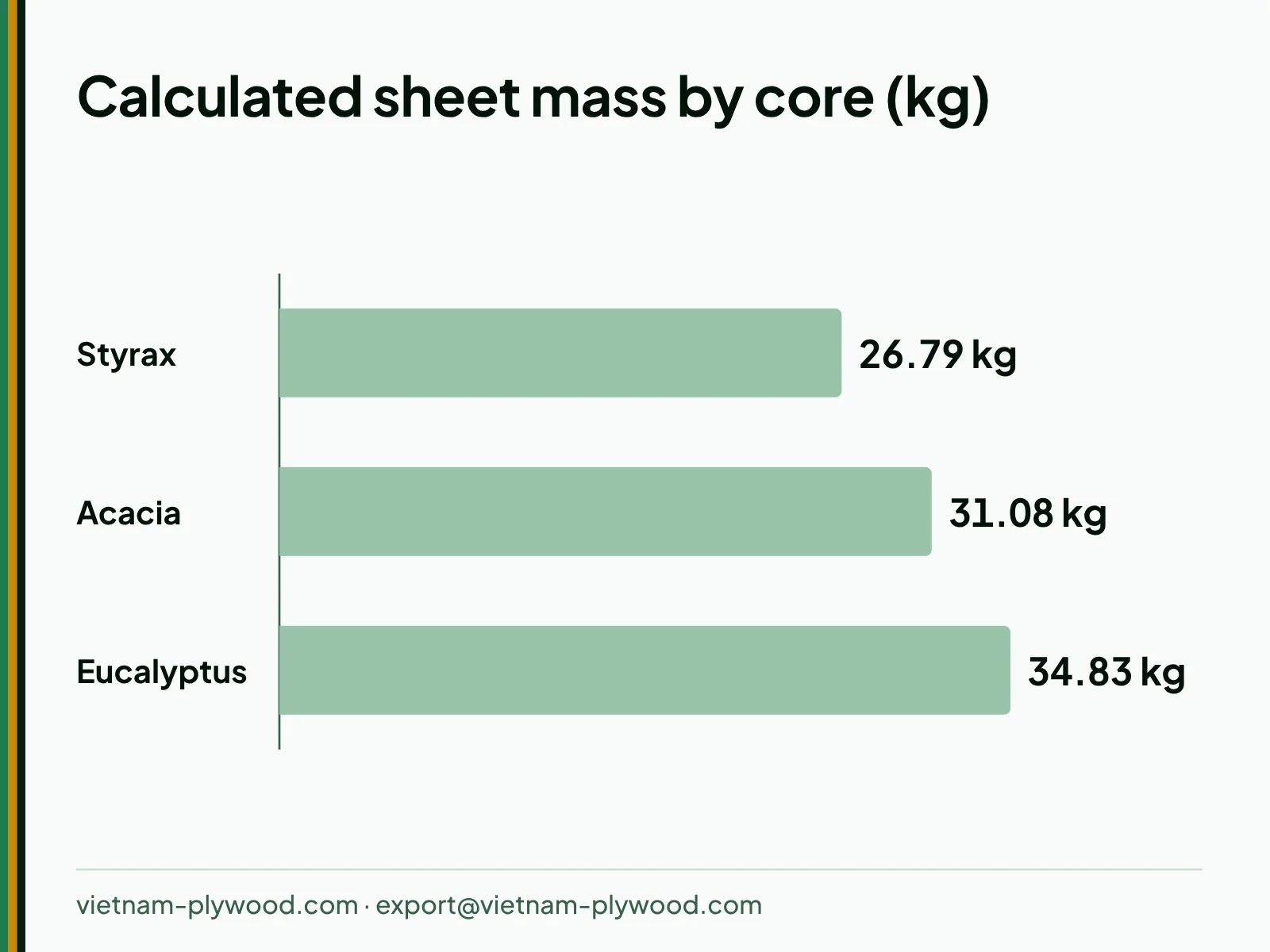
| Core | Density used | Pallets | Sheets per pallet | Total sheets | Calculated sheet mass |
|---|---|---|---|---|---|
| Styrax | 500 kg/m³ | 18 | 55 | 990 | 26.79 kg |
| Acacia | 580 kg/m³ | 16 | 55 | 880 | 31.08 kg |
| Eucalyptus | 650 kg/m³ | 15 | 53 | 795 | 34.83 kg |
The calculation uses sheet volume × core density; it does not use the meranti, bintangor or okoume face name as a density input. At the stated pallet stack heights, 18 mm sheets give 55 sheets per 1000 mm stack and 53 per 970 mm stack after rounding down. Each full reference load falls in the 26–29 t range.
Specifications can be mixed in a container within the payload limit, so a decorative furniture order can share space with an agreed commercial specification. Recalculate each pallet group separately when core or dimensions change. The container-load calculation owns the full packing method and additional sizes.
What paperwork and commercial terms apply?
The shipment documents should describe the approved substitute face and the producing build consistently. A commercial invoice and packing list identify the goods; the bill of lading (B/L) records the shipment. The certificate of origin and agreed certificate or test documents address origin and specified compliance evidence.
The document package also includes phytosanitary and fumigation papers, insurance under CIF, and the order’s agreed certificate documents. For European Union lots, it includes EUR.1 where applicable and the EUTR/EUDR file set. After loading, the draft shipping documents come to you for approval. Do not relabel bintangor-faced panels as meranti to match an outdated purchase order.
Minimum order is one 40HC; one container can carry several specifications as long as the payload limit holds. Factory lead time runs 15–45 days from receipt of the 30% deposit; the exact figure depends on order size, line loading and what the contract fixes. The remaining 70% is paid on the scan of the bill of lading, by T/T, or by irrevocable sight L/C. We ship FOB Hai Phong, or CFR (CNF) or CIF to your port.
Samples cost nothing: a first-time buyer pays the courier, and that charge comes off the first confirmed order. Commercial plywood starts from US$250/m³ FOB Hai Phong (October 2026). This dated starting price is a category reference, not a meranti replacement quotation.
For a specific face-matched panel, the biggest price drivers are the chosen production line and core construction, followed by face sorting and grade, then thickness, size and ordered quantity. A sanded full-stitched furniture build costs more than a utility commercial build because it requires more core preparation and finishing. Request a written quotation against the approved specification rather than assume a price from the veneer name.
Does meranti marine ply mean a marine-certified replacement?
No: a meranti marine ply label does not establish that a different-faced panel meets a marine specification. The intended service, construction and test evidence must be agreed separately. We describe a marine or BS 1088 build only against a test report the buyer accepts.
A water-and-boil-proof glue description is a bond specification, not proof of all the requirements associated with a marine standard. Face quality, internal gaps, construction and test methods also need review. The old meranti sample might be suitable for an interior cabinet but provide no evidence for a boat or wet-service application.
If the project calls for BS 1088, ask for the exact edition, the buyer’s acceptance criteria and a report for the proposed build before treating the substitute as acceptable. Do not infer structural performance from a darker veneer or a heavier core. The factory lines do not offer a blanket marine certification based on a product name.
What should a buyer send for a replacement specification?
Send the retained meranti sample and the original performance requirements together. We can then quote an identified face, grade and core rather than a vague “equivalent meranti” description. The specification below is the handoff for purchasing, production and inspection.
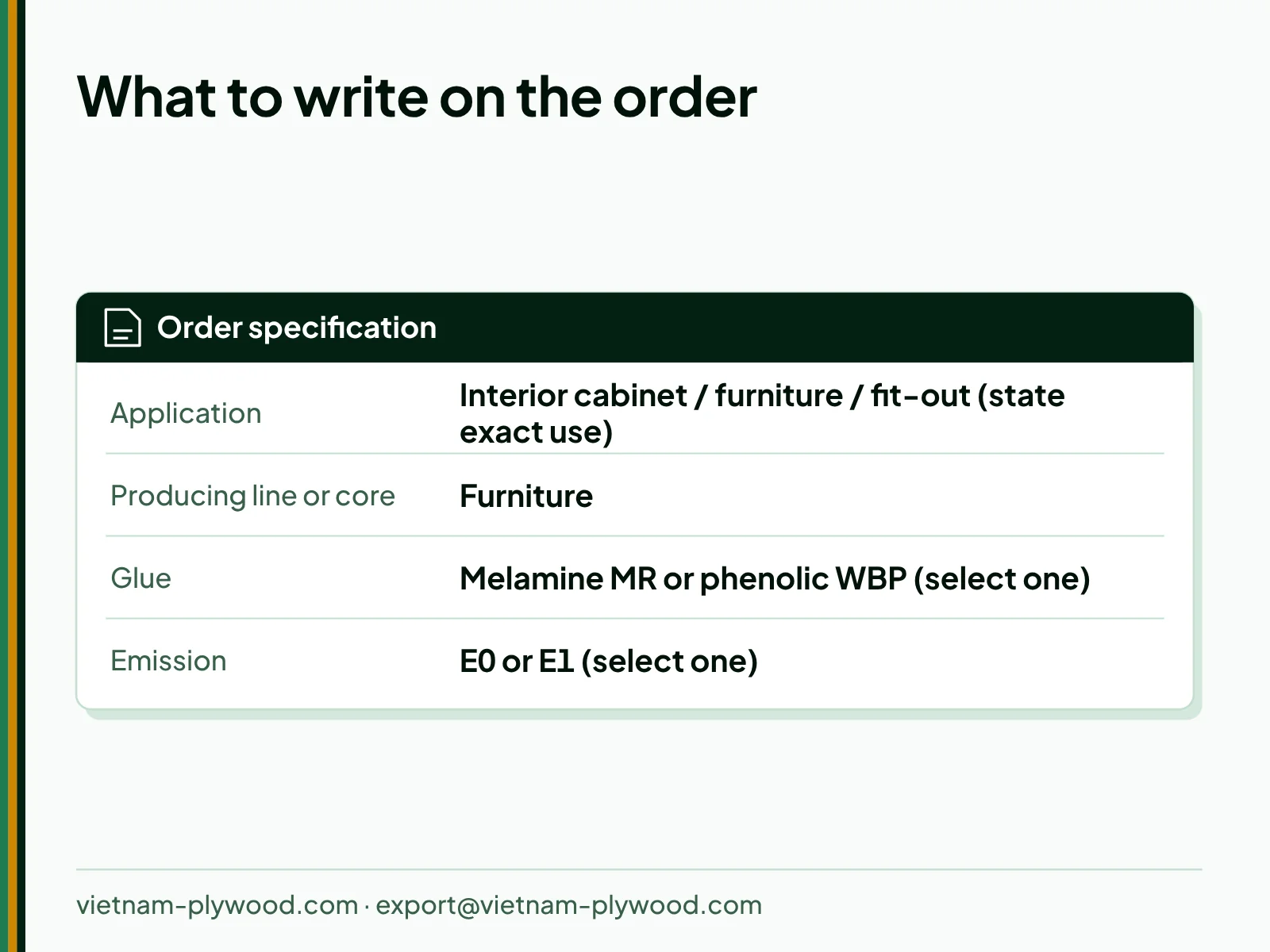
Application: interior cabinet / furniture / fit-out (state exact use)
Producing line or core: furniture; styrax or eucalyptus, full stitched
Glue: melamine MR or phenolic WBP (select one)
Emission: E0 or E1 (select one)
Face and grade: bintangor / okoume / EV; A/B; approved reference sample
Thickness and tolerance: ___ mm; +/-0.2 or +/-0.3 mm as ordered
Size: ___ x ___ mm; length/width tolerance +/-2 mm
Quantity: ___ sheets / ___ m3; minimum one 40HC
Destination port: ___
Request the spec sheet through contact and attach the signed face reference so the quotation can be tied to the same acceptance criteria.