





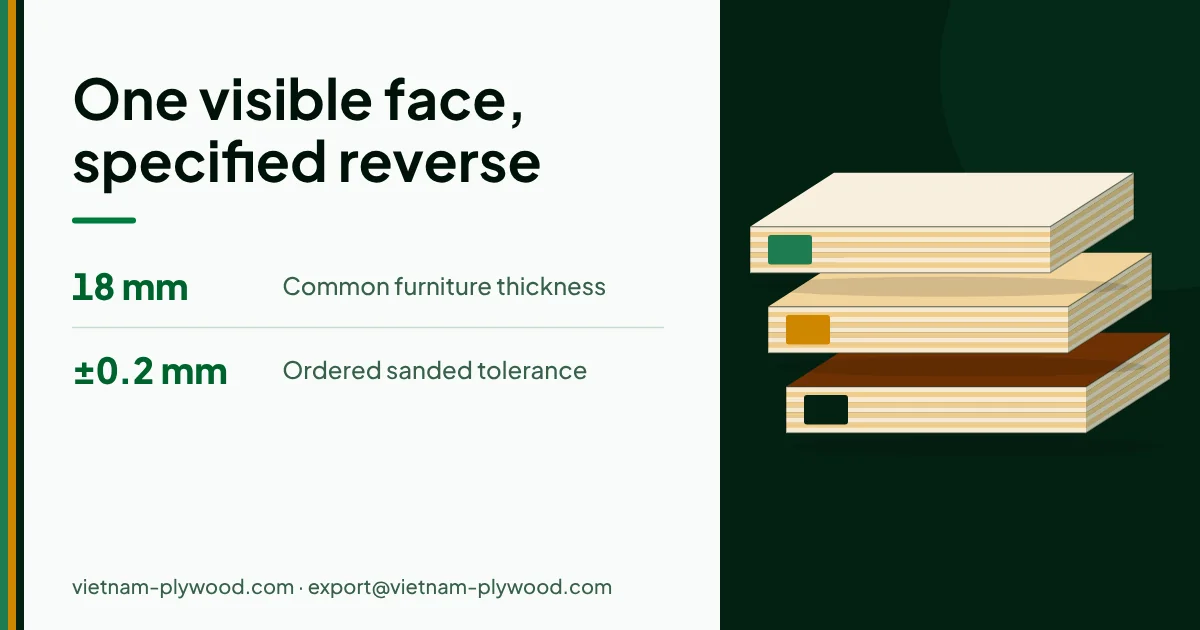
HCPLY makes good one side plywood for cabinet and fit-out orders by defining the selected face and the reverse as separate acceptance surfaces. A vague G1S order can cost a rejected load or extra rework when the exposed side does not match the buyer’s finish schedule.
What is good one side plywood?
Good one side plywood is a panel selected for an appearance-grade face, while its reverse is allowed a less decorative finish. In Canadian purchasing language, G1S describes the visible-side requirement; it does not identify one universal veneer species, back grade, adhesive or structural classification. HCPLY quotes the face and reverse separately so cabinet makers can compare the same construction.
A visible cabinet end, shop-fitting partition or painted display panel can use one selected face when the reverse stays concealed. For a cabinet door exposed on both sides, specify two appearance faces instead. A G1S label alone cannot settle sanding, permitted repairs, colour matching or edge appearance. See our face veneer category for related face choices.
What does select plywood mean in Canada?
Select is a purchasing description that needs a written appearance definition. It can signal a cleaner face in a seller’s range, but the word alone does not specify a common national face/back combination. Ask whether the seller means a particular published grade, a house selection or a sample-approved appearance.
A Canadian good-one-side construction example uses an A face and C back under its own product specification. That example does not make A/C the automatic grade for every imported decorative hardwood panel. Record the grading basis and accepted sample before comparing offers. For another grade naming system, see BC grade plywood and BCX plywood meaning.
What back grade comes with a G1S panel?
The back grade must be written into the order: G1S alone does not fix it. For our furniture line, request an A-grade selected face with a specified B-grade reverse when that appearance suits the application. State allowable knots, repairs, colour variation and sanding on the back in the approved sample description.
A back hidden against a cabinet carcass can accept a different visual standard from the show face. A back exposed inside open shelving deserves its own sample inspection. The buyer should distinguish a lower visual grade from a damaged panel: core gaps, delamination and out-of-tolerance thickness remain separate acceptance questions. Our quality plywood checks explain those distinctions.
Which Vietnam furniture faces answer a G1S request?
Our furniture line presses sanded, full-stitched panels with styrax or eucalyptus cores and E0 or E1 emission classes. Face options include bintangor, okoume, engineered veneer (EV), gurjan, pine, poplar, eucalyptus, birch and sapele. Select the face for the visible finish, then specify its grade and the reverse separately.
A bintangor or okoume face can be discussed for a visible wood finish; EV is an option when a more repeatable veneer appearance is requested. Pine, poplar and eucalyptus faces should be evaluated against the actual finish schedule. Birch is listed with D/E/F face grades in our range, so do not substitute an A/B designation for birch. Common face veneer thickness is 0.2–0.4 mm.
The product name follows the face veneer; panel density follows the core. For example, a poplar-faced styrax-core panel remains a styrax-core build for weight planning. Compare actual samples under the buyer’s lighting and finishing method before locking the appearance schedule. See furniture plywood for the product family.
How do our three lines answer the same request?
A good-one-side cabinet order belongs on our furniture line; the other lines serve different end uses. The table makes the distinction explicit before a buyer sends a generic plywood inquiry.
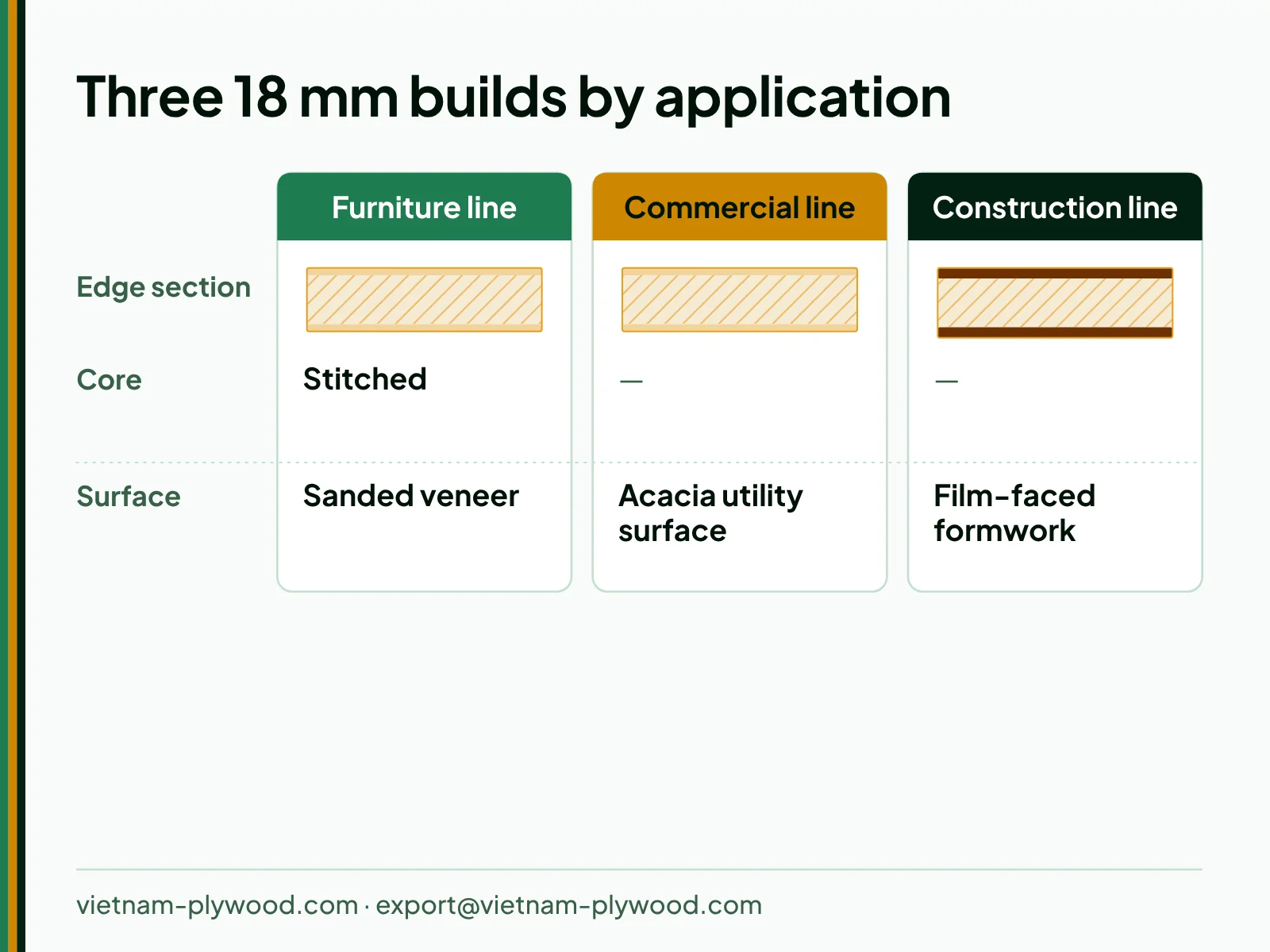
| Requested use | Producing line | Core and surface | Typical surface acceptance |
|---|---|---|---|
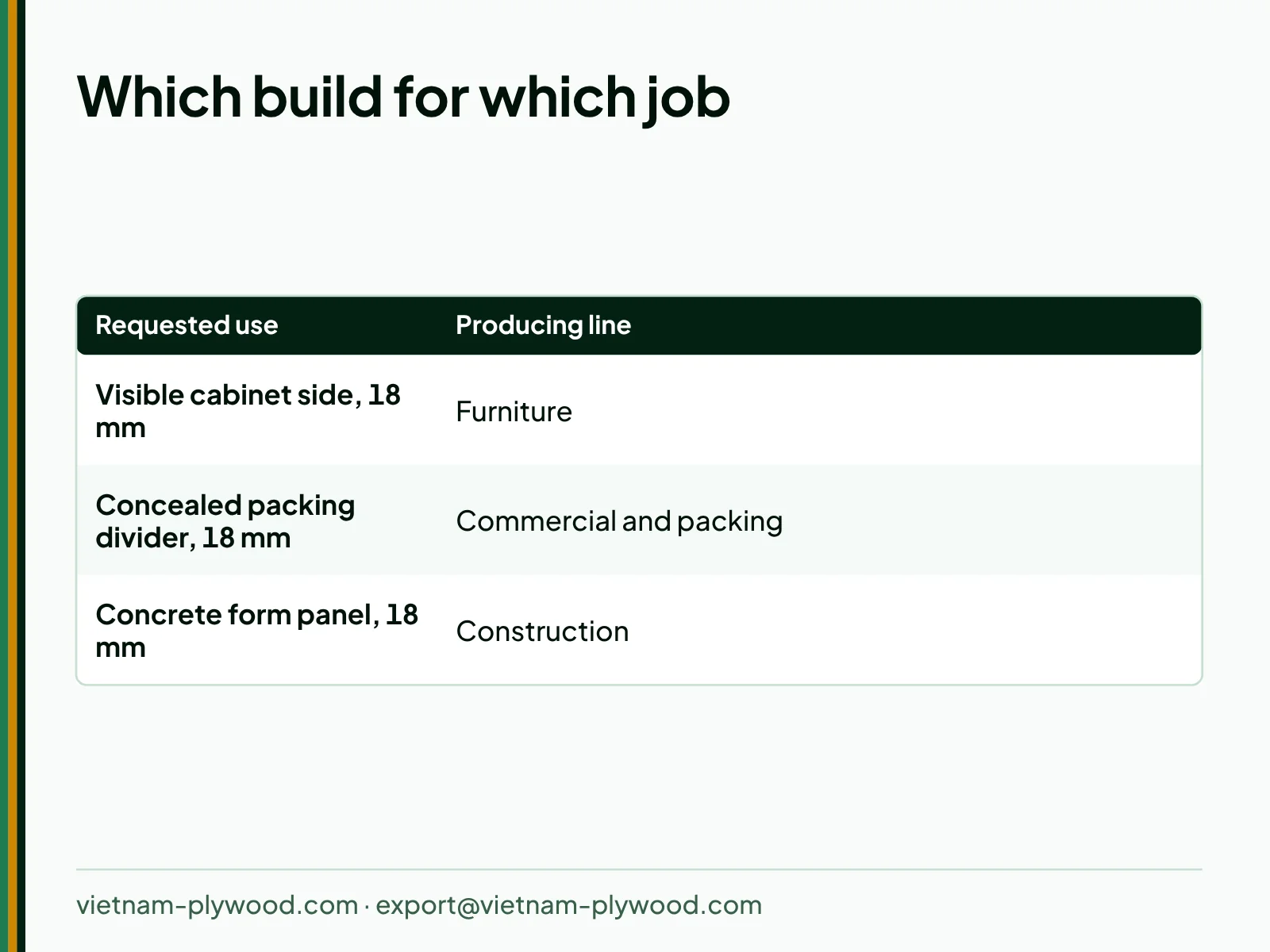
| Visible cabinet side, 18 mm | Furniture | Styrax or eucalyptus, stitched and sanded, selected veneer face | Face and back approved separately |
| Concealed packing divider, 18 mm | Commercial and packing | Acacia, unsanded or light-sanded, MR glue | Utility surface, not a decorative G1S match |
| Concrete form panel, 18 mm | Construction | Acacia or eucalyptus, film-faced and unsanded | Film integrity and formwork suitability |
Our commercial and packing line does not replace a selected furniture face merely because the nominal thickness matches. Our construction line presses phenolic or melamine film, including anti-slip film, for different service conditions. For the broader comparison, read grades across factory lines.
Is 3/4 inch good one side plywood available in 4x8 sheets?
A 1220 × 2440 mm sheet is available in our furniture size range, and 18 mm is a common thickness. For a 3/4 4x8 plywood good one side inquiry, write the required finished metric thickness rather than assuming that 18 mm equals 19.05 mm. We also produce within a 3–40 mm thickness range, with the final dimension agreed in writing.
A 3/8 plywood good one side inquiry likewise needs a metric thickness choice: 3/8 inch equals 9.525 mm, while 9 mm is a common factory thickness. For furniture sanded panels, specify ±0.2 mm or ±0.3 mm thickness tolerance as ordered; length and width tolerance is ±2 mm. Record finished dimensions after sanding, rather than a nominal inch label alone.
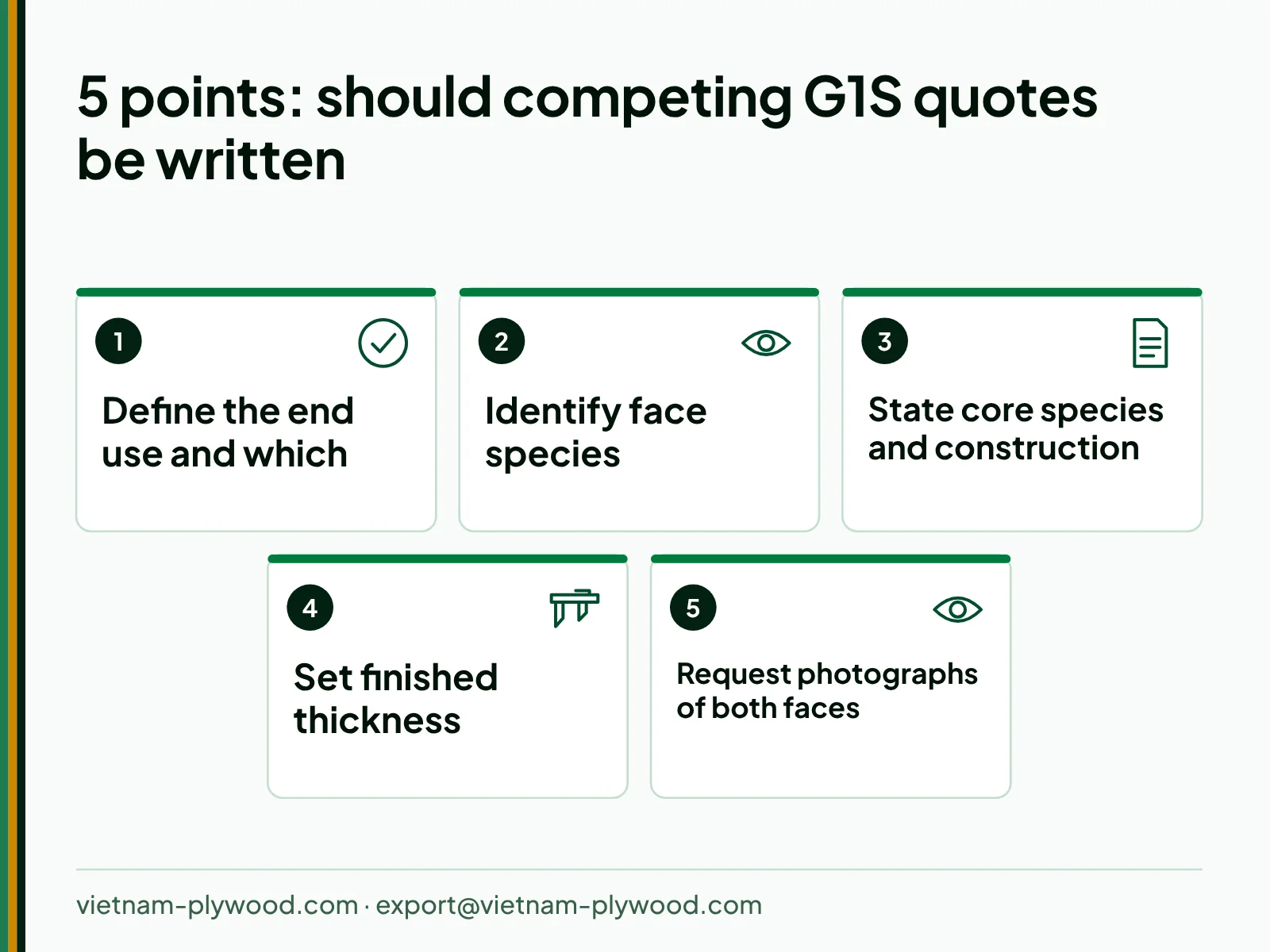
How should competing G1S quotes be written?
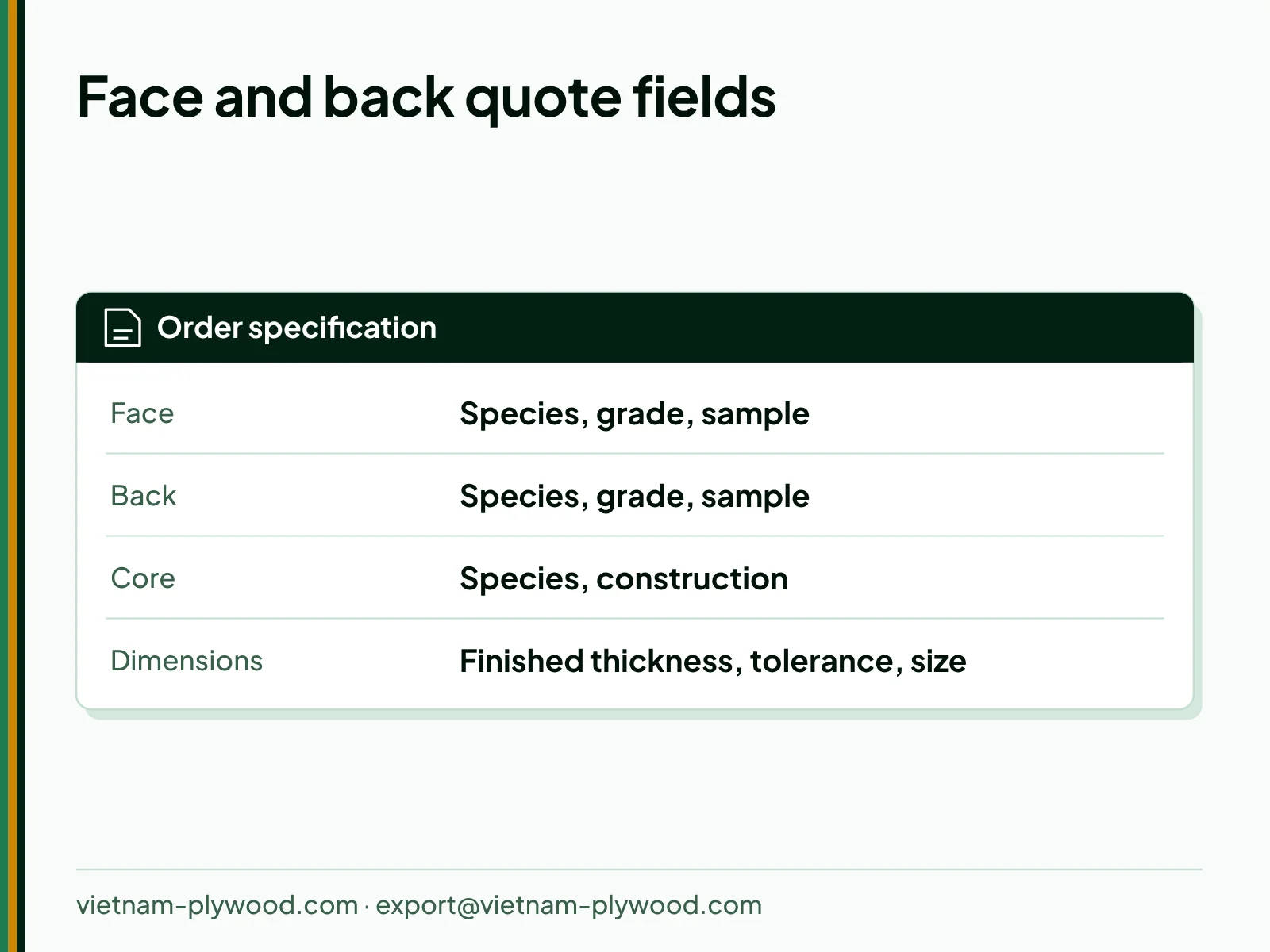
Write a common specification sheet and ask every manufacturer to quote that exact build. A face-grade label without a reverse-grade acceptance standard can conceal differences in sanding, veneer repair and core construction.
- Define the end use and which surface remains visible after installation.
- Identify face species, face grade, back species or appearance, and acceptable repairs against reference samples.
- State core species and construction, glue type, emission requirement and supporting documents separately.
- Set finished thickness, tolerance, sheet size, quantity, packing and destination port.
- Request photographs of both faces and an inspection of the first approved production sample.
For HCPLY, a full-stitched core is the furniture construction to request. MR and WBP describe glue performance: melamine MR has a 12-hour boil condition, while phenolic WBP has a 72-hour boil condition. E0 and E1 are emission classes, separate from glue type. An RTD plywood explanation helps distinguish another naming convention from a decorative face requirement.
What can an inspector check at the producing factory?
An inspector can compare both faces with the signed appearance sample, then measure finished thickness and dimensions on identified sheets. Check the approved veneer species, sanding consistency, repairs, edge quality and core construction at accessible cut edges. Record observations against the purchase specification rather than accepting the G1S label as the test.
Buyers visit the factory office and inspect goods at the producing factory. HCPLY handles specification, on-site QC, documents and loading. Ask for the producing line’s certificate or test documentation with factory details masked, on request, where it applies to the ordered build.
What Canadian emission paperwork belongs in the order?
For Canadian furniture and cabinet imports, the applicable formaldehyde rules must be addressed separately from visual grade. Canada’s Formaldehyde Emissions from Composite Wood Products Regulations (2021, amended 2025) define hardwood plywood as a covered composite wood panel and set its primary-test emission limit at 0.05 ppm. Read the Canadian regulations when preparing import requirements.
Specify the emission regime, the product type, testing or certification evidence and labelling responsibilities in the contract. E0 or E1 terminology alone does not replace a Canadian regulatory compliance assessment. Relevant member-factory CARB P2 documentation can be shown with factory details masked, on request; acceptance for a particular Canadian order must be checked against its required records.
How should quantity and mixed loading be planned?
For 18 mm, 1220 × 2440 mm styrax-core panels, the planning lookup gives 55 sheets per pallet and 990 sheets across 18 pallets: 53.05 m³ and 26.52 t. The 40HC payload ceiling is 28.5 t. Those figures exclude face-film weight and apply to the stated core and size.
Specifications can be mixed within one 40HC while respecting payload. A second furniture face can share the load when the packing plan and weight remain within that ceiling; a commercial or construction item needs its own core-density calculation. See mixed container loads and the container packing reference for quantity planning.
What drives a comparable furniture quote?
Furniture plywood starts from US$350/m³ FOB Hai Phong (October 2026). A quote for G1S must still name the selected face, back appearance, core, sanding and dimensional acceptance; the dated starting figure is not a fixed price for every build.
A more tightly selected face with controlled repairs costs more to prepare than a utility appearance. Full-stitched furniture cores require more preparation than loose-laid utility cores; thicker or more tightly specified veneer selection adds another cost consideration. Ask for an itemized written offer against the same approved sample and tolerances, rather than comparing a bare cubic-metre figure.
What should the final order request contain?
The request should give the factory a complete build and an inspection reference. HCPLY can prepare the offer and export paperwork for the agreed product; shipping documents include the commercial invoice, packing list, bill of lading and certificate of origin, alongside the order’s applicable certificate documents. After loading, the draft shipping documents come to you for approval.
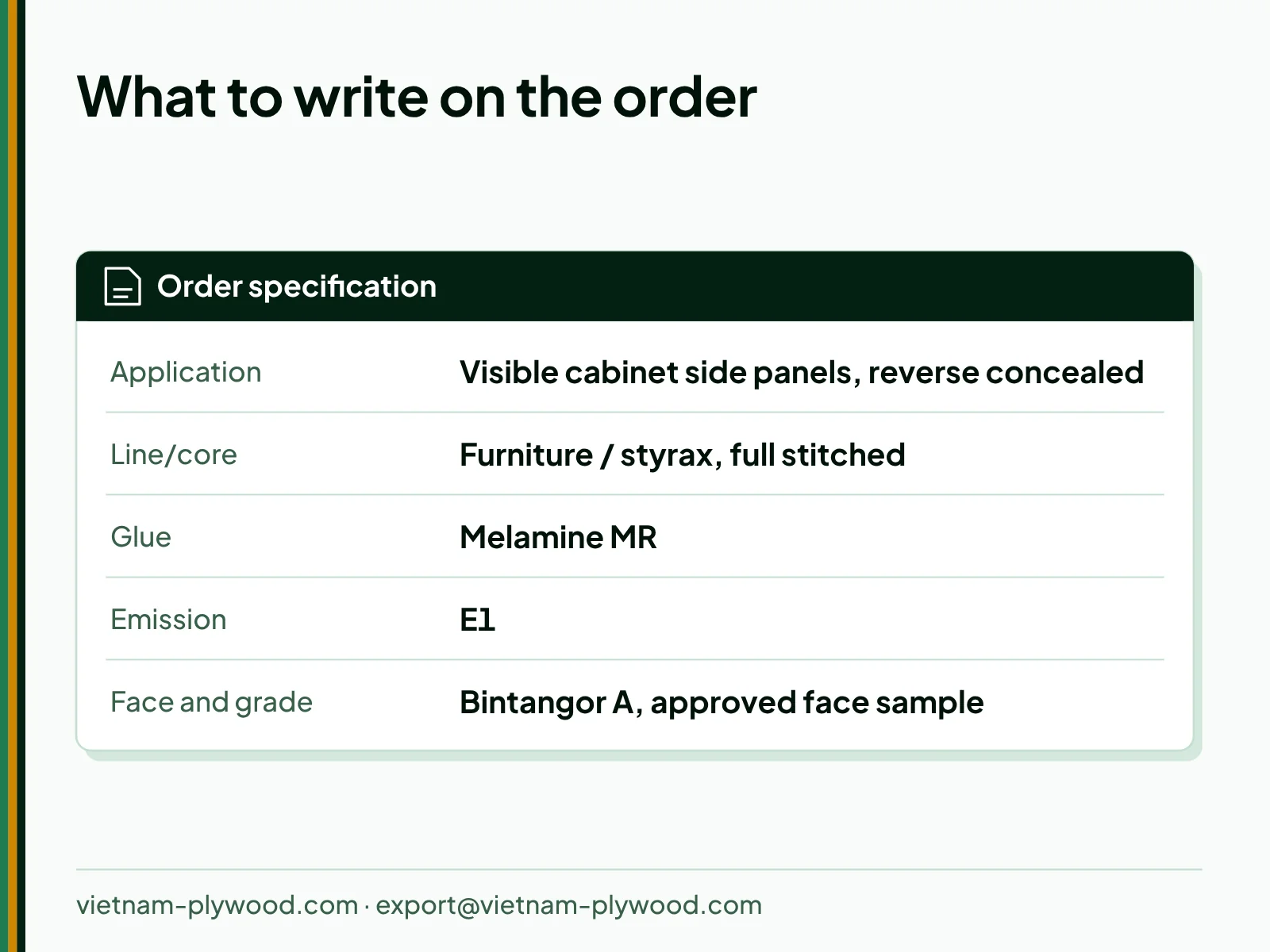
Send the following specification to Lucy at export@vietnam-plywood.com or through contact:
Application: visible cabinet side panels, reverse concealed
Line/core: furniture / styrax, full stitched
Glue: melamine MR
Emission: E1; Canadian compliance evidence requested for agreed build
Face and grade: bintangor A, approved face sample
Back and grade: bintangor B, approved reverse sample
Thickness and tolerance: 18 mm finished, +/-0.2 mm
Size: 1220 x 2440 mm, length/width +/-2 mm
Quantity: one 40HC, 990 sheets for styrax 18 mm reference load
Destination port: [Canadian discharge port to specify]
Next step: book a factory visit to approve both face samples and witness the producing-factory inspection.