





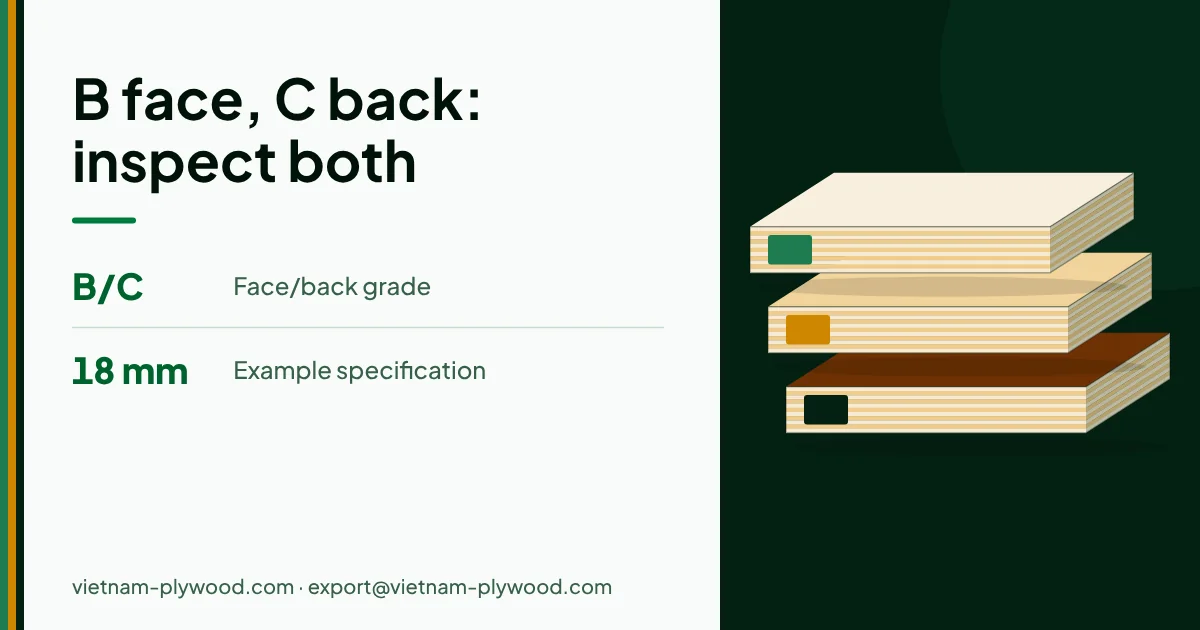
BC plywood pairs a B-grade face with a C-grade back; HCPLY builds the appearance pair against an agreed sample and written defect limits. Choosing the wrong face can waste finishing money or cause a rejected shipment. The saving comes when the better side is visible and the rougher back is hidden.
What is BC plywood?
BC plywood is a panel described by two veneer appearance grades: B on the face and C on the reverse. The letters identify different acceptable surface conditions, rather than core species, adhesive class or structural performance. A buyer should specify the actual face species, repair limits and sanding finish alongside the B/C designation. That separates an economical cabinet component from an unsuitable exposed panel.
A sample board and defect photographs make that agreement measurable.
The face veneer category groups related appearance decisions. Our face-defect inspection guide covers how to describe repairs without relying on letters alone.
What patches and knots can a B face have?
A B face can contain sound knots and neatly fitted repairs while presenting a reasonably uniform working surface. It is a practical option for a painted cabinet back or a shelf where some veneer character is acceptable. A-grade faces call for a cleaner visual selection and therefore require more selective veneer sorting.
APA – The Engineered Wood Association, in its online plywood selection guidance accessed in 2026, states: “Plywood panels are identified by grade designations that reflect veneer appearance, surface finish, and intended end use.” Its description of B-grade veneer includes tight knots and router or sled repairs. These are definitions for the cited grading system; our purchase order must separately define the acceptable sample and repair limits. See the APA plywood guidance.
For a production approval, mark the largest acceptable sound knot, the allowed patch shape and the maximum visible split on a reference panel. Photograph the repaired areas in normal inspection light. A patch that is acceptable behind a cabinet can still show through a thin decorative finish. Where the face remains exposed, inspect after the specified sanding operation rather than judging raw veneer alone.
What defects can a C back have?
A C back permits a less uniform appearance, including more conspicuous knots, repairs and limited open characteristics under the applicable grading rules. It works when the reverse side is concealed and does not receive a decorative finish. A back visible through open shelving or inside a display cabinet needs tighter limits.
Do not treat C as permission for uncontrolled core voids, delamination or a panel that fails the written thickness tolerance. Face grading describes surface appearance; core construction and bond performance require separate checks. Ask the producing factory to show both faces under the same light, with defect locations recorded against the approved sample.
How much appearance is lost versus an A face?
The principal concession is surface uniformity: a B face tolerates visible repairs and sound knots that a more selective A face limits.
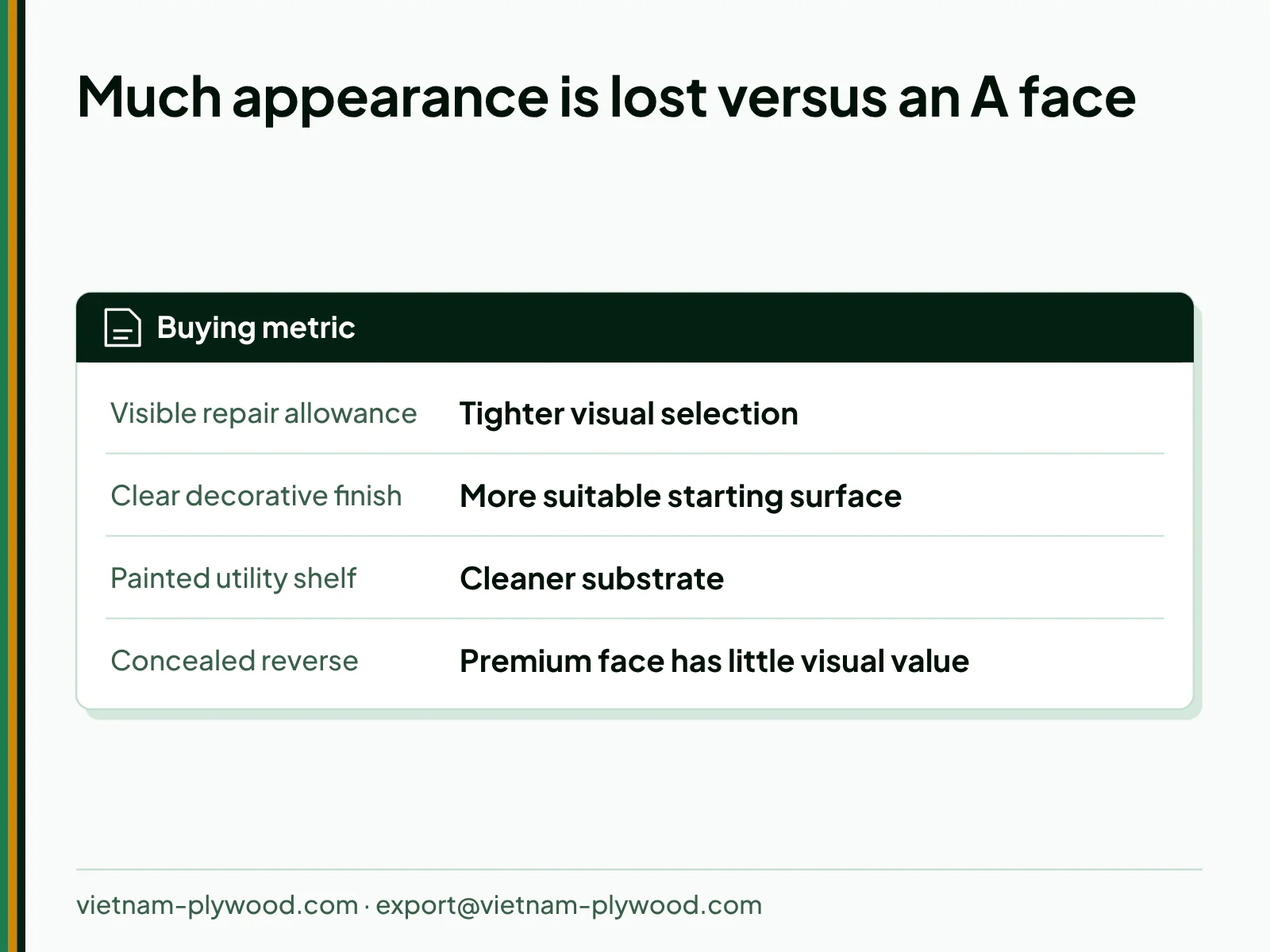
| Buying metric | A-face selection | B-face selection | Verdict by use |
|---|---|---|---|
| Visible repair allowance | Tighter visual selection | Sound knots and neat repairs accepted | B for concealed cabinet backs |
| Clear decorative finish | More suitable starting surface | Patches can remain visible | A for premium exposed panels |
| Painted utility shelf | Cleaner substrate | Spot filling may be needed | B if finishing allowance is accepted |
| Concealed reverse | Premium face has little visual value | C back can be specified | B/C for hidden backs |
| Strength evidence | Face grade alone is insufficient | Face grade alone is insufficient | Compare core and test data |
For finishing decisions, review sanded versus unsanded plywood before specifying the surface.
Which factory line should make a B/C order?
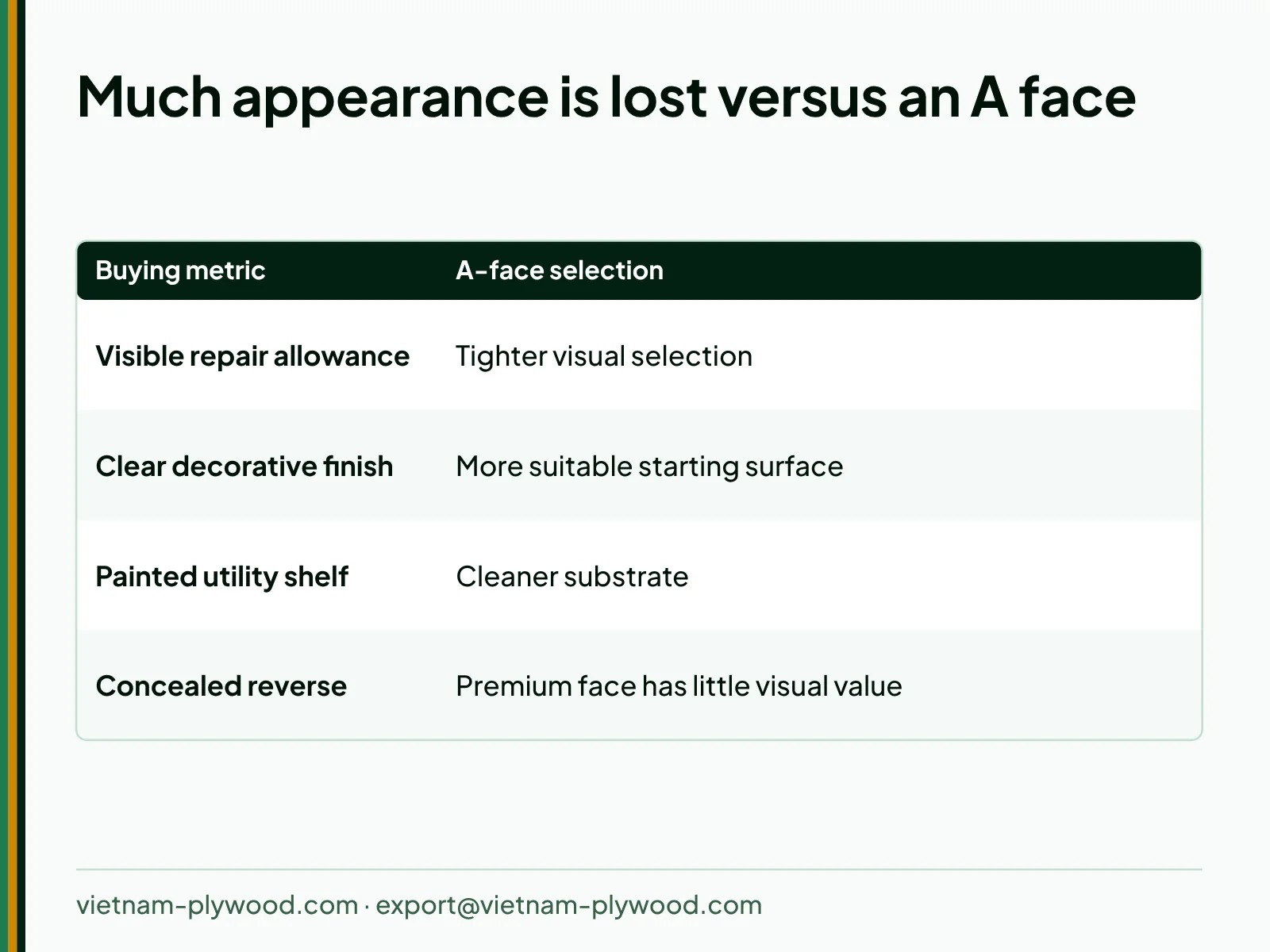
Our furniture line is the first choice for sanded cabinet components requiring a controlled visible face. Our commercial and packing line suits utility parts where an unsanded or light-sanded surface is accepted. Our construction line makes film-faced panels for concrete work, rather than a decorative B/C veneer finish.
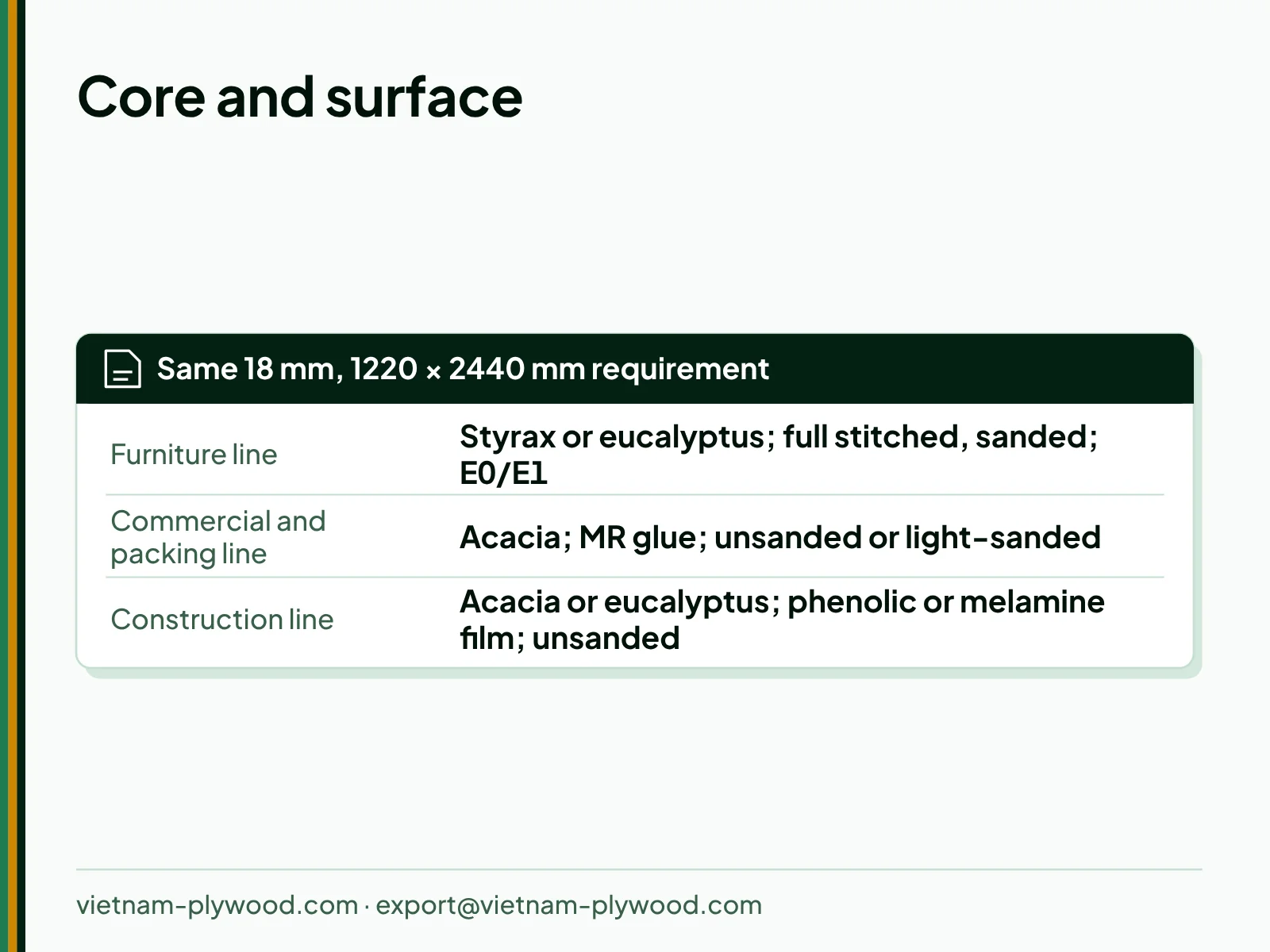
| Same 18 mm, 1220 × 2440 mm requirement | Core and surface | Thickness tolerance | Better application |
|---|---|---|---|
| Furniture line | Styrax or eucalyptus; full stitched, sanded; E0/E1 | ±0.2 or ±0.3 mm as ordered | Cabinet backs and finished shelving |
| Commercial and packing line | Acacia; MR glue; unsanded or light-sanded | ±0.5 mm commercial; ±0.5–1.0 mm packing | Crates and utility panels |
| Construction line | Acacia or eucalyptus; phenolic or melamine film; unsanded | ±0.5 mm | Concrete formwork, not visible B/C veneer |
HCPLY can compare those builds against the same nominal size without treating the grade pair as a complete specification.
The common face veneer thickness is 0.2–0.4 mm, while core veneer thickness is 1.4–2.0 mm. An 18 mm sheet has 11–13 plies according to the core veneer build. Core density follows the core rather than the decorative face: styrax is 500 kg/m³, acacia 580 kg/m³ and eucalyptus 650 kg/m³.
Which uses fit cabinet backs, shelving and packing?
Cabinet backs are a strong B/C candidate when only one surface needs a clean painted or lined finish.
Shelving is suitable when a utility finish is acceptable and the supporting design has been checked independently. Face grade alone does not set shelf span, bending capacity or fastener performance.
Packing panels can accept more cosmetic variation because the load and protective function dominate the appearance. Our commercial and packing plywood page addresses that application. Specify whether crate surfaces contact finished goods and whether protruding repairs could abrade the contents.
BC plywood should not be substituted automatically for rated roof sheathing or structural flooring. Those uses call for a defined structural and exposure specification with accepted evidence. For concrete forming, the construction line uses film-faced builds; the B/C decorative veneer discussion does not replace a formwork specification.
How does BC plywood compare with birch plywood?
BC describes the face/back appearance pair; birch identifies a veneer species. On our builds, birch faces use D/E/F grade labels, so a B/C quotation and a birch D/E/F quotation need a sample crosswalk.
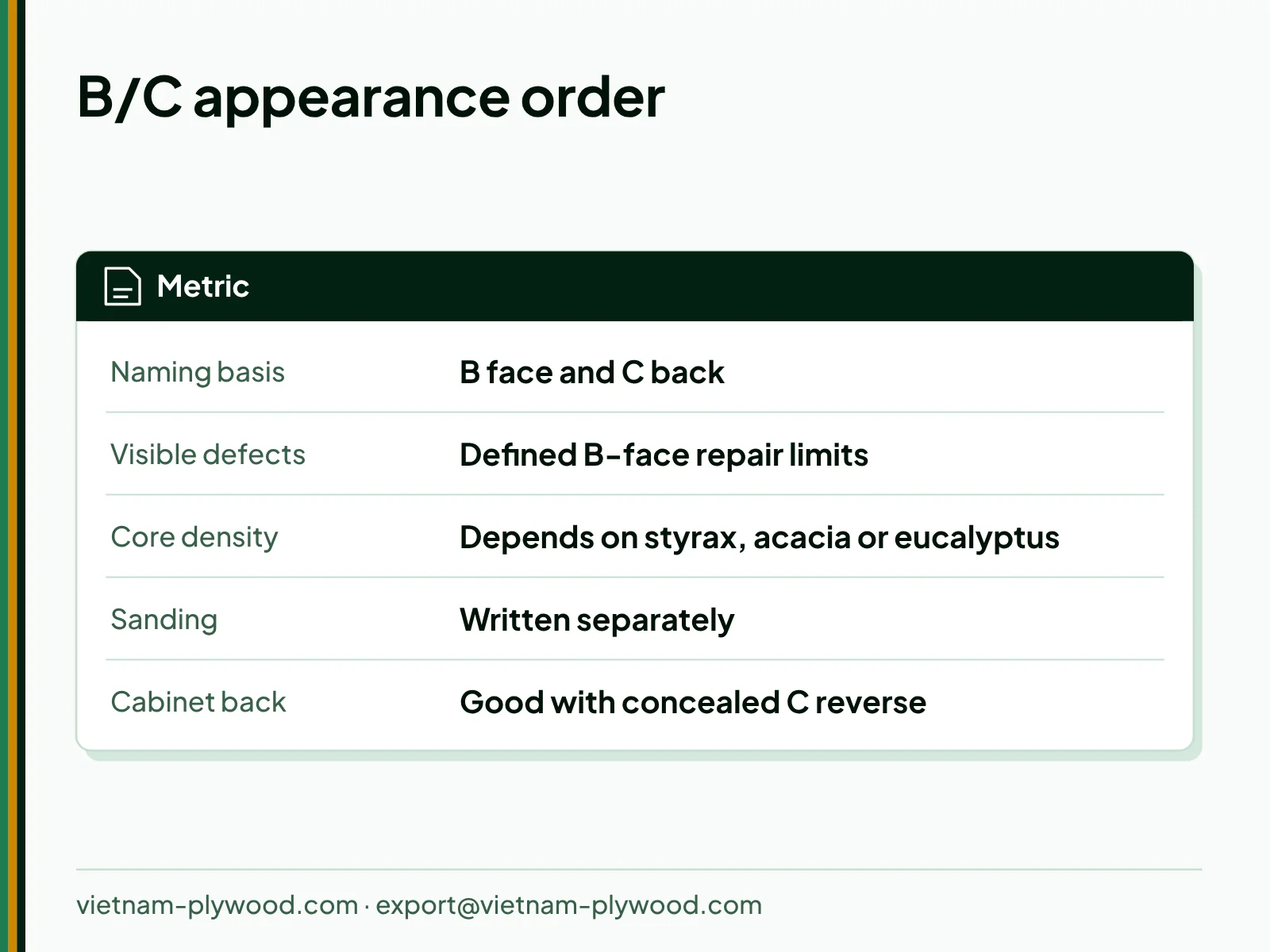
| Metric | B/C appearance order | Birch-face order | Verdict by use |
|---|---|---|---|
| Naming basis | B face and C back | Birch veneer species, D/E/F face grade | Compare actual sample |
| Visible defects | Defined B-face repair limits | Defined D/E/F sample limits | Choose by required finish |
| Core density | Depends on styrax, acacia or eucalyptus | Also depends on core, not birch face | Compare weight by core |
| Sanding | Written separately | Written separately | Require sanding for finished cabinet parts |
| Cabinet back | Good with concealed C reverse | Good if birch look is specified | B/C for painted hidden components |
| Decorative exposed face | Repairs may show | Birch appearance can be specified | Birch when that look is required |
We do not press birch-core plywood. A birch face on a styrax or eucalyptus core is a different product from a birch-core sheet. See the birch D/E/F grade explanation for the relevant face terminology. A phrase such as “b c plywood vs birch plywood” becomes useful only after both quotations state face, core, grade and finish.
Does BC sanded pine plywood mean the same thing?
BC sanded pine plywood adds a face species and a surface operation to the B/C grade pair. The name still leaves core species, glue, emission class and thickness tolerance open.
Our pine plywood range concerns pine as a face option, with the core stated separately. We do not press pine-core plywood.
Likewise, BCX and CDX are North American trade labels encountered in comparisons. The “X” is commonly associated with an exposure classification, but the letters alone do not replace a verified bond specification. APA distinguishes veneer appearance from panel exposure and structural ratings. The RTD plywood terminology page covers another label buyers should avoid confusing with face grade.
What glue and emission fields belong on the order?
Specify glue and formaldehyde emission class as separate fields. Our furniture line uses E0 or E1 emission classes; our commercial and packing line uses moisture-resistant (MR) glue with an acacia core. Melamine MR glue has a 12-hour boil description in our build options, while phenolic weather-and-boil-proof (WBP) glue has a 72-hour boil description. Neither description alone is a structural rating.
For US regulated sales, CARB Phase 2 and TSCA Title VI refer to an emission limit and third-party certification framework, rather than a face grade. Factory certificates such as FSC, CARB P2, ISO 9001 and CE, and EU documentation, are shown with factory details masked, on request. The order must identify the particular document required for its market and panel build.
Can B/C and another specification share one container?
A mixed shipment is possible within the 40HC payload limit of 28.5 t. For 18 mm, 1220 × 2440 mm sheets, a full styrax-core load is 990 sheets at 26.52 t; acacia is 880 sheets at 27.35 t; eucalyptus is 795 sheets at 27.69 t. These lookup weights exclude film weight.
The individual sheet weights are 26.79 kg for styrax, 31.08 kg for acacia and 34.83 kg for eucalyptus at that size and thickness. Mixing a sanded furniture B/C component with a commercial packing panel changes the weight per sheet.
The container-loading reference owns the full pallet calculations. The minimum order is one 40HC; one container can carry several specifications as long as the payload limit holds.
What should an inspector witness at the producing factory?
The inspector should compare the B face and C back against the signed sample before loading. Start with appearance, then measure thickness, check core edges and reconcile bundle markings with the packing list. Buyers can visit the factory office and inspect goods at the producing factory.
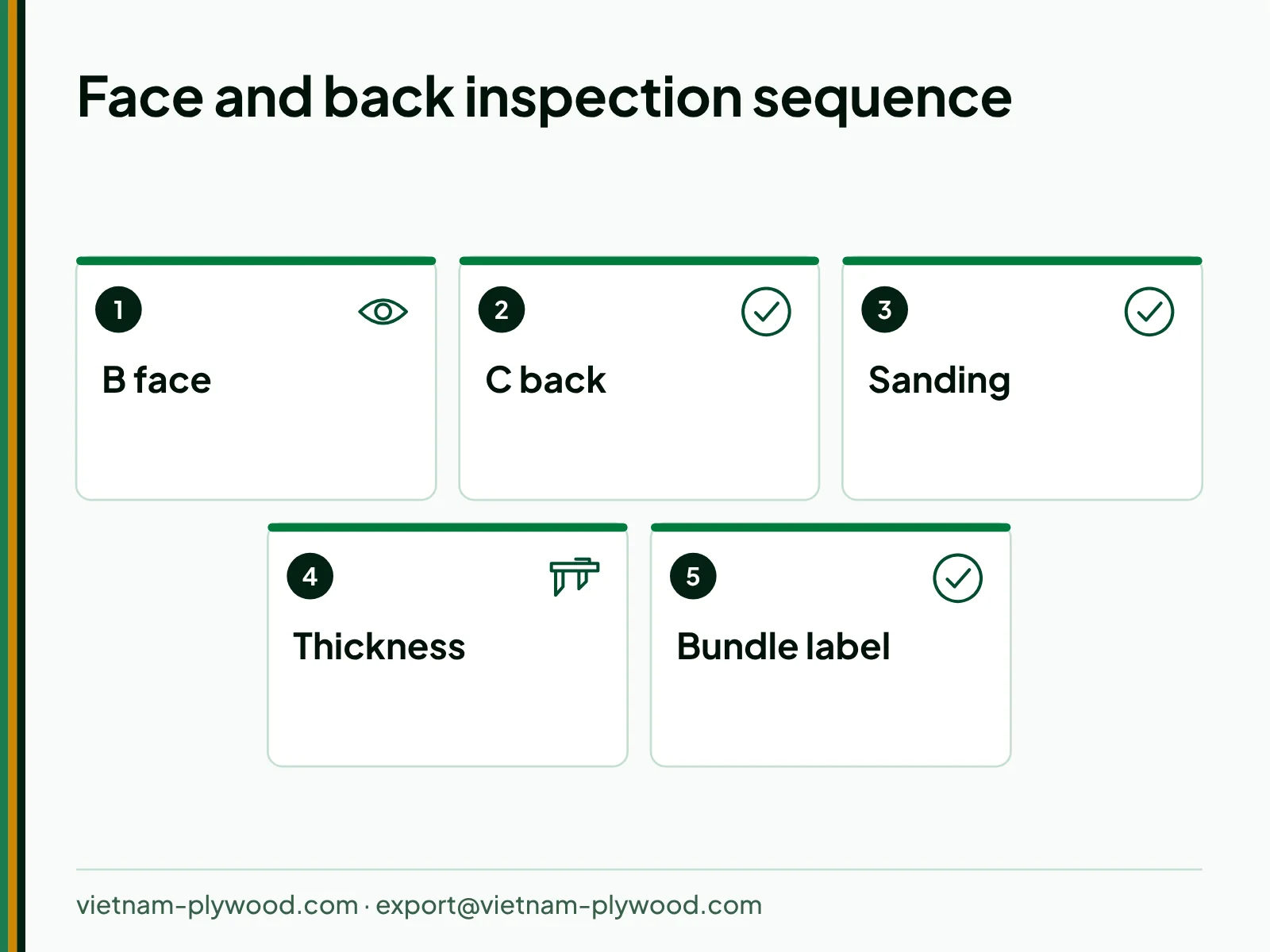
- Identify the approved B-face sample and photograph repairs, sound knots and any split limits.
- Turn the sheet over and compare C-back openings against the separate back acceptance sample.
- Check sanding finish, surface orientation and exposed core edges on cut samples.
- Measure the agreed thickness tolerance and length/width tolerance of ±2 mm.
- Match grade, core, size and bundle quantity to the inspection record and draft packing list.
For an 18 mm furniture build, the ordered thickness tolerance is ±0.2 or ±0.3 mm; a commercial build uses ±0.5 mm. HCPLY handles specification, on-site quality control, shipping documents and loading, with goods shipped directly from the selected factory.
How should buyers request a B/C quotation?
A usable request names the application and visible side, then fixes the face sample, core and process fields. A full stitched and sanded furniture build costs more to prepare than a simpler utility build with less surface processing; a tighter appearance selection adds sorting work.
The commercial plywood indicative starting price is from US$250/m³ FOB Hai Phong (October 2026). The furniture plywood indicative starting price is from US$350/m³ FOB Hai Phong (October 2026). These are category starting prices, not a separate B/C-grade quotation; the final price is based on the written build, quantities and finishing requirements.
Factory lead time runs 15–45 days from receipt of the 30% deposit; the exact figure depends on order size, line loading and what the contract fixes. The remaining 70% is paid on the scan of the bill of lading, by T/T, or by irrevocable sight L/C. We ship FOB Hai Phong, or CFR (CNF) or CIF to your port. Samples cost nothing: a first-time buyer pays the courier, and that charge comes off the first confirmed order.
The shipment documents include commercial invoice, packing list, bill of lading (B/L), certificate of origin, and the order’s agreed certificate or test documents. EUR.1 and the EUTR/EUDR file set accompany EU lots; phytosanitary and fumigation papers are included, with insurance under CIF. After loading, the draft shipping documents come to you for approval. The packing list is the document that identifies the B/C bundles and quantities in the shipment.
Send the following fields to Lucy at export@vietnam-plywood.com or through contact:
Application: cabinet backs / utility shelving / export packing
Line or core: furniture—styrax or eucalyptus / commercial and packing—acacia
Glue: MR melamine or agreed phenolic specification
Emission: E0 / E1 / E2 or required market certificate
Face and grade: [species] B face / C back; approved repair and knot samples
Thickness and tolerance: [mm] / [ordered tolerance]
Size: [length × width, mm]
Quantity: [sheets or m³; mixed-load breakdown if applicable]
Destination port: [port and country]
Book a factory visit to approve the face and back samples before the production order.