





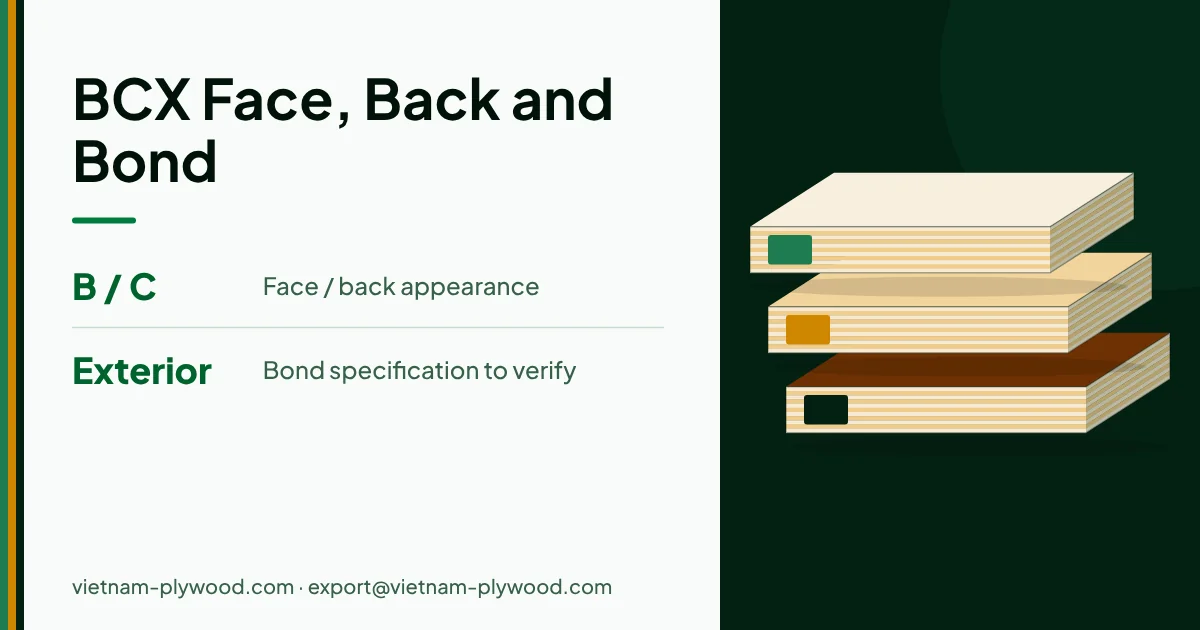
BCX plywood describes a B-quality face, C-quality back and exterior-type bond in common trade usage. Choosing by those letters alone can cost a distributor a rejected load when a structural stamp or exposure class is required. HCPLY explains how to translate the term into an inspectable Vietnamese factory specification, with the US marking question handled separately.
What does BCX plywood mean?
BCX plywood is a trade description for a B-quality face, C-quality back and an exterior-type adhesive bond. The B face is selected for a smoother visible surface; the C back permits more visible repairs and defects. The X points buyers toward bond durability, but it does not identify a complete tested structural classification. A purchase order must state the intended use and acceptance criteria.
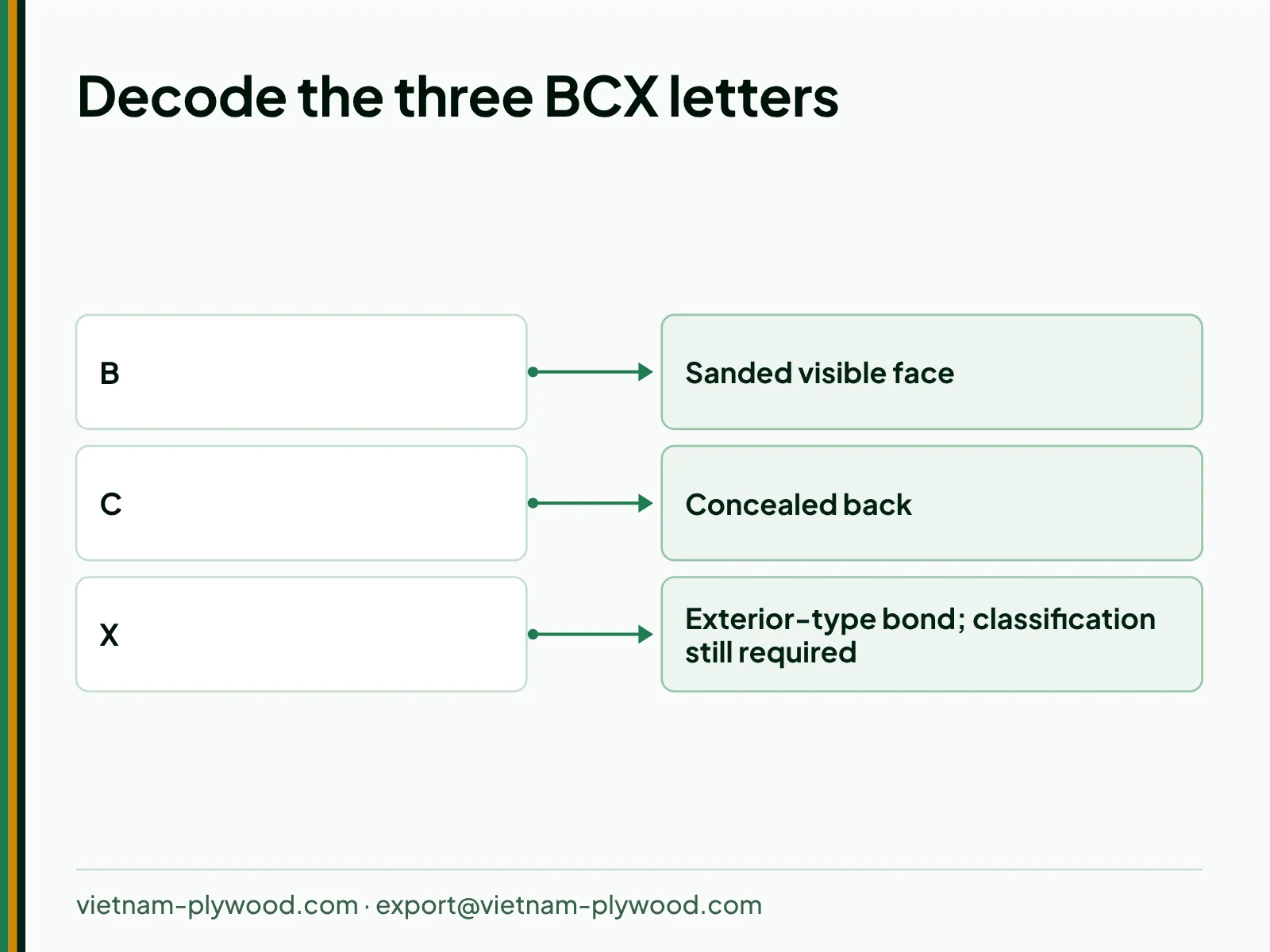
In a North American specification, B and C have meaning within a particular grading standard. A C back is commonly concealed in a finished assembly. Neither letter specifies the core species, panel thickness, emission class or measured strength.
The bcx plywood definition becomes less precise when a supplier outside North America uses the letters as a visual shorthand. Buyers should attach approved face and back samples, a glue requirement and the applicable test or grading standard. See our face veneer category for the distinction between appearance and core construction.
Is BCX plywood an exterior plywood?
BCX-type plywood can use exterior-type adhesive, but exterior bond chemistry alone does not establish the Exterior panel classification. The intended exposure must be written separately from the face grade and verified against the applicable panel standard.
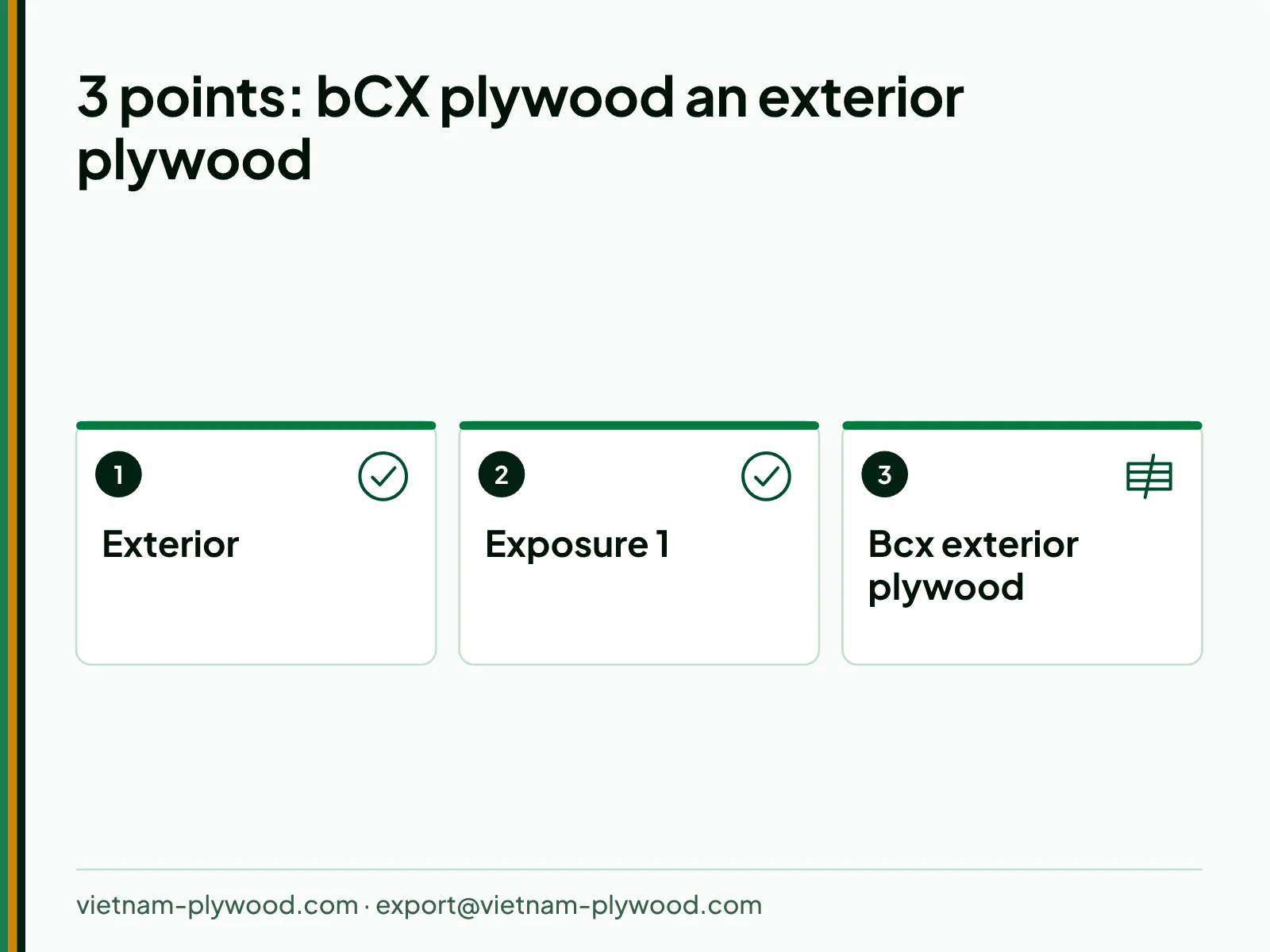
APA — The Engineered Wood Association explains in its technical guidance on plywood that Exterior panels are designed for long-term weather exposure, while Exposure 1 panels resist moisture during construction and are unsuitable for permanent exposure. Its explanation of PS 1-22, revised in 2023, states that structural plywood classification considers veneer grade and adhesive performance together. See APA’s plywood guidance and PS 1-22 overview.
For bcx exterior plywood, separate three questions: does the bond resist the specified moisture cycle, can the wood and exposed edges survive the service environment, and does the project require a recognized structural classification? Sealing cut edges and protecting surfaces remain necessary where the application calls for them. An exterior-type bond does not provide preservative treatment or make untreated veneers resistant to decay.
Our exterior plywood supply specification explains how to request the bond and exposure conditions in writing. For permanently exposed cladding, the buyer should specify the accepted Exterior classification and its supporting evidence, rather than assume the letter X resolves it.
What is the difference between BCX and RTD plywood?
BCX identifies a face/back appearance concept and exterior-type bond; RTD is a manufacturing-process term commonly encountered on construction sheathing. RTD should not be read as a face grade or a stand-alone exposure classification. Ask for the actual panel stamp and the manufacturer’s technical documentation.
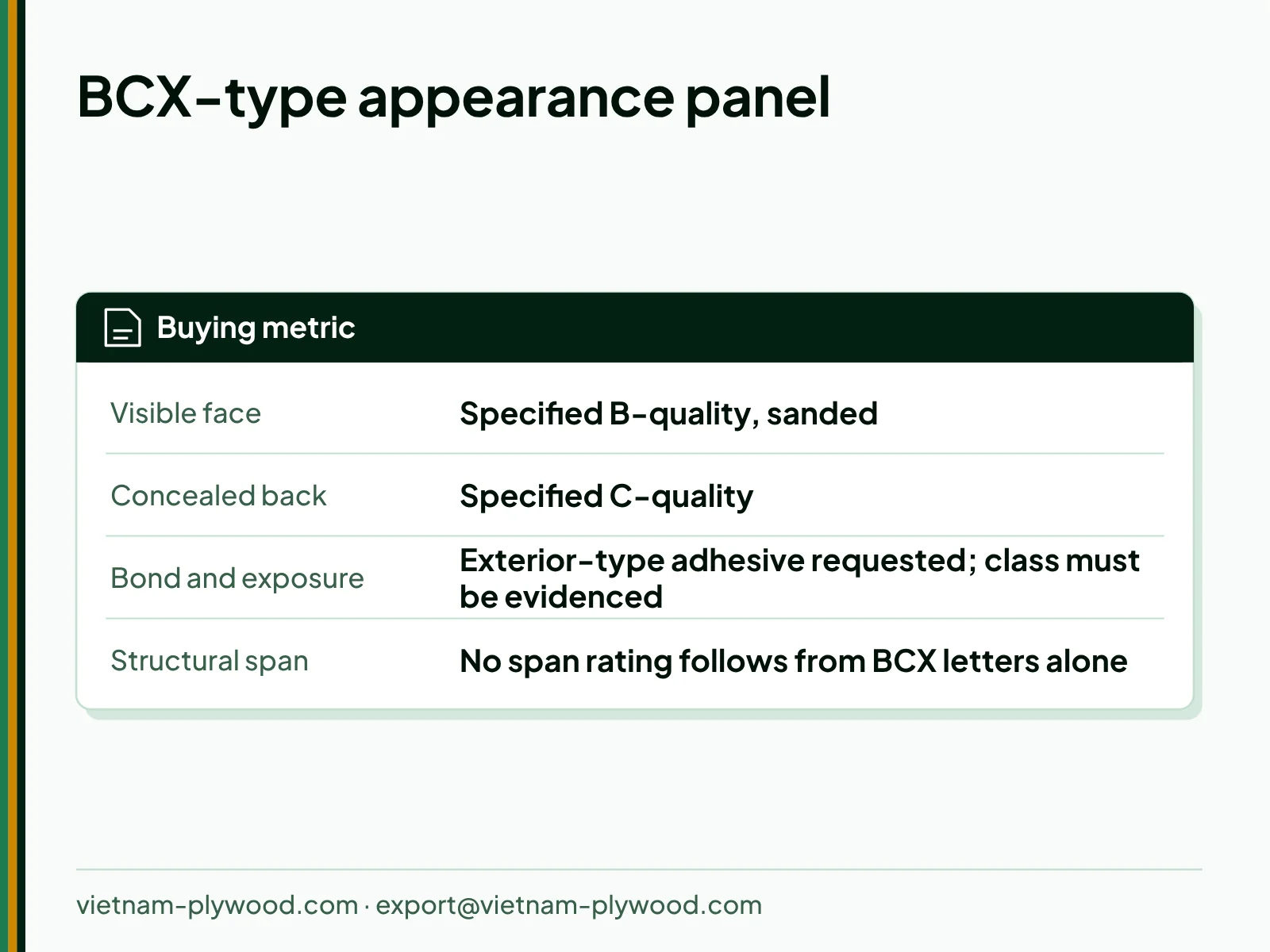
| Buying metric | BCX-type appearance panel | RTD-labelled sheathing | Verdict by use |
|---|---|---|---|
| Visible face | Specified B-quality, sanded | Sheathing face defined by actual panel grade | BCX-type for paintable visible parts |
| Concealed back | Specified C-quality | Defined by sheathing product | Inspect the hidden-side allowance |
| Bond and exposure | Exterior-type adhesive requested; class must be evidenced | Read Exposure 1 or Exterior from product marking | Neither shorthand replaces bond classification |
| Structural span | No span rating follows from BCX letters alone | Rated sheathing may carry a span rating | Use properly rated sheathing for structural spans |
| Acceptance document | Face sample, bond test and ordered standard | Recognized grade stamp and performance documents | Match paperwork to the project requirement |
Our RTD plywood explanation covers that designation in detail.
BCX also differs from CDX, which normally places lower appearance grades on both exposed surfaces. ACX selects a higher face grade, often for a more demanding finish. The BC grade comparison and BB/CC letter-pair guide show why a veneer pair needs a defined grading system.
Can a panel made in Vietnam meet a BCX-type specification?
Yes, a Vietnamese factory can produce a buyer-defined sanded face, selected back and exterior-type glue build. That is an appearance-and-construction supply route; a North American structural grade or stamp requires its own acceptance process.
HCPLY operates three member factories in Phu Tho and Hai Phong. Our furniture line handles sanded, full-stitched styrax or eucalyptus-core panels, while our commercial and packing line builds acacia-core panels with moisture-resistant (MR) glue. Our construction line presses film-faced panels for formwork. The producing factory is selected from the written order specification.
A B/C appearance target needs a signed sample identifying permissible patches, knots, splits and sanding marks on each side. Our stated face grades are A/B; a buyer requesting a C back must define that visual target by sample and acceptance schedule before it can be treated as an agreed build. Our standard furniture line is the logical starting point for a sanded visible face, but its regular emission and glue fields must be checked against the intended exposure.
For the bond, specify phenolic water-boil-proof (WBP) glue rather than equate an E0 or E1 emission class with water resistance. The construction line uses phenolic or melamine film; its film surface is a different finish from the raw sanded B face. The commercial line’s standard MR build is likewise different from a requested WBP appearance panel.
Which factory line should build the requested panel?
Our furniture line is the starting point for a sanded visible veneer; the other lines are configured for different panel uses. A BCX-type inquiry must identify which feature is decisive before production is allocated.
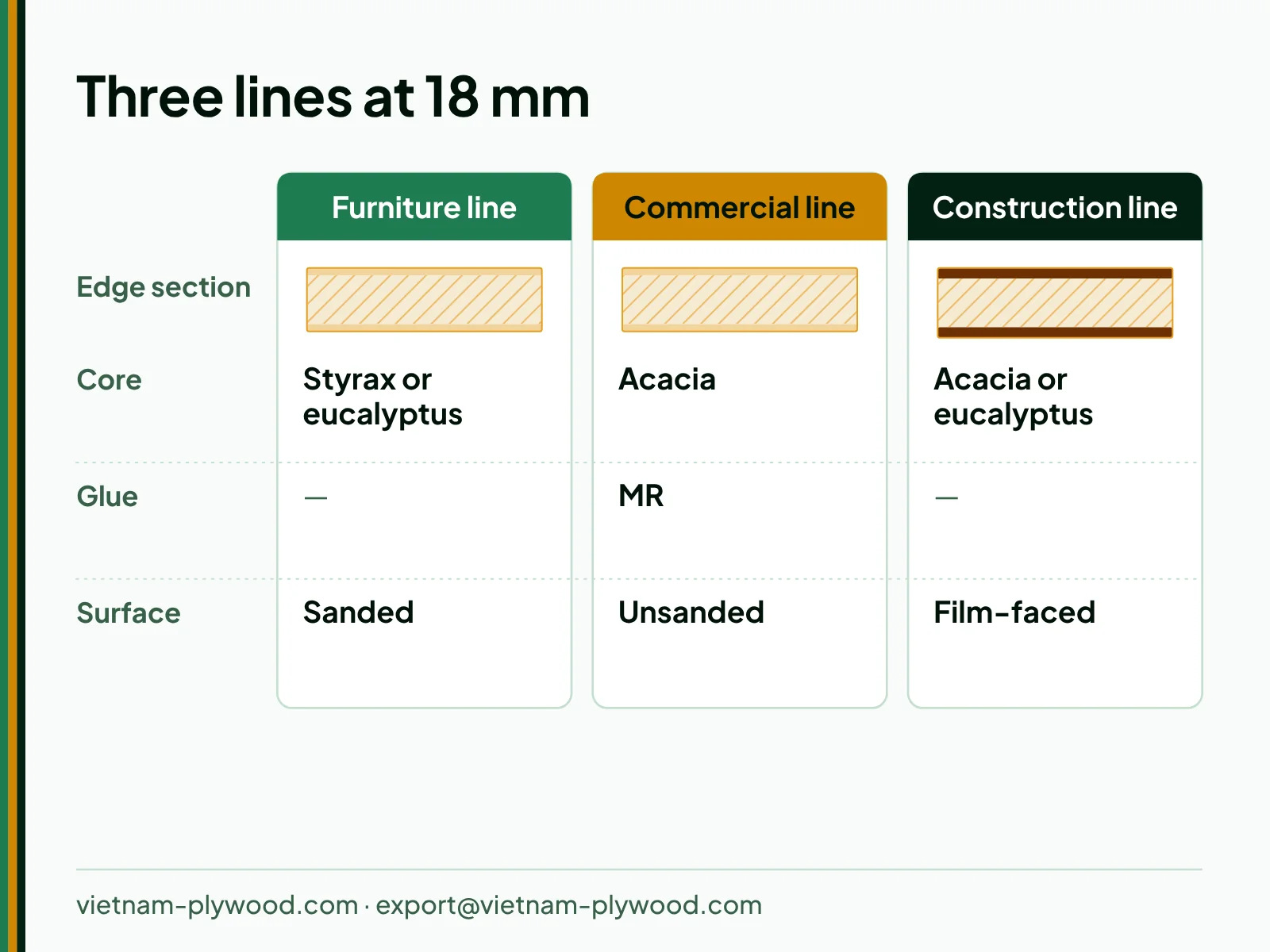
| Same 18 mm thickness | Core and surface | Glue or finish route | Suitable purchase intention |
|---|---|---|---|
| Furniture line | Styrax or eucalyptus, full stitched, sanded | E0/E1 emission specified separately | Visible painted cabinet or fit-out part |
| Commercial and packing line | Acacia, unsanded or light-sanded | MR glue | Concealed commercial or packing component |
| Construction line | Acacia or eucalyptus, unsanded | Phenolic or melamine film | Concrete formwork, not raw BCX appearance |
An 18 mm order normally contains 11–13 plies, according to veneer thickness. Furniture sanded thickness tolerance is ±0.2 or ±0.3 mm as ordered; commercial and film-faced tolerance is ±0.5 mm. The stated length and width tolerance is ±2 mm. These are production options and tolerances, not evidence of a US structural classification.
A film-faced formwork panel should instead follow the construction project plywood specification.
What should an inspector check at the producing factory?
An inspector should compare the signed face/back samples, glue specification and finished-panel measurements against the order. Visual appearance and bond performance require separate checks.
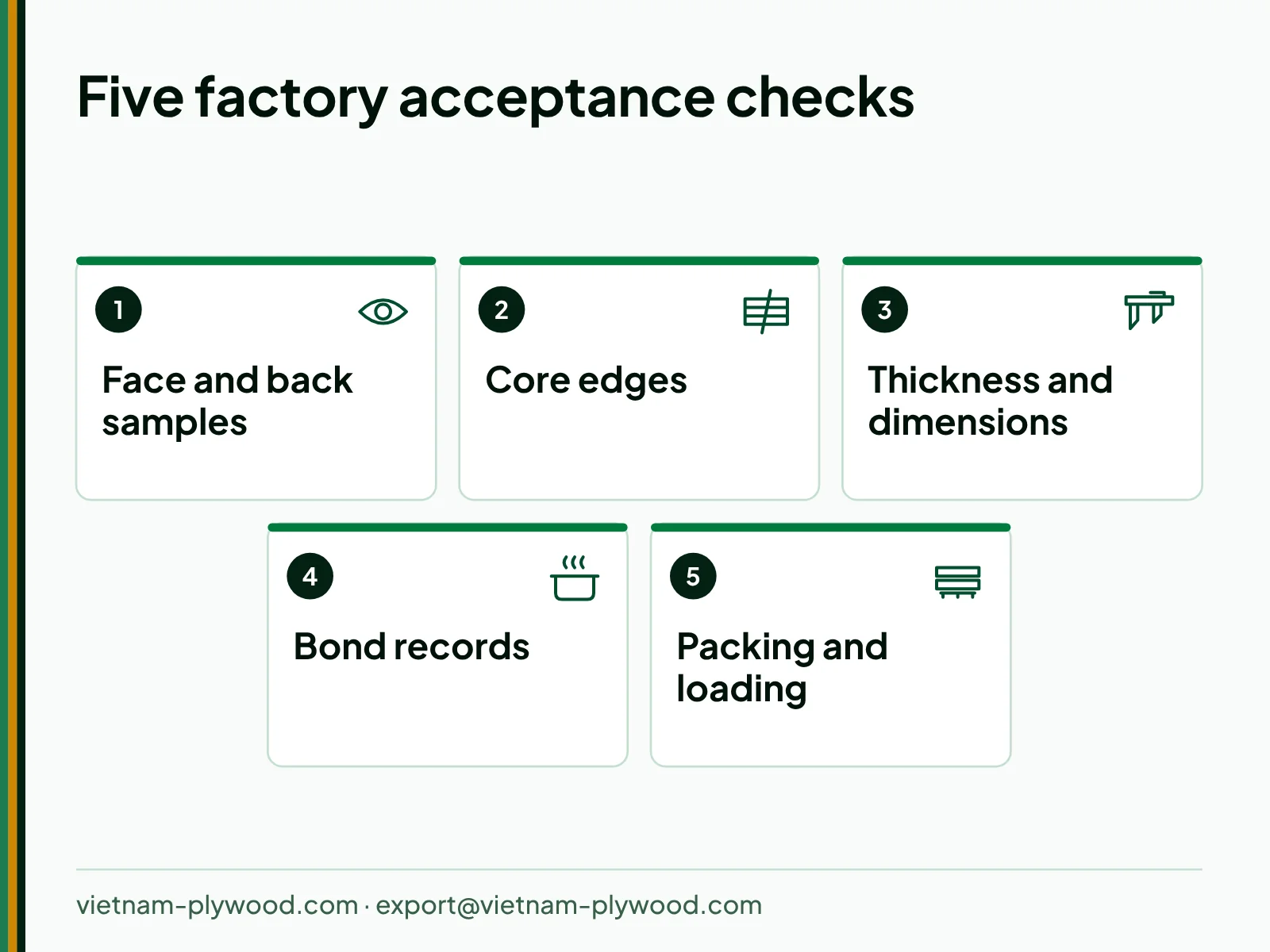
- Identify the face and back on sample and production sheets; record the accepted repairs, open defects and sanding marks.
- Examine cut edges for core gaps, overlaps and uneven joints; record the agreed core construction.
- Measure thickness at the agreed points and compare with the ordered tolerance; measure length and width separately.
- Match production records to the requested glue route and the agreed bond test report, rather than inferring adhesive performance from a smooth face.
- Review the emission requirement independently, including whether a US regulated end use calls for third-party certification.
- Photograph pallet marks, quantities and loading condition against the packing list before shipment.
We manage on-site quality control and export loading. Test reports should identify the build tested, the method and the buyer’s acceptance threshold; a report for a different construction is insufficient for the specified lot.
What if the buyer needs a US grade stamp?
A buyer needing a US-recognized structural grade stamp must plan the standard, approved certification or inspection route and panel qualification before ordering. The letters BCX and a supplier’s laboratory report alone do not create a recognized stamp.
APA’s PS 1-22 standard overview describes requirements for veneer grading, bond, construction, dimensions, testing, marking and certification. For a code-regulated project, the buyer should ask the architect, authority or receiving inspector which standard and certification body are accepted. If a stamp is mandatory, procure through a qualifying supply route rather than relabel an appearance-matched panel.
For a nonstructural appearance order, specify an agreed face/back reference, phenolic bond test and dimensional inspection. For a structural application, obtain the required evaluation and approval independently before purchase. This distinction protects a distributor from receiving a visually acceptable shipment that cannot be used in its intended market.
US formaldehyde requirements are a separate issue from structural marking. CARB Phase 2 and Toxic Substances Control Act (TSCA) Title VI address specified composite-wood emissions and certification obligations; they are not a substitute for structural panel grading. Ask for the applicable emission documents for the ordered build.
How should a mixed container be specified?
A mixed 40-foot high-cube (40HC) order can combine agreed specifications within the 28.5-tonne payload limit. Weight planning starts with the core, sheet size and thickness, then the pallet configuration.
At 18 mm and 1220 × 2440 mm, a styrax-core sheet weighs 26.79 kg; an acacia-core sheet weighs 31.08 kg; a eucalyptus-core sheet weighs 34.83 kg. A full container on the stated pallet plans holds 990 styrax sheets at 26.52 tonnes, 880 acacia sheets at 27.35 tonnes or 795 eucalyptus sheets at 27.69 tonnes. These figures exclude film weight.
For a mixed load, request a pallet-by-pallet loading plan showing each specification, pallet tare, packaging mass and total payload before approving the packing list.
The order can mix furniture and commercial specifications only where the agreed production and loading plan accommodates both. For the full pallet and size method, see container loading calculations.
What documents and commercial terms belong on the order?
The commercial invoice, packing list and bill of lading (B/L) identify the shipped goods and quantities; the agreed test reports describe the panel build. The buyer should reconcile these records against the signed specification.
We ship FOB Hai Phong, cost and freight (CFR/CNF), or cost, insurance and freight (CIF). The minimum order is one 40HC; one container can carry several specifications as long as the payload limit holds. Factory lead time runs 15–45 days from receipt of the 30% deposit; the exact figure depends on order size, line loading and what the contract fixes. The remaining 70% is paid on the scan of the bill of lading, by T/T, or by irrevocable sight L/C.
Each shipment has a commercial invoice, packing list, B/L, certificate of origin, phytosanitary and fumigation papers, plus the agreed certificate documents and test reports. CIF shipments add insurance; EU lots use EUR.1 and the EUTR/EUDR file set as applicable. After loading, the draft shipping documents come to you for approval. Factory certificates are shown with factory details masked, on request.
A BCX-type build has no listed starting price. Face selection and sanding, core construction, phenolic versus MR bond, tolerance, testing and shipment mix are the price drivers. A fully stitched sanded face and phenolic bond request calls for more processing than an unsanded MR commercial panel; request a written quotation for the actual combination. The production lead-time guide explains scheduling considerations.
Which applications justify BCX-type appearance?
A BCX-type appearance build suits specified visible, painted fit-out or utility cabinet components where one selected face matters. It should not be substituted for rated structural sheathing solely because its face looks smoother.
For importers and distributors, the purchasing decision is often between a finished appearance part and a concealed construction component. A paint-grade soffit or covered lining can require an exterior bond and protected edges; a cabinet carcass may prioritize surface finish, emissions and screw performance. Roof decking, subfloors and bracing demand the relevant span, load and exposure evidence.
BCX is not pressure-treated plywood. Repeated wetting, exposed cut edges and prolonged outdoor service require a separate material and finishing assessment. Concrete formwork is usually better specified as a film-faced build with the appropriate release and handling procedure.
When both faces are visible, a one-good-face B/C concept is a poor match. When a buyer requests birch appearance, note that our birch face grades are D/E/F rather than a North American B/C claim; see the birch D/E/F grading explanation.
What should the buyer send for a sample set?
Send the intended application, reference face and back, bond and emission requirements, and acceptance documents in one written specification. The sample review should settle the visible finish before production and shipment checks begin.
Application: Painted utility cabinet / protected fit-out component
Line or core: Furniture line; styrax core, full stitched
Glue: Phenolic WBP requested; agreed bond test method and threshold
Emission: E1; supporting document required
Face and grade: B-quality sanded visible face; C-quality back by approved samples
Thickness and tolerance: 18 mm; ±0.2 mm as ordered
Size: 1220 × 2440 mm; length and width ±2 mm
Quantity: One 40HC; mixed specifications only against agreed loading plan
Destination port: [buyer to specify]
Ask Lucy at HCPLY contact or export@vietnam-plywood.com for a sample set against this specification.